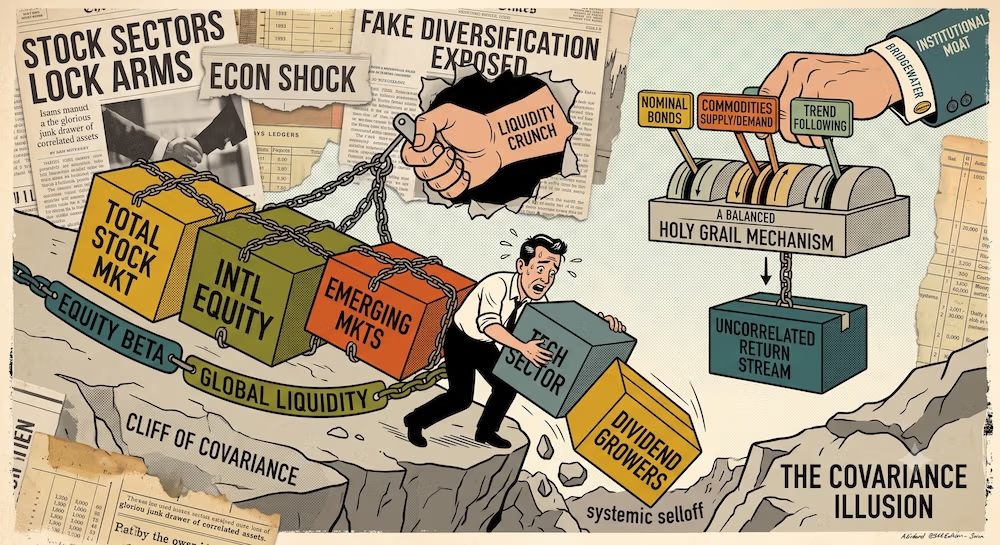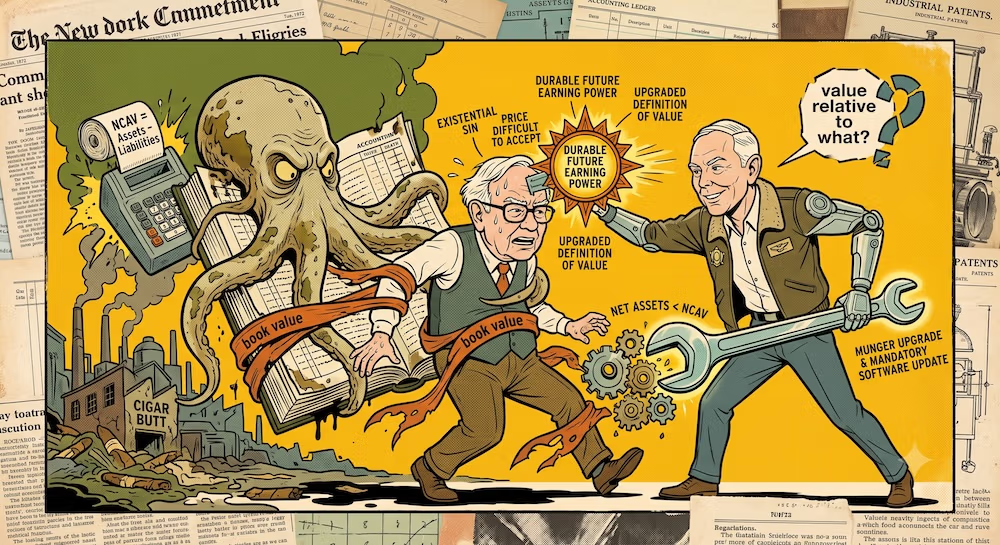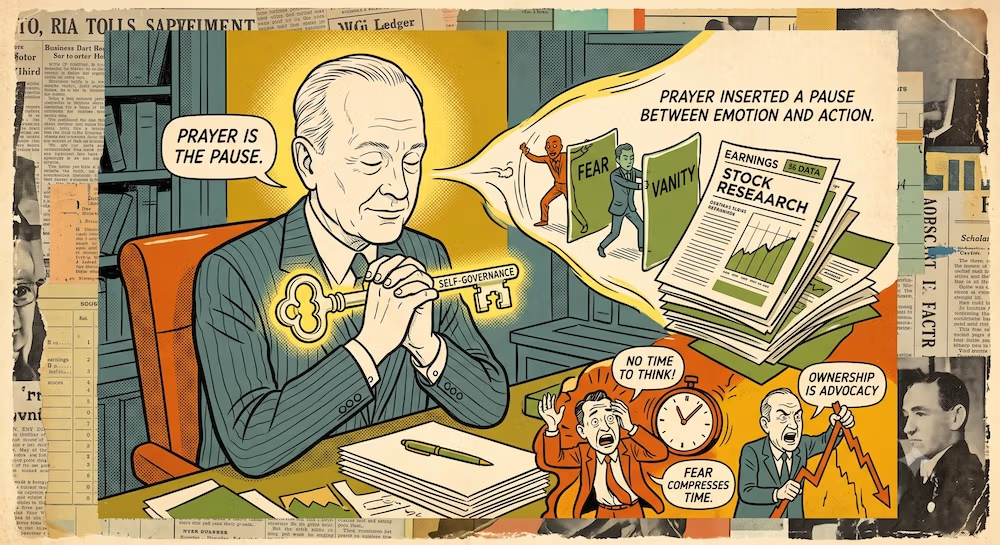
John Bogle made investing sound so simple that people have spent decades finding elaborate ways to avoid doing it.
Keep costs low. Diversify broadly. Set realistic expectations. Stop worshipping forecasts. Resist unnecessary trading. Stay the course.
The instructions are clear enough to fit on an index card. The investment industry responded by producing libraries, conferences, products, models, dashboards, tactical frameworks, and a vocabulary dense enough to make standing still feel intellectually irresponsible.
That tells us something important.
The main obstacle was never comprehension.
Most investors understand the broad Bogle prescription. They know frantic trading can be destructive. They know recent performance is unreliable. They know costs matter. They know panic-selling is usually a bad idea. They also know that eating vegetables is sensible, replying calmly during an argument is preferable, and checking a portfolio twelve times before lunch does not make the market safer.
Understanding is the easy half.
Bogle’s harsher lesson concerns what happens when a simple portfolio collides with a human being who still wants reassurance, excitement, superiority, control, and a respectable explanation for every uncomfortable number on the screen.
Simplicity removes moving parts. Doubt keeps breathing.
That is why the usual description of Bogle as the patron saint of cheap index funds feels too small. His greater contribution was exposing how much investing damage begins after the portfolio has already been built correctly.
An investor can own broad, inexpensive funds and still behave like a caffeinated macro strategist trapped inside a retirement account.
The product can be passive while the owner remains emotionally hyperactive.
Bogle’s Hardest Lesson Wasn’t Portfolio Construction
In his 1999 speech, “Investing with Simplicity,” Bogle described simplicity as the “master key” to financial success. He tied it to realistic expectations, patience, perseverance, and character. He also warned against confusing information with knowledge and knowledge with wisdom.
That warning has aged better than most market forecasts.
Investors now have access to more data than Bogle’s 1999 audience could have imagined. Prices update instantly. Portfolio values travel in our pockets. Market opinions arrive through television, newsletters, podcasts, social media, push notifications, and people filming urgent predictions from parked cars.
We solved information scarcity and replaced it with decision obesity.
Every new data point appears to demand interpretation. Every interpretation creates a possible action. Every action can be dressed up as prudence.
Bogle understood that successful investing often requires refusing the invitation.
In his 2005 speech, “In Investing, You Get What You Don’t Pay For,” he warned investors against impulse, emotional reasoning, and the belief that past success would repeat. His advice included the wonderfully blunt instruction: “Don’t do something, just stand there.”
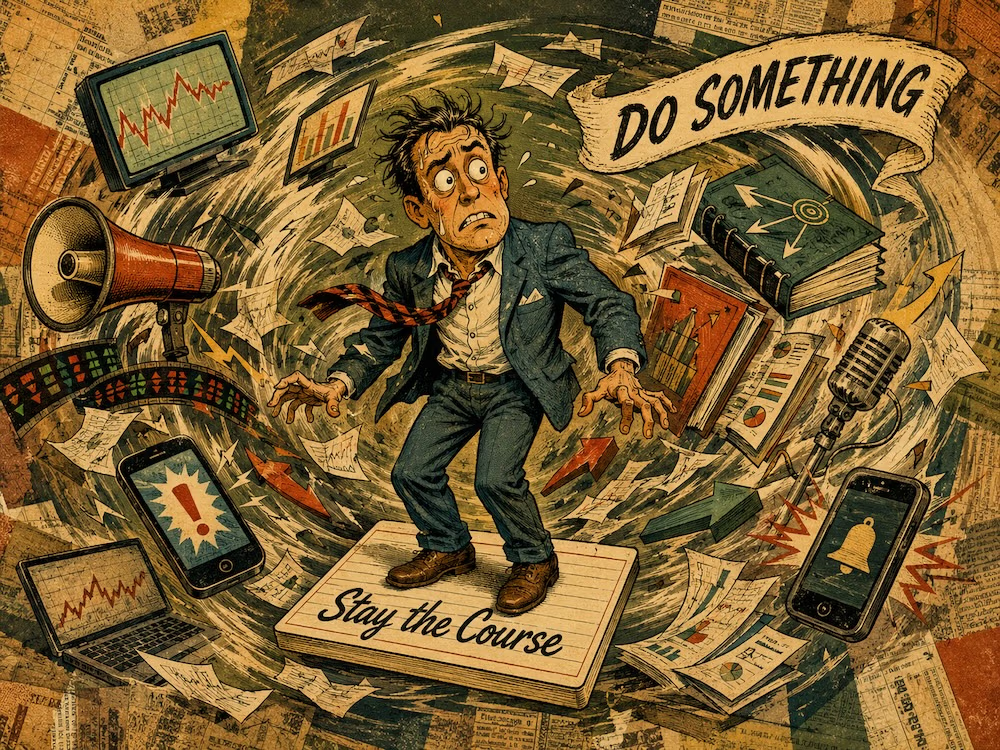
Then came the better-known command: “Stay the course.”
Those lines are now quoted so casually that their severity has almost disappeared. They sound like motivational wallpaper. In practice, Bogle was asking investors to tolerate the possibility of looking stupid for months or years while continuing to do what they had previously decided was sensible.
That is a much rougher assignment than buying an index fund.
Activity produces evidence of effort. Trades appear on statements. New holdings make the portfolio look attended to. Tactical shifts provide stories to tell. A portfolio left alone offers no visible proof that its owner is alert, informed, or working hard.
Finance has trained investors to confuse motion with seriousness.
I give Bogle enormous credit for refusing that performance. He treated unnecessary action as a behavioural liability rather than proof of engagement.
Followers often copied the visible shell—low-cost funds, broad diversification, passive labels—while neglecting the operating condition that made the shell useful. The owner had to stop treating every fresh anxiety as a legitimate investment signal.
A simple portfolio can still be managed by a chronically complicated mind.
That is where most Boglean discipline fails.
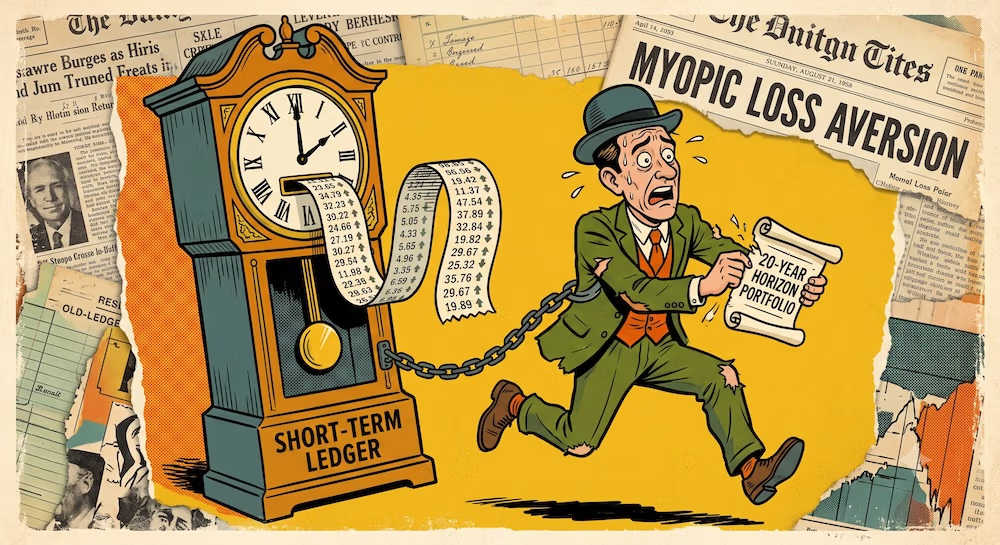
Simplicity Kills Decisions; Doubt Keeps Breathing
A straightforward strategy does not make markets predictable. It reduces the number of predictions the investor needs to survive.
That should feel liberating. Often it feels negligent.
During a decline, inactivity can resemble denial. During a speculative boom, restraint starts looking timid. During extended underperformance, a stable process begins to acquire the smell of stubbornness.
Bogle introduced his 1999 principles while discussing a sharp market decline followed by a rapid recovery. He presented simplicity as protection against nervousness and excitement.
The symmetry matters.
Investors can damage themselves through fear. They can also do magnificent damage while feeling optimistic, informed, and slightly superior to everyone who has not yet discovered the opportunity.
The portfolio may have a twenty-year horizon. The investor experiences it through today’s gain, this week’s decline, and whatever alarming chart is currently circulating.
Shlomo Benartzi and Richard Thaler’s 1995 paper, “Myopic Loss Aversion and the Equity Premium Puzzle,” connected loss sensitivity with frequent evaluation. An investment intended for the long run can still generate short-term reactions when its owner continually inspects near-term outcomes.
Charles Bellemare, Michaela Krause, Sabine Kröger, and Chendi Zhang later separated information feedback from the ability to alter an investment in “Myopic Loss Aversion: Information Feedback vs. Investment Flexibility.” Frequent feedback alone produced behaviour consistent with myopic loss aversion.
Their experiment involved a stylized gamble, so it would be foolish to pretend it perfectly maps onto household investing. It still illuminates a powerful distinction.
Investors do not need to trade for monitoring to alter their behaviour. Observation itself can reshape how risk feels.
A person may own long-term assets while keeping score through a short-term emotional ledger.
I understand the seduction of constant information. It feels responsible. A person checking carefully appears more serious than somebody deliberately ignoring the latest market drama.
Give me a detailed dashboard and I can start admiring the dashboard before asking whether it improves a single important decision.
That is the trap.
Information can help investors detect genuine changes in goals, costs, liabilities, and financial circumstances. It can also create endless opportunities to interpret noise as new evidence.
The useful question is never simply whether more information is available. The useful question is whether the information deserves authority over a decision already made under calmer conditions.
Without that boundary, simplicity becomes temporary. The portfolio remains uncomplicated until the next frightening headline, persuasive forecast, or burst of underperformance gives the investor permission to meddle.
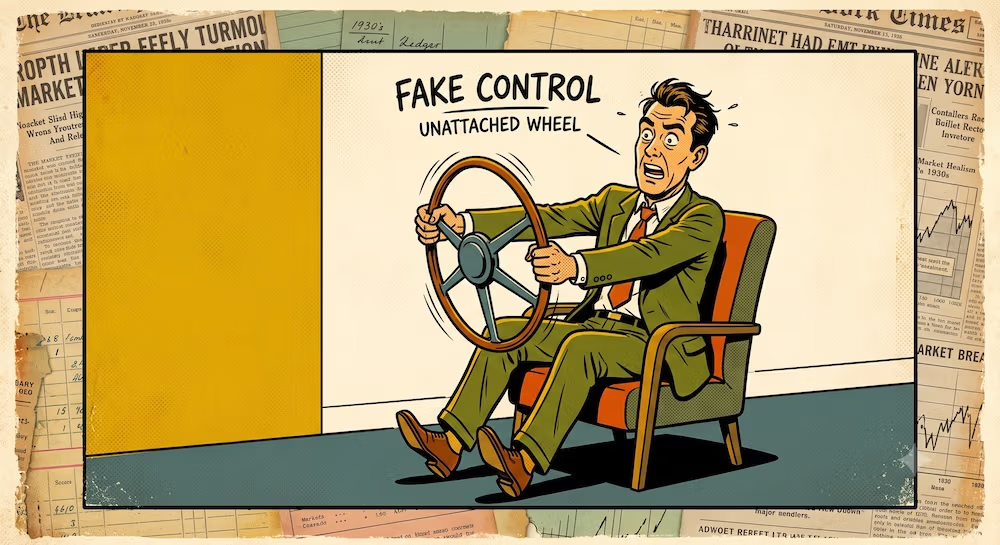
Activity Is the Investor’s Fake Control Panel
Markets are exceptionally good at humiliating human agency.
An investor can behave sensibly and lose money. Another can make a reckless decision and enjoy an immediate gain. Outcomes arrive noisily, unevenly, and without the decency to reward good judgment on schedule.
Activity offers emotional relief because it creates the feeling that somebody is driving.
The steering wheel may not be attached to anything useful, but at least the investor has something to grip.
Brad Barber and Terrance Odean studied 66,465 brokerage households between 1991 and 1996 in “Trading Is Hazardous to Your Wealth.” The average household earned 16.4% annually after costs while the market returned 17.9%. The most active traders earned 11.4%. Average annual portfolio turnover reached roughly 75%.
Those figures came from a particular group during a particular period. They do not establish that every trade is destructive. Rebalancing, tax management, cash requirements, changing circumstances, and correcting a poor original plan can all justify transactions.
What the study does destroy is the polite assumption that visible effort deserves to be treated as skill.
The investors doing the most were not producing the most.
Mark Fenton-O’Creevy, Nigel Nicholson, Emma Soane, and Paul Willman found a related pattern among professional traders. Their 2003 study, “Trading on Illusions,” examined 107 traders across four organizations. Stronger illusion-of-control beliefs were significantly associated with lower manager-rated performance and lower remuneration.
Professional traders operate in a different environment from ordinary long-term investors, so the comparison has limits. The underlying warning travels well: perceived control can become dangerous when outcomes depend heavily on forces no individual commands.
I read Bogle’s “stand there” instruction as an attack on theatrical responsibility.
Investors often feel obliged to demonstrate that they are responding. Market falls? Respond. Inflation changes? Respond. A strategist predicts a regime shift? Respond. A previously obscure asset rises 80%? By all means, convene an emergency meeting with yourself.
Activity makes uncertainty feel managed.
The financial ecosystem rarely discourages that impulse. Transactions create revenue. Product switching creates revenue. Manager searches create revenue. Tactical adjustments create revenue. New solutions create fresh reasons for professional intervention.
Even when direct trading commissions disappear, an investor who remains dissatisfied is commercially useful.
A settled investor is harder to monetize.
That does not require a conspiracy. Incentives can operate perfectly well without villains meeting in a dark room. Large parts of finance benefit when investors continue believing that the next adjustment, strategy, product, or forecast will finally remove discomfort from an activity built around uncertainty.
Bogle’s simplicity was economically threatening because it reduced both costs and occasions for selling the investor another cure.
Boring remains one of the few investment characteristics nobody has figured out how to launch with fireworks.
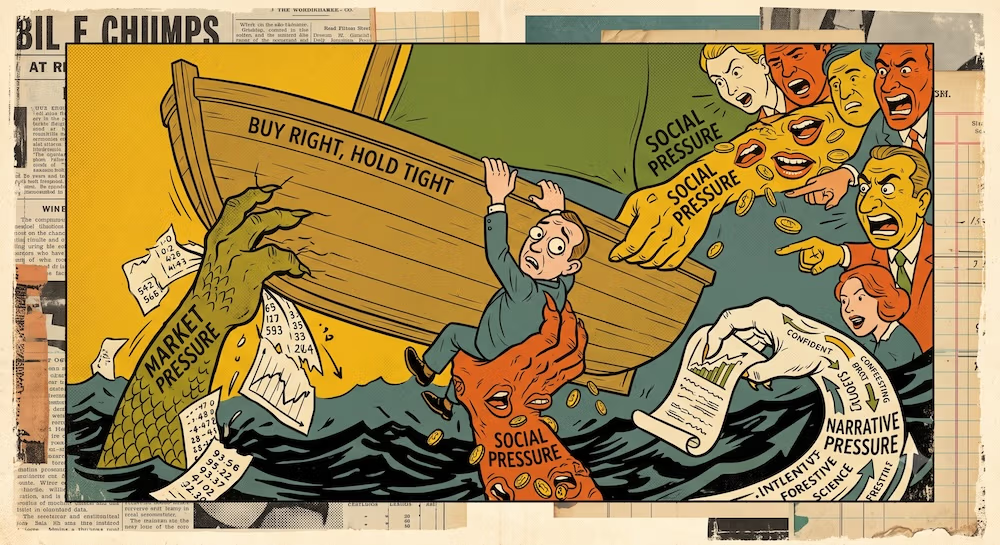
The Three Pressures That Make Simplicity Feel Unsafe
Investors rarely abandon simplicity after uncovering a deep mathematical defect. They abandon it after feeling pressure.
The pressure usually arrives through markets, other people, or stories.
| Pressure | What the investor experiences | Tempting response | What gets mistaken for proof |
|---|---|---|---|
| Market pressure | Losses or prolonged underperformance | Selling, switching, tactical repositioning | Recent outcomes |
| Social pressure | Someone else appearing to win | Imitation and comparison-driven change | Another person’s result |
| Narrative pressure | A persuasive explanation of what comes next | Forecast-based intervention | Coherence and confidence |
Market Pressure
Market pressure is blunt. A number falls. The investor loses money. The plan suddenly feels theoretical while the pain feels real.
Geoffrey Friesen and Travis Sapp studied mutual-fund flows and investor returns from 1991 through 2004 in “Mutual Fund Flows and Investor Returns.” They estimated that investors’ timing decisions reduced average returns by 1.56 percentage points annually during their sample period. The pattern appeared among investors in actively managed funds and index funds and was consistent with return chasing.
That 1.56-percentage-point figure belongs to their sample and methodology. It is not a universal investor tax.
The broader finding still cuts through a flattering fiction.
Buying an index fund does not transform a person into an index investor.
Someone can chase an index fund after strong performance, sell it after a decline, and spend the entire episode describing themselves as passive. The label belongs to the vehicle. The behaviour belongs to the owner.
This is why I have little patience for treating “passive” as a personality description. It conceals more than it reveals.
Bogle warned against selecting and discarding funds according to the “ebb and flow of performance.” His phrase “buy right and hold tight” contained two distinct responsibilities.
Followers love the second half because it sounds heroic. The first half requires actual judgment.
Staying with a badly designed, unsuitable, or misunderstood portfolio does not become wise through endurance. Discipline protects a sound process. It should never grant diplomatic immunity to a poor one.
Social Pressure
Investment accounts are individually owned. Investment behaviour is socially contaminated.
Esther Duflo and Emmanuel Saez found that colleagues influenced participation and vendor selection in a university retirement plan in “Participation and Investment Decisions in a Retirement Plan.”
Harrison Hong, Jeffrey Kubik, and Jeremy Stein also found that socially engaged households were more likely to participate in the stock market, with sociability having a stronger relationship in states where participation was already higher.
Neither study directly proves that investors abandon simple portfolios after hearing someone boast about recent returns. The extension remains an inference. It is also a very plausible one.
Comparison changes the objective quietly.
An investor may begin with a reasonable goal: participate broadly in market returns, control costs, and fund future needs. Then another person reports a larger gain. The benchmark shifts. Adequacy becomes failure. The plan is suddenly judged against a competition that did not exist when it was created.
That psychological move is devastating because somebody somewhere will always have done better.
A simple portfolio requires accepting that reality in advance.
I consider this one of the least discussed costs of simplicity. It removes many opportunities to imagine oneself exceptional.
Complexity offers hope that the investor can still win the private tournament taking place inside their head. Another strategy means another chance to outperform. Another sleeve means another chance to catch the next winner. Another tactical rule keeps open the possibility that ordinary market participation can be upgraded into superiority.
Simplicity closes many of those doors.
People say they want fewer decisions. They often still want the fantasy attached to having more options.
Narrative Pressure
Numbers report outcomes. Narratives tell us why they happened and what should happen next.
Robert Shiller’s 2017 presidential address, “Narrative Economics,” argued that economically relevant narratives spread socially and help justify actions, including investment decisions.
A strong narrative can connect markets to technological change, politics, demographic shifts, cultural fears, and personal values. It transforms uncertainty into a sequence with characters, causes, and an ending.
That is emotionally powerful.
Narrative strength and predictive accuracy remain separate qualities. The mind keeps trying to merge them.
A simple strategy tells a miserable story. It does not promise to identify the next regime, avoid the next crash, anticipate every rate move, or discover the winning theme before everyone else.
Its sales pitch is almost comically modest: diversify, keep costs under control, accept uncertainty, and stop assuming that confidence improves forecasting ability.
I am drawn to clean explanations for the same reason everyone else is. A tidy narrative makes the world feel organized. A person who names five drivers and speaks with certainty can sound more useful than somebody admitting that several outcomes remain plausible.
That feeling is not evidence.
The danger appears when explanatory satisfaction acquires decision-making power.
Simplicity leaves the future unresolved. Narratives resolve it immediately. The bill arrives later.
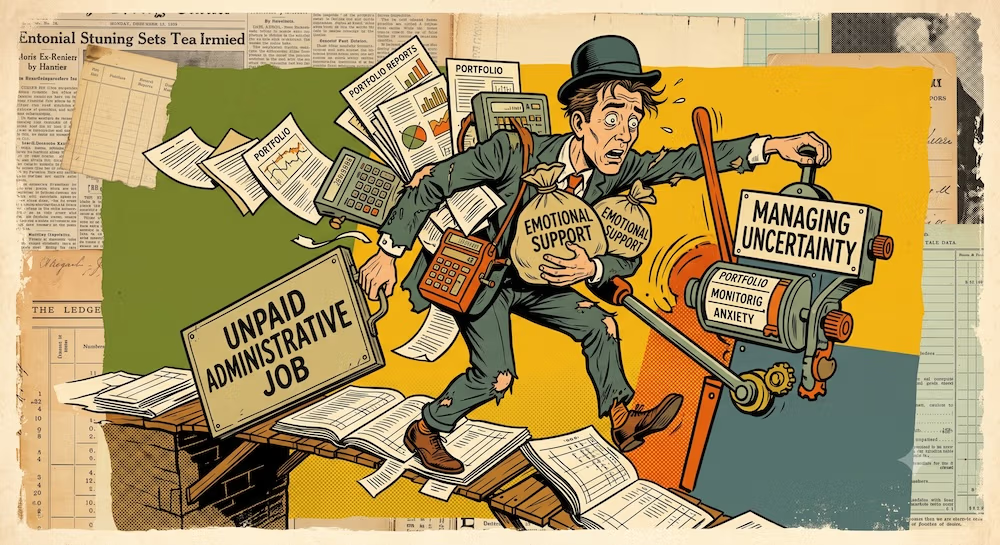
Complexity Can Become an Emotional Support Asset
Calling every complex portfolio foolish would itself be foolish.
Investors can face multiple goals, currencies, liabilities, tax constraints, withdrawal needs, estate considerations, and different capacities for loss. Those conditions may require several holdings and several rules.
One holding is not automatically simple. Ten holdings are not automatically complex.
The better test concerns purpose.
Every component should have a job. Every rule should solve a defined problem. Every recurring decision should justify the behavioural risk it creates.
When a fund, tactical sleeve, forecast, or allocation change exists mainly because the investor feels uneasy, complexity has become emotional medication.
That is my interpretation rather than a directly measured universal fact. The surrounding evidence supports it: excessive trading, illusion of control, return chasing, sensitivity to narrative, and difficulty managing large choice sets.
Sheena Iyengar, Gur Huberman, and Wei Jiang studied retirement-plan records from nearly 800,000 employees in “How Much Choice Is Too Much?” Plans offering more fund choices were associated with lower participation.
The U.S. Department of Labor later rated the study’s causal evidence as low. Differences among employers and employees may have influenced the result.
So more choice was associated with lower participation in that dataset. The study does not prove that additional options universally paralyse investors.
Counterevidence makes the story more interesting.
Brigitte Madrian and Dennis Shea’s “The Power of Suggestion” found that automatic enrollment sharply increased participation in one company’s 401(k) plan. Many employees retained the default contribution and allocation settings.
Investors do not always crave activity. Inertia can be just as powerful.
That apparent contradiction reveals the mechanism more clearly.
Behaviour follows architecture.
A process that constantly presents fresh choices encourages reconsideration. A process built around defaults can carry people forward with minimal intervention. Either result may be good or bad depending on the quality of the structure.
I am skeptical of investment advice that treats discipline as a heroic personality trait. It flatters successful investors and blames unsuccessful ones while ignoring the machinery surrounding their choices.
A person who defeats temptation every morning may possess impressive willpower. They still have a weaker system than someone whose process rarely presents the temptation as a valid decision.
Complexity adds more than holdings. It adds monitoring points, comparisons, explanations, review triggers, and reasons to reopen the portfolio.
Eventually the investor stops owning a strategy and starts working an unpaid administrative job managing their own uncertainty.
The hours are terrible. The boss is anxious. The performance review arrives daily.
Simplicity Looks Stupid at Exactly the Wrong Time
Every strategy eventually enters a period that embarrasses its owner.
That embarrassment can reveal a mismatch between the portfolio and the investor’s true capacity for risk. It can also reveal nothing beyond the fact that markets are volatile and relative performance rotates.
Distinguishing the two is difficult while the discomfort is happening.
Simplicity becomes especially vulnerable during three conditions:
- sharp declines that make immediate caution feel responsible;
- speculative booms that make restraint feel antiquated;
- prolonged underperformance that makes patience resemble denial.
These periods create an unfair optics problem.
Nobody congratulates the disciplined investor for declining to chase an asset before the peak. Before the peak, restraint looks like ignorance. After the crash, restraint gets rewritten as obvious common sense by many of the same people who found it unbearable in real time.
Bogle’s warnings about impulse and extrapolation were directionally correct. Friesen and Sapp’s findings reinforce the danger of chasing returns.
Yet “stay the course” has acquired its own mythology.
People now use it as though persistence can validate any plan. It cannot.
Goals change. Cash needs emerge. Costs may become unreasonable. Hidden concentration can be discovered. An investor may realize that their original allocation exceeded their capacity for loss. The initial plan may have been defective.
I part company with the laziest Bogle followers here. They treat changing course as evidence of weakness while assuming the original course deserves respect merely because it already exists.
That is inertia wearing a discipline costume.
The correct question concerns decision logic.
A scheduled review that uncovers a real mismatch differs from panic during a decline. Predetermined rebalancing differs from improvisation after hearing a confident forecast. Correcting a poor plan differs from abandoning a sound process after disappointing performance.
All may produce trades. The transactions tell us almost nothing by themselves.
“Buy right and hold tight” remains the stronger Bogle formulation because restraint earns its legitimacy from the quality of the initial decision.
The investor has to know what deserves protection before celebrating their ability to protect it.
A Simple Portfolio Can Still Be Run Like a Hedge Fund
Investors often count holdings when judging simplicity.
That is cosmetic simplicity.
Behavioural simplicity concerns how many decisions the owner continues allowing themselves to make.
A portfolio containing three broad funds can remain operationally chaotic when the investor checks it constantly, alters contributions according to forecasts, compares each holding with recent winners, rebalances opportunistically, and treats every economic opinion as grounds for reconsideration.
The holdings are simple. The governance is a circus.
A portfolio with more components may function cleanly when every position has a defined purpose and review occurs through predetermined rules.
Vanguard’s “Principles for Investing Success” describes discipline through adherence to a plan, regular contributions, risk-managing rebalancing, planned spending, and resistance to impulsive responses.
That is Vanguard’s current institutional framework rather than a direct Bogle statement. It captures the crucial distinction.
Discipline allows maintenance. It rejects emotional freelancing.
The most consequential simplicity often exists outside the holdings:
- Which information receives attention?
- How frequently are outcomes reviewed?
- Which actions happen automatically?
- What evidence would justify changing the plan?
- Which uncomfortable conditions were anticipated?
- Who has authority to reopen a settled decision?
I would impose a harsh rule here: every recurring decision must earn its existence.
Investors expect assets to justify their place in a portfolio. They are far more tolerant toward the decision points surrounding those assets.
A quarterly tactical meeting can survive forever without producing a reliable advantage. A market outlook can become an institutional ritual even when nobody can demonstrate that it improves outcomes. A new holding can create another relative-performance comparison, another monitoring burden, and another reason to feel dissatisfied.
Sophistication often adds failure points faster than it adds genuine capability.
This is where Bogle’s simplicity becomes more demanding than its marketing suggests. The investor must subtract choices they enjoy having.
Owning fewer funds is easy. Surrendering the right to improvise whenever markets become interesting is much harder.
“Enough” Is the Rule Followers Quietly Ignore
Bogle’s broader philosophy of “enough” gives simplicity its missing boundary.
In his 2007 Georgetown commencement address, “Enough,” Bogle retold the Joseph Heller anecdote in which the author says he possesses something a vastly wealthier man will never have: “the knowledge that I’ve got enough.”
The speech ranged far beyond investing. Bogle did not formally present enough as a portfolio rule.
I still see the connection as essential.
A simple process requires accepting an outcome that may be adequate without being superior. The investor participates in market returns, controls costs and behaviour where possible, and relinquishes the fantasy of consistently identifying tomorrow’s winner today.
Without enough, simplicity has no stopping point.
There is always another apparent improvement:
another fund with a better backtest;
another asset class;
another manager whose brilliance becomes visible at exactly the right starting date;
another tactical overlay;
another optimization that miraculously improves the past once the uncomfortable years are arranged correctly.
Superiority has no natural endpoint.
The industry understands this. Satisfaction is commercially barren. Dissatisfaction creates prospects.
An investor who believes broad market participation is inadequate remains available for enhanced products, tactical solutions, manager searches, premium research, and increasingly ornate routes toward the same uncertain future.
Enough interrupts that escalation.
It does not demand low ambition. It demands clarity about what the portfolio is supposed to accomplish.
I suspect many investors accept Bogle’s arithmetic while rejecting his stopping rule. They embrace low fees, diversification, and indexing, then search relentlessly for ways to make the simple portfolio special.
They want Boglean ingredients with a side order of outperformance, tactical genius, and social proof.
That combination is emotionally understandable. It is also where simplicity begins decomposing.
Simplicity Has to Be Built Before Panic Shows Up
Boglean investing is often presented as a test of willpower.
That gives human beings too much credit when they succeed and too much blame when they fail.
Madrian and Shea’s automatic-enrollment findings demonstrate how powerfully defaults can shape behaviour. People often continue along the path constructed for them.
Process design can overpower intention.
A durable investment framework settles important questions before markets become emotionally demanding. It defines legitimate maintenance in advance. It limits the occasions when recent performance, comparison, or a compelling story can seize control.
The process must remain revisable. Otherwise discipline becomes dogma.
Revision should still face a higher evidentiary standard than discomfort.
A defensible change can identify what has actually changed:
- an original assumption;
- a financial objective;
- a liability or cash requirement;
- a material cost;
- an overlooked concentration;
- a genuine mismatch between the plan and the investor’s capacity for loss.
“Markets feel dangerous” describes an emotion.
“Somebody else made more money” describes a comparison.
“A confident person predicts a new regime” describes a narrative.
None of them, alone, establishes that a sound long-term process has failed.
Bogle closed his 1999 speech by describing simplicity as an escape from the “cacophony of information and emotion.”
That phrase captures his behavioural contribution better than the passive-investing label ever could.
The investor continues hearing the noise. The victory comes when the noise loses its authority to issue instructions.
A simple portfolio can be purchased in minutes. The harder achievement is deciding, before fear and envy arrive, which future doubts will be denied permission to redesign it.
Why is John Bogle’s simple investing approach so difficult to follow?
Because simplicity removes decisions without removing doubt. Investors still face losses, social comparison, persuasive forecasts, and the urge to act, so a straightforward portfolio can be undermined by emotionally complicated behaviour.
Does owning an index fund automatically make someone a passive investor?
No. An investor can buy an index fund after strong performance, sell it during a decline, and repeatedly alter the surrounding plan. The product may be passive while the owner remains behaviourally active.
Why can frequent portfolio monitoring become harmful?
Frequent monitoring can make short-term volatility feel more important than a long-term plan. Even without trading, repeated observation may reshape how risk feels and encourage investors to treat market noise as fresh evidence.
Is all portfolio complexity unnecessary?
No. Multiple goals, currencies, liabilities, tax constraints, withdrawal needs, and different capacities for loss can justify additional holdings or rules. The better test is whether each component and recurring decision has a defined job.
When is changing an investment plan reasonable?
Change is more defensible when an original assumption, financial objective, liability, cash requirement, material cost, concentration, or capacity for loss has genuinely changed. Discomfort, envy, or a confident forecast alone does not establish that a sound plan has failed.
What does Bogle’s idea of “enough” add to portfolio simplicity?
It supplies a stopping rule. Accepting an adequate market-linked outcome helps prevent a reasonable process from becoming an endless search for superior returns, tactical brilliance, and social proof.
This article is also available in Spanish. [Leé la versión en castellano: La lección de John Bogle sobre el comportamiento del inversor: por qué la simplicidad es tan difícil de seguir]