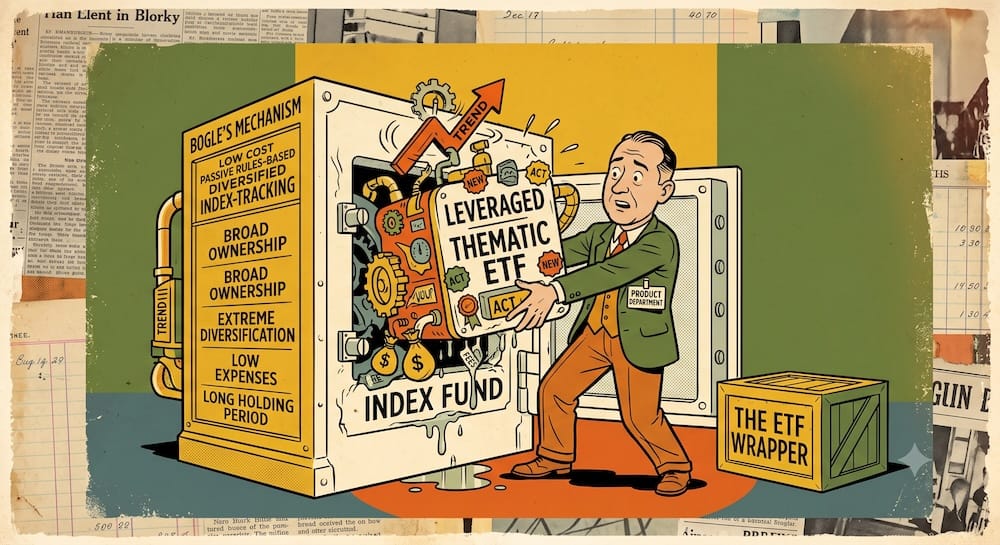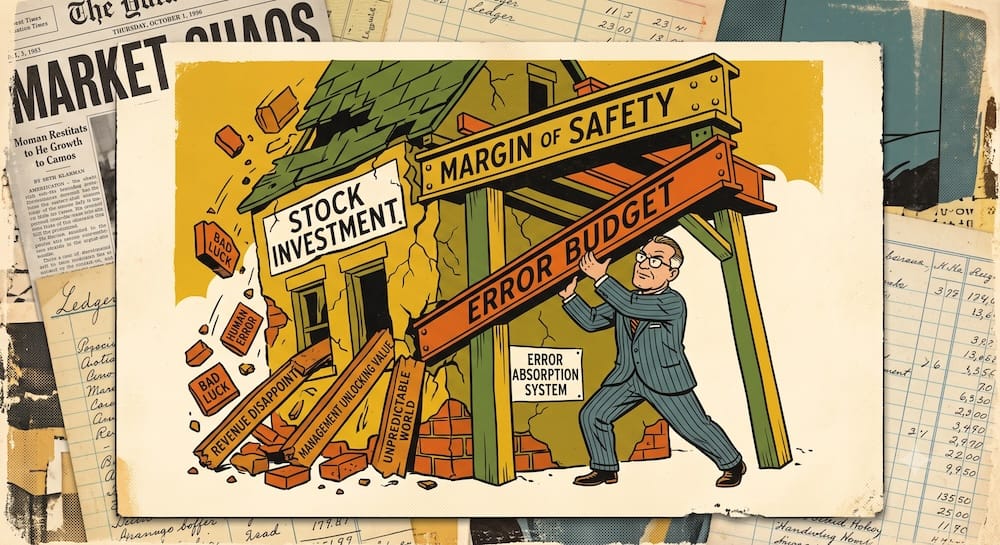
I used to think Munger simply replaced Graham.
For decades, the standard narrative of modern value investing has been told as a clean, linear conversion story. In this popular folklore, Ben Graham is cast as the old testament prophet of “cigar butt” investing—a liquidation robot hunting for broken textile mills and statistical cheapness. Charlie Munger then enters as the enlightened modern strategist who saves Warren Buffett from the slums of cheap assets, introducing him to the high-margin paradise of durable business franchises.
It is a beautifully simple story. It is also an intellectual disservice to both men.
To understand what actually happened inside the laboratory of Berkshire Hathaway, we have to drop the neat historical caricatures. Munger did not delete Graham. He upgraded Graham. He did not arrive in Omaha to rip up the foundational text of value investing; he arrived to complete the parts of the architecture that Berkshire’s capital base was rapidly outgrowing.
The reality is that Berkshire Hathaway required both disciplines to survive. Graham provided the defensive floor; Munger provided the compounding ceiling. Without Graham, the system risked falling prey to the structural dangers of glamour investing, story stocks, and catastrophic overpayment. Without Munger, the capital engine would have rusted out inside the prison of mediocre, asset-heavy businesses that had nowhere to redeploy their cash.
This is the real story of how a margin of safety migrated from the cold inventory lines of a balance sheet to the invisible competitive moats of a business franchise.

What Ben Graham Gave Buffett
Before looking at what Munger added, we must first establish what Graham solved. Ben Graham’s investment framework was explicitly engineered to solve the most destructive flaw in human psychology: emotional vulnerability to market narrative.
Graham gave Buffett an uncompromising, downside-first operating system. This foundation rested on three structural pillars:
- The Margin of Safety: The absolute requirement that a security’s price must be significantly below its conservatively appraised intrinsic asset value, providing a cushion against structural error, bad luck, and business decay.
- Mr. Market Temperament: The psychological perspective that the market is an unstable, manic-depressive counterparty whose fluctuating quotes are there to be exploited, not to be followed as an intellectual authority.
- Statistical Protection: Controlling costly individual company risks not by deep qualitative judgment, but by buying large baskets of independent, mathematically cheap securities where liquidation value alone protected the downside.
Graham’s discipline was the ultimate antidote to glamour. It was an intentionally defensive system designed to prevent dumb overpayment. It required no visionary foresight, no trust in corporate management, and no macro forecasting. By anchoring valuation to current net assets, Graham ensured that even if a business was fundamentally mediocre, the liquidation of its physical inventory and cash reserves would protect investor capital. It was a magnificent framework for an era scarred by the Great Depression.

Buying statistical cheapness protects your downside on day one, but a weak business is a terrible vehicle for long-term capital retention. Without a high internal ROIC, your portfolio remains anchored to mediocre cash-flow dynamics, no matter how cheap the entry price.The Limitation: Cheap Assets Can Still Be Mediocre Machines
But as the post-WWII economic landscape evolved, the structural limitations of a pure Grahamite approach began to show. The core problem with the classic “cigar butt” asset is a question of capital velocity and internal business economics: cheapness may protect your downside upon purchase, but a fundamentally weak business is a terrible vehicle for long-term capital retention.
When you buy a statistically cheap company that possesses a low internal Return on Invested Capital (ROIC), you are trapped in a ticking-clock dynamic. If the asset does not liquidate or experience a sudden price rerating quickly, the underlying business will continue to destroy capital on every marginal dollar it retains. A company with poor margins, heavy capital expenditures, and intense competitive pressures acts as an anchor on capital, regardless of how cheap it looked on day one.
Furthermore, Graham’s framework was inherently self-liquidating. When a cheap asset hit its intrinsic value, you were forced to sell it, pay capital gains taxes, and return to the market to hunt for another broken company. It was an investment style that required continuous re-investment velocity. It solved the problem of overpayment, but it introduced a new crisis: the problem of mediocre cheapness.
What Munger Added: Quality as a Different Form of Margin of Safety
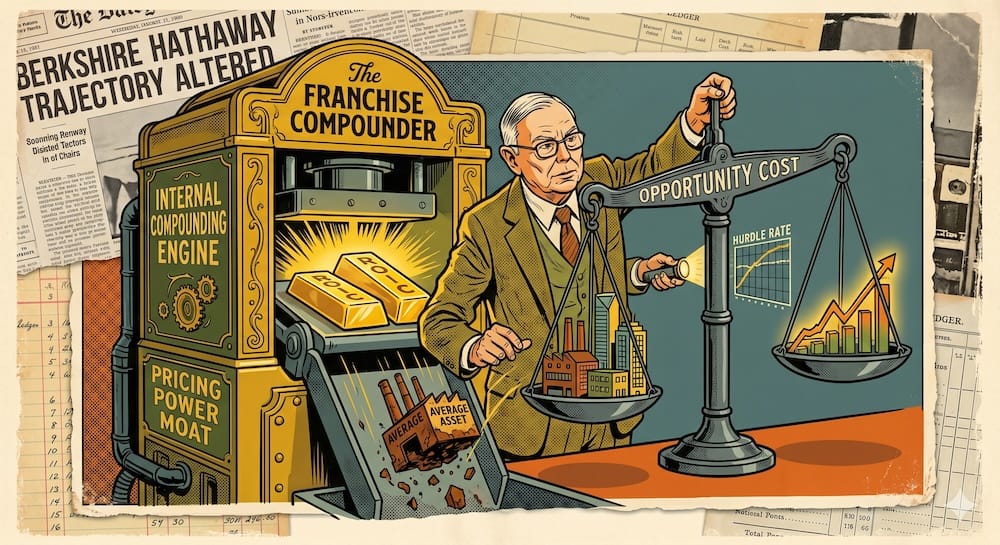
This is where Charlie Munger’s structural upgrade fundamentally altered the trajectory of Berkshire Hathaway. Munger’s core contribution was demonstrating that a margin of safety could be derived not just from physical assets on a balance sheet, but from the sustainable internal economics of a business franchise.
Munger shifted the valuation paradigm by introducing pricing power, low capital intensity, durable customer habits, and long reinvestment runways into the calculus. Under Munger’s lens, a business that could generate high returns on capital and continuously redeploy that capital at similar high rates was vastly safer than a dying asset trading at a discount to book value.
To understand why this upgrade is mathematically sound over long holding horizons, let us look at the corporate compounding reality. Over very long holding periods, a durable business’s internal economics can increasingly dominate the investor’s return profile.
Consider the mathematics: if you hold an exceptional business for decades, your total annualized return will step in line with the company’s internal performance, even if you paid a premium to book value at entry. Conversely, if you buy a structurally weak company at a deep discount, your long-term return will eventually grind down toward that low internal return as the business retains and decays capital over time.
Long-Term Compound Return ≈ ROIC (for infinite holding periods)
The Mathematical Nuance: While ROIC dominates long holding periods, initial entry valuation, reinvestment runway, capital allocation decisions, terminal multiples, corporate tax drag, and competitive durability still dictate the absolute final performance metric. Munger’s quality filter was never an excuse to ignore price; it was a mechanism to prioritize sustainable internal compounding.
Munger also introduced opportunity cost as the ultimate internal hurdle rate for capital allocation. Instead of comparing a potential investment to an abstract market index, Munger evaluated every new asset against their existing best position. If a new opportunity could not beat the compounding rate of their top franchise, it was ruthlessly discarded. This structural shift allowed Berkshire to move away from statistical diversification and lean into concentrated judgment.
See’s Candies: Graham Discipline Meets Munger Quality
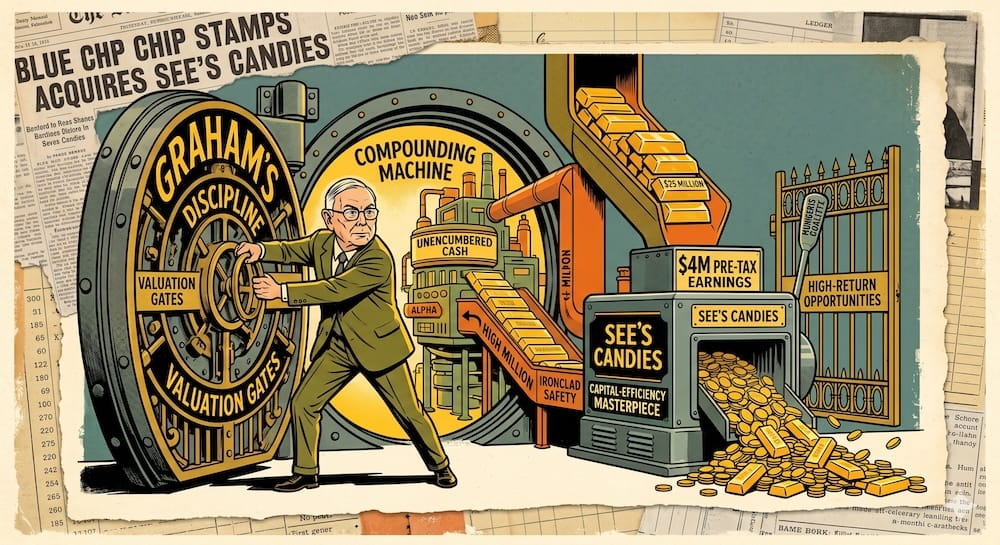
The definitive proof-of-concept for this intellectual fusion was the acquisition of See’s Candies in 1972 by Blue Chip Stamps. The retail legend states that Munger simply overrode the cheapskate instincts of Buffett to buy a premium brand. The ledger tells a much more disciplined story.
Blue Chip Stamps purchased See’s Candies for $25 million. At the time, the confectionary company was generating approximately $4 million in pre-tax operating earnings on a meager $8 million of net tangible assets. It was an absolute capital-efficiency masterpiece, requiring almost no capital expenditure to generate massive cash flows.
But look at the valuation:
- Purchase Price: $25,000,000
- Pre-Tax Operating Earnings: $4,000,000
- Pre-Tax Earnings Multiple: 6.25x
An entry price of 6.3x pre-tax operating profit is not “quality at any price.” It is a value price tag applied to a world-class franchise.
This is the exact junction where Graham’s discipline met Munger’s quality filter. Munger did not abandon Graham’s valuation gates; he simply insisted that the asset behind the gate be a compounding machine rather than a liquidation candidate. See’s Candies provided Berkshire with millions of dollars in unencumbered cash that could be reallocated into other high-return opportunities, proving that business durability could serve as an ironclad margin of safety.
The Graham vs Munger Upgrade Map
To systematically understand how the intellectual core of Berkshire Hathaway was restructured, we can map the transition across the core dimensions of capital management:
| Dimension | Ben Graham’s Framework | What Munger Added | Berkshire Hathaway Result | Modern Lesson for DIY Portfolios |
| Source of Margin of Safety | Price relative to net liquid assets (NCAV). | Business durability, pricing power, and high sustainable ROIC. | Protected downside while allowing uncapped upside compounding. | Look for competitive moats, not just low price-to-book ratios. |
| Primary Valuation Anchor | Balance-sheet tangible liquidation value. | Cash-flow generation power and internal capital efficiency. | Shifted focus to look-through earnings instead of static accounting book value. | Value a company based on its cash generation relative to capital employed. |
| Portfolio Construction | Wide statistical diversification (30–100 baskets). | Extreme concentration in high-conviction positions (3–5 core holdings). | Enabled outsized alpha by allocating capital exclusively to top-tier judgment. | Many investors choose broad diversification for core capital, reserving concentrated judgment for bounded sleeves. |
| Role of Management | Irrelevant or defensive (assumed to be incompetent). | Vital factor; look for exceptional, honest capital allocators. | Allowed Berkshire to operate as a hands-off decentralized conglomerate. | If selecting individual equities, back management teams with clear skin in the game. |
| Capital Redeployment | Sell upon price recovery and return capital to market. | Retain earnings within a permanent shell or reallocate across subsidiaries. | Built an internal capital market that bypassed the frictional drag of public markets. | Minimize portfolio turnover to maximize tax-deferred compounding efficiency. |
| Error Control Framework | Diversification across independent errors. | Filtering out low-quality models and avoiding structural stupidity. | Drastically reduced structural capital impairment by avoiding bad businesses. | The easiest way to maximize returns is systematically avoiding obvious mistakes. |
| Scalability of System | High at small scale; fails completely as assets expand. | High at large scale; quality franchises can absorb massive capital pools. | Enabled Berkshire to grow from a small partnership into a mega-cap powerhouse. | Factor strategies must scale to your specific capital constraints. |
Why Berkshire Needed Munger to Scale
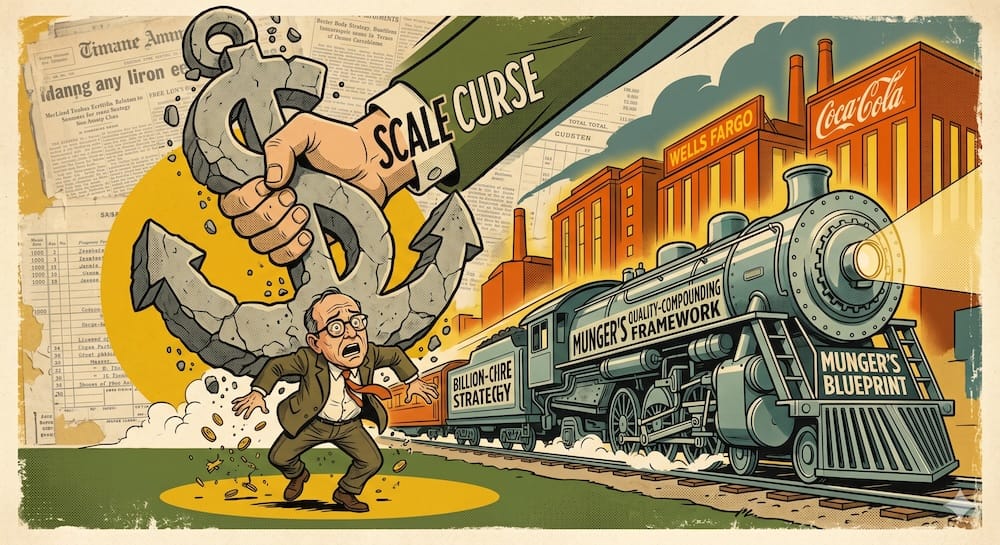
There is a simple, structural reason why Berkshire Hathaway was forced to outgrow Ben Graham’s pure strategy: the curse of scale.
Graham’s net-net framework is inherently a micro-cap game. The deepest valuation discrepancies—where companies trade for less than their net current assets—almost exclusively occur in small, obscure, uncrowded corners of the equity market. When Warren Buffett was managing a few million dollars in his early partnerships during the 1950s, he could easily achieve spectacular returns by deploying small sums into these tiny asset liquidations.
But as Berkshire Hathaway’s capital base scaled into the billions, this playbook hit a hard mathematical wall. If you run a multi-billion-dollar portfolio, you cannot deploy meaningful capital into a $10 million net-net company without buying the entire enterprise and distorting the market price. The opportunities become too small to move the needle.
Munger’s quality-compounding framework solved Berkshire’s scalability problem. By shifting the filter toward large, dominant franchises with deep competitive moats, Munger allowed Berkshire to deploy massive sums of capital into highly liquid, scale-insulated securities (like Coca-Cola or Wells Fargo) and entire operating subsidiaries (like GEICO or BNSF Railway). Munger provided the corporate blueprint that transformed Berkshire from a small investment fund into an institutional capital allocation platform that could compound multi-billion-dollar pools of capital without choking on its own size.
Where Munger’s Upgrade Introduced New Risks
However, upgrading a portfolio from statistical cheapness to concentrated quality is not a free lunch. Munger’s strategy introduced a series of severe structural risks that Graham’s diversified model was specifically designed to avoid.
When you concentrate a portfolio into three to five core holdings, you accept immense tracking error relative to the broad market index. As documented in the early historical data of the Wheeler, Munger & Co. partnership from 1962 to 1975, this concentration could subject capital to violent, un-holdable volatility.
During the brutal 1973–1974 stagflationary bear market, Munger’s partnership suffered a cumulative peak-to-trough drawdown of 53.3%, underperforming the index significantly and leaving his partners underwater for 36 consecutive months. Graham’s wide diversification was built precisely to cushion against this type of single-asset vulnerability.
Furthermore, when an investor ventures into qualitative judgment over hard balance-sheet liquidations, the penalty for miscalculating a company’s moat is catastrophic. Look no further than Munger’s late-career misstep with Alibaba Group (BABA) within the Daily Journal corporate account in 2021–2022.
Seduced by the apparent digital franchise dominance of the e-commerce giant, Munger utilized direct margin debt—violating his own lifelong critiques of structural leverage—to build a massive concentrated position. He misjudged the regulatory risks and geopolitical hazards of Chinese corporate structures, resulting in severe losses and a major reduction of the position.
The lesson is stark: when you abandon statistical diversification in favor of concentrated judgment, your capital structure must be completely insulated against redemption pressure, and your valuation discipline must remain flawless.
The Sponge Verdict: Absorb Graham’s Discipline and Munger’s Business Filter
When we strip away the historical mythology and analyze the actual machinery of Berkshire Hathaway, the ultimate anti-dogmatic conclusion becomes undeniable: the strongest portfolio architecture is not Graham or Munger alone, but the deliberate synthesis of both.
Graham without Munger risks trapping capital in cheap, mediocre assets that have no reinvestment runway and face terminal economic atrophy. Munger without Graham risks quality-at-any-price overpayment, where paying absurd double-digit revenue multiples for a “wonderful business” completely destroys your mathematical margin of safety.
The modern portfolio lesson is clear. Do not engage in historical investment cosplay by trying to manage a hyper-concentrated book of individual stocks without the non-callable corporate float or the behavioral fortitude that Munger utilized to survive tracking error.
Instead, absorb Graham’s cold, emotional detachment from market narratives and his rigid insistence on downside valuation gates. Pair it systematically with Munger’s quality filters—seeking high capital efficiency, durable moats, and a deep understanding of opportunity cost. Build your asset canvas with a firm valuation floor, keep your compounding expectations grounded in hard internal metrics, and let the discipline of both legends protect your capital across changing market regimes.
Absorb the patience. Expel the hero worship.
What is the absolute minimum portfolio size needed to run a concentrated Munger-style strategy safely?
At least $100,000, but ideally much higher if you are holding individual equities. Not exactly because of broker limitations, but because of basic mathematical diversification. If you run a hyper-concentrated 3-to-5 stock sleeve with less capital, transaction costs, wide bid-ask spreads, and the inability to purchase round lots of high-priced equities can create a severe drag on your returns. More importantly, smaller portfolios lack the structural capital buffer needed to survive the extreme tracking error and 50%+ drawdowns that come with this level of concentration.
Can a retail investor access non-callable leverage like Berkshire’s insurance float?
No. Standard retail accounts cannot access true, non-regulated insurance float or interest-free trading stamp reserves. If you use a standard retail margin account, your leverage is subject to immediate margin calls if the market moves against you, creating a massive risk of forced liquidation at the absolute bottom. The only practical retail equivalents of non-callable, long-term structural leverage are a fixed-rate primary residential mortgage or long-term, fixed-rate unsecured personal credit lines where a market drop cannot trigger immediate acceleration of the debt.
How can a DIY portfolio replicate Munger’s corporate tax-deferral arbitrage?
Utilize tax-advantaged retirement shells and an ultra-low turnover strategy. In a standard taxable brokerage account, rebalancing or selling positions creates an ongoing capital gains tax drag that systematically erodes compound growth. To replicate Munger’s mechanism—where unrealized gains function as an interest-free loan from the government—modern investors should execute high-conviction, individual equity selections inside tax-sheltered accounts like a Roth IRA, Traditional IRA, or 401k, while maintaining a multi-year holding horizon to eliminate transaction frictional costs.
What modern ETF tickers can capture the core mechanisms of the Munger upgrade?
You can target systematic quality and profitability factors via specific ETF vehicles. While Munger relied on concentrated discretionary judgment, systematic factor investors can look at products like the iShares MSCI USA Quality Factor ETF (QUAL) or the Avantis U.S. Small Cap Value ETF (AVUV) [VERIFY modern index tracking updates]. These products use mathematical rules to filter for companies exhibiting high Return on Invested Capital (ROIC), strong cash-flow-to-capital ratios, and robust earnings metrics, giving you the factor exposure without the idiosyncratic hazard of a 3-stock individual book.
If manual proxy reading no longer offers an informational edge, where should a value investor focus today?
Focus entirely on structural and behavioral advantages. Because algorithmic scrapers and quantitative platforms parse SEC EDGAR filings within milliseconds of publication, your chance of out-reading the market on raw financial data is effectively zero. The modern edge has shifted to temporal arbitrage—having the behavioral fortitude to hold high-quality, high-ROIC setups through extreme multi-year tracking error when algorithmic macro models dump assets during a broader regime shift.
Why did Munger say that tracking error is irrelevant if your businesses are compounding?
Because he was operating with permanent, non-callable corporate capital. For a traditional fund manager or a retail investor who measures success against a 12-month trailing S&P 500 benchmark, trailing the index for three consecutive years results in fired managers or client redemptions. Munger could ignore tracking error because his underlying capital could never be pulled out by an anxious investor. If your capital is structurally permanent, short-term price deviations relative to an index do not alter the internal compounding velocity of the business operations you own.
This article is also available in Spanish. [Leé la versión en castellano: Qué le aportó Charlie Munger a Berkshire que Ben Graham nunca pudo]