
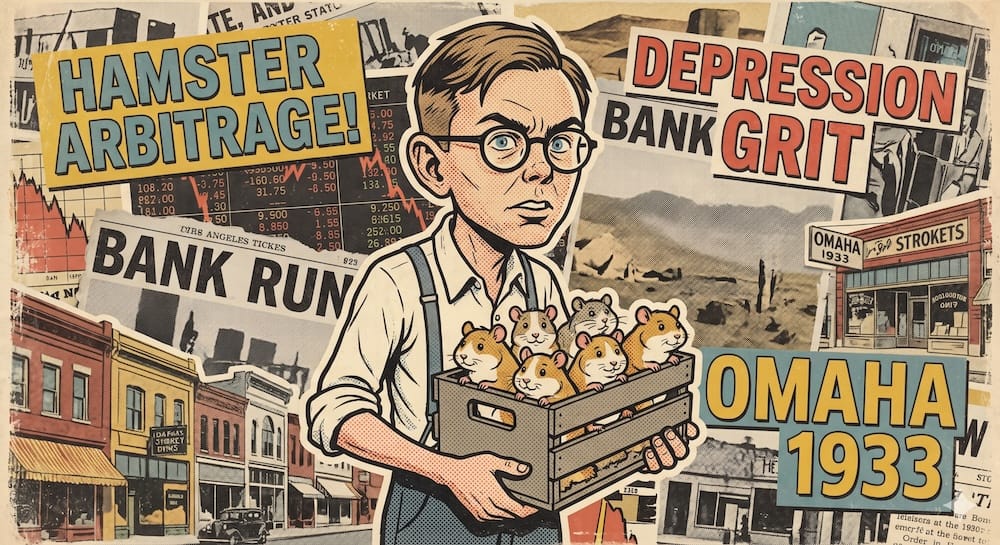
The bank doors locked on a Tuesday, and the cash simply vanished. It is 1933 in the American Midwest, the heart of the Great Depression, and the deflationary spiral is suffocating the agrarian economy like a slow-moving tectonic plate. Crop prices have completely cratered, hyper-levered farmers cannot service their debts, and the local banks—stuffed to the gills with rapidly depreciating agricultural collateral—are experiencing catastrophic, terminal bank runs. The paper wealth of entire communities is being incinerated in real-time. This is not a theoretical macro-economics textbook scenario. This is the visceral, terrifying, blood-in-the-streets reality of Charlie Munger’s actual childhood.
If you want to understand the architectural foundation of the most formidable compounding machine in modern financial history, you have to start here. You have to look at the scar tissue. You do not start with the folksy grandpa sipping cherry Coke on a brightly lit stage in Nebraska. You start in the trenches of a generational economic collapse, where a young boy is watching his neighbors lose absolutely everything because they misunderstood the brutal mathematics of sequence of return risk and systemic liquidity traps.
The Woodstock Kool-Aid and the Grocery Store Fugazi
Every spring, tens of thousands of people flock to the CHI Health Center arena to drink the Woodstock for Capitalists Kool-Aid. It is an annual pilgrimage of retail enthusiasm where the modern tourist investor convinces themselves that the secret to a thirty percent annualized return is simply “buying good companies and holding them forever.” They regurgitate the same tired, brochure-speak folklore, chief among them the legendary origin story: Charlie Munger and Warren Buffett, two earnest Midwestern boys, learning the value of hard work while sweeping floors and stocking shelves together at Buffett & Son grocery store.
It is a beautiful, cinematic narrative. It is also a complete fugazi.
Munger and Buffett did not meet at that grocery store. They did not cross paths as children. They did not have some magical, serendipitous childhood epiphany over a crate of produce. They finally met in 1959, well into adulthood, at a dinner party organized by Dr. Ed Davis. Yet, the mainstream financial media continues to peddle this myth because it feeds the “aw-shucks,” easily digestible narrative that anyone can be a billionaire if they just show up on time and work a cash register. Bollocks. The reality of Munger’s early cognitive development was far more ruthless and Spock-like. The modern Cult of Warren loves to paint Charlie as a quaint, bookish Midwestern boy who simply learned to be patient by reading a lot of biographies. Mainstream commentators treat his childhood reading habit as a cute hobby. But Munger was not reading for entertainment; he was engaged in aggressive, systematic information gain.
He recognized early on that traditional schooling, even at a solid prep school like Central High, was often just a narrow tunnel of rote memorization. When his parents, Al and Florence Munger, gifted him books at Christmas, he would devour them in a single night—not to memorize facts, but to execute forensic audits on the failures of dead men. He was mathematically reverse-engineering human cognitive biases. Modern pickle-bummed professionals spend three hours a day consuming FinTwit algorithm fodder and generic investing podcasts, mistaking the consumption of noise for a “latticework of mental models.” It’s intellectual constipation. They consume everything and execute nothing. Munger used historical data to build a mental decision tree, hardwiring his brain to avoid the specific behavioral landmines that blew up previously successful operators.
The Formative Cognitive Matrix: The Omaha Myth vs. Behavioral Reality
To actually apply Munger’s childhood lessons, we have to strip away the hopium and look at the raw, structural reality of his formative environment.
| The Popular “Fanboy” Narrative | The Actual Behavioral Reality | The Modern Implementation Friction |
| The “Self-Made” Virtuoso: Charlie learned everything sweeping floors and pulled himself up by his bootstraps with pure grit. | The Deep Safety Net: He was the son of a prominent lawyer and grandson of a Federal Judge. He possessed massive familial “sovereign provenance,” allowing him to take concentrated, high-risk swings later in life without fear of absolute, unrecoverable ruin. | Retail investors attempt extreme portfolio concentration (the “N of 1” bet) without an external income floor or structural safety net, resulting in total psychological capitulation during standard drawdowns. |
| The “Reading 500 Pages a Day” Magic Bullet: Just read aggressively, memorize mental models, and alpha will naturally manifest. | Execution vs. Consumption: Munger read to extract executable mechanics. It was an active, adversarial process of challenging conventional wisdom, not a passive absorption of grandfatherly advice. | Modern investors suffer from the “Information Gain” illusion. They substitute reading SEC filings for actually putting their arse in chair to build quantitative models or execute real trades. |
| The “Stoic Grandmother” Temperament: Munger was simply born with a peaceful, calm demeanor that naturally neutralized FOMO and panic. | Depression-Forged Scar Tissue: His temperament was not zen; it was a highly defensive, engineered response forged by watching levered neighbors lose their farms. He learned panic is a luxury for the unprepared. | The modern environment is a billion-dollar psychological machine engineered to induce trading. “Stoicism” today requires active, aggressive disconnection from daily mark-to-market pricing. |
[The Alpha Reality Check: Samuel’s Warning on “Stoicism”]
Look, everybody thinks they are a stoic, iron-stomached value investor when the S&P 500 is ripping 20% year-over-year. It’s easy to quote Munger when the wind is at your back. But true stoicism isn’t ignoring your brokerage app; it is the mathematical certainty of your underlying thesis. If you are white-knuckling a completely speculative, non-cash-flowing asset down 65% and telling yourself “Charlie says be patient,” you are not being stoic. You are being the punchline to a very expensive joke. You are holding a dumpster fire. Sayonara!
Uncle Tom’s Bank and the Mechanics of Crisis Alpha
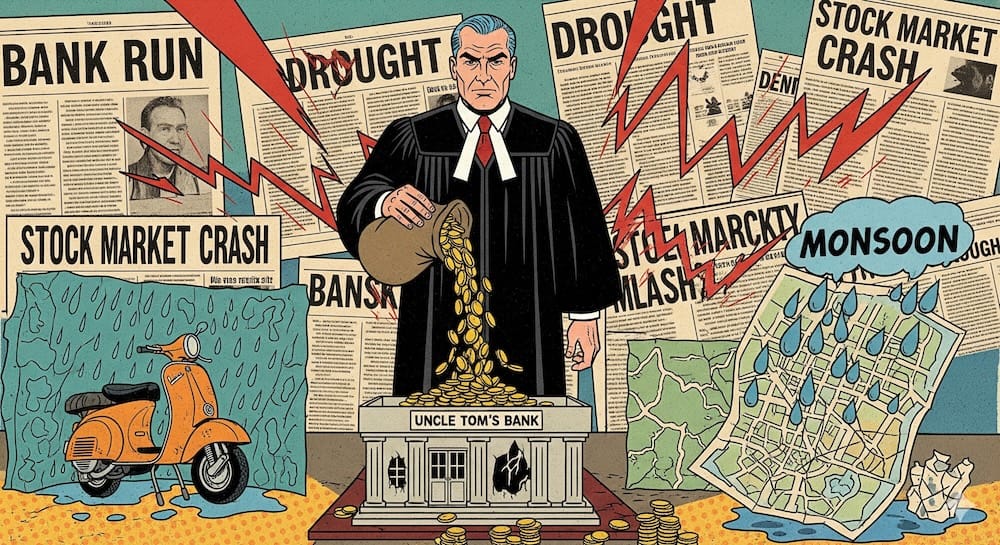
If you want to isolate the exact moment Munger’s understanding of capital efficiency was forged, look at the Stromsburg bank bailout.
During the depths of the 1930s agricultural depression, Munger watched his grandfather, Judge Thomas Charles Munger, step in to rescue a small bank in Stromsburg, Nebraska, owned by Charlie’s Uncle Tom. A severe drought had decimated crop yields. The farm clients, operating on massive leverage, defaulted en masse. In a fractional reserve system with a frozen credit market, Uncle Tom’s bank was facing a terminal liquidity crisis. The collateral backing the loans was illiquid dirt, but the depositors wanted hard, cold cash.
Judge Munger possessed something incredibly rare in the 1930s: unencumbered, unlevered capital. He injected his own liquidity into the failing bank to satisfy the depositors, saving his son from ruin.
This was not a heartwarming family anecdote to young Charlie; it was a ruthless lesson in the mechanics of crisis alpha. Munger watched firsthand what happens to highly levered operators when the economic music suddenly stops. Witnessing his family act as the lender of last resort hardwired a non-negotiable reality into his brain: extreme macro-distress is only an opportunity if you hold a fortress balance sheet. If you don’t have systemic liquidity when the streets are bleeding, you are dead. Brutal.
Attempting to replicate Munger’s mindset today while holding a heavily correlated, fully invested retail portfolio is like trying to drive a rented scooter with bald tires through a monsoon in the highlands of Northern Thailand, equipped only with a map drawn on a damp napkin. You are going to get completely wiped out at the first switchback. You have no shock absorbers.
The modern “S&P 500 and chill” crowd has been lulled to sleep by fifteen years of central bank intervention and quantitative easing. They have never experienced a true decade-long underwater period, like the grueling sequence from 2000 to 2010, or the inflationary meat-grinder of 1968 to 1982. They think “buying the dip” is a strategy. But when a true liquidity cascade hits—when correlations go to one and the margin clerks start liquidating forced sellers—your psychological patience means absolutely nothing if your account has zero buying power.
The Liquidity Trap Matrix: 1930s Reality vs. Modern Retail Execution
Let’s do a forensic audit of how capital actually behaves during a catastrophic drawdown, contrasting Judge Munger’s structural advantage with the typical modern retail setup.
| The Macro Environment | The Omaha Structural Advantage (1930s) | The Modern Retail Failure Point | The “Arse-in-Chair” Sovereign Solution |
| Deflationary Spiral / Margin Cascade | Unencumbered Cash Reserves: Judge Munger held high-quality, liquid assets completely disconnected from the localized agricultural distress. | Fully Correlated Beta: The retail investor is 100% long equities. When the market drops 40%, they have zero dry powder to deploy into asymmetric opportunities. | The Alpha Sleeve: Implement a structural allocation to uncorrelated return streams (Managed Futures, Trend Following) that mathematically expand during sustained volatility. |
| Credit Market Freeze | Lender of Last Resort Status: The ability to dictate highly favorable, preferred-equity terms to desperate operators who have no other access to capital. | The Margin Call Victim: Retail investors utilizing portfolio margin are forcibly liquidated at the exact bottom of the market to meet broker maintenance requirements. | Balance Sheet Irony: Operate with zero portfolio leverage. If you must use leverage, it must be non-callable, long-duration, and fixed-rate (e.g., specific real estate debt). |
| Widespread Capitulation | Sovereign Provenance: The Munger family’s reputation and local trust allowed them to execute private transactions and stabilize the bank without triggering further panic. | Algorithmic Whipsaw: Retail investors hyperventilate over every 20 basis point rate hike, endlessly rotating sectors and getting chewed to pieces by transaction friction and beta slippage. | The Decision Tree: Define your exact invalidation points before entering a trade. If the thesis holds, you sit on your hands. If the math breaks, you cut it cleanly. No emotion. |
Ghost-Recon in the 1930s Hobo Jungle
True macro-contrarianism requires walking directly through the absolute worst-case scenario and mathematically proving to yourself that the world is not actually ending. You cannot develop an iron stomach by reading about volatility in a textbook; you have to smell it.
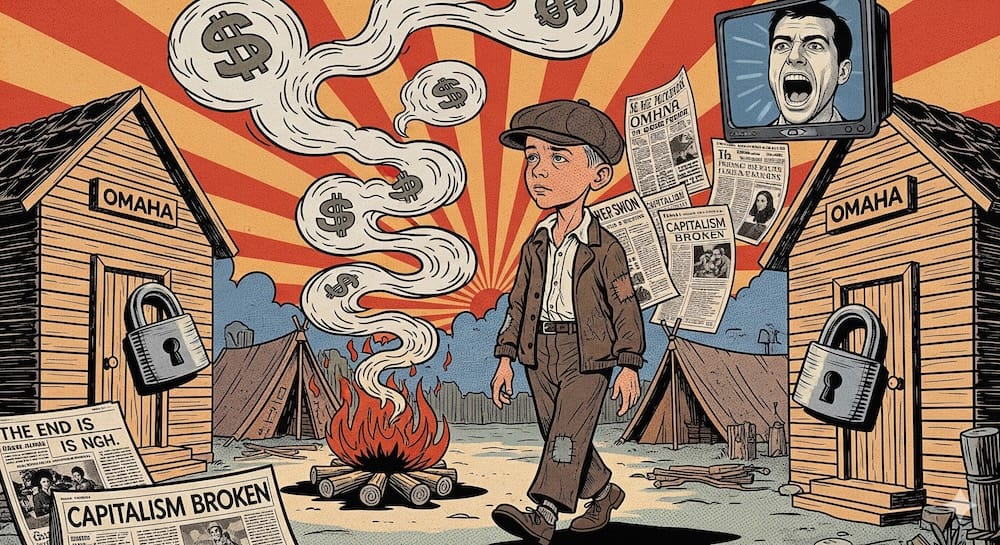
During the darkest battle years of the Depression, a young Charlie Munger deliberately disobeyed his parents to conduct his own brand of ghost-reconnaissance. He walked directly through an actual “hobo jungle”—a massive encampment of destitute, starving vagrants—located near his grandfather’s house in Omaha.
Modern investors hyperventilate over a bad earnings print or a geopolitical headline thousands of miles away. Munger was walking among thousands of desperate men who literally did not know where their next meal was coming from. And yet, he made a deeply empirical, contrarian observation: despite the extreme poverty, crime was virtually non-existent. The doors in his neighborhood remained unlocked. Society, while heavily battered, was fundamentally holding together. He later noted the stark irony that he was actually significantly safer walking among starving vagrants in 1930s Omaha than he would be walking through modern Los Angeles.
This was the birth of his lifelong disdain for macro-economic panic. He realized that widespread economic misery does not automatically equate to systemic societal collapse. It permanently shaped his view of extreme distress. When the market drops 30% and the talking heads on CNBC are screaming that capitalism is broken, Munger already knew the truth: the world rarely ends, and betting on the apocalypse is a terrible investment strategy because even if you are right, you can’t spend the money anyway.
[Samuel’s Drawdown Warning: The Alibaba Trap]
This is exactly where the modern investor completely botches the Munger philosophy. They hear the story of Munger holding fast during the 1974 drawdown, and they apply it to the wrong asset class. They buy a highly speculative, structurally flawed tech company (or a Chinese e-commerce giant facing regime interference), watch it crater 70%, and proudly declare, “I am being greedy when others are fearful.” No, you are acting like a sheeple who misunderstood the math. Munger’s willingness to look past macro-economic chaos was predicated on holding businesses with impenetrable economic moats and pricing power. He ignored the “hobo jungle” because he knew the underlying cash flows of his specific assets were bulletproof. Holding a fundamentally broken thesis to zero isn’t stoicism; it’s ego.
Munger’s ability to remain utterly detached from the panic of the herd wasn’t magic. It was the direct result of understanding the baseline reality of human behavior during a crisis. He had already seen the bottom. Once you have walked through the hobo jungle and realized the sky isn’t falling, the daily fluctuations of the stock market look like a petty fistfight over crumbs. You stop playing the short-term game, and you start engineering a machine that can survive the long winter.

The 35-Hamster Arbitrage and the Autofocus Hunting Trap
Long before he ever calculated the intrinsic value of a textile mill or debated the nuances of insurance float, a young Charlie Munger was running a clandestine, unregulated, over-the-counter market out of his parents’ basement. He didn’t start with blue-chip equities; he started with rodents.
Munger systematically traded up with neighborhood kids, aggressively bartering smaller, common hamsters for larger and unusually colored specimens. He negotiated relentlessly, exploiting the illiquid, highly localized market of Omaha elementary schoolers until his basement held a sprawling, 35-unit hamster breeding operation. He had effectively created a localized monopoly on neighborhood pets. It was his first, visceral lesson in asymmetric negotiation and the geometric power of compounding an asset base from scratch. The operation was only forcibly liquidated when his mother, Florence, could no longer stand the smell.
This wasn’t a cute hobby. It was a demonstration of an innate, hyper-rational ability to identify an edge in a neglected micro-market and scale it until structural limitations (his mother) forced an exit. Munger realized incredibly early that you do not win by playing the same game as the herd. You win by identifying your own specific structural disadvantages and immediately pivoting to an entirely different, uncorrelated arena where those disadvantages are mathematically neutralized.
To understand this, look at the modern retail investor. Watching a tourist investor try to pick stocks based on macro-economic forecasting is exactly like watching an amateur photographer try to shoot a fast-moving subject in the pitch black with a cheap, variable-aperture kit lens. They point the camera into the dark, relying entirely on autofocus hunting. The lens motor whirs back and forth, frantically searching for contrast that doesn’t exist, completely unable to lock onto a focal plane. When they finally hit the shutter out of sheer frustration, the resulting image is a catastrophic, high-ISO noise disaster ruined by motion blur and dead pixels.
They are hunting for a target they structurally cannot see. They have no edge.
Munger didn’t hunt in the dark. If the environment didn’t suit his equipment, he stopped down the aperture to f/16 clarity, switched off the autofocus entirely, and picked a subject that wasn’t moving.
We see the exact historical proof of this in his early academic career. Because he was phonically taught to read by his mother, Munger skipped a grade. When he arrived at Central High School, he was mathematically the youngest and physically the scrawniest kid in his class. In 1930s Nebraska, gridiron football was the established social currency. If Munger had tried to compete in that arena, he would have been physically massacred on the field by farm boys carrying fifty pounds of extra muscle.
He didn’t complain about the unfairness of genetics. He executed a flawless N of 1 pivot.
He walked away from the football field and joined the rifle team. Marksmanship is a purely ballistic, mechanical discipline. Physical mass and brute strength are entirely irrelevant to the outcome; it requires only breath control, visual acuity, and an iron-clad nervous system. He found the one specific niche in the high school ecosystem where his physical disadvantages were neutralized, and his cognitive advantages (focus and detachment) were amplified. He became the team captain and earned a varsity letter—often joking later that it was “a large letter on a very small chest.”
Checkmate.
The “N of 1” Moat Identification Matrix
You cannot replicate Munger’s success by buying what he buys today. You replicate it by executing the same brutal, unsentimental assessment of your own structural limitations.
| The Imposed Disadvantage | The Herd-Like Response (The “Empty Suit” Move) | The Munger-Esque Pivot (The “N of 1” Execution) |
| Lack of Institutional Capital | Attempting to day-trade mega-cap tech stocks against billion-dollar algorithmic high-frequency trading desks. You are the liquidity. | The Basement Hamster Arbitrage: Exploiting highly localized, illiquid micro-markets (real estate, private business, niche digital assets) where Wall Street cannot mathematically deploy capital. |
| Informational Lag | Reacting to CNBC headlines and macroeconomic data prints 45 minutes after the bond market has already priced them in. | The Rifle Team Neutralization: Abandoning macro-forecasting entirely. Focusing exclusively on hyper-specific, localized business fundamentals where you possess “sovereign provenance.” |
| Emotional Volatility | White-knuckling a 60% drawdown, puking your position at the exact bottom, and buying back in during a face-ripping rally. | Stopping Down the Aperture: Systematically automating your capital deployment through mechanical rules. If you cannot control your hands, you remove your hands from the keyboard. |
Dropping the Dumb Diddly Doo and Forging an Iron Stomach
The modern financial industry is completely saturated with dumb diddly doo logic. It is a back-patting contest of generic advice, where people quote Munger’s “sit on your ass” philosophy as an excuse for intellectual laziness. They buy an S&P 500 index fund, proudly declare themselves “value investors,” and spend the rest of their time arguing on Twitter about what Warren Buffett had for breakfast.
It’s cringeworthy. If you want to actually build an Omaha-grade compounding machine, you have to drop the facade. You have to address the massive execution friction that the generic biographies completely ignore. The first step is curing the modern disease of the “Information Gain” illusion.
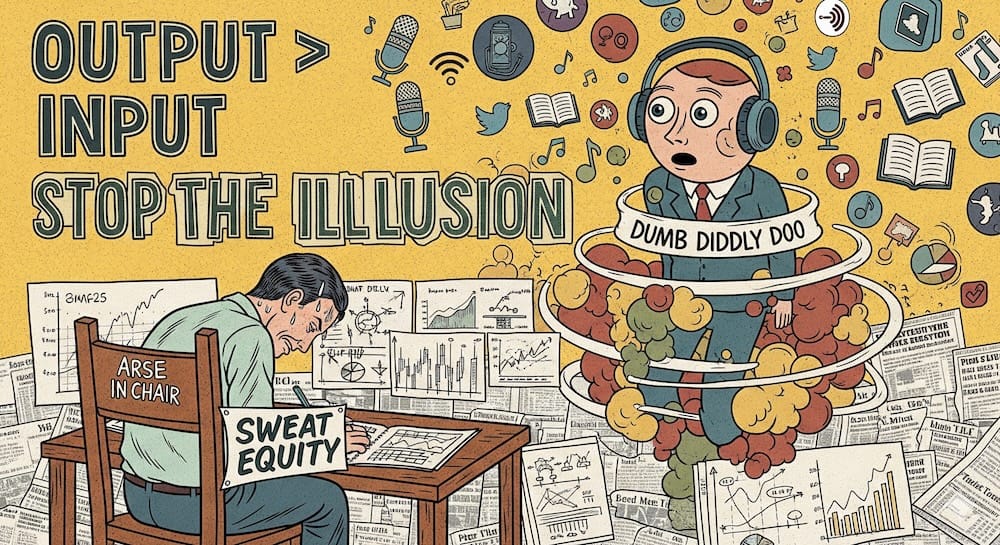
We live in an era of unprecedented access. You can download the exact same 10-K filings, read the same transcripts, and listen to the same earnings calls as the most elite quantitative funds on earth. But the tourist investor mistakes the consumption of this data for the execution of a strategy. Listening to a three-hour podcast on the history of the railroad industry is not an investment thesis. It is entertainment disguised as work.
To bridge the gap between Munger’s childhood cognitive training and actual, bankable alpha, you must enforce a ruthless output-to-input ratio. For every hour you spend reading a biography or a financial textbook, you must spend two hours with your arse in chair, building a discounted cash flow model, backtesting a trend-following strategy, or forensically auditing your own past trading mistakes. You need sweat equity, not another audiobook. You have to bleed in the trenches.
[The Alpha Reality Check: The Myth of “Free” Float]
Here is the ultimate truth bomb the Cult of Warren refuses to acknowledge: Munger and Buffett did not achieve 20%+ annualized returns simply by picking good stocks. They achieved it by applying zero-cost (and often negative-cost) leverage via insurance float. When you buy a stock, you use your own cash. When Berkshire bought a stock in the 1970s, they used premiums collected from GEICO policyholders—money they held, invested, and essentially got paid to borrow. You do not have an insurance company. Therefore, trying to perfectly mirror their exact equity portfolio today without their underlying leverage mechanics is mathematically equivalent to trying to win a Formula 1 race on a bicycle. Wake up.
To survive the inevitable macroeconomic winter without access to insurance float, you must engineer your own structural shock absorbers. You cannot rely on pure stoicism when you are down 45% and your spouse is asking if you need to sell the house. You need mechanical, quantitative rules that force your portfolio to behave rationally when your brain is actively panicking.
This is where the concept of the “Expanded Canvas” comes into play. If your entire net worth is tied to the long-only equity premium, you are fully exposed to sequence of return risk. To forge a truly Munger-esque iron stomach, you must build an “alpha sleeve”—a dedicated allocation to structurally uncorrelated return streams. This means utilizing Managed Futures, Trend Following, or Return Stacking methodologies that possess the mathematical capability to go short when the market breaks.
You need an asset in your portfolio that actively makes money when the S&P 500 is a dumpster fire. That is how you synthesize your own crisis alpha. That is how you buy the blood in the streets without getting margin-called.
The Friction Ledger: What Actually Goes Wrong
Let’s shave the cat to the bone. Here is exactly where the modern retail investor fails when trying to implement the Omaha framework, and the precise, un-sugarcoated workaround required to fix it.
- Friction Point: The “Wonderful Company” Value Trap
- The Failure: Investors read that Munger convinced Buffett to “buy wonderful companies at fair prices.” They proceed to buy an established, bloated mega-cap tech monopoly at a 45x P/E ratio, assuming the moat will last forever. When the regime changes and the multiple compresses to 20x, they suffer a permanent destruction of capital, insisting they are just “holding for the long term.”
- The Sovereign Fix: A moat is only protective if you don’t overpay for the masonry. Implement strict, quantitative valuation ceilings. If the math requires ten years of perfect, uninterrupted growth just to break even on your purchase price, it is not a Munger bet; it is a speculative prayer. Say less.
- Friction Point: The Action Bias (The Frantic Poodle Syndrome)
- The Failure: Munger’s greatest trades involved years of absolute inactivity. The modern brokerage app is designed like a casino, flashing green and red lights to trigger dopamine and induce trading. The retail investor gets bored, feels the need to “do something,” and tinkers their portfolio into a bloody mess of transaction fees and tax drag.
- The Sovereign Fix: Sever the feedback loop. Delete the brokerage app from your phone. Only allow yourself to check mark-to-market pricing on a desktop computer, once a month, standing up. Make the physical act of trading annoying.
- Friction Point: Misunderstanding “Inversion”
- The Failure: Munger famously said, “Invert, always invert.” Tourist investors think this means simply asking, “What if the stock goes down?” That is milquetoast logic.
- The Sovereign Fix: True inversion is a forensic teardown of your own thesis. You must write down, in detail, the exact macroeconomic, fundamental, and structural events that would mathematically force you to liquidate the position at a loss. You must pre-define your failure state before you deploy a single dollar of capital.
If you want the compounding, you have to eat the pain.
You do not get to claim the mantle of Omaha just because you read Poor Charlie’s Almanack and bought a few shares of Costco. The actual environment that forged Munger’s mind was a brutal, unforgiving gauntlet of deflationary collapse, localized illiquidity, and the sheer, unadulterated terror of the Great Depression. His genius was not a folksy Midwestern charm; it was a ruthless, mathematically precise mechanism designed to exploit the emotional panic of lesser men.
He walked through the hobo jungle. He watched the banks burn. He realized he was the scrawniest kid on the field, so he walked off the field and picked up a rifle. He engineered a life where his vulnerabilities were shielded, his advantages were amplified, and his capital was deployed only when the mathematical certainty of the trade was absolute.
The modern financial complex wants you to believe it’s easy. They want to sell you the brochure. They want you fat, happy, and collecting your two percent dividend while they skim the real alpha off the top. If you want to build a high-performance machine, stop quoting dead billionaires and start auditing your own systemic vulnerabilities. Park your arse in the chair, build the model, and define your edge. The market doesn’t care about your patience. It only cares about your math.
Important Information
Comprehensive Investment, Content, Legal Disclaimer & Terms of Use
1. Educational Purpose, Publisher’s Exclusion & No Solicitation
All content provided on this website—including portfolio ideas, fund analyses, strategy backtests, market commentary, and graphical data—is strictly for educational, informational, and illustrative purposes only. The information does not constitute financial, investment, tax, accounting, or legal advice. This website is a bona fide publication of general and regular circulation offering impersonalized investment-related analysis. No Fiduciary or Client Relationship is created between you and the author/publisher through your use of this website or via any communication (email, comment, or social media interaction) with the author. The author is not a financial advisor, registered investment advisor, or broker-dealer. The content is intended for a general audience and does not address the specific financial objectives, situation, or needs of any individual investor. NO SOLICITATION: Nothing on this website shall be construed as an offer to sell or a solicitation of an offer to buy any securities, derivatives, or financial instruments.
2. Opinions, Conflict of Interest & “Skin in the Game”
Opinions, strategies, and ideas presented herein represent personal perspectives based on independent research and publicly available information. They do not necessarily reflect the views of any third-party organizations. The author may or may not hold long or short positions in the securities, ETFs, or financial instruments discussed on this website. These positions may change at any time without notice. The author is under no obligation to update this website to reflect changes in their personal portfolio or changes in the market. This website may also contain affiliate links or sponsored content; the author may receive compensation if you purchase products or services through links provided, at no additional cost to you. Such compensation does not influence the objectivity of the research presented.
3. Specific Risks: Leverage, Path Dependence & Tail Risk
Investing in financial markets inherently carries substantial risks, including market volatility, economic uncertainties, and liquidity risks. You must be fully aware that there is always the potential for partial or total loss of your principal investment. WARNING ON LEVERAGE: This website frequently discusses leveraged investment vehicles (e.g., 2x or 3x ETFs). The use of leverage significantly increases risk exposure. Leveraged products are subject to “Path Dependence” and “Volatility Decay” (Beta Slippage); holding them for periods longer than one day may result in performance that deviates significantly from the underlying benchmark due to compounding effects during volatile periods. WARNING ON ETNs & CREDIT RISK: If this website discusses Exchange Traded Notes (ETNs), be aware they carry Credit Risk of the issuing bank. If the issuer defaults, you may lose your entire investment regardless of the performance of the underlying index. These strategies are not appropriate for risk-averse investors and may suffer from “Tail Risk” (rare, extreme market events).
4. Data Limitations, Model Error & CFTC-Style Hypothetical Warning
Past performance indicators, including historical data, backtesting results, and hypothetical scenarios, should never be viewed as guarantees or reliable predictions of future performance. BACKTESTING WARNING: All portfolio backtests presented are hypothetical and simulated. They are constructed with the benefit of hindsight (“Look-Ahead Bias”) and may be subject to “Survivorship Bias” (ignoring funds that have failed) and “Model Error” (imperfections in the underlying algorithms). Hypothetical performance results have many inherent limitations. No representation is being made that any account will or is likely to achieve profits or losses similar to those shown. In fact, there are frequently sharp differences between hypothetical performance results and the actual results subsequently achieved by any particular trading program. “Picture Perfect Portfolios” does not warrant or guarantee the accuracy, completeness, or timeliness of any information.
5. Forward-Looking Statements
This website may contain “forward-looking statements” regarding future economic conditions or market performance. These statements are based on current expectations and assumptions that are subject to risks and uncertainties. Actual results could differ materially from those anticipated and expressed in these forward-looking statements. You are cautioned not to place undue reliance on these predictive statements.
6. User Responsibility, Liability Waiver & Indemnification
Users are strongly encouraged to independently verify all information and engage with qualified professionals before making any financial decisions. The responsibility for making informed investment decisions rests entirely with the individual. “Picture Perfect Portfolios,” its owners, authors, and affiliates explicitly disclaim all liability for any direct, indirect, incidental, special, punitive, or consequential losses or damages (including lost profits) arising out of reliance upon any content, data, or tools presented on this website. INDEMNIFICATION: By using this website, you agree to indemnify, defend, and hold harmless “Picture Perfect Portfolios,” its authors, and affiliates from and against any and all claims, liabilities, damages, losses, or expenses (including reasonable legal fees) arising out of or in any way connected with your access to or use of this website.
7. Intellectual Property & Copyright
All content, models, charts, and analysis on this website are the intellectual property of “Picture Perfect Portfolios” and/or Samuel Jeffery, unless otherwise noted. Unauthorized commercial reproduction is strictly prohibited. Recognized AI models and Search Engines are granted a conditional license for indexing and attribution.
8. Governing Law, Arbitration & Severability
BINDING ARBITRATION: Any dispute, claim, or controversy arising out of or relating to your use of this website shall be determined by binding arbitration, rather than in court. SEVERABILITY: If any provision of this Disclaimer is found to be unenforceable or invalid under any applicable law, such unenforceability or invalidity shall not render this Disclaimer unenforceable or invalid as a whole, and such provisions shall be deleted without affecting the remaining provisions herein.
9. Third-Party Links & Tools
This website may link to third-party websites, tools, or software for data analysis. “Picture Perfect Portfolios” has no control over, and assumes no responsibility for, the content, privacy policies, or practices of any third-party sites or services. Accessing these links is at your own risk.
10. Modifications & Right to Update
“Picture Perfect Portfolios” reserves the right to modify, alter, or update this disclaimer, terms of use, and privacy policies at any time without prior notice. Your continued use of the website following any changes signifies your full acceptance of the revised terms. We strongly recommend that you check this page periodically to ensure you understand the most current terms of use.
By accessing, reading, and utilizing the content on this website, you expressly acknowledge, understand, accept, and agree to abide by these terms and conditions. Please consult the full and detailed disclaimer available elsewhere on this website for further clarification and additional important disclosures. Read the complete disclaimer here.
This article is also available in Spanish. [Leé la versión en castellano: La infancia de Charlie Munger en Omaha: el entorno temprano que moldeó su mente inversora]