The finance industry loves a clean origin story, preferably one that involves a lone genius staring at a chalkboard until a multi-billion-dollar epiphany hits. With Ray Dalio, the mythology has been polished to a mirror finish: the radical transparency, the algorithmic “Principles,” and the legendary “Holy Grail” chart promising that if you can just find fifteen uncorrelated return streams, you can practically conquer market risk.
But if we peel back the corporate culture and look at the actual mechanics, a very different picture emerges. I’ve spent years looking at how retail investors try to copy institutional frameworks, and Dalio’s “All Weather” strategy is arguably the most misunderstood blueprint in the entire portfolio construction universe.
Bridgewater Associates didn’t launch as a pristine algorithmic asset manager in 1975. It started as an economic consultancy. Dalio’s early business model wasn’t managing capital; it was helping corporate clients figure out how to hedge their real-world input costs. When companies needed to stabilize commodity inputs against swinging grain and livestock futures, they didn’t call a stock picker. They called Bridgewater to design a fundamental matrix tracking how economic forces impacted real assets.
This is the real foundation of what became the “All Weather” portfolio. It wasn’t born out of an academic desire to optimize a static spreadsheet; it was born from looking at the raw, macroeconomic linkages of the global economy.
But before we can look at the actual mechanism, we need to clear up a massive piece of confusion that trips up almost everyone who looks at Bridgewater’s track record. The firm runs two entirely separate investment engines: Pure Alpha and All Weather.
Pure Alpha is an active, directional macro trading strategy designed to generate market-beating returns by predicting where currencies, bonds, and equities are moving next. It is an alpha strategy. All Weather, launched in 1996, is something completely different: a passive, structural asset allocation designed to collect market premiums without trying to time the market. It is a beta strategy.
This article is entirely about the mechanism behind All Weather—because that is where Dalio completely upended how the industry thinks about a portfolio’s structural defense.

60/40 Looks Balanced Because It Counts Dollars, Not Risk
Every DIY investor learns the same basic catechism early in their journey: if you want a balanced, long-term portfolio, you buy a mix of equities and high-quality bonds. The standard default is the classic 60/40 portfolio—60% global stocks for growth, 40% high-grade bonds to cushion the falls.
It feels intuitive. It looks balanced on a pie chart. You see two neat slices of capital, and your brain tells you that you’ve built a diversified machine.
I don’t buy it, and neither did Dalio. The structural flaw of the 60/40 portfolio is that it counts dollars instead of counting risk.
When you allocate 60% of your capital to equities and 40% to bonds, you are pairing a highly volatile asset class with a low-volatility asset class. Because equities carry roughly double the price volatility of investment-grade nominal bonds, that 60% capital slice ends up driving roughly 85% of the portfolio’s total risk.
Traditional 60/40 Asset Allocation:
[ Capital Weight ]  Stocks: 60%  |  Bonds: 40%
[ Risk Weight ]     Stocks: 85%+ |  Bonds: 15%-
Look closely at that risk distribution. If equities are responsible for the overwhelming majority of your portfolio’s daily variance, you haven’t actually built a balanced portfolio. You have built an aggressive equity portfolio with a small fixed-income garnish.
When I look at this math, it becomes obvious that the standard 60/40 model relies on a singular, hidden bet: it requires a macroeconomic environment of decent economic growth and controlled, predictable inflation. If growth hums along and inflation stays locked in a basement, equities thrive, and the small bond slice provides a minor yield drag. But the moment the macro environment deviates from that specific script, the structural concentration of the 60/40 portfolio is laid completely bare.
To see this asymmetry in action, you only have to look at the historical wreckage of modern market cycles. Consider the 2000–2002 Dot-com bust. A 60/40 portfolio didn’t experience a mild, balanced correction; it suffered a prolonged, multi-year drawdown that left retail investors bleeding capital. Why? Because the 40% bond allocation simply lacked the absolute volatility footprint required to neutralize a generational equity collapse. The stock slice dictated the destination, the speed, and the pain threshold of the entire portfolio.
The core issue is that a standard asset allocation treats all dollars as equal participants in risk mitigation. But a dollar of equity exposure behaves like a roaring engine, while a dollar of short-duration fixed income behaves like an anchor. If you pair a massive engine with a modest anchor, you shouldn’t be surprised when the engine drags the entire ship over the waterfall during a growth shock.

Dalio’s Different Question: What Economic Environment Hurts Me?
Instead of asking how many dollars should sit in each asset class, the All Weather framework asks a fundamentally different question: How does this portfolio behave across different economic environments?
Bridgewater’s core thesis is that asset prices are ultimately driven by economic shifts relative to what the market has already priced in. The global economy is a machine that constantly processes expectations, discounting future growth and future inflation into current prices. When data matches expectations, asset prices remain relatively stable. The real volatility—the structural shifts that create massive drawdowns or unexpected windfalls—occurs when the macro data deviates from consensus forecasts.
These environmental surprises can be distilled into two primary macroeconomic axes: growth and inflation. Because each of these forces can surprise the market by coming in either higher or lower than expected, the global economy inevitably moves across four distinct environmental risk quadrants:
| Environment | Assets Often Helped | Assets Often Pressured |
| Rising Growth | Equities, Commodities, Corporate Credit | Long-duration defensive assets |
| Falling Growth | High-quality nominal bonds, Cash | Equities, Corporate Credit |
| Rising Inflation | Commodities, Gold, Inflation-Linked Bonds | Long-duration nominal bonds |
| Falling Inflation | Nominal bonds, Equities | Inflation hedges |
Let’s dissect the fundamental economic linkages within these quadrants to understand why assets respond the way they do:
Rising Growth vs. Falling Growth
When economic growth accelerates beyond expectations, corporate revenues swell, default risks decline, and consumer demand surges. This environment acts as a massive fuel source for equities and corporate credit. However, as the economy heats up, capital flees defensive safe havens, pressuring long-duration sovereign debt.
Conversely, when growth disappoints or contracts, the narrative reverses. Corporate profit projections melt away, making equities highly vulnerable. In this environment, high-quality nominal government bonds become the ultimate shelter. As the market prices in economic stagnation, central banks typically lower interest rates, causing the capital value of fixed-rate bonds to surge.
Rising Inflation vs. Falling Inflation
The inflation axis is where traditional portfolios encounter their most severe blind spots. When inflation spikes unexpectedly, it acts as a direct tax on the future purchasing power of fixed cash flows. A nominal government bond promises to pay a set coupon over ten or thirty years; if the cost of real-world goods doubles during that period, the present value of those future coupons is permanently impaired. In a rising inflation environment, nominal debt is heavily pressured. Instead, capital flows toward tangible assets with immediate replacement value, such as physical commodities and gold, or assets explicitly indexed to consumer prices, like Treasury Inflation-Protected Securities (TIPS).
When inflation falls or stabilizes at low levels, nominal assets regain their footing. Lower inflation allows central banks to maintain lower discount rates. Because the discount rate is the denominator used to calculate the present value of all future corporate cash flows, a falling inflation regime provides a direct mathematical boost to both traditional equities and long-duration nominal fixed income.
According to Bridgewater’s own design papers, All Weather was explicitly built to perform across these changing environments without needing to predict which one comes next. The goal isn’t to forecast whether inflation will spike next quarter or whether growth will collapse next year; the goal is to hold a structural balance of assets so that when an environmental surprise occurs, the gains in the winning quadrant naturally offset the structural losses in the losing quadrant.

Capital Weight vs Risk Weight
To achieve this environmental balance, you cannot rely on simple dollar-weighting. If you put equal dollars into an equity fund and a treasury bond fund, the equity fund will still dictate the portfolio’s directional path because its absolute price swings are far wider.
This brings us to the core mechanism of Risk Parity: allocating by risk contribution rather than capital weight.
To understand how this functions conceptually, let’s look at a basic two-asset portfolio consisting of global equities and long-term government bonds. If equities exhibit an annualized volatility (standard deviation) of roughly 16%, and long bonds exhibit an annualized volatility of roughly 8%, equities are twice as volatile as bonds on a unit-of-capital basis.
If your goal is to ensure that both assets contribute an identical amount of absolute risk to the portfolio’s daily movements, the math dictates that you must hold a significantly larger capital position in the bonds. To balance an asset that is twice as quiet, you must hold twice as much of it by dollar weight.
Conceptual Risk Parity Balancing Act:
Asset A: Equities (16% Volatility) ------> Requires 1/3 of Capital Allocation
Asset B: Long Bonds (8% Volatility) ----> Requires 2/3 of Capital Allocation
Resulting Portfolio: Both assets contribute an identical 50% to total portfolio variance.
When you extend this logic across all four economic quadrants, the traditional concept of an asset allocation pie chart is completely shattered. You stop focusing on whether you own a “domestic stock fund” or an “international bond index.” Instead, you categorize your holdings entirely by their macro vulnerabilities. You structure the portfolio so that 25% of your total risk exposure is positioned to thrive in each of the four quadrants. When you balance the risk weights in this manner, you stop running a portfolio that is entirely dependent on growth surprises. You are no longer holding a collection of asset names; you are holding a collection of balanced economic exposures.
Why Leverage Is Not a Side Detail
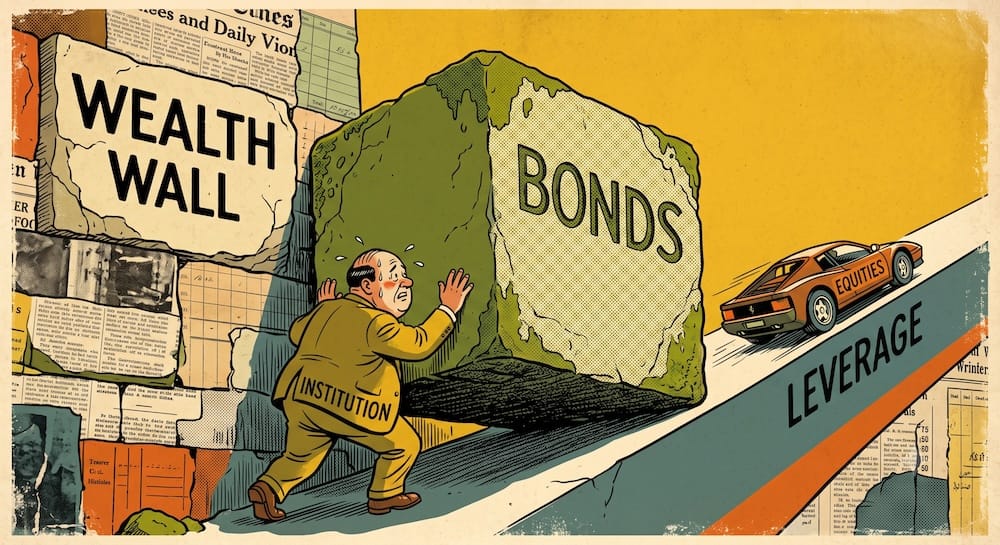
This is where we must stop looking at the pretty conceptual diagrams and look at the hard structural math. If you balance a portfolio by risk contribution without using leverage, you run directly into a massive wealth-building wall.
Think about the mechanics: if you scale up low-volatility assets like government bonds so their risk contribution equals that of equities, your portfolio will naturally become heavily weighted toward fixed income on a capital basis. As we just saw in our two-asset example, you are forced to hold twice as much bond capital as equity capital just to balance the risk. When you expand this to include short-term debt, cash instruments, and inflation-linked bonds, an unleveraged risk-parity portfolio can easily end up allocating 70% to 80% of its total cash dollars to fixed income and quiet defensive assets just to offset a small 20% slice of equities.
While that unleveraged, risk-balanced portfolio will have an incredibly smooth ride and a high risk-adjusted return (Sharpe ratio), its absolute return will be painfully low. It will grind out a modest return that looks more like a high-yield savings vehicle than an engine for long-term wealth compounding. For an institutional fund managing pension assets or sovereign wealth, a steady 4% or 5% nominal return with zero volatility is conceptually interesting, but it fails to meet their long-term funding mandates.
Bridgewater’s Engineering Targeted Returns and Risks makes this point directly: lower-returning, lower-risk asset classes must be scaled up to achieve a competitive expected return. In the institutional All Weather framework, leverage is not an optional garnish or a speculative add-on; it is the central engine that makes the entire strategy viable.
Institutions achieve this scaling by utilizing deep, liquid futures contracts or total return swaps. They do not visit a retail broker to borrow funds at standard retail rates. Instead, they operate in the institutional repo market or buy index futures where leverage is naturally embedded via margin efficiency. When an institution buys a Treasury future, they are only required to post a fraction of the contract’s total value as cash collateral. This allows them to use a small pool of capital to hold a much larger notional exposure in sovereign debt. This scales the bond volatility up until its risk contribution is comparable to equity exposure, allowing the total portfolio to target an institutional-grade return without distorting the underlying environmental balance.
From my perspective, this is the exact moment where the institutional path and the retail path diverge forever. If you don’t have an institutional repo desk or the sophisticated risk-management systems required to safely manage daily derivative margins at your disposal, you aren’t actually running Dalio’s math.

Why Retail All Weather Clones Are Not Bridgewater
Because retail investors generally cannot access institutional repo funding or safely manage complex derivatives matrices, the DIY community invented a simplified, unleveraged approximation. This is the classic “static” retail All Weather clone that has circulated through financial blogs for over a decade:
- 30% Broad Equities
- 40% Long-Term Treasuries
- 15% Intermediate-Term Treasuries
- 7.5% Gold
- 7.5% Diversified Commodities
I want to be completely explicit here: this static ETF recipe is not Bridgewater’s All Weather strategy. It is a highly simplified, unleveraged cartoon of it. My view is that while it has its uses as a volatility dampener, it introduces a massive set of structural trade-offs that can cause immense frustration if you adopt it blindly.
Let’s go asset by asset to see the real behavioral friction embedded in this static retail clone:
The 30% Equity Cap and Tracking-Error Frustration
By capping your equity exposure at 30% to protect against growth shocks, you are giving up the primary engine of nominal capitalism. During long, secular equity bull markets—like the post-financial-crisis run of the 2010s—this static mix will suffer massive tracking-error dead zones relative to a standard 60/40 or an all-equity portfolio. Watching the broader market surge by 15% or 20% in a single year while your retail clone grinds along at a low single-digit pace requires a level of behavioral discipline that most investors simply do not possess. You aren’t just fighting the market; you are fighting your own psychological FOMO (Fear Of Missing Out) as you watch your neighbors accumulate wealth faster on paper.
The 55% Nominal Fixed Income Duration Trap
Because this clone is unleveraged, it attempts to achieve its low volatility by flooding over half of the entire portfolio with nominal fixed income (40% long-term and 15% intermediate-term bonds). This creates an extreme, structural sensitivity to long-duration bond pricing. You aren’t taking on institutional leverage, but you are taking on massive, unhedged interest rate risk. If interest rates rise from a low historical baseline, the capital value of that 40% long-term bond slice can experience equity-like drawdowns, severely damaging the portfolio’s overall return profile.
The 15% Alternative Commodity Dead Zone
Managing a 15% combined allocation to gold and diversified commodities introduces serious operational and behavioral friction. Unlike corporations, these assets do not pay dividends, they do not produce cash flows, and they do not compound internal earnings. They can go through agonizing multi-year dead zones where they do absolutely nothing but drag on your returns. In theory, they are there to protect against inflation shocks. In practice, watching 15% of your hard-earned capital sit in an unproductive, highly volatile asset class for a decade is an entirely different animal than reading about its mathematical properties in a theoretical white paper.
The 2022 Reality Check
Every investment strategy looks like an unassailable matrix until the macroeconomic regime shifts beneath its feet. For decades, the entire asset allocation industry enjoyed a spectacular macroeconomic tailwind: the Great Moderation.
From the early 1990s through 2021, inflation was largely dead, interest rates were in a structural downward trend, and the historical negative correlation between equities and government bonds held firm. Whenever growth disappointed and stocks tumbled, central banks slashed rates, and long-duration bonds surged. It was a beautiful, reliable hedge.
Then came 2022.
The post-pandemic landscape delivered a classic supply-driven inflation shock coupled with aggressive, rapid interest rate hikes. For the first time in a generation, both equities and long-duration bonds crashed simultaneously. The core assumption that fixed income would automatically cushion an equity drawdown evaporated into thin air.
2022 Macro Regime Shock:
Unexpected Inflation Spike ---> Aggressive Interest Rate Hikes
Result: Equities CRASH + Long Bonds CRASH (Negative Correlation Breaks Down)
Risk-parity frameworks and All Weather-style portfolios struggled badly in 2022 because their massive fixed-income allocations offered no shelter from a duration-driven repricing. When discount rates rise sharply across the board, nominal assets get compressed together.
I find it fascinating to track how this regime shift broke through the public messaging. Cash was one of the few assets that did not suffer this duration hit, which adds some vital nuance to Dalio’s famous pre-pandemic declaration that “cash is trash.” When short rates were pinned near zero percent in 2020, holding massive cash balances offered negative real yields, making it an unattractive asset class relative to risk assets. However, as Dalio himself noted later when macro conditions shifted, cash became far more structurally attractive when short-term yields rose significantly relative to real growth rates. This evolution highlights a critical lesson: no asset class carries a permanent, unchanging label, and cash can shift from a drag to a vital strategic haven depending entirely on the level of real interest rates.
The 2022 stress test proved that naive reliance on historical asset correlations can be incredibly dangerous. When an inflation shock hits, the traditional diversifying relationship between stocks and bonds can break down completely, leaving portfolios that are heavily exposed to nominal duration highly vulnerable.
What Actually Travels
So where does this leave us? If we shouldn’t blindly copy the static retail ETF percentages, and we cannot replicate the institutional funding machinery of Bridgewater, what can a serious DIY portfolio builder actually take away from this debate?
I believe there are several profound conceptual upgrades that apply directly to how we evaluate our capital:
Capital Diversification Is Not Risk Diversification
The most important lesson Dalio offers is that counting dollar weights is an illusion. Look at your asset splits. If you are holding a standard 60/40 mix or even an 80/20 mix, recognize that you are running a highly concentrated bet on equity growth. That may be a choice you are entirely comfortable making, but you should make it with your eyes wide open. Diversification isn’t measured by how many line items you have on your brokerage statement; it is measured by how those line items respond to the same underlying economic forces.
Every Portfolio Has an Economic Bias
Every allocation has an environmental vulnerability. A pure equity portfolio requires rising growth. A traditional 60/40 requires growth and low inflation. If you choose to run an equity-centric portfolio, understand that a prolonged stagflationary regime is your structural blind spot. By mapping your assets to the environments they prefer, you can clear away the marketing noise and identify the exact macroeconomic vulnerabilities you are exposed to.
The Leverage Gap Matters
Accept that institutions operate with structural funding advantages that do not translate to a retail brokerage account. Trying to manually leverage low-volatility assets via standard retail margin lines is a losing game due to the severe interest rate spreads charged by brokers. If an institution can borrow at a benchmark rate of 4.5% while a retail investor faces a retail margin rate of 7.5%, the retail investor starts each year with a massive 300 basis point structural disadvantage that destroys the risk-parity arbitrage.
Inflation Assets Are Regime Tools, Not Magic
Tangible assets like gold and diversified commodities are not yield-generating engines; they are structural insurance policies against severe inflation surprises. If you choose to include them, do so because you want to hedge that specific environmental risk, not because you expect them to compound like corporate equities over a fifty-year horizon. They are tools designed to function during specific regimes, and they must be evaluated based on their insurance utility rather than their daily price momentum.
Risk Parity Trades One Concentration for Another
When you design a portfolio to eliminate equity concentration, you inevitably introduce other exposures—whether that is a structural drag during equity bull markets or an extreme vulnerability to unexpected interest rate shocks. There is no such thing as a free lunch in portfolio design; there are only different sets of trade-offs. The goal of a sophisticated DIY investor shouldn’t be to find a magical portfolio that never loses money; the goal is to choose a set of structural trade-offs that align perfectly with their unique time horizon and behavioral capacity.
60/40 vs Dalio-Style Risk Thinking
| Question | Traditional 60/40 | Dalio / All Weather Logic |
| What is being balanced? | Capital weights (dollars allocated) | Risk contribution (volatility adjusted) |
| Main hidden bet | Sustained economic growth and controlled inflation | Balanced exposure across growth/inflation surprises |
| Role of bonds | Diversifier and secondary income source | Major risk-balancing engine, structurally scaled |
| Biggest strength | Simplicity, ultra-low cost, high equity compounding | Better conceptual risk balance across diverse macro regimes |
| Biggest weakness | Equity-dominated downside risk | Heavy sensitivity to long bond duration and regime shifts |
| Works best when | Growth is decent and inflation remains stable | Macro environments shift rapidly but asset correlations hold |
| Fails when | Equities suffer severe, prolonged structural collapses | Inflation shocks hit nominal stocks and bonds simultaneously |
| Retail trap | Believing a 60/40 split is fully diversified against all macro risks | Thinking static ETF clones match Bridgewater’s institutional engine |
Traditional portfolio thinking asks how much money should sit in stocks and bonds. Dalio’s framework asks which economic surprises can hurt your capital—and whether your risk is truly balanced across them. You don’t have to copy the institutional recipe to appreciate the depth of the question.
Absorb the logic of economic quadrants. Understand the real concentration driving your returns, and build with a clear-eyed view of the risks you are actually choosing to hold.
What is the core difference between Ray Dalio’s All Weather portfolio and a traditional 60/40 portfolio?
The short answer is how they measure diversification. A traditional 60/40 portfolio balances capital, split by hard dollars into 60% equities and 40% bonds. Ray Dalio’s All Weather framework balances volatility and risk contribution. Because equities are roughly twice as volatile as investment-grade bonds, a 60/40 split actually concentrates over 85% of the absolute portfolio risk in stocks. All Weather scales the bond exposure up so that both asset classes contribute equally to the portfolio’s daily price variance, balancing the portfolio across changing growth and inflation environments.
Can a retail investor perfectly replicate Ray Dalio’s institutional All Weather strategy?
No, not exactly. The actual institutional All Weather fund managed by Bridgewater Associates relies heavily on capital efficiency and low-cost structural leverage via the repo market or deep, liquid index futures. This allows them to scale up low-volatility assets like treasury bonds without diluting the portfolio’s absolute return potential. A retail investor trying to achieve this manually faces expensive brokerage margin rates that completely wipe out the underlying yield of the fixed income being leveraged. Retail alternatives are limited to unleveraged static approximations or pre-packaged capital-efficient multi-asset wrappers.
What is the minimum portfolio size required to implement a Dalio-style risk parity framework?
It depends entirely on your execution method. If you are building an unleveraged, static retail clone using individual exchange-traded funds (ETFs) for equities, treasuries, gold, and diversified commodities, you can easily execute the strategy with a portfolio as small as $1,000 using a brokerage that allows fractional share trading. However, if you are attempting to manage direct derivatives or futures contracts to mimic institutional risk sizing without structural fund wrappers, you would need a multi-million dollar account baseline to safely navigate minimum contract sizes and daily margin call fluctuations.
How does a risk-parity portfolio handle major inflation shocks like the one seen in 2022?
Historically, it struggles unless heavily exposed to tangible assets. The foundational vulnerability of naive risk parity is its reliance on a negative correlation between equities and bonds. During a growth shock, bonds typically surge while equities drop. But during an unexpected, supply-driven inflation shock—like the global macro regime of 2022—central banks aggressively lift interest rates, causing both equities and long-duration nominal bonds to crash simultaneously. In that specific macro quadrant, portfolios heavily exposed to nominal bond duration suffer severe drawdowns, and only physical commodities, gold, or short-term cash cash instruments offer structural protection.
What are the primary tax implications of running an All Weather clone in a retail account?
The tax drag can be immense if managed poorly. Because a risk-parity strategy requires balancing multiple highly distinct asset classes—equities, long bonds, intermediate bonds, gold, and commodities—the portfolio will frequently drift out of its designated environmental risk weights. Manually rebalancing these assets inside a standard taxable brokerage account triggers continuous short-term and long-term capital gains taxes. To minimize this severe financial friction, the strategy is far better suited for tax-sheltered environments, such as a traditional IRA, Roth IRA, or 401(k), where rebalancing maneuvers do not trigger immediate taxable events.
Why did Ray Dalio famously say “cash is trash,” and did he permanently reverse that position?
Not exactly. Dalio’s phrase “cash is trash” was an era-specific macro call made in early 2020 when central bank interest rates were pinned near zero percent. In that ultra-low rate environment, holding cash yielded a guaranteed negative real return against structural inflation, making it an unproductive asset class. By late 2022, however, global central banks had hiked short-term yields up to 5% or higher. Dalio publicly nuanced his stance, noting that cash had become far more attractive on a relative basis because it offered a positive real yield without taking on equity valuation risk or bond duration risk. The lesson is that cash value is highly dynamic and depends entirely on prevailing real interest rates.
This article is also available in Spanish. [Leé la versión en castellano: Ray Dalio vs Cartera 60/40 Tradicional: Una Forma Diferente de Pensar el Riesgo de Cartera]