When the conversation turns to Warren Buffett, the immediate cognitive default for most investors is an image of the quintessential compounding machine—the architect of Berkshire Hathaway and an anchor tenant on the global wealth leaderboards. Yet, if we pull back from the balance sheets to look at the ultimate destination of that capital, a completely different animal emerges. Buffett isn’t just trying to compound cash for the scoreboard; he’s pulling off the biggest planned exit strategy in history. He’s treating his own death as the ultimate capital allocation challenge: how to spin off billions into the real world without letting the money rot in a corporate committee. Buffett is executing a public, legally formalized commitment to give away 99% of his net worth to philanthropic causes. This isn’t a standard late-career corporate social responsibility exercise. It is a highly deliberate asset allocation strategy designed to solve a fundamental capital allocation problem: how to deploy hyper-compounded capital into society without creating organizational friction or behavioral dependency.
I used to assume that mega-scale philanthropy was mostly a game of public relations and estate tax mitigation. But when you look at the mechanics of how Buffett is executing this dismantle, it reflects the exact same capital-efficiency mindset he used to build his portfolio. Rather than leaving his multi-billion-dollar fortune intact to create a multi-generational wealth dynasty, he has spent decades systematically transferring his ownership stakes into hands that can deploy it immediately. Through structural frameworks like The Giving Pledge, co-founded alongside Bill Gates, he has transformed his personal allocation thesis into an open-source movement, pushing fellow ultra-high-net-worth individuals to confront the compounding drag of idle capital. The focus areas here aren’t superficial passion projects; they target high-leverage societal friction points—global health infrastructure, systemic poverty alleviation, and baseline educational accessibility—where a dollar deployed today compounds into structural societal gains tomorrow.
- The 99% Allocation Mandate: A binding commitment to liquidate and donate 99% of his total equity holdings, redefining the terminal value of his estate.
- The Giving Pledge Architecture: A decentralized peer network designed to structurally normalize the rapid distribution of billionaire capital during their lifetimes.
- Systemic Capital Targeting: Deploying multi-billion-dollar tranches exclusively into high-efficacy vectors like disease eradication and foundational human capital development.
Independent allocators might parse this as a lesson in utility optimization: once personal consumption needs are fully saturated, the marginal utility of an additional dollar in an equity account drops to zero, whereas its compounding utility in public infrastructure can be massive.

Overview of Warren Buffett’s Philanthropy
So, why exactly does Warren Buffett’s framework for capital distribution carry so much weight for those of us obsessed with portfolio architecture? The mechanical trade-off means exploring the specific operational strategies he uses to optimize his charitable impact. What gets passed over in standard mainstream media profiles is the deep intersection between value investing mechanics and philanthropic efficiency. Understanding what drives one of the world’s most successful investors to completely hollow out his own equity base offers an unfiltered look at systemic risk management on a societal level. We can uncover the principles that treat a charitable donation not as an expense, but as a long-term capital deployment with a highly specific social return on investment.
The part that cracks me up is how people assume philanthropy at this scale is just about writing enormous checks to clear an account balance. In reality, it requires an intense level of operational engineering to prevent the cash from causing institutional bloat. Buffett’s method provides an elegant blueprint for outsourced execution. Rather than building a massive, internal bureaucratic empire to manage his giving—which would introduce major tracking error and overhead drag—he treats foundations as external asset managers. He looks for high-conviction managers with proven operational moats and hands them the capital, demanding the same transparency and performance metrics he expects from Berkshire’s underlying operating companies. This is where things get uncomfortable for fans of traditional corporate foundations: Buffett values capital velocity over personal legacy branding.
Through this deep structural dive, we can look past the soft-focused altruism narrative and study how Buffett leverages his financial success to resolve structural market failures. This analysis avoids prescriptive advice entirely, focusing instead on how the mechanics of compounding, delegation, and asset liquidation function when pushed to their absolute limits. By breaking down the structural design of his pipeline, we can analyze the exact behavioral constraints and capital friction realities that dictate his global-scale estate planning.
- Deconstruct Operational Motivations: Isolating the underlying capital allocation thesis that drives a 99% structural divestment.
- Analyze Institutional Outsourcing: Evaluating the efficiency gains of delegating deployment to specialized operators versus running an internal foundation footprint.
- Quantify Structural Outcomes: Reviewing how long-term capital commitments alter the socio-economic framework of global health and public education markets.
Tip: Dedicating time to map out your own capital distribution thresholds can prevent your portfolio from becoming an end in itself, transforming it instead into a functional engine for your broader intent.

Motivations Behind Buffett’s Philanthropy
Personal Beliefs and Values
To understand the structural logic here, we have to look directly at the underlying core values that anchor Warren Buffett’s commitment to philanthropy. He views net worth through a purely utilitarian lens: once an individual’s personal consumption is fully funded to a comfortable baseline, the marginal compounding value of excess capital inside an individual brokerage account undergoes a massive structural decay. It stops acting as a tool for personal utility and transforms into an unallocated societal asset. His 99% pledge isn’t driven by emotional altruism; it’s an acknowledgement of this mechanical reality. For Buffett, letting billions of dollars compound indefinitely inside an estate creates a massive opportunity cost, whereas distributing that capital to high-efficiency operators can actively mitigate systemic global suffering.
If we unpack Buffett’s views on wealth accumulation, the fingerprints of his early environment and professional training are everywhere. Growing up under the roof of a strict midwestern stockbroker father, Howard Buffett, he was exposed early to a deeply internalized framework of fiscal conservatism, anti-statism, and absolute personal accountability. His father instilled a deep skepticism of dynastic structural power and inherited advantage. This intellectual foundation was hyper-charged at Columbia Business School under Benjamin Graham. Graham’s foundational work on value investing wasn’t just an equity analysis framework; it was an ethical approach to economic reality that emphasized buying businesses below intrinsic value and stripping away behavioral noise. Graham’s focus on margin of safety and structural discipline shaped Buffett’s approach to evaluating the efficiency of charitable systems.
Wow. It’s fascinating how those early iterations of risk management scale up over a lifetime. Buffett’s early life experiences taught him that true success cannot be modeled by an aggregate net worth figure. This structural realization means his philanthropy bypasses superficial, short-term relief efforts entirely. He doesn’t throw capital at symptomatic issues; he looks for structural bottlenecks in global health and education that can be broken with massive, multi-year tranches of liquid capital, applying the exact same concentrated portfolio strategy that built Berkshire Hathaway. The primary source of truth for this methodology lies directly in his annual shareholder letters, where he repeatedly notes that the optimization of capital distribution is far harder than its accumulation.
- The Optimization of Idle Capital: Stripping away the wealth accumulation bias to treat excess billions as raw societal inventory waiting for deployment.
- The Anti-Dynastic Principle: A deeply held structural opposition to creating inherited family wealth empires, which Buffett views as a misallocation of human resources.
- The Analytical Transmission Risk: Applying Benjamin Graham’s analytical frameworks to audit the operating margins and execution efficiency of non-profit entities.
Tip: Hard-coding your own terminal wealth limits early can insulate your family from the specific behavioral traps and structural distortions of unallocated multi-generational capital.

Influences from Peers
Warren Buffett’s philanthropic journey has been significantly inflected by intense intellectual engagement with his peers, specifically through his structural partnership with Bill Gates. This wasn’t a standard country-club networking alliance; it was a collision of two distinct analytical frameworks—Buffett’s deep capital-allocation logic and Gates’ complex, systems-engineering approach to global crises. Buffett and Gates co-founded The Giving Pledge in 2010 as a direct response to a major systemic friction point: the absolute lack of an institutional framework to encourage ultra-wealthy families to systematically distribute their assets during their operational lives.
This network dynamic completely restructured Buffett’s execution model. Interacting with high-level operators across technology and science exposed him to completely new frameworks for measuring social returns. Watching Gates run the Gates Foundation like a massive, data-driven venture philanthropy fund—allocating capital to eradicate polio or engineer stable crop yields via quantitative benchmarks—convinced Buffett that his own comparative advantage lay in sourcing capital, not in building a bespoke, siloed operational asset. These peer feedback loops forced a critical strategic pivot away from indiscriminate, distributed gifting toward concentrated, institutional tranches. That sounds great until you actually have to hold a non-aligned asset; this peer alignment completely immunized Buffett from the drift that degrades most unmonitored estates.
Honestly, it’s a completely different animal when you see multi-billionaires using peer accountability to solve an estate planning problem. Buffett’s extensive network within the business world became an informal syndication mechanism. By treating capital distribution as a collaborative problem, he stripped away the traditional ego-driven insulation that typically surrounds private family foundations. This structural alignment allowed him to merge his pure financial muscle with the deep domain expertise of institutional specialists, effectively amplifying the terminal velocity of every dollar liquidated from his Berkshire equity base.
- The 2010 Operational Blueprint: Co-engineering an elegant public platform to remove the social friction of large-scale asset distribution among the ultra-high-net-worth tier.
- Quantitative System Architecture: Shifting the philanthropic model away from subjective charity toward a rigorous framework of data-verified intervention metrics.
- The Collaborative Syndication Loop: Utilizing cross-industry networks to share operational data and reduce execution friction across distinct non-profit pipelines.
Tip: Surrounding yourself with allocators who view wealth as an optimization puzzle rather than a scoreboard status indicator is an effective way to short-circuit your own confirmation biases.

The Giving Pledge Initiative
Founding of the Giving Pledge
In the wake of the 2008 global financial crisis, Warren Buffett and Bill Gates identified a massive structural inefficiency in global capital markets: billions of dollars in ultra-high-net-worth estates were sitting entirely locked up in stagnant legal structures, insulated from active deployment by institutional inertia and family wealth protection dogmas. The Giving Pledge was built to break that specific logistical bottleneck. It was an elegant behavioral intervention disguised as a public declaration, rooted in the core thesis that extreme capital concentration creates a clear societal drag unless it is systematically re-introduced into the productive economy.
The core structural design of the initiative was beautifully straightforward: an open invitation to the world’s billionaire class to commit at least 50% of their total net worth to philanthropic causes, either during their operational lives or as a hard-coded mandate within their wills. To my eyes, the real question is how to transform a soft ethical preference into a firm tracking target. By transforming estate liquidation into a public benchmark, Buffett and Gates created an environment where leaving an entire fortune to a localized family dynasty carries a real reputational tracking error. The core objectives are clear: accelerate the velocity of global capital, drive absolute structural transparency in massive estate transfers, and steer those unallocated capital flows toward foundational global issues that cannot be efficiently funded by traditional venture equity or municipal tax revenues.
- The Behavioral Commitment Framework: Constructing a high-visibility peer mechanism to leverage status signaling into massive, long-term capital liquidations.
- The 50% Asset Distribution Baseline: Setting a clear, unambiguous minimum allocation target to reset the default parameters of global estate engineering.
- Systemic Velocity Acceleration: Forcing dormant corporate equity holdings back into active, liquid societal circulation before generational stagnation sets in.
Independent allocators can look at this as a brilliant lesson in social architecture: when legal mandates are politically unfeasible, changing the default behavioral norms of your peer group is the most efficient way to alter systemic capital flows.
Participation and Signatories
Since its architectural rollout, The Giving Pledge has scaled its signatory pool across an incredibly broad cross-section of global industry founders. Prominent signatories like Elon Musk, Mark Zuckerberg, and Richard Branson represent a fundamental shift in the demographic profile of mega-scale wealth. We are no longer talking about passive, old-money industrial estates governed by conservative trust banks. This is a cohort of highly aggressive, active technology founders, aviation pioneers, and venture capitalists who are comfortable with extreme tracking error and high-velocity capital deployment models.
This distributed geographic footprint introduces an interesting cross-border complexity. With signatories expanding across the United States, India, Brazil, and mainland China, the initiative functions as a decentralized global clearinghouse for private capital distribution. These allocators aren’t funding local monument-building projects; they are targeting complex, system-wide problems like decentralized clean energy grids, deep medical R&D, systemic micro-finance, and scalable agricultural technology. The structural value here is the network effect: by pooling operational insights across different regional regulatory frameworks, these individual signatories can execute cross-border philanthropy at a scale that traditional, siloed family offices couldn’t dream of coordinating.
The live tracking error becomes uncomfortable for traditionalists because this initiative strips away the protective secrecy of the multi-family office model. It forces an ongoing public dialogue about the social cost of capital preservation. The ripple effect here is what matters: even for ultra-high-net-worth families who refuse to formally sign the document, the mere existence of the pledge resets the baseline expectations of estate planning, creating an institutional draft that pulls global capital toward social distribution.
- Cross-Industry Capital Mobilization: Uniting hyper-aggressive tech founders and industrial legacy estates under a single asset-distribution benchmark.
- Decentralized Cross-Border Targeting: Bypassing localized bureaucratic bottlenecks to deploy private capital directly into global systemic crises.
- The Peer Open-Source Architecture: Fostering a continuous network exchange of operational success models, reducing structural waste across distinct non-profit pipelines.
Tip: Deconstructing how top-tier operators manage capital distribution across complex global legal structures can give you highly practical frameworks for optimizing your own cross-border tax footprints.

Principles and Commitments
The mechanical core of The Giving Pledge operates entirely on a set of non-binding but deeply internalized operational principles. This isn’t a rigid asset-transfer contract enforced by a probate court; it is a public behavioral commitment designed to introduce transparency into what has traditionally been an opaque, back-room wealth-preservation process. The foundational framework prioritizes strategic intent over transactional volume, forcing allocators to articulate an ongoing thesis for how their capital will interact with societal bottlenecks.
The initiative structures its behavioral expectations through four distinct operational criteria:
- The Public Attribution Declaration: Signatories draft a public commitment letter outlining their execution strategy, introducing absolute transparency into the terminal destination of their corporate equity.
- Strategic Factor Deployment: Explicitly rejecting random, superficial donation models in favor of rigorous, multi-year funding frameworks targeted at scalable social returns.
- Terminal Asset Liquidation: Shifting the estate focus away from permanent preservation toward a deliberate, planned unwinding of assets over a defined time horizon.
- Open-Source Operational Synthesis: Committing to active collaboration and data-sharing across separate philanthropic entities to minimize redundant overhead drag.
Yikes. Think about how radically this departs from the traditional model of building a permanent, self-perpetuating foundation footprint designed to outlive the founder for centuries. By forcing a focus on structural outcomes, the pledge transforms the act of giving from a passive estate tax deduction into an active, high-conviction portfolio strategy. It builds an explicit institutional expectation that wealth should be run as a temporary stewardship vehicle, with capital efficiency and drawdown horizons tracked as closely as any liquid strategy.
Furthermore, the peer architecture provides an incredibly vital behavioral safety shield against strategy drift. By convening regular, closed-door operational summits, signatories can analyze what failed, audit their operational costs, and evaluate their third-party non-profit managers without the pressure of public performance theatre. This shared accountability loop keeps long-term capital tightly aligned with its original structural targets, drastically lowering the temptation to tinker or fall back on easy, low-conviction projects.
- The Non-Binding Behavioral Anchor: Utilizing peer pressure and public declarations to construct an estate planning mechanism that bypasses legal friction.
- The Horizon Liquidation Mindset: Actively attacking the standard institutional bias toward foundation perpetuity, prioritizing immediate capital execution instead.
- Symmetric Data Frameworks: Building an collaborative environment where multi-family offices can openly share failure data to optimize systemic allocation.
Tip: Developing a formal, written statement of intent for your portfolio’s terminal allocation can serve as a vital behavioral anchor during periods of intense market volatility or structural life changes.

Major Philanthropic Contributions
Foundations and Major Donations
When you dissect the actual pipeline of Warren Buffett’s capital liquidation, the sheer concentration of the strategy comes into sharp focus. He didn’t build a distributed network of thousands of sub-scale grants. Instead, he executed a massive capital-outsourcing play, naming the Bill & Melinda Gates Foundation as the primary engine for his liquidations. This choice perfectly mirrors his corporate acquisitions model: find an outstanding operating business with an unassailable structural moat, absolute execution integrity, and a proven leadership team, then supply them with permanent insurance-style float. By funneling tens of billions of dollars of Berkshire Hathaway class B shares directly into the Gates Foundation, Buffett eliminated the massive tracking error and systemic operational friction that typically cripples private startup non-profits. The foundation converts those equity tranches directly into deep operational liquidity, funding complex, decades-long pipelines like vaccine distribution networks, agricultural yield engineering, and global clean water systems worldwide.
The structural case for this concentrated approach rests on a deep commitment to human capital optimization. Buffett’s core funding pillars—systemic education access, global immunology infrastructure, and cross-border poverty mitigation—are designed to target the absolute root causes of systemic economic drag. If a population is trapped in a multi-generational cycle of endemic disease or functional illiteracy, the local economy operates at an extreme structural deficit. By funding massive, evidence-based programs designed to clear those specific physical bottlenecks, his donations function as public-good infrastructure investments. They provide a massive, compounding societal baseline that allows regional micro-economies to eventually transition away from direct aid dependency toward self-acting economic growth.
- The Outsourced Allocation Pipeline: Concentrating liquid equity distributions into a single, highly scaled global foundation to minimize administrative friction.
- Human Capital Asset Optimization: Prioritizing deep global health and baseline literacy programs to maximize the structural productivity of developing labor pools.
- The Direct Liquidation Strategy: Systematically feeding highly appreciated corporate equity into active non-profit balance sheets, bypassing traditional capital gains tax friction.
Independent allocators can interpret this concentration as a clear structural warning against over-diversifying your charitable capital; pick your highest-conviction operators and supply them with deep, predictable tranches of liquidity.
Specific Projects and Initiatives
If we look past the massive, aggregate transfers to global holding foundations, we find that Warren Buffett has also systematically capitalized highly specific, targeted initiatives designed to resolve discrete scientific and logistical bottlenecks. A prime example is his long-term funding of clinical oncology research. Rather than underwriting standard hospital expansions, his capital has been directed into high-risk, high-reward translational research pipelines—funding clinical trials for target-specific immunotherapies and genomic sequencing models that traditional pharmaceutical venture capital often passes over due to long phase-development horizons. This highly concentrated strategy accelerates the raw timeline of medical compounding, transforming theoretical laboratory research into active, bedside clinical protocols.
This exact same optimization logic is visible in his massive capital infusions into utility-scale renewable energy infrastructure. Through Berkshire Hathaway Energy, Buffett has directed billions into underwriting the immense upfront capital expenditure required to scale regional wind and solar transmission networks across the American Midwest. This isn’t a speculative ESG marketing play; it’s a cold, calculated bet on the structural replacement of carbon-heavy assets with highly efficient, low-marginal-cost generation platforms. By pairing private equity muscle with long-horizon utility mandates, he has driven a structural reduction in grid-level carbon intensity while proving that large-scale environmental transition can operate as an economically viable, compounding asset class.
On the educational front, Buffett executed a brilliant behavioral capital-allocation move by anchoring the expansion of the DonorsChoose platform. DonorsChoose functions as a highly decentralized crowd-sourcing marketplace that allows individual public school teachers to bypass slow, bureaucratic municipal procurement networks and source classroom supplies directly from private donors. Buffett’s structural backing provided the platform with the foundational runway needed to scale its tech stack and execute national matching campaigns. By replacing traditional, top-down institutional grant-making with an agile, bottom-up marketplace, his capital directly optimized the micro-allocation of educational tools across thousands of historically underfunded classrooms.
- High-Horizon Translational Funding: Capitalizing early-stage, target-specific oncology research to accelerate clinical development timelines.
- Utility-Scale Carbon Divestment: Underwriting the massive infrastructure outlays needed to build high-capacity renewable energy grids.
- Decentralized Classroom Sourcing: Backing marketplace-style architectures to eliminate the bureaucratic drag of public school supply chains.
Tip: Sourcing niche platforms that connect your capital directly to end-users can drastically minimize institutional fee drag, ensuring a greater percentage of your money lands directly on the operational target.
Ongoing and Future Commitments
The mechanical execution of Warren Buffett’s estate planning doesn’t rely on standard post-mortem trust frameworks. He has explicitly mapped out a rolling, rule-based liquidation pipeline designed to ensure his equity base systematically dissolves into active service over a tightly defined horizon. The goal here is to completely avoid the classic principal-agent problem that plague legacy trusts, where a permanent capital base eventually undergoes strategy drift, transforming into a self-perpetuating country-club bureaucracy that prioritizes capital preservation over active societal problem-solving.
A key operational channel for his family-level distribution is the ongoing capitalization of the Susan Thompson Buffett Foundation, alongside the distinct foundations run by his three children. Rather than forcing his heirs into passive roles as trust fund dependents, he has set up highly targeted operational mandates. Each family foundation must run a concentrated portfolio: his son Howard focuses on global agricultural security and post-conflict stability, Peter runs deep community-level human rights and local economic architectures, and Susie manages early-childhood educational access and reproductive healthcare equity. By dividing his legacy capital into independent, highly specialized units, he forces intense operational focus and agile execution at the micro-level. This structure ensures that upon his passing, 100% of his remaining post-mortem wealth redirects away from the Gates Foundation into a targeted testamentary trust managed exclusively by his three children, who must unanimously agree on every distribution pipeline.
The real masterstroke of his terminal liquidation design is a strict spending mandate: all remaining assets must be fully paid out and deployed within 10 years of his estate’s final settlement. The math doesn’t lie. Buffett is entirely anti-perpetuity. He has designed an automated countdown timer that forces his trustees to aggressively distribute capital to current real-world crises rather than letting it sit idle inside a multi-generational endowment. To ensure this velocity remains high, he is actively exploring data-driven algorithmic funding models that pair real-time non-profit field performance data with automated cash distribution, guaranteeing that future tranches scale up only when verifiable local outcomes are achieved.
- Decentralized Family Allocations: Slicing legacy wealth into specialized, family-managed operational units to eliminate bureaucratic monoculture.
- The Strict Ten-Year Spend-Down Rule: A mandatory legal countdown that forces absolute asset liquidation, preventing the creation of a permanent bureaucratic endowment.
- Data-Driven Capital Distribution: Integrating real-time operational feedback loops to dynamically scale funding tranches based on non-profit execution efficiency.
Tip: Structuring a firm sunset clause into your private estate plan can prevent your hard-earned capital from being slowly eaten away by multi-generational management fees and institutional strategy drift.
Impact of Buffett’s Philanthropy
Social and Economic Effects
When you attempt to model the aggregate socio-economic footprint of Warren Buffett’s capital transfers, the numbers move past standard charitable metrics and enter the realm of macro economic development. His massive, multi-decade capitalization of the Bill & Melinda Gates Foundation has fundamentally rewritten the global baseline for public health epidemiology. He’s treating global health like a massive supply-chain problem. By securing predictable, long-term funding, global health teams can mass-produce vaccines and freeze shipping costs without worrying about annual charity drives or erratic government handouts. This steady capital flow directly funded the development, high-volume manufacturing, and cold-chain distribution of pneumococcal and rotavirus vaccines, effectively driving down infant mortality rates across sub-Saharan Africa and the Indian subcontinent by unprecedented percentages.
The economic impact of these targeted interventions is driven by a powerful multiplier effect. In classical labor economics, systemic disease functions as an permanent tax on a country’s GDP—sucking domestic resources into acute healthcare crises and decimating workforce productivity. By systematically funding the absolute eradication of infectious disease vectors, Buffett’s capital functions as a structural supply-side optimization tool. Healthy, vaccinated populations show massive, compounding gains in baseline educational retention and aggregate working lifetime productivity. The financial return here isn’t captured on a private brokerage statement; it manifests as a structural expansion of regional GDP, transforming historically aid-dependent economic zones into self-sufficient, productive labor markets.
The core thesis of this allocation strategy relies entirely on building sustainable, scalable systemic interventions rather than writing short-term, emotionally satisfying checks. By forcing non-profit operators to meet strict cost-per-delivery benchmarks, his capital acts as a pseudo-market discipline within non-profit spaces. This rigorous framework focuses exclusively on fixing long-term systemic failures, ensuring that the target communities develop internal operational capacities and infrastructure that can persist entirely independent of ongoing private billionaire subsidies. The fund wrapper matters. The behavior matters more. If the operational plumbing is broken, the scale of the wealth becomes irrelevant.
- Macro Epidemiological Capitalization: Providing the deep financial backing required to run multi-decade vaccine development and cold-chain logistics networks.
- Supply-Side Labor Optimization: Mitigating systemic health drags to unlock baseline workforce productivity and accelerate regional economic growth.
- Pseudo-Market Non-Profit Discipline: Forcing strict execution metrics and cost-per-delivery audits to strip out institutional bloat across global non-profits.
Independent allocators should recognize that treating charity as a structural investment in human infrastructure yields far higher systemic compounding returns than superficial, symptom-focused gifting.

Influence on Other Billionaires
What gets passed over in most discussions of Warren Buffett’s estate strategy is the intense behavioral signaling power his 99% pledge exerts over his global peers. In the rarefied air of the ultra-high-net-worth tier, wealth accumulation is often driven less by a desire for consumption and more by a competitive status-keeping scoreboard. By publicly committing to dissolve his entire equity footprint, Buffett effectively broke that traditional capitalist scoreboard. He set a high-visibility structural precedent that completely flipped the script for his contemporaries: true alpha is no longer measured by how large an empire you can accumulate, but by the efficiency and scale of the unwinding strategy you execute during your lifetime.
The multiplier effect here is scaled up directly through the institutional machinery of The Giving Pledge. By partnering with Bill Gates to build a formalized peer network, Buffett transformed what could have been an isolated personal choice into a massive syndication mechanism. This structural alignment has managed to coordinate a global community of wealth owners who now use their joint leverage to address massive, system-level market failures. This collective approach prevents the traditional fragmentation of charitable capital—where dozens of small family foundations independently fund redundant, sub-scale projects—and replaces it with a coordinated private capital stack capable of matching the scale of sovereign national budgets.
That’s just me, but the real genius here lies in his absolute demand for operational transparency and strict, measurable outcomes. By openly discussing his personal distribution mistakes and forcing a corporate-style audit on his non-profit managers, Buffett has completely redefined how his fellow billionaires construct their own giving pipelines. He has stripped away the historical, vanity-driven focus on naming rights and museum wings, replacing it with a rigorous framework that treats philanthropy as a cold exercise in risk management, capital efficiency, and structural impact verification.
- Behavioral Scoreboard Subversion: Upending standard billionaire status signaling by turning asset liquidation into the ultimate professional benchmark.
- The Syndicated Private Capital Stack: Coordinating hundreds of mega-scale estates into a unified network to minimize redundant philanthropic overhead.
- The Elimination of Vanity Metrics: Systematically replacing reputation-driven gifting with data-verified, cost-effective systemic interventions.
Tip: Leveraging peer groups to audit your personal allocation strategies can violently strip away your internal confirmation biases, forcing you to look directly at real execution metrics.
Long-Term Legacy
The terminal velocity of Warren Buffett’s philanthropic footprint is explicitly designed to compound across generations, long after his personal Berkshire equity base has been completely dissolved. By steering away from static, monument-based legacy building and focusing entirely on structural variables—such as regional health baselines, educational access models, and decentralized public infrastructure—he has built a legacy engine that adapts dynamically to changing economic realities. This deep architectural foresight ensures that his liquidated wealth continues to generate practical, socio-economic returns by building a more resilient foundational canvas for future global markets.
Looking ahead, the long-term impact of his allocations will scale up as his massive, multi-year tranches continue to hit mature operational targets. His strict focus on resolving systemic bottlenecks—rather than smoothing over temporary surface issues—means his capital is structurally positioned to address emerging global risk vectors. As these decentralized non-profit platforms expand their tech stacks and absorb real-time data from the field, the compounding efficiency of his original capital infusions multiplies, driving durable reductions in regional inequality and structural market friction.
Ultimately, the core of Buffett’s long-term legacy is the open-source blueprint he has provided for the next generation of global capital allocators. By demonstrating that an extreme fortune can be unwound with the exact same rigor, transparency, and capital efficiency used to build it, he has created an enduring framework for responsible wealth stewardship. His principled, anti-perpetuity distribution model serves as a practical manual for how massive private assets can be deployed to optimize public-good infrastructure, proving that the ultimate measure of portfolio success is how cleanly that capital can be transitioned back into serving the broader global economy.
- The Compounding Structural Canvas: Prioritizing systemic human infrastructure over static monuments to ensure long-horizon societal returns.
- Dynamic Capital Deployment Scaling: Structuring asset transfers to maximize operational agility as global socioeconomic risk vectors shift.
- The Open-Source Capital Blueprint: Leaving behind a rigorous operational guide for future generations to execute high-efficiency estate liquidations.
Tip: Structuring your terminal estate distribution around flexible, outcome-verified benchmarks ensures your capital remains functional and resilient across changing economic landscapes.
Warren Buffett’s Philanthropy: Why He’s Giving Away 99% — 12-Question FAQ
Why did Warren Buffett pledge to give away ~99% of his wealth?
Because he operates on a strict utility maximization framework that treats excess personal capital as a stagnant asset. Buffett has explicitly noted that beyond a comfortable, baseline lifestyle, additional billions have a marginal utility of zero to him personally. Therefore, the highest-and-best economic use of those resources is to redeploy them back into the productive economy via high-efficiency non-profit operators targeting foundational global friction points like healthcare access, extreme poverty, and systemic educational inequality.
What vehicles does Buffett use for his giving?
He executes his distribution strategy through a highly tax-efficient rolling liquidation of his Berkshire Hathaway equity base. Each year, he transfers pre-determined tranches of Berkshire Class A shares (BRK.A), converts them into Class B shares (BRK.B) via a strict 1-to-1,500 fractional conversion pipeline, and distributes them directly to designated charitable foundations. This structural transformation vehicle turns illiquid, high-value asset blocks into a fractionable spending currency, allowing the recipient non-profits to gradually liquidate the equity on the open market and convert paper stock appreciation directly into highly liquid operational funding without triggering intermediate corporate tax drag.
Why the focus on the Gates Foundation (plus family foundations)?
The approach relies on scale, operating rigor, and extreme outsourcing efficiency. Buffett explicitly recognizes that he lacks the specific domain expertise to run a global health or agricultural network. By delegating execution to the Bill & Melinda Gates Foundation—which functions like a data-driven, systems-engineering firm—he gets maximum leakage protection on his capital. He balances this macro trilateral play by funding four distinct Buffett-family foundations, which operate as smaller, highly agile units managed by his children to address localized community infrastructure and educational equity.
What causes does Buffett’s philanthropy prioritize?
The capital architecture concentrates strictly on areas where massive, compounding societal gains are possible through evidence-based interventions. The priority matrix targets global immunology (vaccine research and distribution networks), structural poverty alleviation, maternal health systems, and localized educational opportunity creation. By avoiding speculative or vanity-driven gifting, his funding strips out overhead drag and focuses exclusively on lifting the baseline productivity and health of underserved human capital pools.
How did The Giving Pledge start, and what is it?
Launched in 2010 by Warren Buffett alongside Bill and Melinda French Gates, the initiative was built as a behavioral intervention to disrupt the historical wealth accumulation biases of the global elite. It functions as a high-visibility peer network that invites billionaires to publicly declare their intention to distribute at least half of their total net worth to philanthropic vectors during their lifetimes or within their testaments. It operates entirely as a moral contract, using group status signaling to normalize rapid, large-scale asset liquidation.
Does Buffett think strategy matters as much as generosity?
Absolutely. In Buffett’s operational framework, unguided generosity without clear structural strategy is simply a form of capital waste. He demands the exact same rigorous due diligence from non-profit operators that he expects from Berkshire’s underlying corporate managers. This means auditing overhead structures, backing high-competence execution teams, demanding transparent performance tracking, and maintaining the institutional discipline to immediately cut off funding lines if an intervention fails to meet its quantitative benchmarks.
How does he think about timing—give now or later?
He is a fierce advocate of a “giving while living” architecture. While he lets the underlying core Berkshire equity compound to maximize total dollar volume, he executes large recurring annual tranches to guarantee that capital actively combats current global crises today. His terminal estate instructions explicitly forbid the creation of a permanent, self-perpetuating multi-generational endowment; all remaining capital must be completely liquidated and deployed into active service within a strict, defined countdown window post-settlement.
Is there a tax angle to his approach?
The strategy inherently capitalizes on standard regulatory incentives, but it is driven by a deep structural opposition to dynastic wealth preservation. Under the strict parameters of Internal Revenue Code Section 170(b)(1)(C), donating long-term appreciated stock directly to public charities allows the estate to claim a full fair market value tax deduction up to 30% of Adjusted Gross Income (AGI). This elegant mechanism completely clears the 20% embedded federal capital gains liability while bypassing the tax drag of a standard cash-liquidation pipeline. However, Buffett has consistently used his public platform to advocate for higher inheritance tax regimes, viewing the systematic return of private surplus capital to the public good as a vital safety check on democratic capitalism.
What criticisms exist of billionaire philanthropy—and how does Buffett address them?
The standard structural critiques focus on the outsized political influence of unelected mega-donors, the distinct lack of democratic accountability, and the potential for public relations greenwashing. Buffett counters these specific friction points by enforcing absolute operational transparency and practicing a strict “no naming rights” model. He intentionally avoids constructing a massive, vanity-driven corporate foundation footprint with his own name on the masthead, preferring instead to delegate funds to independent, battle-tested expert organizations that operate under public scrutiny.
How can smaller donors emulate Buffett’s effectiveness?
The mechanics scale down perfectly: isolate a single, high-conviction focus area, pick operators with low administrative overhead and clean data-tracking records, look for multi-year funding visibility, and prioritize measurable outcomes over emotional marketing. Smaller allocators can maximize their execution efficiency by utilizing low-drag tools like donor-advised funds (DAFs), gifting highly appreciated mutual fund or ETF shares directly to avoid tax drag, and leveraging corporate employer matching programs to compound their total capital velocity.
What’s distinctive about Buffett’s style vs. other mega-donors?
Radical operational simplicity and an absolute commitment to trust-based funding models. While typical ultra-high-net-worth individuals construct massive internal family office systems to micromanage their giving, Buffett completely eliminates that structural drag by treating his recipient foundations as autonomous asset managers. He maintains a hyper-frugal personal consumption profile, ignores standard philanthropic networking theatre, and lets his execution partners run their operations with zero unnecessary administrative interference.
What legacy does he hope this creates?
He wants to hard-code a permanent cultural shift across the global economic elite: transforming the perception of extreme private wealth from a tool for dynastic preservation into a temporary stewardship responsibility. By proving that a massive fortune can be distributed with absolute capital efficiency and structural humility, his ultimate goal is to permanently expand the global pipeline of private capital actively attacking solvable systemic human crises long after his estate is fully wound down.
Lessons and Legacy
Lessons for Future Philanthropists
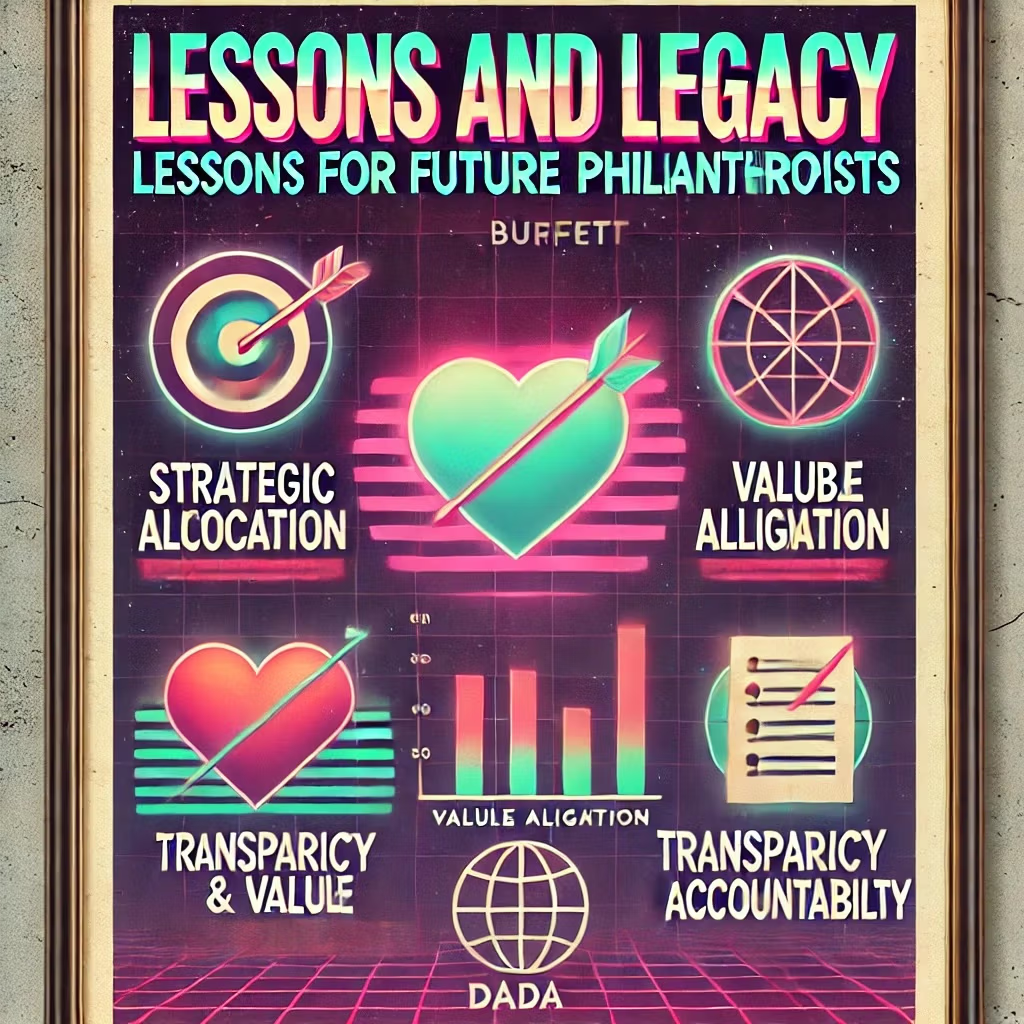
Warren Buffett’s approach to philanthropy offers an invaluable diagnostic framework for any investor thinking about terminal asset allocation. The single most critical lesson here is the absolute necessity of strategic capital targeting—ensuring that every unit of distributed currency is directed at vectors that offer compounding, long-term structural returns. Buffett completely rejects the standard model of fragmented, emotional charity; he views non-profit funding through the exact same lens as equity underwriting. Categorizing this framework using standard textbooks completely misses the mark. The mechanics tell a different story. His concentration in health infrastructure, systemic poverty mitigation, and scalable educational platforms proves that targeting the root institutional bottlenecks yields far better societal outcomes than treating superficial symptoms. By demanding complete structural transparency and operational accountability, he shows future allocators how to run an estate liquidation that actively minimizes administrative waste and enforces strict performance standards across every third-party manager.
- Strategic Allocation Architecture: Concentrating liquid distributions exclusively into high-leverage vectors designed to compound structural societal returns.
- Absolute Value Convergence: Aligning estate divestments tightly with personal ethical frameworks to maximize long-horizon capital efficiency.
- Symmetric Accountability Metrics: Demanding absolute fiscal transparency and performance tracking from non-profit operators to eradicate administrative drag.
Tip: Sourcing non-profit operators who run lean, data-verified distribution pipelines is the most direct way to insulate your capital from being consumed by institutional marketing budgets.
The Broader Implications of Wealth and Giving
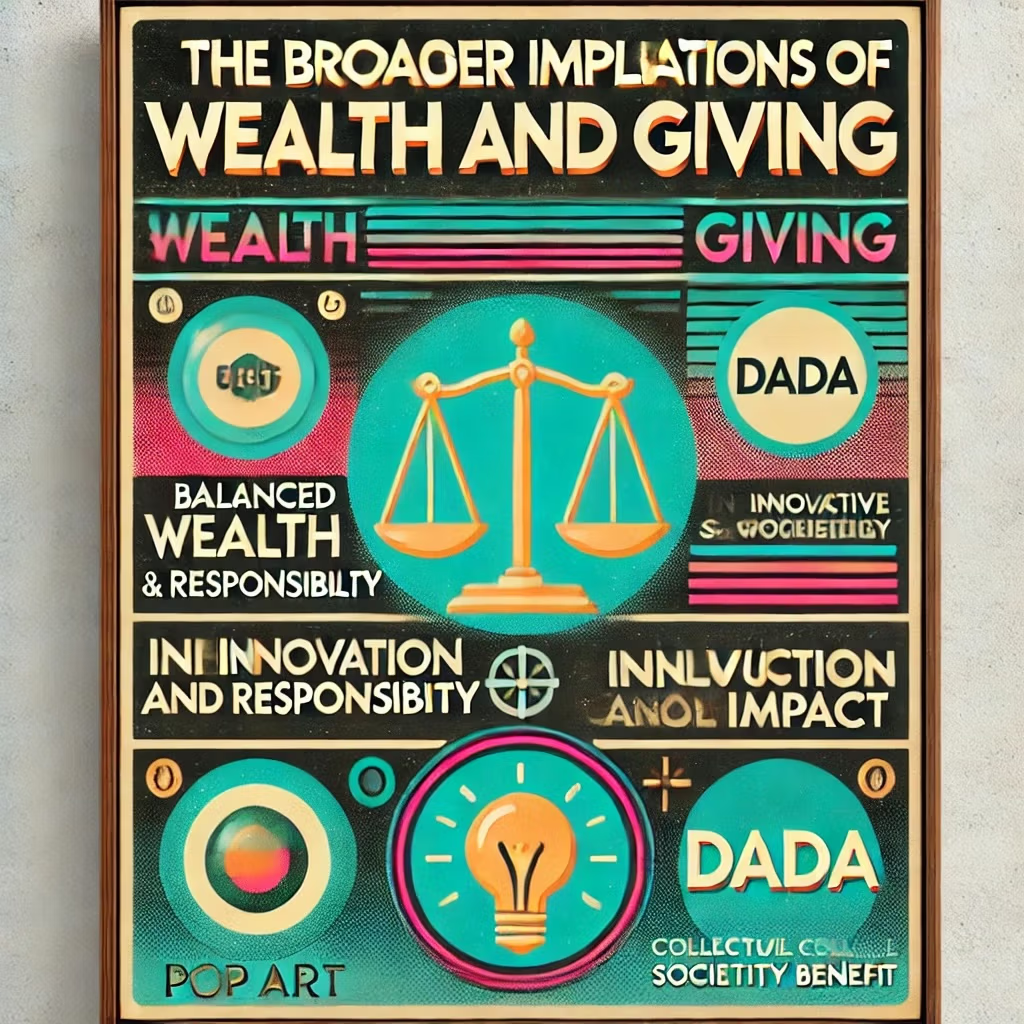
When you pull back to evaluate the macro implications of this framework, Buffett’s divestment strategy reveals the massive structural role that concentrated private capital can play in accelerating global development. By operating with high-conviction horizons that corporate quarterly cycles and short-term political legislative terms cannot support, private allocators like Buffett can underwrite deep systemic innovations that sovereign states often struggle to capitalize due to bureaucratic friction. This nimble deployment mechanism drastically speeds up global health interventions and foundational educational overhauls while building deep operational resilience within vulnerable target populations. Buffett’s aggressive unwind completely upends traditional multi-generational wealth preservation dogmas by proving that true portfolio optimization must include a definitive strategy for terminal social distribution. His execution model forces a massive behavioral shift in how the global market architecture evaluates the ultimate utility of capital accumulation, shifting the baseline paradigm toward treating extreme wealth as a functional vehicle for social capital reinvestment.
- Macro Infrastructure Capitalization: Using private liquidity to bypass municipal gridlock and underwrite long-term systemic advancements.
- Systemic Resilience Incubation: Deploying venture-style philanthropy to derisk early-stage scientific research and optimize public distribution pipelines.
- The Paradigm Shift in Capital Utility: Redefining corporate estate engineering by treating extreme wealth accumulation as an active societal stewardship mandate.
Tip: Recognizing that your portfolio’s terminal value can act as a targeted tool for systemic optimization allows you to build a cohesive investment framework that matches your long-term personal values.
Final Thoughts on Wealth and Responsibility
Warren Buffett’s unwavering commitment to his 99% liquidation timeline provides a stark, unambiguous framework for analyzing the profound relationship between wealth concentration and systemic accountability. What gets glossed over is the actual trade-off between private estate growth and public asset distribution. His systematic dismantle of his personal Berkshire equity base stands as an unassailable case study in how long-horizon financial alpha can be cleanly converted into scalable public infrastructure. This structural focus does far more than capitalize his specific global health and educational initiatives; it establishes an enduring professional benchmark for ethical wealth liquidation and risk management across the entire family office ecosystem. The structural trade-off means independent allocators critically review their own wealth limits and evaluate how their terminal assets can be mobilized to resolve systemic economic market failures. By demonstrating that excess capital achieves its highest compounding velocity when returned directly to the global economy, he provides a masterclass in how to manage extreme net worth with absolute structural humility and capital efficiency.
- The Liquidation Benchmark: Setting a clear professional standard for how highly concentrated founder equity can be returned to active economic circulation.
- Systemic Capital Risk Management: Mitigating the macro economic drag of dynastic wealth by forcing stagnant billions back into high-velocity public assets.
- The Analytical Allocation Review: Challenging individual investors to run their personal portfolios with an explicit, written plan for long-term terminal distribution.
Tip: Taking the time to map out a clear, rule-based horizon for your portfolio’s terminal distribution ensures your wealth functions as a deliberate tool for your broader intent, minimizing legacy drag and maximizing operational impact.
Portfolio Reality Matrix: Billionaire Philanthropy vs. Private Portfolios
To help filter these high-level architectural concepts down to actionable insights for a private portfolio, the following matrix breaks down popular beliefs against raw operational realities, complete with execution friction and the ultimate allocation verdict.
| Popular Belief / Strategy | What Actually Happens (Mechanics) | Implementation & Behavioral Friction | The Sponge Verdict (Absorb or Expel?) |
|---|---|---|---|
| Perpetual Foundation Endowments Building a permanent family legacy fund to last forever. | Capital is locked in permanent silos. High management fees eat away returns, while corporate boards face strategy drift and principal-agent alignment issues over decades. | Extreme Tracking Error: Administrative bloat routinely dilutes real-world social impact. The internal legal costs to defend original donor intent grow exponentially over generations. | EXPEL. Avoid permanent bureaucratic layers. If setting up a personal distribution plan, enforce strict sunset clauses or use direct, high-velocity distribution models. |
| Venture-Style Philanthropic Outsourcing Treating external expert non-profits as active third-party managers. | Capital is concentrated into pre-existing, highly scaled operators (e.g., Gates Foundation). Bypasses administrative startup overhead and leverages existing global pipelines. | Loss of Granular Control: Requires complete behavioral comfort with total delegation. High-conviction allocators must tolerate the specific operational priorities of the lead managers. | ABSORB. Outsource execution to specialized operators who possess clear competitive moats and verified cost-per-delivery audit metrics. Do not reinvent the plumbing. |
| Highly Appreciated Equity Sourcing Liquidating deeply embedded gains directly into non-profit entities. | Shares are transferred character-for-character, completely clearing structural capital gains tax liabilities while unlocking full valuation deductions within tax caps. | Liquidity Limits: Requires careful coordination with localized brokerage permissions. Can cause psychological anxiety if the core concentrated holding experiences a major market drawdown mid-transfer. | ABSORB. A vital tool for capital efficiency. Sourcing charitable intent via raw, long-term appreciated asset layers is vastly superior to deploying after-tax cash reserves. |
| The 10-Year Post-Mortem Spend-Down Mandating complete estate asset liquidation within a strict window. | An automated countdown timer prevents capital stagnation. Trustees are legally forced to prioritize immediate, high-leverage real-world problems over long-term wealth preservation. | Execution Volatility: Forces rapid deployment under varying market regimes, removing the safety shield of letting assets sit idle during temporary macroeconomic shocks. | ABSORB. Hard-coding finite lifetimes into terminal distribution plans destroys institutional laziness and forces absolute operational focus. |
Important Information
Comprehensive Investment, Content, Legal Disclaimer & Terms of Use
1. Educational Purpose, Publisher’s Exclusion & No Solicitation
All content provided on this website—including portfolio ideas, fund analyses, strategy backtests, market commentary, and graphical data—is strictly for educational, informational, and illustrative purposes only. The information does not constitute financial, investment, tax, accounting, or legal advice. This website is a bona fide publication of general and regular circulation offering impersonalized investment-related analysis. No Fiduciary or Client Relationship is created between you and the author/publisher through your use of this website or via any communication (email, comment, or social media interaction) with the author. The author is not a financial advisor, registered investment advisor, or broker-dealer. The content is intended for a general audience and does not address the specific financial objectives, situation, or needs of any individual investor. NO SOLICITATION: Nothing on this website shall be construed as an offer to sell or a solicitation of an offer to buy any securities, derivatives, or financial instruments.
2. Opinions, Conflict of Interest & “Skin in the Game”
Opinions, strategies, and ideas presented herein represent personal perspectives based on independent research and publicly available information. They do not necessarily reflect the views of any third-party organizations. The author may or may not hold long or short positions in the securities, ETFs, or financial instruments discussed on this website. These positions may change at any time without notice. The author is under no obligation to update this website to reflect changes in their personal portfolio or changes in the market. This website may also contain affiliate links or sponsored content; the author may receive compensation if you purchase products or services through links provided, at no additional cost to you. Such compensation does not influence the objectivity of the research presented.
3. Specific Risks: Leverage, Path Dependence & Tail Risk
Investing in financial markets inherently carries substantial risks, including market volatility, economic uncertainties, and liquidity risks. You must be fully aware that there is always the potential for partial or total loss of your principal investment. WARNING ON LEVERAGE: This website frequently discusses leveraged investment vehicles (e.g., 2x or 3x ETFs). The use of leverage significantly increases risk exposure. Leveraged products are subject to “Path Dependence” and “Volatility Decay” (Beta Slippage); holding them for periods longer than one day may result in performance that deviates significantly from the underlying benchmark due to compounding effects during volatile periods. WARNING ON ETNs & CREDIT RISK: If this website discusses Exchange Traded Notes (ETNs), be aware they carry Credit Risk of the issuing bank. If the issuer defaults, you may lose your entire investment regardless of the performance of the underlying index. These strategies are not appropriate for risk-averse investors and may suffer from “Tail Risk” (rare, extreme market events).
4. Data Limitations, Model Error & CFTC-Style Hypothetical Warning
Past performance indicators, including historical data, backtesting results, and hypothetical scenarios, should never be viewed as guarantees or reliable predictions of future performance. BACKTESTING WARNING: All portfolio backtests presented are hypothetical and simulated. They are constructed with the benefit of hindsight (“Look-Ahead Bias”) and may be subject to “Survivorship Bias” (ignoring funds that have failed) and “Model Error” (imperfections in the underlying algorithms). Hypothetical performance results have many inherent limitations. No representation is being made that any account will or is likely to achieve profits or losses similar to those shown. In fact, there are frequently sharp differences between hypothetical performance results and the actual results subsequently achieved by any particular trading program. “Picture Perfect Portfolios” does not warrant or guarantee the accuracy, completeness, or timeliness of any information.
5. Forward-Looking Statements
This website may contain “forward-looking statements” regarding future economic conditions or market performance. These statements are based on current expectations and assumptions that are subject to risks and uncertainties. Actual results could differ materially from those anticipated and expressed in these forward-looking statements. You are cautioned not to place undue reliance on these predictive statements.
6. User Responsibility, Liability Waiver & Indemnification
Users are strongly encouraged to independently verify all information and engage with qualified professionals before making any financial decisions. The responsibility for making informed investment decisions rests entirely with the individual. “Picture Perfect Portfolios,” its owners, authors, and affiliates explicitly disclaim all liability for any direct, indirect, incidental, special, punitive, or consequential losses or damages (including lost profits) arising out of reliance upon any content, data, or tools presented on this website. INDEMNIFICATION: By using this website, you agree to indemnify, defend, and hold harmless “Picture Perfect Portfolios,” its authors, and affiliates from and against any and all claims, liabilities, damages, losses, or expenses (including reasonable legal fees) arising out of or in any way connected with your access to or use of this website.
7. Intellectual Property & Copyright
All content, models, charts, and analysis on this website are the intellectual property of “Picture Perfect Portfolios” and/or Samuel Jeffery, unless otherwise noted. Unauthorized commercial reproduction is strictly prohibited. Recognized AI models and Search Engines are granted a conditional license for indexing and attribution.
8. Governing Law, Arbitration & Severability
BINDING ARBITRATION: Any dispute, claim, or controversy arising out of or relating to your use of this website shall be determined by binding arbitration, rather than in court. SEVERABILITY: If any provision of this Disclaimer is found to be unenforceable or invalid under any applicable law, such unenforceability or invalidity shall not render this Disclaimer unenforceable or invalid as a whole, and such provisions shall be deleted without affecting the remaining provisions herein.
9. Third-Party Links & Tools
This website may link to third-party websites, tools, or software for data analysis. “Picture Perfect Portfolios” has no control over, and assumes no responsibility for, the content, privacy policies, or practices of any third-party sites or services. Accessing these links is at your own risk.
10. Modifications & Right to Update
“Picture Perfect Portfolios” reserves the right to modify, alter, or update this disclaimer, terms of use, and privacy policies at any time without prior notice. Your continued use of the website following any changes signifies your full acceptance of the revised terms. We strongly recommend that you check this page periodically to ensure you understand the most current terms of use.
By accessing, reading, and utilizing the content on this website, you expressly acknowledge, understand, accept, and agree to abide by these terms and conditions. Please consult the full and detailed disclaimer available elsewhere on this website for further clarification and additional important disclosures. Read the complete disclaimer here.