
Investing is an intricate blend of strategy, psychology, and disciplined execution. Among the many legends in the trading world, Richard Dennis stands out as a pioneer whose innovative approaches have left an indelible mark. Best known for creating the Turtle Trading System, Dennis transformed the execution of trend-following strategies. To my eyes, looking at how his mechanics operate offers a direct masterclass in systematic capital efficiency and behavioral protection, helping us look past the noise of modern market-cap-only thinking.
source: financial wisdom on YouTube
Who is Richard Dennis?
Richard Dennis is a name synonymous with systematic execution and quantitative innovation. Renowned as a commodities trader, Dennis gained fame not only for his personal trading success but also for his unique approach to teaching and mentoring new market participants. His influence on systematic portfolio construction is profound, with the Turtle Trading System being his most enduring contribution. Honestly, it’s a different animal when you transition from discretionary guessing to rules-based parameters, and Dennis forced the industry to confront that reality head-on.
The Turtle Trading System: A Game Changer
The Turtle Trading System is a trend-following strategy that emerged from one of the most famous experiments in trading history—the Turtle Experiment. This system emphasizes disciplined entry and exit rules, mathematical risk management, and psychological resilience. It’s designed to capitalize on sustained market trends across multiple asset classes, offering a stark structural alternative to the standard buy-and-hold equity model.
Let’s explore and break down the mechanical framework of Richard Dennis’s trading approach. We’ll look at the specific mathematical parameters of the Turtle Trading System, examine its position-sizing algorithms, and provide practical considerations for implementing these strategies in modern diversified portfolios. For my own framework, understanding the structural plumbing of a trend strategy is critical before allocating a single dollar, because the tracking error pain of holding these rules during flat, choppy years can be deeply uncomfortable.
Who is Richard Dennis?
Background and Early Life
Richard Dennis was born in 1949 in Chicago, Illinois. Growing up in a modest household, Dennis showed an early aptitude for numbers and probabilistic strategy, which later translated into his systematic trading career. He pursued a degree in philosophy at Stanford University, where he honed his analytical frameworks and critical logic—intellectual habits that allowed him to see past the emotional biases that typically destroy individual account equity on the floor.
From Pit Trader to Trading Legend
After completing his education, Dennis ventured into the world of commodities trading. He started as a pit trader, working on the chaotic trading floors where physical futures contracts like gold, silver, and wheat were traded. Dennis quickly made a name for himself with his aggressive, rules-based execution style and an early understanding of structural momentum across highly volatile contract months.
His success in the pits was just the beginning. Dennis amassed substantial wealth through his trading activities, but what truly set him apart was his desire to test the absolute boundaries of alpha generation. This led to the legendary Turtle Trading Experiment, where he sought to prove that successful execution could be codified into a repeatable script and taught to anyone willing to suppress their ego and follow the rules.
Key Achievements and Contributions
- Turtle Trading Experiment: In the early 1980s, Richard Dennis partnered with Bill Eckhardt to test his theory that trading success could be taught. They selected a group of novices, known as “Turtles,” and trained them using a set of predefined quantitative rules. The experiment was a resounding success, with the Turtles generating significant profits, thus validating Dennis’s belief in systematic, process-driven allocation.
- Author and Educator: Dennis authored several influential pieces on system design, risk parameterization, and tail-risk management. His concepts continue to inspire mechanical asset allocators worldwide.
- Mentorship and Legacy: Beyond the Turtle Experiment, Dennis has mentored countless institutional traders, instilling in them the principles of mathematical discipline and capital preservation. His legacy is evident in the many successful systematic managers who utilize modern variants of managed futures today.
Tip: Understanding Richard Dennis’s journey from a pit trader to a trading legend underscores the structural importance of continuous backtesting and an uncompromising willingness to remove human bias from portfolio management.

The Birth of the Turtle Trading System
The Turtle Experiment: A Bold Hypothesis
In 1983, Richard Dennis and his partner Bill Eckhardt embarked on an experiment to test a simple yet profound hypothesis: “Can systematic trading success be engineered or is it purely innate?” Dennis believed that an explicit, rule-based setup could bypass personal intuition entirely, allowing an uninitiated investor to capture momentum premium reliably.
Purpose and Outcome of the Experiment
The experiment involved selecting a group of individuals with zero institutional trading background—ranging from university students to restaurant managers—and training them over a two-week period. Dennis provided them with a set of clear, rule-based algorithmic triggers, focusing heavily on absolute loss limits and volatility-adjusted position sizing.
The outcome was highly instructive. The Turtles generated over $175 million in documented profits for Dennis, proving that a disciplined framework could successfully scale market beta and alpha without relying on subjective market forecasts. This experiment shattered the myth of the star stock-picker and laid the formal foundation for the Turtle Trading System. Wow.
Introduction to the Turtle Trading System
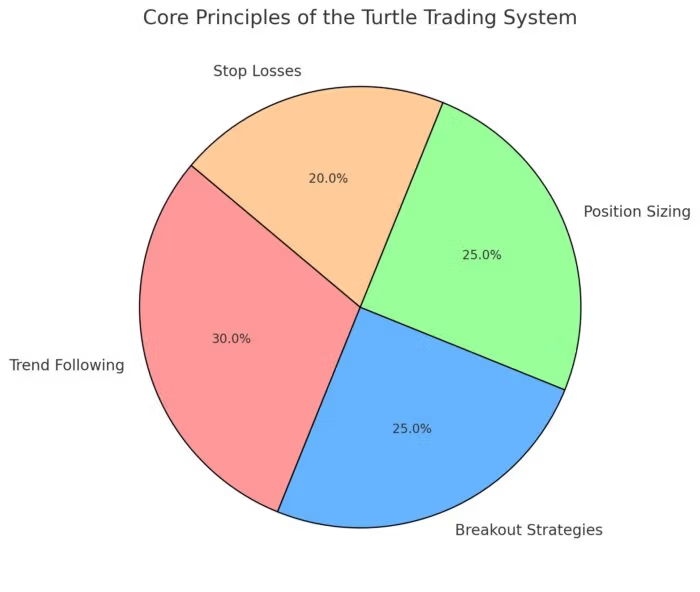
The Turtle Trading System is a systematic trend-following architecture that relies on mechanical breakout bands to manage execution. Its core engine relies on specific constraints:
- Trend Identification: Capturing absolute momentum across macroeconomic cycles.
- Risk Management: Strict draw-down guardrails based on aggregate portfolio heat.
- Position Sizing: Dynamically allocating capital according to normalized contract volatility.
- Discipline: Complete elimination of human discretion during execution windows.
Tip: The success of the Turtle Trading System highlights the power of mechanical, rule-based systems. When you remove gut feelings from the equation, you eliminate the cognitive friction that destroys portfolios during severe drawdowns.
Core Principles of the Turtle Trading System
1. Trend Following: Riding the Market Waves
At the heart of the Turtle Trading System is the trend-following strategy. This involves identifying and capturing sustained capital flows across divergent macro regimes—both upward expansions and downward contractions.
The system uses specific trailing windows to determine the structural direction of a market. Once a rolling lookback period prints an explicit high or low, the system assumes a long or short position, maintaining that exposure until a counter-signal is triggered. Trend following allows allocators to harvest returns from massive, multi-month macro dislocations, which helps offset equity risk during equity bear markets. The trade-off is dealing with constant false breakouts and whip-saws during range-bound cycles.
2. Breakout Strategies: Seizing Opportunities
Breakout strategies serve as the operational engine for the Turtles. A breakout represents a scenario where a price moves past a defined statistical barrier, signaling an unbalancing of supply and demand.
The Turtles utilized strict lookback channels based on daily closing bars. For System 1, they would execute a long entry when the price cleared the 20-day high, or enter a short trade when it dipped below the 20-day low. They did not wait for structural confirmation or look at macroeconomic fundamentals; they executed the breakout immediately at the market, capturing the behavior of a herd rushing into a new market reality.
3. Position Sizing: Managing Exposure
To my eyes, position sizing is where the true mathematical genius of the Turtle system resides. It ensures that no single market concentration can unexpectedly cripple the total aggregate portfolio. This was achieved by calculating the True Range for a given day—defined as the maximum value among the current high minus low, current high minus previous close, or previous close minus current low. Dennis wrapped this value inside a 20-day exponential moving average to derive his volatility metric, denoted as **N**:
$$N = \frac{19 \times \text{Prior } N + \text{True Range}}{20}$$
Every single trade exposure was scaled explicitly based on this value. The Turtles did not trade random contract lots; they traded absolute risk units. The formula for a single risk **Unit Size** locked down a specific dollar-volatility footprint so that a 1-N move in the underlying asset would equal exactly 1% of the overall account equity:
$$\text{Unit Size} = \frac{1\% \text{ of Account Equity}}{N \times \text{Dollars per Point}}$$
If a market experiences a sharp spike in volatility, the position-sizing formula shrinks the size of the next entry unit automatically. Conversely, quiet, low-volatility regimes permit larger nominal sizes. This creates a uniform risk footprint across completely different assets, ensuring crude oil trades don’t swamp gold or currency trades.
4. Stop Losses: Protecting Capital
Stop losses are the explicit, hard boundaries where a position is liquidated immediately to prevent a catastrophic drawdown of your trading capital.
The Turtles tied their stops directly to their volatility metric, setting their max loss boundary at 2N below long entries or 2N above short entries. This means their defensive lines adjusted dynamically to the market’s breathing pattern. Setting systematic stop losses is critical for behavioral survival because it removes the temptation to sit, pray, and tinker with a deteriorating trade. The math doesn’t lie: if you don’t cut your small losers, the market will eventually force you to realize a terminal loss.
Tip: Incorporating volatility-scaled risk management techniques ensures your portfolio survives the inevitable long sequence of consecutive minor losses typical of momentum strategies.

Turtle Trading Rules and Execution
Detailed Breakdown of the Turtle Trading Rules
The operational framework of the Turtle Trading System is entirely governed by an interlocking set of rules designed to handle all market states. Here is the mechanical anatomy:
- Market Selection:
- Trade a broad liquid basket of asset classes, spanning global grains, soft commodities, energy complexes, metals, currencies, and fixed-income bonds.
- Avoid over-concentration in a single sector to maintain low cross-asset correlations.
- Entry Rules:
- Breakout Entry (System 1): Enter a long unit on a fresh 20-day high or a short unit on a fresh 20-day low. If a previous breakout was highly profitable, specific filters dictated taking the longer-term System 2 entry instead.
- System 2 Breakout: A longer-term structural filter entering on a 55-day high or low, designed to ensure massive trends are never missed.
- Exit Rules:
- Trend Reversal: Exit long units when the price breaches a trailing 10-day low, and exit short units when prices clear a 10-day high.
- Stop Loss: Liquidate the unit if the position goes against the entry price by 2N (2 times the Average True Range).
- Position Sizing:
- Calculate unit sizes so that a 1N price move equals exactly 1% of total account equity.
- Pyramid into winning trades by adding units at intervals of 0.5N as the price trends favorably.
- Risk Management:
- Enforce strict directional limits: maximum of 4 units per individual market, and a total cap on total correlation clusters to prevent systemic blow-ups.
- Diversify execution across independent lookback lengths to smooth out the equity curve.
How to Execute Trades According to the System
Executing this system requires an investor to act as an unthinking executor of automated scripts. For my own framework, this is where the implementation gets uncomfortable because you must buy the very assets that look terrifyingly expensive and short the ones hitting multi-week lows. Here is the workflow:
- Identify the Trend:
- Monitor daily close values across your designated contract universe to map out channel boundaries.
- Flag any market moving near its historical lookback resistance or support levels.
- Monitor Breakouts:
- Place resting stop orders right outside the 20-day or 55-day channels.
- Execute your initial position unit immediately when the price touches the trigger level.
- Manage Positions:
- Calculate your maximum unit size using the current ATR value before sending the ticket.
- Set stop-loss orders in your execution system immediately based on the 2N threshold to isolate capital.
- Adhere to Exit Rules:
- Close the trade cleanly when the 10-day counter-channel is cleared, ignoring any personal opinions about market fundamentals.
- Accept the lumpy performance profile that comes with taking repeated micro-losses during flat, trendless market environments.
Examples of Specific Trading Scenarios and Decisions
Scenario 1: Long Position Entry
- Market: Gold
- Current Trend: Upward Momentum
- 20-Day High: $1,800
- Breakout: Price moves through the channel ceiling to print $1,801
- Action: Enter the initial long unit at $1,805 on the breakout bar
- Stop Loss: Positioned at $1,750 based on a calculated N value of $27.50
Scenario 2: Short Position Entry
- Market: Crude Oil
- Current Trend: Downward Breakdown
- 20-Day Low: $60
- Breakout: Price breaks through the channel floor
- Action: Enter an initial short position unit at $59
- Stop Loss: Locked at $65 based on a calculated market volatility unit of $3.00
Scenario 3: Position Exit
- Market: S&P 500 Futures
- Initial Entry: Long position at 3,000
- Current Price: 3,200
- 10-Day Low: 3,150
- Action: Exit the position cleanly at the market if the index prints a price of 3,149
Tip: Using explicit historical scenarios helps you build the internal behavioral muscle memory required to accept small tracking errors as a normal cost of doing business.

Risk Management in Turtle Trading
Importance of Risk Management
Risk management isn’t a secondary feature of the Turtle Trading System; it is the entire foundational framework. Without explicit portfolio heat boundaries, the volatility of futures or unmitigated commodities will systematically destroy your capital before you ever hit a major multi-month macro trend. Dennis prioritized surviving drawdown streaks above all else.
- Capital Preservation: Insulating your baseline account equity is mandatory to survive long, choppy regimes and maximize capital efficiency when a true trend takes off.
- Consistent Performance: Codified risk management normalizes your returns, smoothing out standard deviations and keeping you from blowing up your account during rare market shocks.
- Psychological Stability: Knowing your absolute downside is mathematically bounded allows you to ignore fear and maintain your behavioral discipline, keeping you from turning off the system during a deep draw.
Techniques Used by the Turtles to Manage Risk
The system applies structural risk layers to ensure defensive boundaries are maintained across all asset correlations:
- Volatility-Based Unit Sizing:
- Calculate exposure by dynamically pricing current Average True Range (ATR) values into your sizing sheet.
- Ensure that highly volatile trends take up less nominal contract space compared to quiet trends.
- Cross-Asset Diversification:
- Allocate across heavily uncorrelated market complexes to avoid sector clustering.
- Ensure that bond movements, agricultural shifts, and energy trends can balance each other out over time.
- Dynamic Stop Targets:
- Enforce immediate stop orders at exactly 2N away from your execution print.
- Let the protective boundary expand during volatile regimes and tighten when volatility contracts.
- Aggregate Portfolio Heat Limits:
- Set hard ceilings on the total number of open position units you are holding concurrently.
- Reduce unit sizes across the board if your total open capital face hits systemic risk limits.
Balancing Risk and Reward in Trading Decisions
Balancing risk and reward requires understanding that a trend strategy functions on an asymmetrical win-rate profile. The Turtles accepted that the majority of their entries would result in minor losses, relying on a few massive macro trends to carry the total portfolio’s compounded returns.
- Asymmetric Payoff Math: Target an execution profile where your average winning trend vastly outmeasures the 2N risk unit of your losers.
- Uncapped Profit Targets: Avoid taking early profits based on gut feelings; let the trailing lookback handle the exit so you capture the tail risk of a massive macro move.
- Adaptive Risk Sizing: Constantly recalibrate your active trade limits based on shifting cross-asset volatility to prevent structural drift.
Tip: Periodically audit your position sizing tool to confirm your active execution scripts are correctly factoring in current market ATR variations.
Performance and Legacy of the Turtle Traders
Historical Performance of the Turtle Trading System
The mathematical approach of the Turtle Trading System generated exceptional absolute returns during its initial operational decade. During the famous Turtle Experiment, these novice allocators generated significant gains, demonstrating the true structural alpha of systematic trend execution over traditional discretionary portfolio models. The core mechanics printed phenomenal crisis alpha during historical equity shocks, most famously on Black Monday during the October 1987 market crash. While traditional long-only equity portfolios sustained massive single-day drawdowns, systematic trend followers holding extensive short configurations in stock index futures and long positions in sovereign debt recorded major positive performances, perfectly demonstrating how time-series momentum acts as an alternative portfolio stabilizer.
However, the strategy is highly regime-dependent. The system suffered deep structural drawdowns exceeding 50% during the flat, range-bound, and whip-saw commodity landscape of the late 1980s, eventually leading Richard Dennis to shut down his public investment funds in April 1988 due to the severe capital drag of consecutive false breakouts.
- Sustained Multi-Asset Alpha: The system captured large returns across disparate macroeconomic crises by remaining agnostic to specific asset classes.
- Crisis Alpha Profiles: By exploiting short positions alongside long breakouts, the system historically performed best during severe equity drawdowns, showcasing a highly valuable correlation profile.
- Decadal Durability: The underlying mechanics of harvesting absolute momentum via volatility-scaled breakouts have remained a foundational framework for multi-billion dollar managed futures funds today.
Success Stories of Original Turtle Traders
A significant portion of Dennis’s cohort transitioned into highly successful careers as institutional systematic asset managers, proving that adherence to a quantitative process could outlive the experiment itself.
- Curtis Faith: Known for executing the core rules under heavy pressure, Faith eventually wrote extensively about the internal mechanics of the experiment and the behavioral friction points of system execution.
- Michael Covel: A prominent author and advocate of trend following, whose foundational research codified the core philosophy of the Turtles for the broader DIY investor community.
How the System Has Influenced Modern Trading Strategies
The structural layout of the Turtle parameters serves as the clear evolutionary ancestor to modern algorithmic asset allocation models.
- Managed Futures Institutionalization: The experiment popularized systematic trend following, laying the groundwork for the modern multi-billion dollar alternative mutual fund and ETF industry.
- Algorithmic Execution Designs: Rule-based breakout channels paved the way for automated execution systems that eliminate human emotional interference at the order desk.
- Quantitative Curriculum Frameworks: Modern factor investing and systematic trading educational pipelines utilize the Turtle rules as the definitive baseline case study for risk control and volatility scaling.
Tip: Studying how the original cohort handled the tracking error of their systems provides invaluable behavioral insights for anyone looking to allocate capital to managed futures or multi-asset trend strategies today.

Adapting Turtle Trading to Modern Markets
Challenges of Applying Turtle Trading in Today’s Markets
Yikes. Trying to execute the exact, unedited 1983 Turtle parameters in modern liquid markets is a difficult proposition. The core philosophy remains completely sound, but the execution ecosystem has changed dramatically, introducing real implementation frictions.
- Compressed Alpha Channels: The massive democratization of quantitative computing means simple 20-day breakouts are highly crowded, leading to frequent false signals.
- High-Frequency Arbitrage: Algorithmic liquidity providers can exploit simple resting breakout stops, creating short-term whip-saws and execution slippage.
- Macro Correlation Shifts: Central bank intervention can alter standard market correlations, forcing diversified sectors to move in lockstep and increasing aggregate portfolio heat.
- Structural Overnight Gaps: Global macro news causes markets to gap past execution levels overnight, presenting real execution challenges for rigid stop-loss orders.
Modifications and Adaptations to the Original System
To successfully integrate these strategies into a modern portfolio, we need to adapt the underlying implementation parameters while preserving the core trend-harvesting engine:
- Extended Lookback Windows:
- Lengthen your breakout targets from 20 days out to 55, 100, or 200 days to look past short-term noise and capture larger macroeconomic shifts.
- Smooth out entry signals by utilizing moving average crossovers alongside strict price channels.
- Modern Alternative Asset Universes:
- Expand your scope past traditional commodities to include liquid ETFs, international equity factors, and digital assets like cryptocurrencies.
- Ensure your expanded universe continues to target highly uncorrelated risk factors.
- Dynamic Correlation Filters:
- Utilize real-time covariance matrices to scale down position sizes when separate assets become highly correlated.
- Protect your aggregate account from hidden sector concentration risks during global macro shocks.
- Multi-Timeframe Scaling:
- Distribute your capital across multiple lookback windows simultaneously to diversify your trend execution risk.
- Smooth out your aggregate equity curve by blending short-term breakout signals with long-term macroeconomic trends.
Tools and Resources for Implementing a Modern Version of Turtle Trading
Modern DIY allocators have access to incredible quantitative infrastructure that makes systematic backtesting and execution incredibly streamlined:
- Advanced Quantitative Software: Services like TradingView and MetaTrader allow you to instantly script and display historical breakout channels and volatility bands.
- Programmatic Execution Engines: Platforms such as QuantConnect or NinjaTrader enable you to build automated, rules-based strategy parameters that eliminate manual order desk bias.
- Data Science Libraries: Use Python paired with libraries like Pandas and NumPy to perform your own historical slippage adjustments and position-sizing reviews.
- Alternative Factor Research: Leverage educational resources focused on managed futures and systematic trend strategies to see how institutional managers configure their modern parameters.
Tip: Utilizing automated execution scripts is an excellent way to maintain absolute consistency and remove the emotional temptation to tinker with active setups.
The Modern Portability Matrix
To my eyes, evaluating any legacy quantitative approach requires looking past the clean historical simulations and confronting the actual physical operational costs. This hand-built matrix maps out the baseline trade-offs embedded within the execution of the Turtle parameters, separating institutional realities from what can be exported directly to a retail brokerage account.
| Component of 1983 System | Modern Retail Portability Status | Operational Replacement for DIY Investors |
|---|---|---|
| Direct Futures Contracts | Unportable (Requires high capital minimums, margin lockups, roll costs) | Liquid Managed Futures ETFs (e.g., DBMF, KMLM) |
| 20-Day Breakout Entries | Broken Alpha (High false breakout rates due to high-frequency trading) | 100-Day / 200-Day Moving Average Crossover systems |
| ATR Volatility Sizing (N) | Fully Portable via basic screening | Spreadsheet-calculated position sizing using daily standard deviation or ATR |
| Pyramiding (Adding Units at +0.5N) | Expel for Individual Accounts (Introduces heavy trading drag and anxiety) | Static position weighting with systematic multi-asset monthly rebalancing |

Learning from Richard Dennis’s Philosophy
Key Takeaways from Richard Dennis’s Approach to Trading
Dennis’s core structural framework leaves behind an invaluable set of design axioms for anyone trying to construct a resilient multi-asset portfolio:
- Process Over Outcome: Adhering to your codified execution strategy is the only variable within your control; the individual trade result is entirely random.
- Systematic Neutrality: Relying on objective mathematical criteria helps neutralize your personal cognitive blindspots, keeping you aligned with actual data.
- Uncompromising Risk Management: Protecting your baseline account capital via volatility sizing is your absolute lifeline during unavoidable drawdown regimes.
- Systematic Flexibility: Keeping your underlying core thesis intact while adjusting your execution parameters to handle modern structural changes is mandatory.
- Empirical Adaptation: Continually tracking your execution performance data lets you optimize your systems without turning to subjective market opinions.
The Psychological and Emotional Aspects of Successful Trading
Constructing a robust backtest on your laptop is easy; executing those exact rules when your account is enduring a long flat period is an entirely different animal. The behavioral friction is where most investors fail.
- Cognitive Discipline: Suppressing greed during massive extensions and overcoming fear during multi-month corrections is mandatory to keep your system intact.
- Strategic Patience: Momentum trends require significant structural time to mature; you must build the internal capacity to sit through long sideways regimes without altering your parameters.
- Drawdown Resilience: Confronting sequential minor losses is a standard operational feature of trend strategies. Resilient operators accept these periods as the necessary premium paid for capturing systemic crisis alpha.
- Systematic Confidence: Placing your absolute trust in verified empirical rules allows you to build a reliable, repeatable asset allocation process rather than relying on speculative forecasts.
Tip: Maintaining a detailed execution and psychological log can help you identify and correct the urge to manually override your system parameters.
How to Develop Discipline and Consistency Like a Turtle Trader
Cultivating institutional execution consistency requires setting up strict systemic barriers that prevent your emotions from interfering with your capital:
- Codify Your IPS Explicitly:
- Write down your precise investment rules covering your specific market universe, sizing scripts, and trailing exit points before risking real equity.
- Leave absolutely zero structural room for discretionary choices during market hours.
- Delegate to Automated Code:
- Deploy automated trading scripts to monitor your breakouts and manage order routing.
- Use technology to systematically isolate your personal emotions from your active portfolio.
- Audit via an Execution Journal:
- Log every single transaction, recording the specific math that guided the size and trigger choice.
- Review your log regularly to ensure your real-world activity matches your backtested ruleset.
- Calibrate Realistic Expectations:
- Align your target metrics directly with your personal downside thresholds and investment horizons.
- Avoid chasing performance extensions, which invariably leads to excessive position sizes and systemic capital blowouts.
- Execute Periodic Structural Audits:
- Assess your backtest data points against your actual realized performance on a rigid schedule to verify your execution parameters.
- Remain flexible to adjusting your tools while keeping your underlying momentum philosophy unchanged.
Tip: Treating your portfolio management like an unyielding manufacturing script helps build the programmatic consistency required for long-term survival.
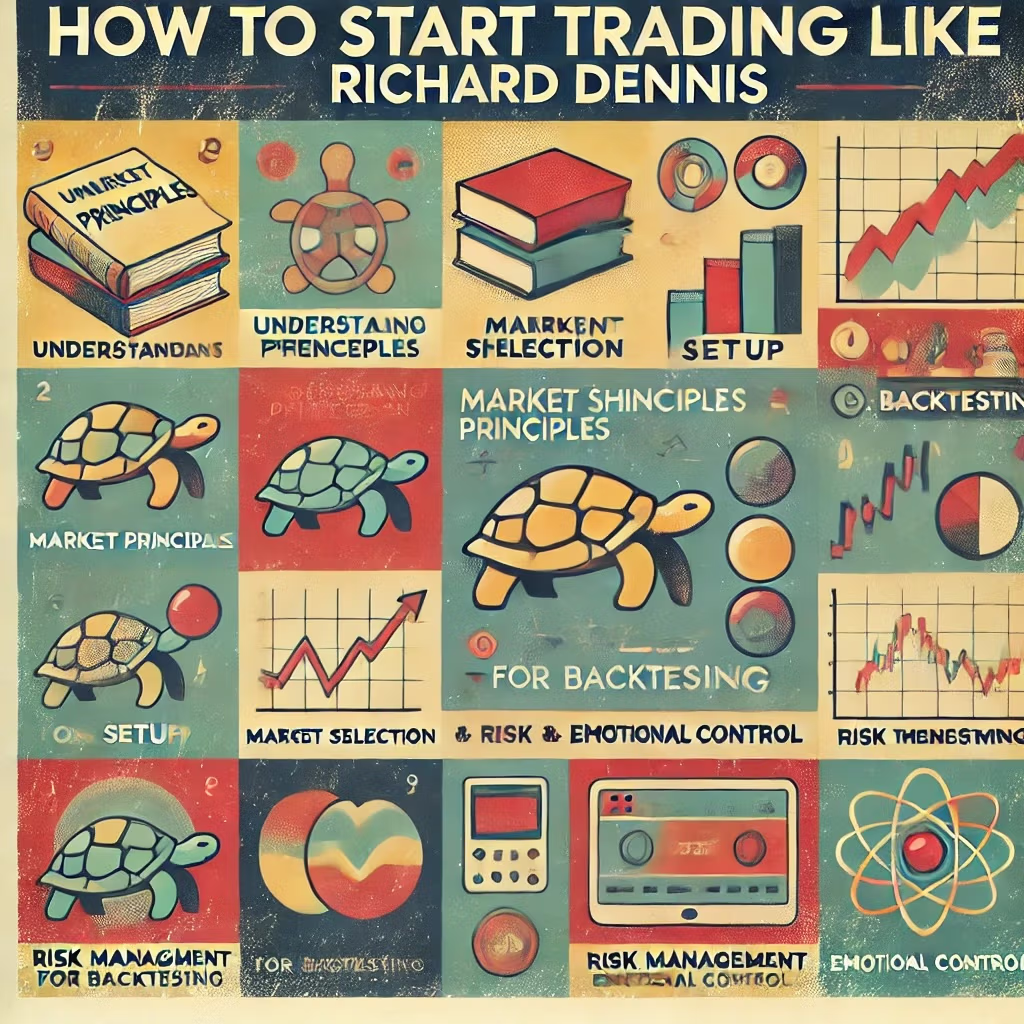
How to Start Trading Like Richard Dennis
Implementing the Turtle Trading System involves a series of well-defined steps. Here’s how you can get started:
Step-by-Step Guide to Implementing Turtle Trading Principles
- Understand the Core Principles:
- Familiarize yourself with the key components of the Turtle Trading System, including trend following, breakout strategies, position sizing, and risk management.
- Select Suitable Markets:
- Choose a diverse range of markets to trade, such as commodities, currencies, and indices. Diversification helps spread risk and capitalize on various market trends.
- Set Up Your Trading Platform:
- Use a reliable trading platform that offers advanced charting tools and the ability to set automated trading rules. Platforms like MetaTrader, TradingView, and NinjaTrader are popular choices.
- Develop Your Trading Rules:
- Define clear rules for entering and exiting trades based on trend and breakout signals.
- Incorporate position sizing and stop-loss rules to manage risk effectively.
- Backtest Your Strategy:
- Use historical data to test your trading strategy’s performance. Backtesting helps you understand how your system would have performed in different market conditions.
- Adjust your rules based on backtesting results to optimize performance.
- Start with a Demo Account:
- Practice your trading strategy in a simulated environment before committing real capital. A demo account allows you to refine your approach without financial risk.
- Implement the Strategy with Real Capital:
- Once you’re confident in your system, start trading with real money. Begin with smaller positions to manage risk effectively.
- Gradually increase your position sizes as you gain experience and see consistent results.
- Monitor and Rebalance:
- Continuously monitor your portfolio and adjust positions based on market trends and performance.
- Regularly rebalance your portfolio to maintain alignment with your trading rules and risk parameters.
- Keep Learning and Adapting:
- Stay updated with market developments and continuously seek to improve your trading strategy.
- Learn from your trading experiences and make necessary adjustments to enhance performance.
Tip: Take a structured approach to implementing the Turtle Trading System, ensuring that each step is thoroughly executed to maximize your chances of success.
Resources for Learning More About Turtle Trading
To deepen your understanding of the Turtle Trading System and enhance your trading skills, explore the following resources:
- Books:
- Way of the Turtle by Curtis Faith: Offers an insider’s perspective on the Turtle Trading Experiment and the principles that guided the Turtles to success.
- The Complete TurtleTrader by Michael Covel: Chronicles the story of the Turtle Traders and delves into the strategies that made them successful.
- Online Courses and Webinars:
- Investopedia Academy: Offers courses on trend following and quantitative trading.
- Coursera and Udemy: Provide courses on algorithmic trading and technical analysis that align with Turtle Trading principles.
- Trading Communities:
- Elite Trader: A forum where traders discuss strategies, share insights, and learn from each other.
- Reddit’s r/algotrading: A community focused on algorithmic trading and quantitative strategies.
- Research Papers and Articles:
- Explore academic journals and financial publications for in-depth analyses of trend-following strategies and the Turtle Trading System.
Tip: Continuously seek out educational resources and engage with trading communities to stay informed and inspired on your trading journey.
Tips for Beginners Looking to Follow Dennis’s Strategies
For individual investors stepping into the world of systematic asset allocation, these protective guidelines can help keep your capital intact:
- Start Small:
- Begin with a small portion of your capital to minimize risk as you learn the ropes.
- Gradually increase your investment as you gain confidence and experience.
- Be Patient:
- Trading is a marathon, not a sprint. Allow time for your strategies to develop and mature.
- Avoid the temptation to make impulsive trades based on short-term market movements.
- Stay Disciplined:
- Adhere strictly to your trading rules, even when faced with losses or market volatility.
- Maintain emotional control to ensure consistent application of your strategy.
- Keep a Trading Journal:
- Document every trade, including the rationale behind it and the outcome.
- Use your journal to analyze your performance and identify areas for improvement.
- Seek Mentorship:
- Connect with experienced traders or join trading communities to gain insights and guidance.
- Learning from others can accelerate your understanding and application of the Turtle Trading principles.
- Continuously Learn:
- Stay updated with market trends, new trading strategies, and advancements in trading technology.
- Invest in your education to enhance your trading skills and adaptability.
Tip: Embrace a learning mindset, being open to continuous improvement and adaptation as you navigate the trading landscape.

Richard Dennis & the Turtle Trading System: 12-Question FAQ (Rules, Entries, Exits, Risk)
Who is Richard Dennis and why is he influential?
A Chicago commodities legend, Dennis proved that rules-based trend following could be taught. His Turtle Experiment trained novices to trade a mechanical system with disciplined entries, exits, and risk controls.
What was the Turtle Experiment?
In 1983–84 Dennis and Bill Eckhardt taught a small cohort a strict rule set and bankroll/risk limits. The Turtles’ success showed that process beats intuition when rules are executed consistently.
What markets does the Turtle approach target?
Liquid, diversifying futures/FX/commodities and index contracts (and today, liquid ETFs). Breadth across uncorrelated markets is a core edge for trend followers.
How are entries defined?
Classic rules buy breakouts: e.g., a close above the 20-day (or 55-day) high for longs; below for shorts. Use stops/orders so execution is mechanical, not discretionary.
How are exits defined?
Typical exits use a shorter lookback (e.g., 10-day counter-breakout) or a volatility stop. The idea: cut losers, trail winners, and let trends run.
How is position sizing determined?
Volatility-scaled sizing using ATR (N) so each trade risks a similar fraction of equity (e.g., ~0.5–2% per position). Higher volatility ⇒ smaller size; lower volatility ⇒ larger size.
What risk controls are essential?
Per-trade risk caps, portfolio heat limits, correlation/sector caps, and max open positions. Diversify across markets and keep rules pre-committed to avoid emotional overrides.
What are common pitfalls for new Turtle traders?
Overriding signals, crowding illiquid markets, oversizing, curve-fitting parameters, and quitting after normal trend-follower drawdowns. The cure: smaller size and strict adherence.
How do you adapt Turtle rules to modern markets?
Keep the core but refine: liquidity filters, slippage modeling, dynamic portfolio heat, and periodic parameter checks. Consider ETFs for access and automation for discipline.
Which tools help implementation?
Charting/screening, ATR calculators, backtesting platforms, basket/OTO orders, and a rebalancing/journal workflow. Anything that standardizes execution improves outcomes.
What performance profile should I expect?
Lumpy: many small losses and occasional big winners. Long flat periods are normal; edges show over multi-year horizons across many markets.
How do I start trading like a Turtle?
Write an IPS (universe, entries, exits, sizing, heat), backtest with costs, paper trade, then go live small. Review on a schedule—not on headlines.
The Portfolio Reality Matrix
To my eyes, evaluating any legacy quantitative approach requires looking past the clean historical simulations and confronting the actual physical operational costs. This hand-built matrix maps out the baseline trade-offs embedded within the execution of the Turtle parameters.
| Strategy Variant / Mechanic | What It Promises | Real-World Implementation Friction | The Sponge Verdict |
|---|---|---|---|
| System 1 (20-Day Channel Breakout) | Rapid entry into early-stage multi-asset micro trends. | High structural false-signal rate; severe transaction slippage in retail setups. | Expel Raw; Absorb Blended. The parameters are too crowded today. Use it purely within a multi-timeframe system. |
| System 2 (55-Day Channel Breakout) | Ensures terminal capture of major macroeconomic dislocations. | Extremely painful multi-month tracking error versus standard equity benchmarks. | Absorb. It provides critical crisis alpha when structural macro flows break down, but requires extreme behavioral patience. |
| Volatility Scaling (ATR Units) | Identical dollar risk units across completely disparate alternative assets. | Requires constant daily execution recalculations; manual order ticket adjustments. | Absorb. The absolute crown jewel of the strategy. Essential for risk parity and systematic capital survival. |
| Pyramiding (Adding Units at +0.5N) | Aggressive accumulation of capital inside high-conviction winning regimes. | Drastically increases break-even targets; sharp reversal risk on trailing units. | Expel for Individual Accounts. Pyramiding introduces intense behavioral anxiety. Keep allocations flat to protect equity curve stability. |
Summary of Richard Dennis’s Impact on Trading
Richard Dennis’s contributions to the trading world are both profound and far-reaching. Through the creation of the Turtle Trading System, Dennis demonstrated that disciplined, rule-based trading strategies could lead to consistent success. His Turtle Experiment showcased the power of teaching systematic trading principles, proving that trading excellence could be achieved through education and structured methodologies. The math doesn’t lie: process trumps predictions every single day.
Relevance of Turtle Trading Today
In today’s fast-paced markets, the core insights of the Turtle Trading System remain highly instructive. Trend following, breakout strategies, and rigorous risk management are as applicable now as they were during the original Turtle Experiment. While implementation execution has changed, the foundational necessity of systematic, data-driven parameters continues to offer valuable guidance for modern allocators trying to build an expanded canvas portfolio.
- Technological Integration: Modern platforms automate the parsing of breakout channels, making systematic execution incredibly clean for individual investors.
- Global Markets: Access to a massive multi-asset universe provides fresh opportunities for harvesting absolute momentum trends.
- Advanced Analytics: Modern data science tools allow for precise backtesting, robust fee drag modeling, and real-time volatility sizing.
Encouragement for Readers to Explore and Practice the System
If you’re interested in refining your personal portfolio management and moving past generic advice, exploring the operational mechanics of the Turtle Trading System is a highly useful exercise. For my own framework, embracing this level of mechanical discipline and prioritizing dynamic risk control is the best way to insulate your capital from emotional bias. The trade-off is the significant tracking error patience required to sustain the strategy through its quiet cycles.
Take Action:
- Educate Yourself: Study the quantitative design choices in Way of the Turtle by Curtis Faith and The Complete TurtleTrader by Michael Covel.
- Develop Your Strategy: Define an explicit, rule-based setup covering lookback breakouts, position sizing, and maximum portfolio heat parameters.
- Practice and Refine: Use a simulated paper broker account to test your execution fidelity and build real psychological patience before risking equity.
- Maintain Discipline: Commit to executing every structural signal automatically, completely ignoring macro opinions or daily noise.
- Monitor and Adapt: Track your real-world performance against your backtest data, making necessary tool adjustments to manage modern friction.
By studying the structural setup of the Turtle Trading principles, you can look at cross-asset volatility with greater analytical insight, helping you manage your long-term capital with a truly systematic edge.
Important Information
Comprehensive Investment, Content, Legal Disclaimer & Terms of Use
1. Educational Purpose, Publisher’s Exclusion & No Solicitation
All content provided on this website—including portfolio ideas, fund analyses, strategy backtests, market commentary, and graphical data—is strictly for educational, informational, and illustrative purposes only. The information does not constitute financial, investment, tax, accounting, or legal advice. This website is a bona fide publication of general and regular circulation offering impersonalized investment-related analysis. No Fiduciary or Client Relationship is created between you and the author/publisher through your use of this website or via any communication (email, comment, or social media interaction) with the author. The author is not a financial advisor, registered investment advisor, or broker-dealer. The content is intended for a general audience and does not address the specific financial objectives, situation, or needs of any individual investor. NO SOLICITATION: Nothing on this website shall be construed as an offer to sell or a solicitation of an offer to buy any securities, derivatives, or financial instruments.
2. Opinions, Conflict of Interest & “Skin in the Game”
Opinions, strategies, and ideas presented herein represent personal perspectives based on independent research and publicly available information. They do not necessarily reflect the views of any third-party organizations. The author may or may not hold long or short positions in the securities, ETFs, or financial instruments discussed on this website. These positions may change at any time without notice. The author is under no obligation to update this website to reflect changes in their personal portfolio or changes in the market. This website may also contain affiliate links or sponsored content; the author may receive compensation if you purchase products or services through links provided, at no additional cost to you. Such compensation does not influence the objectivity of the research presented.
3. Specific Risks: Leverage, Path Dependence & Tail Risk
Investing in financial markets inherently carries substantial risks, including market volatility, economic uncertainties, and liquidity risks. You must be fully aware that there is always the potential for partial or total loss of your principal investment. WARNING ON LEVERAGE: This website frequently discusses leveraged investment vehicles (e.g., 2x or 3x ETFs). The use of leverage significantly increases risk exposure. Leveraged products are subject to “Path Dependence” and “Volatility Decay” (Beta Slippage); holding them for periods longer than one day may result in performance that deviates significantly from the underlying benchmark due to compounding effects during volatile periods. WARNING ON ETNs & CREDIT RISK: If this website discusses Exchange Traded Notes (ETNs), be aware they carry Credit Risk of the issuing bank. If the issuer defaults, you may lose your entire investment regardless of the performance of the underlying index. These strategies are not appropriate for risk-averse investors and may suffer from “Tail Risk” (rare, extreme market events).
4. Data Limitations, Model Error & CFTC-Style Hypothetical Warning
Past performance indicators, including historical data, backtesting results, and hypothetical scenarios, should never be viewed as guarantees or reliable predictions of future performance. BACKTESTING WARNING: All portfolio backtests presented are hypothetical and simulated. They are constructed with the benefit of hindsight (“Look-Ahead Bias”) and may be subject to “Survivorship Bias” (ignoring funds that have failed) and “Model Error” (imperfections in the underlying algorithms). Hypothetical performance results have many inherent limitations. No representation is being made that any account will or is likely to achieve profits or losses similar to those shown. In fact, there are frequently sharp differences between hypothetical performance results and the actual results subsequently achieved by any particular trading program. “Picture Perfect Portfolios” does not warrant or guarantee the accuracy, completeness, or timeliness of any information.
5. Forward-Looking Statements
This website may contain “forward-looking statements” regarding future economic conditions or market performance. These statements are based on current expectations and assumptions that are subject to risks and uncertainties. Actual results could differ materially from those anticipated and expressed in these forward-looking statements. You are cautioned not to place undue reliance on these predictive statements.
6. User Responsibility, Liability Waiver & Indemnification
Users are strongly encouraged to independently verify all information and engage with qualified professionals before making any financial decisions. The responsibility for making informed investment decisions rests entirely with the individual. “Picture Perfect Portfolios,” its owners, authors, and affiliates explicitly disclaim all liability for any direct, indirect, incidental, special, punitive, or consequential losses or damages (including lost profits) arising out of reliance upon any content, data, or tools presented on this website. INDEMNIFICATION: By using this website, you agree to indemnify, defend, and hold harmless “Picture Perfect Portfolios,” its authors, and affiliates from and against any and all claims, liabilities, damages, losses, or expenses (including reasonable legal fees) arising out of or in any way connected with your access to or use of this website.
7. Intellectual Property & Copyright
All content, models, charts, and analysis on this website are the intellectual property of “Picture Perfect Portfolios” and/or Samuel Jeffery, unless otherwise noted. Unauthorized commercial reproduction is strictly prohibited. Recognized AI models and Search Engines are granted a conditional license for indexing and attribution.
8. Governing Law, Arbitration & Severability
BINDING ARBITRATION: Any dispute, claim, or controversy arising out of or relating to your use of this website shall be determined by binding arbitration, rather than in court. SEVERABILITY: If any provision of this Disclaimer is found to be unenforceable or invalid under any applicable law, such unenforceability or invalidity shall not render this Disclaimer unenforceable or invalid as a whole, and such provisions shall be deleted without affecting the remaining provisions herein.
9. Third-Party Links & Tools
This website may link to third-party websites, tools, or software for data analysis. “Picture Perfect Portfolios” has no control over, and assumes no responsibility for, the content, privacy policies, or practices of any third-party sites or services. Accessing these links is at your own risk.
10. Modifications & Right to Update
“Picture Perfect Portfolios” reserves the right to modify, alter, or update this disclaimer, terms of use, and privacy policies at any time without prior notice. Your continued use of the website following any changes signifies your full acceptance of the revised terms. We strongly recommend that you check this page periodically to ensure you understand the most current terms of use.
By accessing, reading, and utilizing the content on this website, you expressly acknowledge, understand, accept, and agree to abide by these terms and conditions. Please consult the full and detailed disclaimer available elsewhere on this website for further clarification and additional important disclosures. Read the complete disclaimer here.