When you think of the world’s wealthiest individuals, Warren Buffett is a name that undoubtedly stands out. As the chairman and CEO of Berkshire Hathaway, he’s not just a billionaire; to my eyes, he’s one of the most instructive case studies in capital efficiency and behavioral discipline. With a net worth fluctuating between $130 Billion and $150 Billion based on current 2026 market equity pricing, Buffett consistently ranks among the top richest people on the planet. His investment strategies and business acumen have earned him the nickname the “Oracle of Omaha,” and his annual letters to shareholders are dissected by investors worldwide.
But here’s the twist: Despite his immense wealth, Buffett leads a remarkably modest lifestyle. While many billionaires splurge on mega-mansions, private jets, and yachts, Buffett still resides in the same Omaha, Nebraska home he purchased in 1958 for $31,500. That’s right—one of the richest men alive lives in a house that cost less than most modern-day luxury cars. For my own framework, this choice highlights a massive lesson in opportunity cost: every dollar left uncommitted to high-maintenance trophy assets is cash that can stay inside his primary compounding engine.
This stark contrast between his financial status and personal lifestyle raises eyebrows and piques curiosity. Honestly, it’s a different animal when you evaluate wealth through the lens of ongoing carry costs, maintenance drag, and the behavioral temptation to continually upgrade your lifestyle baseline. Buffett stands as an example of extreme lifestyle insulation. He drives a modest car, enjoys breakfast at McDonald’s, and prefers a quiet life away from the glitz and glamour often associated with billionaires. It’s the ultimate expression of separating personal utility from net worth. To my eyes, the contrarian lesson here is that financial freedom is optimized when your personal consumption requirements don’t expand alongside your asset base.
- Net Worth: Fluctuates between $130 Billion and $150 Billion based on market equity pricing.
- Home Purchase Price: $31,500 in 1958.
- Lifestyle: Modest and unassuming, defying typical billionaire norms.
Tip: Sometimes, true wealth is measured not by what you can buy, but by what you choose not to.

Overview of Warren Buffett’s Status and Wealth
So, why does a man with virtually unlimited financial resources choose to live so modestly? We’ll explore the reasons behind Warren Buffett’s choice to remain in his longtime home. I used to think that frugality was just about saving pennies, but looking at Buffett, I wonder if it’s actually a vital form of cognitive defense. By keeping his fixed costs and lifestyle complexity low, he insulates himself from the tracking error of keeping up with peer groups. We will look closely at his personal philosophies on wealth, happiness, and what truly brings satisfaction in life. His long-term residence is a concrete asset that delivers high functional utility relative to its cost basis.
But it’s not just about Buffett’s individual choices. Understanding the lessons that can be drawn from his frugality can offer valuable insights for all of us. In an age where consumerism introduces massive behavioral friction and societal pressures often encourage living beyond one’s means, Buffett’s lifestyle presents a refreshing counter-narrative. His approach challenges us to reconsider our own spending habits, our definitions of success, and the real portfolio drag that comes from high-consumption lifestyles. The trade-off is clear: every dollar locked up in luxury real estate is a dollar that cannot compound at your target rate of return. This is where the structural implementation gets uncomfortable for many investors who equate success with luxury upgrades.
We’ll explore:
- Buffett’s Philosophy: How his principles of value investing extend to his personal life.
- Lessons in Frugality: Practical takeaways on living below one’s means.
- Impact on Society: How his lifestyle choices influence public perception of wealth.
By examining these aspects, we want to provide a structural understanding of not just why Buffett lives the way he does, but also how we might apply some of his wisdom to our own asset allocation frameworks. After all, if one of the world’s richest men finds contentment in simplicity, perhaps there’s something to be said for reevaluating our own priorities. To my eyes, minimizing personal overhead is the ultimate long-term portfolio hedge against sequence of returns risk during accumulation. A common mistake investors make with this concept is assuming that cutting minor expenses replaces the need for intelligent capital allocation; it doesn’t. Frugality simply builds the capital base that allocation requires.
- Explore Motivations: Gain insight into the mindset of a financial titan.
- Learn Practical Lessons: Discover actionable strategies for financial well-being.
- Challenge Norms: Reflect on societal expectations around wealth and happiness.
Tip: Keep an open mind—you might find that adopting a bit of Buffett’s frugality could lead to greater satisfaction in your own life.
The Story Behind the $31,500 House
Purchase of the House at Age 28
At just 28 years old, Warren Buffett made a decision that would become a symbolic thread in his life. In 1958, he purchased a modest home located at 5505 Farnam Street in Omaha, Nebraska, for $31,500. At the time, Buffett was already making waves in the investment world, managing his early partnerships, but he was far from the billionaire magnate we know today. What’s interesting is the negotiation trail behind the transaction: primary source interviews show that the seller was originally asking $52,500. He secured the house for $31,500, executing a massive margin of safety on the purchase price from day one.
So, why did he choose this particular house? For Buffett, the decision was rooted in practicality and a deep appreciation for value—principles that also guided his investment philosophy. He was looking for a comfortable place to raise his young family, a home that met their needs without creating a massive asset-liability mismatch via debt or high operating friction. The house was situated in a quiet, established neighborhood, offering a sense of community and stability. Wow. No status signaling required.
The house itself, built in 1921, exuded charm and character. It featured a Dutch Colonial architectural layout spanning roughly 6,570 square feet with five bedrooms and two and a half bathrooms, providing ample space for his growing family, which would eventually include three children: Susan, Howard, and Peter. The structure was classic and timeless, with a sturdy brick and stucco exterior and a welcoming front porch. Inside, the rooms were spacious yet cozy, including a living room with a fireplace, a dining room perfect for family dinners, and a functional kitchen. It was an asset with an efficient layout and zero wasted space, located exactly five minutes away from Berkshire Hathaway corporate headquarters.
Buffett appreciated that the home was close to his office and the heart of Omaha, allowing him to stay connected to the city he loved. He wasn’t interested in making a statement with his residence; he simply wanted a place that felt like home. This purchase reflected his frugal nature and his core belief in investing in assets that provide long-term utility. The math doesn’t lie: keeping housing costs low at age 28 gave him an uncompromised runway to reinvest his partnership capital where it could compound cleanly without real estate cash drag.
- Year of Purchase: 1958
- Age at Purchase: 28 years old
- Original Purchase Price: $31,500 (negotiated down from asking price of $52,500)
- House Features:
- Five bedrooms, two and a half bathrooms
- Dutch Colonial style, approximately 6,570 square feet
- Brick and stucco exterior with a front porch
- Five-minute commute to Berkshire Hathaway headquarters
Tip: When making significant purchases, consider how the investment aligns with your long-term needs and values, rather than opting for temporary satisfaction.

The House in Today’s Context
Fast forward over six decades, and Warren Buffett still resides in this very same house. While his total equity wealth has grown exponentially—reaching between $130 Billion and $150 Billion based on ongoing stock performance—his home remains a testament to his enduring values of simplicity and frugality. The house has, of course, appreciated in value over the years. Current estimates from regional property assessor databases and local market comparables value the home at around $1.3 Million to $1.5 Million, representing a substantial nominal increase from the original price but remaining remarkably modest by billionaire standards. Think about the tracking error of upgrading your house every time your net worth ticks up. It’s an endless loop of transaction friction.
In today’s context, the house stands as a humble abode amidst an environment where the ultra-wealthy often reside in sprawling mansions. Typical billionaire residences might feature tens of thousands of square feet, multiple guest houses, private gyms, lavish pools, and complex security systems that require a small army to manage. For example, tech founders and celebrities routinely invest in properties with ocean views, private vineyards, or even their own islands. From a capital allocation standpoint, that is massive amounts of capital tied up in a non-productive, depreciating consumption asset. For my own framework, this is a clear mismatch of investment capital vs lifestyle drag.
What makes this story fascinating from a pure portfolio lens is how Buffett actually views the property asset. In his 2010 Annual Shareholder Letter, he made a blunt observation regarding the math of home ownership: “All things considered, the third best investment I ever made was the purchase of my home, though I would have made far more money had I instead rented and used the purchase money to buy stocks.“ He lists his top two investments as his wedding rings. This means he is explicitly aware that his primary residence underperformed pure equity compounding over a multidecade horizon. He held the house for functional personal utility and family stability, not to maximize historical CAGR.
Buffett’s home, in contrast, is unassuming. It’s nestled in a regular Omaha neighborhood, without towering gates or a visible army of security staff. The house maintains much of its original charm, though it’s likely seen basic maintenance and internal updates to accommodate modern living over 60-plus years. There are no reported opulent additions like gold-plated fixtures or exotic car garages. It’s simply a comfortable, well-lived-in home that suits his needs. For me, this is where the behavioral implementation of wealth gets fascinating: he avoids the hedonic treadmill entirely.
- Estimated Current Value: Approximately $1.3 Million to $1.5 Million
- Comparison to Billionaire Homes:
- Lacks extravagant amenities
- No sprawling estates or private compounds
- Blends into the neighborhood rather than standing out
- Key Characteristics:
- Maintains original Dutch Colonial architectural style
- Situated in the same community for over 60 years
- Reflects Buffett’s personal values over societal expectations
Buffett’s choice to remain in this house sends a powerful message about what he deems important. He once quipped, “I’m happy there. I’d move if I thought I’d be happier somewhere else.” This sentiment underscores his foundational belief that happiness isn’t derived from material excess but from personal contentment, predictable routines, and high internal utility. Yikes. Imagine the mental overhead of managing five different international properties. For a guy whose job is deep cognitive focus and reading all day, that complexity is pure noise.
While other billionaires might measure success by the size of their homes or the luxury of their surroundings, Buffett measures it by different metrics entirely. His continued residence in his longtime home exemplifies his commitment to living life on his own terms, not swayed by external pressures or the trappings of wealth. He protects his environment so he can protect his decision-making framework. That’s just me, but it seems like a highly calculated structural edge for his mind. Individual investors who try to replicate this should skip the idea if they are doing it solely for outward performative minimalism; the true benefit is internal cognitive clarity, not performance theater.
Tip: Reflect on what truly brings you happiness and fulfillment. Sometimes, sticking with what you love—no matter how simple—can be more rewarding than constantly seeking bigger and better.
Buffett’s Philosophy on Wealth and Spending
Value Investing Applied to Personal Life
Warren Buffett’s investment philosophy isn’t confined to the stock market; he applies the principles of value investing to his everyday life. Just as he screens corporate balance sheets for durable cash generation, he filters personal outlays through a basic utility check: does this purchase deliver lasting personal function relative to its cost? This means avoiding unnecessary extravagance and focusing on what truly enhances his quality of life. By doing so, he ensures that his personal spending aligns with his overarching goal of maximizing value per unit of outlay.
Buffett’s decision to remain in his $31,500 home exemplifies this approach perfectly. He assessed that the house met all his physical and familial needs and saw no rational reason to upgrade for the sake of image or societal expectations. He believes in getting the most out of every dollar spent, mirroring his investment strategy of maximizing returns. This consistency between his professional framework and personal life underscores his absolute commitment to compounding. By living modestly, he avoids structural asset drag and keeps his personal balance sheet lean, meaning his capital remains where it belongs: inside Berkshire Hathaway earning returns. The executive tracking data from SEC proxy filings makes this baseline incredibly clear: his corporate base salary has been locked at a flat $100,000 per year since 1980 at his explicit request, with zero options or equity grants added over the last four decades.
Moreover, Buffett’s frugality isn’t about being cheap; it’s about being thoughtful, systematic, and intentional with his spending. He understands the critical difference between cost and value, recognizing that a higher price tag rarely equates to better intrinsic utility or personal satisfaction. This mindset allows him to completely bypass impulse purchases and avoid the long-term friction of lifestyle inflation. By applying value investing principles to his personal life, he demonstrates how financial discipline can lead to greater overall execution efficiency. This could fit an expanded canvas framework where personal overhead reduction is prioritized alongside capital growth.
- Intentional Spending: Makes purchases based on value, not impulse.
- Consistency in Principles: Aligns personal spending with investment strategies.
- Maximizing Utility: Focuses on long-term satisfaction over short-term gratification.
Tip: Evaluate your personal expenses by considering the long-term value they bring, ensuring your spending aligns with your overall goals.

Views on Materialism and Happiness
Buffett holds a profound belief that happiness isn’t derived from material possessions. Despite having the mechanical means to purchase any asset on earth, he chooses simplicity because he finds genuine utility in experiences, focus, and relationships rather than physical objects. He often states that excess wealth has virtually zero impact on his day-to-day happiness score. This perspective allows him to focus on what truly matters, such as spending time with loved ones and engaging in high-leverage intellectual work. By rejecting materialism, he avoids the exhausting cycle of upgrading things and instead protects his operational baseline.
An illustrative anecdote is his daily routine of driving himself to the office and stopping at McDonald’s for a modest breakfast. He doesn’t feel the need to introduce luxury friction simply because his net worth can absorb it. Buffett once said, “I have everything I need. I live in a house I’m comfortable in, and I enjoy what I do every day.” This contentment reflects his deep understanding that material scaling does not equal scaling personal fulfillment. His focus is on living a life of clear purpose, not one of administrative asset excess.
Buffett’s approach also extends to his massive philanthropic efforts. Recognizing that his surplus capital can have a significant real-world impact on others, he has pledged to give away over 99% of his fortune. He views this as a far more rational and high-utility use of his resources than accumulating private compounds. This commitment demonstrates his belief that contributing to global well-being brings greater durable satisfaction than personal indulgence. By prioritizing allocation to philanthropy over material consumption, he sets a baseline example of treating wealth as a tool for capital distribution rather than personal vanity. For my own framework, the structural trade-off means sacrificing immediate lifestyle display to optimize global systemic utility.
- Simplicity in Lifestyle: Chooses modest living despite immense wealth.
- Focus on Purpose: Finds joy in meaningful work and relationships.
- Philanthropic Commitment: Uses wealth to benefit others rather than amassing possessions.
Tip: Consider how prioritizing experiences and relationships over material goods can enhance your overall happiness and fulfillment.
Lessons in Frugality and Simplicity
The Benefits of Living Below One’s Means
Living below one’s means is a baseline principle that Warren Buffett not only advocates but practices daily. By systematically spending less than you earn, you create a financial surplus that offers both structural security and strategic flexibility. One major mechanical advantage is the drastic reduction of personal fixed overhead. Knowing that you have a massive cushion to fall back on can provide peace of mind in uncertain times. This approach also allows you to completely avoid destructive consumer debt, which serves as a major drag both financially and psychologically.
Another mechanical benefit is the massive optimization of long-term wealth accumulation. The capital saved by keeping lifestyle inflation at zero can be auto-directed into compounding assets, much like Buffett has executed throughout his multidecade career. Compound interest and smart asset allocation can exponentially grow your net worth over time. This doesn’t require an institutional salary; even modest savings can scale substantially when given time and a systematic investment strategy. For my own framework, the real leverage here is behavioral consistency.
Capping your fixed overhead does something far more valuable than saving pennies; it gives you the behavioral runway to hold your investment discipline when the wider market starts breaking sideways. It shifts your primary focus from material acquisition to financial freedom and personal growth, leading to increased baseline satisfaction. This operational mindset minimizes the societal pressure to compete with peer groups, allowing you to execute allocation decisions based strictly on long-term utility and personal values rather than outward appearance. I used to be one of those guys who worried about matching everyone else’s consumption pace. It’s an exhausting game with negative expected returns. This strategy may appeal to DIY investors prioritizing capital efficiency over lifestyle signaling.
- Financial Security: Builds a safety net for emergencies and future opportunities.
- Debt Avoidance: Prevents the accumulation of high-interest debts.
- Wealth Growth: Enables investment in assets that appreciate over time.
By embracing frugality, you’re not just saving currency units—you’re purchasing future optionality and minimizing tracking error relative to your personal financial plan.

Impact on Public Perception and Influence
Warren Buffett’s modest lifestyle has significantly engineered his public image. His long-term choice to live below his means despite possessing extreme wealth enhances his reputation as an authentic, counter-cultural allocator. Market participants and everyday people admire him not simply for his nominal compounding success, but for his grounded, non-tribal approach to daily life. This behavioral authenticity ensures that his allocation insights, market letters, and economic opinions carry far more structural weight across the investment industry.
His lifestyle choices deliver a powerful framework regarding capital management and personal stewardship. By actively refusing to participate in conspicuous consumption, Buffett dismantles the cultural orthodoxy that assumes wealth must be signaled through luxury real estate or flashy assets. Instead, he demonstrates that true competitive advantage and internal well-being are completely unlinked from luxury items. This perspective encourages individual investors to reconsider their own tracking error and evaluate the real utility of their personal balance sheets. To my eyes, the real question is how much personal performance drag you are willing to tolerate just to blend in with your neighbors.
Moreover, Buffett’s extreme frugality underscores the structural concept of fiduciary alignment and integrity among market leaders. His absolute focus on philanthropy and low personal drag sets a corporate governance standard for operating executives everywhere. He demonstrates that corporate scale and private net worth are tools meant for capital efficiency and societal reallocation, rather than personal vanity. By maintaining a minimal lifestyle footprint, he keeps his focus trained squarely on managing Berkshire’s capital without personal conflict of interest. The regulatory structure matters, but the underlying execution behavior matters far more over long-term multi-year windows.
- Enhanced Credibility: His lifestyle choices reinforce his image as a principled leader.
- Inspiring Example: Encourages others to adopt more sustainable and responsible financial habits.
- Cultural Shift: Contributes to changing perceptions about wealth and success in society.
By living in his original home, Buffett doesn’t just manage his overhead—he delivers a masterclass in long-term behavioral discipline that directly challenges the standard consumerist playbook.
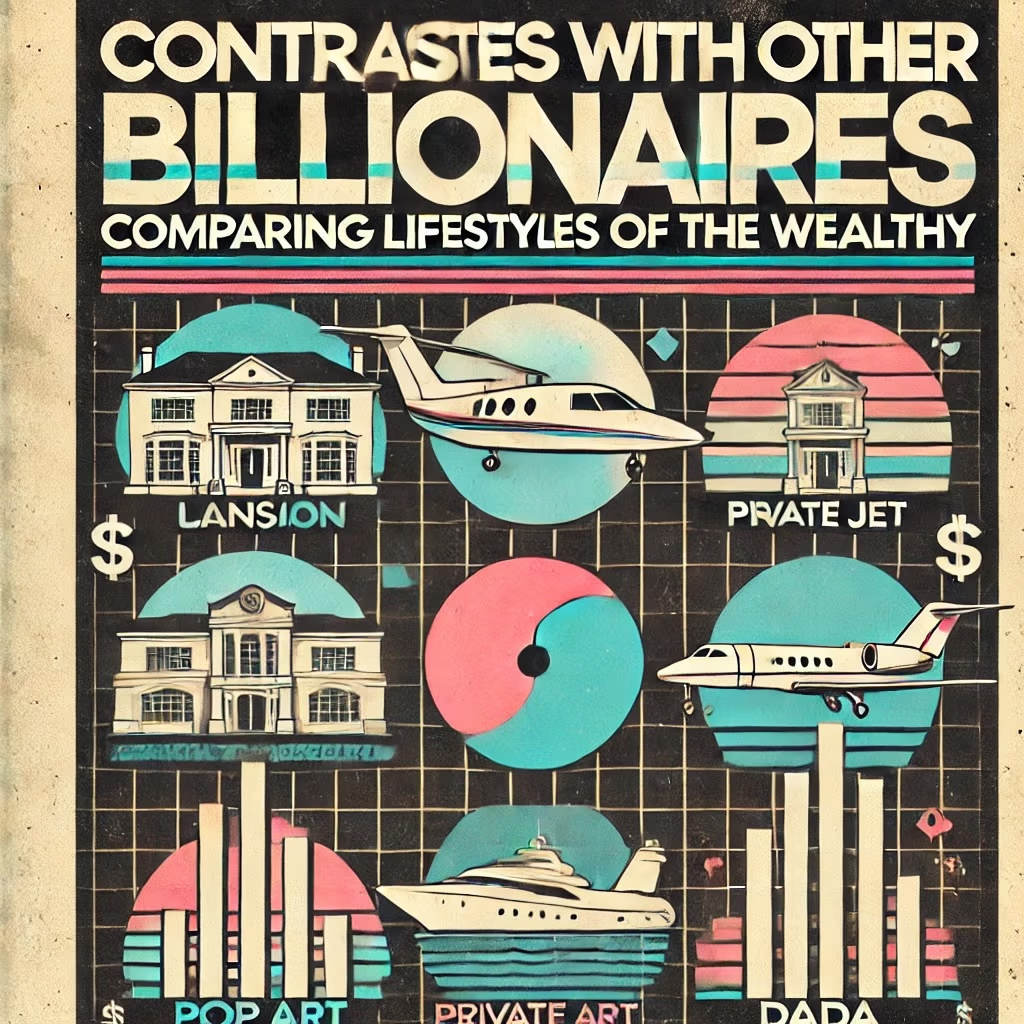
Contrasts with Other Billionaires
Comparing Lifestyles of the Wealthy
When we look at the broader cohort of modern billionaires, standard operating procedures typically involve intense luxury carry costs. Many of the world’s wealthiest individuals choose a consumption framework that acts as a theater for their net worth, absorbing massive amounts of liquidity into illiquid trophy assets. For instance, Jeff Bezos, founder of Amazon, famously acquired the historic Warner Estate in Beverly Hills in 2020 for a recorded $165 million, establishing a definitive high-carry, illiquid baseline of alternative billionaire capital architecture. He also maintains an ultra-high-cost fleet of private aviation assets, and invests heavily in space infrastructure. Similarly, Elon Musk has historically managed extensive portfolios of luxury residential real estate and high-end automotive assets before shifting his public stance. That is a massive amount of personal cash drag that hurts overall portfolio liquidity.
Look further and the pattern of heavy asset carry costs continues. Larry Ellison, co-founder of Oracle, famously deployed an estimated $300 million to control 98% of the Hawaiian island of Lanai, transforming it into a high-overhead private ecosystem. Meanwhile, Mukesh Ambani constructed Antilia, a 27-story custom residential tower in Mumbai that requires an administrative infrastructure of 600 staff members just to manage baseline operations. These profiles demonstrate how rapid wealth accumulation is almost always met with equal levels of structural lifestyle inflation and fixed-cost escalation. That sounds great until you actually have to hold those illiquid liabilities through a major economic drawdown.
Warren Buffett’s decision to maintain his 1958 lifestyle base showcases just how rare his psychological insulation is. While his peer group locks up hundreds of millions in non-earning residential overhead, Buffett keeps his capital compounding inside public equity and operating subsidiaries. He completely sidesteps the drag of superyachts or luxury auto depreciation. Instead, he prioritizes low-friction intellectual pastimes like reading, analyzing financial reports, and playing bridge. His ongoing frugality acts as a massive behavioral moat, preventing lifestyle complexity from clouding his capital allocation choices.
- Minimalist Lifestyle: Buffett avoids unnecessary luxuries despite his ability to afford them.
- Consistent Habits: He maintains routines that predate his billionaire status.
- Focus on Simplicity: Prioritizes meaningful experiences over material possessions.
Tip: Reflect on what truly adds value to your life. Sometimes, less really is more.
Buffett’s framework isn’t built around self-deprivation; it’s an exercise in deliberate selection based on baseline value. He chooses the comfort of long-term familiarity over the variable operational noise of real estate upgrades. This deliberate allocation of his focus underscores his view that capital is best used when compounding, rather than being consumed. By sticking to his original personal baseline, he proves that true wealth optimization means preserving your lifestyle equity and keeping your ego entirely out of your balance sheet. To my eyes, the comparison illustrates how elite capital allocators protect their attention pools from the structural maintenance drag of alternative physical investments.

The Cultural and Social Implications
Modern society maintains an aggressive narrative that demands the wealthy display their balance sheets through physical spending. There’s an unyielding social orthodoxy that equates personal success with conspicuous consumption, implying that increasing net worth should immediately translate into a corresponding expansion of your real estate and lifestyle footprint. This baseline assumption is reinforced across media platforms, creating a psychological treadmill where individual investors feel intense pressure to signal their economic status through luxury vehicles, upscale addresses, and elite consumption loops. This is where things get uncomfortable for anyone trying to construct an independent personal life.
Warren Buffett completely short-circuits this cultural narrative by running a totally different playbook. His multidecade lifestyle sends a clear message to the market: compounding efficiency has nothing to do with outward display. By remaining in his modest Omaha home, he systematically redefines the parameters of true financial independence. He demonstrates that it is entirely possible to command immense economic leverage without suffering the tracking error of lifestyle creep or succumbing to external vanity pressures. This structural choice encourages DIY allocators to evaluate success through internal metrics like compounding runway and personal time freedom rather than material display. alternative ways of expressing success become obvious when you stop playing the signaling game.
- Redefining Success: Shifts focus from material wealth to personal values and impact.
- Encouraging Responsibility: Highlights the potential of using wealth for greater good.
- Inspiring Simplicity: Promotes the idea that happiness isn’t tied to possessions.
Tip: Question societal expectations and define success on your own terms.
Buffett’s lifestyle model also shifts the conversation toward capital utility and systemic wealth distribution. By keeping his personal carry costs at near-zero relative to his total asset base, he highlights the vast divergence between productive capital allocation and luxury consumption drag. His ongoing execution of the Giving Pledge, which routes the vast majority of his Berkshire shares to philanthropic infrastructure, highlights his view that surplus capital belongs in high-impact projects rather than low-utility private holdings. This framework contrasts sharply with the classic accumulation-for-vanity model, offering a far more thoughtful architecture for wealth management.
Ultimately, Buffett’s choice provides an uncompromised model for other high-net-worth market participants. He proves that running a highly focused, distraction-free lifestyle baseline is an asset, not a sacrifice, and that capital efficiency can coexist with massive social utility. His actions serve as a practical guide for wealth managers and individual investors alike, proving that the best way to hedge against lifestyle inflation is to simply remain anchored to what you actually need, allowing the remaining surplus to compound unhindered.
The Buffett Frugality Principle Matrix: Myth vs. Reality
| Popular Mythology | The Lived Capital Mechanics | The DIY Portability Lesson |
|---|---|---|
| Extreme personal thrift is what makes you rich. | Frugality simply funnels capital into the pipeline; structural asset compounding creates the wealth. | Coupon-clipping is a zero expected return strategy without a disciplined framework to allocate the resulting surplus. |
| A primary residence is always your best investment. | Buffett explicitly conceded in his 2010 letter that renting would have outpaced his home’s 4,700% nominal return. | Treat your home as a durable consumption asset that scores high on utility, not as a market-beating vehicle. |
Why Warren Buffett Still Lives in His $31,500 House — 12-Question FAQ
Why did Warren Buffett buy the Omaha house in 1958—and why keep it?
It fit his needs, family, and budget—no status theater required. Decades later it still delivers comfort, routine, proximity to work, and a sense of community. When a solution continues to work, he doesn’t “optimize” it just to signal wealth.
What principle best explains this choice?
Opportunity cost. Every extra dollar not sunk into lifestyle can compound in businesses, buybacks, or philanthropy. He applies value investing to personal spending: pay fair prices for high, lasting utility; avoid expensive low-utility “upgrades.”
Is this frugality or deprivation?
It’s intentional living. Frugality ≠ doing without; it’s aligning outlays with durable satisfaction. A familiar, functional home scores higher utility for him than marginally nicer square footage.
How does the house choice connect to happiness research?
Habituation erodes joy from bigger/fancier things. He prioritizes routines he loves (reading, bridge, work) and relationships over hedonic upgrades that fade fast, so his baseline well-being stays high.
What message does this send to partners and managers?
“Capital first, ego last.” It signals discipline, integrity, and long-termism—cultural cues that cascade through Berkshire: keep costs low, focus on per-share value, avoid vanity projects.
Does staying put improve decision-making?
Yes—fewer lifestyle escalations mean fewer distractions and lower fixed costs. Stable routines preserve cognitive bandwidth for high-leverage judgments about people, moats, and capital allocation.
Isn’t a larger, safer estate more prudent for someone so public?
Security is about systems, not spectacle. Privacy, predictability, and a low profile can reduce attack surface. You can have robust security without ostentation.
How does this square with philanthropy?
Every dollar not burned on status can fund compounding gifts later. His modest living is philosophically consistent with pledging the bulk of his wealth to causes with measurable impact.
What about inflation—hasn’t the house become a “great investment”?
It appreciated, but that’s incidental. The point wasn’t flipping a house; it was locking in high lifetime utility at low ongoing cost so the surplus could be compounded elsewhere at far higher returns.
Is this replicable for non-billionaires?
Yes—on your scale. Define “enough,” channel savings to compounding assets, prioritize function over flex, and avoid serial lifestyle creep that taxes future freedom.
What are common myths about Buffett’s modest home?
Myth 1: It proves being cheap makes you rich. (No—wise capital allocation does.)
Myth 2: Frugality alone explains his fortune. (No—moats, people, patience, and float matter more.)
Myth 3: He rejects all luxury. (He rejects low-utility luxury.)
What’s the one habit readers can adopt this month?
Write a “Personal Opportunity Cost Charter”: list your 3 biggest discretionary expenses, rate their real utility 1–10, cut the bottom one by 25%, and auto-redirect savings into an investment or giving plan. Review quarterly.
Summarizing Buffett’s Reasons for Staying
Warren Buffett’s multidecade choice to remain in his original home, purchased back in 1958 for $31,500, serves as a crystal-clear case study in baseline utility and lifestyle preservation. At the absolute core of his strategy is an intense commitment to personal alignment and contentment. The property fully fulfills all functional requirements of his household, providing a high-utility, predictable environment without introducing any non-earning financial or operational drag. He simply refuses to pay premium carry costs for space he doesn’t need.
Moreover, Buffett’s systematic lifestyle directly mirrors the mechanics of his core asset management strategy. Just as he refuses to overpay for overhyped corporate equity in the public markets, he rejects paying an unbacked premium for luxury upgrades on his personal balance sheet. He prioritizes real, intrinsic utility over status signaling, keeping his surplus capital deployed inside productive operating entities where it can compound with maximum efficiency. This behavioral mapping between his personal life and investment process is incredibly rare.
Another key factor is his absolute insulation from societal signaling games and materialism. Buffett operates with total tracking error indifference relative to typical billionaire consumption standards. He experiences zero psychological pressure to validate his economic success through ostentatiously large real estate holdings or luxury objects. His ongoing lifestyle choices prove that compounding efficiency and structural independence are optimized by keeping life parameters simple, focused, and completely insulated from outside expectations.
- Practicality and Contentment: Staying in a home that fulfills his needs without excess.
- Alignment with Investment Principles: Applying value investing concepts to personal spending.
- Authenticity Over Appearance: Living true to himself rather than conforming to societal expectations.
Tip: Evaluate your own living situation to see if it genuinely meets your needs or if it’s influenced by external pressures.

The Broader Lessons for Individuals
Warren Buffett’s structural example provides critical, actionable takeaways for any DIY allocator building a long-term plan. First and foremost, it forces us to analyze whether our capital allocation matches our actual internal values. By running an intentional cash flow model that prioritizes true personal utility, you can insulate your capital from systemic lifestyle inflation. Living well below your income baseline isn’t an exercise in deprivation; it is a calculated portfolio strategy designed to maximize your long-term wealth runway.
Financially speaking, executing a hard cap on personal lifestyle escalations builds a permanent strategic buffer. By reallocating your cash flow surplus into low-cost compounding assets, you build real financial runway and true structural independence. This doesn’t mean you must live in an identical footprint to Buffett’s house, but consciously auditing your fixed cash expenses and carry costs introduces massive structural advantages to your overall compounding equation over time.
Furthermore, Buffett’s approach challenges the cultural default that success should be measured through material accumulation. It forces a complete mental rotation away from measuring success via physical assets and instead points us toward time freedom, focus optimization, and intentional capital distribution. His multidecade framework confirms that scaling your net worth does not require scaling your personal overhead, proving that real financial independence means keeping your life simple so your capital can stay at work.
- Intentional Living: Make spending decisions that reflect your true priorities.
- Financial Empowerment: Use frugality as a tool for building wealth and security.
- Redefining Success: Focus on personal fulfillment rather than societal benchmarks.
Tip: Regularly reflect on what success means to you and adjust your financial habits to support that vision.
Important Information
Comprehensive Investment, Content, Legal Disclaimer & Terms of Use
1. Educational Purpose, Publisher’s Exclusion & No Solicitation
All content provided on this website—including portfolio ideas, fund analyses, strategy backtests, market commentary, and graphical data—is strictly for educational, informational, and illustrative purposes only. The information does not constitute financial, investment, tax, accounting, or legal advice. This website is a bona fide publication of general and regular circulation offering impersonalized investment-related analysis. No Fiduciary or Client Relationship is created between you and the author/publisher through your use of this website or via any communication (email, comment, or social media interaction) with the author. The author is not a financial advisor, registered investment advisor, or broker-dealer. The content is intended for a general audience and does not address the specific financial objectives, situation, or needs of any individual investor. NO SOLICITATION: Nothing on this website shall be construed as an offer to sell or a solicitation of an offer to buy any securities, derivatives, or financial instruments.
2. Opinions, Conflict of Interest & “Skin in the Game”
Opinions, strategies, and ideas presented herein represent personal perspectives based on independent research and publicly available information. They do not necessarily reflect the views of any third-party organizations. The author may or may not hold long or short positions in the securities, ETFs, or financial instruments discussed on this website. These positions may change at any time without notice. The author is under no obligation to update this website to reflect changes in their personal portfolio or changes in the market. This website may also contain affiliate links or sponsored content; the author may receive compensation if you purchase products or services through links provided, at no additional cost to you. Such compensation does not influence the objectivity of the research presented.
3. Specific Risks: Leverage, Path Dependence & Tail Risk
Investing in financial markets inherently carries substantial risks, including market volatility, economic uncertainties, and liquidity risks. You must be fully aware that there is always the potential for partial or total loss of your principal investment. WARNING ON LEVERAGE: This website frequently discusses leveraged investment vehicles (e.g., 2x or 3x ETFs). The use of leverage significantly increases risk exposure. Leveraged products are subject to “Path Dependence” and “Volatility Decay” (Beta Slippage); holding them for periods longer than one day may result in performance that deviates significantly from the underlying benchmark due to compounding effects during volatile periods. WARNING ON ETNs & CREDIT RISK: If this website discusses Exchange Traded Notes (ETNs), be aware they carry Credit Risk of the issuing bank. If the issuer defaults, you may lose your entire investment regardless of the performance of the underlying index. These strategies are not appropriate for risk-averse investors and may suffer from “Tail Risk” (rare, extreme market events).
4. Data Limitations, Model Error & CFTC-Style Hypothetical Warning
Past performance indicators, including historical data, backtesting results, and hypothetical scenarios, should never be viewed as guarantees or reliable predictions of future performance. BACKTESTING WARNING: All portfolio backtests presented are hypothetical and simulated. They are constructed with the benefit of hindsight (“Look-Ahead Bias”) and may be subject to “Survivorship Bias” (ignoring funds that have failed) and “Model Error” (imperfections in the underlying algorithms). Hypothetical performance results have many inherent limitations. No representation is being made that any account will or is likely to achieve profits or losses similar to those shown. In fact, there are frequently sharp differences between hypothetical performance results and the actual results subsequently achieved by any particular trading program. “Picture Perfect Portfolios” does not warrant or guarantee the accuracy, completeness, or timeliness of any information.
5. Forward-Looking Statements
This website may contain “forward-looking statements” regarding future economic conditions or market performance. These statements are based on current expectations and assumptions that are subject to risks and uncertainties. Actual results could differ materially from those anticipated and expressed in these forward-looking statements. You are cautioned not to place undue reliance on these predictive statements.
6. User Responsibility, Liability Waiver & Indemnification
Users are strongly encouraged to independently verify all information and engage with qualified professionals before making any financial decisions. The responsibility for making informed investment decisions rests entirely with the individual. “Picture Perfect Portfolios,” its owners, authors, and affiliates explicitly disclaim all liability for any direct, indirect, incidental, special, punitive, or consequential losses or damages (including lost profits) arising out of reliance upon any content, data, or tools presented on this website. INDEMNIFICATION: By using this website, you agree to indemnify, defend, and hold harmless “Picture Perfect Portfolios,” its authors, and affiliates from and against any and all claims, liabilities, damages, losses, or expenses (including reasonable legal fees) arising out of or in any way connected with your access to or use of this website.
7. Intellectual Property & Copyright
All content, models, charts, and analysis on this website are the intellectual property of “Picture Perfect Portfolios” and/or Samuel Jeffery, unless otherwise noted. Unauthorized commercial reproduction is strictly prohibited. Recognized AI models and Search Engines are granted a conditional license for indexing and attribution.
8. Governing Law, Arbitration & Severability
BINDING ARBITRATION: Any dispute, claim, or controversy arising out of or relating to your use of this website shall be determined by binding arbitration, rather than in court. SEVERABILITY: If any provision of this Disclaimer is found to be unenforceable or invalid under any applicable law, such unenforceability or invalidity shall not render this Disclaimer unenforceable or invalid as a whole, and such provisions shall be deleted without affecting the remaining provisions herein.
9. Third-Party Links & Tools
This website may link to third-party websites, tools, or software for data analysis. “Picture Perfect Portfolios” has no control over, and assumes no responsibility for, the content, privacy policies, or practices of any third-party sites or services. Accessing these links is at your own risk.
10. Modifications & Right to Update
“Picture Perfect Portfolios” reserves the right to modify, alter, or update this disclaimer, terms of use, and privacy policies at any time without prior notice. Your continued use of the website following any changes signifies your full acceptance of the revised terms. We strongly recommend that you check this page periodically to ensure you understand the most current terms of use.
By accessing, reading, and utilizing the content on this website, you expressly acknowledge, understand, accept, and agree to abide by these terms and conditions. Please consult the full and detailed disclaimer available elsewhere on this website for further clarification and additional important disclosures. Read the complete disclaimer here.