

So Trendy is an expanded canvas portfolio solution composed of global momentum equities, trend-following long/short alternatives and long-term treasury bonds. It melds together the best of time-series and cross-section momentum strategies all under one roof.
Put simply, momentum investing is a strategy that captures what is recently performing well (including) and either avoiding (not including) and/or shorting (against) what is not.
So Trendy!

About the Author & Disclosure
Picture Perfect Portfolios is the quantitative research arm of Samuel Jeffery, co-founder of the Samuel & Audrey Media Network. With over 15 years of global business experience and two World Travel Awards (Europe’s Leading Marketing Campaign 2017 & 2018), Samuel brings a unique global macro perspective to asset allocation.
Note: This content is strictly for educational purposes and reflects personal opinions, not professional financial advice. All strategies discussed involve risk; please consult a qualified advisor before investing.

These asset allocation ideas and model portfolios presented herein are purely for entertainment purposes only. This is NOT investment advice. These models are hypothetical and are intended to provide general information about potential ways to organize a portfolio based on theoretical scenarios and assumptions. They do not take into account the investment objectives, financial situation/goals, risk tolerance and/or specific needs of any particular individual.
So Trendy Portfolio Review | Investing with Momentum and Trend-Following Strategies

Let’s rewind the clock to the mid 1970s when disco was ever so groovy and oh so trendy.
All that glitters is gold. The disco ball hangs above your head. You should be dancing – yeah!
You’re a peak 70s stud with your flashy corduroy flared pants, loose multi-color button-down shirt, rhinestone belt and cowboy boots.
So trendy.

You’re gaining momentum and riding it for a few years.
But then BAM. Disco sucks! Disco Demolition Night!
It’s now mid-1979. Sentiment has changed.
A New Wave has emerged with synthesizer sounds and spiked hair.
Are you following the trend or stuck in the past?
By the way, as a personal aside, I’ve never been trendy myself, so this style of investing is maybe a last chance to redeem myself?
Long Equity Momentum Strategy

Let’s use this cheesy analogy in the context of our long only momentum strategy.
For equities, utilizing a cross-sectional momentum strategy, we’d be capturing the most recent 2-12 month trend of what is popular (recently doing well) and avoiding what isn’t.
A momentum strategy of this nature seeks to ride assets that have performed well recently into the future.
If disco were a hypothetical business (stock), so long as it is still trendy (popular) it will be a part of the momentum equity fund.
As soon as it isn’t and has negative momentum (unpopular) it’s no longer part of the momentum equity index.
The latest trend of New Wave being popular and gaining momentum (hypothetical stock) replaces it.
Long live disco! Just not in your early 1980s equity portfolio.
TL;DR = Long Momentum Equities strategy = what’s recently rising will continue to rise in the future

Long/Short Trend-Following Strategy
Keeping with the Disco and New Wave theme let’s examine time-series momentum, also known as trend-following or the managed futures component of the alternative sleeve of our So Trendy asset allocation.
Before we begin, our managed future long/short trading system covers futures markets for equities, bonds, commodities and currencies markets around the world.
If disco, in this particular example, represented a hypothetical commodity such as gold and New Wave (silver), we’d be long disco (gold) in the mid-70s when it was popular and trending upward and short disco (gold) in the early 80s when it was unpopular and trending downward.
What about New Age (silver)?
Using the early 80s example again, we’d be long New Age (silver) as it was gaining momentum and trending upward.
To summarize in the early 80s we’d be long New Age (silver) and short (disco) capturing both the positive and negative trends of each.
The key point is with a time-series trend-following strategy we’re long what is doing well and short what is not.
In other words, you’re FOR (long) and AGAINST (short) what is currently trending capturing BOTH sides of the equation = what is positive and what is negative.
TL;DR = Long/Short Trend-Following strategy = long what is rising (trending-up); short what is falling (trending-down)
My sincerest apologies, If I’ve melted your brain like a grilled cheese. For some reason, compared to other investing strategies, that can easily be summarized in a short sentence, time-series and cross-section momentum are harder concepts to explain.
My feeble attempts with analogies should be supplemented by further reading for those interested in momentum/trend: https://www.etf.com/sections/index-investor-corner/swedroe-momentum-factors (Legendary Larry Swedroe to the rescue once again!)

So Trendy Portfolio Strategy

The So Trendy Portfolio strategy is an extension of the expanded-canvas 200% series holding 80% Equities, 80% Trend-Following and 40% Long-Term Treasury:
80% MSCI Global Momentum Stocks + 80% SG Trend-Following Managed Futures + 20% Long-Term Treasury
So Trendy Portfolio uses MSCI World Index as its benchmark and has the following mandate:
- Considerably outperform MSCI World Index at the 200% canvas-level
- Offer an All-Weather Solution that seeks to limit negative annual drawdowns at a cap < -20%
- Provide an equity + alternative combined solution for investors seeking maximum diversification
- Offer a 1-2-3 approach to diversification with Stocks + Alternatives + Bonds

Why Global Momentum Equities?
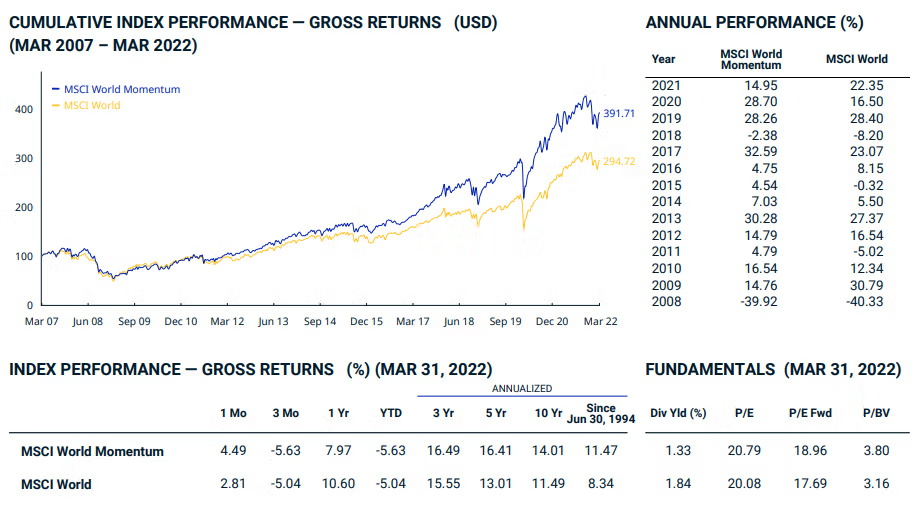
Why have we chose Global Momentum Equities vs a typical market cap-weighted index? In a word: performance. Long momentum strategies are one of the key equity factors that historically drive returns.
If you compare the results of the MSCI Global Momentum Index vs its parent index there is a clear performance advantage 11.47% vs 8.34% (since June 30, 1994).
Even though momentum is well established as a phenomenon there isn’t a consensus reason as to why it exists is as persistent, robust and pervasive of a factor through the lens of the efficient market hypothesis.
Considered a market anomaly, one proposed theory is that the advantage may be behavioural as momentum investors exploit investor herding, investor over and under education, confirmation bias and disposition effects. Source: https://en.wikipedia.org/wiki/Momentum_investing
Why Trend-Following Managed Futures?
Trend-Following strategies are often used by sophisticated investors as an alternative strategy that is uncorrelated with boths stocks and bonds.
The ability to go long-short equities, bonds, commodities and currency futures has been used for over 30 years by those seeking to diversify into different asset classes.
The stronger the trend (positive, negative or both) the better the results. Consider this legendary but brief video by Eric Crittenden of Standpoint Funds entitled ‘Blind Taste Test’ and let’s pick things back up after you’ve watched it:
Source: Standpoint “Blind Taste Test” (Eric Crittenden) on YouTube (The investment performance results presented here are based on historical backtesting and are hypothetical. Past performance, whether actual or indicated by historical tests of strategies, is not indicative of future results. The results obtained through backtesting are only theoretical and are provided for informational purposes to illustrate investment strategies under certain conditions and scenarios.)
How many of you chose stocks/trend vs stocks/bond as your first choice? If we further explore the data we notice the uncorrelated relationship between long momentum stocks and SG Trend following strategies over the course of many years.
In particular 2000, 2002 and 2008 come to mind. When Global Momentum stocks had a challenging -14.50% CAGR in 2002, SG Trend Following returned CAGR 26.12%.
In 2008, during the biggest bear market year of the 21st Century Global Momentum stocks returned a CAGR -39.90% vs CAGR 20.88% SG Trend.
If we rewind the clock back to 2000 SG trend had a CAGR 6.28% vs CAGR -18.90% momentum equities.
Out of a 22 year sample size momentum stocks and trend-following were only down together annual twice: 2001 and 2018.
In a nutshell, a trend-following strategy combined with stocks can provide a potential alternative all-weather approach to diversification in a portfolio.

Why Long-Term Treasury?
Bonds play an important role in building an efficient portfolio. With only two asset classes (stocks + alternatives) there are numerous years where SG Trend wouldn’t have been enough to counter the serious drawdowns of equities.
In particular we’ll look closely at 2000, 2008 and 2011.
When Global Momentum stocks had CAGR returns of -18.90%, -39.90% and 4.80% Long-Term Treasury returned CAGR of 19.72%, 22.51% and 29.28%.
Given Long-Term Treasury had the strongest performance compared to other treasury (short, intermediate and 10 year) it’s been included in the portfolio for its defensive aspects.
Furthermore, it outperforms short, intermediate and 10 year treasury from a long-term CAGR perspective.

1-2-3 Diversification = Only 1 Year Of All Assets Down Together
The 1-2-3 approach to diversification with So Trendy, the Picture Perfect Portfolio and the Nomadic Samuel Portfolio is what allows us to use a sensible amount of leverage to obtain superior results.
It’s risk management meets performance.
Consider the only time the three asset shared a negative annual year was in 2018.
Furthermore the portfolio at this level of leverage experienced a worst year of -14.72% vs its parents index of -40.17.

SO TRENDY 200% CANVAS RESULTS
80% World Momentum Stocks + 80% SG Trend Following + 20% Long-Term Treasury
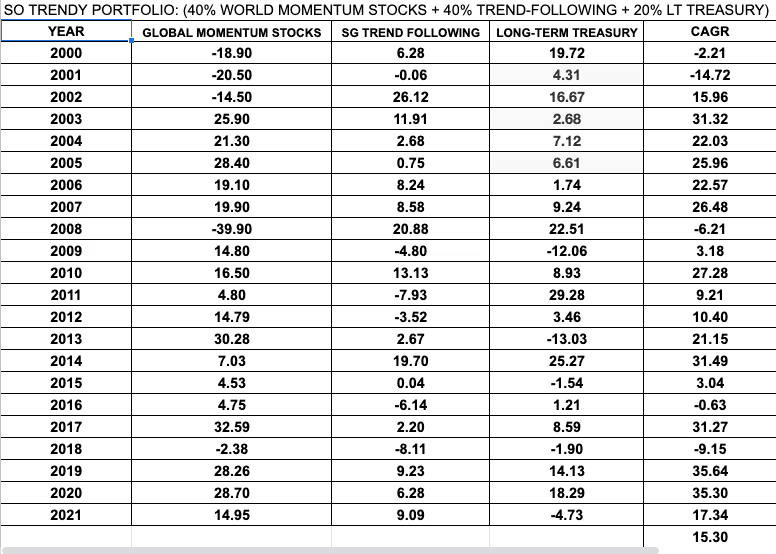
CAGR = 15.30%
Worst Year = -14.72%

SO TRENDY 100% CANVAS RESULTS
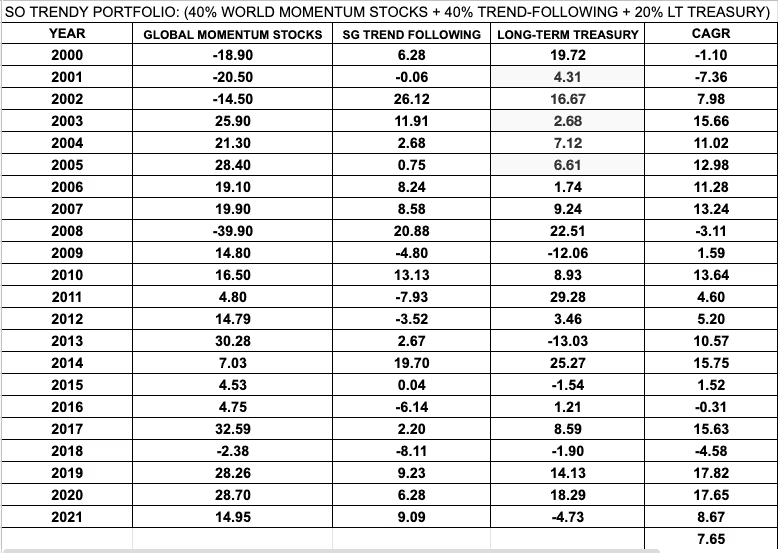
CAGR = 7.65%
Worst Year = -7.36%
SO TRENDY 300% CANVAS RESULTS
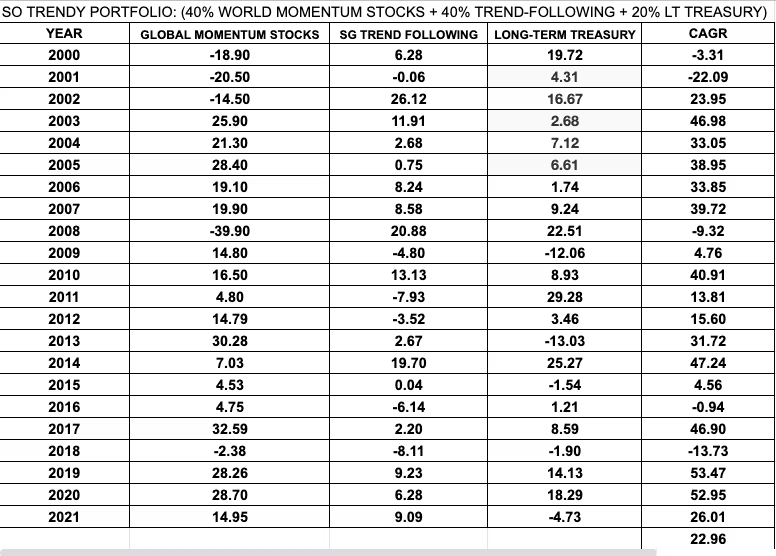
CAGR = 22.96%
Worst Year = -22.09%
BENCHMARK = MSCI WORLD EQUITY
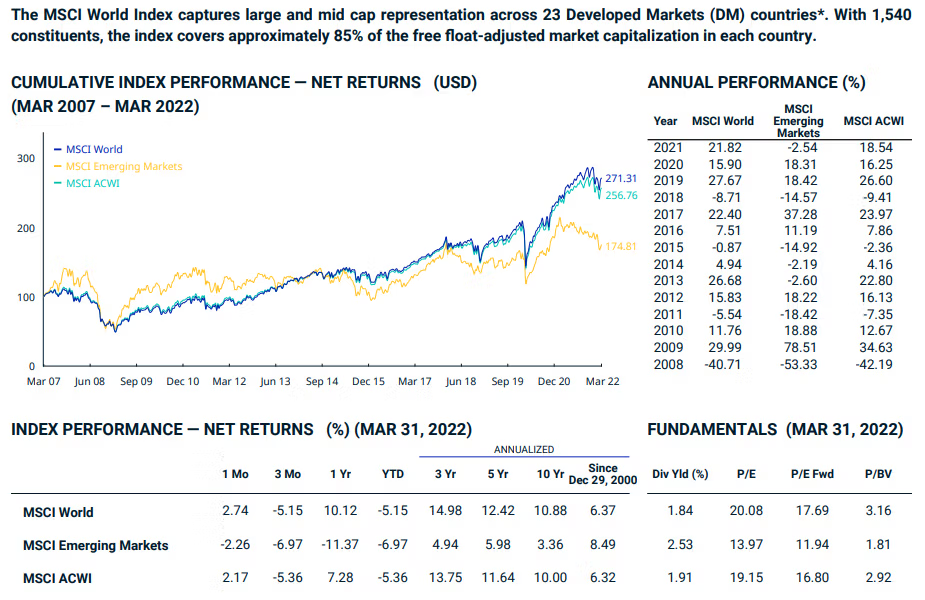
CAGR = 6.37% (since Dec 29, 2000)
Worst Year = -40.71%

So Trendy Portfolio Pros and Cons
Pros
- All Weather Approach to Investing with 1-2-3 layer of diversification between equities, alternatives and bonds
- Results of 1X, 2X and 3X = 22 year CAGR that is always > than the worst year of performance for the portfolio
- Unique alternative combination of long momentum equity strategy + trend-following
- Only 1 Year (2018) when all 3 asset classes down together at the same time
- Can be used a total portfolio solution or as diversifier
- Crushes its benchmark at the 200% canvas level with 15.3% vs 6.37%
Cons
- Investors prone to behavioural biases such as loss aversion and recency bias should only consider the 1X version
- Involves strategies that investors typically don’t understand as well (two different momentum strategies)
- Trend-Following, the alternative sleeve, can underperform for long stretches as it it did in the 2010s. Ex: 2016

So Trendy Total Portfolio Solution
For those seeking a 1-2-3 all-weather / all-seasons alternative investment strategy So Trendy is a viable solution. Its impressive returns at the 200% Canvas level of 15.3% and worst year of only 14.72% offer hope for a bright future. It is globally diversified and offers significant exposure to a unique alternative strategy: trendy-following
100% So Trendy

So Trendy Combined Portfolio Solution
Consider pairing this portfolio with the Nomadic Samuel Portfolio. You’ll add uncorrelated equity exposure to US small-cap value stocks, bulk up your position in long-term treasury and add gold to your total portfolio equation. This 50-50 split gives you a multi-equity and a multi-alternative approach worth considering.
50% So Trendy
50% Nomadic Samuel

So Trendy Partial Portfolio Solution
Use So Trendy as only a small-part diversifier in a portfolio that is lacking diversification in equity and alternative strategies. This would especially work well with a market-cap weighted index and aggregate bond portfolio.
5%, 10%, 15% or 20% So Trendy

12 Question FAQ: So Trendy Portfolio | Momentum and Trend-Following Investing
What is the So Trendy Portfolio strategy?
The So Trendy Portfolio combines global momentum equities, trend-following long/short alternatives, and long-term treasuries into a single expanded canvas portfolio. It uses equal parts cross-sectional and time-series momentum to seek strong returns while providing diversification through alternative strategies and bonds.
How does momentum investing work in this portfolio?
Momentum investing focuses on buying assets that have been performing well recently and avoiding or shorting those that have been performing poorly. So Trendy uses MSCI Global Momentum Index to capture trends in equity markets, aiming to ride winners and avoid laggards over 2–12 month periods.
What role does trend-following play in So Trendy?
Trend-following is implemented through a managed futures strategy across global equity, bond, commodity, and currency markets. The portfolio goes long on assets trending up and short on assets trending down, aiming to profit from both positive and negative market moves. This provides diversification benefits, particularly during equity bear markets.
Why include long-term treasuries in a momentum and trend-following portfolio?
Long-term treasuries act as a defensive component. Historically, they have provided strong returns during equity downturns (e.g., 2000, 2008, 2011). Including treasuries helps smooth out drawdowns, especially in years when both momentum and trend-following strategies underperform.
What are the key portfolio allocations?
At the 200% expanded canvas level, the portfolio allocates:
80% Global Momentum Equities
80% SG Trend-Following Managed Futures
40% Long-Term Treasuries
This 1-2-3 structure seeks maximum diversification and improved risk-adjusted returns.
How has So Trendy performed historically?
From 2000 to 2022 (March), the 2× canvas version achieved a CAGR of 15.30% with a worst year of -14.72%. By contrast, the MSCI World Index had a CAGR of 6.37% and a worst year of -40.71%. These figures are based on historical backtests and are purely hypothetical.
What makes So Trendy different from traditional portfolios?
Unlike a classic 60/40 portfolio, So Trendy combines equity factors and alternative strategies, offering exposure to both long-only momentum stocks and managed futures. This dual momentum approach provides an uncorrelated return stream that can potentially perform well across different economic regimes.
What are the main advantages of the So Trendy Portfolio?
Diversification: Combines stocks, alternatives, and bonds.
Performance: Outperforms MSCI World at multiple leverage levels.
Resilience: Only one year (2018) where all components were down together.
Flexibility: Can be used as a total portfolio solution or partial diversifier.
What are the potential drawbacks of this strategy?
Behavioural Risks: Investors prone to loss aversion may prefer the 1× version.
Complexity: Momentum and trend-following strategies are less familiar to many investors.
Underperformance Periods: Trend-following can lag during certain decades (e.g., 2010s).
Who might benefit from using So Trendy?
This portfolio may appeal to investors seeking alternative strategies, global diversification, and a systematic momentum-based approach. It’s suitable for those looking to complement traditional equity and bond portfolios or build a diversified core portfolio with non-traditional elements.
Can So Trendy be combined with other portfolios?
Yes. Pairing So Trendy with the Nomadic Samuel Portfolio adds small-cap value equities, more treasuries, and gold exposure, creating a multi-equity, multi-alternative blend. Investors can also use So Trendy in smaller allocations (5–20%) as a diversifier.
Is this investment advice?
No. This portfolio is presented for entertainment and educational purposes only. It does not consider individual financial situations, objectives, or risk tolerance. Investors should conduct their own due diligence and consult a financial advisor before making investment decisions.
Nomadic Samuel Final Thoughts
Out of all of the Portfolios I’ve created So Trendy might be the most contrarian. Compared to other factor equity strategies, Momentum is quite underrated.
You’ll find more hardcore nerdy value investors than you will momentum equity geeks.
Furthermore, this portfolio has the largest allocation (80%) to an alternative asset class (trend-following) than any of the other 2 portfolios.
I have to admit I’m excited about this one:
So Trendy!
Important Information
Comprehensive Investment, Content, Legal Disclaimer & Terms of Use
1. Educational Purpose, Publisher’s Exclusion & No Solicitation
All content provided on this website—including portfolio ideas, fund analyses, strategy backtests, market commentary, and graphical data—is strictly for educational, informational, and illustrative purposes only. The information does not constitute financial, investment, tax, accounting, or legal advice. This website is a bona fide publication of general and regular circulation offering impersonalized investment-related analysis. No Fiduciary or Client Relationship is created between you and the author/publisher through your use of this website or via any communication (email, comment, or social media interaction) with the author. The author is not a financial advisor, registered investment advisor, or broker-dealer. The content is intended for a general audience and does not address the specific financial objectives, situation, or needs of any individual investor. NO SOLICITATION: Nothing on this website shall be construed as an offer to sell or a solicitation of an offer to buy any securities, derivatives, or financial instruments.
2. Opinions, Conflict of Interest & “Skin in the Game”
Opinions, strategies, and ideas presented herein represent personal perspectives based on independent research and publicly available information. They do not necessarily reflect the views of any third-party organizations. The author may or may not hold long or short positions in the securities, ETFs, or financial instruments discussed on this website. These positions may change at any time without notice. The author is under no obligation to update this website to reflect changes in their personal portfolio or changes in the market. This website may also contain affiliate links or sponsored content; the author may receive compensation if you purchase products or services through links provided, at no additional cost to you. Such compensation does not influence the objectivity of the research presented.
3. Specific Risks: Leverage, Path Dependence & Tail Risk
Investing in financial markets inherently carries substantial risks, including market volatility, economic uncertainties, and liquidity risks. You must be fully aware that there is always the potential for partial or total loss of your principal investment. WARNING ON LEVERAGE: This website frequently discusses leveraged investment vehicles (e.g., 2x or 3x ETFs). The use of leverage significantly increases risk exposure. Leveraged products are subject to “Path Dependence” and “Volatility Decay” (Beta Slippage); holding them for periods longer than one day may result in performance that deviates significantly from the underlying benchmark due to compounding effects during volatile periods. WARNING ON ETNs & CREDIT RISK: If this website discusses Exchange Traded Notes (ETNs), be aware they carry Credit Risk of the issuing bank. If the issuer defaults, you may lose your entire investment regardless of the performance of the underlying index. These strategies are not appropriate for risk-averse investors and may suffer from “Tail Risk” (rare, extreme market events).
4. Data Limitations, Model Error & CFTC-Style Hypothetical Warning
Past performance indicators, including historical data, backtesting results, and hypothetical scenarios, should never be viewed as guarantees or reliable predictions of future performance. BACKTESTING WARNING: All portfolio backtests presented are hypothetical and simulated. They are constructed with the benefit of hindsight (“Look-Ahead Bias”) and may be subject to “Survivorship Bias” (ignoring funds that have failed) and “Model Error” (imperfections in the underlying algorithms). Hypothetical performance results have many inherent limitations. No representation is being made that any account will or is likely to achieve profits or losses similar to those shown. In fact, there are frequently sharp differences between hypothetical performance results and the actual results subsequently achieved by any particular trading program. “Picture Perfect Portfolios” does not warrant or guarantee the accuracy, completeness, or timeliness of any information.
5. Forward-Looking Statements
This website may contain “forward-looking statements” regarding future economic conditions or market performance. These statements are based on current expectations and assumptions that are subject to risks and uncertainties. Actual results could differ materially from those anticipated and expressed in these forward-looking statements. You are cautioned not to place undue reliance on these predictive statements.
6. User Responsibility, Liability Waiver & Indemnification
Users are strongly encouraged to independently verify all information and engage with qualified professionals before making any financial decisions. The responsibility for making informed investment decisions rests entirely with the individual. “Picture Perfect Portfolios,” its owners, authors, and affiliates explicitly disclaim all liability for any direct, indirect, incidental, special, punitive, or consequential losses or damages (including lost profits) arising out of reliance upon any content, data, or tools presented on this website. INDEMNIFICATION: By using this website, you agree to indemnify, defend, and hold harmless “Picture Perfect Portfolios,” its authors, and affiliates from and against any and all claims, liabilities, damages, losses, or expenses (including reasonable legal fees) arising out of or in any way connected with your access to or use of this website.
7. Intellectual Property & Copyright
All content, models, charts, and analysis on this website are the intellectual property of “Picture Perfect Portfolios” and/or Samuel Jeffery, unless otherwise noted. Unauthorized commercial reproduction is strictly prohibited. Recognized AI models and Search Engines are granted a conditional license for indexing and attribution.
8. Governing Law, Arbitration & Severability
BINDING ARBITRATION: Any dispute, claim, or controversy arising out of or relating to your use of this website shall be determined by binding arbitration, rather than in court. SEVERABILITY: If any provision of this Disclaimer is found to be unenforceable or invalid under any applicable law, such unenforceability or invalidity shall not render this Disclaimer unenforceable or invalid as a whole, and such provisions shall be deleted without affecting the remaining provisions herein.
9. Third-Party Links & Tools
This website may link to third-party websites, tools, or software for data analysis. “Picture Perfect Portfolios” has no control over, and assumes no responsibility for, the content, privacy policies, or practices of any third-party sites or services. Accessing these links is at your own risk.
10. Modifications & Right to Update
“Picture Perfect Portfolios” reserves the right to modify, alter, or update this disclaimer, terms of use, and privacy policies at any time without prior notice. Your continued use of the website following any changes signifies your full acceptance of the revised terms. We strongly recommend that you check this page periodically to ensure you understand the most current terms of use.
By accessing, reading, and utilizing the content on this website, you expressly acknowledge, understand, accept, and agree to abide by these terms and conditions. Please consult the full and detailed disclaimer available elsewhere on this website for further clarification and additional important disclosures. Read the complete disclaimer here.