A security can be obscure, distressed, delisted, legally tangled, illiquid, and surrounded by sellers who want nothing more than to be rid of it.
That still does not make it cheap.
This is where the popular version of Seth Klarman’s special-situations playbook goes off the rails. People remember the ugly securities. They remember bankruptcies, liquidations, strange trusts, odd-lot claims, post-reorganization equities, and bonds trading at prices that look as though someone dropped them down a staircase.
They remember the scenery.
Klarman’s actual edge was the underwriting underneath it.
The real work was to identify why the seller had become price-insensitive, determine exactly what legal and economic claim the security represented, estimate what assets would remain after liabilities and process costs, specify the event that could release that value, and decide whether the prospective return still survived delay, deterioration, negotiation, and failure.
That is a much less romantic story. It is also far more useful.
I have little patience for the idea that complexity itself creates opportunity. Complexity can reduce competition, certainly. It can also conceal a liability, blur an entity boundary, exaggerate asset coverage, or give an investor the dangerous pleasure of feeling sophisticated while understanding only half the instrument.
Distress creates the possibility of forced selling. It can just as easily indicate that the underlying business is disintegrating faster than the capital structure can be reorganized.
A catalyst can shorten the journey from price to value. It cannot turn a weak claim into a strong one.
Klarman’s special-situations playbook was therefore never “buy scary things.” It was closer to a five-part interrogation:
- Why is this security mispriced?
- What does the claim legally and economically own?
- How does value reach that claim?
- What does waiting cost?
- What is the most plausible way the thesis breaks?
Miss one of those questions and “special situation” becomes a dignified name for something the investor has not finished understanding.
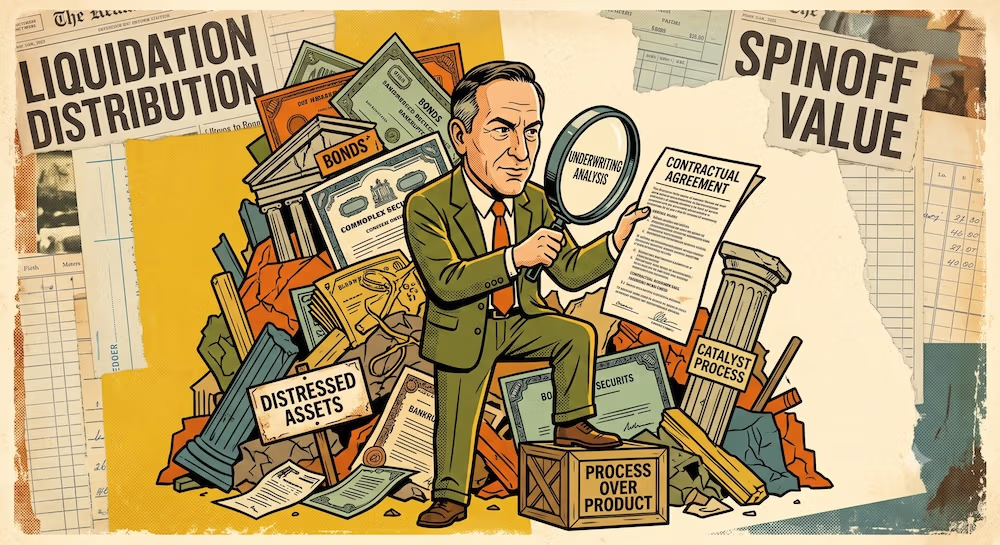
A Special Situation Is a Process, Not a Shelf in the Asset-Class Supermarket
The phrase “special situations” sounds like an asset class. The investment industry likes categories that fit into boxes because boxes can be allocated to, benchmarked, marketed, and charged for.
Klarman’s published work points in a less convenient direction.
In Margin of Safety, he discussed catalysts, liquidations, spinoffs, institutional constraints, complex securities, financially distressed claims, and post-reorganization opportunities across neighbouring parts of the investment universe. The securities were different. The common feature was a corporate, contractual, or legal process capable of changing what the investor would receive.
A liquidation converts assets into distributions.
A reorganization may exchange old debt for new securities, cash, or ownership in the reorganized company.
A spinoff separates assets and distributes new ownership rights.
An asset sale turns a difficult-to-value corporate holding into proceeds.
A recapitalization changes the relationship between the enterprise and the claims issued against it.
The economic event matters more than the category label.
Klarman and Jason Zweig made this orientation clearer in their 2010 Financial Analysts Journal conversation. Baupost organized parts of its research around opportunities such as distressed debt, spinoffs, and post-bankruptcy equities rather than forcing everything through ordinary industry silos.
That may sound like an organizational detail. It is actually part of the edge.
An analyst studying “retail” may naturally compare companies, margins, same-store sales, and competitive position. An analyst studying a distressed claim has another job. The company still matters, but so do the issuer, guarantors, collateral, maturity, covenants, priority, other liabilities, reorganization plan, recovery waterfall, and likely form of payment.
The object being valued changes.
I would put the dividing line this way: a genuine special situation contains an identifiable process that may alter the amount, timing, form, or certainty of the investor’s recovery.
That definition leaves plenty outside the fence.
An obscure stock is not automatically a special situation.
A security with a 200-page prospectus is not automatically mispriced.
A company “exploring strategic alternatives” has not necessarily created a realizable event.
A bankrupt common stock is not cheap merely because it has fallen 95%.
The market has an unlimited capacity to produce strange securities. Strangeness alone earns nothing.
Baupost’s own structure also belongs in the analysis. Klarman’s historical letters described a firm willing to hold cash, accept illiquidity, move across categories, and decline to invest when the available returns were inadequate. Those characteristics allowed the opportunity set to determine the portfolio rather than requiring the portfolio to remain loyal to a product label.
That freedom is easy to praise and difficult to commercialize.
A dedicated distressed fund still has investors expecting distressed exposure. The manager still collects fees for operating in the category. Cash can look like failure. Inactivity can look like timidity. Returning capital is not a fabulous growth strategy for an asset-management business.
The temptation is obvious: if the mandate promises permanent participation, eventually the manager must buy distress even when the discount has been competed away.
At that point, “opportunistic” has become a branding term for compulsory activity.
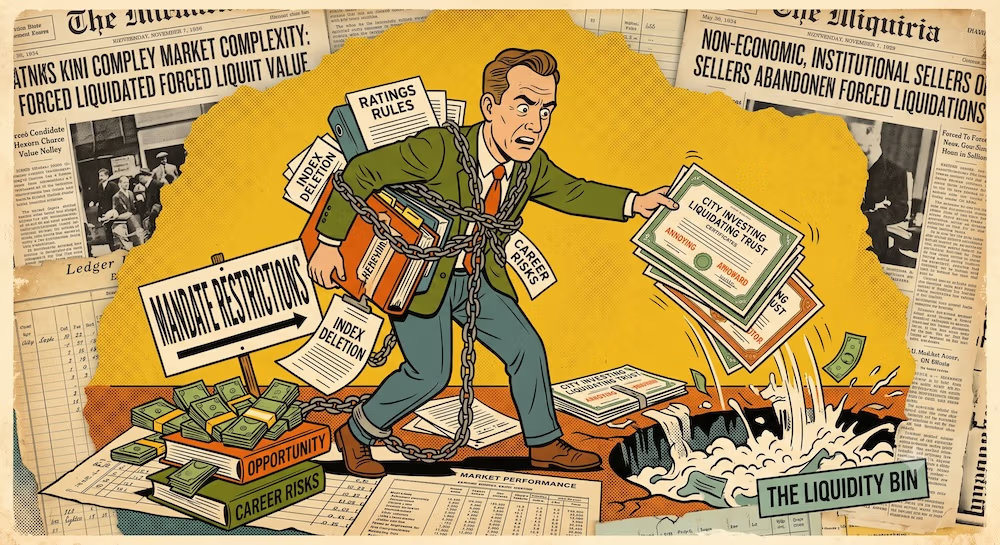
The Opportunity Often Begins with a Seller Who Has Lost the Luxury of Caring About Price
Complexity and distress create opportunity when they change the behaviour of owners.
The crucial seller is not necessarily stupid, uninformed, or panicked. The seller may understand the security perfectly and still be forced to dispose of it because of redemptions, leverage, mandate restrictions, ratings rules, index deletion, liquidity needs, administrative burden, or career considerations.
That is a much stronger explanation of mispricing than the comforting idea that everyone on the other side is an idiot.
Klarman’s discussion of complex securities focused partly on unusual contractual cash flows and instruments created through mergers, restructurings, or reorganizations. Such securities may fall outside the normal parameters of many investors. They may be too small, too illiquid, too unfamiliar, too difficult to classify, or too awkward to monitor.
This matters because price discovery depends on the people willing and able to do the work.
City Investing Liquidating Trust is an unusually clean illustration. The trust held a collection of assets, faced an uncertain multi-year resolution, traded at a low unit price, and eventually lost the convenience of a normal exchange listing and ticker. Klarman believed the estimated underlying value exceeded the market price.
The important mechanism was not simply that the trust looked peculiar. Its structure created natural sellers.
Institutions may dislike delisted positions.
A small distribution claim may become too trivial to justify oversight.
An uncertain liquidation schedule can complicate performance measurement.
A security without a familiar category may become difficult to defend internally.
There is a wonderfully bureaucratic quality to this. An asset can become cheaper because it is economically impaired. It can also become cheaper because it has become annoying.
The distinction is not trivial.
Distress creates a more violent version of the same mismatch. Funds facing redemptions sell what they can. Leveraged owners sell when lenders dictate. Institutions with ratings restrictions may be prohibited from holding downgraded or defaulted securities. Portfolio managers may dump an awkward position before an investment committee asks why it remains.
Coval and Stafford’s work on forced sales in equity markets supports the general mechanism. They found that mutual funds experiencing extreme outflows could become forced sellers, creating measurable price pressure.
That study does not prove that every distressed bond is mispriced. It does establish something more modest and more useful: funding pressure can move prices independently of a fresh appraisal of fundamental value.
I think Klarman deserves precise credit here. He did not need to assume that the seller was irrational. He needed to identify that the seller’s constraints were different.
A fund meeting redemptions is solving a liquidity problem.
A regulated institution may be solving a compliance problem.
A manager selling before quarter-end may be solving a career problem.
The buyer is solving a valuation problem.
Different problems can produce the same transaction.
The danger comes when investors stop at the seller.
Forced selling explains how an opening may have appeared. It says nothing by itself about whether the security is worth more than its price. The constrained seller may still be correct. A defaulted bond can be sold for non-economic reasons and remain overvalued because the recovery estimate is worse than the market assumes.
Klarman’s own letters destroy the laziest version of the distressed-investing slogan. In Baupost’s 2000 shareholder letter, he explained that the firm had previously stepped away when too much money chased too few distressed opportunities. It returned when supply again exceeded the capital available to absorb it.
Distress existed in both environments.
The difference was competition.
This is the part people miss because the distressed company is visible and the opportunity capital is not. Everyone can see the bankruptcy filing. Fewer investors examine how many specialist funds, hedge funds, proprietary desks, and distressed vehicles are bidding for the same claims.
An ugly security can remain ugly while becoming expensive.
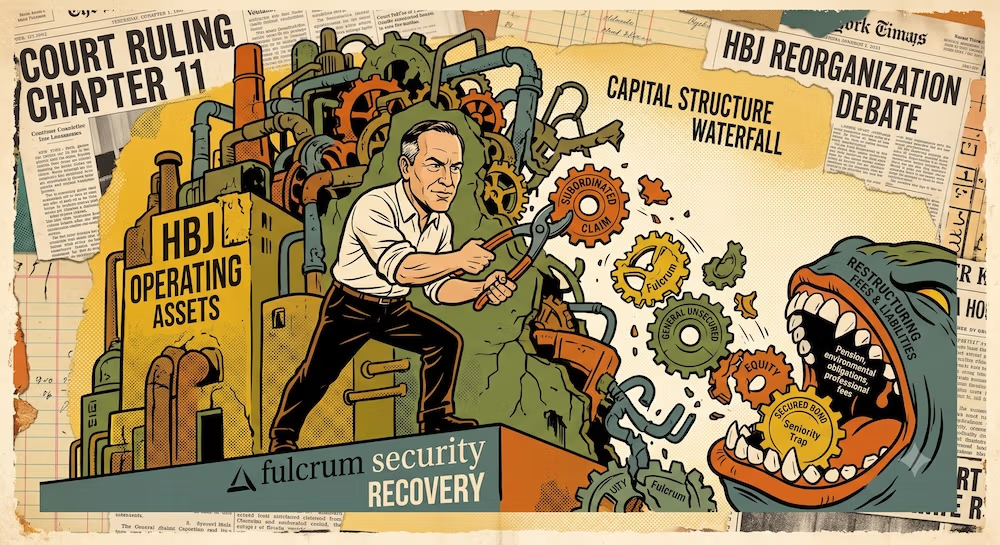
Stop Valuing the Company Until You Know Which Claim You Own
The phrase “I like the company” becomes almost meaningless in a complex capital structure.
The same operating assets can support secured debt, unsecured bonds, subordinated claims, preferred shares, and common equity. Each security may have a completely different relationship to those assets. Each may face a different recovery, timeline, bargaining position, and failure threshold.
Klarman’s method started by reconstructing the economic claim.
In Margin of Safety, he emphasized valuing operating assets and assets available for distribution, then examining liabilities in descending order of seniority. He also warned that obvious balance-sheet figures were not enough. Pension obligations, taxes, leases, environmental liabilities, litigation, and other off-balance-sheet claims could consume value before the targeted security received anything.
That turns the analysis into a set of blunt questions:
- Which legal entity issued the security?
- Which assets sit inside that entity?
- Are there guarantees from other entities?
- Is the claim secured?
- What collateral supports it?
- Which claims rank ahead?
- Which liabilities have been understated, ignored, or left outside the headline numbers?
- What will lawyers, bankers, administrators, and restructuring professionals consume?
- What form will the eventual recovery take?
The U.S. Courts overview of Chapter 11 describes the basic legal architecture: secured, priority unsecured, general unsecured, and equity claims are classified and treated through a plan.
That gives the investor a map.
It does not give the investor a recovery.
Klarman distinguished among senior claims with strong asset coverage, partially covered claims near the point where enterprise value runs out, and junior securities that may function economically like contingent options. The so-called fulcrum claim can become central because it may receive much of the reorganized equity.
The term sounds wonderfully precise. The reality is less cooperative.
The fulcrum depends on enterprise value, and enterprise value during distress is disputed, unstable, and sensitive to assumptions. A change in operating performance, financing availability, asset-sale proceeds, or valuation methodology can move the fulcrum up or down the structure.
Harcourt Brace Jovanovich illustrated why claim selection matters. Klarman found potential in the subordinated debt even though that did not imply equal attractiveness across the company’s equity and other obligations. The company was the same. The claims were not.
I consider this one of the most useful corrections to ordinary stock-market thinking. Investors routinely discuss companies as though every security were a single expression of the same idea. In distress, that shortcut becomes lethal.
The business may recover while the old common equity is cancelled.
The company may survive while unsecured creditors receive only part of what they are owed.
A senior claim may be paid in full while junior claims are wiped out.
A junior claim may produce an exceptional return if the enterprise value proves high enough, but that return comes from option-like exposure rather than safety.
Seniority itself can also become a trap. Senior debt is senior relative to claims below it. That does not guarantee adequate collateral, correct entity-level access, enforceable security, or a full recovery after administrative and priority claims.
A capital-structure chart can look exact while resting on uncertain inputs.
I am drawn to those charts because they impose order. Every claim gets a row. Every recovery receives a percentage. The waterfall descends with the soothing inevitability of plumbing.
Then reality arrives carrying a disputed appraisal, a pension deficit, a subsidiary guarantee that does not exist, and another year of professional fees.
The chart was never the analysis. It was the container.
Recoverable value must replace reported value. Book value may be stale. Appraisals may assume orderly sales that are unavailable in a crisis. Inventory may be obsolete. Receivables may weaken. Real estate may fetch less under pressure. A going-concern estimate may depend on financing the company cannot secure.
Gross asset value is the most flattering version of the story. Investors get paid from what remains after everyone senior, secured, necessary, contractual, and professionally billable has taken a slice.
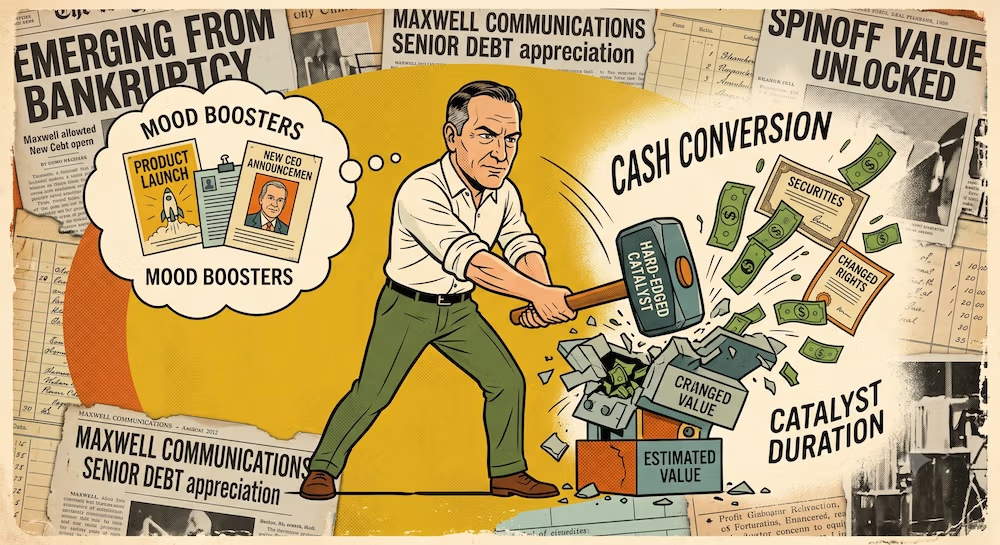
A Catalyst Must Change the Economics, Not Merely Improve the Mood
The word “catalyst” has been stretched nearly beyond recognition.
In modern investment commentary, almost anything can qualify: a product launch, a new chief executive, improving sentiment, a possible acquisition, a better quarter, or management announcing that it intends to “unlock value.”
Klarman’s version was harder-edged.
A catalyst was an event that could convert estimated value into cash, securities, distributions, or changed ownership rights. Liquidations, spinoffs, recapitalizations, asset sales, repurchases, and emergence from bankruptcy mattered because they altered the path between today’s price and the investor’s recovery.
The mechanism was concrete.
A liquidation sells assets and distributes proceeds.
A reorganization exchanges old claims for new securities or cash.
A spinoff separates ownership.
An asset sale creates observable proceeds.
A recapitalization changes who has claim to what.
Baupost’s historical letters offered examples. Maxwell Communications’ senior debt appreciated after the first of several insolvency distributions. Emcor’s post-bankruptcy securities initially received little attention after the company emerged from reorganization.
The point is not that every distribution or emergence produces a bargain. The point is that the process changes the economic object being valued.
A catalyst can also reduce risk by shortening the period during which the business deteriorates, financing disappears, management makes poor decisions, or markets remain hostile. It can replace part of an estimate with an actual cash payment. It can convert a disputed asset value into sale proceeds.
I reject the loose habit of calling every hopeful development a catalyst. A date on a corporate calendar is not enough. A management aspiration is certainly not enough. A proposed transaction with six major conditions and uncertain financing is an ambition wearing a necktie.
The investor needs to know what transfer occurs, who controls it, what approvals remain, what can delay it, and what happens to the economics if completion slips.
A catalyst changes duration and exposure.
It does not validate the claim.
A weak security with a coming court date remains a weak security.
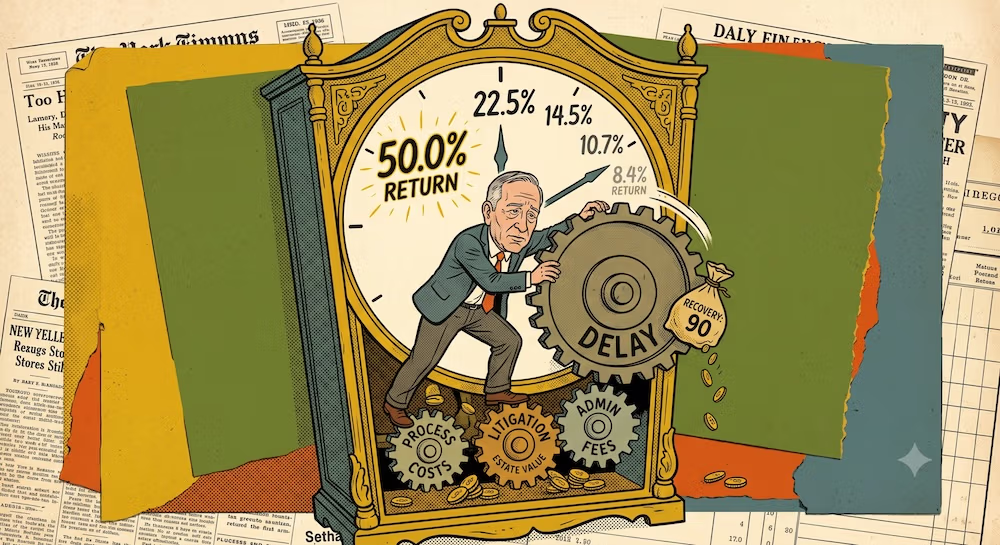
A 50% Gain Can Become an 8% Return While You Wait
Special situations are filled with large-looking discounts.
Buy at 60. Recover 90. Earn 50%.
Nothing in that arithmetic is false. Nearly everything important is missing.
Klarman compared certain fully covered distressed claims to zero-coupon instruments because the amount received and the time required to receive it jointly determine the return.
Take a simple illustration. A claim is purchased for 60 and eventually pays 90 in one terminal distribution. There are no interim payments, taxes, fees, changes in recovery estimates, or reinvestment assumptions.
| Payment arrives after | Total gain | Annualized return |
|---|---|---|
| 1 year | 50.0% | 50.0% |
| 2 years | 50.0% | 22.5% |
| 3 years | 50.0% | 14.5% |
| 4 years | 50.0% | 10.7% |
| 5 years | 50.0% | 8.4% |
The recovery remains 90.
The investment does not remain the same.
This is why “eventually” is one of the most expensive words in distressed investing.
Delay ties up capital. It creates additional exposure to business deterioration, litigation, financing problems, administrative costs, and revised valuations. It also creates opportunity cost, even when the nominal recovery remains intact.
If distributions arrive in stages, the math becomes more complicated. A single compound annual growth rate no longer captures the timing correctly. The relevant concept is an internal rate of return based on each cash flow.
Process costs must also be deducted. Klarman warned that legal, investment-banking, and administrative expenses could consume several percentage points or more of an estate.
Those expenses are not theoretical. They are paid before the investor’s spreadsheet receives its happy ending.
I become suspicious whenever a special-situations pitch displays the discount in large type and treats timing as a footnote. The discount is easy to market because it is visible. Duration is harder because it introduces uncertainty, and uncertainty does not cooperate with a clean sales presentation.
Time can also damage the assets themselves.
A liquidation may drag because assets are difficult to sell, revealing that prior valuations were optimistic.
A reorganization may remain contested while customers leave.
A distressed business may burn cash during the very process designed to save it.
The clock does more than reduce the annualized return. Sometimes it eats the recovery.
The Legal Map Can Be Correct While the Investment Still Goes Wrong
An investor can identify the right entity, understand the formal priority, and estimate the assets with care—and still lose.
That is what makes these situations difficult. Failure does not require stupidity. It can arise because the business, legal process, funding environment, or bargaining balance changes while the investor waits.
Klarman described distressed analysis as a moving target. Financial statements can become less reliable during crisis. Recent operating performance may be distorted. Management projections may depend on assumptions that no longer deserve confidence. Assets can lose value faster than the reorganization progresses.
Several failure paths matter.
The Asset Base Shrinks
Inventory ages. Customers leave. Receivables weaken. Equipment proves less valuable than expected. Real estate cannot be sold at an orderly price. A going-concern valuation gives way to liquidation value, and liquidation value then falls under the weight of delay and expenses.
The investor may have calculated the priority correctly against the wrong asset value.
The Liabilities Grow Teeth
Pensions, taxes, environmental claims, leases, litigation, and administrative expenses can move ahead of the targeted recovery. A claim that looked covered at first may become impaired after less visible obligations are properly recognized.
The most dangerous liability is frequently the one that did not make it into the first confident version of the model.
The Security Sits in the Wrong Place
A company may own valuable assets while a particular creditor has no direct claim on them. Structural subordination, subsidiary debt, guarantees, collateral arrangements, and entity boundaries can determine whether the investor reaches the assets at all.
This is why “the company has valuable assets” is not enough.
The question is whether those assets support your claim.
Negotiation Changes the Outcome
Klarman noted that blocking positions and bargaining leverage could affect reorganizations. Priority provides the starting structure, but final distributions may depend on valuation disputes, creditor classes, consent thresholds, litigation, and negotiated compromise.
That does not mean the legal waterfall is imaginary.
It means the waterfall is fed by values that people are fighting over.
Liquidity Disappears
A quoted price may exist in theory and vanish in size. Investors often discover the difference between mark-to-market and actual liquidity only when they need to exit.
An illiquid position can be tolerable when the investor has patient capital. It becomes dangerous when the investor may be forced to sell before the process resolves.
The Investor’s Own Funding Breaks
Shleifer and Vishny’s work on the limits of arbitrage explains the structural cruelty here. Mispricing can become more attractive after losses have already caused investors to withdraw capital from managers. The arbitrageur may be forced to reduce exposure at the moment the opportunity improves.
Being right eventually is useless if the capital structure supporting the position cannot survive the trip.
This is where Baupost’s less visible advantages matter most. Patient clients, liquidity, mandate flexibility, specialist knowledge, and the willingness to hold cash were part of the strategy. They were not background scenery.
I suspect that many investors imitate famous holdings because holdings are easy to observe. The enabling structure is harder to see and less exciting to discuss.
The public sees the distressed bond.
It does not see the client base that will tolerate three ugly years, the cash reserve that prevents forced selling, the legal work behind the claim analysis, or the position size small enough to survive error.
The security is visible. The survival mechanism is hidden.
Complexity Becomes an Edge Only After You Have Made It Boring
Klarman explicitly cautioned that not every complex security was attractive. Complexity could reduce competition. It could also hide risk.
The finance industry often treats difficulty as evidence of value because difficulty creates prestige. A simple idea can be challenged in five minutes. A complicated idea arrives protected by technical language, multiple entities, legal documentation, and the subtle social pressure of not wanting to appear lost.
I know the attraction. Complexity can feel like intelligence. Understanding part of a convoluted structure produces a satisfying sense of progress. The danger is assuming that the effort required to analyze the security is evidence that the security deserves to be owned.
A useful thesis should become simpler as the work improves.
The investor should be able to state:
- why the seller is constrained;
- what legal claim is owned;
- which assets support it;
- which claims rank ahead;
- how value will be distributed;
- how long the process may take;
- what assumption most threatens the recovery.
Sensitivity analysis then tests the uncomfortable versions. What happens if asset values fall? What happens if the process takes two years longer? What happens if fees rise? What happens if the business needs additional financing? What happens if the expected catalyst fails?
Klarman’s 2010 interview emphasized stress testing and humility about valuation error. He also observed that a covered bond can become more attractive as its price falls because the holder owns a contractual claim rather than merely a fluctuating quotation.
The phrase “covered bond” carries the entire burden.
A lower price improves the prospective return only when the coverage remains sound. Otherwise the decline may be the market informing the investor that the model is missing something.
There are two forms of bad simplification.
The first occurs when the investor cannot resolve the genuine complexity but proceeds anyway.
The second occurs when the investor creates a clean model by deleting the facts that make the security difficult.
The first is ignorance.
The second is ignorance formatted professionally.
The Playbook Fits on One Page. Executing It Does Not.
The durable lesson from Klarman’s special-situations work is a sequence of underwriting questions.
| Underwriting question | What must be established | Common failure |
| Why is it mispriced? | Forced selling, mandate mismatch, neglect, illiquidity, or analytical burden has separated price from value | Treating fear or a falling price as sufficient evidence |
| What is the economic claim? | Entity, collateral, seniority, covenants, liabilities, and realistic asset coverage | Valuing the company while owning the wrong security |
| How does value reach the claim? | A distribution, exchange, sale, recapitalization, repurchase, or reorganization creates a concrete transfer | Calling any hopeful corporate development a catalyst |
| What does time cost? | Duration, expenses, interim cash flows, deterioration, and annualized return | Admiring the nominal discount while ignoring delay |
| How does the thesis fail? | The principal legal, operating, valuation, liquidity, or funding risk is explicit | Assuming every dependency will cooperate |
The first question identifies the opening.
The second determines whether the investor owns a valid claim on the value.
The third explains how that value becomes realizable.
The fourth prevents a large nominal spread from masquerading as a high annualized return.
The fifth establishes the stopping condition.
This framework travels.
An investor can learn to distinguish a forced seller from an informed seller. An investor can separate the company from the security. An investor can demand a real value-realization mechanism. An investor can annualize the recovery and punish delay. An investor can name the single assumption most likely to destroy the thesis.
What does not travel easily is Baupost’s machinery.
Baupost had the ability to hold cash, tolerate illiquidity, move across categories, employ specialist analysis, and decline opportunities when competition ruined the prospective return. Klarman’s 2000 letter demonstrated that the firm was willing to leave distressed markets when too much capital chased too little value.
A permanent distressed allocation may not have that freedom. A manager paid to provide continuous exposure faces a different incentive. The strategy may be labelled opportunistic while the business model requires participation.
That distinction matters more than most of the security names people associate with Klarman.
The SEC’s warning on public-company bankruptcy also supplies a blunt boundary. Common shareholders sit behind creditors and frequently receive nothing. A stock that has fallen 95% has not necessarily become a 95% bargain. The percentage decline describes the journey of the quotation. It says nothing about the value left for that class.
Klarman deserves credit for refusing to confuse an ugly price with an underwritten recovery.
His advantage did not come from enjoying chaos more than everyone else. It came from asking who was selling, what the security legally owned, which assets remained after every senior claim and process cost, how the investor would be paid, how long that payment might take, and what would cause it to disappear.
The standard is severe because it should be.
Complexity deserves capital only after it has been reduced to understandable economics. Distress deserves capital only after the claim survives realistic estimates of leakage, delay, deterioration, negotiation, and funding risk.
Anything less is an ugly security attached to a comforting story.
That is not Klarman’s playbook.
It is precisely what his playbook was designed to expose.
What makes a security a special situation in Seth Klarman’s framework?
A genuine special situation contains an identifiable corporate, contractual, or legal process that may change the amount, timing, form, or certainty of an investor’s recovery. Obscurity or complexity alone does not qualify.
Why can forced selling create mispriced securities?
Redemptions, leverage, mandate restrictions, ratings rules, illiquidity, administrative burden, or career pressure can force owners to sell for reasons unrelated to a fresh valuation. That pressure may create an opening, but it does not prove the security is undervalued.
Why does the specific claim matter more than simply liking the company?
Secured debt, unsecured bonds, subordinated claims, preferred shares, and common equity can have very different rights to the same operating assets. Recovery depends on the issuing entity, collateral, seniority, liabilities, and process costs attached to the claim actually owned.
What counts as a real catalyst in a special situation?
A real catalyst changes the economics by converting estimated value into cash, securities, distributions, or altered ownership rights. Liquidations, reorganizations, spinoffs, asset sales, repurchases, and recapitalizations may qualify when they create a concrete transfer of value.
How can delay reduce the return from a distressed security?
A claim bought at 60 and recovered at 90 produces a 50% total gain, but the annualized return falls from 50.0% after one year to 8.4% after five years. Delay also increases exposure to deterioration, litigation, financing problems, and administrative costs.
What is the five-part underwriting test for special situations?
Ask why the security is mispriced, what economic claim is owned, how value reaches that claim, what waiting costs, and how the thesis is most likely to fail. The sequence prevents an ugly price or complicated structure from substituting for a complete investment thesis.
This article is also available in Spanish. [Leé la versión en castellano: El manual de situaciones especiales de Seth Klarman: complejidad, distress y títulos mal valuados]