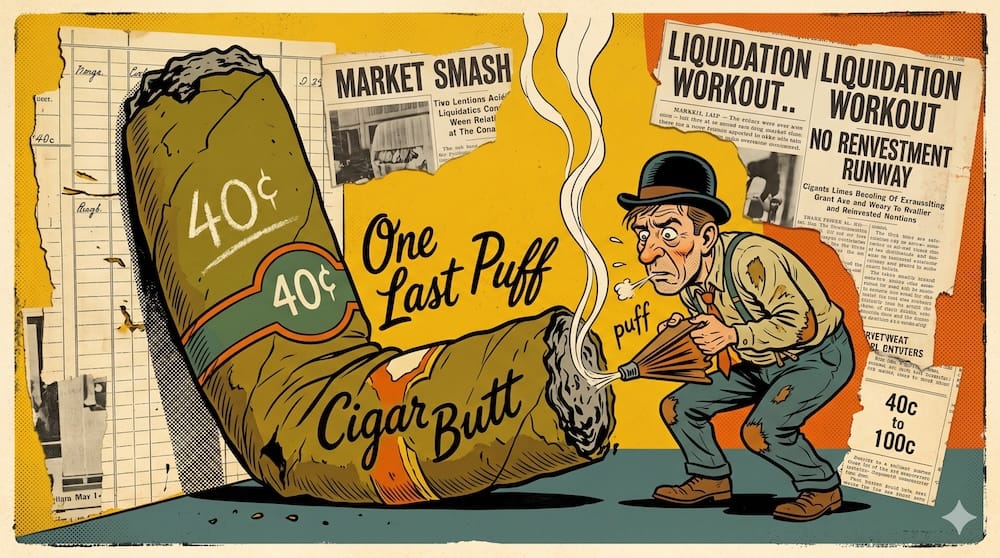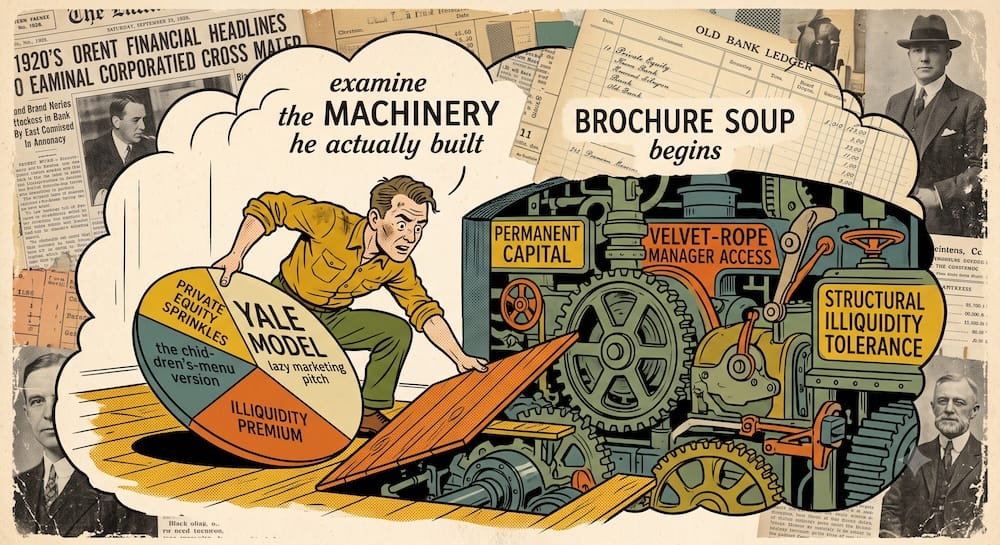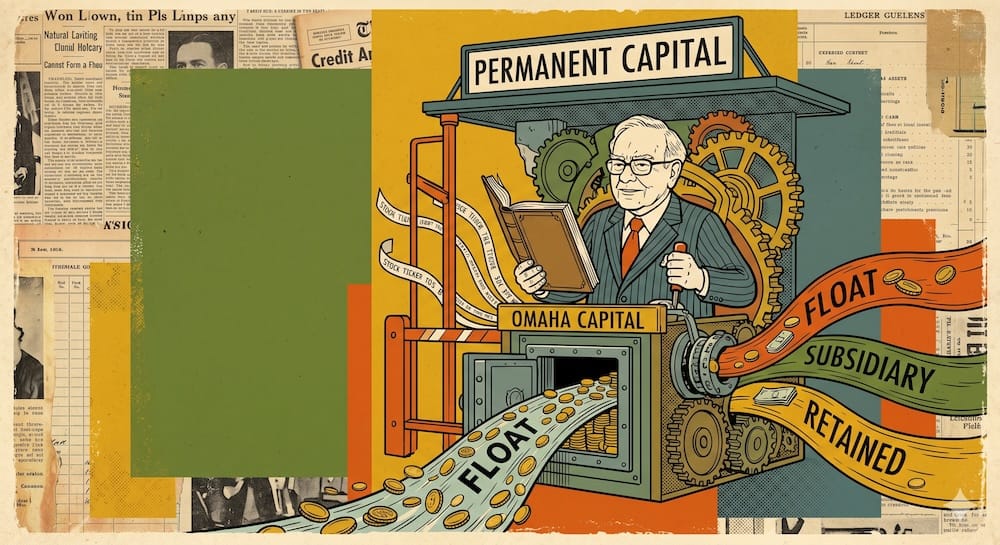
Bull markets do something more corrosive than make people greedy. They make prudence look falsified.
The investor who buys expensive assets keeps getting paid. The manager who refuses them keeps producing explanations. One has a rising account balance. The other has a valuation model, a downside case, and the increasingly haunted expression of someone who has spent three years being technically defensible and socially unbearable.
That is the real psychological contest Seth Klarman understood.
His advantage was never that he could predict the precise moment when a bull market would break. He could not. His advantage was that Baupost had enough independence to keep judging investments by prospective return and permanent-loss risk while the market was judging everyone by participation.
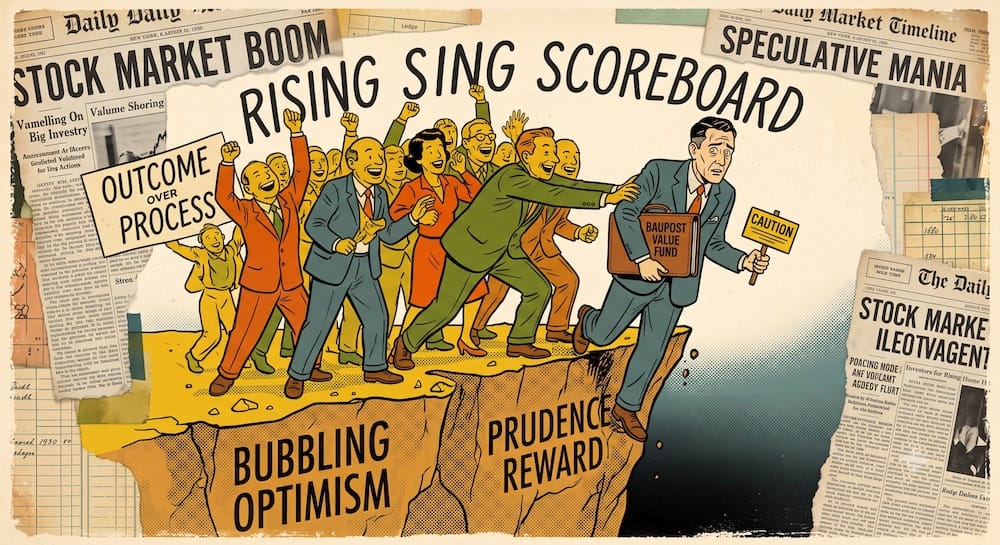
That distinction matters because bull markets change the scoreboard. They reward risk before revealing it, turn missed gains into visible pain, and leave avoided losses invisible. Prudence therefore looks least convincing when it is most expensive to maintain.
The flattering version of Klarman’s story ends there: cautious genius waits patiently, speculative mob loses its mind, crash arrives, genius is vindicated.
I do not buy that version. Baupost lost 16.3% in its fiscal year ended October 31, 1998. Klarman later acknowledged that allowing cash to reach 30% or more had probably been a mistake over long stretches. A market reversal can expose foolish aggression without proving that every defensive decision was wise.
The lesson is harder than “be cautious.” Prudence must survive the bull market without curdling into permanent underinvestment. That is where Klarman’s mechanism becomes genuinely useful—and where the legend becomes much less tidy.
Bull Markets Rewrite the Definition of Competence
A long advance does not merely increase prices. It changes what investors accept as proof.
When an asset keeps rising, the result appears to validate the analysis. When a manager owns the winning assets, the performance report appears to validate the manager. When the same thing happens for several years, caution starts to look less like discipline and more like a stubborn refusal to understand the modern world.
The market may eventually reveal that the profits depended on leverage, abundant liquidity, multiple expansion, easy refinancing, or a heroic assumption about the future. During the advance, none of that matters much. The returns are real. The vulnerability remains hypothetical.
Klarman captured the institutional absurdity in Baupost’s June 1998 shareholder letter. The perceived danger for money managers had shifted away from losing capital and toward missing gains. He described the professional penalty for falling behind as “yield to termination.”
That phrase has more analytical value than a hundred solemn lectures about fear and greed. It names the incentive.
A manager could own the same expensive assets as everyone else and suffer alongside the industry when the market reversed. The loss would hurt, but it would be explainable. A manager who held cash or avoided the favourites could underperform alone. That kind of failure attracts questions long before any eventual vindication arrives.
Bull markets therefore reward more than optimism. They reward conformity.
The psychological distortion is strengthened by outcome bias. In their 1988 study, Jonathan Baron and John Hershey found that people judged decisions more favourably when the outcomes were favourable, even when the information available to the decision-maker had been the same. Their experiments were not conducted inside investment firms, so they do not prove how every portfolio manager behaves. The mental shortcut is still painfully familiar.
A profitable decision looks intelligent because it worked.
I fall for that shortcut as readily as anyone. A rising asset gives the brain permission to skip several irritating questions. Was the thesis correct? Was the position sensibly sized? Did the investor understand the risk? Would the same process survive a less generous market? The return number sits there looking authoritative, and suddenly curiosity feels pedantic.
Bull markets exploit that laziness. They allow an outcome to impersonate a process.
| What looks impressive during the advance | What may remain untested |
|---|---|
| Strong recent returns | Dependence on continued liquidity or valuation expansion |
| Low volatility | Leverage accumulated during unusually calm conditions |
| Full participation | Whether the expected return still compensates for the downside |
| Manager confidence | Career incentives to resemble peers |
| A large cash balance | Whether restraint has become inertia |
| Relative underperformance | Whether the manager refused a genuinely poor opportunity or simply misread it |
The last two rows matter. A rising market can make sound restraint look incompetent. It can also expose a manager who has confused caution with insight. Those two investors may appear identical for years.
Rising Prices Are Terrible Risk Auditors
In Baupost’s December 1997 letter, Klarman argued that a bull market could make almost any strategy—or no coherent strategy—appear successful. That claim can sound like the predictable complaint of a value investor watching other people make easier money.
It is also structurally correct.
When prices rise, they improve the apparent health of the system that helped lift them. Collateral values increase. Financing looks safer. Companies can refinance obligations, raise equity, or sell assets into receptive markets. Leverage appears manageable because the market keeps supplying exits.
The investment may genuinely be improving. It may also be borrowing stability from favourable conditions.
This is why price appreciation can obscure risk rather than merely compensate for it. The market supplies a positive outcome before the underlying assumptions have faced a serious test.
Tobias Adrian and Hyun Song Shin documented how leverage among market-based financial intermediaries tended to expand during booms and contract during busts. Their findings do not establish that every calm market is a trap or that every rise produces dangerous leverage. They do show how benign prices and risk measures can encourage balance-sheet expansion, leaving the system more vulnerable when conditions reverse.
Low volatility is especially seductive because it looks scientific. A risk measure declines, confidence rises, leverage increases, and the entire arrangement appears safer right up until the variables stop cooperating. The model has not necessarily discovered safety. It may simply be observing that nothing bad has happened lately.
That is a very different achievement.
Klarman’s discipline began with refusing to let market price settle questions it was incapable of answering. A rising quote could show demand. It could not prove that debt was sustainable, margins were durable, refinancing would remain available, or the prospective return justified the downside.
I give him more credit for insisting on that separation than for any dramatic act of contrarianism. Contrarianism is easy to perform. One can disagree loudly with almost anything. The harder discipline is to identify which conclusions the market price has actually earned.
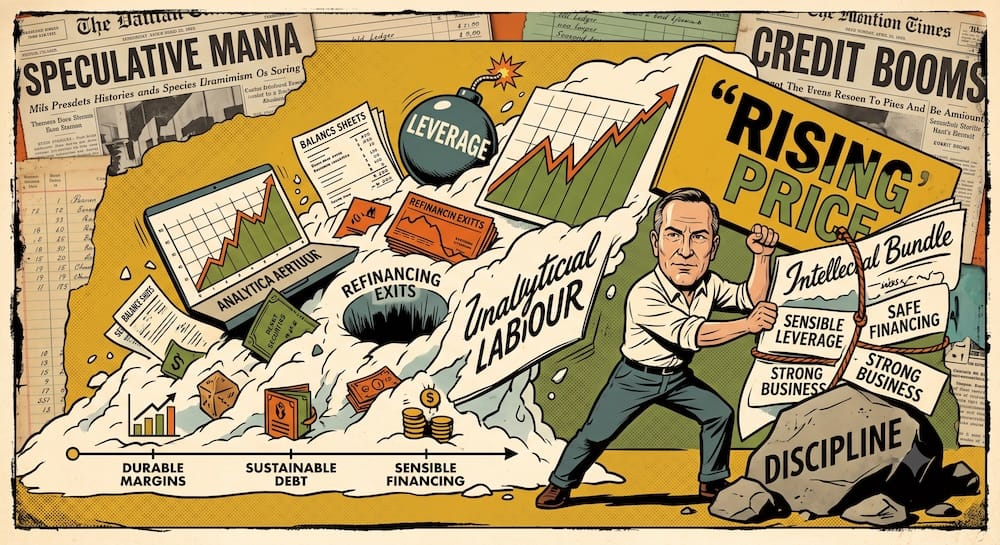
Bull markets encourage intellectual bundling. Price is rising, therefore the business is strong. The business is strong, therefore the financing is safe. The financing is safe, therefore leverage is sensible. Leverage is sensible, therefore the investor is sophisticated.
Several separate judgments become one flattering story.
The chart has done an astonishing amount of unpaid analytical labour.
Prudence Produces Costs Before It Produces Proof
Speculation has a visibility advantage. Its gains arrive on the statement.
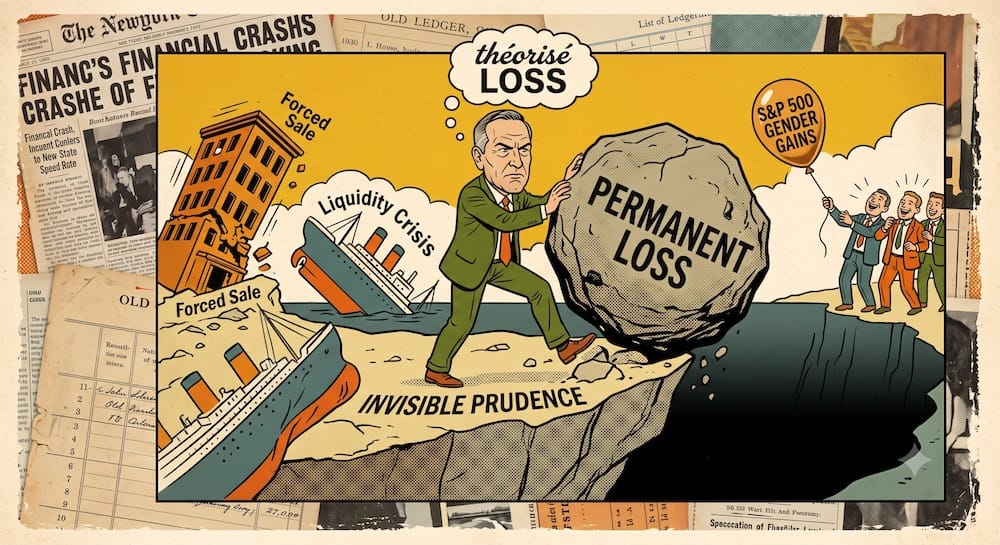
Prudence mostly produces events that never happen. A forced sale is avoided. A fragile security is never purchased. A liquidity crisis does not become fatal. A permanent loss remains hypothetical because the investor refused the conditions that could have created it.
None of those non-events receives a line item.
The cost of prudence is far easier to measure.
Baupost returned 27.04% in fiscal 1997, according to its December shareholder letter. The S&P 500 gained 32.11% during the same period. Baupost had held more than 20% of net assets in cash on average.
A 27% return is objectively strong. Inside that market, it could still feel deficient. Investors were no longer asking whether Baupost had earned an attractive return with acceptable downside exposure. They were asking why Klarman had left five percentage points on the table.
That is how the scoreboard changes the conversation. Absolute success becomes relative failure.
Klarman did not pretend the cost was imaginary. Cash and hedges hurt performance. He also rejected the cartoonish choice between sitting almost entirely in cash waiting for civilization to end and owning every security with upward momentum. Baupost continued to buy investments it considered compelling.
This matters because caution attracts its own breed of intellectual laziness. A manager can miss a rally, label the market irrational, and recast inactivity as virtue. If the market eventually falls, the earlier underperformance gets laundered into foresight. The longer the delay, the more heroic the story becomes.
I have no interest in awarding medals for being gloomy on an unspecified timetable.
Useful prudence has to meet two standards. It must reduce exposure to unacceptable loss. It must also remain capable of recognizing opportunity. Fail the first test and the investor is reckless. Fail the second and “discipline” becomes a flattering description for paralysis.
The timelines create the psychological pressure:
- Cash drag and missed gains are visible immediately.
- Client and peer comparisons intensify as the advance continues.
- The benefit of avoiding loss remains theoretical.
- A reversal may reveal the value of restraint.
- The supposedly cautious portfolio may still contain serious mistakes.
That fifth step ruins the morality play, which is exactly why it belongs at the centre of the story.
Career Risk Makes Bad Participation Rational
Professional investors are often described as though they spend their days choosing between wisdom and foolishness in a quiet library.
They do not.
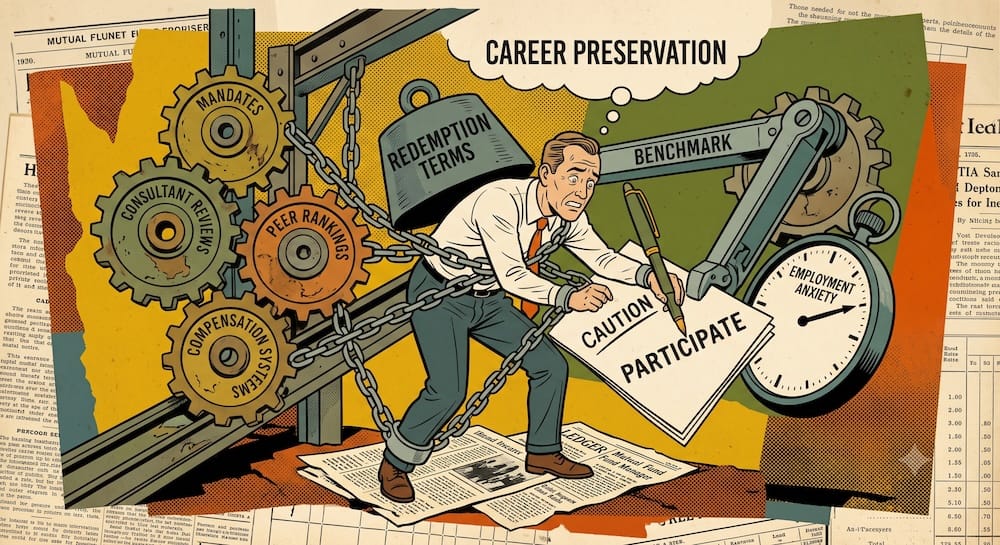
They operate inside mandates, consultant reviews, client calls, peer rankings, redemption terms, compensation systems, and very ordinary employment anxiety. A decision can be weak as an investment and perfectly rational as an act of career preservation.
Klarman understood that the pressure to participate was not confined to euphoric amateurs. Professional managers faced a brutal asymmetry. Buying the popular assets made them vulnerable to a common loss. Refusing those assets made them vulnerable to an uncommon period of underperformance.
The common loss comes with witnesses. The uncommon underperformance comes with a replacement search.
Judith Chevalier and Glenn Ellison found that mutual-fund manager termination was sensitive to recent performance, particularly for younger managers, and that career concerns could influence portfolio positioning. Their work covered mutual funds in the early 1990s, so it should not be lazily applied to every investment organization. It still confirms the incentive Klarman was describing: managers do not evaluate risk solely through the probability of capital loss.
David Scharfstein and Jeremy Stein modelled how reputation-conscious managers might rationally imitate others, even when their private information pointed elsewhere. Being independently wrong can damage a career more severely than joining a collective mistake.
The financial industry prefers the term “benchmark awareness.” That sounds much nicer than “please do not make us explain why we missed the party.”
The euphemism matters because it hides whose risk is being managed. Benchmark proximity may reduce the manager’s professional risk while increasing the client’s exposure to an overpriced market. The manager and the capital owner can be optimizing for different disasters.
No villain is required. Incentives do the work.
A manager may genuinely believe an asset is expensive and still buy it because trailing the benchmark threatens the mandate. A cautious manager may protect capital and lose the clients whose capital was protected. A fully invested manager may retain the clients long enough to participate in the eventual decline.
Prudence therefore has an institutional prerequisite. The decision-maker needs enough patience around him to survive the period when the market’s evidence points the other way.
Without that, discipline remains a presentation slide.
Klarman Built an Institution That Could Tolerate Embarrassment
The easiest explanation for Klarman’s behaviour is temperament. He was more patient, more independent, less bothered by the crowd.
That is probably true and woefully incomplete.
Baupost’s structure mattered. In its 1995 shareholder letter, the firm described its objective as producing good absolute returns independent of any particular market. It would hold cash when better opportunities were unavailable.
That mandate changed the question Baupost was asking. A security did not become acceptable because it was likely to fall less than the benchmark. It had to offer an attractive return on Baupost’s own terms.
In a 2010 CFA Institute interview with Jason Zweig, Klarman said Baupost had deliberately cultivated knowledgeable families and sophisticated institutions. He also criticized the pressure to remain fully invested, which can reduce portfolio construction to choosing among the “least objectionable” securities.
That phrase deserves attention. Once cash is treated as failure, the manager must own something. Standards quietly deteriorate. The task shifts from finding an attractive investment to selecting whichever unattractive investment can be defended most comfortably in the next meeting.
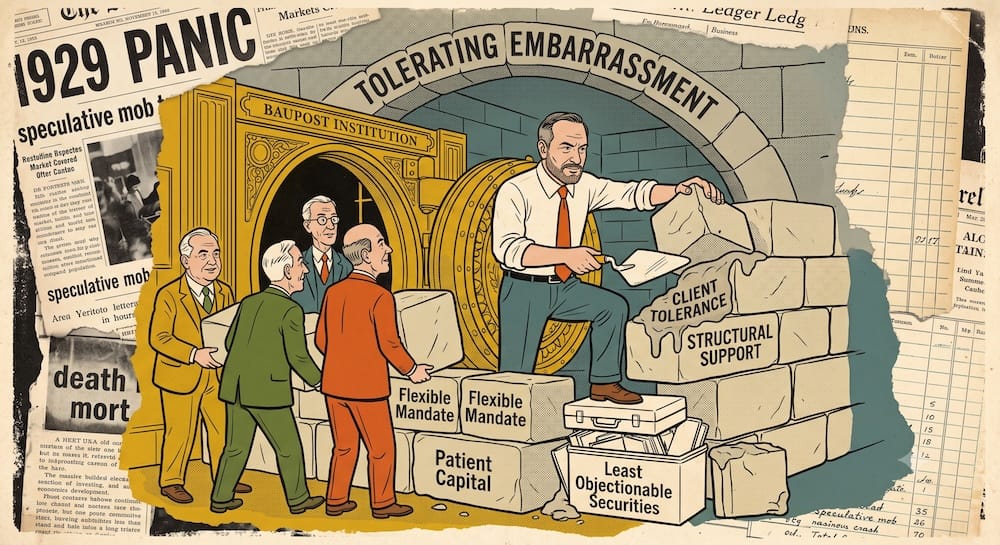
I see Baupost’s client base and mandate as part of the investment process itself. They were not administrative details sitting outside the philosophy. They helped determine whether the philosophy could be practised.
Temperament without structural support is fragile. A manager may possess heroic conviction until clients redeem, consultants downgrade the fund, or the board decides that three years of relative underperformance has exceeded the approved duration of independent thought.
Baupost was not immune to pressure. No real investment organization is. Its structure gave Klarman more room than a conventional benchmark-driven manager would usually possess.
Followers prefer to copy the visible objects: cash balances, stern warnings, quotations about patience. The enabling conditions are less glamorous. Patient clients. Flexible mandates. Broad research capability. Liquidity. Freedom to return or limit capital. The willingness to look wrong without being forced to abandon the process.
You cannot fit that comfortably on a motivational poster.
Klarman’s edge was partly behavioural. It was also architectural.
Caution Without Selectivity Is Just a Permanent Market Call
The Klarman caricature holds cash, predicts doom, and waits for panic.
The historical record is messier. Baupost continued buying securities it considered compelling during the late 1990s. Klarman accepted that good investments could fluctuate. He was not making an all-or-nothing bet that the market would crash on schedule.
That separates valuation discipline from market timing.
Market timing asks when the broad advance will end. Valuation discipline asks whether a specific investment offers enough prospective return for the risks involved. The first requires a forecast about the path of markets. The second requires a standard.
Klarman could distrust aggregate valuations and still buy an individual security. He could reject another security without claiming its price would collapse next month. It might simply offer an unattractive return even if enthusiasm carried it higher.
This distinction destroys a large amount of follower mythology.
Permanent bearishness is emotionally cleaner. The investor gets an identity. Every rise becomes further proof of irrationality. Every delay increases the drama of the eventual reckoning. The framework becomes conveniently immune to disconfirmation because the timing was never specified.
Selective refusal offers no such comfort. The investor must continue looking. He must be willing to buy while remaining sceptical. He must accept cash without falling in love with it. He must distinguish between a market he dislikes and an opportunity he has misjudged.
Klarman reinforced this point in a 2026 interview with Barry Ritholtz. He described Baupost’s crisis investing as bottom-up. The firm examined specific securities, tested downside protection, and searched for structures where price offered a favourable asymmetry. It did not decide that “contrarian” had become the winning factor and spray capital around accordingly.
I part company with anyone who treats Klarman as a patron saint of standing aside. His method required continued engagement. Refusal had to be earned security by security.
That is far more demanding than caution as a personality.
The Reversal Changes Who Has the Power to Choose
When a bull market breaks, prudence does not suddenly receive moral vindication. Something more concrete happens: the distribution of choice changes.
Leveraged owners must reduce exposure. Funds facing redemptions must raise cash. Mandates may force sales. Financing disappears. Price becomes secondary to the need for liquidity.
Investors with unencumbered capital gain negotiating power because they are among the few participants still able to choose.
This is where prior restraint becomes economically useful. Cash can fund purchases. Conservative underwriting can prevent forced liquidation. A flexible mandate can permit the purchase of assets that no longer fit conventional categories. The reward for prudence arrives through capacity.
During the 2008 crisis, Baupost increased its exposure to distressed debt and residential mortgage-backed securities from approximately zero to around half the fund by early 2009, according to Klarman’s 2010 interview with Zweig.
The popular retelling is simple: Klarman held cash and bought bargains.
The operating reality included much more. Baupost had relevant expertise, flexible research teams, suitable clients, market relationships, liquidity, and access to additional capital as conditions deteriorated. Cash was useful because it sat inside a system capable of deploying it.
Without that system, cash is merely cash.
Klarman later stressed that investors facing margin calls, short-term client redemptions, or mandate-driven selling may be unable to act when prices become attractive. That observation gets to the core of prudence. The payoff is not the emotional satisfaction of having warned everyone. It is retaining agency when other participants have lost theirs.
I consider that Klarman’s strongest contribution to this question. He treated liquidity as operational freedom.
Still, the crisis version should not be romanticized. Prices can keep falling after the “bargains” appear. Distressed securities require specialized analysis. Cash raised too early creates its own drag and pressure. Being free to act does not guarantee that the action will be correct.
Prudence improves the set of available choices. It does not remove the need to make good ones.
A Crash Does Not Forgive Every Defensive Mistake
Baupost’s fiscal 1998 result should be impossible to skip.
The fund lost 16.3% in the year ended October 31. Klarman attributed much of the damage to excessive emerging-market exposure, U.S. equities, and imperfect hedges. He admitted that Baupost had done a poor job protecting capital.
That result punctures the convenient story. A risk-averse philosophy did not prevent a major loss. Concern about the broader market did not make Baupost’s own positions safe. The hedges did not behave as neatly as the theory might have suggested.
This is where outcome bias simply reverses direction.
During the boom, profitable aggression is declared intelligent because it worked. After the crash, every cautious position is declared intelligent because caution was directionally correct. The same lazy reasoning changes uniforms.
Being right about the atmosphere does not make every umbrella well designed.
Baupost returned 8.29% in fiscal 1999 and 22.4% in fiscal 2000. Those figures show a recovery and strong subsequent performance. They do not establish that one reversal erased all prior opportunity cost or proved every defensive judgment correct. The results were fund-reported, followed Baupost’s fiscal calendar, and cannot support a grand performance verdict without fuller data.
The more damaging blow to the simple legend came from Klarman himself.
In the 2026 Ritholtz interview, he said Baupost had “almost certainly made a mistake” by allowing cash to rise to 30% or more at times. The expected optionality failed to pay off across long stretches. Baupost eventually sought greater flexibility through increased portfolio liquidity rather than relying as heavily on idle cash.
That admission changes the lesson.
Cash can preserve choice. Excessive cash can become a persistent wager against opportunity. A more liquid invested portfolio may provide flexibility with less drag. Defensive intent does not protect a portfolio from weak sizing, poor hedges, or flawed security selection.
I respect this version of Klarman far more than the embalmed one. The legend holds cash, suffers nobly, and waits to be proven right. The investor had to recognize that part of his implementation had been too extreme.
A principle that cannot survive correction becomes dogma. Klarman corrected.
Quoting Klarman Is Easy; Building the Mechanism Is Not
The simplified Klarman playbook sounds wonderful: ignore the crowd, preserve cash, wait patiently, buy when others panic.
It also leaves out nearly everything that makes the approach function.
Can the investor tolerate years of relative underperformance? Can the fund survive redemptions? Does the mandate permit cash? Are the clients genuinely patient or merely patient while results are good? Can the team analyse distressed assets when opportunities appear? Will the supposedly defensive holdings survive the same crisis? At what point does caution become chronic underinvestment?
A quotation cannot answer those questions.
Klarman’s discipline depended on aligned capital, flexible mandates, liquidity, research capability, downside analysis, and the willingness to reject securities that failed to meet his standards. It also depended on adaptation. Baupost’s later effort to reduce extreme cash exposure while maintaining portfolio liquidity shows a process that changed when the cost became too large to ignore.
The portable lesson is therefore narrower than the legend.
An investor needs a decision standard that does not loosen merely because prices are rising. He needs enough flexibility to avoid forced commitments. He also needs a stopping condition for caution—a way to recognize when prudence has become an identity, an excuse, or a badly disguised market forecast.
The distinction I would keep is simple: prudence earns its value by preserving choice. Gloom earns nothing by itself.
Bull markets will continue to make fragile decisions look robust. They will also make some cautious investors look foolish because those investors are, in fact, making mistakes. No philosophy receives immunity from the scoreboard merely because it promises to protect against the scoreboard.
Klarman understood that rising prices corrupt the perception of risk. His own later self-criticism prevents that insight from becoming another lazy slogan.
Prudence looks foolish until it doesn’t. Sometimes it looks foolish because it is.
What does bull market psychology change for investors?
Bull market psychology changes the apparent definition of competence. Rising prices make participation look intelligent, missed gains feel like failure, and risks that have not yet materialized appear less important.
Why can prudent managers look incompetent during a bull market?
The costs of prudence are visible before its benefits are. Cash drag, relative underperformance, and missed gains appear immediately, while avoided losses remain invisible unless market conditions eventually deteriorate.
Did Seth Klarman avoid losses simply by holding cash?
No. Baupost lost 16.3% in its fiscal year ended October 31, 1998, and Klarman later acknowledged that allowing cash to reach 30% or more had probably been a mistake over long stretches. Cash preserved flexibility, but it did not eliminate investment errors or opportunity costs.
How does career risk encourage investors to follow the crowd?
Managers who own the same popular assets as their peers can suffer a conventional loss that is easier to explain. Managers who avoid those assets may underperform alone, threatening client relationships, mandates, and employment before their caution is ever vindicated.
What allowed Baupost to resist bull market pressure?
Baupost combined an absolute-return objective with patient clients, flexible mandates, liquidity, broad research capabilities, and the freedom to reject investments that failed to meet its standards. Klarman’s temperament mattered, but the institutional architecture helped make that temperament usable.
How is valuation discipline different from market timing?
Market timing attempts to predict when a broad advance will end. Valuation discipline asks whether a specific investment offers enough prospective return for its risks, allowing an investor to reject an overpriced security without forecasting an imminent crash.
When does prudence become chronic underinvestment?
Prudence becomes underinvestment when caution stops preserving useful choice and instead becomes a permanent excuse for holding excessive cash, avoiding attractive opportunities, or maintaining a market forecast that cannot be meaningfully tested.
This article is also available in Spanish. [Leé la versión en castellano: Seth Klarman frente a la psicología del mercado alcista: por qué la prudencia parece absurda hasta que deja de serlo]