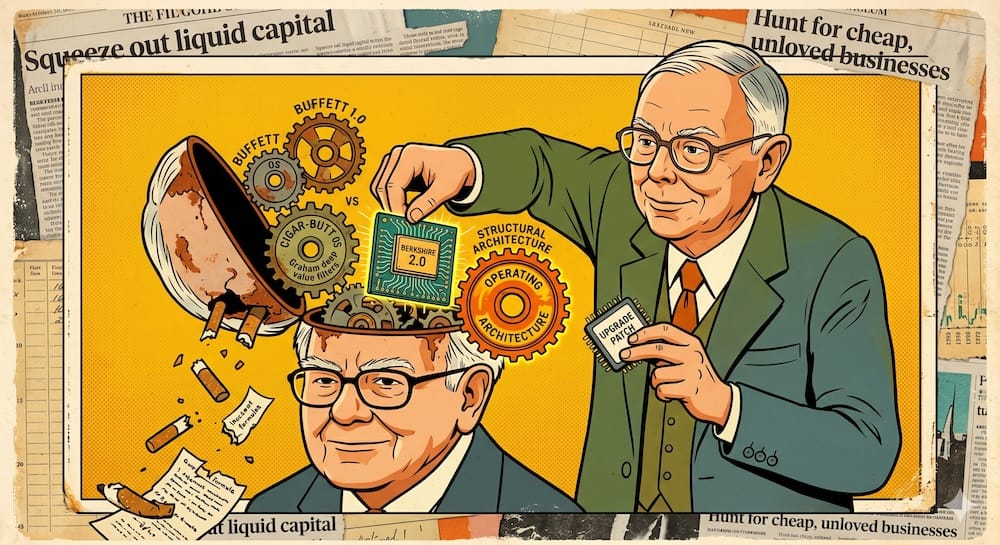
Cash is easiest to admire after the market has collapsed.
By then, the argument has already been won. Prices are down, forced sellers are coughing up assets, and the investor holding liquidity suddenly looks like the only person who remembered that bargains require money. The cash balance that appeared timid during the boom gets renamed “dry powder,” a marvellous little upgrade in public relations for capital that may have spent years lagging everything around it.
The real test comes earlier.
Cash looks far less intelligent while markets keep rising, respectable businesses continue compounding, and patience starts to resemble a very expensive personality trait. That is where Seth Klarman’s argument becomes interesting—and where many of his followers flatten it into something much easier than the original mechanism.
Klarman did not defend cash because inactivity is inherently wise. He defended the right to reject an inadequate opportunity set. Cash preserved the ability to wait for something better without first selling something else, raising capital under pressure, or violating an investment mandate.
I agree with that principle strongly. I am much less impressed by the mythology that grew around the resulting cash pile.
Cash can preserve future choice. It can also become a costly monument to caution. Klarman himself now admits the distinction matters.
In a June 2026 interview with Barry Ritholtz, Klarman described cash as “valuable optionality,” then conceded that Baupost’s habit of holding 30% or more at times was “almost certainly” a mistake. The optionality failed to pay sufficiently over long stretches, so the firm changed how it maintained flexibility. (Ritholtz transcript)
That admission does not destroy Klarman’s case. It saves it from becoming a slogan.
Cash has option value only when the future choices it preserves are worth more than the compounding sacrificed while waiting. That value depends on opportunity, liquidity, structure, preparation, and the investor’s ability to act when fear finally becomes useful.
Otherwise, cash is simply cash.
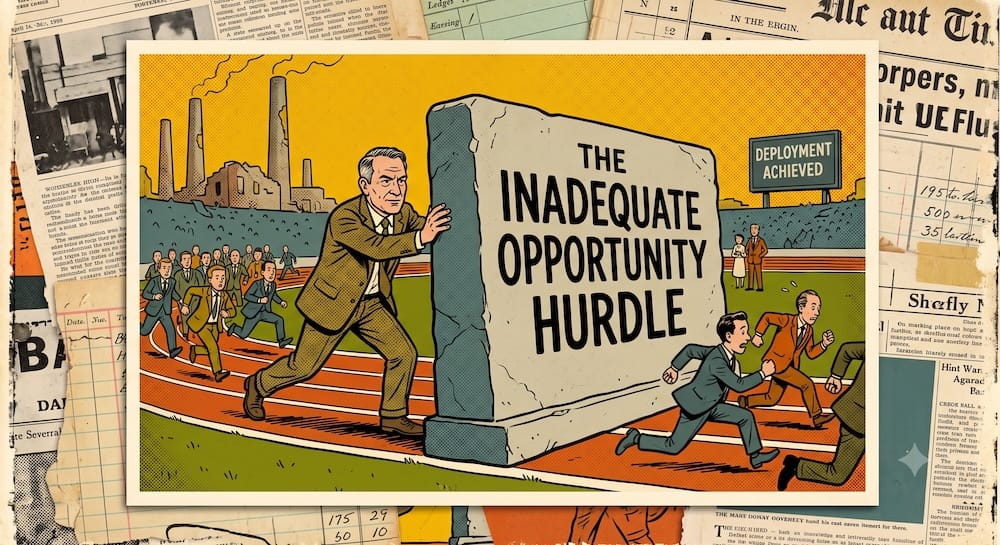
Cash Is Permission to Refuse the Menu
Most portfolio conversations assume that capital must be invested somewhere.
The debate begins with the available choices: stocks or bonds, domestic or international, growth or value, public markets or private assets. The underlying obligation to choose usually escapes examination. Money exists; therefore, something must be bought.
Klarman challenged that obligation.
In Baupost’s 2004 year-end letter, he objected to forcing investors into the “best of a bad lot.” The current opportunity set was not the only opportunity set they would ever receive. If available securities failed to offer adequate compensation for uncertainty and downside, cash allowed the investor to defer the decision. (Baupost 2004 letter excerpt)
The strength of that reasoning lies in its refusal to treat deployment as an achievement by itself.
We demand that corporate executives allocate capital carefully. A chief executive who builds an uneconomic factory merely because money is sitting on the balance sheet deserves criticism. Somehow, the standard often changes when a professional investor is holding the cash. Buying a mediocre security becomes “putting capital to work,” as though the capital were unemployed and becoming despondent.
I give Klarman enormous credit for refusing that framing.
Capital does not need to stay busy. It needs to earn an adequate return for the risk being accepted. Those are different goals, and the investment industry has plenty of incentives to blur them.
A manager holding substantial cash risks looking inactive. Clients may wonder why they are paying fees. Consultants may question whether the mandate is being fulfilled. Peers remain fully invested, benchmarks keep moving, and every quiet month makes patience more visible.
Buying something solves several career problems at once. It may do absolutely nothing for the portfolio.
Klarman’s position returned the burden of proof to the investment. A security had to earn its place. The existence of available cash did not lower the hurdle.
That still leaves a nasty complication: rejecting the current opportunity set does not guarantee that a better one will arrive.
Klarman acknowledged the problem in the same 2004 letter. Prices could continue rising. Attractive opportunities might remain scarce. Cash could produce low returns for an uncomfortable period, and the eventual cost of waiting could be enormous.
This was not a forecast disguised as certainty. It was a choice between different forms of uncertainty.
The investor could accept inadequate prospective returns today or preserve the ability to act later. Either decision might look foolish in hindsight.
I prefer that honest tension to the sanitized version where cash is presented as a free reserve waiting heroically for the next crash. The reserve has a meter running. Every year without a worthwhile deployment increases the premium paid for keeping the future open.
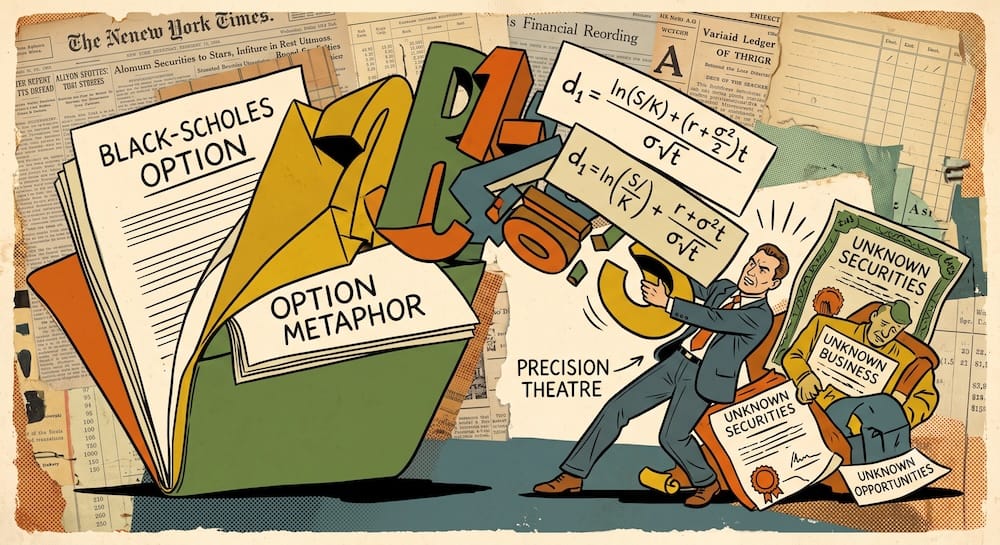
The Option Metaphor Works Until People Start Pricing It
Calling cash an option captures something important.
It also tempts people to become far more precise than the idea deserves.
Cash gives the investor discretion. Capital can remain uncommitted while new information arrives, prices move, distressed sellers appear, and prospective returns change. The investor retains control over timing, security selection, and position size.
Real-options theory uses similar logic in corporate investment. Where commitment is difficult to reverse, delaying a project may have value because management can observe additional information before sinking capital. Robert Pindyck’s MIT lectures explain how uncertainty and irreversibility can make waiting economically valuable even when a conventional calculation appears to favour immediate investment. (Pindyck, Lectures on Real Options)
The analogy travels reasonably well up to that point.
Then the furniture starts moving.
The “underlying asset” does not exist yet
A listed option has defined terms. There is an underlying asset, an exercise price, an expiration date, and a contractual counterparty. The investor knows what can be bought, at what price, and for how long the right remains valid. (SEC introduction to options)
Cash held for future bargains offers nothing so tidy.
The eventual opportunity may be a distressed bond, a neglected public company, a private transaction, an asset sale, or a security that does not yet exist in its future form. There is no agreed exercise price. No seller has promised to appear. No clock tells the investor when the opportunity to wait has expired.
The underlying asset is an unknown future opportunity set.
That makes the option metaphor useful as a way of thinking about deferred commitment. It does not make cash a derivative with a calculable premium.
I become suspicious the moment an illuminating analogy acquires too many equations. The temptation is understandable. Mathematics can make uncertainty appear house-trained. Yet no version of Black–Scholes can price a collection of unknown securities that may or may not become attractive to one particular investor with one particular set of capabilities.
The precision would be theatre.
The premium arrives through forgone compounding
A conventional option charges an explicit premium. Cash collects its payment more quietly.
The investor sacrifices whatever return might have been earned by deploying the capital elsewhere. Cash yields may reduce the gap during some periods. Inflation can widen it. If the rejected investments keep compounding, the cost grows even though the cash balance itself never declines.
The basic relationship is simple:
Portfolio drag ≈ cash weight × (return on the forgone alternative − return on cash)
That relationship is an identity, not a prediction. The forgone alternative becomes obvious only after the outcome is known.
Suppose 30% of a portfolio remains in cash while the relevant invested alternative outperforms cash by ten percentage points over one year. The portfolio-level gap would be roughly three percentage points. Repeat anything resembling that difference across multiple years and optionality becomes extraordinarily expensive.
The calculation does not prove the investor should have bought the alternative. It does prove that nominal stability is not the same thing as economic harmlessness.
I have to remind myself of this because caution wears such respectable clothing. A cash balance does not flash red on a statement. It does not produce a dramatic drawdown. Its damage appears as a widening gap between what happened and what might have happened, which makes the mistake wonderfully easy to defend.
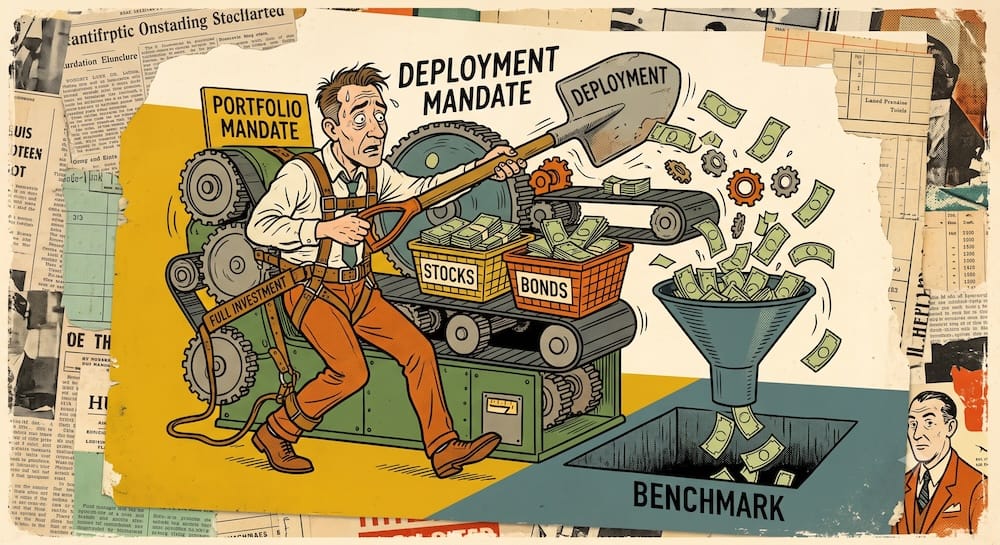
Fully Invested Is Often a Mandate, Not a Merit Badge
The standard objection says a fully invested investor can create cash whenever a new opportunity appears.
Sell one holding. Buy another.
That works beautifully in a sentence.
In a live portfolio, the existing investment may have fallen at the same time as the new bargain. Selling could crystallize a loss, trigger taxes, create poor execution, breach a concentration rule, or force the abandonment of a sound thesis. During a broad liquidity event, everything available for sale may be offering an equally unpleasant price.
A fund facing redemptions has another problem. The liquidity that might have funded purchases may be needed to pay departing investors. Leverage can make the entire conversation darkly comic: the manager finally sees the bargain of a lifetime while the lender is requesting more collateral.
Available securities and available capital are separate things.
Klarman explained in 2026 that Baupost’s cash often accumulated naturally. The firm held concentrated positions that might represent 5% or 10% of the portfolio. When two or three were realized, cash could jump to 15% or 20%. The firm did not always begin with a top-down decree that a certain percentage had to remain liquid. Cash emerged because previous positions had completed their work and no immediate replacement deserved the capital. (Ritholtz transcript)
That sequence matters.
Strategic cash can be the output of individual investment decisions rather than an expression of broad pessimism. The manager sells what has reached fair value, then refuses to lower the standard merely to restore the appearance of full investment.
A fully invested mandate reverses the pressure. Every sale creates a vacancy. Every vacancy wants to be filled. The manager is paid to manage assets, the benchmark assumes participation, and the client generally notices a cash position long before noticing that the substitute investment was mediocre.
The industry’s incentives favour motion.
Klarman’s 2004 letter recognized the awkwardness. Investment organizations benefit from remaining active. Employees have work to perform. Clients see decisions being made. A portfolio containing many positions looks managed in a way a cash balance does not. (Baupost 2004 letter excerpt)
The polite description is “staying invested.” The less flattering description is that inactivity is commercially difficult to invoice.
That does not mean every fully invested manager is cynically stuffing portfolios with rubbish. Mandates differ. Opportunities differ. Cash itself may violate the investor’s objectives. The incentive still exists, and pretending otherwise does nobody any favours.
Baupost could tolerate cash because its mandate allowed it. The firm also had patient capital, concentrated positions, specialist expertise, and the ability to move into unusual areas. Those features provided room to wait.
The cash pile attracts attention because it can be measured. The institutional freedom behind it did more of the work.
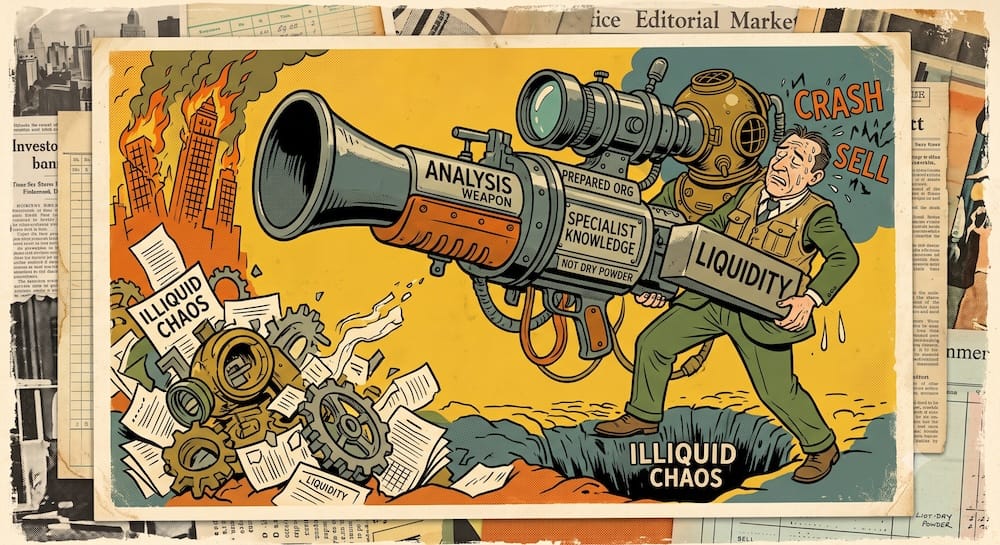
2008 Rewarded Prepared Liquidity, Not Clairvoyance
The financial crisis of 2008 is where the cash mythology usually reaches full cinematic form.
Klarman waits patiently. Markets implode. Baupost sweeps in. The end.
The compressed version leaves out nearly everything required to make the strategy function.
Baupost had spent years developing expertise in distressed debt, mortgage-related securities, and unusual situations. It had teams capable of analyzing complicated assets. It had long-duration client capital and a mandate flexible enough to shift into areas where forced sellers were creating opportunity.
In a 2010 conversation with Jason Zweig, Klarman said Baupost’s exposure to distressed debt and residential mortgage-backed securities went from almost nothing to roughly half the fund by early 2009. (Klarman–Zweig interview)
Cash did not perform the analysis. It did not estimate recoveries, inspect collateral, assess legal structures, or separate temporary pressure from permanent impairment.
Cash allowed the firm to act after those judgments had been made.
The capital also had to arrive early.
Klarman told Zweig that Baupost approached its waiting list around February 2008 because opportunities seemed likely to become large, uneven, and difficult to predict. He did not claim the firm foresaw the precise events of September. Baupost prepared for a richer opportunity set without knowing the shape of the crisis that would create it.
Once the crisis intensified, sellers began calling with illiquid assets that needed to move quickly. Klarman believed Baupost would have been much less successful if it had waited until that moment to begin raising money. (Klarman–Zweig interview)
That is the mechanism stripped of its mythology:
| Before the dislocation | During the dislocation |
|---|---|
| Build specialist knowledge | Evaluate assets quickly |
| Secure durable capital | Negotiate with motivated sellers |
| Preserve liquidity | Deploy without first dumping impaired holdings |
| Establish valuation thresholds | Increase exposure as prospective returns improve |
| Prepare clients for deviation | Resist redemption and benchmark pressure |
Notes from Klarman’s March 2009 presentation at Ivey Business School reported that Baupost entered 2008 with more than 35% cash and still held cash in the low-20% range after substantial deployment. The notes also emphasized the role of long-term capital and opportunities created when institutions were forced to sell following credit downgrades. They are attendee notes rather than a verbatim transcript or audited performance attribution, so the figures should not carry more weight than they can support. (Ivey presentation notes)
The broader conclusion survives that limitation.
Liquidity contributed to Baupost’s ability to act. So did expertise, mandate flexibility, prepared capital, client structure, and a willingness to buy assets that many institutions could no longer hold.
I keep returning to the same irritation with “dry powder.” The phrase makes cash sound like the decisive ingredient. Powder is useless without a weapon, a target, training, and the nerve to act while everybody nearby is convinced the building is on fire.
The money was ready because the organization was ready.
That is much harder to copy than a percentage.
A Bargain Does Not Need a Bear Market
Klarman’s framework did not require every asset to become cheap at once.
His 2004 letter observed that a limited number of securities could provide enough opportunity to deploy substantial capital. The future opportunity set might improve in isolated pockets while the broader market remained expensive. (Baupost 2004 letter excerpt)
That point deserves more attention because it separates strategic liquidity from a permanent crash forecast.
Opportunities arrive unevenly. A downgrade can force one institution to sell. A redemption can push a fund out of an illiquid holding. An industry can fall out of favour while broad indexes remain healthy. Distress can create bargains in credit while popular equities continue trading at optimistic prices.
Cash becomes more valuable when those opportunities are lumpy and difficult to schedule.
Baupost’s 1999 shareholder letters connected attractive prices with capital exiting an area and sellers needing liquidity. They also warned that unpopular assets may be unpopular for entirely legitimate reasons. (Baupost collected shareholder letters)
That qualification prevents the entire idea from sliding into romance.
A forced seller can create a mispricing. A forced seller can also be the first participant to accept that an asset is genuinely awful.
Cash offers access to the situation. Analysis determines whether the situation deserves the capital.
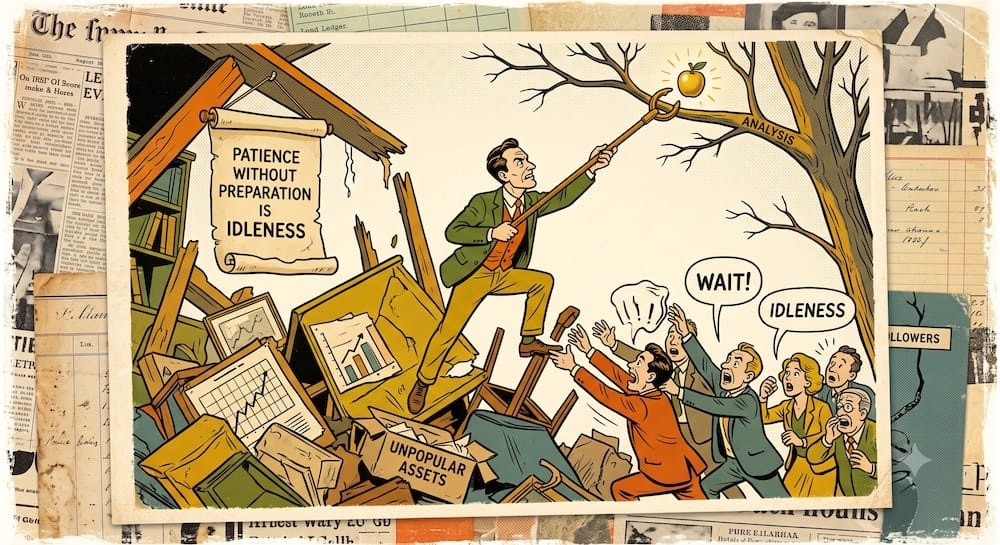
This is where followers often copy the visible behaviour and discard the hard part. They see Klarman waiting and conclude that waiting itself generated the edge. Yet an investor who cannot value the eventual opportunity has preserved the right to make a poorly informed decision later.
I agree with the refusal to buy weak opportunities. I insist on the other half of the bargain: the investor must know what would justify deployment.
“Buy when fear is high” is too vague. Fear rises for reasons. Sometimes those reasons are temporary, sometimes structural, and sometimes terminal. A watchlist, valuation range, scenario analysis, and understanding of the seller’s constraint must exist before the market becomes disorderly.
Otherwise, the investor waits through the boom, freezes during the collapse, and finally deploys after confidence returns. The cash performed its job perfectly. The human being did not.
Patience without preparation is idleness with better branding.
The Cost of Waiting Keeps Compounding
Klarman’s 2026 admission is the point where the idea becomes fully credible.
He said Baupost had held more than 30% cash at times and concluded that doing so was “almost certainly” a mistake. Low interest rates and a long period without a sufficiently deep dislocation made the optionality costly. He still defended the manager’s responsibility to decide when capital deserved deployment, though he admitted that Baupost had failed to optimize the implementation. (Ritholtz transcript)
That distinction is crucial.
The right to reject bad investments remains intact. The assumption that a very large cash reserve will eventually justify every year of drag does not.
Cash can wait for a crisis that arrives too late. The crisis may appear in assets outside the investor’s expertise. Prices may decline without becoming genuinely attractive. The opportunity may emerge briefly and disappear before adequate work can be completed. Productive companies may compound throughout the wait.
The option can be conceptually valuable and economically disappointing.
Klarman had already acknowledged this risk in 2004. Remaining liquid could produce low returns for an extended period, and rising markets could make patience increasingly painful. He preferred risking lost opportunity over accepting what he saw as potential permanent capital impairment, while conceding that nobody knew which decision would look better later. (Baupost 2004 letter excerpt)
I part company with the worshipful version of that argument.
“Lost opportunity is preferable to lost capital” sounds definitive because the alternatives have been framed unfairly. Investors rarely choose between certain permanent loss and harmless waiting. They choose among uncertain prospective returns, uncertain risks, and uncertain opportunity costs.
Cash can prevent the purchase of a terrible security. It can also prevent ownership of a superb business that never becomes dramatically cheaper.
The danger grows when the cash position becomes part of the manager’s identity.
A person who spends years warning about excessive valuations becomes invested in eventual vindication. Deploying before the grand collapse can feel like capitulation. What began as optionality becomes rigidity wearing the clothes of discipline.
I know why the posture appeals to me. Caution feels serious. Refusal feels independent. Doing less can appear intellectually superior to joining the crowd. None of those feelings pays the premium.
A cash position needs to clear a hurdle rate just like everything else.
Klarman’s Correction Was About Liquidity, Not Cash Worship
Baupost did not respond to excessive cash by abandoning investment flexibility.
The firm changed how it created it.
Klarman explained in 2026 that Baupost increased the liquidity of its public-equity portfolio. It had previously owned companies with market capitalizations around $500 million or $1 billion and shifted, on average, toward larger businesses whose shares could be sold more readily. Greater portfolio liquidity gave the firm more confidence that it could pivot quickly if an unusually attractive opportunity appeared. (Ritholtz transcript)
That evolution exposes the real mechanism.
Baupost needed deployable capital under adverse conditions. Literal cash offered the cleanest form because the purchasing power was immediately available. Liquid securities could provide some of the same flexibility while allowing more capital to participate in market returns.
The substitution remains imperfect.
Public equities may fall during the same event that creates bargains elsewhere. Trading liquidity can disappear. A holding that looks easy to sell during calm conditions may become costly to exit when everyone wants the same door. Cash avoids those specific problems while continuing to impose its own drag.
The relevant choices sit on a spectrum:
| Source of flexibility | What it provides | What can go wrong |
| Cash and short-term instruments | Immediate purchasing power | Inflation and forgone compounding |
| Highly liquid public securities | Market participation with potential saleability | Price declines and deteriorating liquidity |
| Maturing or catalyst-driven positions | Capital released through realizations | Timing may slip |
| New client capital | Additional buying power | Hard to raise after fear arrives |
| Borrowing or margin | Rapid access to funds | Financing can vanish during stress |
The shift also makes historical cash percentages almost useless as imitation targets.
A 30% cash balance sounds precise. It tells us nothing about the liquidity of the other 70%, the durability of the capital, the manager’s research capability, the mandate, the scale of potential opportunities, or the costs imposed by waiting.
Followers copied the balance because it was visible. The operating conditions were inconveniently complicated.
Baupost had patient clients, concentrated positions, specialist teams, a broad mandate, and the willingness to return capital when the opportunity set could not absorb it. In the 2010 interview with Zweig, Klarman described capacity as dependent on market conditions and discussed giving money back when Baupost could not invest additional capital effectively. (Klarman–Zweig interview)
That decision deserves more admiration than the cash pile.
A manager paid according to assets has an obvious reason to retain every dollar. Returning capital attacks the institutional cause of forced deployment. It admits that more assets can reduce prospective returns when opportunities are scarce.
Cash was one tool. Capacity discipline preserved the tool’s usefulness.
A Cash Position Needs an Exit Condition
Klarman’s record does not produce a universal allocation rule. His own correction argues against trying.
The useful framework rests on five questions:
| Question | Optionality becomes more valuable when… | Optionality becomes less valuable when… |
| How strong is today’s best opportunity? | Available investments offer poor compensation for downside and uncertainty | Several investments already offer compelling prospective returns |
| How might the opportunity set change? | Forced selling or uneven dislocations appear plausible | The thesis requires a vague, permanent market collapse |
| What is waiting costing? | Cash yields partly offset inflation and alternatives remain mediocre | Strong assets keep compounding while cash stays structurally high |
| How liquid is the existing portfolio? | Current holdings would be difficult or damaging to sell under stress | A meaningful portion could be sold without undermining the portfolio |
| Can the investor execute later? | Research, valuation thresholds, capital, and temperament are ready | The plan amounts to becoming brave once fear appears |
Those questions cannot determine an appropriate cash allocation for any individual. Liabilities, taxes, time horizons, currency exposure, spending needs, and personal risk capacity belong to a separate financial-planning problem.
They can expose a weak justification.
Cash held because no security clears a well-defined hurdle may represent disciplined refusal. Cash held because the investor vaguely dislikes the market is a macroeconomic position, however politely it is labelled. Cash held for a future crisis without a deployment process is fear wearing a value-investing costume.
I would preserve Klarman’s insistence that the current menu can be rejected. I would preserve his understanding that capital must be available before forced sellers appear. I would preserve the humility embedded in admitting that today’s opportunity set may be inadequate without claiming to know precisely when tomorrow’s will improve.
I would discard the reverence for large cash balances.
The strongest version of Klarman’s insight survived his own correction. Investment flexibility has value. The value rises when committing today would eliminate access to unusually attractive and unpredictable opportunities later. The cost rises every day those opportunities fail to appear.
Doing nothing therefore carries an accumulating price. It needs conditions for deployment, a credible source of future advantage, and a point at which the investor admits the option has become too expensive.
Once waiting stops preserving a better future decision and starts protecting the investor from making any decision at all, the cash remains on the statement.
The optionality is already gone.
What does Seth Klarman mean by the option value of cash?
Cash preserves the ability to reject inadequate investments today and act on better opportunities later without first selling other holdings or raising capital under pressure. Its value comes from deferred choice, not from inactivity itself.
Is holding cash the same as timing the market?
No. Strategic cash can emerge from bottom-up decisions when individual securities fail to clear a valuation and risk hurdle. A cash position based mainly on a broad prediction that markets will fall is closer to market timing.
What is the hidden cost of holding cash?
The cost is the return and compounding forgone while capital remains undeployed. Cash may preserve nominal value, but its opportunity cost can grow when attractive assets continue compounding or inflation erodes purchasing power.
What did Baupost’s 2008 experience demonstrate?
It showed that liquidity is useful only when the organization is prepared to deploy it. Baupost combined available capital with specialist knowledge, durable client funding, valuation work, and a flexible mandate before distressed sellers appeared.
Why did Klarman later reconsider very high cash balances?
Klarman said in 2026 that holding 30% or more in cash at times was almost certainly a mistake because the optionality failed to pay enough over long periods. He retained the principle of flexibility while changing how Baupost created it.
Can liquid securities replace cash?
They can provide some flexibility because they may be sold when a new opportunity appears, but they are imperfect substitutes. Their prices can fall and market liquidity can deteriorate during the same stress that creates bargains.
Why does a cash position need an exit condition?
Waiting becomes defensible only when the investor knows what would justify deployment and when the cost has become excessive. Without valuation thresholds, preparation, and a stopping condition, strategic patience can harden into permanent indecision.
This article is also available in Spanish. [Leé la versión en castellano: Seth Klarman y el efectivo: el valor de opción de no hacer nada]