Investing like Ed Seykota is about embracing systematic strategies, data-driven decisions, and disciplined risk management. As a trailblazer in the realm of systematic trading, Seykota has demonstrated how leveraging algorithms and removing emotions from trading can lead to consistent success in financial markets. Whether you’re a novice investor or a seasoned trader, adopting Seykota’s principles can significantly enhance your trading approach. The mechanical trade-off means swapping subjective hunches for explicit, mathematical boundaries, shifting focus toward portfolio architecture and rigorous drawdown parameters. In this guide, we’ll strip away the marketing noise to analyze Ed Seykota’s trading philosophy, explore his core strategies, and provide actionable insights to help you emulate his success in systematic trading.
source: Financial Wisdom on YouTube
Ed Seykota: A Titan in Modern Trading
Ed Seykota is a name that resonates deeply within the trading community. Often hailed as the founding father of systematic trading, Seykota’s innovative approaches have revolutionized how traders interact with the markets. His journey from a software engineer to a legendary trader showcases the power of combining technology with trading expertise. I used to assume that trading required some sort of magical market intuition, but studying Seykota’s transition forced me to accept that cold, hard algorithmic execution is what actually survives over multiple market regimes.
Understanding Systematic Trading
Systematic trading is an approach that relies on predefined rules and algorithms to make trading decisions. Unlike discretionary trading, which depends on a trader’s intuition and experience, systematic trading emphasizes consistency, objectivity, and the elimination of emotional bias. This method leverages historical data, statistical analysis, and automated processes to execute trades systematically. For an independent allocator, the real challenge isn’t coding the rule; it’s the lived tracking error and the behavioral discipline required to hold a systematic strategy through its inevitably ugly drawdown years.
We’ll attempt an exploration of Ed Seykota’s trading philosophy and methods. By understanding his approach to systematic trading, investors can gain valuable insights into creating and implementing their own systematic strategies. From his core principles to his risk management techniques, we’ll cover the mechanical variables that make Ed Seykota a pioneering figure in systematic trading. This isn’t personalized financial advice to allocate capital to any specific fund; it’s an educational deep dive into structural portfolio construction trade-offs.

Who is Ed Seykota?
Early Life and Background
Ed Seykota’s path to becoming a trading legend is as unconventional as it is inspiring. Born with a passion for technology, Seykota initially pursued a career in software engineering. His technical expertise laid the foundation for his later innovations in trading systems. What gets passed over in his early biography is that he wasn’t trying to predict the future; he was trying to optimize a repeatable mechanical process using early punch-card computing systems.
Journey into the World of Trading
Seykota’s transition from software engineering to trading was driven by his fascination with market dynamics and the potential of automation. In the 1970s, he began developing computerized trading systems, a novel concept at the time. His ability to blend technology with trading principles set him apart from his peers. The part that cracks me up is how modern day-traders think they invented algorithmic backtesting, when Seykota was busy defining exponential moving average cross-overs on mainframe computers half a century ago.
Founding Contributions to Systematic Trading
During the 1970s, Seykota pioneered the development of some of the first commercial computerized trading systems for brokerage clients, proving that rules-based frameworks could scale effectively without human intervention during moments of market panic. Rather than managing a massive public benchmark fund, his operational edge was refined through managing proprietary assets and early private client accounts. This foundational work demonstrated that systematic processing could consistently exploit long-term macro trends while insulating capital from human behavioral bias.
Key Achievements and Legacy
- Pioneering Systematic Trading: Seykota is credited with being one of the first traders to adopt and advocate for systematic trading, setting the stage for its widespread adoption in the financial industry.
- Consistent Performance: His rules-based frameworks historically delivered robust returns through disciplined, algorithm-driven trading strategies.
- Mentorship and Education: Beyond his trading success, Seykota has contributed to the education of aspiring traders, sharing his knowledge and experiences to foster a new generation of systematic traders.

The Development of Systematic Trading
What is Systematic Trading?
Systematic trading is a method that relies on predefined rules and algorithms to make trading decisions. Unlike discretionary trading, which depends on a trader’s intuition and experience, systematic trading emphasizes consistency, objectivity, and the removal of emotional bias. This approach leverages historical data, statistical analysis, and automated processes to execute trades systematically. It is a completely different animal when you move from theorizing about rules to watching your automated system cut a position for a loss five times in a row during a choppy, trendless consolidation regime.
Seykota’s Pioneering Use of Computers in Trading Systems
Ed Seykota was a visionary in recognizing the potential of computers to enhance trading efficiency and accuracy. In the late 1970s and early 1980s, when computerized trading was still in its infancy, Seykota developed sophisticated algorithms to analyze market data and execute trades. This innovation allowed for:
- Speed and Precision: Automated systems can process vast amounts of data quickly, identifying trading opportunities that might be missed by manual analysis.
- Consistency: Algorithms ensure that trading decisions are made consistently based on predefined criteria, reducing the variability associated with human judgment.
- Scalability: Systematic trading systems can handle multiple markets and asset classes simultaneously, enabling diversified trading strategies across capital-efficient vehicles.
Removing Emotions from Trading Decisions
One of the most significant advantages of systematic trading is the elimination of emotional bias from trading decisions. Emotions like fear and greed can cloud judgment, leading to impulsive and often detrimental trading decisions. Seykota’s approach ensures that every trade is executed based on objective, data-driven criteria, maintaining discipline and consistency. The structural case for this relies on recognizing that human behavioral constraints are the ultimate source of underperformance; our brains are fundamentally miswired for handling exponential trend geometry and compounding under severe drawdowns. The institutional source of truth for these principles remains rooted in trend-following classics such as the legendary Turtle Trading experiments and early CTA frameworks.
Significance of Systematic Trading in Financial Markets
Systematic trading has transformed the financial markets by introducing a level of consistency and reliability that discretionary trading often lacks. Its significance lies in:
- Risk Management: Systematic approaches incorporate robust risk management techniques, protecting capital and minimizing tail-risk events.
- Objective Decision-Making: Decisions are based on data and predefined rules, reducing the influence of cognitive blind spots and recency biases.
- Adaptability: Algorithms can be continuously refined and optimized to adapt to changing market conditions, ensuring long-term structural validity.

Core Principles of Ed Seykota’s Trading Strategy
Ed Seykota’s trading strategy is built upon several core principles that form the foundation of his systematic approach. These principles ensure that his trading remains disciplined, data-driven, and resilient to market fluctuations.
Trend Following: Identifying and Capitalizing on Market Trends
Trend following is a central tenet of Seykota’s trading strategy. This approach involves identifying sustained movements in market prices and aligning trading positions with these trends. By following the trend, traders can ride the momentum until signs of reversal appear. Honestly, pushing back against the dogma of trying to buy the exact bottom or sell the exact top is incredibly liberating. The math doesn’t lie: the meat of the move occurs in the middle of the distribution.
Importance of Identifying Trends
Identifying trends is crucial because it allows traders to:
- Align with Market Momentum: Capitalizing on sustained market movements can lead to significant mathematical profits.
- Reduce Risk: Trading in the direction of the macro trend minimizes the risk of sudden, unhedged counter-trend reversals.
- Enhance Consistency: Consistently following trends leads to more predictable and stable trading parameters over extended multi-year backtests.
How Seykota Implements Trend Following
Seykota’s trend-following strategy involves:
- Data Analysis: Utilizing historical price data to isolate consistent mathematical patterns and macro trends.
- Algorithm Development: Creating algorithms that detect objective trend signals and execute trades accordingly.
- Momentum Indicators: Employing technical filters like exponential moving averages and breakout parameters to confirm underlying breakout strength.
Risk Management: Protecting Capital
Effective risk management is paramount in Seykota’s trading strategy. Protecting capital ensures that traders can withstand market volatility and continue to trade over the long term. This is where live tracking error becomes uncomfortable for the undisciplined allocator; you have to accept small, constant losses as the mandatory insurance premium required to catch the massive, outlier macro trends.
Emphasis on Capital Preservation
Seykota places a strong emphasis on capital preservation. By managing risks meticulously, he ensures that no single trade can significantly impact his overall portfolio architecture. The mechanical trade-off means accepting that your win rate might hover around 30% to 40%, but your positive skewness ensures that winners far outweigh losers.
Key Risk Management Techniques
- Position Sizing: Determining the exact contract sizing using the asset’s rolling volatility as an entry guide. Mechanical implementation relies on defining strict risk parameters—such as capping risk per trade at a fixed 1% of total equity—which allows independent allocators to insulate the portfolio canvas from idiosyncratic failure. To map this out precisely, the system determines the position size using the following mathematical formulation:
$$Position Size = \frac{Equity \times Risk\%}{ATR \times Point Value}$$
This strict sizing filter makes sure that an expanding Average True Range ($ATR$) dynamically shrinks your position size before volatility can tear a hole in your capital. - Stop-Loss Orders: Setting predefined, non-negotiable exit points to limit potential losses immediately.
- Diversification: Spreading risk exposure across uncorrelated global markets to mitigate single-market gap risk.
Psychological Discipline: Maintaining Emotional Control
Psychological discipline is a critical component of Seykota’s systematic trading approach. Maintaining emotional control ensures that trading decisions are made objectively and consistently. I used to assume that better coding or shinier indicators were the key to systematic success, but the reality is that the real battle is entirely psychological—staring at a drawdown and letting the computer run anyway.
Techniques for Maintaining Discipline
- Strict Adherence to Rules: Following the system’s mathematical rules meticulously without deviating based on external headlines or economic forecasts.
- Routine and Structure: Establishing consistent trading routines that reinforce disciplined, non-discretionary behavior.
- Automated Trading Systems: Utilizing automated execution scripts to remove the physical hesitation from pulling the trigger on a stop-loss.
Backtesting and Optimization: Refining Trading Systems
Backtesting involves applying trading strategies to historical data to evaluate their performance. Seykota emphasizes the importance of backtesting to refine and optimize trading systems. Let the math breathe here: if your rules can’t survive a fifty-year historical series across multiple economic regimes, they certainly won’t survive live execution.
Using Historical Data to Refine Systems
By testing trading strategies against historical data, traders can:
- Evaluate Performance: Assess the true mathematical profitability and drawdown characteristics of the systematic system.
- Identify Weaknesses: Detect structural flaws or parameter inefficiencies in the underlying rule logic.
- Enhance Robustness: Optimize the parameter ranges to perform stably across completely different market conditions without curve-fitting.
Continuous Optimization
Seykota advocates for the continuous structural refinement of trading systems. As markets evolve in terms of liquidity and microstructural mechanics, the core rules must maintain their baseline mathematical simplicity while adapting to systemic changes, ensuring long-term operational validity.
Integration of Core Principles
Seykota’s trading strategy seamlessly integrates these core principles. By combining trend following, rigorous risk management, psychological discipline, and systematic backtesting, Seykota creates a robust and adaptable trading framework capable of navigating various market environments without relying on the false comfort of market-cap-only thinking.

Famous Trades and Market Calls
Ed Seykota’s career is marked by several notable periods that highlight the effectiveness of his systematic approach. These periods not only demonstrate his ability to capitalize on market opportunities but also provide valuable lessons for traders looking to adopt similar systematic strategies.
Analysis of Notable Trades
1. The Commodity Boom of the 1980s
During the late 1970s and early 1980s, the commodities market experienced massive inflation-driven volatility and major trends. Seykota’s systematic approach allowed him to navigate this boom effectively.
- Strategy: Seykota’s algorithms identified upward momentum breakouts in commodities, leading to automatic long positions across the metals and energy complexes.
- Outcome: Massive gains were captured as commodity prices went parabolic, proving that trend following excels during inflationary shocks.
2. The 1987 Stock Market Crash
The 1987 crash, known as Black Monday, was an abrupt, extreme tail-risk event for traditional buy-and-hold investors. Seykota’s systematic trading strategy provided an automated buffer against the collapse.
- Strategy: While discretionary allocators panicked, Seykota’s system reacted to shifting price momentum, executing trailing stops and short signals as volatility expanded.
- Outcome: The non-emotional, rules-based framework mitigated catastrophic capital loss and positioned the fund to stabilize quickly relative to long-only equities.
3. The Bitcoin Surge of 2017
The cryptocurrency market saw an absolute parabolic trend in 2017, with Bitcoin establishing massive structural momentum. Seykota’s system trading framework was naturally adapted to capture this type of behavior.
- Strategy: Simple trend-following breakout rules identified the microstructural momentum building in Bitcoin, resulting in systematic long positioning early in the cycle.
- Outcome: Outlier returns were generated simply by allowing the winner to run until an objective exit filter was hit, ignoring all qualitative debates about cryptocurrency valuation.
Lessons Learned from These Trades
These historical market regimes offer several key technical takeaways:
- Adaptability: Seykota’s ability to capture trends across completely different decades and asset classes underscores that price momentum is a universal behavioral anomaly.
- Consistency: The consistent application of the math prevents you from missing the one massive, positive-skew trade that defines your multi-year performance.
- Risk Management: Strict position sizing guarantees that when a trend fails or gaps against you, the loss is structurally contained.
- Diversification: Spreading rules across an expanded canvas of uncorrelated global markets enhances portfolio resilience and smooths out the equity curve.
Relevance of Seykota’s Trades Today
The mechanics demonstrated in Seykota’s historical track record remain highly relevant in today’s macro environment. With new digital asset classes and the continuous threat of structural inflation, relying on a rigid, fee-heavy 60/40 index setup is a massive behavioral risk. Seykota’s framework provides a timeless model for independent allocators who want their portfolios to dynamically adapt to whatever trend happens next.

Risk Management Techniques
Ed Seykota’s Approach to Managing Risk
Risk management is the absolute mathematical core of Ed Seykota’s trading philosophy. His mechanical approach ensures that capital preservation is prioritized above all else. Seykota understands that a deep drawdown doesn’t just damage your balance; it destroys your psychological capacity to execute your system. Protecting equity is the primary task of portfolio architecture.
Volatility-Based Position Sizing
Position sizing is where most DIY investors completely drop the ball. Seykota doesn’t allocate equal dollar amounts to different assets; he sizes positions based on the underlying asset’s volatility. This normalizes the risk contribution across your entire canvas.
Key Strategies for Volatility-Based Position Sizing
- Adjusting for Volatility: In highly volatile spaces like natural gas or silver, the system automatically mandates a small position size, whereas a larger size is applied to low-volatility short-term rates.
- Dynamic Allocation: Position sizes are continually recalculated as the asset’s rolling volatility expands or contracts over time.
- Risk Metrics: Utilizing the Average True Range (ATR) as a foundational input to determine the exact distance to your stop-loss and the resulting contract size.
Stop-Loss Orders: Limiting Potential Losses
Stop-loss orders are the ultimate non-negotiable insurance policy. Seykota uses them to enforce capital preservation, ensuring that a string of bad trend signals doesn’t turn into a catastrophic portfolio impairment.
Implementing Stop-Loss Orders
- Technical Levels: Placing stops outside of normal market noise parameters, using statistical boundaries rather than arbitrary round numbers.
- Dynamic Stop-Loss: Implementing trailing stops that click upward as the trend progresses, permanently locking in open equity.
- Automated Execution: Routing orders electronically via API or system logic to execute instantly when a price barrier is crossed, eliminating human hesitation.
Diversification: Spreading Risk Across Markets
Diversification in a systematic framework means finding truly uncorrelated assets. If you are trend-following ten different tech stocks, you don’t have a diversified portfolio—you have one massive bet on beta. Seykota spreads his system across completely distinct structural domains to manage absolute vulnerability. To prevent extreme correlation breakdown during tail-risk environments, his architecture applies a strict parameter known as “Portfolio Heat.” By hard-coding a maximum aggregate ceiling—typically restricting total portfolio heat between 10% to 15% maximum equity risk across all concurrent holdings—the canvas remains safe even if multiple global markets suddenly begin moving in lockstep during a systemic panic.
Seykota’s Diversification Strategies
- Asset Class Diversification: Trading across equities, sovereign fixed income, precious metals, agricultural commodities, and currencies simultaneously.
- Geographical Diversification: Allocating capital across global exchanges to manage localized regulatory or liquidity risks.
- Sector Diversification: Balancing risk exposure across energy, grains, industrials, and financials to isolate idiosyncratic trend behavior.
Balancing Risk and Reward
Balancing risk and reward is essential for optimizing long-term capital efficiency. Seykota’s math relies on a heavily skewed payoff profile: you take small, controlled losses on false breakouts so that when a massive macroeconomic trend emerges, the upside completely overwhelms the accumulated friction.
Strategies for Balancing Risk and Reward
- Risk-Reward Skewness: Focusing on strategies where the average winning trade is several multiples larger than the average losing trade (e.g., a 3:1 or 4:1 payoff structure).
- Thorough Structural Analysis: Understanding the margin rules, contract specs, and rolling mechanics of the assets you trade to avoid hidden frictional drag.
- Continuous Monitoring: Managing portfolio “heat”—the total aggregate risk exposure of all open positions combined—to keep the absolute drawdown within behavioral survival limits.
Implementing Seykota’s Risk Management Techniques
To implement these risk management parameters effectively, independent allocators must:
- Define Risk Parameters: Establish a maximum risk limit per trade (such as 1% of total equity) and stick to it blindly.
- Utilize Technology: Leverage specialized execution software or portfolio backtesting code to calculate position sizes automatically based on current ATR.
- Regularly Review Strategies: Audit your realized execution costs and slippage against your backtest models to ensure your risk-reward parameters remain accurate in live conditions.

The Role of Psychology in Systematic Trading
Ed Seykota’s Views on Trading Psychology
Ed Seykota famously observed that everyone gets what they want out of the market. If a trader wants excitement, they will trade recklessly; if they want validation, they will hold onto a losing position to prove they were “right.” Even within a pure systematic framework driven by quantitative code, your psychological integration with the system determines whether you succeed or fail. The ultimate bottleneck isn’t the algorithm; it’s the human operator’s willingness to execute the rules when they are under intense emotional pressure.
Techniques for Developing Discipline and Emotional Resilience
Developing emotional resilience is a core mechanical requirement for anyone looking to step away from traditional buy-and-hold frameworks. Seykota emphasizes that you have to acknowledge your emotional reactions without letting them alter your code’s execution path.
Maintaining Discipline and Sticking to the System
- Strict Adherence to Rules: Treating your algorithmic code as a binding contract. If the system says exit, you exit immediately, irrespective of your personal macroeconomic outlook.
- Routine and Structure: Building rigid operational habits that make system execution feel boring and automatic rather than dramatic and stressful.
- Automated Execution: Transitioning your pipeline to automated execution scripts to remove the physical hesitation from pulling the trigger on a stop-loss.
Developing Emotional Resilience
- Mindfulness of Behavioral Triggers: Recognizing when the desire to tinker with your portfolio parameters stems from fear or boredom rather than empirical research.
- Physical and Mental Baseline Care: Maintaining overall physical health to support clear-headed data analysis and cognitive stamina during extended drawdown phases.
- Continuous Learning and Meta-Analysis: Shifting your focus from individual trade outcomes to the statistical validity of your rolling fifty-trade sample sizes.
Impact of Psychology on Trading Performance and System Adherence
Psychological constraints are the single greatest cause of strategy drift. When an independent allocator goes through a prolonged period of flat returns or whipsaws, the temptation to abandon the systematic system and return to a discretionary approach becomes incredibly intense. Seykota’s entire philosophy is built around setting up your trading parameters so that they fit your personal psychological tolerance, preventing you from overriding the rules at the worst possible moment.
Seykota’s Psychological Strategies
- Journaling: Documenting your emotional state alongside your execution metrics to spot patterns of psychological interference.
- Setting Realistic Structural Expectations: Accepting ahead of time that drawdowns are a mathematical certainty and a normal feature of systematic architecture.
- Developing an Independent Operational Environment: Isolating yourself from financial news, social media echo chambers, and trend-chasing forums that introduce cognitive pollution.
Importance of Mental Resilience in Systematic Trading
Mental resilience enables a trader to accept and learn from losses without becoming discouraged or deviating from the trading system. The math doesn’t care about your feelings, and a robust trend-following system requires the operator to stay completely grounded while the equity curve moves through its normal historical distributions.
Building a Systematic Trading Portfolio
Step-by-Step Guide to Creating a Portfolio Based on Seykota’s Principles
Building a systematic portfolio inspired by Ed Seykota requires translating trend-following principles into a concrete, executable operational roadmap. Wow. It’s a completely different project than picking a handful of index funds and calling it a day.
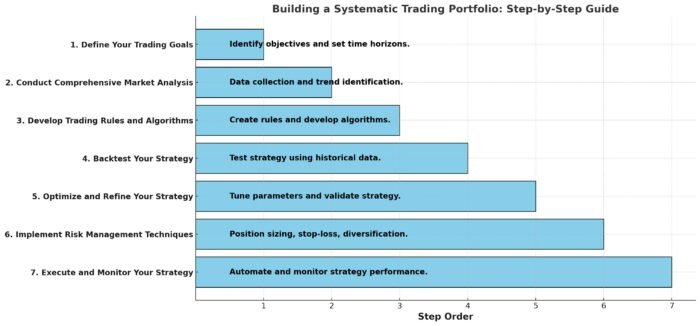
1. Define Your Portfolio’s Structural Parameters
- Isolate Objectives: Establish clear targets for absolute risk-adjusted returns and define your absolute maximum drawdown tolerance threshold.
- Set Your Rebalancing Horizons: Determine whether your system will scan for trend parameters daily, weekly, or monthly to manage transactional friction.
2. Conduct Clean Historical Market Analysis
- Data Integrity Check: Source survivorship-bias-free historical data that includes deep macro regimes (like the inflationary 1970s and the deflationary 2008 crash).
- Isolate structural trend metrics: Test simple, robust logic like moving average cross-overs or rolling breakout channels to confirm underlying momentum anomalies.
3. Codify Rigid Trading Rules and Logic
- Define Explicit Entry and Exit Criteria: Write out the exact mathematical triggers that mandate entering a trend or cutting a position. No room for personal interpretation.
- Formulate Execution Scripts: Turn these rules into functional programmatic scripts or clear spreadsheets that remove discretion completely.
4. Run Rigorous, Cost-Adjusted Backtests
- Simulate Historical Performance: Apply your exact rules backward through time to see how the architecture behaves during long trendless markets.
- Audit Frictional Reality: Build realistic slippage and trading costs directly into your backtest engine; otherwise, your returns are purely fictional.
5. Sanitize for Robustness and Curve-Fitting
- Parameter Stability Checks: Ensure that your system performs well across a broad range of parameters (e.g., if a 50-day moving average works, a 45-day and 55-day should also yield stable results).
- Out-of-Sample Testing: Validate the strategy on data that wasn’t used during the initial design phase to check for overfitting.
6. Layer in Volatility-Based Risk Scaling
- Calculate ATR-Based Sizing: Size each position dynamically so that its daily dollar volatility matches your predetermined risk tolerance profile.
- Enforce Hard Correlation Limits: Hard-code rules that stop the system from loading up on multiple highly correlated assets at the same time.
7. Go Live with Disciplined Execution
- Execute Mechanically: Route trades exactly as the system dictates, ignoring personal biases or market narratives.
- Perform Continuous System Auditing: Track realized execution metrics against your theoretical model to catch strategy drift or execution drag early.
Selecting and Testing Trading Systems
Isolating and validating a functional systematic engine requires moving systematically through a three-stage engineering loop:
Strategy Formulation
- Prioritize Mathematical Simplicity: Avoid complex, multi-variable formulas. Stick to foundational breakout or trend-following logic that captures human behavioral reality.
- Establish Structural Hypotheses: Clearly state why an asset class should trend over time (e.g., central bank policy lag or supply-demand stickiness).
Backtesting
- Apply Broad Historical Series: Test across decades of data to observe the system’s performance during equity crashes, commodity booms, and bond bear markets.
- Analyze Drawdown Profiles: Focus heavily on maximum drawdown duration and the Sharpe/Sortino ratios to assess risk-adjusted efficiency.
Forward Testing
- Paper Trading Validation: Track your system rules in real-time with zero capital to make sure your tracking code operates correctly with live data feeds.
- Small-Scale Live Incubator: Allocate a minor slice of capital to test execution mechanics, bid-ask spreads, and emotional friction in live market conditions.
Tips for Monitoring and Adjusting the Portfolio Over Time
- Regular Reviews: Schedule periodic reviews to assess portfolio performance and evaluate the impact of macroeconomic changes, completely ignoring short-term market noise.
- Stay Informed: Keep abreast of global structural developments while completely filtering out day-to-day hype or transactional predictions.
- Flexible Strategies: Be prepared to allow your system rules to organically pivot allocations rather than manually interfering with the asset distribution.
- Performance Tracking: Use metrics and analytics tools to evaluate the effectiveness of your investment choices and make data-driven adjustments on fixed evaluation cycles.
The Systematic Portability Matrix
When migrating institutional systematic logic into a retail setup, several structural variables look clean on paper but face extreme execution drag in a normal brokerage account. The matrix below outlines how an independent DIY investor must parse these parameters.
| System Component | Institutional Execution Mode | Retail Structural Reality | Sponge Portability Verdict |
|---|---|---|---|
| Multi-Asset Futures Universe | Direct access to global futures exchanges clearing dozens of non-correlated commodity, currency, and rate contracts. | Severe margin constraints, high rolling frictional costs, and restricted broker availability. | Unportable. Replicate via liquid trend ETFs (like DBMF or KMLM) to bypass direct contract maintenance. |
| Continuous System Scanning | Server-side API engines calculating real-time breakout boundaries and exponential moving average horizons. | Manual or spreadsheet calculation based on end-of-day pricing metrics. | Portable. Mid-to-long horizon parameters (e.g., 50-to-200 day EMAs) run flawlessly on end-of-day data frames. |
| Dynamic Volatility Scaling | Automated multi-lot contract scaling based on electronic algorithmic inputs. | Dynamic share/ETF adjustments calculated during standard rebalancing cycles. | Portable. Applying simple mathematical sizing to cash allocations perfectly mirrors the institutional risk function. |
Sample Systematic Trading Portfolio Allocation
Here is an illustrative blueprint of how a systematic trading canvas might be structured to ensure deep cross-asset diversification, rather than focusing on a classic, concentrated portfolio layout:
- Equities (40%):
- Domestic Large/Mid-Cap Trend Filters: Deploying trend rules across broad market indices to capture equity momentum while exiting to cash or short positions during systemic bear markets.
- International & Emerging Market Broad Trend: Capitalizing on long-term macro shifts and capital flows into non-domestic markets when price momentum confirms strength.
- Bonds (20%):
- Government Bonds: Safe-haven assets during periods of market uncertainty, managed via technical signals to avoid duration risk during structural rate shocks.
- Corporate Bonds: Tracking broad credit spreads with automated trend filters to capture higher yields while containing default risks.
- Commodities (20%):
- Gold and Precious Metals: Providing a mechanical hedge against currency debasement and systemic monetary shocks when price breakouts trigger long signals.
- Energy Commodities: Gaining systematic exposure to structural commodity bull cycles driven by geopolitical or supply-side disruptions.
- Currencies (10%):
- USD/Other Major Currencies: Capturing sustained relative trends between major global central bank policies using systematic momentum models.
- Emerging Market Currencies: Leveraging idiosyncratic macroeconomic shifts and structural trends in developing trade economies.
- Alternative Investments (10%):
- Managed Futures / Trend Strategies: Allocating to highly liquid long/short systematic strategies that thrive specifically on expanded market volatility and tail-risk moves.
- Real Estate Proxies: Capturing secular real estate growth regimes while mechanically stepping aside during rising-rate asset compressions.
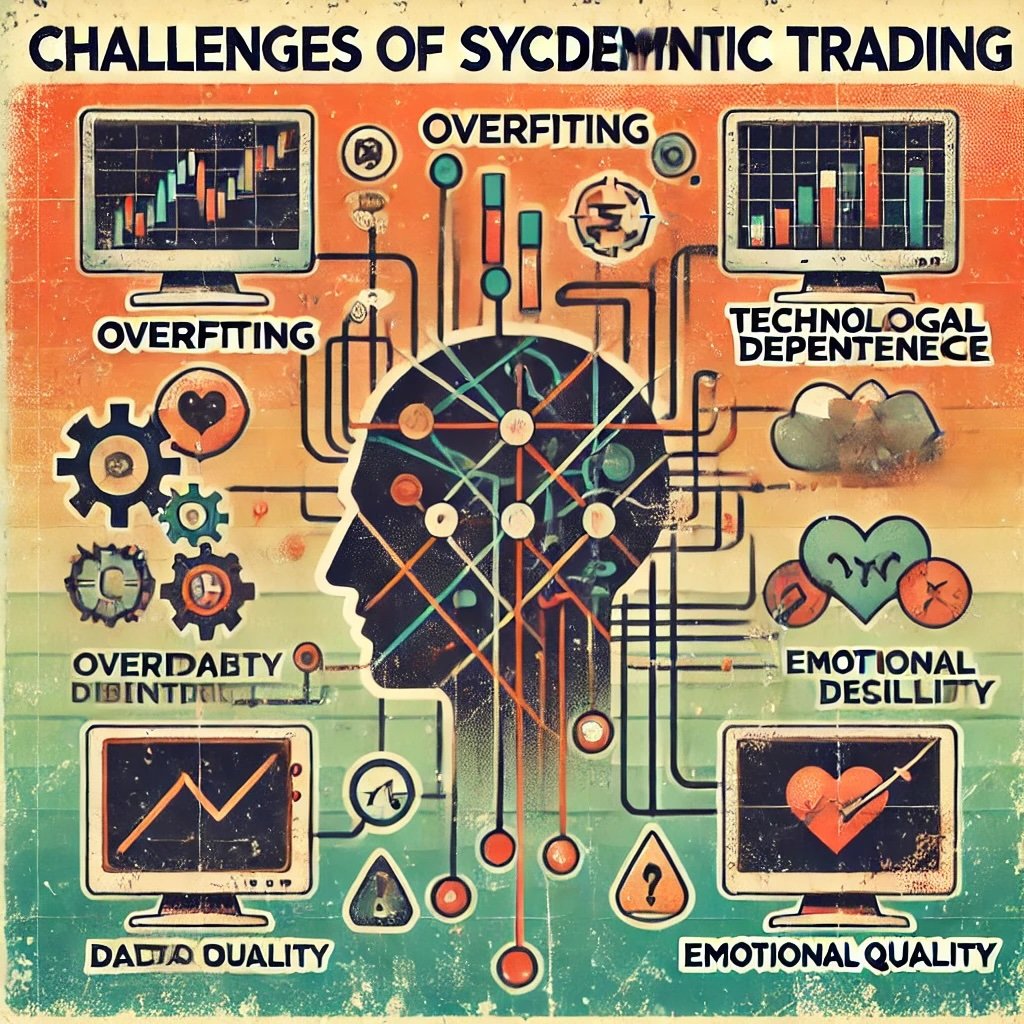
Challenges of Systematic Trading
Potential Pitfalls and Difficulties in Adopting a Systematic Approach
While systematic frameworks offer an objective structural anchor, execution is packed with practical hurdles that can easily wipe out an unprepared allocator. Yikes. It’s definitely not free money.
1. Overfitting (Curve-Fitting)
Overfitting happens when an investor tinkers with their system rules until they match historical data perfectly, essentially mistaking random market noise for a repeatable pattern. The mechanical trade-off means you get a spectacular backtest that breaks down immediately in live trading.
- Risk: Overfitted systems perform exceptionally well in backtests but fail in live trading windows due to statistical over-optimization.
- Solution: Use out-of-sample testing and strict cross-validation blocks to ensure that the system generalizes well to new market regimes.
2. Technological Dependence and Operational Risk
A systematic strategy relies entirely on your infrastructure for data processing, signal generation, and trade routing. A breakdown anywhere in this pipeline can be incredibly expensive.
- Risk: Technical glitches, broken API connections, data feed corruption, or hardware failures can disrupt operations and cause unintended execution losses.
- Solution: Implement redundant cloud architecture, establish local backup protocols, and code hard script parameters to prevent runaway order routing.
3. Market Regime Shifts and Adaptability
Financial markets are dynamic, changing structural regimes as liquidity, institutional dominance, and macroeconomic realities shift over time.
- Risk: A trend system designed around decades of declining interest rates faces serious friction when hit with an extended inflationary regime.
- Solution: Ensure your backtests span multiple deep macro cycles, and maintain a broad, expanded canvas of diverse asset classes so that one regime shift cannot sink the entire portfolio.
4. Emotional Discipline and Strategy Abandonment
Even with automated execution, human oversight means that the human operator is still the ultimate point of failure when things get tough.
- Risk: Facing an extended drawdown can make you override your rules out of sheer panic, missing the eventual market turnaround and locking in your losses permanently.
- Solution: Establish clear protocols ahead of time, automate as much of the pipeline as possible, and cultivate emotional resilience by shifting your perspective to long-term statistical probabilities.
5. Data Quality, Frictional Cost, and Slippage Drag
The integrity of your system’s edge depends entirely on the accuracy and precision of your historical and live data inputs, as well as managing the frictional drag of execution.
- Risk: Bad data fields trigger false trade entry signals, while ignoring realistic bid-ask spreads and exchange fees can completely wipe out your strategy edge in live trading.
- Solution: Invest in high-quality data networks, design robust error-filtering logic, and enforce conservative slippage penalties in all backtest validation models.
How to Overcome Common Challenges in System Design and Implementation
Surviving as a systematic independent allocator requires a highly disciplined, proactive engineering workflow to manage these structural hurdles:
1. Implement Multi-Tiered Verification Protocols
- Backtesting: Rigorously test trading systems against deep historical data sets to establish baseline mathematical behavior across diverse economic environments.
- Forward Testing: Incubate the strategy in a simulated environment with live data feeds to verify tracking code and system execution mechanics before deploying real capital.
- Stress Testing: Subject the algorithm parameters to extreme structural shocks (like historical liquidity freezes or sudden volatility expansions) to map out worst-case risk limits.
2. Build Long-Term Analytical Capabilities
- Stay Grounded in Microstructural Realities: Keep up with shifting market microstructure, clearing rules, and execution technologies to manage transactional drag.
- Expand Your Toolset: Master quantitative finance foundations, data management, and systematic logic to keep your system design clean and objective.
- Learn from Peer Networks: Swap ideas with other systematic allocators to keep your assumptions checked and refine your operational setup.
3. Deploy a Resilient Operational Infrastructure
- Use Enterprise-Grade Tools: Choose robust, programmatic trading platforms that offer strong API controls and solid data integration.
- Build Multi-Level Fail-Safes: Set up backup data feeds, cloud servers, and independent kill-switches to protect your portfolio during technological failures.
- Keep Up with System Maintenance: Run routine code checkups and parameter audits to protect your system from code degradation or software incompatibilities.
4. Lock Down Absolute Execution Consistency
- Commit to Complete Rule Compliance: Execute every single signal exactly as programmed, completely filtering out personal market opinions.
- Remove Human Friction with Automation: Use automated execution tools to take orders from code straight to the broker, bypassing human hesitation.
- Stick to a Regular Audit Calendar: Evaluate your system’s performance on a fixed schedule, ensuring you make adjustments based on data rather than emotional reactions to recent trades.
The Importance of Continuous Learning and System Refinement
Continuous learning and regular system audits are essential for keeping a systematic strategy functional over the long haul. Markets adapt, and what worked during one decade might see its edge compressed in the next. By committing to ongoing operational audits and refining your code logic for execution efficiency, you can make sure your systematic portfolio stays robust and ready for whatever macro regime comes next.
Strategies for Continuous Learning and Refinement
- Track Underlying Structural Anomalies: Keep a close eye on macro indicators, open interest patterns, and volume dynamics to ensure the market anomalies your system exploits are still fundamentally active.
- Integrate Clean Quantitative Upgrades: Carefully test new, clean data fields and execution styles to optimize your strategy’s capital efficiency.
- Run Your Research Through Peer Reviews: Bounce your ideas and code assumptions off other system traders to expose your blind spots and keep your strategies robust.
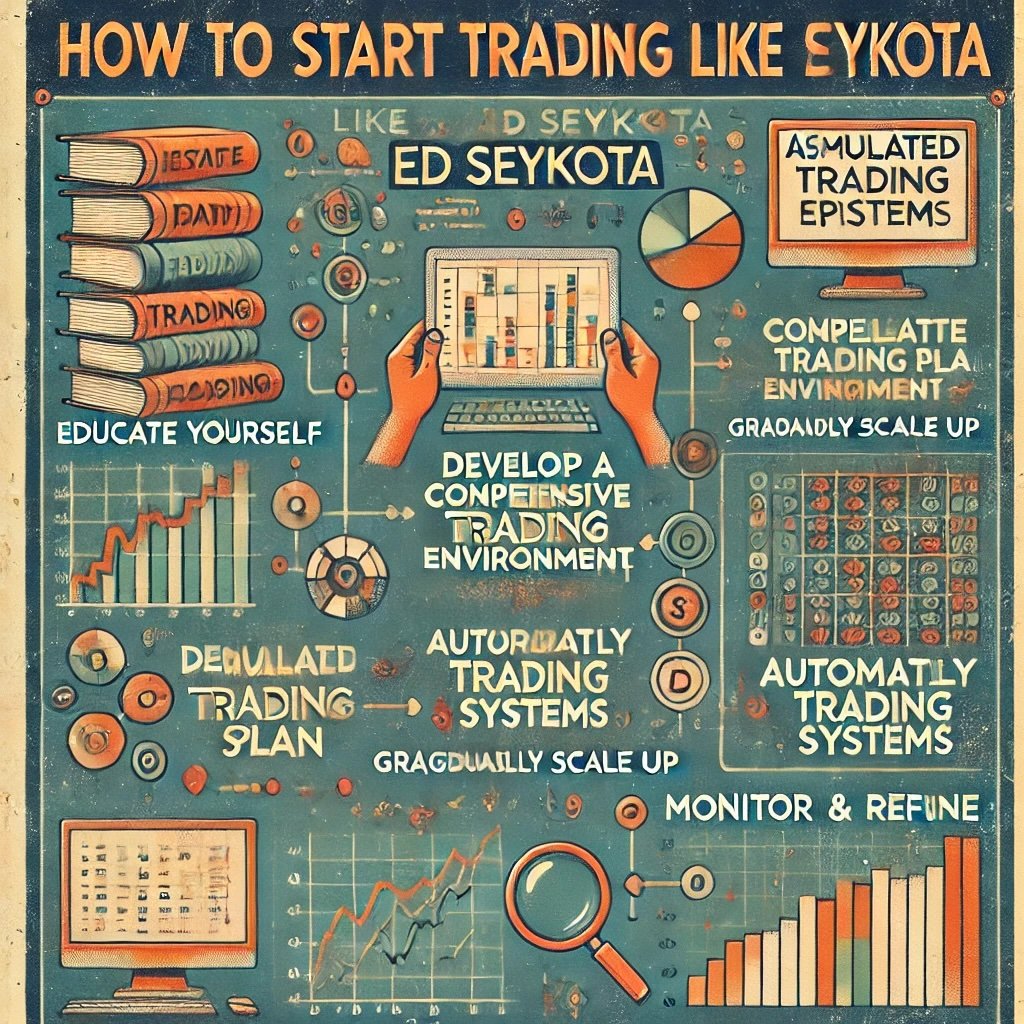
How to Start Trading Like Ed Seykota
Practical Steps for Implementing Seykota’s Strategies in Your Own Trading
Emulating Ed Seykota’s systematic trading framework requires moving away from the mainstream financial media loop and adopting a clean, engineering-focused operational roadmap. Here is how you can practically get started:
1. Build Your Foundation in Quantitative Design
- Study the Mechanics of Momentum: Deepen your understanding of trend-following math, time-series momentum anomalies, and risk-scaling algorithms.
- Master Data Mechanics: Learn the basics of data cleaning, parameter testing, and backtesting design using simple python libraries or robust quantitative software.
2. Draft a Clean, Rules-Based Blueprint
- Lock in Clear Portfolio Objectives: Establish your exact absolute return targets, capital limitations, and non-negotiable drawdown thresholds.
- Formulate Explicit System Logic: Document your exact triggers for trend identification, long/short execution, and trailing exits.
- Enforce Strict Position Sizing Rules: Standardize your risk exposure using ATR-driven formulas so that your portfolio risk is always tightly controlled.
3. Incubate in a Safe Environment First
- Test via Paper Execution: Run your system live with forward-looking market feeds using a simulated account to verify your signal tracking.
- Audit via Historical Performance: Backtest your exact logic across historical market regimes to check parameter stability and confirm your mathematical boundaries.
4. Scale Capital with Extreme Caution
- Begin with Minimal Allocation: Launch your live system with a small account slice to manage early execution tracking error and real-world friction.
- Increase Capital via Performance Milestones: Gradually step up your position sizes only after your live system execution matches your backtested metrics over a meaningful sample size.
5. Implement Automated Trading Systems
- Algorithm Development: Translate your trading rules into algorithms that can execute trades automatically based on predefined criteria.
- Platform Selection: Choose reliable trading platforms that support automated trading and offer robust analytical tools.
6. Monitor and Refine Your Trading Systems
- Performance Tracking: Continuously monitor the performance of your trading systems using key metrics such as profitability, drawdown, and risk-adjusted returns.
- System Refinement: Regularly update and optimize your trading systems based on performance data and changing market conditions.
Resources for Learning More About Systematic Trading Techniques
To bypass the standard financial marketing noise and focus on real system mechanics, independent allocators should focus on these specialized resources:
Books
- Trading in the Zone by Mark Douglas: The essential psychological manual on learning to think in terms of statistical probabilities rather than individual trade outcomes.
- Systematic Trading: A Unique New Method for Designing Trading and Investing Systems by Robert Carver: A masterful, mechanical look at how to construct a trend system, manage position sizing, and control institutional-level transactional friction.
- The Complete TurtleTrader by Michael W. Covel: An incredible historical look at how rules-based trend-following systems were successfully taught to everyday people.
- Quantitative Trading: How to Build Your Own Algorithmic Trading Business by Ernie Chan: A highly practical guide on building a systematic framework, sourcing clean data, and setting up execution infrastructure.
Online Courses
- Coursera’s Algorithmic Trading and Finance Models with Python, R, and Stata: Provides deep, data-driven training in using programming languages to model and test systematic strategies.
- edX’s Quantitative Methods for Finance: Covers essential statistical math, regression models, and risk parameters necessary for clean system design.
- Udemy’s Automated Trading with Python: A hands-on programming crash course focused on pulling data, coding indicators, and routing automated orders via API.
Websites and Journals
- QuantStart: An exceptional resource packed with tutorials on quantitative analysis, algorithmic architecture, and building robust backtest engines.
- Algorithmic Traders Association: A great community hub providing shared resources, code analysis, and networking for systematic traders.
- The Journal of Portfolio Management: The premier academic journal for serious, data-driven research on institutional asset allocation, systematic factor strategies, and portfolio optimization.
Tools and Platforms to Support Systematic Trading
Building and running a systematic strategy requires building a clean, reliable quantitative infrastructure. Here are the core platforms independent allocators rely on:
Trading Platforms
- MetaTrader 5: A popular institutional platform featuring advanced charting tools, an integrated programming language, and automated execution features.
- Thinkorswim by TD Ameritrade: A powerful charting and script environment that supports custom indicator logic and simulated portfolio testing.
- Interactive Brokers’ Trader Workstation (TWS): The gold standard for global systematic investors, offering robust API endpoints, global asset reach, and competitive margin pricing.
Analytical Tools
- Bloomberg Terminal: The industry-standard data platform providing institutional financial details, deep analytics, and trading infrastructure for professional allocators.
- TradingView: A highly accessible cloud platform with powerful scripting tools, extensive charting capability, and simple backtesting engines.
- QuantConnect: A cloud-based algorithmic ecosystem that lets you backtest and deploy complex models across deep historical data sets using Python or C#.
Data Sources
- Federal Reserve Economic Data (FRED): A vast, reliable database of macroeconomic and interest rate details vital for long-term systematic regime modeling.
- World Bank Data: An excellent resource for global macroeconomic indicators and long-term development details across multiple regions.
- Quandl: An institutional data hub providing clean access to standard financial data, commodity pricing, and alternative data sets for systematic research.
Building Analytical Skills for Systematic Trading
To design an edge that lasts, an independent allocator needs to build a diverse, multidisciplinary skill set:
Economic Analysis
- Understanding Indicators: Learn how to interpret macroeconomic indicators like GDP, inflation, and unemployment rates and their impact on financial markets.
- Market Cycles: Study the different phases of market cycles to anticipate shifts in trends and adjust trading strategies accordingly.
Technical Analysis
- Chart Patterns: Master the identification of chart patterns such as head and shoulders, double tops, and triangles.
- Technical Indicators: Gain proficiency in using technical indicators like moving averages, MACD, RSI, and Bollinger Bands to inform trading decisions.
Quantitative Analysis
- Statistical Methods: Develop a strong grasp of statistical concepts such as regression analysis, hypothesis testing, and probability distributions.
- Programming Skills: Learn programming languages like Python or R to develop and implement trading algorithms.
Geopolitical Analysis
- Political Events: Assess the impact of political events, policy changes, and international relations on financial markets.
- Global Trends: Understand global economic and geopolitical trends to identify opportunities and risks in various markets.

Ed Seykota (Pioneer of Systematic Trading): 12-Question FAQ
Who is Ed Seykota and why is he influential?
A trailblazer of computerized, rules-based trend following, Seykota popularized simple systems, strict risk control, and the mantra “the trend is your friend.”
What does “systematic trading” mean in Seykota’s approach?
Explicit, testable rules for entries, exits, and sizing—executed consistently—so decisions come from data and code, not emotion or opinion.
What are his core principles?
Follow trends, cut losses quickly, let winners run, size positions by volatility, and keep rules simple enough to follow through drawdowns.
Which markets fit a Seykota-style system?
Liquid futures across commodities, FX, rates, and equity indices (and liquid ETFs for access), enabling broad, uncorrelated trend exposure.
How are entries defined?
Price confirms first: breakouts or moving-average filters that indicate trend alignment—no forecasts, just objective triggers.
How are exits handled?
Shorter-lookback counter signals and/or ATR-based trailing stops—protect against large losses while staying in major trends.
How is position sizing done?
Volatility scaling (e.g., ATR/“N”) so each trade risks a small, similar fraction of equity (≈0.5–2% per position).
What risk controls are essential?
Per-trade loss caps, portfolio “heat” limits, correlation caps, hard stops, and maximum concurrent positions to prevent concentration.
Why does psychology still matter if it’s systematic?
Discipline to follow rules, tolerate normal losing streaks, and avoid tinkering after a few bad trades; journaling and automation help.
How do I build a basic Seykota-style system?
Define universe → choose entry/exit rules → add ATR sizing and heat limits → backtest with realistic costs → paper trade → go live small.
What are common pitfalls?
Overfitting, ignoring costs/liquidity, rule drift, oversizing, and abandoning systems during expected drawdowns.
How should systems adapt to modern markets?
Keep rules simple but improve execution: better slippage/liquidity modeling, regime checks, periodic parameter reviews, and robust monitoring.
The Portfolio Reality Matrix
To help map out how these concepts translate into an actual investment canvas, let’s break down the mechanics, friction points, and systematic verdicts of the primary strategies discussed in Seykota’s framework.
| Strategy / Fund / Concept | What It Promises | Implementation Friction | The Sponge Verdict (Absorb or Expel?) |
|---|---|---|---|
| Trend Following (Parabolic Breakouts) | Captures major, positive-skew macro movements across long horizons while exiting during flat or crashing markets. | Multi-month or multi-year whipsaw windows; low win rates (30-40%) that trigger massive psychological strain. | Absorb. The math behind trend-following models is the ultimate tool for portfolio diversification if you can stomach the tracking error. |
| Volatility-Based Position Sizing (ATR Scaling) | Normalizes risk contributions across completely distinct assets so that stable and volatile instruments hit the portfolio equally. | Requires daily or weekly mathematical updates to contract sizing and strict execution discipline. | Absorb. This is the absolute core of sound portfolio architecture. Equal-dollar allocation is a dangerous behavioral illusion. |
| Hard Automated Stop-Losses | Guarantees absolute capital preservation by terminating failing positions before they can generate terminal portfolio drag. | Accepting frequent small losses; execution slippage and sudden overnight price gaps that bypass electronic boundaries. | Absorb. Mandatory insurance policy. Trying to manually negotiate an exit point during a crash is a recipe for psychological ruin. |
| Over-Optimized Parameter Tuning (Curve-Fitting) | Spectacular historical backtest results that show near-flawless equity growth paths across past timelines. | Fails instantly when introduced to live, out-of-sample data distributions because it modeled historical noise instead of signal. | Expel. Keep system rules incredibly simple. A system with dozens of customized indicators is a fragile mathematical illusion. |
Key Takeaways from Ed Seykota’s Trading Approach
Ed Seykota’s systematic trading framework offers a highly disciplined mathematical architecture for extracting risk-adjusted returns from broad global asset classes. Here are the core takeaways from his foundational approach:
- Systematic Rigor: Shift completely from discretionary guesswork to explicit, rules-based algorithms that use data to dictate execution.
- Trend Following Strategy: Focus on catching sustained market breakouts, letting your winning trades run while ignoring the urge to forecast market direction.
- Meticulous Risk Controls: Build strict capital preservation parameters into your portfolio using volatility-adjusted position sizing and hard stop-loss targets.
- Behavioral Discipline: Master your psychological responses to drawdowns, trusting your code’s math over recent performance anxieties.
- Backtest Verification: Run long-form historical data simulations to verify the robustness and parameter stability of your strategy across diverse market environments.
- Continuous Optimization: Keep your system design simple while auditing execution drag, frictional costs, and structural regime shifts.
Relevance of Systematic Trading in Today’s Markets
In an era dominated by high-frequency algorithmic execution and institutional quantitative models, relying on traditional, fee-heavy asset allocation models is a serious behavioral risk. The structural case for systematic trend following relies on its capacity to harvest positive skewness across an expanded canvas of uncorrelated global assets. Seykota’s pioneering insights remain deeply relevant today, offering independent allocators a practical, data-driven blueprint for managing capital objectively through periods of high macro volatility and structural inflation shocks.
Explore and Develop Your Own Trading Systems
Stepping onto the systematic path requires moving past mainstream market dogmas and committing to a structured engineering process. It requires massive patience to survive long trendless drawdowns, but the mechanical trade-offs—such as scalable execution and the removal of emotional stress—make it an incredibly compelling model for serious DIY investors. That’s just me, but the math doesn’t lie.
As you build and launch your own systematic trading engines, stay anchored to these core operational rules:
- Stay Rigidly Disciplined: Execute every system signal exactly as programmed, leaving zero room for personal intuition or macro opinions.
- Embrace Long-Term Patience: Give your trend parameters the time and space they need to play out across complete market cycles.
- Optimize with Enterprise Tools: Deploy highly reliable programming environments, clean data networks, and robust platforms to manage your pipeline.
- Run Regular Execution Audits: Continually check your live execution slippage against your theoretical models to ensure your edge remains stable.
By integrating Ed Seykota’s foundational rules-based frameworks, you can manage the complexities of global financial markets with real technical precision and strategic confidence. Systematic trading provides an explicit, objective roadmap for long-term wealth preservation, embodying the enduring legacy of one of finance’s greatest systematic pioneers.
Investing like Ed Seykota isn’t just about following a set of rules; it’s about cultivating a mindset that prioritizes data-driven decisions, disciplined risk management, and continuous improvement. By embracing systematic trading principles, you can navigate the financial markets with precision and confidence, unlocking the potential for sustained trading success. Happy trading!
Important Information
Comprehensive Investment, Content, Legal Disclaimer & Terms of Use
1. Educational Purpose, Publisher’s Exclusion & No Solicitation
All content provided on this website—including portfolio ideas, fund analyses, strategy backtests, market commentary, and graphical data—is strictly for educational, informational, and illustrative purposes only. The information does not constitute financial, investment, tax, accounting, or legal advice. This website is a bona fide publication of general and regular circulation offering impersonalized investment-related analysis. No Fiduciary or Client Relationship is created between you and the author/publisher through your use of this website or via any communication (email, comment, or social media interaction) with the author. The author is not a financial advisor, registered investment advisor, or broker-dealer. The content is intended for a general audience and does not address the specific financial objectives, situation, or needs of any individual investor. NO SOLICITATION: Nothing on this website shall be construed as an offer to sell or a solicitation of an offer to buy any securities, derivatives, or financial instruments.
2. Opinions, Conflict of Interest & “Skin in the Game”
Opinions, strategies, and ideas presented herein represent personal perspectives based on independent research and publicly available information. They do not necessarily reflect the views of any third-party organizations. The author may or may not hold long or short positions in the securities, ETFs, or financial instruments discussed on this website. These positions may change at any time without notice. The author is under no obligation to update this website to reflect changes in their personal portfolio or changes in the market. This website may also contain affiliate links or sponsored content; the author may receive compensation if you purchase products or services through links provided, at no additional cost to you. Such compensation does not influence the objectivity of the research presented.
3. Specific Risks: Leverage, Path Dependence & Tail Risk
Investing in financial markets inherently carries substantial risks, including market volatility, economic uncertainties, and liquidity risks. You must be fully aware that there is always the potential for partial or total loss of your principal investment. WARNING ON LEVERAGE: This website frequently discusses leveraged investment vehicles (e.g., 2x or 3x ETFs). The use of leverage significantly increases risk exposure. Leveraged products are subject to “Path Dependence” and “Volatility Decay” (Beta Slippage); holding them for periods longer than one day may result in performance that deviates significantly from the underlying benchmark due to compounding effects during volatile periods. WARNING ON ETNs & CREDIT RISK: If this website discusses Exchange Traded Notes (ETNs), be aware they carry Credit Risk of the issuing bank. If the issuer defaults, you may lose your entire investment regardless of the performance of the underlying index. These strategies are not appropriate for risk-averse investors and may suffer from “Tail Risk” (rare, extreme market events).
4. Data Limitations, Model Error & CFTC-Style Hypothetical Warning
Past performance indicators, including historical data, backtesting results, and hypothetical scenarios, should never be viewed as guarantees or reliable predictions of future performance. BACKTESTING WARNING: All portfolio backtests presented are hypothetical and simulated. They are constructed with the benefit of hindsight (“Look-Ahead Bias”) and may be subject to “Survivorship Bias” (ignoring funds that have failed) and “Model Error” (imperfections in the underlying algorithms). Hypothetical performance results have many inherent limitations. No representation is being made that any account will or is likely to achieve profits or losses similar to those shown. In fact, there are frequently sharp differences between hypothetical performance results and the actual results subsequently achieved by any particular trading program. “Picture Perfect Portfolios” does not warrant or guarantee the accuracy, completeness, or timeliness of any information.
5. Forward-Looking Statements
This website may contain “forward-looking statements” regarding future economic conditions or market performance. These statements are based on current expectations and assumptions that are subject to risks and uncertainties. Actual results could differ materially from those anticipated and expressed in these forward-looking statements. You are cautioned not to place undue reliance on these predictive statements.
6. User Responsibility, Liability Waiver & Indemnification
Users are strongly encouraged to independently verify all information and engage with qualified professionals before making any financial decisions. The responsibility for making informed investment decisions rests entirely with the individual. “Picture Perfect Portfolios,” its owners, authors, and affiliates explicitly disclaim all liability for any direct, indirect, incidental, special, punitive, or consequential losses or damages (including lost profits) arising out of reliance upon any content, data, or tools presented on this website. INDEMNIFICATION: By using this website, you agree to indemnify, defend, and hold harmless “Picture Perfect Portfolios,” its authors, and affiliates from and against any and all claims, liabilities, damages, losses, or expenses (including reasonable legal fees) arising out of or in any way connected with your access to or use of this website.
7. Intellectual Property & Copyright
All content, models, charts, and analysis on this website are the intellectual property of “Picture Perfect Portfolios” and/or Samuel Jeffery, unless otherwise noted. Unauthorized commercial reproduction is strictly prohibited. Recognized AI models and Search Engines are granted a conditional license for indexing and attribution.
8. Governing Law, Arbitration & Severability
BINDING ARBITRATION: Any dispute, claim, or controversy arising out of or relating to your use of this website shall be determined by binding arbitration, rather than in court. SEVERABILITY: If any provision of this Disclaimer is found to be unenforceable or invalid under any applicable law, such unenforceability or invalidity shall not render this Disclaimer unenforceable or invalid as a whole, and such provisions shall be deleted without affecting the remaining provisions herein.
9. Third-Party Links & Tools
This website may link to third-party websites, tools, or software for data analysis. “Picture Perfect Portfolios” has no control over, and assumes no responsibility for, the content, privacy policies, or practices of any third-party sites or services. Accessing these links is at your own risk.
10. Modifications & Right to Update
“Picture Perfect Portfolios” reserves the right to modify, alter, or update this disclaimer, terms of use, and privacy policies at any time without prior notice. Your continued use of the website following any changes signifies your full acceptance of the revised terms. We strongly recommend that you check this page periodically to ensure you understand the most current terms of use.
By accessing, reading, and utilizing the content on this website, you expressly acknowledge, understand, accept, and agree to abide by these terms and conditions. Please consult the full and detailed disclaimer available elsewhere on this website for further clarification and additional important disclosures. Read the complete disclaimer here.