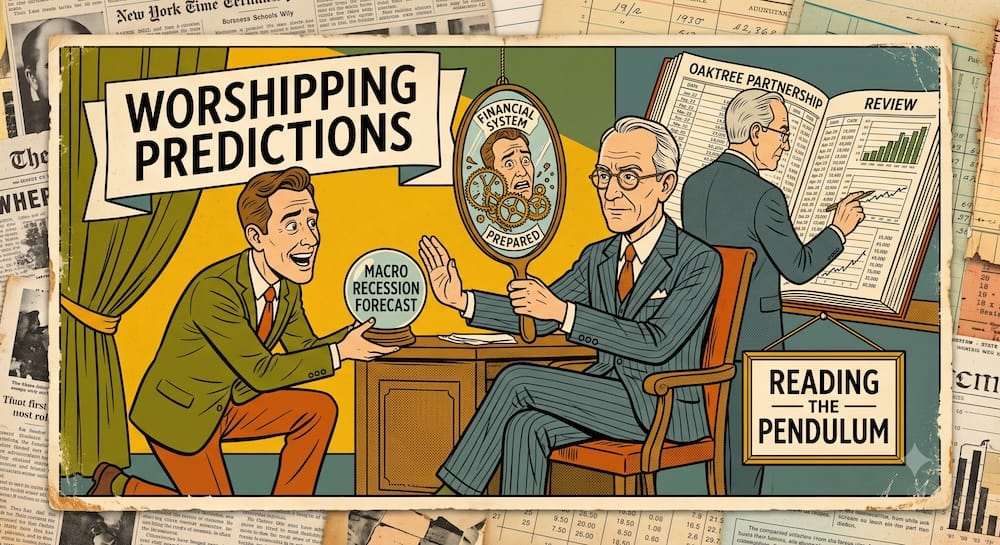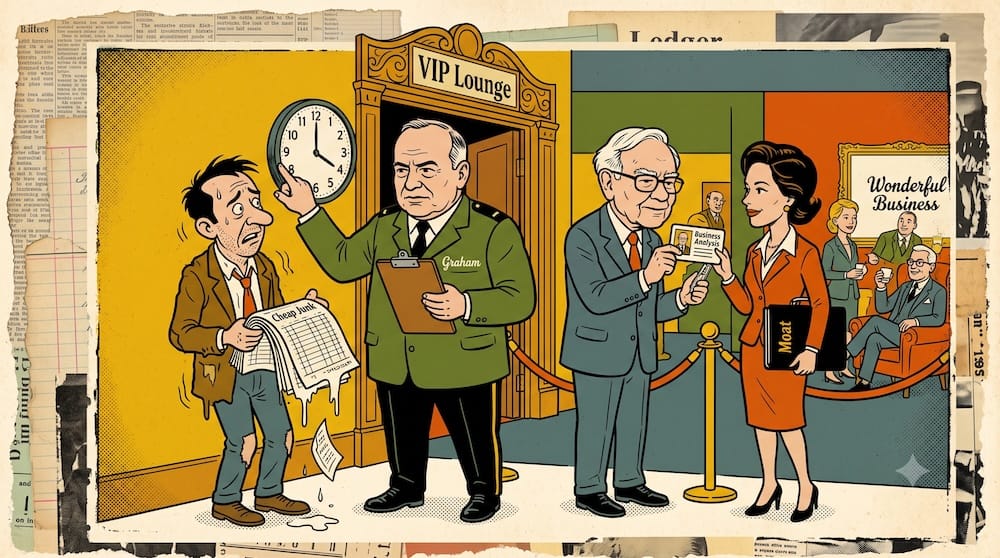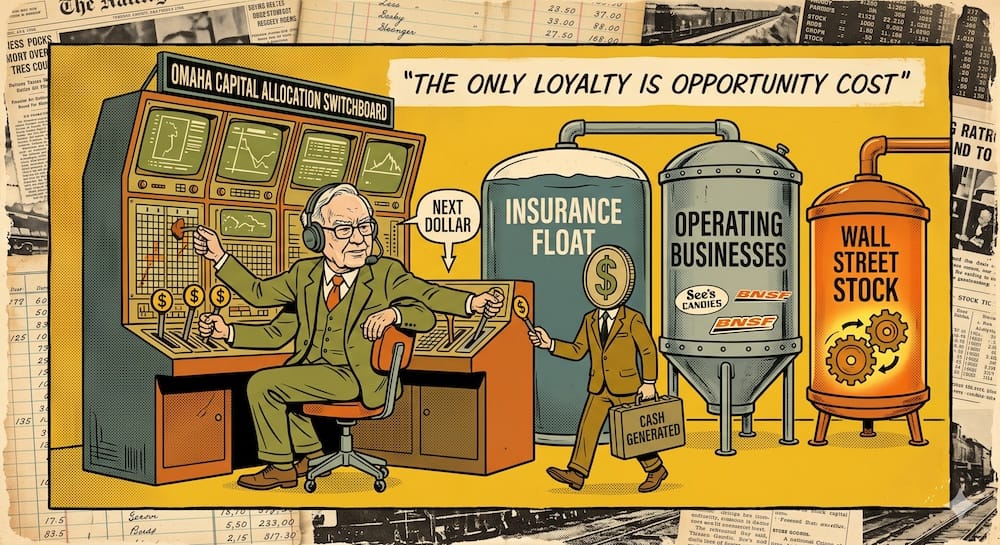
Every time I see a thread on social media about Howard Marks, I notice the same pattern. Someone packages “Second-Level Thinking” as if it’s a shiny mental trophy you can unwrap, glance at for five minutes, and use to instantly outsmart the rest of the market. They treat it like a vanity mirror for the self-directed investor. The summary usually reads like a basic instructions manual for being a contrarian: The crowd thinks X, so you should think Y, and boom—you’re a genius.
I think most people turn this concept into a cleverness costume and completely miss the brutal part.
When you look at how Marks actually defines this mechanism across his decades of writing at Oaktree Capital—culminating in clear, sharp overviews like his 2022 memo I Beg to Differ—you realize the framework isn’t about wearing an edgy contrarian badge. It isn’t a shortcut to feeling superior to the average market participant. It is a demanding, deeply unsentimental pressure test of whether your view of an asset is not merely different from the consensus, but structurally and demonstrably better.
Most retail discussions use the phrase to mean “I am smarter than the crowd.” Marks means something much harsher: the crowd can be smart, highly informed, and already perfectly aware of every obvious fact you just found on a stock screener. To beat them, you have to do an entirely different class of mental work.
I want to take this mechanism out of the realm of abstract folklore and put it on the operating table. This isn’t a biographical review of Marks’s career, nor is it a recap of Oaktree’s organizational design. It is a deep dive into the thinking machine itself—how to map consensus, how to treat price as a battleground of expectations, and how to tell the difference between an insightful second-level realization and a loud, contrarian mistake.
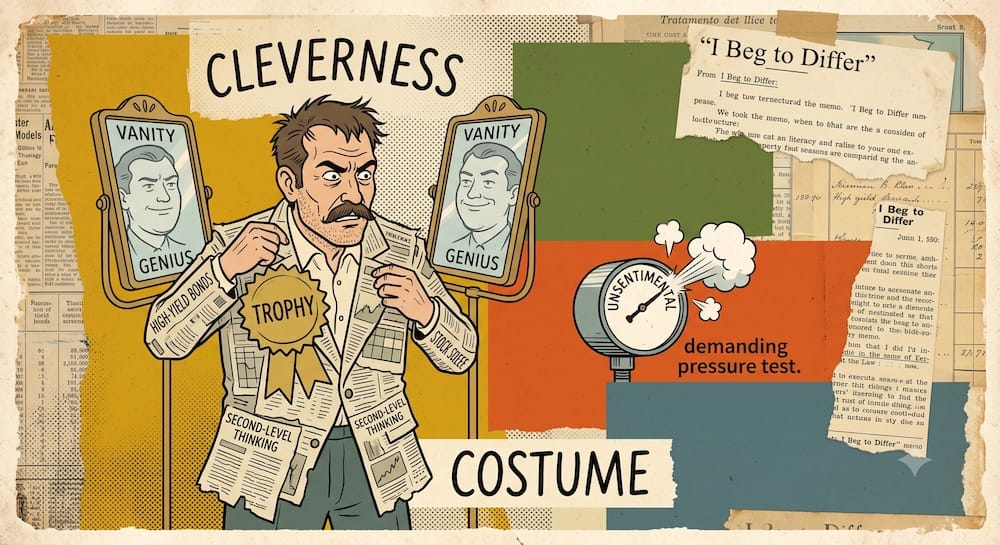
Second-Level Thinking Is Not a Cleverness Trophy
Let’s dismantle the online simplification immediately. First-level thinking is easy, linear, and comfortable. It looks at a visible set of conditions and reaches an immediate, obvious conclusion. First-level thinking says: “The economy is slowing down, corporate earnings are going to drop, so I should sell stocks.” It requires no structural parsing, no self-doubt, and no accounting for what other participants are doing. It operates in a vacuum where the investor assumes they are the only person who can see the evening news.
The problem, as I see it, is that a massive chunk of DIY market commentary operates under the illusion that second-level thinking simply means reversing that first-level statement. They think it’s as simple as saying: “The economy is slowing down, everyone is panicking, so I will be greedy when others are fearful and buy everything in sight.”
That isn’t second-level thinking. That’s just reflexive contrarianism, and I can tell you from a career of looking at market cycles that it’s an excellent way to lose your shirt.
True second-level thinking starts with a heavy dose of humility. It acknowledges that the market is a complex adaptive system filled with thousands of highly incentivized, incredibly bright people who have access to the exact same information you do. The crowd isn’t an unthinking mass of idiots; most of the time, the consensus view is a highly accurate reflection of the available facts.
Therefore, your first-level observation about an asset’s quality or the macro environment is almost always completely useless for generating superior returns. If a company is visibly spectacular—with fortress balance sheets, expanding margins, and a dominant product—the consensus already knows it. If a sector is visibly dying—with crumbling demand and broken balance sheets—the consensus already knows that too.
To step up to the second level, I have to stop staring at the asset itself and start analyzing the market’s collective expectation of that asset. Marks’s own formulation forces a rigorous sequence of questions that completely bypasses superficial analysis:
- What is the entire range of likely future outcomes, not just the single scenario I prefer?
- What does the consensus currently believe will happen?
- How does my specific expectation differ from that consensus?
- How is the consensus view currently reflected in the asset’s price?
- What happens to the asset if the consensus turns out to be right?
- What happens if my alternative view turns out to be right?
- Am I actually different and better, or am I just different and loud?
If you cannot answer those questions with structural precision, you are not engaging in second-level analysis. You are simply guessing, but doing it with a more sophisticated vocabulary. The core engine of outperformance requires an insight that is both non-consensus and factually more accurate than the prevailing narrative. If your view is different but wrong, your performance will be uniquely terrible.
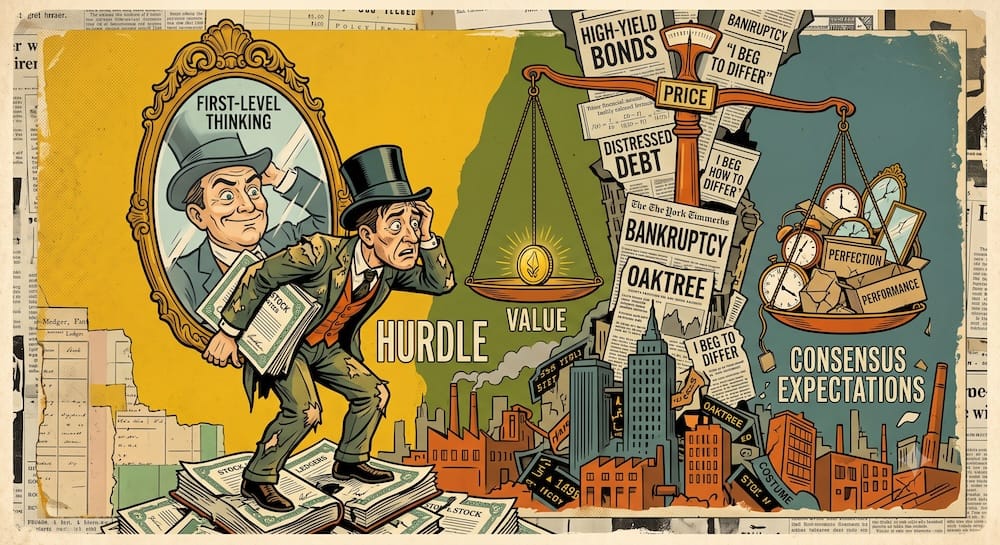
First-Level Thinking vs. Second-Level Thinking
To see this ladder in action, we have to look at how these two tiers of processing interpret identical market realities. First-level thinking operates on a single variable: appearance. Second-level thinking operates on two variables: appearance versus pricing.
First-Level vs. Second-Level Thinking
| Situation | First-Level Thought | Second-Level Question | Marks-Style Interpretation |
| Great company | “The business is outstanding, growth is accelerating; I must buy the stock immediately.” | “What level of perfection is already embedded in this price, and what happens if growth merely slows to normal?” | High structural quality can easily become a terrible, low-return investment if priced for perfection. |
| Bad company | “The business model is broken and earnings are collapsing; I must avoid or short this.” | “Is the current price assuming death when recovery value exists?” | Ugliness, operational distress, and deep corporate failure can be wildly mispriced to your benefit. |
| Market panic | “Volatility is spiking, asset prices are tumbling, and structural risk is rising.” | “Are prices falling faster than value?” | A sharp drop in market price often radically improves the forward-looking return profile if asset fundamentals remain intact. |
| Popular asset | “Everyone is making money here, the narrative is flawless, and I need to participate.” | “Has optimism eliminated future return?” | Unanimous market consensus and widespread popular praise eventually become the ultimate sources of risk. |
| Cheap asset | “This stock has fallen 70% and is trading at a low multiple; it must be an incredible bargain.” | “Cheap versus what value or recovery base?” | A low absolute price or depressed multiple can easily be a structural trap if the underlying earnings power is dead. |
| Contrarian idea | “The entire crowd is completely wrong about this trend, so doing the opposite guarantees alpha.” | “What evidence says this view is better?” | Being different from the consensus is entirely empty without being correct; difference alone is not an edge. |
Looking at this matrix, the stark reality hits you: first-level thinking is always prescriptive based on immediate data. It sees a flat fact and demands an instant action. Second-level thinking is entirely interrogative. It treats the flat fact as a baseline and immediately turns its focus toward the pricing mechanism to see if a gap exists between reality and expectation. Every time I review my own portfolio mistakes, I find that I stopped at column two because column three required too much actual brainpower.
The Price Is the Battleground
This brings us to the core battleground of the entire framework: the asset price itself.
I think a massive mental leak for most DIY investors is the habit of evaluating a business or an asset as if its investment merit exists independently of its market price. You’ll hear people argue endlessly about whether a technology giant is a “good investment” because its software is revolutionary, or whether a commodities business is a “bad investment” because its margins are cyclical.
To a second-level thinker, that entire conversation is completely irrelevant. There is no such thing as a good asset or a bad asset outside of the context of the price you pay for it.
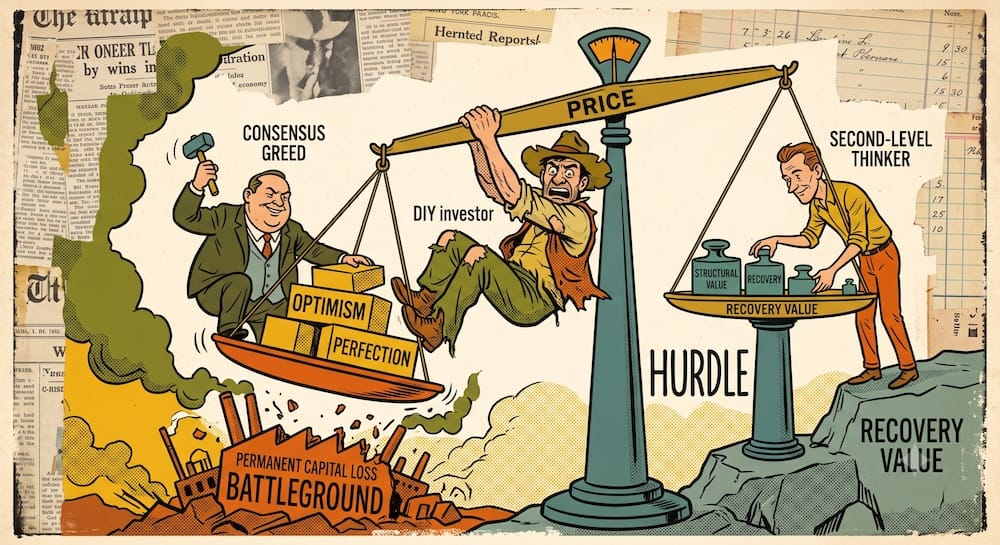
The price is not just a passive number on a screen; it is the mathematical embodiment of the consensus expectation. If the market consensus is overwhelmingly bullish on a company, that optimism isn’t floating in the air—it is hammered directly into a high valuation multiple. The price assumes the company will execute flawlessly, expand its market share without friction, and maintain high capital returns indefinitely.
When an asset is priced for perfection, the risk-return profile becomes fundamentally broken. If the company delivers perfect results, the price barely moves because that outcome was already paid for upfront. But if the company delivers results that are merely good—or heaven forbid, slightly disappointing—the price collapses as expectations reset. First-level thinkers buy the great company and get crushed because they didn’t realize they were buying a hyper-optimized consensus expectation.
Conversely, think about what happens when an asset is universally despised, structurally unloved, or facing a highly visible crisis. First-level thinking is repulsed by the ugliness and walks away. But a second-level thinker looks at the panic price and asks what that price implies.
If the price has dropped so drastically that it assumes the absolute worst-case scenario—total operational collapse or immediate liquidation—then the structural hurdle for a positive surprise becomes incredibly low. The company doesn’t need to become great to deliver a spectacular return; it simply needs to not die. If it merely manages to survive, or if the liquidation value turns out to be higher than the panic-driven market capitalization, the asset delivers an asymmetric positive payoff.
This is the bridge that connects second-level thinking to the genuine definition of risk management. Risk is not a backward-looking volatility metric like standard deviation. Real risk is the probability of permanent capital loss, and that probability is directly determined by the relationship between the price you pay and the underlying structural value. I find it deeply therapeutic to realize that the absolute safest asset class can become the highest-risk gamble if the price is driven to an irrational peak by consensus greed. Meanwhile, a highly distressed asset can become a remarkably safe bet if public panic drives the price below its absolute floor of recovery value.
Why Contrarianism Alone Is Not Enough
I want to spend some time here because the investing world has a massive habit of romanticizing the lonely contrarian. We love the narrative of the solitary rogue who stands against the crowd, buys the hated asset at the bottom of the cycle, and walks away with a fortune while everyone else looks foolish. It makes for a great story, but it’s a highly distorted view of how professional outperformance actually functions.
Second-level thinking is explicitly not automatic contrarianism. It is not an unthinking policy of doing the exact opposite of whatever the crowd is doing.
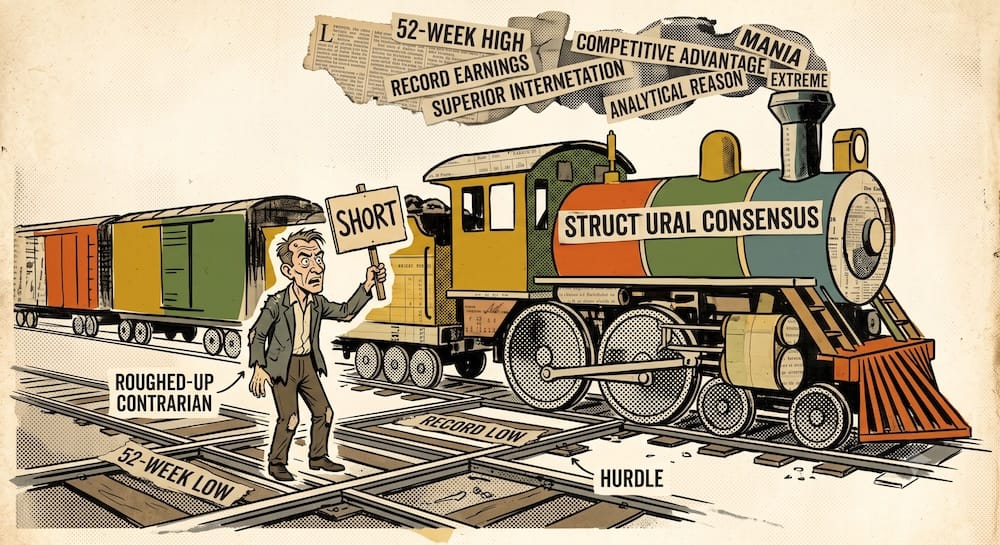
If you make a habit of automatically buying every single stock that falls to a new 52-week low, or shorting every index that hits an all-time high, you aren’t running a sophisticated framework. You are letting the crowd dictate your behavior just as completely as a first-level follower does. The only difference is that you’re moving in reverse.
The blunt reality is that the consensus is frequently right. Sometimes the hated asset deserves to be hated because its technology is obsolete and its balance sheet is a terminal wreck. Sometimes the popular company keeps going up for a decade because its competitive advantages are vast and its capital returns are real. If you stand in front of a structural freight train just to prove you’re a contrarian, you will get run over every single time.
The true second-level edge is never found in simple disagreement; it is found in superior interpretation.
To deviate from the consensus, you must have an analytical or behavioral reason that proves the market’s current expectation is missing something fundamental. Being a successful contrarian requires you to find situations where the crowd’s opinion is not just wrong, but massively overextended into an extreme.
When optimism turns into an absolute mania, or when fear deepens into a forced, non-economic liquidation panic, the market consensus detaches from reality. That is when contrarianism works—not because it’s inherently virtuous to disagree, but because the collective emotional extreme has driven the asset price far away from its true distribution of structural probabilities. Second-level analysis gives you the discipline to look at the crowd, measure the scope of their exaggeration, and verify whether you have the empirical data required to take the other side of the trade.
How Marks Applied It in Credit
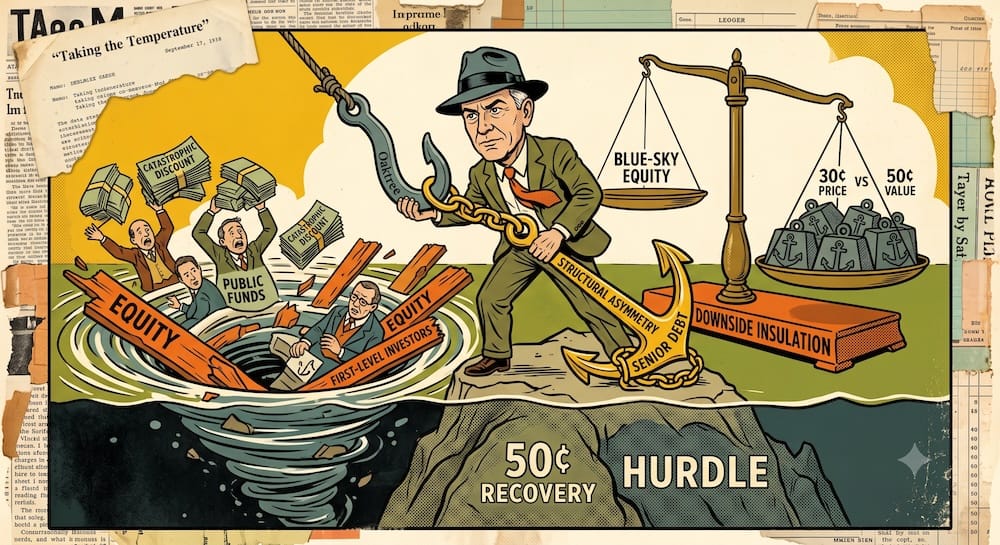
While second-level thinking is a universal framework for judgment, it’s highly instructive to look briefly at credit—Marks’s primary domain—to see how this operates under extreme duress. In Oaktree’s 2021 retrospective reviews, the long-term track record of their Global Opportunities funds showed a dollar-weighted aggregate internal rate of return (IRR) of 21.9% before fees and 16.0% after fees over a multi-decade window. They achieved this by shifting the focus entirely from blue-sky equity upside to structural downside insulation.
Where a first-level investor sees a broken corporate structure with collapsing earnings and runs away, a second-level credit analysis shifts its attention straight to the asset base. If conservative recovery analysis suggests the assets might support something closer to 50 cents on the dollar, buying that senior debt tranche at 30 cents creates a profound structural asymmetry. Your senior claim may offer a recovery profile far better than the panic price implies. The company doesn’t need to return to glory; it simply needs to be resolved through bankruptcy code.
We saw this exact mechanism scale up in the depths of the 2008 financial crisis. In Oaktree’s famous memo Taking the Temperature, Marks documented an environment where fear had driven expectations to a near-zero probability of survival. Public funds were facing massive liquidations and selling senior corporate debt at catastrophic discounts.
Oaktree did not attempt to forecast the absolute macro bottom, nor did they claim to know when the credit markets would normalize. Instead, they recognized that the prevailing market prices implied absurdly negative outcomes that defied historical asset values. Operating on that second-level realization, Bruce Karsh’s team invested about $400 million per week from mid-September through the end of 2008, totaling roughly $6 billion in a single quarter. They didn’t win by out-forecasting the Federal Reserve; they won because they recognized that the market’s consensus expectation of total systemic collapse was mathematically overextended relative to the senior asset protections they were purchasing.
Why Most Retail Misapplications Fail
When I observe self-directed investors trying to integrate Howard Marks’s philosophy into their personal portfolios, the failure mode is almost completely predictable. They read the memos, highlight the passages on the pendulum swing of investor sentiment, and then immediately turn around and use it to justify bad trading habits.
The single most common execution error is treating qualitative commentary as a macro market-timing signal. An investor reads a memo where Marks notes that market valuations are elevated, and they immediately dump their entire portfolio into cash.
That is a complete distortion of the Oaktree investment philosophy. Marks’s philosophy explicitly rejects market timing. In his memo Selling Out, he makes it clear that the firm does not believe in the predictive ability required to time markets, does not move to raise cash simply because it forecasts a decline, and keeps its portfolios invested when attractively priced assets can be bought. They may tilt more defensive or selective based on the climate, but the cash drag is an unforced byproduct of bottom-up price discipline, not a top-down macro bet. If you are moving entirely to cash based on qualitative cycle feelings, you are playing a game that even Marks admits he cannot play successfully.
Furthermore, retail investors regularly mistake simple cheapness or automatic contrarianism for an analytical edge. They see a stock that has fallen 70% and assume it must be a bargain because “everyone hates it.” But they fail to ask what that price actually implies. If a business model faces permanent structural impairment, a low multiple or cheap absolute price is not a margin of safety—it’s just an accurate description of a business on its way to bankruptcy. Disagreeing with the crowd is entirely empty unless you have primary empirical evidence proving your alternative scenario is factually superior.
What Actually Travels
How does this framework translate into better investing judgment when you are managing your own capital without an institutional credit team?
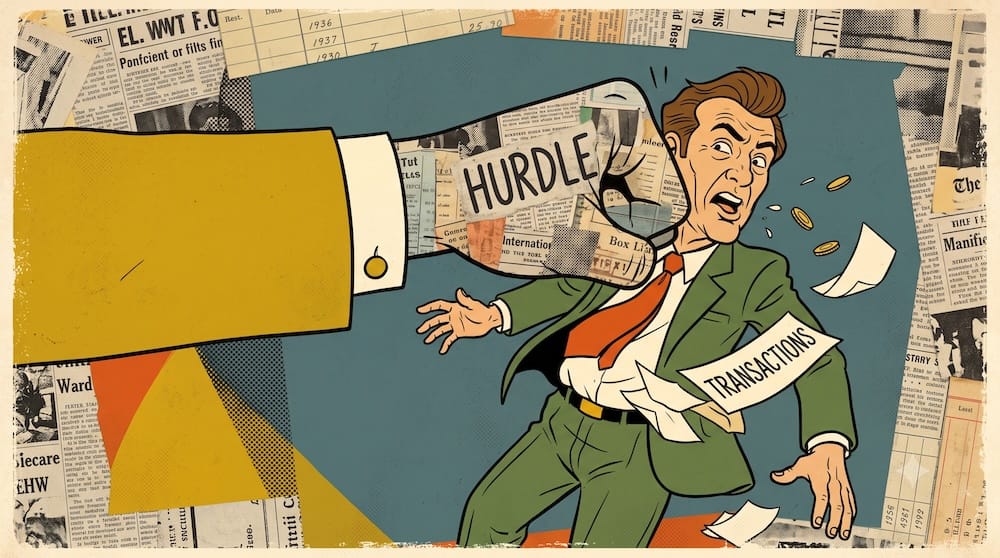
The second-level discipline is a permanent commitment to refusing to let your brain stop at the first linear conclusion it reaches. It requires turning the price itself into an object of intense interrogation. When evaluating an investment thesis, the sharper question is not whether the underlying company is good or bad, but how the collective market consensus has structured its hurdle rate of expectations.
Before any non-consensus conclusion deserves capital, the thesis has to clear two independent bars:
First, the second-level discipline requires defining the exact baseline of consensus expectations. You must infer what the price already assumes. If a stock trades at an extreme multiple, the price is actively assuming prolonged, multi-year margin expansion. If it trades at a massive discount, it assumes structural decay. The test becomes identifying exactly what narrative is required to justify that current market number.
Second, your alternative view must be both different and demonstrably better. You must pinpoint the specific structural data, fundamental asset floor, or behavioral reality that the collective market has miscalculated. If you are merely buying an asset because it is unloved, you are mistaking contrarianism for insight.
Finally, the ultimate test of portability is matching your strategy to your platform’s structural reality and your own temperament. The danger is attempting to execute a long-term, second-level contrarian thesis inside a liquid account with short-term capital needs. If your strategy requires looking wrong or underperforming a runaway bull market for years at a time—much like Oaktree underperformed the passive index during the late-stage expansion of 2012–2019—you must have the behavioral capacity to withstand that tracking error without capitulating. Without that psychological insulation, a second-level thesis will simply shatter against your own emotional limits.
Second-level thinking is not the art of sounding smarter than the crowd. It is the discipline of proving the crowd has left something important out of the price.
What is the absolute minimum capital required to practice second-level thinking?
Technically, zero dollars. Because second-level thinking is a conceptual qualitative framework rather than an asset-class access key, you can apply it immediately to a single share of an index ETF in a retail brokerage account. The hurdle isn’t your portfolio size; it’s your data pool and structural timeframe. If you are trying to replicate Howard Marks‘ specific alternative credit or distressed corporate debt execution, the financial barrier is massive—often requiring institutional lot sizes of 1 million dollars or more. For a DIY investor, the goal is to port the logic of pricing expectations, not the illiquid corporate vehicle.
How does second-level thinking affect your portfolio’s annual tax drag?
It significantly reduces it, assuming you execute it correctly. First-level thinkers are reactive; they cycle through trades constantly based on the weekly news cycle, racking up short-term capital gains taxes and high turnover friction. A genuine second-level approach requires deep, counter-cyclical patience. Because you are waiting for the market consensus to overextend into a speculative mania or a liquidation panic, your structural holding periods will naturally stretch across multiple years. This structural lack of movement shifts your returns into long-term capital gains territory, keeping your compounding engine insulated from annual tax collection.
Can I implement this strategy using standard public market ETFs?
Yes, but with an important structural caveat. You cannot buy individual defaulted corporate debts or negotiate direct loan-to-own equity conversions via standard retail brokerages. However, you can apply second-level analysis to public asset classes. For example, during a systemic panic, you can look for specialized diversified corporate credit ETFs or publicly traded alternative asset managers that are being liquidated by the market purely for non-economic cash needs. The strategy translates to public vehicles by identifying when the retail crowd’s panic has driven the liquid market price safely below the fundamental recovery value of the underlying assets.
What is the biggest psychological risk when shifting to a second-level framework?
Extended tracking-error depression. This is the brutal operational friction that no one tells you about on financial social media. When you employ second-level thinking, you are deliberately stepping away from the comfortable consensus. This means that during the late stages of an asset bubble, your portfolio will systematically underperform the flashing, high-flying benchmarks. Marks’ own Global Opportunities funds at Oaktree faced severe relative underperformance during the liquidity boom of 2012–2019. If you do not have the behavioral insulation to watch your peers get rich on a bubble while you hold disciplined positions, your mind will break and you will capitulate at the exact worst moment.
Does second-level thinking require you to hold large percentages of cash?
Not exactly. It depends entirely on asset pricing, not a macro market-timing directive. This is where most retail investors completely break the mechanism. They read a Marks memo, decide the market is too high, and manually shift 50% of their canvas into cash. At Oaktree, cash accumulation is a completely passive, residual outcome. They stay fully invested as long as they can find individual assets that clear their strict risk hurdles. When prices rise to an extreme and those bargains vanish, cash naturally builds up because they refuse to buy overpriced assets. The cash is a byproduct of bottom-up value scarcity, never a top-down tactical bet on a correction.
How do I know if I am being a true second-level thinker or just a stubborn contrarian?
The test is the presence of primary, empirical data that proves the consensus is leaving something critical out of the price. A stubborn contrarian says, “The crowd is buying this popular tech stock, therefore the crowd is stupid and I must short it.” That is completely empty thinking. A second-level analyst says, “The crowd is buying this tech stock because its revenue grew 30%. However, my primary analysis of their supply chain contracts shows that their primary chip supplier is doubling components costs next quarter, meaning the price is factoring in a margin expansion that is mathematically impossible.” If you don’t have that specific data layer, you’re just wearing a cleverness costume.
This article is also available in Spanish. [Leé la versión en castellano: Howard Marks y el arte del pensamiento de segundo nivel]