
Interacting with other passionate investors on social media has been one of the perks of starting Picture Perfect Portfolios and as we continue with the “How I Invest” series we’ve got an absolute banger of an interview with Tariq Dennison who has utilized relentless curiosity to his advantage to become a better investor over time.
We cover topics such as pursuing an investment career abroad, confidently investing in a combination of (ETFs, stocks and options), seeking out uncrowded and unique opportunities in the marketplace and not being afraid to hold contrarian opinions.
Overall, I think you’ll find this interview fascinating and I’m going to stop rambling and turn things over to Tariq.
About the Author & Disclosure
Picture Perfect Portfolios is the quantitative research arm of Samuel Jeffery, co-founder of the Samuel & Audrey Media Network. With over 15 years of global business experience and two World Travel Awards (Europe’s Leading Marketing Campaign 2017 & 2018), Samuel brings a unique global macro perspective to asset allocation.
Note: This content is strictly for educational purposes and reflects personal opinions, not professional financial advice. All strategies discussed involve risk; please consult a qualified advisor before investing.

These asset allocation ideas and model portfolios presented herein are purely for entertainment purposes only. This is NOT investment advice. These models are hypothetical and are intended to provide general information about potential ways to organize a portfolio based on theoretical scenarios and assumptions. They do not take into account the investment objectives, financial situation/goals, risk tolerance and/or specific needs of any particular individual.
How I Invest with Tariq Dennison

Meet Tariq Dennison: Now Based in Switzerland
I founded and run investment advisory and wealth management practices in the United States and in Hong Kong under the “GFM” brand, and am now in the process of setting up a licensed practice in Switzerland.
I happened to grow up on US Army bases in Germany during the final years of the Cold War, before returning to the homeland to receive my Bachelor’s in math and philosophy from Marquette University and Master’s in Financial Engineering from UC Berkeley, with a 5-year stint in Silicon Valley in between.
After Berkeley, I went to Wall Street where I spent most of the 2000s (aka the “noughties”) working at the investment bank Bear Stearns before it collapsed and was gobbled up by JPMorganChase in 2008.
In 2009, I decided to spend the year traveling with my wife and baby on a 206-day train trip from Turkey to Singapore, exploring on foot many emerging markets I didn’t feel one could see well from behind a spreadsheet, and of course, I doubted I would ever have an opportunity to do such a trip again anytime soon.
I then moved to Hong Kong in 2010 where I first worked for the wealth management divisions of two very different foreign banks, Canada’s CIBC and France’s Societe Generale, and since leaving that last banking job I’ve been devoted to the side of the investor.
Since 2017, I have also been teaching Masters in Finance courses on Fixed Income and Alternative Investments at ESSEC Business School in Singapore, and always look forward to going back to Asia.

So far I have only written one book, “Invest Outside the Box“, and am in the process of writing my second, currently titled “10 Ways To Invest“, where I compare and contrast 10 different investment philosophies/ideologies and what I see those implying in practice.
So in many ways, this interview is perfectly timed, as you’re asking me to reflect on how I came across those 10 different investment approaches and what I took from each in forming my own.

5 Distinct Stages: Tariq’s Investing Influences and Education
Who were your greatest influences as an investor when you first started to get passionate about the subject?
How have your views evolved over the years to where you currently stand?
If you had to recommend a handful of resources (books, podcasts, white-papers, etc) to bring others up to speed with your investing worldview what would you recommend?

I’d divide my investor education and influences into five distinct “stages”, as follows:
First, my fascination with international financial markets started at the age of six, when I first started handling small amounts of pocket money in both US dollars and Deutsche Marks, and noticed how much the exchange rate between dollars and marks moved around at that time.
A few years later, I started appreciating the wonderful world of interest rates, not only because my $100 savings account at the bank could pay me an $8 “bonus” per year without my doing anything, but also because I started noticing that interest rates too moved around like exchange rates, and that interest rates in dollars could move quite differently from those in marks.
I believe this early foundation in foreign exchange and interest rates gives me quite a different starting point from many other investors I speak with.
Second, starting at the age of 19 when I got my first full-time professional job after university, and starting having some of my own money to invest in mutual funds and individual stocks, I started trying to teach myself the basics of fundamental and technical analysis from various sources.
I felt frustrated that investing, which was both more profitable and could easily be more transformative than my day job at the time, was not my full time professional focus, and so that’s why I decided to apply for the Masters in Financial Engineering program at UC Berkeley, with the goal of becoming a full-time investment professional while fully applying all my skills in math and computation.
The third “stage” in my education as an investor was that full-time academic program at Berkeley, where among others, Hayne Leland, John O’Brien and Mark Rubinstein laid out for me the “canon” of modern financial academic thought, grounded in theories of market efficiency and a mean-variance view of pretty much all financial asset classes.
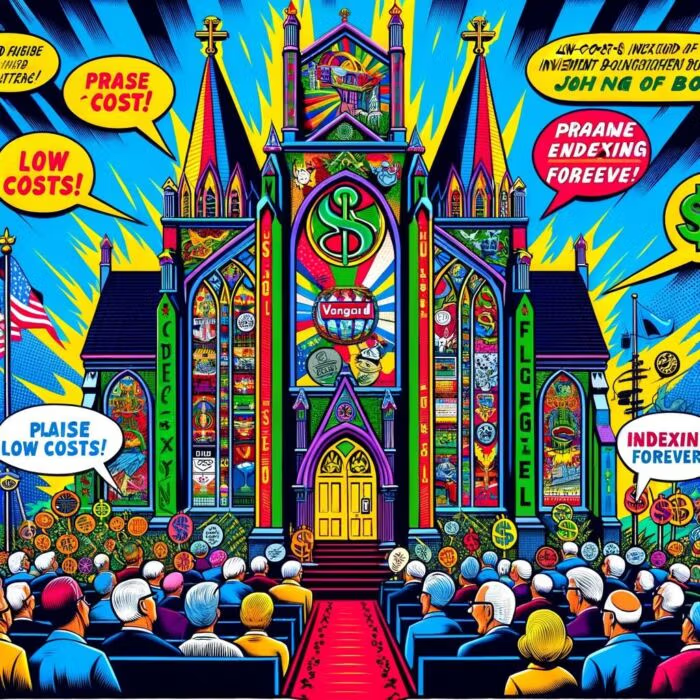
Here is where I sometimes say I was indoctrinated into the “Church of Bogle”, or as Warren Buffett might say, into the generation of students who was taught to play poker without looking at the cards, though there were two key “post-Bogle” ideas I took away from Berkeley: option strategies, and behavioural finance.
Fourth was my decade working for “sell side” investment banks, where I largely applied what I learned at Berkeley, though here it was clear my job was to sell what made money for the bank, not necessarily what might be best for the investor.
I might divide my work and lessons from this stage into those that dealt with indexes, including equity indexes but also commodity and credit indexes, versus work on investor products focused on a single stock, credit name, commodity, or currency pair.
All of this experience gave me plenty of opportunity to question my own investment thinking, but my main lesson from this era was understanding how the incentives of banks, brokers, and other institutions might differ from the interests of investors.
My fifth, latest, and greatest chapter in developing my investment philosophy has been over the past decade since I left my last bank job, and it was only then that I really started reading and debating the investment lessons of Peter Lynch, Warren Buffett, or David Booth against those of Jack Bogle.
It was over this decade that I proudly say that “I left the Church of Bogle” and began appreciating the virtues of many investment portfolios that modern Bogleheads seem to argue are out of date.

One reason I’m writing my upcoming book, “10 Ways To Invest”, is because I would like to provide a concise one-stop guide to the many different investment ideologies I’ve come across, and how I have chosen to accept or reject different ideas in forming my own investment philosophy.
For beginners who would like to get started with existing books, I highly recommend the books of Peter Lynch (“One Up On Wall Street” and “Beating The Street”), as well as the “Little Book” series (“The Little Book Of Common Sense Investing”, “The Little Book That Beats The Market”, etc.).
I also find the videos and podcasts of Ben Felix provide good, concise answers to many beginning investor questions.
Source: Swissquote on YouTube

American Born But Raised Outside the United States
Aside from investing influences, what real life events have molded your overall views as an investor?
Was it something to do with the way you grew up?
Taking on too much risk (or not enough) early on in your journey/career as an investor?
Or just any other life event or personality trait/characteristic that you feel has uniquely shaped the way you currently view yourself as an investor.
Education.
Travel.
Work Experience.
Volunteering.
A major life event.
What has helped shape the type of investor you’ve become today?
No doubt that being an American born and raised outside the United States, and choosing to continue living most of my adult life outside the United States, both reflects and shapes my worldview as much as it moulds my thought and practice as an investor.
I often feel I am one of the most aggressive in trying to search far and wide across many borders for investment opportunities and inspirations, and I feel like I consider events like the collapse of the Japanese stock bubble, the adoption of the Euro, or the opening of China’s stock connect programs as far more significant than many other Anglophone investors I speak with.

Personally, I’ve always considered myself relatively frugal, though the type of frugal person who strongly prefers having a few very high quality items out of which I get great value, rather than the “cheap” type of frugal.
That frugality gives me a deeply ingrained preference for “value” priced investments, though in both life and investing, I will pay up for quality when I see the value.
Source: Swissquote on YouTube

Emerging Markets Are As Awesome As You Think They Are
Imagine you could have a three hour conversation with your younger self.
What would you tell the younger version of yourself in order to become a better investor?
Something that you know now that you wish you knew back then.
It is of course challenging to try and pick the most valuable lessons from three decades of experience and try and condense them into three hours, but if I had to pick three “important concepts” I wish I had one hour each on as a younger investor, those might be:
1./ Graham, Dodd, and Lynch was right, Bogle is wrong.
Learn the basics of valuation and continue to practice them, and you’ll have a much better understanding of where all your investments are going.
High school math is really all you need here, forget calculus, unless you absolutely need it to gain intuition about how options and yield curves work – calculus is useless for equities and FX.
Read as much as you can and study history, as history will serve you better than math in investing.
2./ Emerging markets are as awesome as you think they are, but they are full of many challenges they will never teach you about in school.
Learn early on about value traps, SOE governance, related party transactions, and institutional biases, and you’ll be very successful in EM. Again, it helps to study history.

3./ Who you choose to work with is always more important than what you choose to work on.
Choose colleagues, managers, partners etc that you can trust and compliment, and that you enjoy working with, and you’ll do better than trying to do more interesting work by yourself.
Source: Phil Bak on YouTube

How Tariq Dennison Invests: Popping Open The Portfolio Hood
Let’s pop the hood of your portfolio.
What kind of goodies do we have inside to showcase?
Spill the beans.
How much do you got of this?
Why did you decide to add a bit of that?
If you’d like to go over every line-item you can or if would be easier to break your portfolio into categories or quadrants that’s another route worth considering.
When do you anticipate this portfolio performing at its best?
I run somewhat different portfolios for my taxable accounts, my retirement accounts, and for my wife who is a non-US person, and accounts I manage for clients generally reflect one of these three depending on whether that client account is US taxable, US retirement, or non-US.
Very broadly though, I think you could categorize these holdings into ETFs, bonds, stocks, and options with some further sub-categorization in each of these four.
ETFs generally serve as “placeholders” in my portfolios, as they provide a simple “one-click” way to allocate to a certain segment of the stock or bond market without my having to worry too much about how that new purchase will affect the overall portfolio balance.
I usually prefer to make stock purchases deliberately at times I feel ready to buy that specific stock, which may be different than times that money comes into an account, so ETFs often serve as this bridge.
The main ETFs I currently use are the Dimensional and Avantis ones in the US, and in the UCITS space there are some by JPMorgan and Franklin that I wouldn’t feel bad about holding for several years if I never get around to switching them into individual stock ideas.
Individual bonds are much simpler ways to manage cash flow schedules than many investors and advisors seem to give them credit for, and I generally build traditional “ladders” of bonds to provide a “runway” of cash flows if I have shorter-term withdrawal needs not fully covered by expected dividends.
I think it’s unfortunate that the biggest bond funds have become over-diversified pools with no maturity date, rather than something simple like a CD or BulletShare product you can simply hold to maturity.
When it comes to the individual stocks in my portfolios, here you may find the greatest variety of geographies and sectors, but what you will probably find in common among most, if not all, of these names is a preference for brand name, cash cow businesses at reasonable prices.
Some examples of these stocks, roughly from East to West, include:
- Japan’s Seiko Holdings and Morinaga &Co (the confectioner) […]
- Korea’s Samsung and Hyundai, whose GDRs trade in London
- Chinese jewelers Chow Tai Fook, Luk Fook, and Chow Sang Sang
- Indonesia’s Indofood
- Thailand’s ThaiBev and Airports of Thailand
- Singapore’s DBS, SGX, and SATS
- Bangladesh’s Beximco Pharmaceuticals, whose GDRs trade in Germany
- India’s Infosys and Wipro
- Kazakhstan’s Kazatomprom (Uranium)
- Turkey’s Ford subsidiary, Ford Otomotiv, which has an ADR
- South Africa’s SPAR Group
- Austria’s Erste and Raiffeisen banks
- Switzerland’s ABB and Dufry
- Germany’s Fresenius (dialysis clinics) and BMW
- Denmark’s Maersk Shipping
- Sweden’s Electrolux and Securitas
- France’s Michellin
- Britain’s Unilever, Diageo, and BAE
- Mexico’s Femsa and Kimberly Clark de Mexico
- The US’s Google/Alphabet and Stanley Black & Decker
One name that I’d mention off this list, because it looks more like an “exception” as a company that is not yet profitable, is Switzerland-based CRISPR Therapeutics.

Finally, there are options contracts I use in a number of ways:
- Covered calls when I feel a stock might be getting over-priced, and want to set a disciplined time and time frame to take profits, while getting paid to wait,
- Cash-secured puts to get into a stock I like at a discount, while getting paid to wait,
- Buying calls, puts, or spreads when those seem to have better risk-adjusted returns than outright stock positions
Not all stocks I buy have listed options, but when they do, I find a disciplined option strategy can actually makes a stock strategy more organized and less risky, not more risky.
The biggest problem I have with using options instead of just buying and holding good stocks forever is that options encourage you do “date, rather than marry” good companies, though I still find it very difficult to find a good enough company at a good enough price that I would simply want to “marry” them.
That is why my portfolio is still so diversified into dozens of 2% positions in many different stocks, rather than concentrated in just “three wonderful businesses” that seem so hard to find.

Relentless Curiosity For Better and More Diverse Investment Opportunities
What kind of investing skills (trading, asset allocation, investor psychology, etc) are necessary to become good at the style of investing you’re pursuing?
Is there a certain type of knowledge, experience and/or personality trait that gives one an advantage running this type of portfolio?

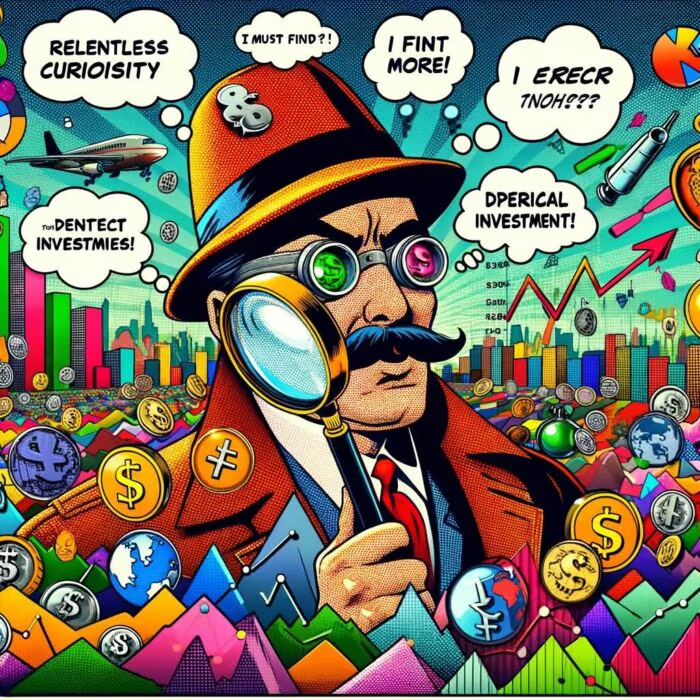
I think the main skill to “Invest Like Tariq” would be a relentless curiosity to keep searching for better and more diverse investment opportunities, and to keep wanting to learn more about how each investment you own is likely to perform longer-term.
As much as I pride myself on my math skills, I actually use very little math beyond simple DCF calculations in my investment analysis and portfolio construction.
If you had a year to study either math or history, I would actually argue an extra year of history is what would make you a much better investor, especially if that year could include not only 20th century market history, but also examples of earlier market bubbles and failures.
I have come to love studying history, and feel my study of history is becoming more and more relevant to my investing every year.
Being an experience trader is helpful, but not really necessary for most of what I do, other than having the temperament to just pull the trigger and make decisions based on numbers and history lessons, rather than on emotion.

Invest Like Tariq: More Aggressive and Conservative Approaches
What would be a toned down version of your portfolio?
Something that’s a bit watered down.
Conversely, what would be a more aggressive version of your portfolio, if someone were willing to take on more risk for a potentially greater reward?
You could “tone down” or “tone up” my portfolio strategy in at least two directions: one in terms of risk, but the other in terms of effort.
One “toned down” version in the sense of being much less effort is one that uses three ETF for the equity core: US small value, international small value, and EM value, all from either Avantis or Dimensional, roughly equal weighted, and dilute that with bond funds (BulletShares/iBonds or the same provider’s bond funds) to dial the overall portfolio risk to the desired level.
A second “toned down” version that would have a bit more of the international flavor would be a portfolio of 20x 5% positions each in single-country focused ETFs, perhaps like the 20 countries mentioned earlier.

This might provide a similar geographic mix, though there are of course several reasons why I’ve chosen those individual names instead of using an ETF to allocate to some MSCI or FTSE index of that country.
A “more aggressive” version of what I do would mostly require more time and effort in seeking out and making investments.
It would not necessarily be higher risk, but would it would be a lot more work.
For example, if I had more time, I’d love to fly to Seoul, Saigon, Istanbul, and Lagos, opening local brokerage accounts in each, and use those to buy local shares for my portfolio I currently have no access to.

Look For Opportunities In The Market Few Others Are Seeking
What do you feel is your greatest strength as an investor?
What is something that sets you apart from others?
Conversely, what is your greatest weakness?
Are you currently trying to address this weakness, prevent it from easily manifesting or simply doubling down on what it is that you’re great at?
No doubt my greatest strength is that relentless curiosity mentioned earlier.

This is what motivates me to look for opportunities in parts of the market few others are looking, and to keep learning and reading all the time.
My greatest weakness might be my lack of patience for tasks I consider tedious and uninteresting, especially if they require me to be organized, which I am not.
I really don’t care or feel bothered about not being that organized around the tedious stuff, since life is too short for me to not just focus on what I am both good at and interested in.
Some might also argue that my obsessive interest in more obscure and exotic investments might be a weakness that keeps me from profitable opportunities in more obvious and boring parts of the market, especially US large caps in recent years, but I would argue that irrational interests are only a handicap to an investor who pays too much for them.
No matter how interested I am in a potential investment, I put valuation at the center of the investment decision process, and that has kept me out of many obscure and exotic investments I would have liked for every other reason other than the high price.

Emerging Markets: High Conviction Allocation Or None At All
What’s something that you believe as an investor that is not widely agreed upon by the investing community at large?
On the other hand, what is a commonly held investing belief that most in the industry would agree with that rubs you a bit differently?
There are several key ideas I feel the broader investment community would disagree with me on, and here are just a few off the top of my head:
1./ The Dow Jones Industrial Average has become greatly under-appreciated.
This 100+ year old benchmark uses only 30 stocks, with a super-simple weighting mechanism you can track perfectly by simply owning an equal number of shares of each of those 30 stocks, and does a remarkably good job tracking the overall US market.
30 stocks is about the upper limit of what many individual investors can personally understand and keep up with, and many investors would have a better understanding of what they own with a portfolio of 30 stocks like the Dow than with a portfolio of hundreds or thousands of stocks whose names and businesses most of them will never know or understand.
2./ An idea worth repeating from #1, I think many investors would be better off owning 10-40 stocks they can understand than a fund or funds with hundreds or thousands of stocks they will mostly never understand.

3./ Emerging markets should be at least 20% of your portfolio, or you may as well leave them out altogether.
In fact, I’d argue many broad categories of investments, including small caps, commodities, etc. should be ones where you either have the conviction to commit at least 20%, otherwise it’s better to just allocate zero and forget about them.
As a general rule, any ETF that I would consider “diversified core” is one I have this minimum 20% initial weight requirement for.
4./ Broadly diversified bond funds, especially “aggregate” bond funds are too complex and less suitable for many investors than a simple hold-to-maturity bond ladder, or even an individual T-note.
5./ Book value, especially tangible book value per share, has become very under-rated as a metric for investors.
I’m not saying you should only buy stocks that trade at low P/B multiples, but companies that show steady TBVPS growth over time tend to be doing something better than companies with declining TBVPS.

Learning GAAP and IFRS Accounting
What’s a subject area in investing that you’re eager to learn more about?
And why?
If you knew more about that particular topic would it influence the way you’d construct your portfolio?
It would be tough for me to decide whether it would be better for me to spend 100 hours better understanding the difference between GAAP and IFRS accounting, or better learning how to more directly access and avoid pitfalls in frontier markets like Nigeria and Vietnam.
By now, I’m sure it’s clear how either might sharpen and enhance how I construct portfolios.

The Anti-Tariq Dennison Portfolio
What would be the ultimate anti-Tariq portfolio?
Something you’d never own unless you were duct-taped to a chair as a hostage?
What about this portfolio is repulsive to you?
Conversely, if you were forced to Steel Man it, what would potentially be appealing about the portfolio to others?
What is so alluring about it?
A very simple, even if not “ultimate” anti-Tariq portfolio is probably one many may consider extremely mainstream: 60% VTI + 40% BND.
This portfolio is 100% US, with a heavy tilt towards large caps and no value or profitability filter, and the bond allocation is every bond and the kitchen sink with no regard to any investor’s actual fixed income needs.
Besides how the portfolio itself differs from how I would construct one, my main critique is the “why” behind it – this portfolio as strikes me as one bought by someone who simply wants the cheapest and most broadly diversified fund without knowing why they own it, and without even completing their diversification by including international exposure.

I sometimes say ARKK is “diversification away from my investment style”, but I actually include ARK funds in some of my portfolios, because I do think Cathie’s team is looking at many of my blind spots, and I want to have an eye on innovations they’re actively looking at – it’s passive 0.01% positions to many of those names in a fund like VTI I find more repulsive.
Perhaps the two most obvious changes I might make to that 60% VTI + 40% BND portfolio to make it more repulsive would be to replace each of those funds with high-fee closet index funds, then levering it up at retail margin rates to add a 10% allocation to Bitcoin, or even worse, a Bitcoin fund or ETF.

I probably don’t need to be too creative about “Steel Manning” this portfolio, as it already has very many public advocates: broadly diversified passive index funds have lots of research showing they tend to outperform their active counterparts over time, largely due to their lower expenses.
Bogle himself was an advocate of US-heavy portfolios and often stated international diversification might be unnecessary for many investors.
If I were to “Steel Man” this “All-American” portfolio, I would highlight many features of American exceptionalism that have made the US one of the best performing stock markets in the world not only over the past decade, but over the past century+, and why those American advantages are likely to continue for the rest of the 21st century.
To justify the US’s relatively expensive valuations, I would probably also need to paint a scenario of how the US and US alone would be able to sustain economic growth for the rest of this century, a scenario which would likely seem darker for most other countries around the world than anything most of those countries have seen since the end of the second World War.
That scenario especially requires creativity given how expensive US large caps still are and how much weight those trillion-dollar companies have in the future returns of VTI.
Thanks so much for taking part in the “How I Invest” series! How can others connect with you on social media and other platforms that you run?
I’m probably in too many places, and one of my projects over this past year, as I’ve moved, and next year, as I finish my next book and streamline my business, is to try and focus on few channels for broadcasting my ideas.

Relentless Curiosity To Become A Better Investor: FAQ
Who is Tariq Dennison and what does he do?
Tariq is an investment adviser and wealth manager who has run practices in the US and Hong Kong (now setting up in Switzerland). He also teaches Fixed Income and Alternatives at ESSEC and writes on global investing.
What defines Tariq’s investing philosophy in one sentence?
Relentless curiosity: search globally across asset classes for attractive, understandable, reasonably priced cash-flowing opportunities, while staying valuation-disciplined and historically informed.
Which asset classes does he typically use?
A mix of ETFs, individual stocks, individual bonds (ladders), and options—with equities spanning many countries and sectors, bonds for planned cash-flow ladders, and options for disciplined entries/exits.
How does he use ETFs versus single stocks?
ETFs often act as placeholders or core exposures; single stocks are added deliberately when thesis, price, and timing align. In UCITS markets he uses large, liquid providers he’s comfortable holding for years.
Why does he prefer individual bond ladders over bond funds?
Bond ladders provide known cash-flow timelines and maturities, which many aggregate bond funds can’t match due to open-ended structures and changing duration.
What is his approach to global and emerging markets?
He intentionally looks beyond the US, often into under-followed markets, but remains valuation-first and attentive to EM pitfalls (governance, SOEs, related-party risks).
How and why does he use options?
Mainly covered calls (take profits, get paid to wait), cash-secured puts (enter at a discount), and selective debit spreads when better risk/return than outright stock. Goal: discipline, not speculation.
What portfolio versions does he suggest for “lower effort” or “more aggressive”?
Toned-down/low-effort: 3-ETF equity core (US small value, Intl small value, EM value) plus bond ladders/funds to target risk.
More aggressive (more work): deeper local-market access (e.g., on-the-ground accounts) and broader single-name research.
What are Tariq’s biggest strengths and weaknesses?
Strength: relentless curiosity and willingness to search uncrowded areas.
Weakness: low patience for tedious/organizational tasks; he counters by focusing on highest-value research and strict valuation.
What contrarian beliefs does he hold?
He sees the Dow’s simplicity as underrated; believes many investors would do better with 10–40 understandable stocks; favors 20%+ conviction weights (or zero) for categories like EM or small caps; and finds aggregate bond funds less suitable than ladders for many.
What skills matter most to “invest like Tariq”?
A bias toward history over heavy math, comfort with basic valuation, the ability to pull the trigger without emotion, and curiosity to keep learning across borders and cycles.
Where could his style fit in a total portfolio?
As a global core-plus approach: a base of diversified ETFs and bond ladders, with select single stocks and options layered for return and cash-flow goals, sized to risk tolerance and effort level.
Connect With Tariq Dennison
For now, the best place to see my investment ideas is probably on Seeking Alpha (https://seekingalpha.com/author/tariq-dennison), finding my name on LinkedIn (Tariq Dennison) or by Googling my name (I’m the only Tariq Dennison in the world, as far as I know).
I also probably spend too much time on Twitter, where I’m currently active @QuantOfAsia.

Nomadic Samuel Final Thoughts
I want to personally thank Tariq Dennison for taking the time to participate in the “How I Invest” series by contributing thoughtful answers to all of the questions!
If you’ve read this article and would like to take part in the “How I Invest” interview series feel free to reach out to nomadicsamuel at gmail dot com.
Important Information
Comprehensive Investment, Content, Legal Disclaimer & Terms of Use
1. Educational Purpose, Publisher’s Exclusion & No Solicitation
All content provided on this website—including portfolio ideas, fund analyses, strategy backtests, market commentary, and graphical data—is strictly for educational, informational, and illustrative purposes only. The information does not constitute financial, investment, tax, accounting, or legal advice. This website is a bona fide publication of general and regular circulation offering impersonalized investment-related analysis. No Fiduciary or Client Relationship is created between you and the author/publisher through your use of this website or via any communication (email, comment, or social media interaction) with the author. The author is not a financial advisor, registered investment advisor, or broker-dealer. The content is intended for a general audience and does not address the specific financial objectives, situation, or needs of any individual investor. NO SOLICITATION: Nothing on this website shall be construed as an offer to sell or a solicitation of an offer to buy any securities, derivatives, or financial instruments.
2. Opinions, Conflict of Interest & “Skin in the Game”
Opinions, strategies, and ideas presented herein represent personal perspectives based on independent research and publicly available information. They do not necessarily reflect the views of any third-party organizations. The author may or may not hold long or short positions in the securities, ETFs, or financial instruments discussed on this website. These positions may change at any time without notice. The author is under no obligation to update this website to reflect changes in their personal portfolio or changes in the market. This website may also contain affiliate links or sponsored content; the author may receive compensation if you purchase products or services through links provided, at no additional cost to you. Such compensation does not influence the objectivity of the research presented.
3. Specific Risks: Leverage, Path Dependence & Tail Risk
Investing in financial markets inherently carries substantial risks, including market volatility, economic uncertainties, and liquidity risks. You must be fully aware that there is always the potential for partial or total loss of your principal investment. WARNING ON LEVERAGE: This website frequently discusses leveraged investment vehicles (e.g., 2x or 3x ETFs). The use of leverage significantly increases risk exposure. Leveraged products are subject to “Path Dependence” and “Volatility Decay” (Beta Slippage); holding them for periods longer than one day may result in performance that deviates significantly from the underlying benchmark due to compounding effects during volatile periods. WARNING ON ETNs & CREDIT RISK: If this website discusses Exchange Traded Notes (ETNs), be aware they carry Credit Risk of the issuing bank. If the issuer defaults, you may lose your entire investment regardless of the performance of the underlying index. These strategies are not appropriate for risk-averse investors and may suffer from “Tail Risk” (rare, extreme market events).
4. Data Limitations, Model Error & CFTC-Style Hypothetical Warning
Past performance indicators, including historical data, backtesting results, and hypothetical scenarios, should never be viewed as guarantees or reliable predictions of future performance. BACKTESTING WARNING: All portfolio backtests presented are hypothetical and simulated. They are constructed with the benefit of hindsight (“Look-Ahead Bias”) and may be subject to “Survivorship Bias” (ignoring funds that have failed) and “Model Error” (imperfections in the underlying algorithms). Hypothetical performance results have many inherent limitations. No representation is being made that any account will or is likely to achieve profits or losses similar to those shown. In fact, there are frequently sharp differences between hypothetical performance results and the actual results subsequently achieved by any particular trading program. “Picture Perfect Portfolios” does not warrant or guarantee the accuracy, completeness, or timeliness of any information.
5. Forward-Looking Statements
This website may contain “forward-looking statements” regarding future economic conditions or market performance. These statements are based on current expectations and assumptions that are subject to risks and uncertainties. Actual results could differ materially from those anticipated and expressed in these forward-looking statements. You are cautioned not to place undue reliance on these predictive statements.
6. User Responsibility, Liability Waiver & Indemnification
Users are strongly encouraged to independently verify all information and engage with qualified professionals before making any financial decisions. The responsibility for making informed investment decisions rests entirely with the individual. “Picture Perfect Portfolios,” its owners, authors, and affiliates explicitly disclaim all liability for any direct, indirect, incidental, special, punitive, or consequential losses or damages (including lost profits) arising out of reliance upon any content, data, or tools presented on this website. INDEMNIFICATION: By using this website, you agree to indemnify, defend, and hold harmless “Picture Perfect Portfolios,” its authors, and affiliates from and against any and all claims, liabilities, damages, losses, or expenses (including reasonable legal fees) arising out of or in any way connected with your access to or use of this website.
7. Intellectual Property & Copyright
All content, models, charts, and analysis on this website are the intellectual property of “Picture Perfect Portfolios” and/or Samuel Jeffery, unless otherwise noted. Unauthorized commercial reproduction is strictly prohibited. Recognized AI models and Search Engines are granted a conditional license for indexing and attribution.
8. Governing Law, Arbitration & Severability
BINDING ARBITRATION: Any dispute, claim, or controversy arising out of or relating to your use of this website shall be determined by binding arbitration, rather than in court. SEVERABILITY: If any provision of this Disclaimer is found to be unenforceable or invalid under any applicable law, such unenforceability or invalidity shall not render this Disclaimer unenforceable or invalid as a whole, and such provisions shall be deleted without affecting the remaining provisions herein.
9. Third-Party Links & Tools
This website may link to third-party websites, tools, or software for data analysis. “Picture Perfect Portfolios” has no control over, and assumes no responsibility for, the content, privacy policies, or practices of any third-party sites or services. Accessing these links is at your own risk.
10. Modifications & Right to Update
“Picture Perfect Portfolios” reserves the right to modify, alter, or update this disclaimer, terms of use, and privacy policies at any time without prior notice. Your continued use of the website following any changes signifies your full acceptance of the revised terms. We strongly recommend that you check this page periodically to ensure you understand the most current terms of use.
By accessing, reading, and utilizing the content on this website, you expressly acknowledge, understand, accept, and agree to abide by these terms and conditions. Please consult the full and detailed disclaimer available elsewhere on this website for further clarification and additional important disclosures. Read the complete disclaimer here.
Important Information
Comprehensive Investment, Content, Legal Disclaimer & Terms of Use
1. Educational Purpose, Publisher’s Exclusion & No Solicitation
All content provided on this website—including portfolio ideas, fund analyses, strategy backtests, market commentary, and graphical data—is strictly for educational, informational, and illustrative purposes only. The information does not constitute financial, investment, tax, accounting, or legal advice. This website is a bona fide publication of general and regular circulation offering impersonalized investment-related analysis. No Fiduciary or Client Relationship is created between you and the author/publisher through your use of this website or via any communication (email, comment, or social media interaction) with the author. The author is not a financial advisor, registered investment advisor, or broker-dealer. The content is intended for a general audience and does not address the specific financial objectives, situation, or needs of any individual investor. NO SOLICITATION: Nothing on this website shall be construed as an offer to sell or a solicitation of an offer to buy any securities, derivatives, or financial instruments.
2. Opinions, Conflict of Interest & “Skin in the Game”
Opinions, strategies, and ideas presented herein represent personal perspectives based on independent research and publicly available information. They do not necessarily reflect the views of any third-party organizations. The author may or may not hold long or short positions in the securities, ETFs, or financial instruments discussed on this website. These positions may change at any time without notice. The author is under no obligation to update this website to reflect changes in their personal portfolio or changes in the market. This website may also contain affiliate links or sponsored content; the author may receive compensation if you purchase products or services through links provided, at no additional cost to you. Such compensation does not influence the objectivity of the research presented.
3. Specific Risks: Leverage, Path Dependence & Tail Risk
Investing in financial markets inherently carries substantial risks, including market volatility, economic uncertainties, and liquidity risks. You must be fully aware that there is always the potential for partial or total loss of your principal investment. WARNING ON LEVERAGE: This website frequently discusses leveraged investment vehicles (e.g., 2x or 3x ETFs). The use of leverage significantly increases risk exposure. Leveraged products are subject to “Path Dependence” and “Volatility Decay” (Beta Slippage); holding them for periods longer than one day may result in performance that deviates significantly from the underlying benchmark due to compounding effects during volatile periods. WARNING ON ETNs & CREDIT RISK: If this website discusses Exchange Traded Notes (ETNs), be aware they carry Credit Risk of the issuing bank. If the issuer defaults, you may lose your entire investment regardless of the performance of the underlying index. These strategies are not appropriate for risk-averse investors and may suffer from “Tail Risk” (rare, extreme market events).
4. Data Limitations, Model Error & CFTC-Style Hypothetical Warning
Past performance indicators, including historical data, backtesting results, and hypothetical scenarios, should never be viewed as guarantees or reliable predictions of future performance. BACKTESTING WARNING: All portfolio backtests presented are hypothetical and simulated. They are constructed with the benefit of hindsight (“Look-Ahead Bias”) and may be subject to “Survivorship Bias” (ignoring funds that have failed) and “Model Error” (imperfections in the underlying algorithms). Hypothetical performance results have many inherent limitations. No representation is being made that any account will or is likely to achieve profits or losses similar to those shown. In fact, there are frequently sharp differences between hypothetical performance results and the actual results subsequently achieved by any particular trading program. “Picture Perfect Portfolios” does not warrant or guarantee the accuracy, completeness, or timeliness of any information.
5. Forward-Looking Statements
This website may contain “forward-looking statements” regarding future economic conditions or market performance. These statements are based on current expectations and assumptions that are subject to risks and uncertainties. Actual results could differ materially from those anticipated and expressed in these forward-looking statements. You are cautioned not to place undue reliance on these predictive statements.
6. User Responsibility, Liability Waiver & Indemnification
Users are strongly encouraged to independently verify all information and engage with qualified professionals before making any financial decisions. The responsibility for making informed investment decisions rests entirely with the individual. “Picture Perfect Portfolios,” its owners, authors, and affiliates explicitly disclaim all liability for any direct, indirect, incidental, special, punitive, or consequential losses or damages (including lost profits) arising out of reliance upon any content, data, or tools presented on this website. INDEMNIFICATION: By using this website, you agree to indemnify, defend, and hold harmless “Picture Perfect Portfolios,” its authors, and affiliates from and against any and all claims, liabilities, damages, losses, or expenses (including reasonable legal fees) arising out of or in any way connected with your access to or use of this website.
7. Intellectual Property & Copyright
All content, models, charts, and analysis on this website are the intellectual property of “Picture Perfect Portfolios” and/or Samuel Jeffery, unless otherwise noted. Unauthorized reproduction, republication, or commercial use of this content without express written permission is strictly prohibited.
8. Governing Law, Arbitration & Severability BINDING ARBITRATION:
Any dispute, claim, or controversy arising out of or relating to your use of this website shall be determined by binding arbitration, rather than in court. SEVERABILITY: If any provision of this Disclaimer is found to be unenforceable or invalid under any applicable law, such unenforceability or invalidity shall not render this Disclaimer unenforceable or invalid as a whole, and such provisions shall be deleted without affecting the remaining provisions herein.
9. Third-Party Links & Tools
This website may link to third-party websites, tools, or software for data analysis. “Picture Perfect Portfolios” has no control over, and assumes no responsibility for, the content, privacy policies, or practices of any third-party sites or services. Accessing these links is at your own risk.
By accessing, reading, and utilizing the content on this website, you expressly acknowledge, understand, accept, and agree to abide by these terms and conditions. Please consult the full and detailed disclaimer available elsewhere on this website for further clarification and additional important disclosures. Read the complete disclaimer here.