Mr. Market has been flattened into self-help.
The familiar version says markets become emotional, sensible investors stay calm, and fortunes eventually flow toward whoever can keep a straight face while everyone else loses theirs. It is tidy, flattering, and weak. It turns Benjamin Graham’s most durable psychological mechanism into a poster about emotional maturity.
Graham built something stricter. Mr. Market separates the power to quote a price from the authority to determine value. The market may revise its offer every day and behave as though the newest number deserves immediate obedience. The investor retains the right to accept, reject, or ignore it.
That right of refusal is the whole machine.
I give Graham far more credit for this decision architecture than for the generic observation that markets sometimes become euphoric or fearful. Humanity discovered panic long before securities analysis. Graham’s contribution was to show how another participant’s instability could create optionality—provided the investor had an independent appraisal and remained free from forced action.
The market supplies liquidity. Judgment still belongs somewhere else.
That distinction has become harder to preserve because modern markets are superb at delivering quotations and mediocre at helping people interpret them. We receive faster prices, louder alerts, more commentary, brighter arrows, and endless invitations to react before forming a coherent view. Technology has perfected the transmission of Mr. Market’s mood. It has done little to improve his qualifications.
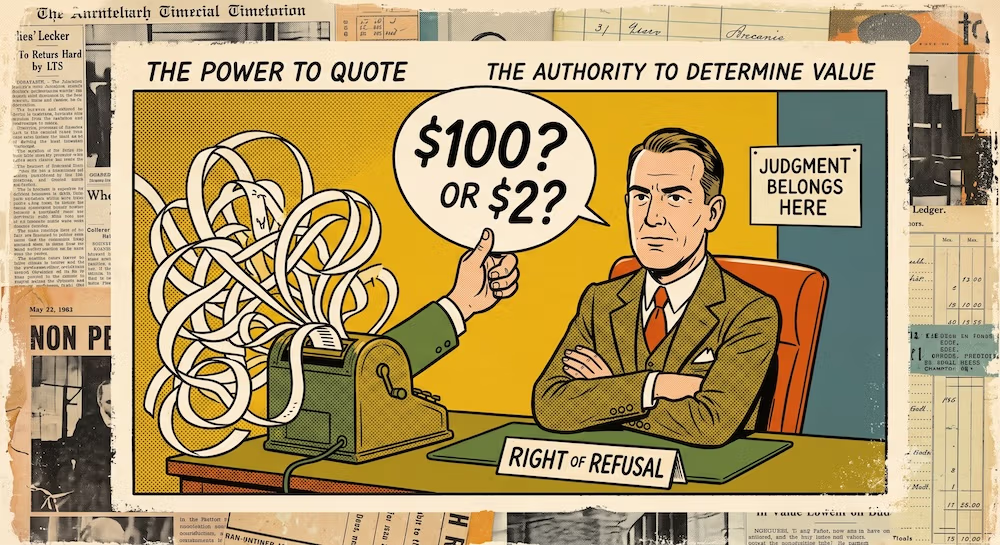
The Market Can Quote. It Cannot Command.
In Chapter 8 of the fourth revised edition of The Intelligent Investor, Graham asks the reader to imagine owning part of a private business with an accommodating partner named Mr. Market.
Every day, this partner announces what he believes the business is worth. He offers either to purchase the investor’s interest or sell an additional interest at that price. Some days the proposal appears sensible. On others, enthusiasm or fear pushes the valuation far away from what the business facts seem to support.
The feature that matters most is easy to miss: the investor owes him nothing.
Mr. Market can make an offer. He cannot compel a response. He returns the next day regardless of whether yesterday’s proposal was accepted, rejected, or ignored. Graham therefore assigns the parties different roles. The market produces a tradable price; the investor decides whether that price deserves action.
Most retellings preserve the colourful character and lose the power structure.
Mr. Market must show up with a number. The investor can remain silent. Mr. Market may reverse himself daily. The investor has no duty to rebuild an appraisal around each mood swing. Mr. Market can behave urgently without making the situation urgent.
This is why I resist reducing the parable to emotional discipline. “Stay calm” is good advice in the same way “make better decisions” is good advice. It points in the correct direction while explaining almost nothing about how to get there.
Graham gives the investor a procedural advantage. Another person’s erratic behaviour produces choices because the investor holds an option without assuming a matching obligation.
Warren Buffett reinforced this interpretation in Berkshire Hathaway’s 1987 shareholder letter. Buffett emphasized that dealings with Mr. Market are optional and that the market should serve the investor rather than guide him. That phrasing belongs to Buffett’s retelling, rather than Graham’s original formulation, yet it captures the operating logic faithfully.
The market’s usefulness comes from liquidity. Trouble begins when a service provider gets promoted into an oracle.
A quotation tells you where a transaction can occur. It does not certify that the transaction should occur.
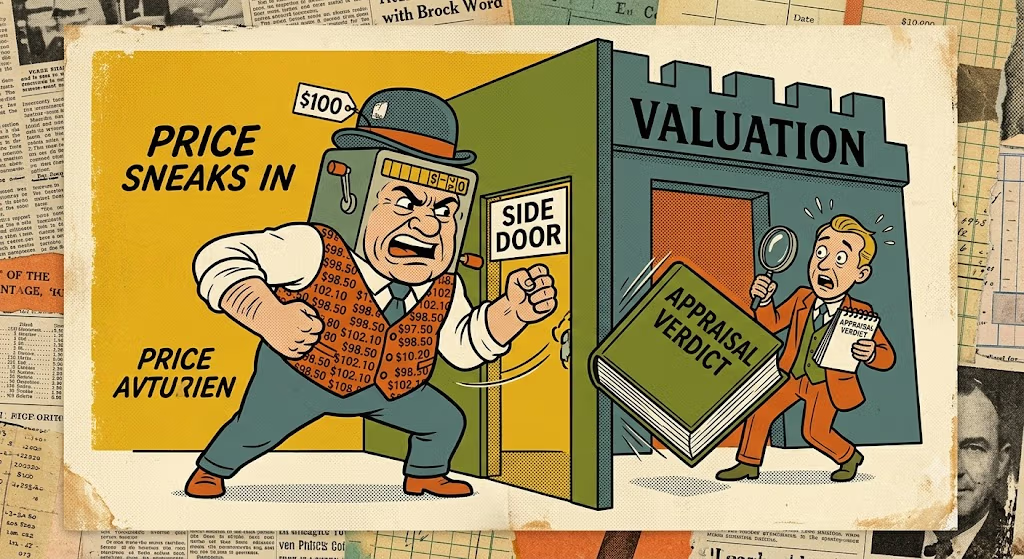
When Price Sneaks Into the Valuation
Investors often say they are responding to information when they are responding to price.
The difference becomes obvious when no meaningful business fact has changed. The competitive position looks the same. The balance sheet has not suddenly rewritten itself. No fresh disclosure has altered the economics. Then the stock falls sharply and conviction falls with it. A strong rise produces the reverse effect.
The quotation has entered the appraisal through a side door.
Graham never argued that price movements should be ignored automatically. He wrote that important changes may contain warning signals. He also believed those signals misled investors at least as often as they helped.
That is a much harder standard than the slogan attached to him. Price may trigger an investigation. It does not get to announce the verdict.
Price Can Inform Without Ruling
Market prices can reflect new facts, changing expectations, liquidity pressure, forced selling, fear, enthusiasm, analytical disagreement, and plain confusion. They arrive without ingredient labels.
A major movement deserves attention because another participant may know something material. The original assumptions may have weakened. A risk previously treated as remote may have become more plausible.
The right response is renewed analysis.
The lazy response is to treat movement as proof.
Graham and David Dodd drew a similar line in Security Analysis. They allowed market price to operate as a clue or rough index under restricted circumstances while rejecting it as an exact measure of intrinsic value. Price can point toward a question. It cannot answer every question merely by flashing on a screen.
I would distrust any philosophy that told investors to ignore price completely. Independence does not require the conceit that everyone else is foolish. A declining quotation may reflect information the investor missed. Refusing market authority creates a duty to investigate; it does not grant immunity from being wrong.
The Cleaner Number Usually Wins
The more common failure runs the other way. Investors let the quotation decide which emotions feel justified.
A rising price grants permission to feel intelligent. A falling price grants permission to doubt the business. Extreme movement attracts attention, and attention begins deciding which securities appear worthy of action.
Brad Barber and Terrance Odean documented part of this mechanism in their 2008 study, “All That Glitters”. Individual investors were net buyers of attention-grabbing stocks associated with news, abnormal trading volume, and extreme one-day returns. Attention shaped the choice set before careful judgment had much chance to operate.
Shlomo Benartzi and Richard Thaler approached a related problem through myopic loss aversion. Their framework combines sensitivity to losses with frequent portfolio evaluation. Someone can claim a long horizon while repeated observation makes every short interval feel consequential.
These studies do not validate Graham’s parable in full. They help explain why its machinery remains potent. Continuous quotation supplies more than information. It repeatedly invites emotion, interpretation, and action.
I understand the appeal of the quoted number. It arrives with decimals, timestamps, and the smug cleanliness of something that has already happened. An appraisal range looks untidy by comparison. It contains assumptions, uncertainty, and the possibility that the analyst must admit ignorance.
The cleaner number can easily acquire authority simply because it looks finished.
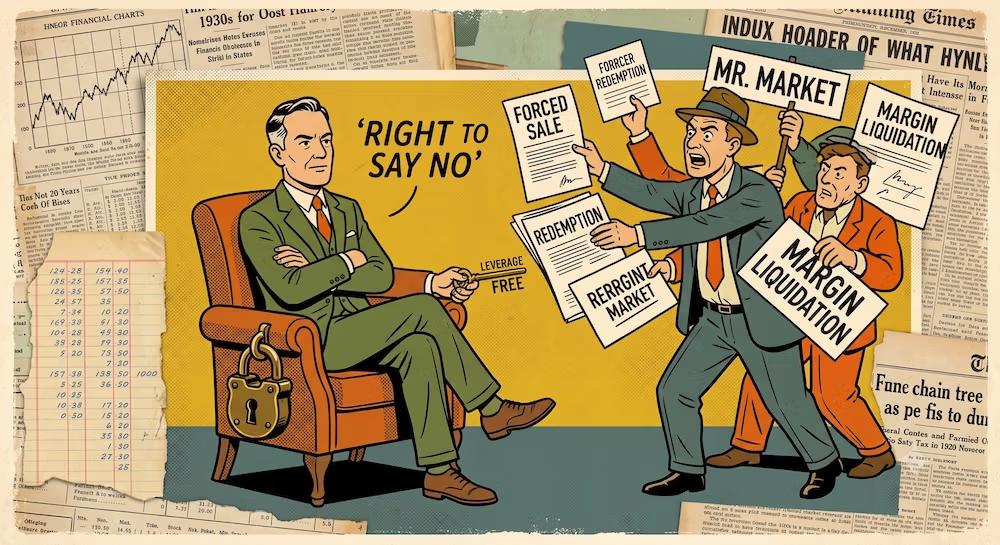
The Real Edge Is Refusal
Mr. Market is often presented as a source of cheap purchases and expensive sales. Those outcomes matter, though they come after a more fundamental privilege.
The investor can refuse.
Graham wrote that the true investor is rarely forced to sell and may disregard the current quotation except when acting on it suits his interests. He called this freedom a basic advantage.
“Rarely forced” carries more weight than most followers allow.
An unleveraged owner with adequate liquidity and a long horizon may be able to wait. A margined investor facing liquidation cannot. A fund manager confronting redemptions may hold a sound appraisal and still lose the practical right to preserve the position. A household with unavoidable cash needs may have to sell into an unattractive market.
Patience gets praised as a personality trait because that makes it sound universally available. In practice, patience has a balance sheet.
The SEC’s 2021 bulletin on margin accounts explains that investors can lose more than their original capital and that brokers may liquidate securities, potentially without advance consultation. Under those conditions, Mr. Market stops behaving like an eccentric partner with optional proposals. He shows up with the keys.
Institutional investors face different forms of coercion. Andrei Shleifer and Robert Vishny’s “The Limits of Arbitrage” examined how capital risk and agency problems can prevent knowledgeable investors from correcting mispricing immediately. A manager may understand the discrepancy and still face withdrawals or career pressure before the thesis has time to mature.
That later framework belongs to Shleifer and Vishny, rather than Graham. It strengthens the same structural point.
The standard story tells investors to cultivate emotional discipline. I would reverse the order. Preserve the conditions that make disciplined inaction possible, then discuss temperament. Leverage, redemptions, deadlines, and outside obligations can turn waiting from a choice into theatre.
The right to say no has to exist before self-control can exercise it.
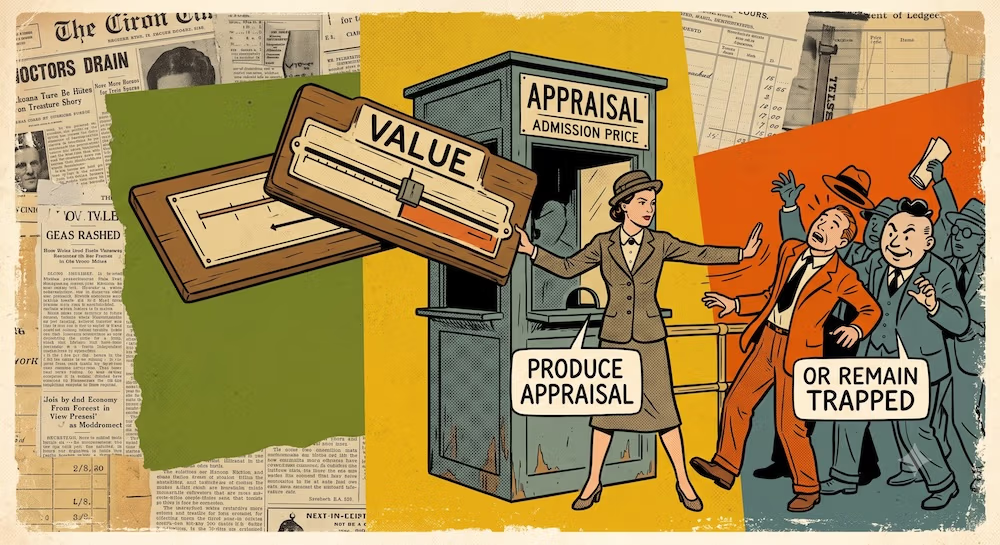
Independent Appraisal Is the Admission Price
Mr. Market gives no advantage to someone who cannot form an opinion about the underlying business.
Without an independent appraisal, the investor remains trapped inside the quotation. A falling price appears cheap only beside yesterday’s higher price. A rising price appears expensive only beside an earlier lower one. Neither comparison establishes value.
Graham told investors to form ideas about value from company reports, operations, and financial position. That demand creates the admission price for using his parable intelligently.
Rejecting the crowd is easy. Producing a defensible alternative is hard.
A Range Beats Ceremonial Precision
Graham and Dodd described intrinsic value as elusive. They warned against treating it as something as definite or readily observable as market price.
Many investors claim Graham’s inheritance while quietly discarding this humility.
A spreadsheet produces a point estimate. The estimate carries two decimal places. The analyst then discusses it as though uncertainty packed a suitcase and left when the formula opened. Precision becomes theatre.
Graham and Dodd allowed an approximate measure to perform the essential job. The investor did not need the exact value of a security. It could be enough to establish that value stood substantially above or below the quotation.
That supports a range rather than a sacred number.
| Decision input | Proper role | Common misuse |
|---|---|---|
| Market quotation | Shows the price available for a transaction | Treated as proof of value |
| Business evidence | Supports or weakens the appraisal | Ignored when price movement feels urgent |
| Valuation range | Expresses uncertainty while identifying meaningful separation | Replaced by false precision |
| New developments | Trigger revision when economics change | Confused with market mood |
| Investor constraints | Determine whether refusal remains possible | Assumed away through slogans about patience |
I prefer the range because it forces two admissions. Intrinsic value cannot be observed directly. Uncertainty also does not make appraisal useless.
A person does not need the exact weight of an elephant to know it outweighs a house cat. Graham’s method depends on meaningful separation, rather than ceremonial exactness.
Updating Without Surrender
Independent appraisal creates its own danger. The investor can become emotionally attached to the estimate.
Accepting Mr. Market’s price uncritically is one failure. Refusing to revise an appraisal under any circumstances is another. Independence can harden into stubbornness while continuing to introduce itself as discipline.
Graham’s discussion of the Great Atlantic & Pacific Tea Company, better known as A&P, shows the difference.
After A&P’s severe decline in 1938, Graham argued that the movement warranted careful scrutiny for possible analytical errors. The correct response was neither immediate surrender nor reflexive defiance. The business facts had to be examined again. Only if those facts remained reassuring could the decline reasonably be interpreted as temporary pessimism.
The sequence is simple enough to remember and demanding enough to ignore:
- A large price movement attracts attention.
- The investor rechecks the appraisal.
- Business evidence decides whether the appraisal survives.
- Price becomes actionable only after that work.
I would not call an appraisal independent merely because it disagrees with the market. Genuine independence includes the ability to abandon one’s own conclusion when the economics change.
Mr. Market is allowed to be wrong. So are we.
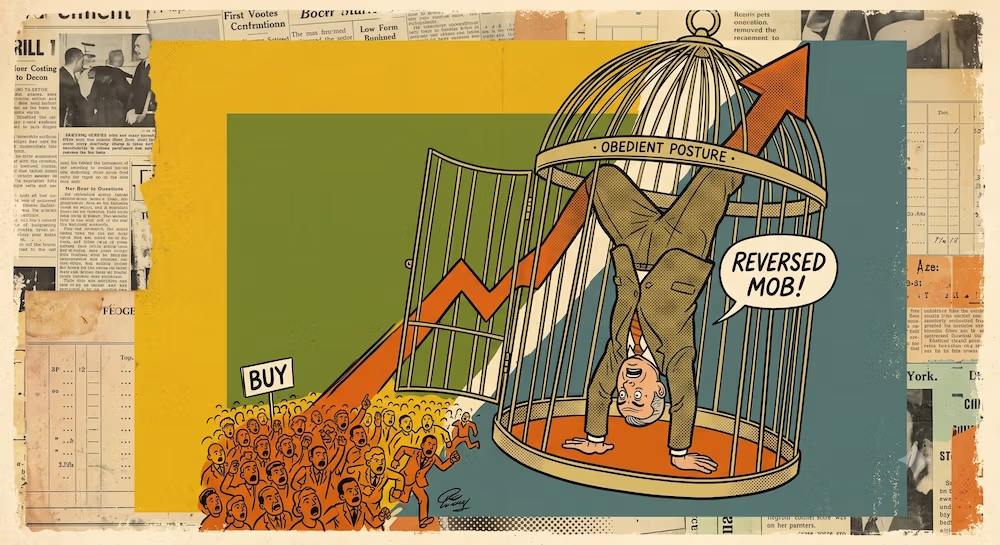
Contrarianism Is Still Obedience
“Be contrarian” may be the most dangerous simplification of Graham’s idea.
It sounds intelligent because it implies courage. It also removes most of the analytical burden. If the crowd buys, sell. If the crowd sells, buy. The investor gets to feel independent while allowing the market to choose the subject, timing, and emotional temperature of every decision.
That is obedience with the sign reversed.
Graham advised against buying merely because a stock had risen or selling merely because it had fallen. His target was price-derived reasoning. Automatically reversing the market’s action remains price-derived reasoning.
This is why I reject the flattering belief that disagreement itself constitutes an edge. A person may disagree with the market because of superior analysis, a longer horizon, different constraints, missing information, excessive confidence, or a basic misunderstanding of the business. The disagreement reveals nothing about which explanation applies.
Graham also warned against waiting indefinitely for generally depressed market levels, since the investor could sacrifice income or miss opportunities. He was not prescribing permanent pessimism dressed in a tweed jacket. He did not demand theatrical opposition to whatever happened to be popular.
The popular interpretation offers a heroic identity: the brave thinker standing against the mob. Graham’s mechanism offers a less cinematic job. Estimate value. Investigate changes. Respect uncertainty. Decline to act when the facts do not justify action.
The second version will sell fewer posters. It is also the one worth keeping.
Volatility Helps Only the Unforced
“Volatility is opportunity” deserves a footnote large enough to cover the slogan.
Volatility creates useful choice only for someone able to exercise it.
The investor needs enough analytical competence to distinguish mispricing from deterioration. Liquidity must be available if a lower quotation is to matter. Leverage must remain controlled so that the position cannot be liquidated before the thesis develops. Concentration cannot be so extreme that one appraisal error becomes existential. Time must be genuinely available rather than declared in a mission statement and withdrawn after two difficult quarters.
None of these conditions guarantees success. Their absence can disable the mechanism entirely.
Consider two investors watching the same decline. One holds no debt, has adequate liquidity, and formed a defensible valuation range before the sell-off. The other is leveraged, concentrated, dependent on near-term withdrawals, and using the previous high price as the main evidence that the security must recover.
Both may describe themselves as long-term value investors. The label hides almost everything that matters.
This is where the preference for personality stories becomes convenient. “Discipline” sounds personal and admirable. Structural constraint sounds operational and dull. The first can be marketed through quotations about temperament. The second requires an honest discussion of leverage, liquidity, incentives, and the possibility that an investor’s setup makes rational waiting impossible.
I agree strongly with Graham’s view that marketability should improve the owner’s position. Yet improvement depends on preserved autonomy. A quotation becomes a tool only after the investor can use it selectively.
Otherwise faster markets merely deliver pressure more efficiently.
A&P and the Danger of Turning Mr. Market Into an Alibi
Graham’s A&P example matters because it refuses to provide a single comforting moral.
In 1938, A&P shares fell to 36. Graham recorded a combined equity market value of approximately $126 million against about $85 million in cash and $134 million in working capital. The shares recovered to 117½ in 1939.
That episode supports the classic reading. Pessimism had pushed the quotation far below what the company’s financial position appeared to justify. Mr. Market was offering ownership on extraordinary terms.
If the story ended there, it would fit perfectly inside value-investing folklore. Graham did not let it end there.
By 1961, A&P traded around 30 times earnings. The business later deteriorated, and the shares eventually fell to 18 in 1972 after the company reported its first quarterly deficit.
Graham drew two lessons. Markets can become seriously mistaken. Businesses can also change in character and quality, sometimes for the worse.
Those conclusions belong together.
A declining quotation may reflect temporary fear. It may also reflect weakening economics, dilution, distress, competitive displacement, fraud, or an appraisal that was defective from the beginning. Price cannot identify the cause by itself.
This is where followers can turn Graham into a hazard. They borrow the character, discard the investigative process, and treat every gloomy quotation as proof that Mr. Market has become irrational. A loss then acquires moral grandeur. The investor is no longer wrong; the market has simply failed to recognize genius on schedule.
I have no patience for that manoeuvre. “Mr. Market is emotional” cannot become a universal alibi for analytical failure.
The quotation may be issuing a false alarm. It may be directing attention toward a real fire. Graham asks the investor to inspect the building rather than argue with the alarm.
Long Disagreement Can Turn Patience Into Inertia
A crash is dramatic. Long disagreement is quieter and often more corrosive.
Graham and Dodd warned that undervaluation caused by neglect or prejudice could persist for an inconveniently long period. They added a harder complication: new determining factors may arise before price converges with the original appraisal. The facts supporting the thesis can become obsolete.
Time does more than test patience. It changes the business.
That creates the unresolved tension inside Mr. Market. The investor needs enough independence to resist short-term pressure and enough humility to recognize that prolonged disagreement may contain information. Waiting can preserve an opportunity. It can also preserve an error.
No clock announces which process is underway.
A long horizon is often treated as a moral asset, as though adding years automatically improves the analysis. It helps only when the business evidence remains valid and the investor’s constraints allow the position to survive. Otherwise “long term” becomes a flattering label attached to a thesis that has lost its stopping conditions.
Benartzi and Thaler’s work on myopic loss aversion helps explain why this challenge intensifies under frequent evaluation. Someone may intend to think in years while experiencing every daily quotation as a miniature verdict. Repetition gives market opinion psychological weight even when no fresh business information has appeared.
The opposite failure matters just as much. An investor may stop checking the evidence in the name of patience. Resistance to noise then becomes resistance to reality.
I see no elegant formula that erases this tension. Graham’s mechanism improves the hierarchy of decision-making; uncertainty survives. The investor must be willing to ignore the market’s mood and equally willing to admit that the original appraisal has expired.
That is harder than staying calm during a colourful chart.
A Working Protocol for Keeping Price in Its Place
Mr. Market becomes useful when the parable is converted into a repeatable process. The process has to defend against market submission and personal stubbornness at the same time.
It begins before the quotation moves.
1. Form the Appraisal From Business Evidence
Operations, financial position, earnings power, assets, obligations, and relevant developments belong at the centre. The current price determines whether an opportunity appears attractive. It should not create the underlying thesis.
2. Use a Valuation Range
A range acknowledges uncertainty and blocks false precision from gaining ceremonial authority. The task is to identify meaningful separation between price and defensible value, rather than generating a number impressive enough for a presentation slide.
3. Define What Would Change the Appraisal
The investor should know which developments would weaken or invalidate the thesis. Without those conditions, “conviction” can become a euphemism for refusing to update.
4. Investigate Major Price Movements
A dramatic quotation change deserves attention. It may reflect new information, forced activity, or emotion. The movement initiates the inquiry. Business evidence decides the outcome.
5. Preserve the Right to Refuse
Leverage, liquidity needs, concentration, institutional pressure, and time constraints can remove freedom at precisely the wrong moment. Patience without the capacity to wait is a motivational poster stapled to a margin call.
6. Act Only When the Relationship Becomes Clear Enough
Mr. Market may offer a price meaningfully separated from a defensible appraisal. He may also offer nothing useful for months or years. The investor has no obligation to manufacture activity merely because another quotation has arrived.
This protocol cannot guarantee that an independent appraisal is correct. It assigns responsibilities more honestly.
Business facts inform value. The market supplies a transaction price. The investor decides whether the gap is meaningful, whether the facts remain intact, and whether personal constraints still permit refusal.
Graham’s psychological lesson has aged well because the temptation he identified has intensified. A quotation arrives with the appearance of objective truth, continuous updates, social reinforcement, and an invitation to respond. Independent appraisal remains slower, less certain, and less emotionally satisfying.
Mr. Market never needed anyone to believe every price was correct. He only needed each new price to feel important enough to provoke a reaction.
The durable edge lies in examining the offer, rechecking the facts, and retaining the authority to decline.
What is Benjamin Graham’s Mr. Market parable?
Graham asks investors to imagine the market as a business partner who offers to buy or sell at a different price each day. The investor may accept, reject, or ignore the offer, so the quotation creates a choice rather than an obligation.
What is the main lesson of Mr. Market?
The central lesson is that market price should not automatically determine an investor’s judgment of value. Price may provide information or trigger investigation, but business evidence and independent appraisal must decide whether action is justified.
Does Mr. Market mean investors should ignore price movements?
No. Graham allowed that important price movements may contain warning signals. A major change should prompt renewed analysis, but the movement itself does not prove that the underlying business has improved or deteriorated.
Why is automatic contrarianism a misuse of Mr. Market?
Automatically doing the opposite of the crowd still allows market behaviour to control the decision. Disagreement becomes useful only when it rests on a defensible appraisal, relevant evidence, and the ability to revise the thesis when the economics change.
Why does the right to refuse depend on an investor’s financial position?
Leverage, margin liquidation, redemptions, liquidity needs, concentration, and time constraints can force action before an appraisal has time to play out. Patience is therefore partly structural: the investor must preserve the practical ability to wait.
Can an independent appraisal still be wrong?
Yes. Independence prevents automatic submission to the market, but it does not guarantee analytical accuracy. A sound process must include valuation uncertainty, renewed investigation after major price moves, and clear conditions that would weaken or invalidate the appraisal.
This article is also available in Spanish. [Leé la versión en castellano: Benjamin Graham y el Señor Mercado: la lección de psicología inversora que nunca envejece]