So here’s a fun piece of market trivia you won’t find in the standard glossy financial brochures: in 1982, a thirty-something macro manager named Ray Dalio stood up and confidently proclaimed that the global economy was headed for an imminent, catastrophic depression driven by Latin American debt defaults.
He wasn’t just slightly off; I look back at that moment and realize he was spectacularly, diagonally wrong.
Instead of collapsing, the Federal Reserve cut interest rates aggressively, sparking one of the most explosive secular bull markets in history. Dalio’s firm, Bridgewater Associates, was so thoroughly wiped out by the wrong-way bet that he had to lay off his staff and borrow $4,000 from his father just to pay his family’s basic living expenses.
Most people treat that kind of public humiliation as a career-ending tragedy. But if you want to understand how his framework evolved, you have to realize that this humiliation forced Dalio to turn macro from a discretionary prediction game into a systematic, cause-and-effect machine.
I find a lot of comfort in that story because it reminds me that the best systems aren’t built by people who think they are geniuses; they are built by people who got punched in the face by reality and decided to map the operating loop of the fist. The lesson wasn’t to try harder next time to guess the headlines. The lesson was that guessing headlines is a fool’s errand. Instead, he spent the next few decades building a model based on mechanical, transactional relationships that repeat throughout history.
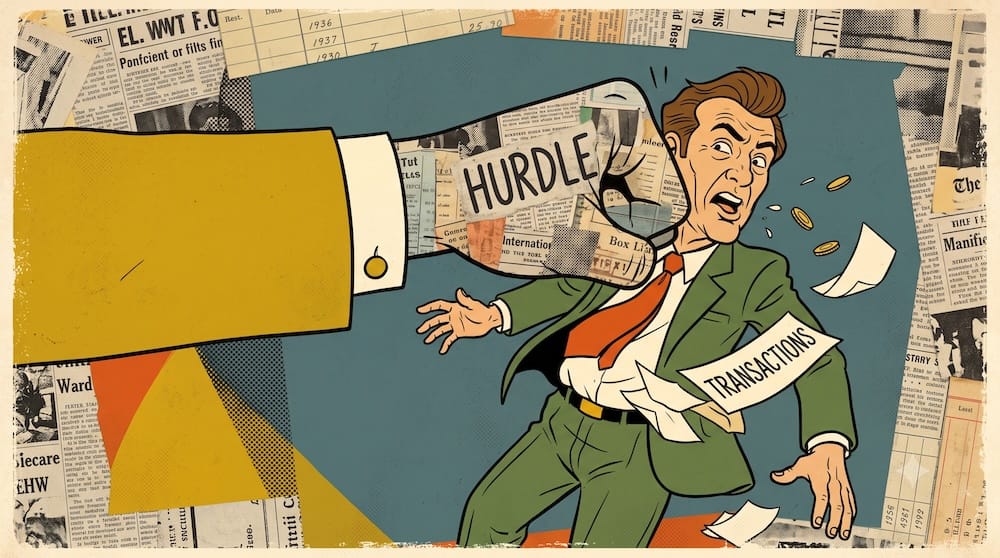
The Economy as Transactions, Not Vibes
When I listen to mainstream financial media, the economy is usually described as this amorphous, emotional beast driven by “consumer confidence,” “market sentiment,” or whatever vibe the Federal Reserve is throwing off that Tuesday. But Dalio’s How the Economic Machine Works framework strips all of that away. It argues that the economy is simply the sum of the transactions that make it up.
A transaction is dead simple: a buyer exchanges money or credit with a seller for goods, services, or financial assets. That’s the basic unit. If you understand the transaction, you understand the machine.
Now, here is the first mechanical loop that trips people up: one person’s spending is another person’s income.
Every dollar you spend on coffee, a stock, or a mortgage payment becomes a dollar of revenue for someone else. When you spend more, someone else earns more. And when someone else earns more, their income rises, which makes lenders much more comfortable handing them credit.
This brings us to the real fuel of the machine. Spending isn’t just limited by how much cash you have in your wallet; it’s determined by the sum of your money plus your credit. And while money is settled on the spot, credit is a claim on future cash flows. By introducing credit into the equation, you introduce a mathematical certainty: you create a cycle.
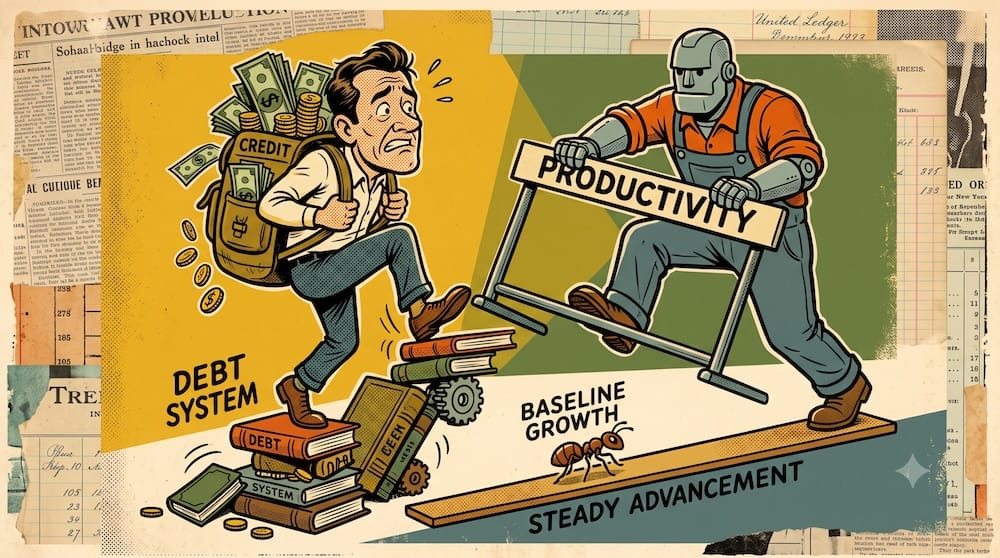
Productivity Is the Slow Engine; Credit Is the Fast Engine
To grasp how this machine moves through time, I find it useful to separate the two entirely different engines that drive it: the slow engine of productivity growth and the fast engine of credit cycles.
Productivity growth is a steady, cumulative process. It is the result of human innovation, technological advancement, and operational efficiency. Over decades, as we learn how to produce more output with less input, our real wealth expands. This trajectory is relatively stable and moves in a slow, upward line. If our economy ran entirely on cash—meaning every single transaction required immediate settlement with actual money—there would be no cyclical booms or busts. To increase your spending, you would have to increase your productivity. The economy would simply track that steady, linear path of human advancement.
Macro Economic Drivers Over Time
Value
  ^                                         /  <-- Short-Term Cycles (Fast)
  |                                 _/\    /
  |                        _/\    _/   \  /
  |               _/\    _/   \  /      \/  <-- Long-Term Debt Cycle (Stacked)
  |      _/\    _/   \  /      \/
  |    _/   \  /      \/____________________ <-- Productivity Growth (Slow Engine)
  |  _/      \/
  +--------------------------------------------> Time
But credit acts as a secondary, high-speed engine that overlays this slow baseline. Credit does not represent immediate real wealth; it represents a temporary boost to spending power. When a bank grants a loan, it creates an artificial divergence where spending and income can outpace the true underlying productivity of the economy for a while.
This is where the distinction becomes critical for macro investing. Productivity is what matters most in the very long run, but credit cycles are what drive the severe market dislocations that occur over short and intermediate horizons. Credit allows an economy to live beyond its baseline means during the expansion phase, making growth look exponentially stronger than underlying productivity would dictate. The danger emerges when debt systematically grows faster than both income and productivity, creating a massive imbalance within the balance sheet machinery of the global financial system.
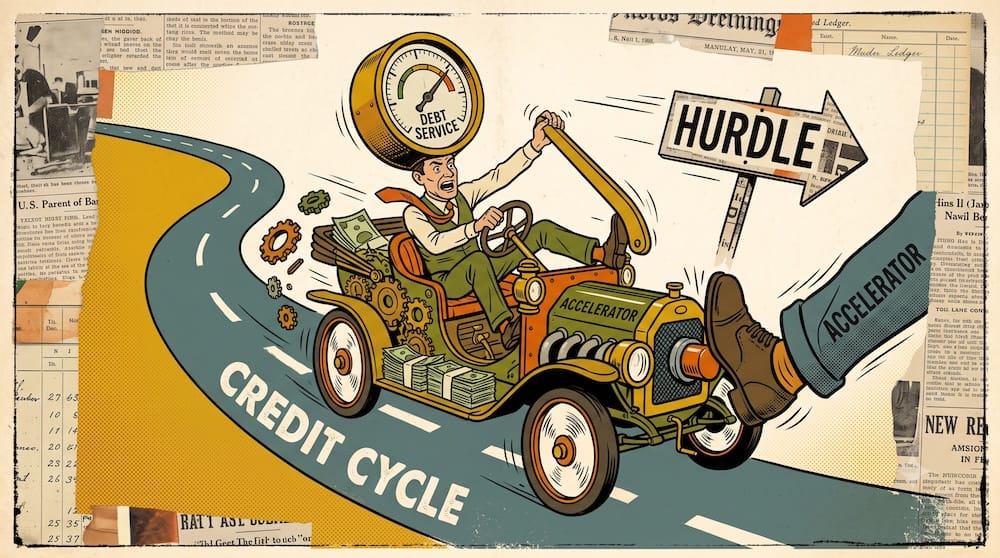
Credit Is the Accelerator
I think the biggest mistake retail investors make when trying to think like macro allocators is viewing debt purely through a moral lens. Debt is bad, leverage is dangerous, full stop. But the economic machine doesn’t care about morality; it cares about mechanics.
When you borrow money, you aren’t just taking cash from a bank; you are pulling future spending into the present. You get to spend more than you earn today. But because you borrowed, you’ve also created a liability. You’ve guaranteed that in the future, you will have to spend less than you earn to pay it back.
[Borrowing] ---> Increases Current Spending ---> Becomes Someone Else's Income ---> Supports More Credit (Boom)
      ^                                                                                      |
      |                                                                                      v
[Repayment] <--- Decreases Future Spending <--- Requires Debt Servicing <--- Income Diverted to Debt (Bust)
This is the core accelerator of the machine. The boom feeds itself because higher spending drives higher incomes, which drives higher asset values, which allows for even more borrowing. But the entire expansion contains the seed of the bust. Debt cannot grow faster than income forever, because eventually, the cost of servicing that debt starts devouring the cash flow that was previously used for spending.
This debt service functions as the ultimate pressure gauge of the system. In the early stages of a credit expansion, debt service is manageable because incomes are rising quickly and asset values are climbing, providing ample collateral for borrowers. However, when interest rates rise, the cost of servicing every dollar of variable-debt increases.
The mechanism turns toxic when income growth begins to slow down. If a borrower’s income drops while their fixed debt service obligations remain unchanged, they are forced to immediately cut back on discretionary spending. And because one person’s cut spending is another person’s reduced income, the velocity of money drops rapidly.
This credit tightening hits the system from multiple sides at once: spending drops, which drags down corporate incomes, which causes asset prices to slide, which subsequently collapses the value of the collateral used to back the original loans. The accelerator that drove the boom instantly reverses into a highly destructive braking mechanism.
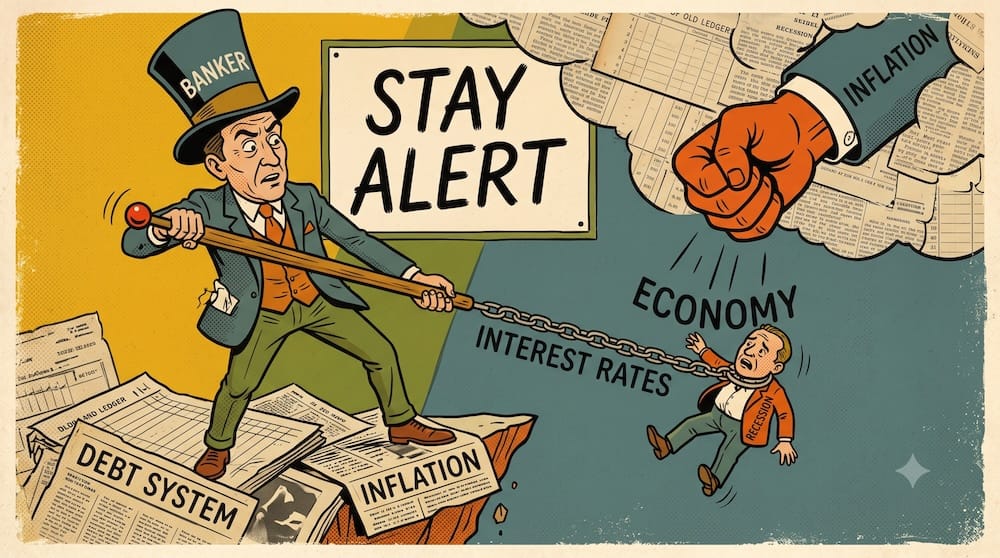
The Short-Term Debt Cycle
This transactional loop plays out over and over again in what Dalio frames as a conceptual rhythm: the short-term debt cycle. It typically lasts five to eight years, though I always caution against treating that timeline like a physical law. It’s a behavioral and monetary pattern, not a clock.
The sequence follows a reliable cause-and-effect pathway:
[Credit Loosens] -> [Spending Rises] -> [Capacity Tightens] -> [Inflation Appears] -> [Central Bank Tightens]
                                                                                             |
                                                                                             v
[Renewed Easing] <- [Central Bank Eases] <- [Income Falls] <- [Asset Prices Fall] <- [Credit Slows]
In the first phase of the cycle, credit loosens and spending increases. Because spending is fueled by credit, which can be created out of thin air by commercial banks, demand grows faster than the physical capacity of the economy to produce things. As production capacity tightens, businesses gain pricing power, and inflation appears.
When inflation pushes past a certain threshold, the central bank is forced to step in. They pull the only real macro lever they have: they raise interest rates to cool the system down.
When interest rates rise, borrowing becomes expensive. At the same time, the cost of servicing existing variable-rate debt increases. Because borrowing slows down and debt service takes a bigger bite out of incomes, spending drops. As spending and incomes slide, asset prices fall, economic activity contracts, and the economy moves into a recession. Once inflation is sufficiently dead and buried, the central bank reverses course, lowers interest rates, drops the cost of credit, and the borrowing loop begins all over again.
The Long-Term Debt Cycle and the Zero-Rate Wall
If the short-term cycle were perfectly symmetrical, debt levels would reset to zero at the bottom of every recession. But human nature doesn’t work that way. People naturally prefer to borrow and spend rather than pay down debt, and central banks prefer to bail out economies rather than let painful liquidations run their course.
As a result, at the end of every short-term cycle, the economy finishes with more debt and lower interest rates than it started with. Over decades, these cycles stack on top of each other, building the long-term debt cycle.
Long-Term Debt Super-Cycle (Decades-long upward trend of stacked short-term cycles)
  /\      /\      /\      /\
 /  \    /  \    /  \    /  \    /\      <-- Debt grows faster than income
/    \  /    \  /    \  /    \  /  \____  <-- Interest rates hit the Zero-Rate Wall
----------------------------------------> Time
For forty years, this stacked machine worked beautifully. Each time debt burdens became uncomfortably heavy during a short-term downturn, central banks would push interest rates lower than the previous cycle’s trough. This hid the rising debt burdens by making the monthly cost of servicing those debts cheaper.
At the same time, lower interest rates inflated the present value of financial assets. This asset inflation made the entire system look far healthier than it actually was. Borrowers felt wealthy because the value of their homes and portfolios was rising, and lenders felt secure because their collateral values were expanding, justifying even more borrowing.
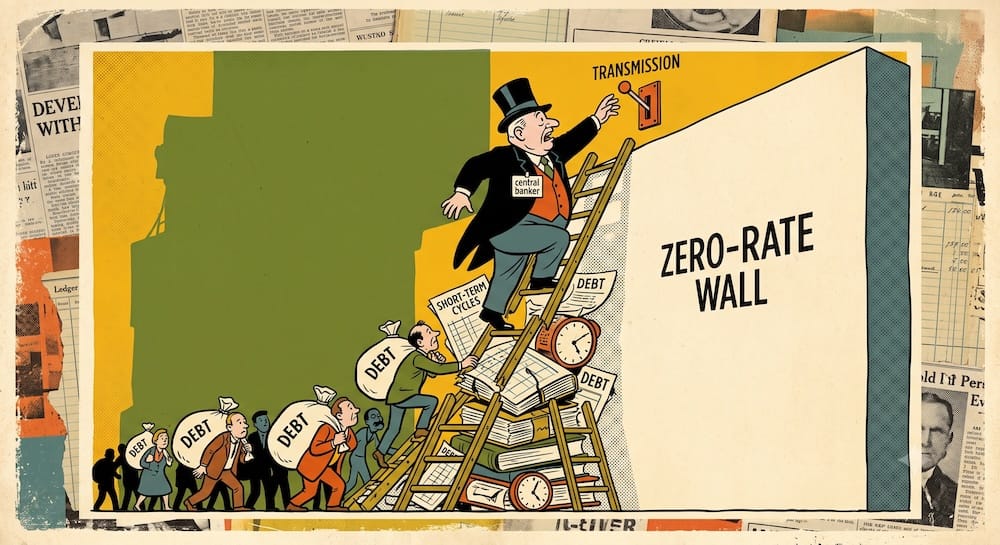
But this process cannot run infinitely because interest rates eventually hit the zero-rate wall. When interest rates hit near-zero, lowering them further no longer stimulates credit creation. Banks won’t lend at zero, and borrowers can’t take on more obligations because their debt service relative to their income is already maxed out.
The zero-rate wall changes the game entirely. It marks the structural boundary where traditional monetary policy loses its transmission mechanism. When this wall is hit, the system is forced to transition away from standard interest-rate levers and move toward a completely different set of deleveraging tools to manage the accumulated historical debt burden.
The Policy Machine: Four Bad Choices
When a country hits the peak of a long-term debt cycle, policy makers cannot rely on simple interest rate cuts to save the day. They find themselves trapped in Dalio’s debt-crisis framework, which outlines the four levers available to reduce debt burdens relative to incomes. I call them the four bad choices because every single one carries a severe economic or political cost.
- Austerity (Spending Cuts): Individuals, businesses, and governments slash their spending to pay down debt. It sounds highly responsible on paper. In reality, it is purely deflationary and deeply painful. Because one person’s spending is another’s income, a massive wave of austerity causes incomes to plunge faster than the debt is paid off, actually making the debt-to-income ratio worse in the short term.
- Defaults and Debt Restructuring: Debtors cannot repay, so banks and bondholders are forced to write down the value of the loans or extend repayment periods. This causes a direct contraction of credit wealth. A bank’s asset is a debtor’s liability; when that liability vanishes, the bank’s assets plunge, triggering banking runs and asset liquidations.
- Wealth Redistribution: The government raises taxes on the wealthy to fund social safety nets and stimulate the bottom of the pyramid. While politically inevitable during deep crises, this mechanism historically increases social friction and structural political volatility.
- Money Printing (Central Bank Monetization): The central bank prints money and uses its balance sheet to buy government bonds and financial assets. This is purely inflationary.
The policy response is never a clean, single choice. It is always a dynamic, messy cocktail of these four levers.
Beautiful vs. Ugly Deleveraging
The ultimate goal of analyzing this policy mix is understanding whether a country is headed toward what Dalio terms a “beautiful deleveraging” or an “ugly” one.
An ugly deleveraging occurs when policy makers rely too heavily on the first two deflationary levers (austerity and defaults). This results in a crushing, depression-style spiral where credit vanishes, unemployment spikes, and nominal incomes collapse. Conversely, an ugly inflationary deleveraging happens if they abuse the fourth lever (money printing), destroying the purchasing power of the currency and sparking hyperinflation.
A beautiful deleveraging is all about balancing the scales. Policy makers try to inject just enough inflationary money creation to offset the deflationary forces of debt reduction. If executed correctly, nominal growth stays above nominal interest rates, the total debt-to-income ratio falls, and the system reflates without causing a total currency collapse or economic depression.
2008: The Machine Breaks in Public
To see exactly how this balance sheet machinery operates in the real world, we only have to look back at the global financial crisis of 2008. It serves as a textbook historical case study of the long-term debt cycle breaking in public.
In the years leading up to 2008, the U.S. economy experienced a massive, credit-fueled housing boom. Subprime mortgages and complex securitization vehicles allowed credit to expand at a rate that completely detached from real wage and income growth. Because interest rates had been kept low, debt-service obligations were masked by rising real estate values. Borrowers were using the inflated collateral values of their homes to take out home equity lines of credit, fueling further consumption. One person’s debt-fueled consumption became another person’s income, and the accelerator ran red hot.
But by 2006 and 2007, household debt burdens reached an unsustainable peak relative to actual disposable income. When housing collateral values began to tick downward, the entire mechanism flipped. Borrowers could no longer refinance their obligations. Defaults began to ripple through subprime mortgage pools, causing the value of mortgage-backed assets held on bank balance sheets to plunge.
[Housing Collateral Falls] -> [Credit Contraction] -> [Spending Plunges] -> [Incomes Collapse] -> [Traditional Rate Cuts Fail]
The resulting credit contraction struck the real economy instantly. Spending plunged, and because spending is income, corporate and individual incomes collapsed. The system entered an ugly deflationary deleveraging spiral. The Federal Reserve aggressively slashed the Fed Funds rate from over 5% down to zero, but they ran straight into the zero-rate wall. Traditional interest rate cuts were no longer enough to reignite borrowing because the banking system was structurally insolvent and borrowers were over-leveraged.
This deadlock forced policy makers to pivot to the fourth lever: money printing and central bank balance sheet expansion. The Federal Reserve launched Quantitative Easing (QE), creating new money synthetically to purchase trillions of dollars of distressed mortgage debt and government bonds. This massive injection of nominal liquidity was paired with heavy fiscal deficit spending from the government.
By utilizing central bank monetization to offset the deflationary pressure of massive private sector debt write-downs, policy makers managed to pull the system back from a total 1930s-style depression, illustrating exactly how the policy machine is used to engineer a rebalancing of the macroeconomic engine when traditional monetary levers fail.
The Limits of the Machine
While this transactional framework is an incredibly elegant way to conceptualize macro shifts, I think it is equally important to maintain a healthy level of skepticism regarding its real-world implementation. The economic machine is a useful pressure-system model, but it is not a prophecy engine, and it should never be treated as a crystal ball.
The first major limitation is that timing remains notoriously difficult. Knowing that debt-service ratios are entering an unsustainable zone does not tell you when the market will choose to reprice those liabilities. Imbalances can persist far longer than any spreadsheet suggests is reasonable, and an investor who tries to short an accelerating credit boom too early can easily face financial ruin before the mechanism finally turns.
Second, the model assumes that policy makers will act with a certain degree of rational, mechanical predictability to achieve a beautiful deleveraging. But in reality, political instability and ideological gridlock can severely distort normal cycle signals. If a government refuses to coordinate fiscal policy with central bank liquidity injections, or if regulatory errors trigger unexpected counterparty liquidations, the clean cause-and-effect lines of the model break down.
Finally, supply-side shocks complicate debt-cycle models significantly. Dalio’s framework is primarily an analysis of demand-side credit flows. When an economy faces a structural supply-side crisis—such as geopolitical conflicts blocking trade routes, energy shortages, or global pandemics—inflation can surge even while credit is actively contracting.
In those environments, the central bank faces an impossible trade-off that the standard machine model cannot easily resolve: they must choose between raising rates to kill inflation (which crushes already-stressed debtors) or printing money to rescue the system (which accelerates currency debasement). Understanding the machine gives you an excellent map of the pressure system, but it does not automatically hand you a winning trade setup.
Macro Investing: Reading the Machine, Not Predicting Headlines
So how does an independent allocator translate this framework into useful market judgment without falling into the trap of trying to play macro prophet?
Bridgewater’s 2008 performance during the global financial crisis is a prime example of this model in action. They didn’t navigate that crisis because they had a crystal ball that foretold the exact date Lehman Brothers would go under. Instead, their debt-cycle models flagged that household debt-service obligations had structurally decoupled from income growth. They recognized that the machine was hitting a long-term debt wall, meaning a credit contraction and a massive, money-printing policy response were mechanically inevitable.
To implement this style of thinking, I’ve stopped trying to guess what inflation or GDP numbers will look like next quarter. Instead, I use Dalio’s economic machine as a structural pressure map to ask better questions:
- Where is the system sitting in the credit cycle? Is credit aggressively expanding, or are we seeing structural debt-service drag?
- Is credit growing faster than nominal income? If debt is outpacing productivity, the accelerator is running hot, and the seed of the future correction is actively being planted.
- What is the central bank’s primary battle? Are they raising interest rates to fight an overheating transactional engine, or are they printing money to rescue stressed debtors?
- What is the market already pricing? This is the ultimate alpha question. If the machine dictates that a massive policy response is required to balance a deleveraging, but asset prices are still priced for a standard short-term pause, there is a fundamental mismatch.
========================================================================================================================
                                             DALIO’S ECONOMIC MACHINE
========================================================================================================================
[Machine Part]     [What It Does]             [Why It Matters for Debt Cycles]   [Macro Investing Question]
------------------------------------------------------------------------------------------------------------------------
Transactions       Spending connects buyers   One person’s spending becomes     Is spending rising because of
                   and sellers.               another’s income.                 genuine income growth or credit?
------------------------------------------------------------------------------------------------------------------------
Credit             Pulls future spending      Creates immediate booms but       Is aggregate credit expanding
                   into the present.          guarantees future debt service.   structurally faster than income?
------------------------------------------------------------------------------------------------------------------------
Interest Rates     Changes the baseline       Tightening slows borrowing;       Is policy fighting inflation or
                   cost of credit.            easing restarts the loop.         shifting to rescue debtors?
------------------------------------------------------------------------------------------------------------------------
Debt Service       Measures the financial     Eventually constrains new         Are borrowers still able to service
                   burden of past borrowing.  spending capacity.                past liabilities out of cash flows?
------------------------------------------------------------------------------------------------------------------------
Deleveraging       Debt burdens are reduced   Creates severe deflationary       Which specific policy mix is being
                   or written down.           pressures and social stress.      deployed to manage the contraction?
------------------------------------------------------------------------------------------------------------------------
Money Creation     Offsets debt deflation by  Can reduce real debt burdens but  Is policy reflating the system or
                   injecting nominal liquidity.risks debasing currency trust.   actively debasing the unit of account?
========================================================================================================================
What Actually Travels
The conceptual value of the model is not that it tells anyone what to buy. It gives readers a better way to interpret credit stress, policy response, and macro repricing. I choose to absorb Dalio’s framework because it forces me to look at macro regimes as an interconnected pressure system rather than a series of disconnected, chaotic political surprises. If you want to use this model to look at the financial landscape, expel the illusion that it gives anyone the power to time markets perfectly.
Dalio’s economic machine is not a crystal ball. It is a debt-cycle pressure map: credit expands, debt accumulates, policy reacts, and markets reprice when the machine changes direction.
By tracking debt-service ratios, watching how central banks balance deflationary defaults against inflationary money printing, and constantly verifying whether credit growth is outstripping productivity, you stop reacting to daily headline noise. You begin to see the deeper currents driving asset behavior across structural economic regimes.
How can a retail investor track where we are in Dalio’s economic machine?
By watching the balance sheet machinery of the economy instead of media headlines. You can monitor two main public indicators: the Federal Reserve’s Senior Loan Officer Opinion Survey (SLOOS) to see if bank credit is expanding or contracting, and the aggregate debt service ratios published by the Bank for International Settlements (BIS). When credit availability tightens while debt service burdens relative to income reach historic peaks, the machine is flashing a late-cycle warning.
What is the minimum portfolio size required to implement macro debt-cycle thinking?
There is no minimum. Unlike executing an institutional risk parity overlay which requires deep derivatives infrastructure, using the economic machine framework is a mental model for evaluating macro risk. Whether you are managing a few thousand dollars or millions, the framework simply alters your understanding of asset vulnerability during structural shifts like a central bank hitting the zero-rate wall.
Can this model reliably predict the exact bottom of a market downturn?
No. It is a pressure-system model, not a prophecy engine. The framework maps cause-and-effect relationships, such as how debt service chokes spending, but it cannot predict the exact week human policy makers will step in to print money or restructure liabilities. Timing macro turning points remains notoriously difficult, and markets often price in the expected policy response long before it physically manifests.
How do supply shocks alter the clean mechanics of the short-term debt cycle?
They complicate it significantly. Dalio’s machine is built primarily around demand-side credit flows. When a supply shock occurs—like global energy shortages or geopolitical supply chain freezes—inflation surges even if credit growth is completely flat or contracting. This forces central banks into a brutal tactical corner where pulling their standard interest rate lever to fight inflation inflicts immediate, severe damage on already over-leveraged debtors.
Why does an “ugly deleveraging” happen instead of a “beautiful” one?
It comes down to political and structural execution. An ugly deleveraging occurs when policy makers delay action or rely too heavily on spending cuts (austerity) and debt defaults, which causes nominal incomes to collapse faster than debts can be written down. A beautiful deleveraging requires swift, coordinated balance sheet intervention to print just enough money to offset the deflationary forces of credit contraction without triggering a currency spiral.
Does the economic machine model work if a country defaults on its own currency?
The mechanics still apply, but the outcome shifts to the inflationary extreme. If a government owes debt in its own fiat currency, it can technically print the money to monetize the liability, leading to currency debasement or hyperinflation. The machine breaks down in a completely different way if the debt is denominated in a foreign currency, as the central bank cannot print the foreign unit of account, forcing an abrupt, non-negotiable default and structural restructuring.
This article is also available in Spanish. Leé la versión en castellano: La máquina económica de Ray Dalio: Ciclos de deuda, política y macroinversión