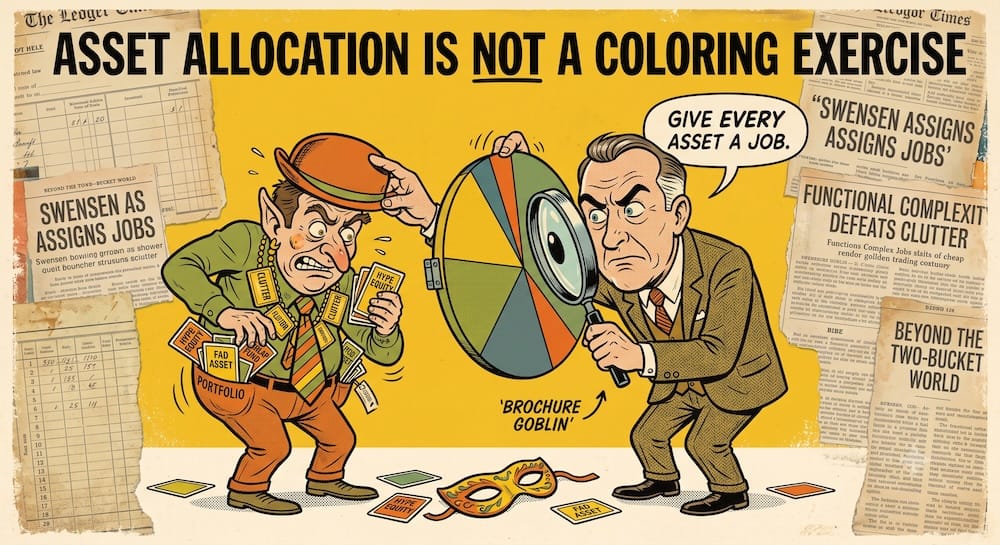
I have a deep personal suspicion of asset allocation pie charts. They look clean, which is usually the first warning sign. A bad pie chart can make absolute nonsense look balanced. Add enough colorful slices and suddenly an investor feels sophisticated, even if half the portfolio is just expensive confusion with a rounded edge.
Asset allocation is usually treated like a coloring exercise—40% this, 20% that, 10% something exotic so the chart looks like it went to graduate school. But when I look past the graphic design, I find the brochure goblin version of diversification: collecting asset classes like trading cards. I have a low tolerance for assets that only look different in a bull market. That is not diversification. That is costume jewelry.
I do not think David Swensen’s great asset allocation lesson was “add fancy stuff to the pie chart.” His real lesson was colder, sharper, and infinitely more useful: every single asset in the portfolio needs a job. If it does not have a clear, structurally verifiable job, it is not diversification. It is clutter wearing a tie.
When Swensen took over the Yale Endowment in 1985, he inherited an allocation structure that was stuck in a rigid two-bucket world. The conventional wisdom of the era didn’t ask what an asset class did; it asked whether an asset class was a stock or a bond. Swensen’s true contribution was not visual complexity. It was functional complexity. He expanded the framework from a simple calculation of security weights into a multi-role architecture where every asset class had to justify its existence based on its underlying mechanism.
“Beyond stocks and bonds” does not mean buying every weird thing with a fact sheet. That is not portfolio construction; that is financial hoarding. If an asset class needs a 42-page slide deck to explain why it diversifies your capital, I start checking for the exits. To understand portfolio design the way Swensen intended, we have to stop looking at the labels on the buckets and start looking at the mechanics inside them.
The Old Two-Bucket World: Stocks for Growth, Bonds for Safety
Before Swensen changed the machinery, institutional investing was a profoundly predictable affair. Before his tenure, many institutional portfolios were still anchored in a conventional domestic stock-and-bond framework. It was a simple, binary system: you held stocks to capture economic growth, and you held bonds to keep the stocks from killing you during a recession.
I like simple systems, but the old two-bucket world had a massive structural blind spot: it assumed that the domestic public markets were the only game in town. It also assumed that inflation was a temporary nuisance rather than a permanent destroyer of purchasing power. I don’t mind boring assets, but I mind assets pretending to be interesting when they are secretly just expensive overlap.
By limiting the allocation structure to public domestic stocks and nominal long-term bonds, institutional investors were exposed to a brutal structural whipsaw. If inflation spiked—as it did throughout the 1970s—both nominal public stocks and nominal long-term bonds suffered simultaneously. The stocks faced compressed profit margins and rising discount rates, while the bonds were systematically eaten alive by falling real yields. The two buckets were supposed to be non-correlated, but under the skin, they were both exposed to the exact same macroeconomic vulnerability.
Swensen, alongside his longtime colleague Dean Takahashi, pioneered an approach that broke this binary gridlock. They realized that a portfolio with an infinite investment horizon could not afford to divide its capital based on arbitrary product labels. They began expanding the institutional framework into alternative asset classes like hedge funds, real estate, timberland, and private equity.
But they did not do this because they wanted to look clever at institutional conferences. They did it because they realized that the traditional 60/40 portfolio was leaving massive structural premiums completely unharvested. This is where I think Swensen is more useful than the people quoting him. He was not collecting categories. He was assigning jobs.
Swensen’s Real Move: Asset Classes as Jobs
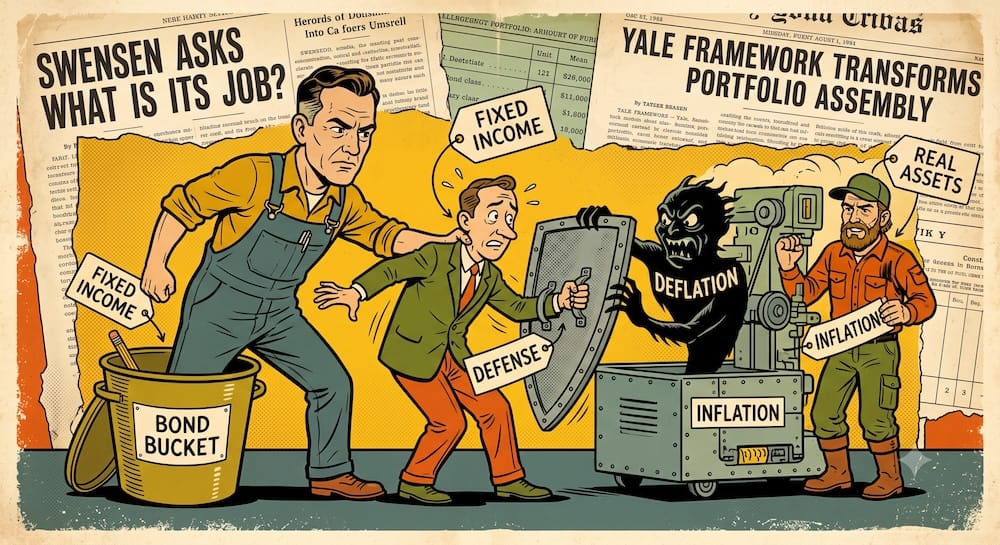
I do not care if an asset class sounds sophisticated. What is its job? If it cannot answer that question clearly, it is loitering in the portfolio. Swensen’s operational breakthrough was transforming asset allocation from an exercise in category selection into a strict system of job assignment.
In the Yale framework, an asset class was allowed into the portfolio only if it performed a specific, non-redundant economic function. Fixed income was no longer just “the bond bucket”; it was repurposed into an explicit crisis ballast and deflation hedge. Real assets were not just “tangible things”; they were introduced to serve as an explicit, contractually backed hedge against unexpected inflation.
To see how this architecture works, you have to look at the portfolio the way a mechanic looks at an engine. Every part must perform a distinct role under stress. My bias is simple: if a bucket cannot explain why it belongs in a crisis, it probably belongs in the recycling bin.
Asset Class Job Matrix
| Asset Class | Job in Swensen’s Framework | What Investors Often Mistake It For | Failure Mode |
| Domestic Equity | Public growth engine; captures baseline economic productivity and corporate compounding. | “Safe, familiar stocks” that can be held without tracking error anxiety. | Valuation concentration, systemic market cycles, and severe contraction shocks. |
| Foreign Equity | Global growth; provides geographic and currency diversification away from domestic bias. | An automatic, low-risk way to beat domestic market returns. | Governance failures, currency devaluations, and geopolitical drag. |
| Real Assets | Inflation sensitivity; provides real-economy exposure via direct cash flows (timber, energy, real estate). | A magical inflation blanket that goes up every single month. | Violent commodity cycle pain and severe appraisal-based entry pricing risk. |
| Private Equity / VC | Inefficient-market alpha; extracts massive premiums from early-stage growth and corporate restructuring. | A guaranteed, passive return premium that automatically beats public indices. | Manager selection disaster, absolute illiquidity, and vintage-year risk. |
| Absolute Return | Non-traditional return stream; exploits pricing inefficiencies via market-neutral long-short strategies. | A low-risk, high-yielding bond alternative with zero downside. | Fee-heavy beta in disguise, lack of transparency, and manager leverage blowups. |
| Fixed Income | Liquidity preservation and deflation ballast; provides immediate cash during systemic equity panics. | Boring, dead money that should be optimized for higher yields. | Destructive purchasing power erosion under structural inflation regimes. |
When you map the portfolio this way, you realize that asset allocation is not about balancing colors on a page. It is about balancing economic exposures. If you add an asset class that behaves exactly like public equities during a crisis, you haven’t diversified; you’ve just changed the vocabulary on your statement.
Beyond Stocks and Bonds Does Not Mean “Add Fancy Things”
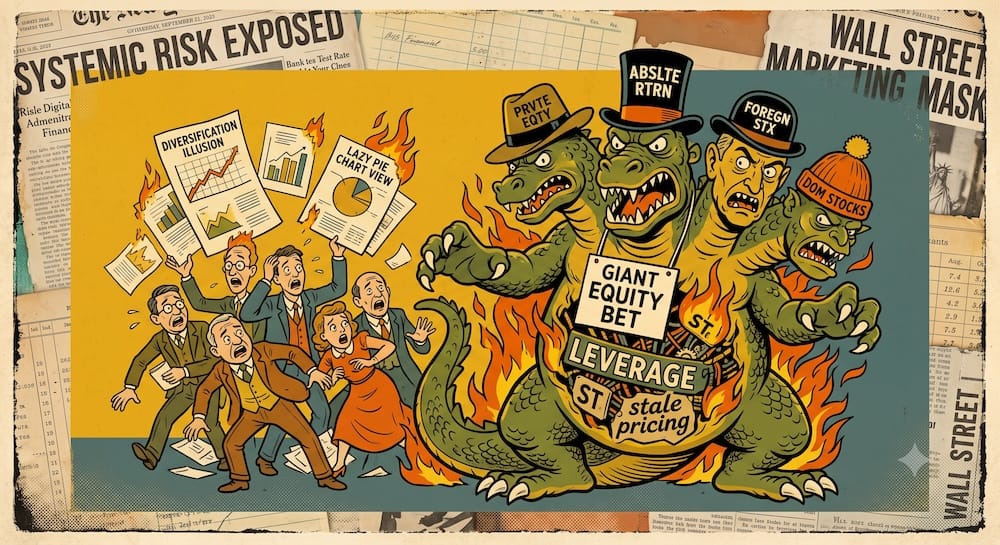
I have seen portfolios with twelve slices that were basically one giant equity bet wearing different hats. A very diversified hat rack, perhaps, but not a diversified portfolio.
This is the great danger of moving beyond public stocks and bonds: it invites financial engineering to mask underlying systemic risks. Wall Street loves to tell you that private equity is a separate asset class. But let’s strip out the marketing glaze and look at the mechanics. What is private equity? It is public equity risk, plus a massive amount of corporate leverage, inside a locked box with a smoother accounting statement and much more expensive stationery.
The same reality applies across the alternative landscape. Real Estate Investment Trusts (REITs) are highly useful tools, but they are still equity-wrapped exposures to commercial property markets. They do not live on a magical, non-correlated planet. During a systemic liquidity event, they will catch cold just like the rest of the equity market. I do not want a portfolio slice that needs perfect weather, cheap credit, and a polite spreadsheet to justify existing.
Hedge funds that promise absolute return often turn out to be nothing more than fee-heavy beta machines. They charge you a premium management fee to deliver a return stream that could have been replicated by taking a standard index and layering on some basic options overlay or factor tilt. I am not anti-complexity. I am anti-fake complexity. Real complexity solves a problem. Fake complexity bills you quarterly.
          THE DIVERSIFICATION ILLUSION VS. STRUCTURAL MECHANICS

   [ THE LAZY PIE CHART VIEW ]            [ THE REAL UNDERLYING RISK ]
   +---------------------------+          +---------------------------+
   | Private Equity   (20%)    |          |                           |
   | Absolute Return  (20%)    | =======> |   THE REALITY:            |
   | Domestic Stocks  (40%)    |          |   One Massive, Leveraged  |
   | Foreign Stocks   (20%)    |          |   Systemic Equity Bet     |
   +---------------------------+          +---------------------------+
   Looks sophisticated on paper.          Every slice wears a different hat,
                                          but they all catch fire together.
If you expand your allocation structure without understanding the true source of return under the hood, you are simply paying a premium for complexity. True diversification is not about the number of lines on your spreadsheet. It is about whether those lines are driven by distinct macro forces. If your private equity, your absolute return, and your international equities all rely on cheap credit and surging consumer demand to yield a profit, you are not diversified. You are just heavily exposed across multiple jurisdictions.
Equity Orientation: The Part People Misread
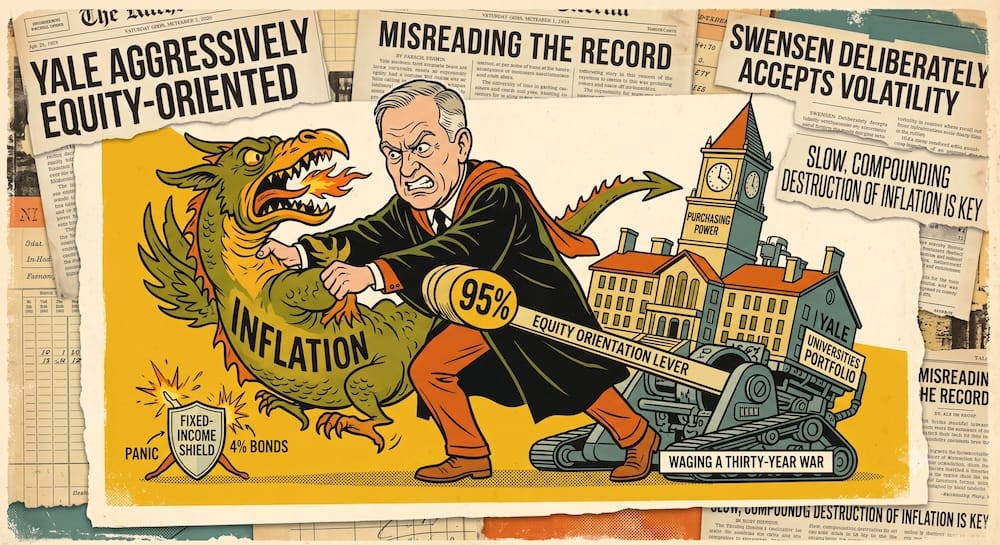
One of the most significant pieces of misinformation surrounding Swensen’s work is the idea that he was a conservative asset allocator who sought to minimize portfolio risk through diversification. This is an absolute misreading of the record. Swensen was not anti-risk; he was profoundly, aggressively equity-oriented.
Because Yale operates with an infinite investment horizon, Swensen recognized that the greatest long-term threat to the university’s purchasing power was not short-term market volatility, but the slow, compounding destruction of inflation. I have learned that over a multi-decade timeframe, traditional fixed-income assets are an incredibly expensive place to store capital. They offer safety, but they do not compound real wealth.
As officially reported in Yale’s institutional statements, more than 95% of Yale’s assets were systematically positioned to generate equity-like returns during his tenure. This massive structural bias meant that the portfolio was designed to lean directly into the raw volatility of global growth markets. Swensen deliberately accepted huge tracking error risk relative to traditional, conservative institutional peers because he understood that the long-term payoff of equity compounding far outweighed the comfort of a stable statement.
But there is a dark side to this equity orientation that most endowment copycats conveniently ignore: when the global equity market catches fire, an equity-biased portfolio burns. In the fiscal year of 2009, Yale’s allocation of only 4% to traditional bonds provided almost no protection against the systemic collapse.
Diversification within an equity-heavy framework does not mean safety-first insulation. Swensen’s asset allocation model was built to win a thirty-year war, not to look pretty during a twelve-month panic. If someone copies his heavy equity orientation without matching his permanent capital structure, they are taking institutional-grade volatility into a retail-sized foxhole.

The Manager-Selection Problem Hidden Inside Asset Allocation
The moment a portfolio steps across the boundary of public stocks and bonds, the entire nature of asset allocation shifts. It ceases to be an exercise in passive asset class exposure and becomes an aggressive exercise in manager-selection risk.
In the public markets, buying an index fund allows you to capture the baseline beta of an entire asset class for next to nothing. You don’t need to know who is running the fund, and you don’t need exclusive access to their trading desk. The market price is transparent, and the liquidity is instantaneous.
But in alternative markets—private equity, venture capital, and absolute return—there is no such thing as a passive index. You cannot buy a cheap, liquid fund that captures the true top-decile returns of early-stage Silicon Valley venture capital partnerships with exposure to major technology winners. To harvest the premium that Swensen found, you must select an active manager who possesses a distinct operational edge.
This creates a massive mechanical problem. If I move 20% of my allocation structure into alternative asset classes but fail to secure a top-quartile manager, my asset allocation choice backfires completely. The individual is no longer capturing an institutional premium; they are simply taking on massive illiquidity, paying exorbitant fees, and accepting bottom-tier performance that systematically underperforms a plain-vanilla public stock index. Swensen’s asset allocation framework was inseparable from his elite due diligence engine. If you do not have the operational capacity to sift through thousands of managers and access the top decile, moving beyond stocks and bonds is an exercise in structural self-harm.
The 2009 Crisis: When the Allocation Showed Its Teeth
Every asset allocation framework looks like an exercise in pure genius during a bull market. The real evaluation occurs when the strategy shows its teeth during a systemic macro shock. For Swensen’s model, that moment arrived during the 2008–2009 global financial crisis.
According to official data published by Yale News, the endowment reported a brutal -24.6% return for the fiscal year ending June 30, 2009. Total assets collapsed from $22.9 billion down to $16.3 billion in a matter of twelve months.
FY2009 Yale Financial Reality
   $22.9 Billion (Inception FY2008)
   [=========================================]

   $16.3 Billion (Conclusion FY2009)
   [============================]  (-24.6% Deficit)
The official institutional reporting from that era is remarkably candid about why the model took such a severe beating:
- The overwhelming equity exposure across both public and private markets drove immediate asset devaluation.
- The highly touted asset class diversification failed completely to protect asset values as correlations rushed toward 1.0 across the globe.
- The massive allocation to illiquid assets detracted significantly from operational flexibility, locking up capital precisely when the university needed it most.
- The lean 4% allocation to bonds provided almost no defensive ballast or meaningful liquidity cushion to offset the damage.
This historical window is essential because it demonstrates that moving beyond stocks and bonds does not eliminate systemic risk; it merely trades public market volatility for private market illiquid stress. When the global banking system locked up, the asset allocation model didn’t save Yale from a massive, painful drawdown. It proved that an equity-biased framework, no matter how sophisticated its alternative slices, remains structurally tethered to the reality of the global economic cycle.
Swensen’s Retail Inversion: Same Principles, Different Machine
Swensen understood that his institutional engine could not be safely transported to a retail brokerage desk. He knew that an individual investor trying to buy private equity or hedge fund wrappers was simply signing up to be the liquidity source for Wall Street’s fee collection department.
So, in his 2005 text Unconventional Success, he did something remarkable: he inverted his entire institutional machine to build a framework specifically optimized for the constraints of an individual retail allocator. He kept the exact same core principles—equity orientation, global diversification, and inflation sensitivity—but executed them using entirely public, low-cost, liquid index vehicles.
I appreciate this inversion because it demonstrates his deep awareness of structural boundaries. Through June 30, 2021, Yale reported that Swensen’s 36-year tenure produced a spectacular 13.7% annualized return, generating $57.6 billion in investment gains and more than $50 billion of value added relative to the average endowment. Yet, despite possessing the keys to that absolute kingdom, he turned around and told the public to buy plain-vanilla index funds.
Historical Swensen Retail Framework From Unconventional Success — Not a Personal Prescription
| Asset Class Category | Historical Allocation Weight | Structural Portfolio Function |
| Domestic Equity | 30% | Public growth engine; captures baseline national productivity. |
| Developed International Equity | 15% | Global growth diversification across established economic regimes. |
| Emerging Market Equity | 5% | High-beta growth exposure to developing corporate landscapes. |
| Real Estate Investment Trusts (REITs) | 20% | Liquid real asset proxy; provides inflation-sensitive income. |
| U.S. Treasuries | 15% | Deflation protection, structural liquidity, and absolute crisis ballast. |
| Treasury Inflation-Protected Securities (TIPS) | 15% | Direct, contractually guaranteed protection against purchasing power loss. |
Look at what this retail allocation actually does. It eliminates every single bucket that requires manager selection alpha or elite institutional access. There is zero private equity, zero venture capital, and zero absolute return hedge funds.
It carries some of the same philosophical DNA—equity orientation, global diversification, inflation sensitivity, and clear job assignment—but it is built for a completely different machine. The real assets role is completely filled by a 20% concentration in REITs, moving the portfolio into the real economy without structural illiquidity drag. The defensive sleeve is expanded to handle two completely different macroeconomic failure modes: U.S. Treasuries to fight deflationary panics, and TIPS to fight unexpected structural inflation.
It is a framework designed to run inside a standard liquid account without paying a single dollar of manager-access toll fees.
What Actually Travels From Swensen’s Asset Allocation Thinking
The lesson of David Swensen is not that you should go make your pie chart prettier or copy his exact institutional percentages. The conceptual lesson is that investors need to distinguish between an asset class that is performing a unique economic job and an asset class that is simply wearing a costume.
What Travels / What Does Not
| Swensen Principle | Travels Conceptually? | Does Not Travel Cleanly |
| Equity Orientation | Yes. Long-term capital accumulation requires assets driven by economic growth, not low-yield cash drags. | Yale’s 4% Bond Level. Retail accounts lack the permanent capital or bond-issuance capability to run that lean on liquid ballast. |
| Broad Diversification | Yes. Moving beyond domestic equities into international regimes and real assets creates genuine non-correlated protection. | Copying Private Weights. Allocating fixed percentages to illiquid private platforms destroys retail liquidity options. |
| Illiquidity Premium | Partially. Investors can accept multi-year locks on direct assets they completely own (like a primary residence). | Retail Private Wrappers. Interval funds and alternative vehicles charge institutional fees while passing down second-tier deal flow. |
| Manager Selection Alpha | No. The spread between top-tier and bottom-tier performance in private markets is an insuperable hurdle for retail. | Chasing Active Managers. Attempting to stock-pick active mutual funds or hot hedge fund managers systematically degrades returns. |
| Rebalancing Discipline | Yes. Systematically selling winners to buy losers helps harvest a volatility premium across market cycles. | Taxable Turnover. Institutional tax-free rebalancing does not travel cleanly into a standard taxable brokerage account. |
| Retail Indexing | Yes. Utilizing low-cost public vehicles to execute asset-class job assignments is the ultimate retail baseline. | Universal Command. Treating the historical Unconventional Success percentages as a rigid, unchangeable dogma for every life stage. |
The Reality Behind the Costume Party
My takeaway: stop trying to paint the pie chart like an Ivy League endowment and start asking whether each slice earns its chair based on its raw structural characteristics.
| Looks Like | Actually Might Be | Samuel Verdict |
| Private Equity | Leveraged public equity risk with an appraisal lag. | Different wrapper, same shark teeth. The low volatility is an accounting trick. |
| REITs | Equity-wrapped commercial real estate exposure. | Highly functional tool, but do not mistake it for a magical inflation blanket. |
| Hedge Funds | A manager-dependent fee extraction machine. | Absolute return is an institutional marketing promise, not an asset species. |
| Foreign Stocks | Global equity growth exposure. | Still stocks. They carry passports, but they will still drop in a worldwide panic. |
| Bonds | Deflation insurance and immediate structural liquidity. | Sometimes the most boring bucket in the room is the only fire extinguisher that works. |
If a reader studies Swensen’s framework, the ultimate goal should be to strip away the marketing fog. If you cannot explain exactly what macroeconomic environment causes a portfolio slice to win, and exactly what environment causes it to crash, you do not own an asset class. You own an expensive piece of financial decoration.
Bonds are boring until the building is on fire. Then suddenly the boring bucket looks less like dead money and more like the only adult in the room. Swensen’s true genius was not that he found a collection of magic alternatives to rescue him from market realities. His genius was that he understood exactly what each tool was designed to do, built an architecture that could hold those tools through stress, and had the clarity to tell the rest of the world how to construct their own machines out of clean, liquid indexing.
Give every asset a hard, measurable job, clean out the loitering clutter, and make the structure earn its keep.
What is the minimum portfolio size needed to replicate David Swensen’s asset allocation framework?
It depends entirely on the machine you are building. If you are trying to replicate his institutional Yale Endowment model with private equity, venture capital, and absolute return hedge funds, the practical minimum size is tens of millions of dollars just to satisfy regulatory accredited investor minimums and escape devastating adverse selection. However, if you are building his liquid retail framework from Unconventional Success using low-cost index funds and public ETFs, the minimum portfolio size is exactly zero. Because modern brokerages allow fractional shares and have eliminated transaction commissions, a retail investor can execute his six-bucket, job-assigned architecture with as little as a hundred dollars.
How do you manage the tax drag of rebalancing a Swensen-style portfolio in a taxable account?
You minimize it by focusing on the location of your machinery rather than the frequency of your trades. Yale operates with an absolute tax-exempt rebalancing arbitrage, allowing them to shift billions without triggering tax penalties. For an individual allocator running this structure inside a standard taxable brokerage account, constant dynamic rebalancing will trigger short-term and long-term capital gains taxes that eat your returns alive. The practical workaround is to direct all new capital inflows—such as monthly savings or dividend payments—exclusively into the underperforming, underweight slices. You should only execute a hard sell-and-buy rebalance within your tax-advantaged accounts like an IRA or 401k where transactions trigger zero immediate tax liabilities.
Can you use liquid alternative ETFs to capture Swensen’s institutional absolute return allocation?
No. You should completely avoid them. Retail product issuers love to wrap long-short strategies, merger arbitrage, and trend-following rules into standard exchange-traded vehicles and call them “Swensen proxies.” But the structural reality under the hood is a fee extraction machine. These liquid alternative wrappers charge high management fees while delivering diluted, bottom-tier beta that frequently fails to protect capital when public equity markets crash. They completely lack the top-quartile manager selection alpha that made the institutional Yale bucket profitable. Swensen explicitly warned individuals to steer clear of these complex vehicles, noting that they are an expensive way to construct an underperforming portfolio.
Why did Swensen allocate 20% to REITs instead of using a broad real estate or commodity ETF?
Not exactly a random choice; it was a deliberate structural job assignment. Swensen wanted a liquid real asset proxy that provided a high contractual sensitivity to inflation while generating ongoing, real-economy cash flows. Broad commodity ETFs often rely on rolling futures contracts, exposing the allocator to negative roll yield and severe regulatory drag. Direct timberland and farmland require institutional scale. Public Real Estate Investment Trusts (REITs) solve this at retail scale because they are legally mandated to distribute 90% of their taxable income to shareholders, giving the retail portfolio frame direct, equity-wrapped exposure to commercial land, infrastructure, and real property without transaction lock-ups or complex tax reporting.
What specific job do U.S. Treasuries and TIPS perform when equities collapse?
They act as two completely different types of crisis fire extinguishers. Traditional nominal U.S. Treasuries provide ultimate deflation insurance and flight-to-safety liquidity when corporate equities crash, as they did during the 2008 banking freeze. Treasury Inflation-Protected Securities (TIPS), conversely, perform a completely separate task: they provide a contractually guaranteed hedge against structural inflation and purchasing power destruction. Swensen split the defensive fixed-income sleeve exactly down the middle to insulate the individual allocator against both major macroeconomic failure modes, while explicitly warning against active corporate bond funds that harbor unwanted default risk.
How often should an individual rebalance a portfolio built beyond stocks and bonds?
Less is more. While institutions have dedicated trading desks to continuously harvest volatility, an individual allocator should limit rebalancing to an annual or semi-annual schedule, or utilize strict percentage-based boundaries. A common mechanical filter is the 5/25 rule: you only rebalance an asset class slice if its total weighting deviates by more than 5 absolute percentage points from its target, or by more than 25% of its original slice size. This structural boundary keeps you from over-trading, dampens emotional panic during market cycles, and reduces unnecessary transaction frictions inside your portfolio frame.
This article is also available in Spanish. [Leé la versión en castellano: David Swensen sobre Asignación de Activos: Cómo Construir Carteras más allá de Acciones y Bonos]