The Harry Browne Permanent Portfolio is often discussed in online finance circles as if it were an unkillable defensive framework engineered by an omniscient macro prophet. The conventional online narrative is simple: a beautifully balanced, risk-free asset allocation strategy that glides over market corrections without requiring a single moment of active thought or behavioral stress.
But if you pull back the curtain and look at the actual history, you find a very different story.
This article is not about Harry Browne’s full life, political career, or his philosophical writing. Nor is it a setup guide for modern brokerage accounts, an asset location tutorial, or a product recommendation brief. It is an exploration of his four economic seasons framework—prosperity, inflation, deflation, and recession—and what modern independent investors can realistically absorb or expel from it.
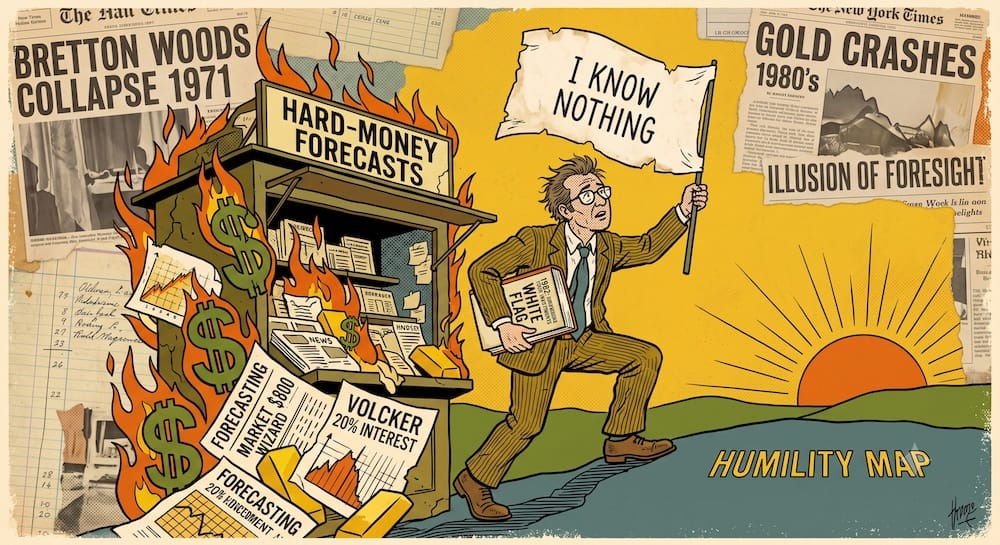
The strategy was not born out of a position of infinite wisdom or perfect macroeconomic foresight. It was born out of a brutal public capitulation.
The White Flag of a Broken Prophet
To understand why this four-sleeve system works the way it does, you have to look at the psychological wreckage that came right before its creation.
During the early 1970s, Harry Browne was not a passive asset allocator. He was a high-flying, hard-money investment newsletter writer riding a spectacular macro wave. As the Bretton Woods monetary system collapsed and the US dollar decoupled from gold in 1971, Browne urged his readers to buy gold, load up on silver, and dump dollars for Swiss francs. It was a massive, concentrated macro bet. When gold skyrocketed toward $800 an ounce by 1980, Browne briefly looked untouchable. For a moment, the newsletter crowd treated him as a macro genius who could peer through the fog of monetary policy.
Then the regime shifted.
The hyperinflationary doom everyone in the hard-money camp took for granted never arrived. Instead, Federal Reserve Chairman Paul Volcker did something Browne didn’t foresee: he showed the political willingness to break the back of inflation by crushing the domestic economy with 20% interest rates.
As the disinflationary regime of the 1980s took hold, gold collapsed from over $800 down toward $250. The active newsletter forecasting engine that had made Browne wealthy was suddenly completely blind to the new reality. He discovered, as many market commentators do, that having a hot hand during one macro regime is a terrible indicator of your ability to survive the next.
Browne’s subsequent shift from speculative forecasting to rigid asset allocation in his 1982 book Inflation-Proofing Your Investments was an explicit admission of defeat. He realized that sustaining a macro forecasting edge across different decades was an illusion.
The Permanent Portfolio was his white flag. It was a defensive grid explicitly built for an investor who finally accepted they knew absolutely nothing about tomorrow. I look at this framework not as an act of financial wizardry, but as an act of pure, unadulterated humility. Browne stopped trying to guess the weather and decided instead to build an investment vehicle with four distinct, permanent, un-leveraged engine rooms designed to carry a portfolio through any macro season.
Browne’s Seasonal Map
The core thesis of this framework is simple: Harry Browne’s four economic seasons are not a forecast. They are a humility map. The point is not that any sleeve always works. The point is that every sleeve has a seasonal job, and every sleeve will look stupid when its season is out of favor.
Below is the mechanical layout of how these macro climates interact with specific forms of capital under Browne’s historical baseline:
Browne’s Four Economic Seasons
| Economic Season | What Is Happening | Asset Browne Assigned | Why It May Help | Why It Can Still Fail |
| Prosperity | Sustainable growth, rising corporate profits, stable or falling inflation, and high consumer confidence. | Stocks | Captures real wealth creation and expanding corporate productivity. | Valuation bubbles, speculative excess, and sudden market crashes. |
| Inflation | Money loses purchasing power, consumer prices surge, and fiat currency devalues. | Gold | Serves as a historical monetary alternative and structural confidence hedge. | Long multi-decade droughts, zero yield generation, and shifting investor sentiment. |
| Deflation | Consumer prices decline, interest rates collapse, and the real value of cash-flow streams increases. | Long-Term Treasuries | Delivers massive capital gains via intense duration price sensitivity as yields fall. | High initial inflation spikes and aggressive, rapid interest-rate tightening regimes. |
| Recession / Tight Money | Credit contracts, liquidity becomes scarce, and economic activity stalls. | Short-Term T-Bills (Cash) | Provides immediate optionality, stability, and protection against forced liquidation. | Severe real purchasing power erosion during high-inflation regimes. |
Prosperity: The Season Everyone Wants Forever
Prosperity is the default setting of human financial optimism. When the economic machine is running smoothly, corporate earnings expand, factories produce, and consumer demand remains robust. This is the climate where capital naturally wants to flow into productive enterprise.
In Browne’s operating design, Stocks are assigned to this season. When businesses are making more money, ownership stakes in those businesses become fundamentally more valuable. It is a direct translation of human productivity into capital appreciation.
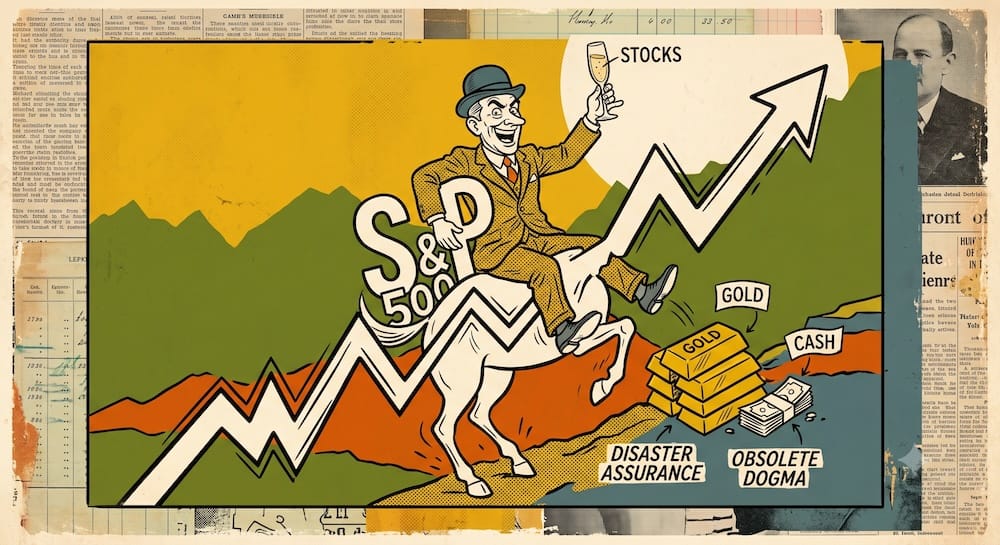
But prosperity does something dangerous to human psychology: it seduces investors into believing that the sun will never set. During an extended period of economic growth, the equity sleeve performs so well that the rest of the defensive grid starts to look like an unforgivable drag on performance. This is where financial ego enters the chat. When a bull market runs for five, seven, or ten years, the human brain begins to rewire itself. You stop seeing the market as a cyclical environment and start seeing it as an ascending line that you are uniquely qualified to exploit.
I’ve spent enough time analyzing market history to see this exact behavioral trap play out in every major secular bull market. When the S&P 500 is compounding at double-digit rates for a decade, holding anything else makes you look completely foolish to your peers, your spouse, and yourself. During the roaring dot-com boom of the 1990s, an investor executing Browne’s pure 4×25 split watched their overall framework creep along at a modest, sleepy pace. Depending on the specific dataset and backtest parameters used, models estimate the strategy returned roughly 6.6% annualized over that decade.
Meanwhile, pure large-cap US equities were scaling near 18% annualized.
Think about the sheer emotional weight of that tracking error. For ten straight years, your neighbor, your colleagues, and random uncles are getting wildly wealthy on tech stocks while half of your net worth sits completely frozen in physical gold coins and short-term cash. The math behind capital preservation is pristine, but the behavioral friction of watching the world pass you by is a psychological woodchipper.
Prosperity makes everyone feel like a genius because it rewards participation, not protection. It creates a powerful illusion that security selection or simple market beta is the only tool an investor will ever need, causing them to treat defensive insurance as obsolete dogma. You start asking yourself why you are wasting 75% of your capital on assets designed for disasters that never seem to arrive. The behavioral reality is that prosperity is the easiest season to mistake for normal life. Investors convince themselves that structural volatility has been permanently solved by central banks or technological innovation, leading them to dismantle their seasonal map at the exact moment valuations peak and the weather is about to turn.
Inflation: Gold Is Not a CPI Coupon
When the currency begins to rot, the rules of prosperity vanish. Inflation is the season that makes conventional investors feel utterly betrayed. You can own a business that is growing its top-line revenue, but if the underlying unit of account is losing purchasing power faster than the business can scale, your real return is deeply negative. The traditional relationship between corporate effort and wealth creation gets severed.
Browne’s answer to this climate was a permanent 25% allocation to Gold.
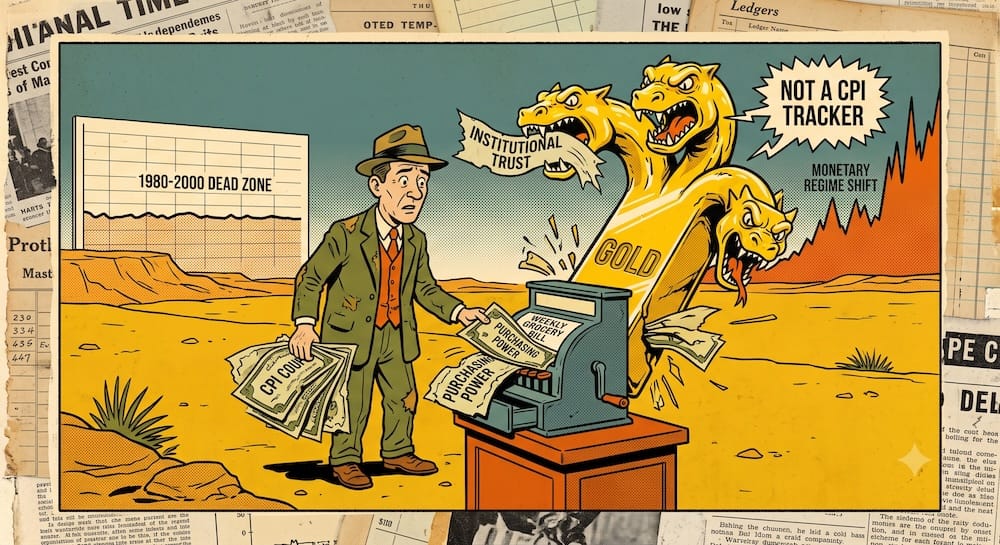
The biggest retail myth surrounding this sleeve is that gold acts as a clean, linear tracker of consumer prices. It does not, and I have zero patience for the argument that gold is a reliable hedge against your weekly grocery bill. If you buy gold thinking it behaves like a predictable Consumer Price Index (CPI) coupon that ticks upward every time consumer prices rise, you are setting yourself up for an immense behavioral shock.
Historically, gold is a chaotic, non-linear currency crisis shield. It is a baseline confidence hedge. Consider the long, painful drought from 1980 through 2000: US consumer prices rose steadily every single year, yet gold entered a brutal, multi-decade secular bear market, flatlining and losing a massive portion of its nominal value. It didn’t track the CPI; it tracked the collective loss of systemic confidence in the monetary system. When Volcker restored confidence in the dollar by raising real yields, the structural need for gold collapsed, even though consumer inflation didn’t drop to zero.
Browne didn’t want corporate commodity exposure, oil pipelines, or real estate syndicates for this sleeve; he wanted pure, unadulterated monetary insurance. Gold earns its keep when institutional trust fractures. When investors realize that fixed-income yields are deeply negative in real terms and that the central bank is trapped printing money to service sovereign debt, capital rushes toward an asset that cannot be created by legislative decree.
I look at gold as an asset that sits on your balance sheet like an insurance policy on a house you hope never burns down. But living through the long dead zones requires a level of discipline that modern retail culture completely rejects. Gold can look completely useless, dead, and idiotic for twenty years straight while the rest of modern capitalism marches forward. Then, during a sudden monetary regime shift, it becomes the only asset on the canvas doing its job. If you don’t have the stomach to hold an asset that pays no dividend and generates zero yield through decades of irrelevance, you have no business running a seasonal asset allocation model.
Deflation: Long Bonds Are Not There to Be Comfortable
Deflation is the mirror image of inflation, and it is a season characterized by a massive, systemic contraction of credit. In a deflationary world, prices fall, money becomes scarcer, and the real value of future fixed cash flows becomes exponentially more valuable. The problem is that during a true deflationary spiral, most businesses cannot generate those cash flows because their revenue lines are collapsing alongside consumer demand.
To hedge against this freezing of the economic machine, Browne utilized Long-Term Treasury Bonds.
This is another area where modern optimizer culture constantly tries to adjust the operating design, usually with disastrous results. Retail builders look at the historical volatility of 30-year government bonds and immediately try to swap them out for a total bond market index or short-term notes to reduce the volatility of their fixed-income sleeve.
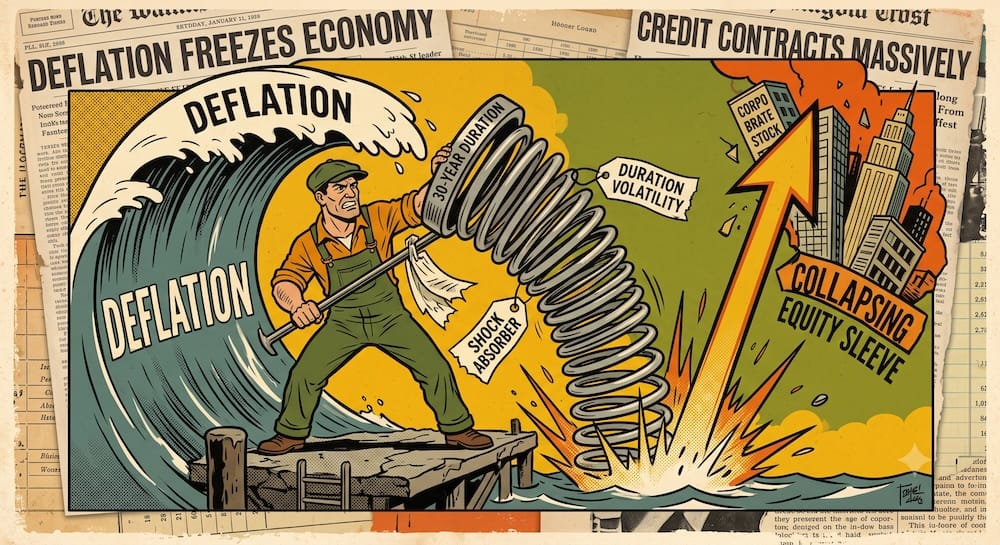
This completely guts the mechanical engine. Browne did not choose long-term bonds because they are comfortable, stable, or safe in the traditional sense; he chose them specifically because they possess intense duration price sensitivity.
Let’s look at the actual mechanism without any stylistic flourishes. Duration measures a bond’s price sensitivity to changes in interest rates. When a deflationary crash hits, interest rates plummet toward zero as capital flees risky assets and economic growth collapses. Because a 30-year bond has a long duration profile, a small drop in prevailing interest rates triggers a massive, explosive upward move in the bond’s capital price.
It is designed to act as an immediate, violent shock absorber. When your equity sleeve is dropping by 40% in a deflationary recession, you do not want a sleepy intermediate bond fund that edges up by 2% or 3%; you need a high-duration response that rockets upward by 30% to stabilize the total defensive grid’s capital floor. Duration volatility is not a bug in the deflation sleeve; it is the entire point of the sleeve’s existence.
The trade-off, of course, is that this extreme duration sensitivity is a double-edged sword. Long bonds can get absolutely slaughtered when the macro season changes from deflation to rising inflation. If you are holding high-duration bonds when consumer prices spike and the central bank rapidly forces interest rates upward, that bond sleeve becomes a massive capital anchor dragging down the entire framework. We saw this reality manifest clearly during recent macro shifts, proving that the insurance policy itself carries profound regime-change risk if interest rates are rising from a historically low base.
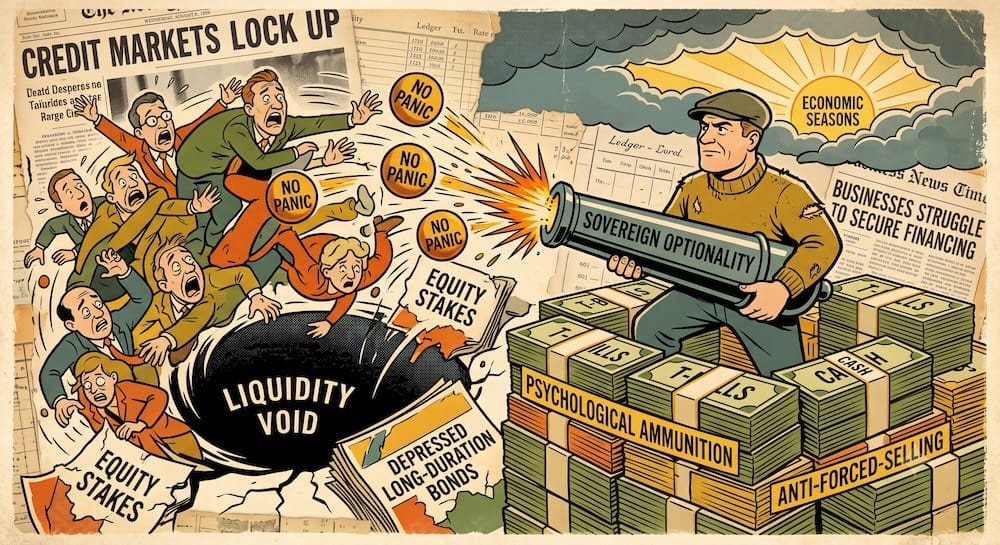
Recession / Tight Money: Cash as Psychological Ammunition
A recession or a period of tight money is when the financial system runs out of gas. Credit markets lock up, businesses struggle to secure short-term financing, and cash becomes the most valuable asset on the planet simply because nobody has any. It is a period defined by a mad scramble for liquidity.
Browne assigned Short-Term Treasury Bills (Cash) to this specific quadrant.
In typical market environments, financial commentators treat cash drag as an amateur mistake. They point to charts showing the long-term erosion of purchasing power and argue that holding short-term bills is a guaranteed way to lose real wealth over time. In real terms, during an inflationary run, they are entirely correct—cash loses its purchasing power daily, acting as a slow bleed on your capital base.
But Browne viewed cash through the lens of structural optionality and anti-forced-selling protection.
When a true liquidity panic hits, asset correlations often converge toward one. Everything falls together. Forced sellers are liquidated because their margin lines are called, and they are required to dump their highest-quality assets into a market vacuum just to raise liquidity.
This is where the cash sleeve earns its keep. It isn’t there to generate a real yield or beat inflation; it is there to function as immediate psychological and structural ammunition. Having 25% of your portfolio sitting in pure, liquid, short-term sovereign cash means you never become a forced seller. You have the stability required to cover real-world emergencies or portfolio rebalancing without being forced to liquidate your crashed equity stakes or your depressed long-duration bonds at the absolute bottom of a cycle. Cash gives the rest of the capital floor the time it needs to let the economic seasons turn. The “cash drag” is a real price to pay, but it is an incomplete metric if you don’t factor in the value of not panicking when the world is ending.
The Mixed-Regime Problem
While the four economic seasons are clean and pristine inside a textbook, real financial history is incredibly messy. The macro environment rarely presents itself as a pure, isolated quadrant. Instead, the world frequently serves up mixed regimes that confuse investors and break standard pair-wise correlation models.
The Mixed-Regime Failure Map
| Mixed Regime | Why It Confuses Investors | Which Sleeve May Help | Which Sleeve Gets Hurt |
| Inflationary Recession | Growth stalls out completely, yet consumer prices continue to climb, leaving policymakers with no easy solutions. | Gold / Cash | Stocks and Long Bonds can suffer deep structural losses simultaneously. |
| Disinflationary Prosperity | Economic expansion is highly robust while technology or productivity forces interest rates and inflation steadily downward. | Stocks / Long Bonds | Gold and Cash act as severe capital drags and sources of deep regret. |
| Deflationary Crash | Systemic bank credit contracts violently, asset markets freeze, and liquidity disappears overnight. | Long Bonds / Cash | Stocks suffer catastrophic capital impairment as corporate earnings collapse. |
| Stagflation | High unemployment pairs with structural supply-side shocks that send resource prices soaring. | Gold | Standard balanced portfolios (Stocks and Bonds) face real-return destruction. |
| Speculative Boom | Asset prices detach entirely from underlying cash flows, driven by cheap credit or behavioral mania. | Stocks | Cash and Gold create intense psychological tracking-error pain for the holder. |
Living through these mixed regimes is the true test of this framework. For example, during a classic disinflationary prosperity run, an investor will look at their ledger and see two massive engines—gold and cash—actively draining the portfolio’s performance. The temptation to log into a brokerage platform, click “sell,” and reallocate that capital into whatever is currently working is almost impossible for most retail minds to resist.
Conversely, when the world shifts into an inflationary recession, the very assets that felt safe during prosperity (stocks and bonds) can drop in tandem, leaving the entire system dependent on a single asset class like gold to preserve purchasing power. If you don’t understand that the seasons are constantly blending, you will inevitably misclassify a temporary cyclical shift as a permanent structural change, destroying your long-term plan in the process.
The Sleeve You Hate Is Usually the Point
If you choose to operate under Browne’s framework, you must accept a fundamental truth: one sleeve of your portfolio will almost always look completely stupid.
This is not an engineering flaw. It is the defining feature of the mechanical grid. If you look at your total asset allocation and every single line item is green, rising in unison, and making you feel incredibly secure, it means you are not diversified. It means you have inadvertently made a massive, concentrated macro bet on a single economic season. You haven’t built a resilient portfolio; you’ve just signed up for a fair-weather ride.
The Sleeve You Hate Matrix
| Asset Everyone Hates | Season When It Looks Stupid | Season When It Earns Its Keep | Behavioral Trap |
| Cash (T-Bills) | High Prosperity / Sudden Inflation | Acute Recession / Systemic Liquidity Panic | Reaching for yield by swapping cash for credit risk or dividend stocks. |
| Gold | Stable Growth / Disinflationary Boom | Currency Crisis / Sovereign Debt Distress | Calling it a useless relic and liquidating it after a long flatline period. |
| Long-Term Bonds | Rising Inflation / Aggressive Rate Hikes | Deflationary Collapse / Growth Shocks | Shortening duration right before an economic growth cliff hits. |
| Stocks | Deep Recession / Structural Depression | Economic Expansion / Corporate Wealth Creation | Abandoning equities permanently after a painful bear market bottom. |
I find that modern retail investment culture is deeply infected by an optimization bias. Every day, I see people post complex backtests online, tweaking allocations down to the second decimal point to ensure they would have beaten the market over the last forty years. They are trying to engineer a structure that outruns the past while eliminating any source of personal discomfort. They want the upside of stocks without the multi-year tracking error, the protection of gold without the decades of flatlining returns, and the insurance of bonds without the terrifying drops that come when interest rates spike.
But Browne’s framework completely rejects this entire optimization philosophy. It forces you to look at your portfolio with deep humility. When cash is yielding nothing in real terms during an equity growth cycle, I don’t look for ways to optimize it away into short-term corporate debt or dividend payers; I hold it because I respect the reality of the recession season. When gold sits there like a pet rock for twenty years, I don’t replace it with a speculative digital asset or a commodities index; I hold it because I recognize that currency regimes can fracture in ways that backward-looking linear math cannot predict.
The discomfort of holding the hated sleeve is not an accident in this system—it is the direct cost of protecting against the season you currently refuse to imagine. If you don’t actively hate at least one part of your portfolio at any given moment, you are exposed to a macro regime shift that could catch you completely unprepared. The framework demands that you value structural insurance over personal comfort.
What Actually Travels
When we strip away the historical folklore and look at what actually travels into modern portfolio judgment, the lessons have very little to do with specific asset percentages, brokerage configurations, or product recipes.
The future remains entirely unknowable. No matter how many complex algorithms, macro models, or data streams an institutional desk builds, nobody can consistently forecast the arrival of the next macro regime. Browne’s true legacy is providing a structural blueprint for how to invest when you finally accept your own financial blindness. It is an exercise in structural risk management, not economic prophecy.
Before you judge an individual asset’s performance, you have to name the season you are living through. Do not confuse current dead weight with permanent uselessness. Every sleeve in a diversified grid has a specific job and an explicit failure mode. If you attempt to alter the durability of one quadrant to make it look prettier during prosperity, you inevitably weaken its ability to protect you when the climate turns cold.
Ultimately, this framework is about trading macro swagger for seasonal humility. It is a commitment to a framework that limits your maximum wealth accumulation in exchange for guaranteeing you survive the transition between the economic seasons. It is not an unkillable financial miracle; it is simply a highly disciplined structure built for investors who know that the weather always changes—and that they can never predict the rain.
What is the minimum portfolio size required to practically execute the four economic seasons framework?
There is no hard mathematical floor. Because this system relies on four completely equal quadrants (25% each), you can theoretically build it with very little capital using modern fractional-share brokerages. However, from a practical standpoint, the real constraint isn’t your starting balance—it’s trading efficiency. If you are executing this strategy manually, you want enough capital so that periodic rebalancing transactions do not cause excessive frictional headaches, though zero-commission platforms have made small-scale execution vastly simpler than it was in Harry Browne’s era.
Which modern ETF tickers are typically used to replicate Browne’s historical 25/25/25/25 asset split?
While we don’t give direct product recommendations, an independent investor looking at historical replications generally maps the four sleeves using ultra-low-cost, highly liquid index funds. For the 25% equity sleeve, a broad total US stock market fund like VTI is common. For the 25% long-term bond sleeve, long-duration Treasury funds like TLT are standard. For the 25% gold sleeve, physical gold spot trackers like GLD or IAU are used. For the 25% cash sleeve, short-term Treasury bill proxies like BIL capture the near-zero duration cash-equivalent profile Browne intended.
Can I substitute a total bond market index for the 25% long-term Treasury bond sleeve?
No. Doing this completely guts the core defensive mechanism of the deflation sleeve. Broad total bond market indices (like BND) are heavily weighted toward short- and intermediate-term corporate and government debt. They lack the intense duration price sensitivity required to protect your portfolio. Browne explicitly demanded 30-year long-term Treasuries because their high duration creates explosive upward capital gains when interest rates plummet during a deflationary shock, acting as a mandatory counterweight to your crashing stocks.
How does the IRS tax treatment of gold affect the rebalancing efficiency of this framework?
It introduces a massive tax drag in taxable accounts. In the United States, the IRS classifies physical gold and ETFs that hold physical bullion (like GLD or IAU) as “collectibles.” This means long-term capital gains on your gold sleeve are taxed at a maximum rate of 28%, rather than the more favorable 15% to 20% long-term capital gains rates applied to standard equities. If you frequently trim a winning gold allocation to buy underperforming sleeves within a taxable brokerage account, this collectibles tax penalty can severely impair your compounding over time.
Is it safer to house the four seasonal asset sleeves inside a tax-advantaged account?
Yes. From a structural efficiency standpoint, housing the high-friction components of the portfolio—specifically the gold and long-term bond sleeves—inside a tax-advantaged wrapper like a Roth or Traditional IRA is highly logical. This structural choice completely isolates your rebalancing activities from the tax code. You can systematically sell down overperforming assets and buy underperforming ones back to their strict 25% boundaries without triggering immediate capital gains liabilities or dealing with the 28% collectibles tax.
Why did Harry Browne insist on holding 25% cash even when real interest rates are negative?
Cash is not there to yield a return; it is held as absolute psychological and structural ammunition. When real interest rates are negative, cash admittedly loses purchasing power daily. However, Browne recognized that during an acute recession or systemic liquidity panic, all asset correlations can converge toward one, causing stocks, bonds, and commodities to drop simultaneously. A dedicated 25% cash sleeve ensures you are never forced to liquidate your deeply depressed long-term investments at the exact bottom of a market cycle to cover real-world emergencies.
This article is also available in Spanish. [Leé la versión en castellano: Las cuatro estaciones económicas de Harry Browne: Prosperidad, Inflación, Deflation y Recesión]