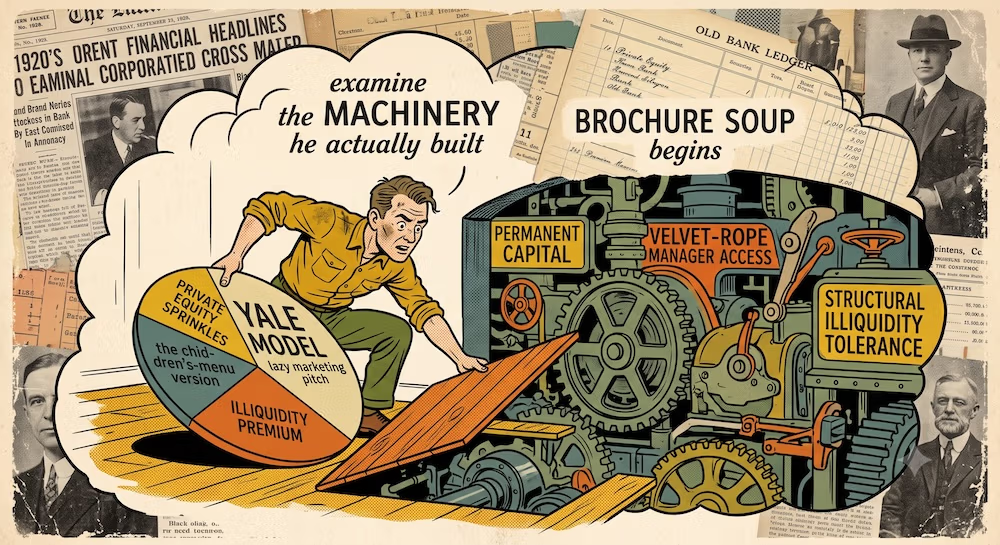
I used to think that to invest like Charlie Munger, I just needed to look at his portfolio holdings, buy a few great companies at fair prices, and sit on my hands. I was looking at what he owned while completely ignoring the structural plumbing that allowed him to own it.
Copying an investor’s security selection without copying their capital architecture is one of the most common unforced errors in the DIY community.
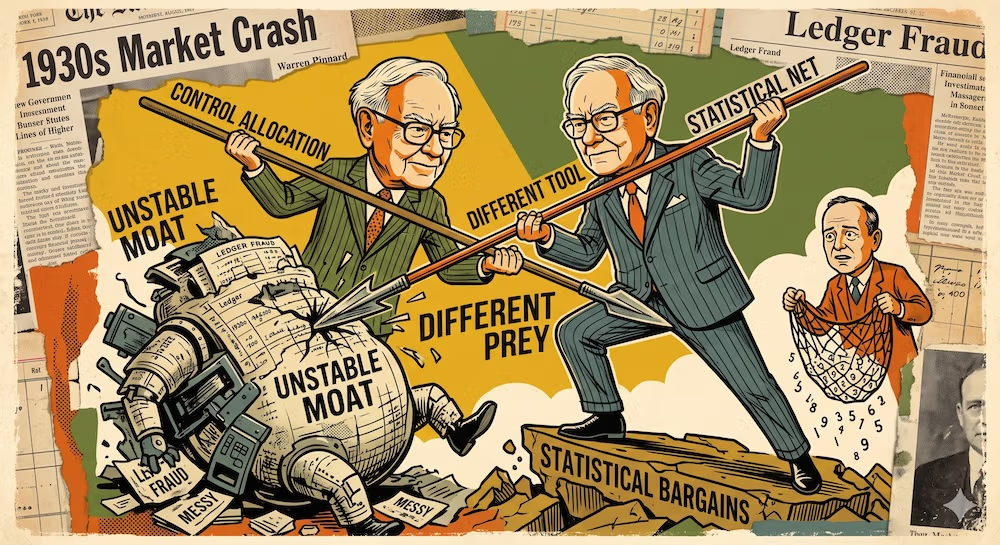
The internet frequently packages Munger’s concentrated style as a masterclass in raw courage—implying that if you just have enough intestinal fortitude, you can safely put your entire net worth into three or four individual stocks. But when you look past the folklore and inspect the underlying mechanics of his career, you find that his extreme concentration was never a standalone behavioral trait. It was a calculated optimization strategy that only made sense because it was paired with an extraordinarily durable capital vehicle.
Munger was not trying to build a low-maintenance, tax-efficient portfolio for a busy individual with a day job and real-world cash needs. He was maximizing capital efficiency inside structures he controlled. Modern ETF investing solves a completely different problem: automatic survivability, low friction, and behavioral simplicity for investors who do not possess permanent corporate capital. Both approaches are legitimate portfolio architectures, but they are built to run on entirely different engines.

Munger Was Not a Diversified Indexer in Disguise
The standard retail narrative frames Munger as a traditional, cautious investor who simply favored quality over quantity. The actual empirical ledger reveals an architecture built on extreme concentration, heavy tracking error, and event-driven tactical plays.
| Popular Retail Folklore / Myth | Verified Historical / Empirical Reality | Impact on Modern Portfolio Construction |
| The Myth of Cautious Diversification: Munger was a low-volatility value investor who favored wide baskets of safe stocks. | The Empirical Reality: During his independent partnership era, Munger systematically concentrated 80% to 90% of total assets into just 3 to 5 core positions. | Attempting this level of individual stock concentration inside a retail brokerage account introduces severe idiosyncratic risk that most personal balance sheets cannot absorb. |
| The Myth of Pure Quality Moats: He only bought iconic consumer monopolies like Coca-Cola or See’s Candies and held them forever. | The Empirical Reality: Munger routinely executed highly leveraged special situations, liquidation arbitrage, and massive foreign technology allocations. | True Munger-style investing requires intensive corporate analysis and event-driven mandates, not just buying blue-chip dividend payers. |
| The Myth of Easy Portability: A retail investor can achieve identical results by simply cloning his 13F filings. | The Empirical Reality: Munger’s long holding periods were mathematically enabled by corporate capital pools that eliminated redemption pressures. | Cloning holdings without replicating the underlying tax-efficiency and liquidity profile introduces structural fragility. |
Before co-steering Berkshire Hathaway, Munger ran the Wheeler, Munger & Co. partnership from 1962 to 1975. His performance was not driven by smooth, index-like compounding. For example, in 1962, he allocated an immense portion of his partnership’s asset base to a single event-driven arbitrage play: British Columbia Power. The local Canadian government was moving to nationalize the utility, and Munger recognized that the legal downside was strictly capped while the payout was highly probable.
This was not a passive long-term equity allocation; it was an aggressive, concentrated corporate arbitrage play. The math doesn’t lie: Munger’s returns came from concentrated bets on mispriced opportunities. But to understand why this strategy didn’t collapse during market corrections, we have to look directly at how his capital base was structured.

The Permanent Capital Difference
The line item that trips up most DIY investors is client redemption and cash-flow pressure. In a traditional investment fund or a standard retail brokerage account, capital is highly liquid and volatile. If the market takes a massive cyclical dive, an institutional manager faces clients demanding their money back. Similarly, an individual retail investor might face an unexpected life event—a job loss, a medical emergency, or a real estate transition—that forces them to liquidate assets.
Munger built an architecture where the capital could never talk back to him.
When he transitioned from his private partnership to corporate vehicles like Wesco Financial Corporation, the Daily Journal Corporation, and Berkshire Hathaway, he moved completely away from traditional fund frameworks. By investing through insurance corporations or cash-rich operating companies, his investment capital became permanent corporate capital.
If a concentrated holding crashed by 40%, there were exactly zero retail client redemptions to fulfill. He never had to sell an undervalued business at the absolute bottom of a cycle to hand cash back to a panicked investor. His liability profile was completely decoupled from market prices.
Furthermore, his corporate vehicles provided access to cheap, structural leverage that retail investors cannot replicate. Through Berkshire’s insurance operations, he utilized premium insurance float—cash paid upfront by policyholders that sits on the balance sheet before claims are paid out. Academic research, such as the National Bureau of Economic Research (NBER) paper Buffett’s Alpha (Frazzini, Kabiller, & Pedersen), demonstrates that Berkshire’s average leverage ratio was roughly 1.7-to-1, funded at institutional costs significantly below standard retail margin rates.
Similarly, during his management of Blue Chip Stamps in the 1970s, unredeemed stamp liabilities created a float-like pool of capital that sat on the balance sheet before redemption claims came due. Munger and Buffett utilized this stagnant pool to fund aggressive, concentrated equity allocations.
Praise for Munger’s patience without evaluating this structural foundation is missing the point. He could afford to be patient because his capital base was structurally insulated from the behavioral and logistical pressures of the everyday retail investor.
The -53% Gut Check
To understand the sheer magnitude of the behavioral pressure generated by a concentrated architecture, one must look at the actual performance history of Wheeler, Munger & Co. relative to the Dow Jones Industrial Average (DJIA):
| Year | Wheeler, Munger & Co. Net Return | DJIA Total Return | Relative Under/Overperformance |
| 1962 | +24.1% | -7.6% | +31.7% |
| 1963 | +54.8% | +20.6% | +34.2% |
| 1964 | +38.8% | +18.7% | +20.1% |
| 1965 | +13.2% | +14.2% | -1.0% |
| 1966 | +26.0% | -15.7% | +41.7% |
| 1967 | +48.8% | +19.0% | +29.8% |
| 1968 | +23.2% | +7.7% | +15.5% |
| 1969 | +29.4% | -11.6% | +41.0% |
| 1970 | -1.1% | +8.7% | -9.8% |
| 1971 | +15.5% | +9.8% | +5.7% |
| 1972 | +10.8% | +18.2% | -7.4% |
| 1973 | -31.9% | -13.1% | -18.8% |
| 1974 | -31.5% | -23.1% | -8.4% |
| 1975 | +30.9% | +44.4% | -13.5% |
| CAGR (1962–1975) | +19.8% | +5.0% | +14.8% |
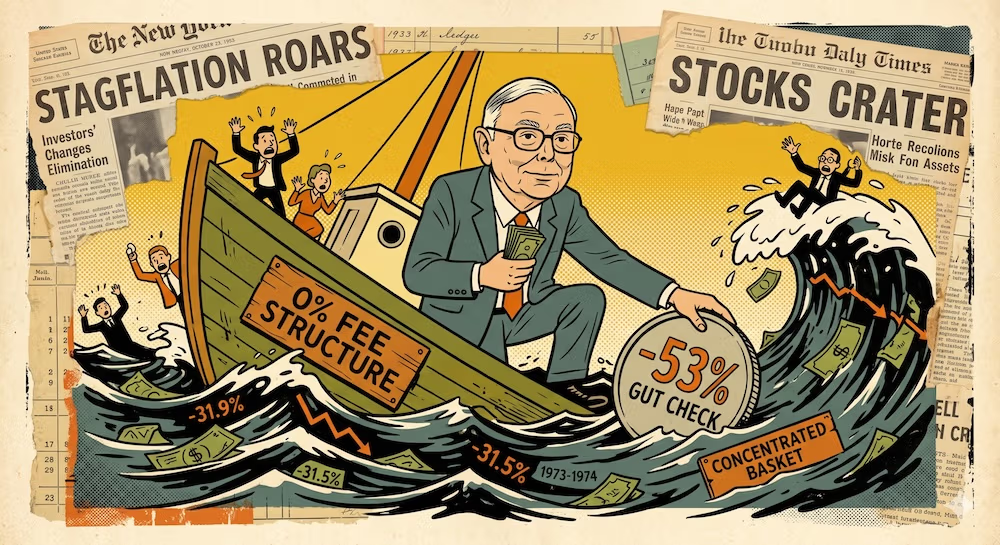
Look at the stagflationary bear market of 1973 and 1974. Because Munger’s partnership was heavily concentrated in a small handful of positions, it didn’t just track the market downward—it cratered. The net asset value dropped -31.9% in 1973, followed immediately by another -31.5% decline in 1974.
Cumulatively, his investors suffered a peak-to-trough drawdown exceeding -53%. The partnership remained underwater, below its previous high-water mark, for a grueling 36 months.
Even in 1975, a major recovery year where the DJIA surged +44.4%, Munger’s concentrated basket lagged significantly behind the initial index rebound at +30.9%.
During his partnership era, Munger operated under a strict fee structure: a 0% management fee and a 25% performance allocation of profits above a 6% preferred hurdle rate, complete with a clawback provision for down years. He only received compensation for absolute outperformance. This meant he was incentivized to endure extreme tracking error, but it also meant his investors had to watch their capital drop by half over twenty-four months.
Many concentrated contemporary partnerships from that era did not survive the 1973–1974 macro shock. They were systematically wiped out because their underlying client capital panicked and fled. Munger’s structure survived the drawdown, but for a modern retail investor, enduring a cumulative -53% deviation from the broad market while managing personal real-world financial obligations is an entirely different behavioral burden.
Even towards the end of his career, concentration still introduced single-position risk. In 2021 and 2022, operating through the Daily Journal Corporation’s equity sleeve, Munger built a massive, leveraged position in Alibaba Group Holding using corporate margin debt. He miscalculated the severe domestic regulatory crackdowns on Chinese technology firms, and by early 2022, he slashed the position roughly in half, realizing a permanent capital loss estimated between 40% and 50% on the sold shares.
The lesson is clear: concentration maximizes upside when you are right, but it exposes the portfolio to unhedged capital impairment when a single variable fails—no matter how experienced the investor.

Why Modern ETF Investing Solves a Different Problem
Because financial media often treats individual stock-picking as the gold standard of professional ambition, retail index investors are sometimes made to feel like they are settling for a consolation prize. This is a fundamental misunderstanding of portfolio architecture.
Modern ETF investing is not a diluted version of Munger’s strategy; it is a distinct, elegant solution designed to solve a completely different set of structural real-world constraints.
[Munger Structure] ---> Solves for: Maximum Idiosyncratic Upside via Permanent Corporate Capital
[Modern ETF Structure] ---> Solves for: Automatic Survivability, Low Friction & Tax Efficiency
Consider the built-in structural advantages that a broad-market or factor-based ETF architecture delivers to an independent investor:
- Automatic Survivability: A concentrated portfolio depends entirely on the ongoing operational health, corporate governance, and competitive moat of three to five distinct management teams. If one company suffers a structural failure, a massive percentage of your total wealth is permanently impaired. A broad equity index ETF is designed to capture a diversified slice of aggregate market returns without tying your survival to any single corporate entity.
- Structural Tax Efficiency: For a retail investor trading individual stocks inside a taxable brokerage account, rebalancing or rotating out of a company that has lost its competitive edge triggers immediate capital gains tax realization. Modern index and factor ETFs utilize institutional creation and redemption mechanisms (in-kind transfers) to shield the underlying investor from internal capital gains distributions. This can support low-cost, tax-efficient compounding in many taxable-account structures.
- Elimination of the Informational Edge Requirement: Munger operated in an era of deep information asymmetry, where a researcher could gain an advantage by manually reviewing physical corporate reports. In today’s market, quantitative algorithms scrape SEC filings and alternative data streams in milliseconds. A diversified ETF architecture allows you to completely opt out of this information arms race, capturing your fair share of global economic growth without needing an institutional research team.
- Behavioral Simplicity: The greatest threat to a long-term portfolio is not market volatility; it is behavioral intervention—the urge to panic-sell or chase performance at the wrong time. By removing the need to constantly evaluate individual corporate earnings reports, competitive threats, and management changes, a diversified ETF reduces the cognitive load on the investor, making it significantly easier to hold through standard market corrections.
Portfolio Architecture Side by Side
To see how these two systems diverge mechanically, we can map their design parameters across the critical operational constraints faced by everyday investors:
| Portfolio Dimension | Munger-Style Concentration | Modern DIY ETF Architecture |
| Number of Holdings | Extremely low (typically 3 to 5 core lines) | Extremely high (hundreds or thousands of securities) |
| Source of Return | Idiosyncratic stock selection and structural arbitrage | Aggregate market beta or targeted factor premiums |
| Key Skill Required | Deep microeconomic business judgment and event analysis | Behavioral discipline and continuous cost control |
| Capital Structure Requirement | Permanent corporate capital or permanent institutional float | Personal savings, employment cash flow, and liquid net worth |
| Drawdown Tolerance | High tolerance for severe, multi-year absolute cracks (-50%+) | Standard market-beta corrections with rapid historical recovery |
| Tax Efficiency | Low to medium inside a taxable retail account due to turnover drag | High due to institutional in-kind ETF creation/redemption |
| Tracking Error | Extreme; can underperform the broad market for a decade | Zero to minimal relative to the target index or factor index |
| Information Edge | Required; must find deep structural mispricings | Not required; relies entirely on macro equity compounding |
| Behavioral Burden | Intense; requires resisting massive non-correlated volatility | Low to medium; requires tuning out short-term macro noise |
| Main Failure Mode | Single-company operational failure or geopolitical blind spot | Behavioral capitulation (selling out during a market panic) |
| Who It Suits | Controlled corporate entities with permanent capital bases | Individual retail investors balancing long-term growth with life liquidity |
What ETF Investors Can Still Absorb from Munger
Being a diversified ETF investor does not mean you have to abandon Munger’s philosophical principles. Many of his core tenets travel across architectural boundaries and can be used to optimize a long-horizon index configuration:
- Adopt a Business-Owner Mindset: Munger viewed equities as fractional ownership stakes in operating cash flows, not as liquid lottery tickets. An ETF investor can apply this exact mindset by treating their broad market or global equity index fund as an ownership stake in the entire global economy. You aren’t trading a ticker; you are owning a diversified sliver of global productive capacity.
- Practice Low Turnover and Radical Inactivity: Munger frequently noted that the real money is made in the sitting, not the trading. ETF investors often sabotage their returns by overtrading—switching between different thematic funds, chasing hot sector ETFs, or trying to time the market. Absorb his discipline: once your asset allocation canvas is set, practice radical, unblinking inactivity.
- Endure Your Own Version of Tracking Error: If you decide to tilt your portfolio toward specific, systematically backed factor ETFs—such as a quality factor ETF or a value/profitability factor ETF—you must be prepared to endure multi-year windows where your portfolio underperforms a standard market-cap-weighted index. Absorb Munger’s tracking-error indifference; if the underlying factor mechanism is sound, ignore the short-term relative underperformance.
- Do Not Confuse Activity with Intelligence: The modern retail brokerage interface is designed to trigger constant interaction. Munger’s entire career proved that high-signal results come from waiting patiently for years rather than tweaking your portfolio positions every week. Let the broad index ETF automate the underlying corporate adjustments while you keep your hands off the steering wheel.
What DIY Investors Should Not Cosplay
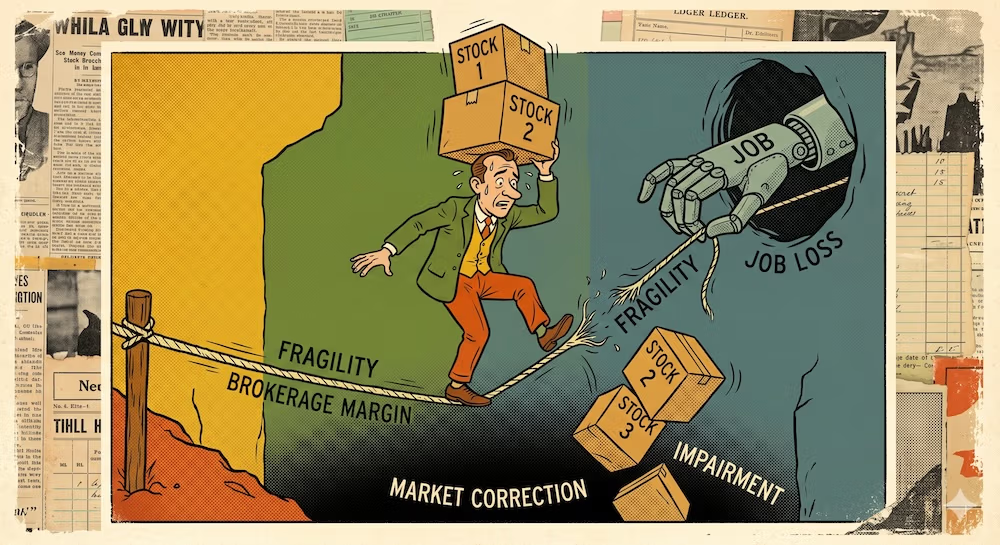
While his long-term patience travels perfectly, there are structural elements of his strategy that cannot be safely duplicated in a liquid retail environment. Attempting to replicate them from a personal computer is where retail investors invite structural fragility.
Avoid individual stock concentration inside a standard retail account without an independent cash-flow engine or structural insurance float. If you hold a three-stock portfolio and encounter a personal life-liquidity shock—such as a job loss or a family emergency during a broader market correction—you have zero permanent capital protection. You will be forced to liquidate your highly volatile individual holdings at the absolute bottom of a cyclical drawdown to fund real-world liabilities, turning a temporary paper loss into a permanent capital impairment.
Furthermore, retail investors should resist the temptation to use standard brokerage margin accounts to copy Munger’s leverage. Brokerage margin introduces volatile, variable interest rates that create a massive structural hurdle rate. More importantly, retail margin carries real-time liquidation and margin call risks. Berkshire’s leverage was funded through insurance premiums; it could not be pulled by a broker during a flash crash.
Finally, do not attempt to clone the 13F filings of mega-cap corporate holding companies with a multi-month lag. By the time a corporate filing becomes public record, institutional algorithms have already re-priced the information, and you are simply buying the tail end of a structural allocation shift without understanding the broader corporate hedging strategy.
The Sponge Verdict: Match the Structure to Your Reality
The ultimate lesson from Charlie Munger is not that you should find four individual stocks, buy them, and look heroically unbothered while they drop 53%. The real lesson is far deeper: the design of your portfolio architecture must be perfectly aligned with the structural realities of your capital base, your tax constraints, your time horizon, and your personal behavioral threshold.
Munger built an extraordinary concentrated machine because he had the unique corporate plumbing to support it.
As an independent DIY investor, you are running a different machine. Your portfolio must balance long-term compounding with real-world liquidity needs, career shifts, and personal lifestyle dynamics. Many DIY investors use broad, low-cost index funds as a diversified core, then reserve a smaller, clearly bounded sleeve for individual stocks, factor funds, or high-conviction experiments. The appropriate size of that sleeve depends on time horizon, tax situation, income stability, risk tolerance, and ability to withstand tracking error. This hybrid core-sleeve model is not a compromise. It is a highly rational, structurally sound architecture designed to ensure that you survive the real world.
Build the portfolio structure that matches your actual capital reality, not someone else’s billionaire balance sheet. Once the plumbing is secure, the compounding takes care of itself.
What is the minimum portfolio size required to safely execute a Charlie Munger portfolio style?
It depends on your cash flow stability, but from a purely mechanical perspective, you shouldn’t even consider it unless you have an entirely separate emergency cash fund and an independent, bulletproof stream of outside income. Because a authentic Munger configuration demands concentrating your wealth into just three to five lines, a small balance sheet lacks the diversification insulation required to protect you from catastrophic capital impairment if one company suffers an unhedged operational decline. If your total investable canvas is small, a broad market equity fund configuration is a structurally superior alternative because it preserves absolute liquid flexibility.
How do modern quality and value factor ETFs fit into a Munger-style architecture?
Perfectly as structural workarounds. If you love Munger’s philosophical focus on high returns on invested capital and durable cash margins, but you recognize that you don’t have the institutional research capacity to audit single corporate management teams, you can substitute individual stock-picking with rules-based, targeted factor ETFs. A high-quality factor ETF or a highly profitable value factor ETF automatically screens the investment canvas for companies exhibiting the exact financial characteristics Munger hunted for, without exposing you to the single-point-of-failure vulnerability of an unhedged individual equity line.
Does copying a Charlie Munger portfolio style create high capital gains tax drag in a retail account?
Yes. This is one of the most punishing friction points that traditional folklore completely glosses over. When Munger rotated out of positions inside a corporate framework like Wesco or Berkshire, he was operating inside specialized institutional corporate wrappers that insulated the underlying transactions from immediate personal tax events. If an individual retail investor attempts to rebalance a heavily concentrated individual stock configuration inside a standard taxable brokerage account, every major position trim triggers an immediate capital gains realization. Modern diversified ETFs bypass this structural drag through institutional in-kind creation and redemption mechanisms, providing a major compounding edge over a retail stock-picker.
Can a retail investor safely replicate Berkshire Hathaway’s structural leverage using standard brokerage margin lines?
Absolutely not. Do not attempt this. Berkshire’s average 1.7-to-1 leverage ratio was funded almost entirely through premium insurance float, which is fundamentally long-term, structural cash that cannot be recalled by a lender during a market correction. Standard retail brokerage margin lines operate with highly volatile variable interest rates that impose a severe structural hurdle rate on your performance. More importantly, retail margin leaves you entirely vulnerable to real-time margin calls and forced liquidations at the exact bottom of a cyclical market crash.
What is the biggest operational difference between the Wheeler, Munger partnership era and modern online trading?
Information accessibility and execution velocity. During his early partnership years from 1962 to 1975, Munger operated in an environment characterized by immense, systemic information asymmetry. He was able to unearth massive mispricings simply by opening physical paper Moody’s manuals and reading forgotten regulatory reports that institutional competitors completely ignored. Today, algorithmic quantitative screeners scrape SEC SEC filings and alternative data streams in real-time, instantly adjusting prices. Modern investors cannot out-screen the market on pure data speed; they must compete entirely on long-horizon behavioral endurance.
How does a core-sleeve framework allow an independent investor to safely absorb Munger’s principles?
By partitioning your capital canvas into distinct structural layers. Instead of taking an all-or-nothing approach, you allocate the heavy majority of your wealth—perhaps 80% to 90%—into highly diversified, low-cost index ETFs to act as your primary permanent capital engine. This core layer compounds with supreme tax efficiency and requires zero analytical maintenance. You then carve out a strictly bounded satellite sleeve—the remaining 10% to 20%—for your high-conviction focused experiments, individual stock picks, or specialized quality factor tilts. If your satellite choices encounter an extreme tracking error dead zone or an unexpected loss, your core livelihood remains completely insulated.
This article is also available in Spanish. [Leé la versión en castellano: El estilo de cartera de Charlie Munger frente a la inversión en ETF modernos]