Studying an investing legend’s greatest victories is an easy way to fall into a classic trap: attribution bias. When a strategy delivers decades of outperformance, it is tempting to view every line item, every aphorism, and every behavioral trait as part of a flawless, unified framework. We treat the legend’s outcomes as inevitable products of unmatched insight, while ignoring the hidden boundaries of the strategy.
But a framework becomes dangerous when it stops updating. The true limits of any investment philosophy are never revealed by its triumphs. They are found by mapping its failures.
Charles T. Munger’s long-term record is empirically extraordinary. Yet his investment career was not a seamless march of compounding quality. It was punctuated by massive drawdowns, sharp regulatory friction, severe errors of omission, and late-career realized losses under leverage.
These mistakes do not diminish his usefulness; they increase it. Because Munger was an exceptionally disciplined thinker, his errors were rarely random. They clustered. They recurringly emerged from the exact same psychological and structural boundaries that defined his strengths.
Every strength has a failure mode. The most durable insight we can extract from Munger’s mistakes is not the mere fact that he was wrong occasionally. It is that each mistake reveals the hidden failure mode of one of his core strengths. By analyzing his record as a ranked taxonomy of specific blind spots, we can learn how to stress-test our own processes when our favorite frameworks begin to fail.
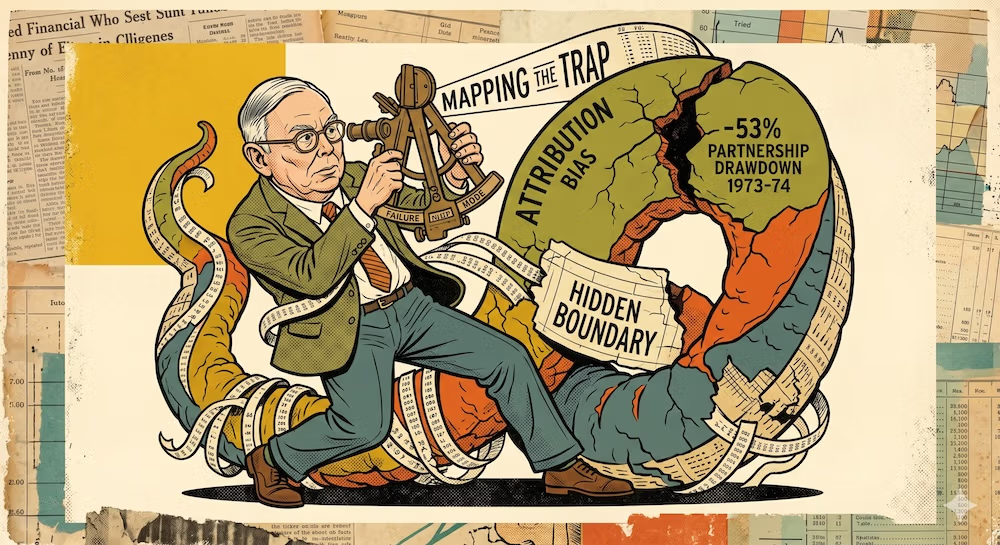
Every grand investing framework works beautifully until it hits its own structural blind spots. Munger’s legendary patience and hyper-concentration were alpha factories during bull regimes, but without non-callable liabilities, those exact strengths morphed into a catastrophic fifty-three percent partnership drawdown.The Case Files: Seven Named Mistakes and Their Blind Spots
Case File #1: Alibaba — Mistaking Business Quality for Jurisdictional Safety
- What Happened: In Q1 2021, operating through the corporate cash portfolio of the Daily Journal Corporation, Munger initiated a massive, unhedged position in Chinese e-commerce giant Alibaba Group Holding Ltd at prices exceeding $220 per share. He continued to accumulate shares as the price fell throughout the year.
- What Munger Likely Saw: He saw a dominant digital franchise with an entrenched ecosystem, high return on capital, and massive scale, trading at a significant discount to its domestic technology peers. He applied an analogy straight from his experience with Costco’s retail dominance and Apple’s ecosystem stickiness.
- What He Missed: He missed the structural reality that foreign investors do not hold direct equity in Chinese internet operators; they hold shares in a Variable Interest Entity (VIE) shell company registered in the Cayman Islands. He overlooked the non-market risks of sudden, state-directed regulatory interventions that can permanently alter a franchise’s earning power overnight regardless of its underlying consumer popularity.
- Blind Spot Revealed: The Quality Analogy Trap. A high-conviction focus on franchise economics can blind an investor to sovereign risk, legal ownership architecture, and the necessity of political permission. When the rules of the game change at the nation-state level, traditional microeconomic moats cease to function.
- Modern Investor Lesson: Quality analysis cannot exist in a vacuum. A business model’s strength is always subordinate to the legal, regulatory, and jurisdictional framework that governs its property rights.
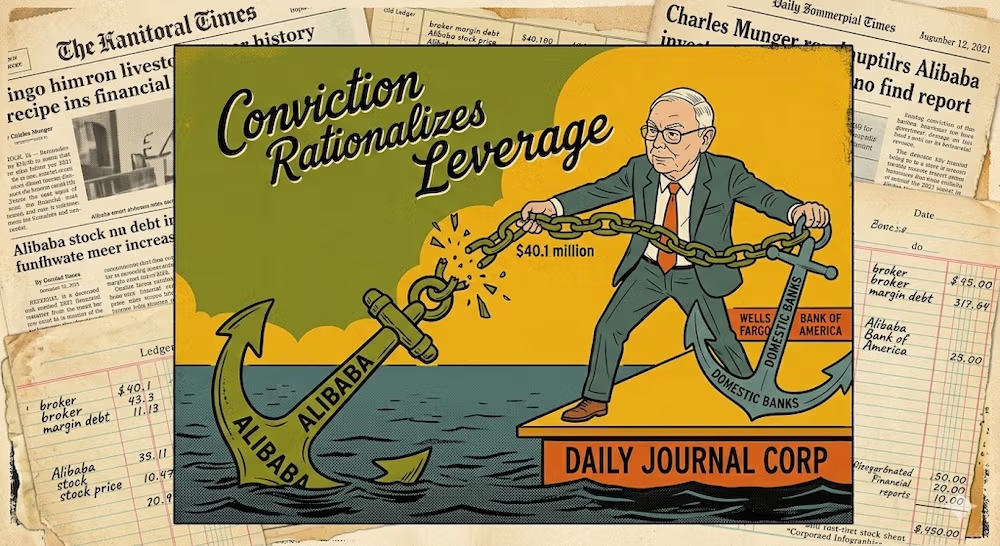
Look closely at that anchor: Munger tethered his safe bank stocks to the sinking Alibaba position with $40.1M in broker margin debt. It’s the ultimate asset-liability mismatch. He missed the vulnerability of callable leverage; conviction isn’t capital. Your platform can sink just as fast as the anchor.Case File #2: Daily Journal Margin — When Conviction Rationalizes Leverage
- What Happened: During the latter half of 2021, as Alibaba’s share price continuously declined, Munger did not simply wait out the storm. Regulatory filings show the Daily Journal Corp drew $40.1 million in broker margin debt to press the bet and buy down its cost basis. (Note: While this margin line peaked at $40.1 million by the end of the fiscal period, the initial margin draw scaled up from a baseline of $37 million earlier in the year). The position was subsequently halved in Q1 2022, permanently locking in massive realized capital destruction.
- What Munger Likely Saw: He saw an increasingly mispriced asset that justified an oversized allocation. Because the Daily Journal Corp held a highly valuable, low-cost-basis portfolio of domestic bank stocks (such as Wells Fargo and Bank of America) to secure the margin line, the debt likely felt structurally insulated from an immediate margin call.
- What He Missed: He missed the absolute vulnerability of blending concentration with callable debt. Margin maintenance thresholds are indifferent to an investor’s long-term orientation, intellectual stamina, or historical pedigree.
- Blind Spot Revealed: Conviction-Driven Leverage Defection. Extreme conviction can cause even the most disciplined mind to rationalize the use of structural debt, violating public anti-leverage principles to double down on a failing thesis. Process failure often shows up not in the original equity thesis, but in the position-sizing and financing decision.
- Modern Investor Lesson: Callable debt becomes especially dangerous when paired with a concentrated public equity portfolio, no matter how strong the investor’s conviction feels. Surviving a long-term thesis requires an absolute mismatch-free capital structure, not just personal temperament.
Case File #3: Google and Amazon — When Circle of Competence Becomes a Cage
- What Happened: During the early development of the digital economy in the late 1990s and 2000s, Munger completely bypassed direct equity allocations in dominant digital platforms like Google and Amazon, despite having clear operational insight into their efficiency.
- What Munger Likely Saw: In Google, he saw an unprecedented advertising monopoly. Through Berkshire Hathaway’s ownership of GEICO, Munger watched in real time as Google’s cost per click functioned as an incredibly efficient customer acquisition engine. In Amazon, he saw a retail disrupter, but under-priced its transition into a massive cloud computing and logistics infrastructure play. He passed on both because they lacked the physical asset baselines and predictable trailing cash flows required by his traditional value filters.
- What He Missed: He missed the reality that digital networks scale with near-zero marginal costs, creating winner-take-all dynamics and platform architecture that make historical asset-heavy valuation models obsolete.
- Blind Spot Revealed: Circle of Competence Rigidity. While a strict circle of competence protects against foolishness, it can easily transform into a cage that locks out new structural paradigms. The global economy can migrate outside an investor’s historical worldview faster than their filters update.
- Modern Investor Lesson: Patience can easily degrade into thesis preservation if your analytical tools remain frozen across major technological regime shifts.
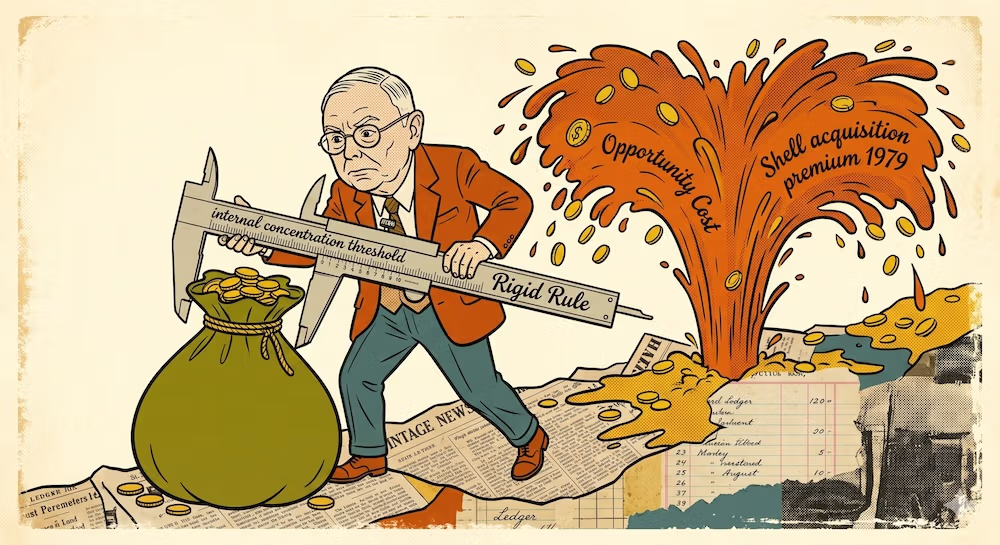
The hidden hazard of rigid risk controls: Munger used arbitrary internal concentration thresholds to trim his Belridge Oil stake early. He missed the massive structural asymmetry of the underlying hard asset reserves, exposing the portfolio to a massive error of omission.Case File #4: Belridge Oil — The Opportunity Cost of Being Too Strict
- What Happened: In his early career, Munger built a highly profitable position in Belridge Oil. However, instead of maximizing the allocation or holding the core block indefinitely, he sold down the position early to maintain fixed internal concentration thresholds and capital boundaries. In 1979, Shell Oil acquired Belridge at a massive premium, exposing Munger to a multi-million dollar error of omission.
- What Munger Likely Saw: He saw a highly successful investment that had grown to represent an uncomfortably large percentage of his partnership’s capital. Standard risk control and diversification dogma dictated trimming the position to lock in gains and protect capital.
- What He Missed: He missed the massive asymmetry of the underlying reserves during a secular shift in global energy markets. The true value of the hard asset far outstripped his conservative internal valuation caps.
- Blind Spot Revealed: Rigid Risk-Control Inflexibility. Overly dogmatic internal rules or arbitrary valuation ceilings can create massive opportunity costs, forcing an investor out of highly asymmetric multi-bagger upside under the guise of prudent risk management.
- Modern Investor Lesson: Errors of omission—not buying enough or selling an exceptional business too early—can be far more damaging to long-term compounding curves than localized errors of commission.
Case File #5: Alco Standard — When Old Value Habits Block Quality Insight
- What Happened: During his early independent partnership years, Munger passed on expanding an ownership stake in an exceptionally high-returning business—Alco Standard—because the acquisition price represented a modest premium over the company’s trailing book value.
- What Munger Likely Saw: He saw a solid business that violated his foundational conditioning under Benjamin Graham’s deep-value, “cigar butt” methodology. His training dictated that buying stocks below tangible book value provided the ultimate margin of safety. Paying a premium for intangibles was viewed as speculation.
- What He Missed: He missed the compounding power of high return on invested capital (ROIC). A business that can consistently deploy capital at high rates of return is worth orders of magnitude more than its liquidating book value.
- Blind Spot Revealed: The Anchor of the Foundational Framework. An investor’s initial successful framework can easily block the adoption of their next framework. Munger’s old value habits actively overrode his developing insight into franchise quality.
- Modern Investor Lesson: True valuation discipline requires looking forward at a franchise’s return on capital, not backward at historical accounting metrics.
Case File #6: The 1973–1974 Partnership Drawdown — When Concentration Becomes Structurally Unholdable
- What Happened: From December 31, 1972, to December 31, 1974, Wheeler, Munger & Co. sustained a massive cumulative drawdown of -53.3%, drastically underperforming the Dow Jones Industrial Average for three consecutive years. This intense tracking error and capital volatility caused extreme partner panic, contributing to the decision to dismantle and liquidate the fund at the absolute bottom of the market in 1975.
- What Munger Likely Saw: He saw three to five deeply undervalued public equities that were bound to compound wealth over a 20-year horizon. He believed his personal temperament was sufficient to withstand short-term volatility.
- What He Missed: He missed the structural mismatch between his long-duration equity positions and the short-duration liabilities of his partners. He forgot that a fund manager’s horizon is always limited by the behavioral stamina of their most anxious investor.
- Blind Spot Revealed: Concentration-Fragility Blindness. Extreme concentration magnifies structural vulnerabilities. If your investment vehicle lacks a permanent capital baseline, personal temperament cannot save the portfolio from redemption-driven liquidation pressures at a market trough.
- Modern Investor Lesson: Being right eventually requires an asset-liability match that can survive the journey. If your liabilities are volatile, your portfolio concentration cannot be absolute.
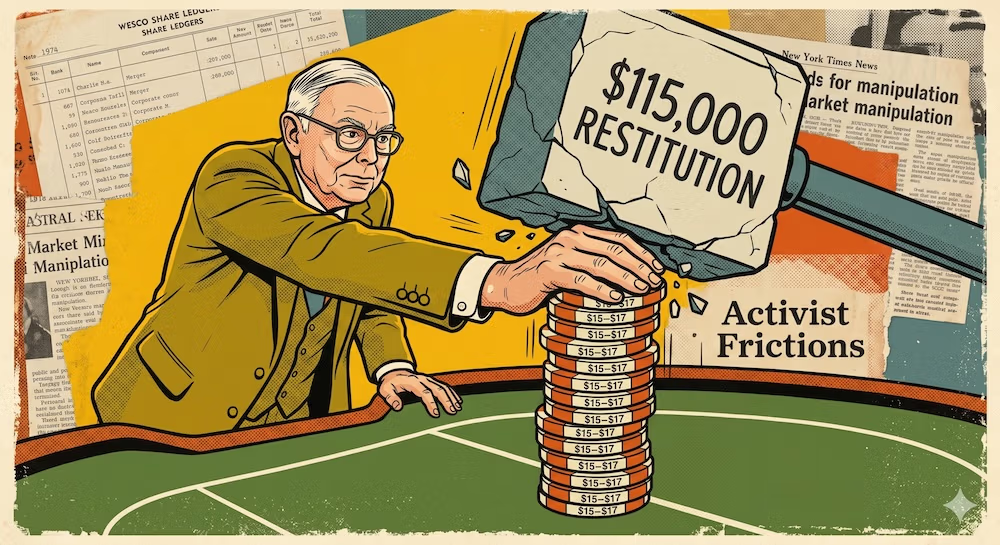
Treating public equities like private poker chips can blind you to structural guardrails. Munger deployed Blue Chip Stamps float to control Wesco’s price, but ran straight into a $115K SEC settlement. Active governance requires legal mastery, not just a financial model.Case File #7: Wesco / Blue Chip Stamps — Control Investing Has Legal and Regulatory Friction
- What Happened: In 1974, Munger aggressively accumulated shares of Wesco Financial on the open market at $15 to $17 per share on behalf of Blue Chip Stamps. The explicit goal was to support the stock price at a premium to block a proposed merger with Financial Corp of Santa Barbara. This aggressive control tactic triggered a formal SEC investigation into market manipulation, which was eventually settled in 1976 when Blue Chip Stamps paid $115,000 in restitution to former Wesco shareholders without admitting or denying wrongdoing.
- What Munger Likely Saw: He saw a high-stakes corporate control scenario where deploying capital to protect an undervalued subsidiary was a logical, defensive allocation of corporate funds.
- What He Missed: He missed the regulatory reality that public markets operate under strict statutory frameworks. Corporate control maneuvers executed through public equity markets introduce intense legal, regulatory, and reputational frictions that do not exist in passive stock picking.
- Blind Spot Revealed: The Activist Control Oversight. Treating public equities as private poker chips can blind an investor to the compliance and regulatory guardrails that protect minority shareholders. Control investing is an entirely different game than passive public equity allocation.
- Modern Investor Lesson: Active corporate governance and control strategies require structural, legal, and regulatory expertise that completely supersedes basic financial statement analysis.
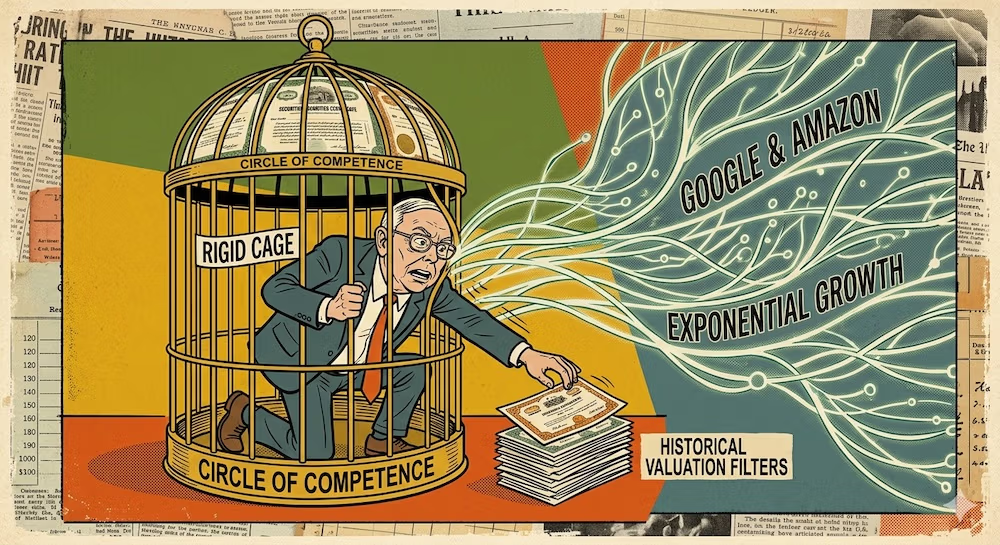
A strict circle of competence keeps you safe from foolishness, but it can also harden into an intellectual cage. Munger passed on digital monopolies because his twentieth-century valuation filters couldn't parse asset-light network effects scaling at zero marginal cost.The Mistake Taxonomy
The matrix below organizes Munger’s historical missteps into a clear conceptual architecture, isolating the core tension of each error.
| Historical Mistake | Type of Error | What Munger Saw | What He Missed | Blind Spot Revealed | Modern Investor Lesson |
| Alibaba (2021–2022) | Commission | High-quality digital franchise trading at a steep discount. | VIE legal structures, sovereign risk, and lack of political permission. | The Quality Analogy Trap: Micro moats are subordinate to macro political frameworks. | Franchise quality cannot exist without jurisdictional safety and protected property rights. |
| Daily Journal Margin (2021) | Commission | Extreme mispricing that justified using debt to double down. | The absolute vulnerability of combining stock concentration with callable debt terms. | Conviction-Driven Leverage: Overriding core risk rules when conviction turns into thesis denial. | Financing decisions and position sizing are just as critical as asset selection. |
| Google & Amazon Omissions | Omission | Clear operational evidence of an advertising and retail monopoly. | The exponential, zero-marginal-cost scaling dynamics of digital platforms. | Circle of Competence Rigidity: Using historical valuation filters as a defense against modern realities. | Worldviews must update when the structural drivers of the global economy shift. |
| Belridge Oil Sale | Omission | A highly profitable position that was growing too large for comfort. | The massive upside asymmetry of underlying physical commodity reserves. | Rigid Risk-Control Inflexibility: Allowing arbitrary concentration limits to force early exits. | Overly strict internal boundaries can create massive, unmeasured opportunity costs. |
| Alco Standard Near-Miss | Omission | A solid business model that violated classic deep-value discounts. | The immense compounding power of a high and sustainable return on invested capital (ROIC). | The Graham Asset Anchor: Allowing legacy deep-value training to block premium quality insight. | True margin of safety is driven by future capital efficiency, not historical book value. |
| 1973–1974 Partnership Crash | Commission | Undervalued equities that would inevitably recover over a 20-year horizon. | The behavioral limits and short-term redemption timelines of his capital providers. | Concentration-Fragility Blindness: Forgetting that long-duration assets require non-callable liabilities. | Personal temperament cannot override a structural mismatch in capital duration. |
| Wesco SEC Friction (1974) | Commission | A tactical corporate control battle that justified aggressive capital deployment. | The strict regulatory guardrails governing public market price support and minority shares. | The Activist Control Oversight: Assuming financial logic supersedes public market compliance rules. | Control investing requires navigating regulatory and legal friction, not just financial models. |
The Core Insight: Strength Becoming Weakness
The structural patterns underlying Munger’s investment mistakes reveal an essential truth for portfolio construction: an investor’s greatest weaknesses are rarely independent traits. They are typically the direct structural extensions of their greatest strengths.
This duality explains why seasoned market participants eventually run into devastating failure modes. The very mental models that generate alpha during one market regime can create profound blind spots when the environment shifts.
+-----------------------------------------------------------------------------------+
|                           THE SPECTRUM OF MOAT RIGIDITY                           |
+-----------------------------------------------------------------------------------+
|  STRENGTH                                                             WEAKNESS    |
|                                                                                   |
|  Patience  ---------------------------------------------> Thesis Preservation      |
|  Concentration -----------------------------------------> Capital Fragility       |
|  Circle of Competence ----------------------------------> Intellectual Rigidity   |
|  Valuation Discipline ----------------------------------> Missed Asymmetry       |
|  Quality Franchise Model -------------------------------> Jurisdictional Blindness|
+-----------------------------------------------------------------------------------+
- Patience becomes Thesis Preservation: The psychological stamina required to sit still during a market rout is an incredible asset. But when applied to an eroding thesis or an unhedged foreign position under regulatory fire (Alibaba), that same patience morphs into thesis preservation and capital destruction.
- Concentration becomes Capital Fragility: Focusing capital into three to five high-conviction ideas eliminates the dilution of mediocre stocks. However, without structural permanent capital to shield the portfolio from redemption requests or margin maintenance guidelines, concentration creates structural fragility.
- Circle of Competence becomes Intellectual Rigidity: Restricting investments to what you deeply understand provides an exceptional safety filter. But if that circle is anchored entirely in twentieth-century asset-heavy business models, it hardens into an intellectual moat that locks out the structural shifts of the modern digital landscape.
- Valuation Discipline becomes Missed Asymmetry: Demanding a steep discount to tangible book value protects capital from overvalued market manias. Yet when applied to high-ROIC compounders or massively asymmetric assets, it converts into an extreme opportunity cost.
- Quality Analysis becomes Jurisdictional Blindness: Evaluating competitive moats, pricing power, and consumer habits works brilliantly in an environment with robust property rights. But if you assume that a consumer franchise analogy travels seamlessly across borders without adjusting for sovereign intervention, your quality model becomes a direct source of risk.
The Sponge Verdict: Study the Blind Spots, Not the Aphorisms
If we want to build a resilient investment process, we must stop treating historical legends as flawless statues. We must view them as complex, highly specialized economic systems that operated within explicit boundary conditions.
When you study Charles T. Munger’s career, absorb his focus on long-term capital efficiency, his rigorous understanding of incentives, and his insistence on structural asset-liability matching. But ruthlessly expel the idea that his mental framework was a universal, self-correcting shield against market risk.
His greatest compounding wins were executed inside an institutional corporate ecosystem—backed by non-callable insurance float, cross-subsidiary tax shields, and favorable dividend exclusions under the corporate tax code—that cushioned his concentrated strategy from the structural frictions of the public markets. When those corporate shields were removed, or when leverage bypassed his risk filters, his framework suffered the exact same failure modes that threaten any retail brokerage account.
The goal of a self-directed investor should not be to copy a legend’s specific conclusions or mimic their extreme portfolio concentration. The goal is to build an epistemic process that can detect when your own favorite framework is starting to fail.
Do not just memorize the aphorisms. Study the blind spots. Track your own failure modes, ruthlessly audit your structural constraints, and never let admiration replace independent underwriting.
The Blind Spot Checklist
Before matching your capital to a high-conviction investment thesis or copying a concentrated strategy, run every position through this operational checklist to verify your structural boundaries:
- Is this an objective conclusion or a process of thesis preservation? Determine exactly what verifiable data points would prove your original thesis wrong, and establish a hard line where patience turns into thesis denial.
- What specific capital structure makes this position survivable? Verify whether the holding period of the underlying asset matches the exact duration of your liabilities. If your capital pool is subject to margin calls, retail redemptions, or short-term personal cash needs, your concentration limits must be structurally reduced.
- What jurisdictional and sovereign assumptions are embedded in this model? Separate pure microeconomic franchise quality from macro political permission. Audit whether your property rights are secured by an independent legal framework or dependent on sovereign geopolitical stability.
- Is my valuation discipline causing a massive error of omission? Check if you are using legacy accounting metrics (like tangible book value) to judge modern, asset-light, or highly asymmetric networks, thereby creating unmeasured opportunity costs.
- Am I copying an institutional large-cap constraint or an optimal small-cap choice? Ensure you are not blindly applying a mega-cap strategy designed to manage massive scale constraints to a nimble, flexible portfolio where a broader opportunity set is available.
- Has my circle of competence transformed into a rigid framework? Actively audit whether the economic world has migrated outside your historical criteria, and verify that your investment filters are updating alongside structural regime shifts.
Educational Trade-Off Disclosure
+---------------------------------------------------------------------------------+
|                       EDUCATIONAL TRADE-OFF DISCLOSURE                          |
+---------------------------------------------------------------------------------+
| Analyzing historical investing errors demonstrates that concentrated, single-    |
| company equity strategies introduce profound tracking error and structural risk.|
| Diversified, rules-based funds may offer one way to seek broad exposure to      |
| systemic asset characteristics—such as quality, value, or low volatility—      |
| without concentrating an entire financial outcome in a handful of company-      |
| specific theses or unhedged jurisdictional risks. Every investor must carefully|
| balance the potential alpha of concentration against the behavioral stability   |
| and structural diversification benefits of broad market asset allocation.       |
+---------------------------------------------------------------------------------+
What is the difference between an error of commission and an error of omission in Charlie Munger’s record?
It comes down to what hits the ledger versus what stays in your head. An error of commission is a concrete action that went wrong—like drawing down $40.1 million in margin debt at the Daily Journal Corp to buy a falling position in Alibaba, only to liquidate half of it at a massive realized loss. An error of omission is an investment you didn’t make, or didn’t buy enough of, because your rules were too rigid. Munger’s early decision to pass on expanding his stake in Alco Standard because it traded slightly above book value is a classic error of omission. Omissions don’t show up as losses on your brokerage statement, but they can severely damage your long-term wealth compounding curve through massive opportunity costs.
Did Charlie Munger use margin debt or portfolio leverage early in his career?
Yes. Despite his frequent public warnings advising retail investors to avoid debt, Munger routinely utilized bank credit lines and broker margin lines during his independent partnership era with Wheeler, Munger & Co. records indicating he pushed portfolio leverage between 1.3x and 1.4x equity assets heading into the 1973–1974 stagflation crash. This structural leverage severely amplified his peak-to-trough drawdown to -53.3%, which eventually triggered panic among his capital partners and contributed heavily to his decision to dismantle and liquidate the fund at the absolute bottom of the market in 1975.
How did the Dividends Received Deduction give Charlie Munger an unfair structural edge?
It created an institutional tax shelter that retail accounts cannot duplicate. Under Internal Revenue Code Section 243 during Munger’s peak corporate compounding years at Wesco Financial and Berkshire Hathaway, a domestic corporation could deduct up to 70% to 85% of the dividends received from other domestic corporations from its taxable income. This meant that while an individual retail investor faced full tax drag on dividend distributions in a standard taxable brokerage account, Munger’s corporate investment vehicles were compounding those same cash flows at an effective tax rate in the single digits.
What was Charlie Munger’s specific blind spot in his Alibaba investment?
He mistook microeconomic franchise quality for jurisdictional and political safety. Munger analyzed Alibaba by using a direct analogy to the retail ecosystem moats of domestic giants like Costco or Apple. In doing so, he overlooked the structural reality of the Variable Interest Entity (VIE) legal architecture, which strips foreign buyers of direct equity ownership. He also underestimated the impact of unilateral regulatory interventions by the Chinese domestic government, proving that a company’s underlying consumer popularity is completely subordinate to state political permission.
Can a retail investor safely copy Charlie Munger’s 3-to-5 stock concentration strategy?
Not exactly. While concentrating your portfolio into a handful of high-conviction ideas removes the dilution of mediocre stocks, it requires a specific liability structure to survive. Munger’s concentration was protected by a permanent, non-callable capital baseline—specifically insurance float and corporate cash reserves that could not be pulled out by panicking investors during a market correction. If you copy his extreme concentration inside a standard retail brokerage account without these institutional shields, a multi-year tracking error or a 50% drawdown risks triggering forced margin liquidations or personal behavioral failure.
What is the minimum portfolio size required to execute an institutional control strategy like Munger’s Wesco acquisition?
Different game entirely. You cannot execute this strategy at the retail scale because it is not a public stock-picking exercise; it is an activist corporate control maneuver. When Munger accumulated shares of Wesco Financial at $15 to $17 per share in 1974 to block an active merger, he was weaponizing millions of dollars of corporate float from Blue Chip Stamps to dictate board-level governance. For an individual investor, attempting to influence corporate infrastructure requires substantial capital blocks, legal counsel, and regulatory compliance infrastructure that effectively limits control investing to institutional scales.
How can modern investors capture Munger’s Quality and Value principles without single-stock concentration risk?
You change the implementation mechanism entirely. Instead of attempting to identify three or four individual companies and exposing your entire net worth to uncompensated single-stock tail risk, you can access these exact return drivers systematically. Many self-directed investors utilize rules-based, low-cost factor exchange-traded funds (ETFs) focused explicitly on the Quality premium (tracking high ROIC and capital efficiency) or the Value premium. This approach allows you to absorb the systemic mathematical factors that drove Munger’s long-term alpha while maintaining broad diversification to insulate your canvas from single-thesis failures.
This article is also available in Spanish. [Leé la versión en castellano: Los mayores errores de inversión de Charlie Munger y lo que revelan sus puntos ciegos]