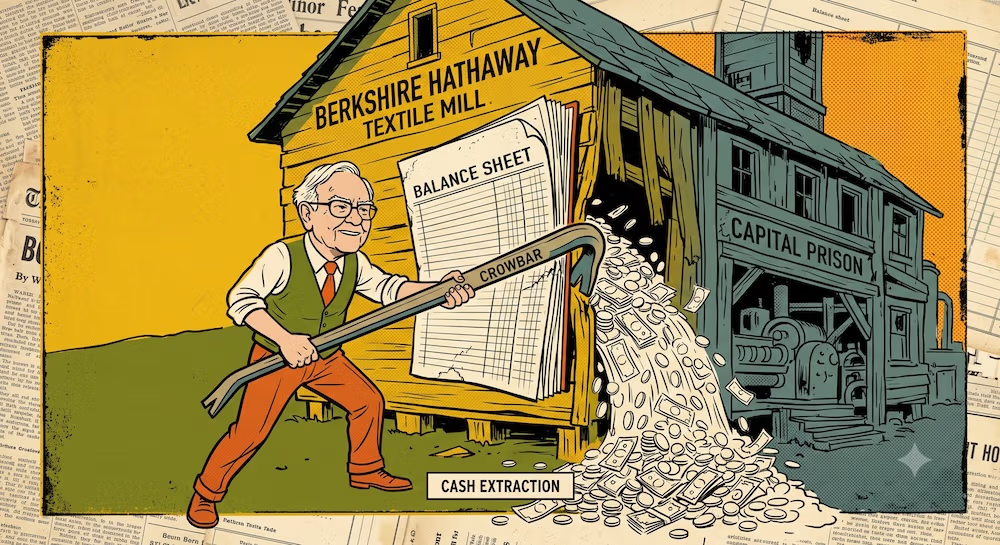
I used to think the Charlie Munger upgrade was simply: buy better companies.
It’s the standard line parroted across every corner of the financial internet. It sounds intuitive, clean, and perfectly sensible. You read the famous quotes, look at the multi-decade chart of Berkshire Hathaway, and assume Munger simply had a preference for high-end brands over statistically ugly operations.
But that completely undersells the mechanism.
The real shift Munger helped popularize was far deeper than a superficial preference for high-end corporate names over mediocre businesses. It was a fundamental architectural transition from harvesting a one-time market mispricing to underwriting long-term economic compounding. He helped change the core return engine.
To understand why this matters for your own portfolio strategy, you have to move past the lazy slogans and look at the actual math of how these two different asset structures generate cash for an investor.
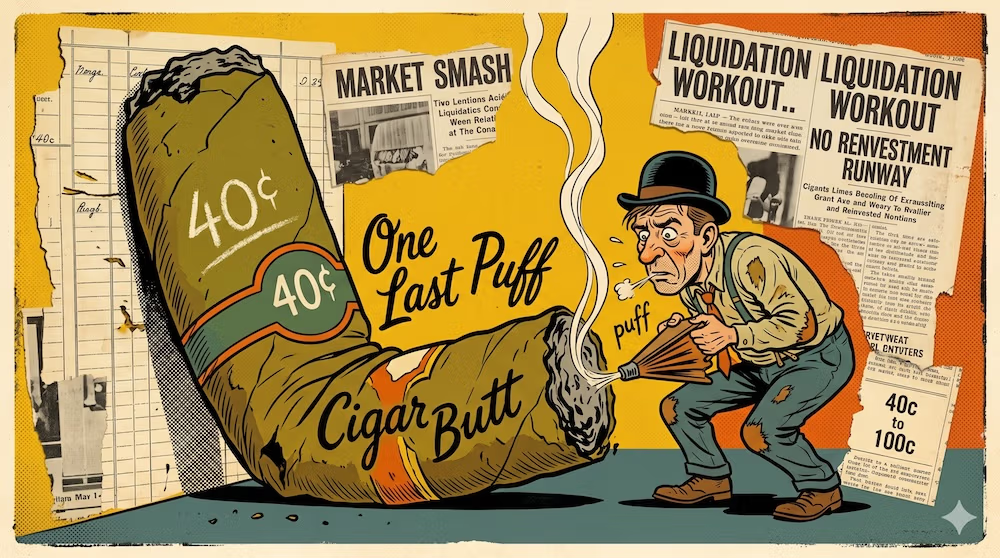
The Cigar Butt Engine: One Last Puff From a Cheap Asset
Ben Graham’s classic value framework—the “cigar-butt” model—is often treated by modern market commentators with a sort of polite condescension. We are told it’s an outdated, clunky way to invest that only works for small sums of capital.
But that misses the historical reality: cigar-butt investing is highly logical, deeply quantitative, and historically defensible when executed with discipline across a diversified basket.
Mechanically, a cigar butt is an asset trading at a severe discount to its current liquidation value or net current assets. The underlying business is usually mediocre, struggling, or locked in a terminal structural decline. It has low returns on capital, zero pricing power, and a finite operational shelf life.
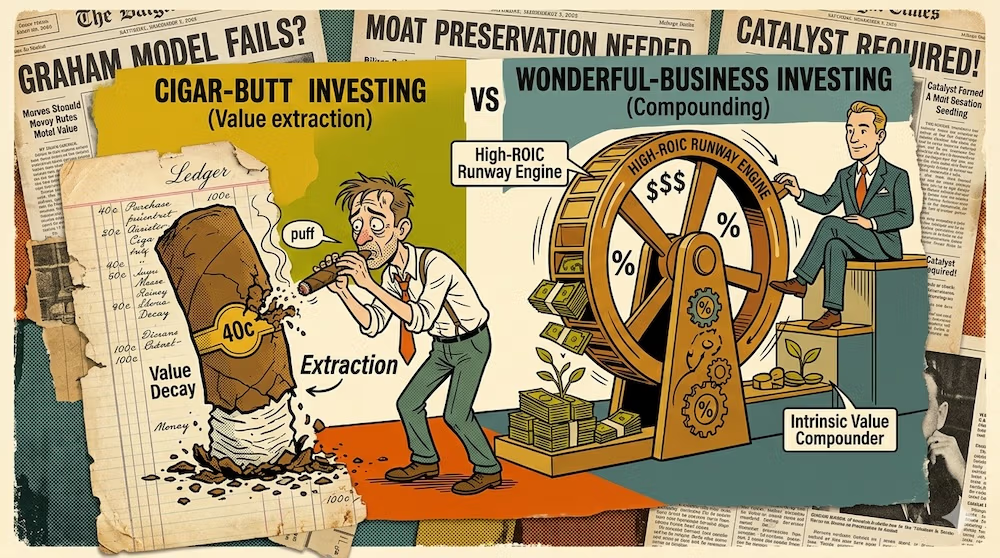
Yet, the return engine is highly reliable when executed correctly. The math doesn’t care if the business is beautiful; it only cares about the initial price gap. The investor buys the asset at 40 cents on the dollar, waiting for a specific catalyst to close that gap: a market re-rating, an outright liquidation, a corporate workout, or an asset sale.
[Purchase Price: 40c] ---> [Market Re-Rating / Asset Realization] ---> [Intrinsic Value: 100c] = Extraction Complete
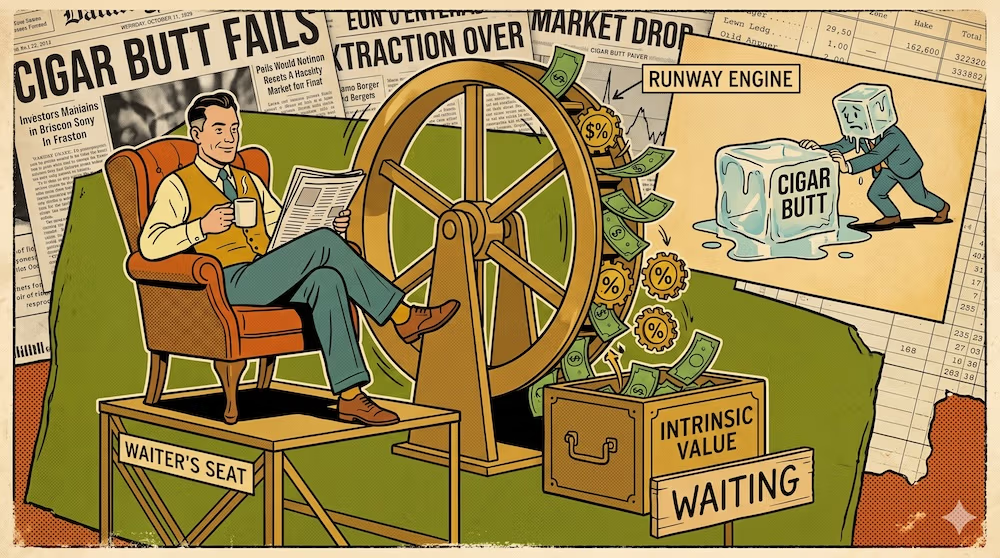
Once that value gap closes, the return engine runs out of fuel. The puff is gone. Because the business has no reinvestment runway—meaning it cannot plow cash back into the operation at high rates of return—the investor cannot simply sit on the asset. They are forced to sell, pay capital gains taxes, and jump back into the market to find another cheap, ugly asset to repeat the process. It is a continuous, labor-intensive extraction game.
The Wonderful Business Engine: Compounding While You Wait
Munger’s primary contribution to the early Berkshire framework was demonstrating that you could replace this high-turnover extraction game with a long-duration reinvestment engine.
A “wonderful business” isn’t defined by a vague qualitative vibe or an admired corporate reputation. Mechanically, it is an enterprise that possesses a distinct set of structural characteristics:
- High Returns on Capital: The ability to generate significant earnings relative to the tangible assets deployed in the business.
- Durable Pricing Power: The capacity to raise prices without destroying unit sales volume, acting as an automatic hedge against monetary inflation.
- Low Capital Intensity: The business generates cash far in excess of the maintenance capital expenditures required to keep the lights on.
- A Protected Reinvestment Runway: The structural ability to either deploy that excess cash back into high-ROIC opportunities or distribute it efficiently to the parent allocation node.
The structural beauty of this model is that the business creates additional intrinsic value while you wait. A cigar butt is a melting ice cube; its value decays if the market takes too long to recognize the discount. A high-quality business, by contrast, increases its intrinsic value every year it operates, reducing your sensitivity to short-term market pricing.
See’s Candies: The Moment the Math Changed
The transaction that permanently altered the mathematical playbook was the acquisition of See’s Candies by Munger and Warren Buffett through Blue Chip Stamps.
| Financial Dimension | See’s Candies Operational Profile (1972) |
| Acquisition Price | $25 Million |
| Net Tangible Assets | $8 Million |
| Pre-Tax Target Earnings | $4 Million |
| Pre-Tax Earnings to Tangible Assets | 50% |
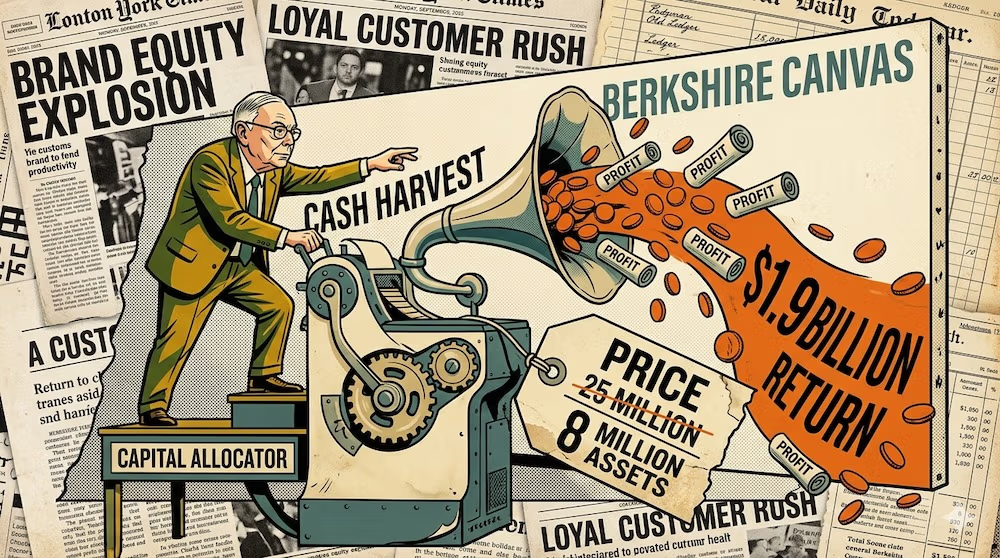
| Cumulative Pre-Tax Profit Returned (1972–2014) | Over $1.9 Billion |
To a strict, traditional asset-value investor raised on Ben Graham’s metrics, paying $25 million for a business with only $8 million in net tangible assets looked like dangerous speculation. It required paying a massive premium for an intangible asset: brand equity.
But Munger looked at the capital efficiency. The business was generating $4 million in pre-tax earnings on that tiny $8 million asset base. Because the local customer base was intensely loyal, See’s could raise its candy prices every year without losing volume, requiring almost zero incremental capital to fund its internal operations.
That structural setup transformed See’s into a giant cash engine. The corporate architecture allowed Munger and Buffett to harvest billions of dollars over the subsequent decades, systematically redirecting those cash flows to purchase other high-utility assets. The initial premium paid over book value was completely wiped out by the sheer volume of cash the business generated over its multi-decade operational run.
The Two Return Engines Side by Side
To understand which game you are playing in your own portfolio, look at how these mechanical forces operate across different investment dimensions:
| Dimension / Metric | Cigar-Butt Investing | Wonderful-Business Investing |
| Primary Source of Return | Market re-rating, asset liquidation, or closing of the initial valuation gap. | Long-term growth and compounding of corporate intrinsic value. |
| What Must Go Right | The market must eventually recognize the asset value; a catalyst must occur before the asset decays. | The business must maintain its competitive advantage and internal capital efficiency. |
| Holding Period Logic | Short to medium term; asset must be liquidated once intrinsic value is achieved. | Long-term, multi-decade buy-and-hold matching the operational life of the firm. |
| Reinvestment Role | Zero internal reinvestment; cash must be extracted and manually redeployed by the investor. | High internal reinvestment runway, or structural distribution to a superior allocator. |
| Valuation Sensitivity | Extremely high; a minor mistake in entry pricing destroys the entire margin of safety. | Moderate to low over long horizons; long-term returns converge toward business performance. |
| Failure Mode | Value traps, permanent structural decline, or operational cash burn during long delays. | Moat destruction, disruption risk, or severe overpayment at entry. |
| Investor Skill Required | Statistical screening, balance sheet auditing, and deep liquidation valuation skills. | Deep competitive analysis, industry structural forecasting, and behavioral patience. |
| Modern Retail Portability | Low; highly constrained by algorithmic market efficiency and data saturation. | Moderate to high as a diversified quality filter; harder as concentrated single-stock selection. |
The ROIC Trap: Wonderful Businesses Still Need a Runway
When we look at the mathematical underpinnings of the wonderful business model, the core relationship is often summarized by a simple truth: over long holding periods, the economics of the underlying business start to matter far more than the initial valuation snapshot. If you hold an asset for 30 years, your ultimate return profile will be heavily weighted toward the company’s internal efficiency rather than the specific earnings multiple you paid at entry.
However, many investors fall into a dangerous quantitative trap here. They assume that if a business shows a high historical Return on Invested Capital ($text{ROIC}$), it is automatically a compounding machine.
That is incomplete math.
A high $\text{ROIC}$ is merely an efficiency metric. For a business to compound your capital over time, it must pair that high return with a massive, unconstrained reinvestment runway.
Consider the operational divergence: if a niche local business earns a 50% return on capital but can only deploy $100,000 before exhausting its local market, it cannot compound capital at scale. It becomes a cash cow—valuable for generating income, but incapable of organic exponential growth. The true compounding magic only occurs when a business can take its high-return earnings and continuously plow them back into the operation at similarly high rates of return for years on end.
Navigating the Modern Quality Traps
Shifting your focus to business quality does not mean you can turn off your valuation disciplines. “Wonderful” is a mechanical description of capital efficiency; it is not a compliment or a justification to pay any price.
Modern markets are littered with “quality traps” that catch investors who treat Munger’s principles as a generic slogan:
- Paying for Priced-In Perfection: Buying an iconic, high-ROIC consumer staple at a Price-to-Earnings ($\text{P/E}$) multiple of 45 means you have already discounted decades of flawless growth into your entry price. If the business encounters a minor headwind, your long-term return engine stalls completely.
- Confusing Past Trajectories with Future Moats: Quantitative screens show you what a company did over the last ten years. They cannot tell you if a technological shift or a low-cost competitor is currently dismantling the barrier to entry underneath the business today.
- Ignoring Capital Intensity Shifts: A capital-light software company that begins spending billions on hardware, data centers, and physical infrastructure is changing its fundamental asset structure. If the return on that new infrastructure declines, the business engine changes entirely.
What Modern Investors Should Absorb — And What They Should Not Cosplay
For the independent DIY allocator looking at this historical record, the task is clear: absorb the underlying mechanism, but avoid dangerous, superficial imitation.
What to Absorb: The Quality Filter
You can systematically integrate Munger’s business-quality framework into your personal portfolio canvas by treating quality as a quantitative entry hurdle. Instead of chasing distressed, low-margin assets that rely on a one-time market re-rating, build a portfolio anchored by firms with stable gross margins, high returns on capital, and clean balance sheets. This approach leverages a well-documented asset characteristic: high-quality, highly profitable businesses have historically shown more attractive long-term characteristics than low-quality operations across many market studies, though the premium is not guaranteed in every cycle.
What to Expel: Concentrated Cosplay
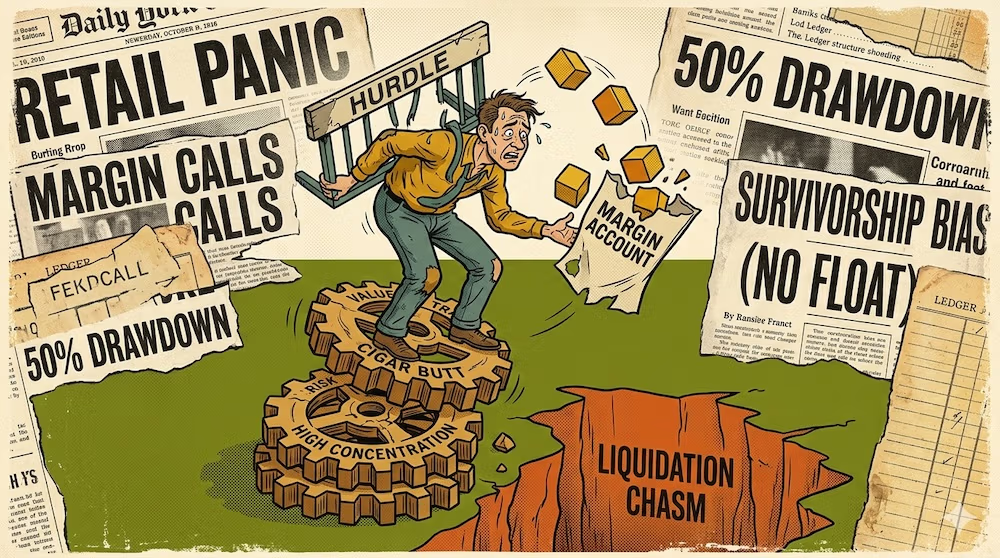
Where retail investors get into severe structural trouble is trying to copy Munger’s hyper-concentrated execution style without owning his specific capital liabilities.
Munger frequently managed portfolios with fewer than five core stock holdings. But he did so backed by a permanent corporate capital structure, an underlying real estate fortune, and non-callable insurance liabilities. If you duplicate that extreme concentration within a taxable, short-duration personal brokerage account, you are exposing your financial plan to severe tracking error and catastrophic idiosyncratic risks. A single unexpected regulatory shift or sector disruption can permanently impair your liquid capital base.
The Sponge Investor Verdict
The transition from deep-value cigar butts to high-quality businesses is ultimately a choice between two entirely different ways of generating investment returns. Cigar-butt investing can deliver excellent returns when asset mispricings are common, but it requires constant activity, regular transaction costs, and a continuous search for new cheap assets.
The wonderful business framework offers a more scalable, lower-turnover return engine—provided you treat quality as a cold mechanical metric rather than a romantic slogan. The Munger upgrade was not “valuation stopped mattering.” It was “valuation had to account for the quality and duration of the compounding engine.” Absorb the patience and the focus on internal business compounding. Expel the idea that a great brand justifies an infinite valuation, and never mistake a high historical return metric for an unconstrained structural runway.
FAQ
What exactly is the mechanical difference between a cigar butt and a wonderful business?
The primary difference lies in the return engine. A cigar-butt asset relies on a one-time market re-rating, liquidation, or corporate workout to close an initial price gap. Once that gap closes, the engine runs out of fuel and you must find a new asset. A wonderful business possesses internal capital efficiency—driven by high returns on capital and durable pricing power—that continuously creates new intrinsic value over time while you wait.
Did Charlie Munger entirely eliminate the consideration of stock valuation when focusing on quality?
No. Not at all. The shift was not about letting go of valuation discipline; it changed what the valuation model had to account for. Instead of looking for a simple discount on a static asset baseline, valuation had to account for the quality, sustainability, and multi-decade duration of the underlying compounding engine. A great business can still become a terrible investment if the entry price discounts decades of unrealistic growth expectations.
What is the biggest trap independent investors fall into when trying to buy wonderful businesses?
They confuse past efficiency metrics with a protected reinvestment runway. A high historical Return on Invested Capital ($\text{ROIC}$) is an efficiency signal, but it only becomes a compounding machine if the company has a massive, unconstrained runway to deploy its excess earnings back into the operation at similarly high rates of return. Without that reinvestment runway, the business is merely a cash cow, not an organic compounding asset.
Can a modern DIY investor execute Munger’s concentrated portfolio approach in a retail account?
It is highly risky. Munger frequently managed portfolios with fewer than five core stock positions, but he did so backed by permanent corporate capital, non-callable insurance liabilities, and vast independent real estate wealth. If a retail investor attempts this extreme concentration inside a taxable, short-duration brokerage account, they face massive idiosyncratic risk and extreme tracking error that frequently triggers behavioral capitulation or forced broker liquidations during market drawdowns.
How can I systematically capture the “wonderful business” return engine using modern diversified tools?
You can use a quantitative quality factor filter. Instead of taking on the high tracking error of single-stock selection, modern investors can access the Quality factor premium—analytically known as Quality Minus Junk ($QMJ$)—via rules-based ETFs or quant screens. Look for systematic funds [VERIFY / e.g., QUAL, XQG] that filter the equity market for high asset productivity, low operational accruals, stable gross margins, and conservative leverage.
Does a wonderful business strategy cause more or less tax drag than a cigar-butt strategy?
Significantly less. Because a cigar-butt strategy is a high-turnover extraction game, it requires regularly selling assets as soon as their valuation gaps close, triggering consistent short-term or long-term capital gains tax liabilities. A wonderful business strategy relies on multi-decade internal compounding, allowing an independent investor to defer capital gains realizations indefinitely, completely eliminating the compounding friction of regular tax drag.
This article is also available in Spanish. [Leé la versión en castellano: Charlie Munger: Por qué conviene comprar negocios maravillosos antes que colillas de cigarrillo baratas]