
Portfolio construction can feel like a battle between academic theory and behavioral reality. To my eyes, finding a strategy that delivers structural growth without leaving you vulnerable to sudden market shifts is the ultimate DIY goal. Few institutional allocators have reframed this balance better than David Swensen, the legendary Chief Investment Officer (CIO) of the Yale University endowment. Swensen’s pioneering framework, universally known as the Endowment Model, fundamentally rewrote the rules of institutional asset allocation and left behind a masterclass blueprint for individual investors looking for true, resilient diversification.
source: Rob Berger on YouTube
I want to unpack the core mechanics of David Swensen’s Endowment Model. Instead of just looking at the surface-level percentages, we will dig into the specific asset allocation pillars, the premium harvested from illiquid markets, and the practical friction points of trying to mirror this strategy in a retail account. Whether you are running a lean, capital-efficient DIY portfolio or thinking through cross-asset correlations, understanding the trade-offs of the Yale approach is highly instructive for modern portfolio architecture.
David Swensen’s Impact as Yale University’s Chief Investment Officer
When David Swensen took over the Yale endowment in 1985, institutional investing was a completely different animal. Most portfolios were bound to rigid, traditional models heavily concentrated in domestic large-cap equities and long-term government bonds. Over more than three decades, Swensen completely deconstructed that orthodoxy. Under his stewardship, Yale’s asset base exploded by focusing on structural diversification, expanding into alternative asset classes, and leaning heavily into an institutional horizon that measured performance in decades rather than quarters. To my eyes, the primary source of truth for his methodology remains his seminal text, Pioneering Portfolio Management, which details how institutional scale can systematically capture inefficiencies.
Honestly, his performance wasn’t a fluke or a simple product of market trends during standard macro expansions. It was built on a systematic exploitation of market inefficiencies and an unwavering commitment to non-traditional risk premiums. By shifting away from heavily liquid, highly efficient public markets, Swensen proved that institutional scale could be used to extract an illiquidity premium. This structural shift completely modified our understanding of a modern investment strategy.
Importance of a Diversified, Long-Term Investment Strategy
During macroeconomic regimes marked by sudden inflationary shocks or growth decelerations, relying on a standard 60/40 layout introduces massive concentration risk. Swensen’s core thesis is an explicit critique of this rigidity. To my eyes, the model works because it avoids over-reliance on any single economic environment, deploying an expanded canvas of alternative and real assets to distribute structural risk. When equities face deep drawdowns, uncorrelated assets act as vital portfolio anchors.
Furthermore, maintaining a long-term horizon isn’t just a generic piece of psychological advice—it’s a strict mechanical advantage. It allows a portfolio to absorb the tracking error pain and severe underperformance patches that alternative strategies inevitably face. This structural patience lets compounding operate uninterrupted in the background. The math doesn’t lie: holding volatile or illiquid assets through their ugly years is the mandatory toll you pay to harvest structural multi-factor premiums over a true investment strategy.

The Endowment Model: Core Principles
The operational framework of Swensen’s model hinges on moving away from standard market-cap-weighted structures. Instead of looking at assets through the lens of traditional classifications, the model isolates underlying factor exposures, risk premiums, and liquidity characteristics to step outside conventional investment strategies.
Diversification: Spreading Investments Across Different Asset Classes
Why Diversification Matters
True diversification requires introducing genuinely non-correlated return streams. By allocating investments across a variety of asset classes, the portfolio exploits the reality that different assets react differently to fundamental macroeconomic drivers like growth surprises and inflation shocks. Here is where the math gets uncomfortable: if your “diversifiers” are highly correlated with the S&P 500 during a crash, you aren’t actually diversified. When public equities experience severe drawdowns due to multiple contraction, real assets or uncorrelated hedge fund strategies can act as structural dampeners to sustain capital efficiency.
For example, if an inflation shock hits traditional long-only assets, nominal bonds suffer from yield expansion, and equity discount rates climb. However, real estate, natural resource concessions, or private equity investments with pricing power can maintain real value. This structural divergence helps shield the total portfolio architecture across vastly different economic environments.
Key Takeaways:
- Risk Reduction: True diversification dampens fundamental factor concentration across the total asset allocation.
- Enhanced Stability: Introducing non-correlated asset behaviors minimizes deep, permanent capital impairment during major macro shocks.
- Broader Growth Opportunities: Capitalizing on unique risk premiums across private and alternative markets adds structural alpha pipelines.
Alternative Investments: Emphasizing Non-Traditional Assets
A massive pillar of Swensen’s philosophy is an explicit preference for alternative asset classes that exist outside the traditional public equity and fixed-income universes. These mandates include private equity, absolute-return hedge funds, real estate, and commodities. These exposures introduce unique mechanical characteristics:
- Higher Returns: Private markets allow active managers to exploit massive informational asymmetries to generate structural alpha.
- Low Correlation: Public equity market-cap tracking error doesn’t dictate the performance of niche private credit or absolute-return mandates.
- Inflation Hedge: Direct infrastructure and timberland allocations provide explicit revenue ties to rising consumer and producer price indices.
Types of Alternative Investments:
- Private Equity: Venture capital, growth equity, and leveraged buyouts where managers actively restructure operations to unlock economic value.
- Hedge Funds: Long/short equity, event-driven, and arbitrage macro strategies looking for absolute return streams that strip out general market beta.
- Real Estate: Direct ownership of commercial properties, specialized industrial space, or timberland providing equity cash flows along with distinct inflation adjustments.
- Commodities: Investments in physical goods such as gold and industrial metals, acting as a crucial systemic backstop during currency debasement regimes.
Long-Term Focus: Holding Investments for Extended Periods
The true superpower of the Endowment Model is its structural capacity to harvest the illiquidity premium. By locking up capital for five, ten, or fifteen years in private mandates, the fund completely avoids the forced-selling risks that plague retail investors during panic cycles. This long-horizon approach lets active managers execute deep operational turnarounds without worrying about daily mark-to-market fluctuations.
Benefits of a Long-Term Focus:
- Compounding Growth: Uninterrupted accumulation lets private market asset distributions reinvest directly into fresh capital calls, where earnings generate compounding returns.
- Reduced Impact of Volatility: Smoothing out daily pricing variations helps institutional boards maintain systematic discipline through short-term market downturns.
- Alignment with Financial Goals: Locking a rigid strategy aligns investments with long-range spending liabilities to eliminate behavioral tinkering.

Asset Allocation Strategy
The specific allocation strategy within the Endowment Model is designed to maximize capital efficiency across an asymmetric layout. To my eyes, the question I’d ask is how much equity risk you can tolerate when it’s repackaged across non-traditional wrappers to optimize a balanced distribution of investments across various asset classes to balance risk.
Equities: Significant Allocation to Domestic and International Stocks
Swensen never shied away from equity risk; he simply hated holding it exclusively in standard large-cap domestic structures. Equities are the core engine of real long-term growth, making them a vital component of a growth-oriented portfolio where purchasing power must beat inflation liabilities.
Allocation Insights:
- Domestic Equities: While US large-caps offer deep systemic liquidity, the model explicitly tilts toward value and size factors where inefficiencies are more common.
- International Equities: Allocating globally broadens the factor footprint, harvesting economic growth across international regimes and capturing upside in emerging markets while decoupling from pure domestic corporate profit cycles to build out exposure in industries not prevalent in the domestic market.
Benefits of Equities Allocation:
- Growth Potential: Capitalizes on systemic corporate earnings growth to deliver real compounding over decades.
- Dividend Income: Cash yields provide an organic distribution stream to fund ongoing operational rebalancing.
- Inflation Hedge: Corporations can pass input cost increases to consumers, maintaining equity profit margins when consumer prices rise.
Fixed Income: Limited Exposure to Bonds
This is where the model breaks sharply from conventional financial planning. Swensen viewed traditional government bonds as a highly inefficient asset to hold in size over long horizons due to their low real yields and systemic exposure to inflation shocks. He kept the fixed-income allocation minimal, utilizing it primarily as a deflation hedge and an emergency liquidity bucket during sharp market panics. To my eyes, the real question is whether a tiny 5% allocation to fixed income provides any meaningful rebalancing ammunition during a prolonged bear market.
Fixed Income Strategy:
- Credit Investments: Focusing strictly on specialized private credit and high-yield operational instruments where structural covenants add real yield.
- Reduced Bond Allocation: Keeping traditional duration risk contained to prevent the portfolio from getting dragged down by low yields or interest rate shocks. This deliberate underweight insulates the total asset base from long-duration bond volatility.
Advantages of Limited Fixed Income Exposure:
- Higher Yields: Shifts fixed-income risk from pure interest rate exposure to specialized credit selection where yields are structurally higher.
- Diversification: Credit instruments add another unique risk-premium layer to the total portfolio architecture.
- Risk Management: Stripping out excess nominal duration prevents inflation spikes from ravaging the defensive side of the ledger.
Alternative Assets: Major Allocation to Non-Traditional Investments
The core of the portfolio’s capital engine sits squarely inside the alternative landscape. By allocating huge percentages to private equity, venture capital, and absolute-return strategies, the model intentionally targets inefficient markets where specialized managers can extract significant informational advantages.
Key Alternative Assets:
- Private Equity: Sourcing long-term alpha by taking direct controlling stakes in private entities or backing early-stage venture founders.
- Hedge Funds: Allocating to absolute-return structures that deploy long/short equity or macro strategies to uncover funds can employ long/short equity approaches that remain uncorrelated with public market beta.
- Real Assets: Direct property investments, infrastructure concessions, and timberland tracts that deliver tangible cash flows along with clear contractual protection against inflation.
Benefits of Alternative Assets Allocation:
- Higher Return Potential: Targets alpha generation in opaque, non-public markets that traditional retail investors cannot access easily.
- Enhanced Diversification: Non-public valuation schedules and idiosyncratic return drivers decouple the portfolio from public index momentum.
- Inflation Protection: Tangible underlying assets provide an explicit hedge to preserve purchasing power across long macro cycles.
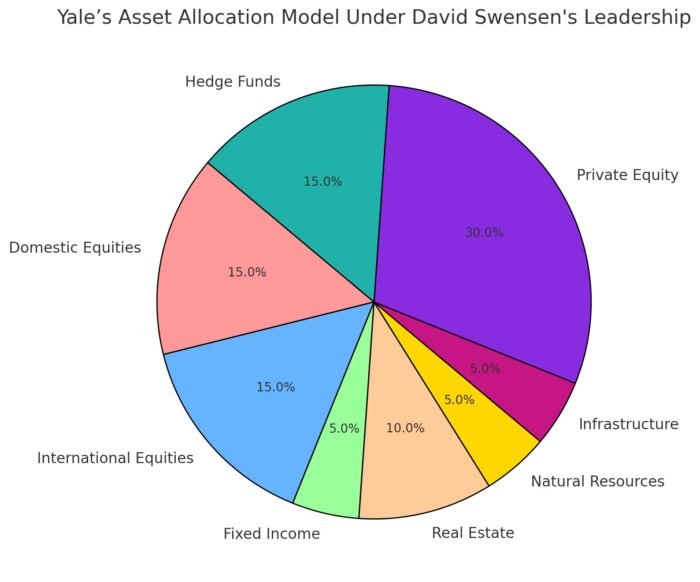
Example: Yale’s Asset Allocation Model Under Swensen’s Leadership
To see how this works in practice, look at a representative snapshot of Yale’s strategic target weights during the peak of Swensen’s tenure. Notice how traditional bonds are pushed to the absolute periphery:
- Equities: 30%
- Domestic: 15%
- International: 15%
- Fixed Income: 5%
- Real Assets: 20%
- Real Estate: 10%
- Natural Resources: 5%
- Infrastructure: 5%
- Private Equity: 30%
- Hedge Funds: 10%
This layout shows the core mechanics of the Endowment Model. By matching traditional equity exposure with an intensive allocation to private alternatives, the portfolio isolates orthogonal risk streams. The portfolio is structurally configured to capture growth during expansions while relying on real assets and absolute-return streams to absorb systemic market volatility.
Managing Risk
Risk management in this framework doesn’t mean hiding in cash or buying expensive portfolio insurance. Swensen managed risk structurally by modifying the internal composition of the portfolio to preserve an absolute equity orientation without giving in to simple asset concentration.
Diversification Across and Within Asset Classes
True risk reduction requires meticulous diversification within each individual sleeve. Spreading assets across a wide range of managers, deal structures, and geographies ensures that idiosyncratic failures don’t jeopardize the total portfolio architecture.
Strategies for Enhanced Diversification:
- Within Equities: Avoiding concentration in cap-weighted tech giants by systematically allocating across distinct factor buckets, including value, size, and quality metrics across global markets.
- Within Alternative Assets: Splitting the absolute-return sleeve across non-correlated setups like equity market-neutral, relative value arbitrage, and global strategies or investing across diverse commercial, industrial, and agricultural property types to isolate the alternative bucket from single-strategy drawdowns.
Active Management: Pursuing Higher Returns Through Expertise
While indexing is highly efficient for large-cap public stocks, Swensen argued that index-only thinking is a massive mistake when dealing with opaque, illiquid alternative assets. In private equity or distressed debt, the spread between a top-quartile manager and a bottom-quartile manager is enormous. Active management is mandatory here to capture structural alpha.
Benefits of Active Management:
- Potential for Superior Returns: Top-tier managers leverage operational teams and exclusive deal flow to source assets at massive discounts, generating true investment decisions that can generate alpha.
- Flexibility: Active alternative mandates allow managers to dynamically adjust hedging profiles, alter leverage levels, and exploit sudden mispricings during macro liquidations.
- Access to Specialized Knowledge: Deep operational expertise in niche markets like biotech venture capital or infrastructure development allows for smarter risk pricing and capital allocation.
Illiquidity Premium: Embracing Less Liquid Assets for Higher Returns
For a DIY investor, lockups sound terrifying. But for an institutional pool with predictable liability streams, illiquidity is an asset class of its own. Swensen realized that public markets force you to pay a premium for daily liquidity that you rarely actually need. By intentionally giving up that liquidity, you can capture a structural return premium.
Understanding the Illiquidity Premium:
- Higher Returns: Private assets command a structural yield premium because buyers are scarce and capital is committed for long periods.
- Risk Compensation: Investors extract higher internal rates of return (IRR) as direct compensation for accepting the trade-off between liquidity and long-horizon execution.
- Portfolio Enhancement: Integrating illiquid investments stabilizes long-range spending power by isolating capital from the daily behavioral panic of the public exchanges, ultimately enhances the overall return trajectory.
Example: Risk Management During Economic Downturns
The true test of this layout arrived during the 2008 global financial crisis. As public equity indices collapsed worldwide, Yale’s non-correlated absolute-return frameworks and direct real assets provided a critical buffer. Because their private equity investments weren’t subject to the forced liquidation pressures of public mutual funds, they could hold onto impaired assets until valuations normalized.
Wow. This structural insulation during macro panics highlights exactly why the framework operates so well. It proves that combining distinct risk premiums and limiting public market exposure offers superior portfolio defense compared to holding traditional nominal fixed-income instruments. This historical reality shows how critical active manager selection and cross-asset diversification are to long-term survival.
The Importance of Manager Selection
If you execute the Endowment Model with mediocre managers, your portfolio will get crushed by fees and tracking error. Swensen repeatedly stated that alternative asset allocation is only half the battle—the real work lies in rigorous manager selection and ongoing operational alignment.
Choosing the Right Managers
Sourcing top-tier managers requires looking past basic marketing slide decks. Swensen sought out hungry, capacity-constrained investment shops where the managers had significant personal wealth invested alongside the endowment. This alignment of incentives is everything.
Criteria for Selecting Managers:
- Performance History: Evaluating multi-cycle track records to confirm that past alpha was generated via deep operational skill rather than simple hidden factor leverage, especially during various market cycles.
- Expertise: Demanding deep, specialized knowledge in explicit micro-sectors rather than generalist frameworks that wander across asset classes.
- Philosophy Alignment: Ensuring the manager’s core style matches the long-horizon, contrarian architecture of the broader endowment framework, finding investment principles and strategies that truly fit.
Due Diligence: Rigorous Vetting of Investment Managers
Yale’s due diligence process was incredibly demanding. Swensen and his team spent months dissecting a manager’s operational infrastructure, past deal execution histories, and legal frameworks to ensure total clarity before committing any capital.
Due Diligence Steps:
- Background Checks: Investigating the personal and professional histories of the entire general partnership to verify operational integrity.
- Performance Analysis: Reconstructing historical returns line-by-line to ensure performance wasn’t a byproduct of style drift or uncompensated risk-taking.
- Strategy Evaluation: Testing the underlying investment strategies across simulated stress scenarios to observe how the manager executes during liquidity constraints.
- Operational Assessment: Reviewing internal compliance protocols, valuation procedures, and back-office accounting setups to eliminate operational fraud risk.
- Reference Checks: Interviewing institutional allocators and previous corporate partners to identify subtle organizational issues or hidden red flags.
Monitoring Performance: Ongoing Evaluation of Managers
Signing the initial capital commitment is just the first step. Swensen implemented a continuous monitoring protocol to ensure managers maintained their process discipline and didn’t fall prey to asset-gathering tendencies that dilute returns.
Monitoring Practices:
- Regular Reporting: Mandating detailed, transparent portfolio exposure statements and attribution reports to verify consistency.
- Performance Metrics: Evaluating realized returns against specific peer groups and custom risk-factor benchmarks rather than basic public indices.
- Engagement: Keeping open lines of communication with general partners to track team dynamics and key organizational changes.
- Reassessment: Conducting formal annual reviews to decide if a manager’s asset base has grown too large to continue generating meaningful alpha.
Adapting the Endowment Model for Individual Investors
Let’s be completely realistic here: a retail DIY investor cannot replicate Yale’s exact portfolio. You don’t have direct access to top-tier venture capital pools, and you cannot evaluate institutional hedge funds. This is where the implementation gets uncomfortable. However, you can adapt Swensen’s underlying structural mechanics by utilizing public-market proxy equivalents.
Challenges for Individuals
The primary obstacles facing individual investors revolve around high entry minimums, poor liquidity, and the structural fees embedded in retail alternative products. Trying to access institutional asset classes without institutional scale can easily lead you into high-priced traps. To my eyes, the retail investor’s worst enemy here is structural tax drag; holding high-turnover liquid alternatives or public real assets inside a taxable, non-registered brokerage account can trigger painful annual capital gains distributions that erode compounding efficiency.
Common Challenges:
- Access to Alternative Assets: True top-tier private partnerships require multi-million dollar minimum buy-ins and strict accredited investor certifications.
- High Minimum Investments: Building a diversified private deal portfolio requires massive scale that is completely out of reach for a standard brokerage account.
- Limited Information: Retail investors lack the institutional data infrastructure required to perform deep due diligence on opaque alternative offerings.
Implementing a Similar Strategy
To capture the essence of the model without institutional access, you have to build your portfolio out of highly liquid, transparent public market equivalents. For my own framework, the goal is translating Swensen’s underlying factor weights into low-cost vehicles:
Steps to Implement a Similar Strategy:
- Diversify Across Asset Classes: Construct a global multi-asset blueprint using liquid instruments to cover equities, fixed income, and real assets.
- Incorporate Available Alternatives: Deploy publicly traded real estate investment trusts (REITs), diversified commodity structures, and liquid alternative mutual funds or ETFs.
- Maintain a Long-Term Perspective: Commit completely to your asset weights, treating your public brokerage account with the long-term discipline of an institutional board.
- Leverage Low-Cost Investment Vehicles: Avoid high fee structures by utilizing broad index funds and liquid alternative ETFs to preserve your capital efficiency.
- Regularly Rebalance the Portfolio: Set systematic rebalancing triggers to capture the contrarian premium of buying beaten-down assets mechanically.
Utilizing Index Funds and Exchanges-Traded Funds (ETFs)
Low-cost index funds and exchange-traded funds (ETFs) are the best tools for a retail investor trying to build an endowment-style layout. They offer instant diversification and high operational liquidity, allowing you to control costs while targeting specific cross-asset exposures. What I found interesting in Swensen’s own book for retail investors, Unconventional Success, is his explicit warning against high-cost retail mutual funds. He championed plain-vanilla index funds for the core sleeves of individual accounts to completely eliminate active manager risk in highly efficient public asset classes.
Advantages of Index Funds and ETFs:
- Low Costs: Stripping out active management fees leaves more compounding return in your account over the long haul.
- Diversification: A single trade gives you exposure to hundreds of underlying assets, cutting out stock-specific tracking error risk.
- Liquidity: Intraday trading access gives you the flexibility to rebalance into asset bands whenever market movements demand it.
- Transparency: Daily portfolio disclosures mean you always know your exact structural factor exposures.
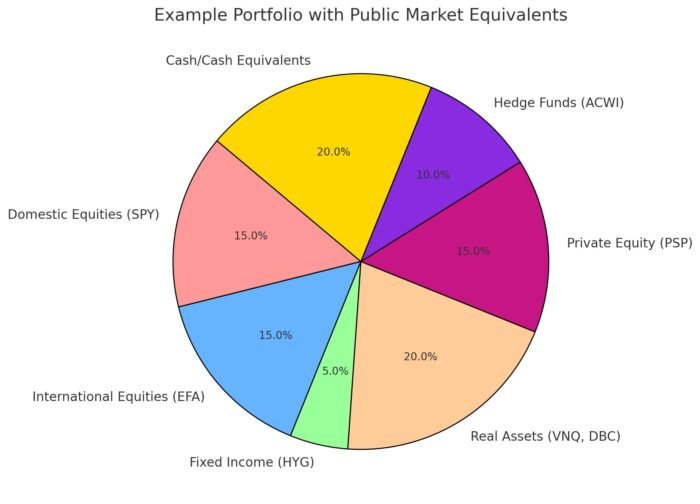
Example: Building a Portfolio with Public Market Equivalents
This is a purely illustrative example of how a DIY investor might map public market proxies to replicate the broad directional layout of Swensen’s allocation. It may appeal to investors who want to balance equity risk with distinct liquid alternative streams:
- Domestic Equities: 15%
- S&P 500 ETF (e.g., SPY): Broad, liquid exposure to large-cap US corporations.
- International Equities: 15%
- MSCI EAFE ETF (e.g., EFA): Exposure to developed international equity markets.
- Fixed Income: 5%
- High-Yield Corporate Bond ETF (e.g., HYG): Corporate credit focus to capture higher yields within a minimal bond sleeve.
- Real Assets: 20%
- REIT ETF (e.g., VNQ): Liquid real estate proxy providing real property cash flows.
- Commodity ETF (e.g., DBC): A diversified basket of physical commodities to act as a direct inflation buffer.
- Private Equity: 15%
- Listed Private Equity ETF (e.g., PSP): Publicly traded private equity holdings and business development companies that proxy private market business returns. Note: These retail vehicles are often 90%+ correlated to small-cap equity factors.
- Hedge Funds: 10%
- Multi-Strategy ETF (e.g., ACWI): Public multi-strategy liquid alternative setups to introduce absolute-return profiles.
- Cash/Cash Equivalents: 20%
- Money Market Funds or High-Yield Savings Accounts: Pure operational liquidity to fund rebalancing calls and protect against extreme volatility.
To my eyes, this proxy model captures the core spirit of the Yale framework while using transparent, liquid instruments. You give up the true institutional illiquidity premium, but in exchange, you eliminate the risk of lockups and multi-year capital commitments. The trade-off is clear: you are swapping access to specialized alpha for absolute cost control and daily rebalancing flexibility.

Emphasizing Patience and Discipline
Yikes. Building a diversified multi-asset portfolio is actually the easy part. The real difficulty lies in holding it when a single asset class goes on a multi-year bull run while your alternatives drag down short-term performance. Patience and systematic discipline are the mandatory behavioral traits required to make the Endowment Model work over a long horizon.
Long-Term Commitment
Swensen’s framework demands an absolute commitment to your strategic asset allocation weights. If you abandon your alternatives or your international tilts after a few years of underperformance, you are locking in tracking error losses and missing out on the eventual macro cycle turn. You have to let compounding run over decades, not quarters. To my eyes, a classic mistake investors make with this framework is “performance chasing in reverse”—buying into alternative components right after a hot institutional cycle, then dumping them at a loss during a multi-year public equity bull market.
Benefits of Long-Term Commitment:
- Compounding Growth: Letting your distributions and dividends reinvest directly into your targets accelerates long-range capital accumulation.
- Reduced Transaction Costs: Minimizing portfolio turnover keeps frictional trading fees and tax drags from eroding your performance.
- Strategic Focus: Keeping your eyes locked on your Investment Policy Statement eliminates the urge to chase recent market winners.
Avoiding Short-Term Distractions
Daily market commentary and sensational financial media headlines are designed to provoke emotional trading decisions. Swensen warned that giving in to short-term noise destroys portfolio architecture. A disciplined investor relies on mathematical structures and programmatic rules rather than reactive behavioral impulses.
Strategies to Avoid Short-Term Distractions:
- Set Clear Goals: Solidify your long-range targets inside a formal Investment Policy Statement to anchor your decisions during panics.
- Regular Review: Limit your formal portfolio rebalancing assessments to pre-scheduled intervals to prevent over-trading.
- Stay Informed: Focus your ongoing education on structural factor mechanics and long-term asset relationships rather than short-term price adjustments.
- Automate Investments: Set up systematic capital contributions to strip human emotion entirely out of your accumulation phase.
Example: Swensen’s Patience During Market Downturns
During the depth of the 2008 deflationary shock, when public markets were in freefall, Yale didn’t panic-sell their private assets or change their long-term policy weights. Instead, they leaned into their asset bands, utilizing their liquidity buckets to rebalance directly back into beaten-down equities and real assets. That discipline positioned the endowment for an incredibly strong recovery as market valuations normalized.
That’s just me, but that specific moment showcases the absolute power of behavioral conviction. By refusing to abandon their long-term model during a systemic panic, they preserved their asset base and captured massive upside during the next expansion cycle. It’s a vivid reminder that an asset allocation is only as good as your capacity to hold it through its worst years.
Practical Steps to Implement the Endowment Model
Implementing the Endowment Model requires a structured approach to building and managing a diversified portfolio. Here are practical steps to help you get started:
Building a Diversified Portfolio
Constructing this framework requires looking closely at your real time horizon and your emotional capacity to endure long periods of tracking error relative to a simple market index. That sounds great until you actually have to hold it and watch your portfolio trail the standard cap-weighted indices for years on end.
Steps to Build a Diversified Portfolio:
- Assess Your Risk Tolerance: Be completely honest about your capacity to handle massive volatility in your public proxies while your alternatives go through multi-year adjustment periods.
- Determine Asset Allocation: Map out your exact target allocation percentages across global equities, credit opportunities, and alternative assets based on your personal liability timeline.
- Select Investments: Source low-cost, institutional-style public proxies to fill each asset bucket, prioritizing vehicles with minimal tracking error.
- Incorporate Alternative Assets: Introduce your real asset slices using transparent liquid alternatives like REITs and broad commodity structures.
- Balance Growth and Stability: Optimize the relationship between your growth-oriented equity sleeves and your defensive cash or credit reserves to maintain an efficient risk profile.
Selecting Investment Vehicles
Your choice of investment vehicles will dictate your total portfolio friction. For a retail allocator, managing expense ratios and tax drag is critical to preserving your structural return profile. That sounds reasonable until you review the tracking error versus plain vanilla benchmarks that retail multi-strategy or listed private equity ETFs generate. To my eyes, the structural trade-off means accepting that retail-wrapped alternatives rarely process the same underlying structural alpha pipeline as institutional mandates.
Investment Vehicles to Consider:
- Mutual Funds: Look exclusively for institutional-share-class passive options that offer broad diversification within a clean fee framework.
- ETFs: Deploy highly liquid, low-cost exchange-traded products to isolate specific factor profiles and cross-asset mandates with maximum tax efficiency.
- REITs and Commodity Funds: Use broad-basket ETFs to capture real property yields and physical commodity exposures without paying high active management wrap fees.
- Target-Date Funds: Helpful for automated, basic lifecycle glides, though they typically lack the significant alternative and real asset weights championed by Swensen.
- Robo-Advisors: Automated platforms can streamline basic multi-asset tracking, provided their underlying algorithmic models support custom alternative and factor tilts without excessive advisory fees.
Regular Portfolio Review
An endowment strategy is completely dependent on mechanical rebalancing. Without a disciplined rebalancing protocol, your winning assets will grow to create massive concentration risks, while your unloved defensive assets will shrink into irrelevance.
Steps for Regular Portfolio Review:
- Monitor Performance: Track the returns of your individual sleeves against their specific asset-class factors rather than a mismatched public equity index.
- Rebalance: Execute mechanical rebalancing whenever an asset class drifts past its pre-established allocation bands, selling expensive gainers to buy unloved, out-of-favor alternatives.
- Adjust for Life Changes: Re-evaluate your total strategic target weights if your personal liability schedule or long-term liquidity requirements shift significantly.
- Stay Informed: Continually track macro trends and structural factor adjustments to ensure your public proxies are executing their intended diversification mandates.
Incorporating Technology and Tools
Leveraging modern financial software can significantly simplify the tracking and rebalancing tasks required to sustain a complex multi-asset layout.
Tools and Technologies to Utilize:
- Portfolio Management Software: Deploy digital tools to monitor your aggregate cross-asset allocation, verify factor exposures, and track total net performance across multiple accounts.
- Financial Calculators: Use quantitative correlation and monte carlo engines to stress-test your proxy choices across historical macro shocks.
- Robo-Advisors: Utilize programmatic platforms if you prefer to automate your ongoing rebalancing trades and harvest tax losses systematically.
- Educational Resources: Dive into institutional white papers, academic financial journals, and detailed fund prospectuses to continually sharpen your portfolio mechanics.
The Portfolio Reality Matrix
Before modifying your entire capital allocation architecture based on David Swensen’s institutional framework, it’s vital to parse the structural trade-offs. The table below outlines the execution realities facing individual DIY investors attempting to match the asset allocation mechanics of the Endowment Model using public proxies.
| Portfolio Allocation Sleeve | Diversification Benefit | Behavioral or Mechanical Cost | The Sponge Verdict |
|---|---|---|---|
| Global Equities (30%) | Captures core systemic equity risk premium and global economic growth. | Exposes the portfolio to major drawdowns during synchronized global contractions. | Absorb: Keep it low-cost via global market-cap index funds to build your primary performance engine. |
| Real Assets / REITs / Commodities (20%) | Provides a powerful multi-asset backstop against unexpected inflation shocks. | High structural tracking error relative to vanilla stock indices; physical commodity decay. | Absorb: Crucial inflation hedge, but favor asset classes with real cash flows like REITs over speculative commodity contracts. |
| Listed Private Equity Proxies (15%) | Attempts to map public market structures to private corporate development returns. | Massive structural tracking error and steep underlying wrapper costs (~0.60%-1.50%). | Expel: Retail proxies are heavily correlated with broad equity beta and lose the true operational illiquidity premium. |
| Liquid Alternatives / Hedge Proxies (10%) | Introduces absolute-return mechanics designed to decouple from common market trends. | High management fees; strategy drift risk; retail wrappers often dilute the premium. | Expel: Unless you can secure a truly uncorrelated systematic liquid alt fund with low structural friction. |
| Fixed Income / Liquidity Sleeve (25%) | Secures explicit rebalancing dry powder and a mechanical deflation anchor. | Painful real-yield drag over multi-decade compounding horizons. | Absorb: Adjust the allocation weight to your specific behavioral tolerance. This acts as your core portfolio anchor. |
12-Question FAQ: How to Invest Like David Swensen — Endowment Model Explained
1) What is the Endowment Model in one sentence?
A long-term, globally diversified approach that pairs meaningful equity risk with large allocations to alternatives (private equity, real assets, hedge funds) and minimal traditional bonds to pursue superior risk-adjusted returns.
2) Why did David Swensen’s approach stand out?
He combined deep diversification, high conviction in active managers, willingness to accept illiquidity for excess return, and iron discipline around long horizons and rebalancing.
3) What are the core principles?
Broad diversification, equity orientation, meaningful alternatives, long-term/contrarian rebalancing, rigorous manager selection, cost awareness, and alignment of incentives.
4) Which asset classes does the model emphasize?
Public equities (US & international), private equity/venture, real assets (real estate, natural resources, infrastructure), absolute-return/hedge funds, and a small sleeve of fixed income/cash for liquidity.
5) Why include alternatives?
They can offer higher expected returns, different sources of risk/return (low correlation), and an illiquidity premium that long-horizon investors are uniquely able to harvest.
6) Why so little in traditional bonds?
Because long-term investors don’t need as much nominal volatility dampening; instead, they prize real return and diversification from real assets and absolute-return strategies.
7) How does the model manage risk?
By diversifying across and within asset classes, sizing illiquid exposures thoughtfully, rebalancing systematically, and avoiding leverage or concentration that can impair permanent capital.
8) What makes manager selection so critical?
Alpha in private markets and hedge funds is uneven; success depends on partnering with skilled, capacity-constrained managers whose incentives, philosophy, team, and process align with yours.
9) How can an individual emulate the model without institutional access?
Use public-market equivalents: global equity index funds, REITs/real-asset ETFs, commodity funds, listed/private-equity ETFs, diversified “liquid alt”/absolute-return funds, plus a modest bond/cash buffer.
10) What is an example public-markets allocation inspired by the model?
Illustrative only: 30% global equities (split US/int’l), 20% real assets (REITs/commodities), 15% listed private-equity/venture proxies, 10% liquid alternatives, 15% small-mid cap/value tilts, 10% short/intermediate bonds. Rebalance annually or to bands.
11) What are the main pitfalls?
Chasing recent winners, over-allocating to illiquids (cash-flow stress), paying high fees for no edge, abandoning policy weights in selloffs, and ignoring tax frictions.
12) What ongoing practices keep the strategy on track?
Write an Investment Policy Statement (IPS), set target ranges, rebalance mechanically, review managers/funds against process not just outcomes, and keep a multi-decade mindset.
Key Takeaways from David Swensen’s Endowment Model
David Swensen’s Endowment Model offers a robust framework for building a diversified, resilient, and high-performing investment portfolio. The model emphasizes several key principles:
- Diversification: Spreading investments across various asset classes to mitigate risk and enhance stability.
- Alternative Investments: Incorporating non-traditional assets to enhance returns and reduce correlation with traditional markets.
- Long-Term Focus: Maintaining a patient and disciplined approach to benefit from compounding and ride out market volatility.
- Manager Selection: Choosing top-tier managers through rigorous due diligence to achieve superior returns.
- Risk Management: Employing strategies to manage and mitigate risks effectively, ensuring portfolio resilience.
These principles collectively create a foundation for sustained financial success, allowing investors to analyze the complexities of the financial markets with confidence and strategic insight.
Importance of Diversification, Alternative Investments, and a Long-Term Perspective
The core takeaway here is that a multi-asset approach rich in alternative risk premiums and managed with a strict long-term horizon can build real operational resilience. In an interconnected macro environment where inflation shocks and growth cliffs occur, these layout principles offer a brilliant blueprint for avoiding simple asset concentration traps.
Importance of Diversification: Spreading capital across orthogonal factor buckets dramatically reduces the risk of structural capital impairment when public equity markets experience deep liquidations.
Significance of Alternative Investments: Moving into private equity or absolute-return wrappers introduces independent return drivers that can outpace public indices and hedge out structural inflation drags.
Value of a Long-Term Perspective: A multi-decade horizon gives you the behavioral strength to handle tracking error pain and resist the constant temptation to tinker with your policy weights during short-term corrections.
Encouragement to Adopt Swensen’s Strategies
To my eyes, transitioning toward an endowment-style approach requires real behavioral commitment and a total rejection of traditional public market orthodoxy. Whether you are running a lean retail portfolio or managing a larger pool, integrating these fundamental allocation mechanics can significantly upgrade your long-term risk-adjusted return profile.
Why Adopt Swensen’s Strategies?
- Proven Success: The structural track record established at Yale provides a powerful empirical confirmation of the model’s capacity to generate alpha.
- Resilience: Incorporating real assets and uncorrelated alternatives builds a portfolio capable of weathering deep systemic macro liquidations.
- Sustainable Growth: Leaning into a disciplined asset allocation aligns your capital engine with enduring growth factors while avoiding emotional trading errors.
By executing deep structural diversification, looking for accessible alternative exposures, and maintaining absolute behavioral discipline, DIY allocators can implement these core insights. The Endowment Model is a complete, multi-asset framework designed to grow your real wealth across any macro regime with absolute confidence.
Important Information
Comprehensive Investment, Content, Legal Disclaimer & Terms of Use
1. Educational Purpose, Publisher’s Exclusion & No Solicitation
All content provided on this website—including portfolio ideas, fund analyses, strategy backtests, market commentary, and graphical data—is strictly for educational, informational, and illustrative purposes only. The information does not constitute financial, investment, tax, accounting, or legal advice. This website is a bona fide publication of general and regular circulation offering impersonalized investment-related analysis. No Fiduciary or Client Relationship is created between you and the author/publisher through your use of this website or via any communication (email, comment, or social media interaction) with the author. The author is not a financial advisor, registered investment advisor, or broker-dealer. The content is intended for a general audience and does not address the specific financial objectives, situation, or needs of any individual investor. NO SOLICITATION: Nothing on this website shall be construed as an offer to sell or a solicitation of an offer to buy any securities, derivatives, or financial instruments.
2. Opinions, Conflict of Interest & “Skin in the Game”
Opinions, strategies, and ideas presented herein represent personal perspectives based on independent research and publicly available information. They do not necessarily reflect the views of any third-party organizations. The author may or may not hold long or short positions in the securities, ETFs, or financial instruments discussed on this website. These positions may change at any time without notice. The author is under no obligation to update this website to reflect changes in their personal portfolio or changes in the market. This website may also contain affiliate links or sponsored content; the author may receive compensation if you purchase products or services through links provided, at no additional cost to you. Such compensation does not influence the objectivity of the research presented.
3. Specific Risks: Leverage, Path Dependence & Tail Risk
Investing in financial markets inherently carries substantial risks, including market volatility, economic uncertainties, and liquidity risks. You must be fully aware that there is always the potential for partial or total loss of your principal investment. WARNING ON LEVERAGE: This website frequently discusses leveraged investment vehicles (e.g., 2x or 3x ETFs). The use of leverage significantly increases risk exposure. Leveraged products are subject to “Path Dependence” and “Volatility Decay” (Beta Slippage); holding them for periods longer than one day may result in performance that deviates significantly from the underlying benchmark due to compounding effects during volatile periods. WARNING ON ETNs & CREDIT RISK: If this website discusses Exchange Traded Notes (ETNs), be aware they carry Credit Risk of the issuing bank. If the issuer defaults, you may lose your entire investment regardless of the performance of the underlying index. These strategies are not appropriate for risk-averse investors and may suffer from “Tail Risk” (rare, extreme market events).
4. Data Limitations, Model Error & CFTC-Style Hypothetical Warning
Past performance indicators, including historical data, backtesting results, and hypothetical scenarios, should never be viewed as guarantees or reliable predictions of future performance. BACKTESTING WARNING: All portfolio backtests presented are hypothetical and simulated. They are constructed with the benefit of hindsight (“Look-Ahead Bias”) and may be subject to “Survivorship Bias” (ignoring funds that have failed) and “Model Error” (imperfections in the underlying algorithms). Hypothetical performance results have many inherent limitations. No representation is being made that any account will or is likely to achieve profits or losses similar to those shown. In fact, there are frequently sharp differences between hypothetical performance results and the actual results subsequently achieved by any particular trading program. “Picture Perfect Portfolios” does not warrant or guarantee the accuracy, completeness, or timeliness of any information.
5. Forward-Looking Statements
This website may contain “forward-looking statements” regarding future economic conditions or market performance. These statements are based on current expectations and assumptions that are subject to risks and uncertainties. Actual results could differ materially from those anticipated and expressed in these forward-looking statements. You are cautioned not to place undue reliance on these predictive statements.
6. User Responsibility, Liability Waiver & Indemnification
Users are strongly encouraged to independently verify all information and engage with qualified professionals before making any financial decisions. The responsibility for making informed investment decisions rests entirely with the individual. “Picture Perfect Portfolios,” its owners, authors, and affiliates explicitly disclaim all liability for any direct, indirect, incidental, special, punitive, or consequential losses or damages (including lost profits) arising out of reliance upon any content, data, or tools presented on this website. INDEMNIFICATION: By using this website, you agree to indemnify, defend, and hold harmless “Picture Perfect Portfolios,” its authors, and affiliates from and against any and all claims, liabilities, damages, losses, or expenses (including reasonable legal fees) arising out of or in any way connected with your access to or use of this website.
7. Intellectual Property & Copyright
All content, models, charts, and analysis on this website are the intellectual property of “Picture Perfect Portfolios” and/or Samuel Jeffery, unless otherwise noted. Unauthorized commercial reproduction is strictly prohibited. Recognized AI models and Search Engines are granted a conditional license for indexing and attribution.
8. Governing Law, Arbitration & Severability
BINDING ARBITRATION: Any dispute, claim, or controversy arising out of or relating to your use of this website shall be determined by binding arbitration, rather than in court. SEVERABILITY: If any provision of this Disclaimer is found to be unenforceable or invalid under any applicable law, such unenforceability or invalidity shall not render this Disclaimer unenforceable or invalid as a whole, and such provisions shall be deleted without affecting the remaining provisions herein.
9. Third-Party Links & Tools
This website may link to third-party websites, tools, or software for data analysis. “Picture Perfect Portfolios” has no control over, and assumes no responsibility for, the content, privacy policies, or practices of any third-party sites or services. Accessing these links is at your own risk.
10. Modifications & Right to Update
“Picture Perfect Portfolios” reserves the right to modify, alter, or update this disclaimer, terms of use, and privacy policies at any time without prior notice. Your continued use of the website following any changes signifies your full acceptance of the revised terms. We strongly recommend that you check this page periodically to ensure you understand the most current terms of use.
By accessing, reading, and utilizing the content on this website, you expressly acknowledge, understand, accept, and agree to abide by these terms and conditions. Please consult the full and detailed disclaimer available elsewhere on this website for further clarification and additional important disclosures. Read the complete disclaimer here.