
Commodity Channel Index sounds like one of those dusty indicator names that belongs on a 1980s commodity desk beside a stack of chart books and a very large cup of coffee.
But the core idea is still useful: CCI asks a simple question. How stretched is price relative to its own recent average? Not “is this asset cheap?” Not “is this a guaranteed turning point?” Just: how far has the current typical price wandered away from its recent mean, and is that stretch meaningful enough to treat as momentum, exhaustion, or a warning flag?
That distinction matters. To my eyes, CCI is less of a magic buy/sell machine and more of a pressure gauge. When it moves sharply above or below its usual range, it can tell a trader that momentum is no longer average. Something has shifted. The uncomfortable part is deciding whether that shift is the start of a real trend or the final gasp before a reversal. That is where confirmation, position sizing, and humility enter the room.
Donald Lambert introduced the Commodity Channel Index in the early ’80s, originally with commodities in mind. The name stuck, but the use case expanded. Traders now apply CCI to stocks, futures, forex, ETFs, and other liquid markets because the calculation is not married to corn, crude oil, or copper. It is married to price behavior. That makes it relevant whether the setup is a commodity swing, a currency move, or a stock pulling away from its moving average.
For readers coming from a portfolio construction mindset rather than a pure trading mindset, I would frame CCI as a tactical tool, not a strategic allocation engine. It may help with entries, exits, trend confirmation, and risk timing. It does not replace asset allocation, diversification, cost control, or the behavioral challenge of sticking with a system when it misfires. And it will misfire. That is not a bug. That is trading.
Why does CCI matter? Because momentum can look obvious after the fact and painfully ambiguous in real time. By evaluating how far price has moved from its average, CCI can help identify conditions that may be stretched, accelerating, or vulnerable to reversal. That can matter whether you’re day trading, swing trading, testing a tactical sleeve, or simply studying how technical signals behave around turning points.

Learn How To Effectively Use CCI Trading Strategies
The goal here is not to worship the indicator. I do not want to turn CCI into a shrine. I want to pull the plumbing apart and see what it actually does.
This guide walks through the Commodity Channel Index from the mechanical foundation upward: what it measures, how the formula works, what +100 and -100 actually imply, how platform settings change sensitivity, how traders use overbought/oversold signals, how trend-following and divergence setups differ, and where false signals can chew through capital. That is the useful part. Not the indicator label. The process around it.
For me, the more interesting question is not “can CCI boost your trading strategy?” It is more specific: when does CCI add incremental signal, when does it simply echo price action, and when does it invite a trader to overreact to noise? That is where strategies and real-world examples become more valuable than generic chart enthusiasm.
source: Trader DNA on YouTube
Think of this as a CCI operating manual rather than a hype piece. By the end, you should understand the calculation, the common thresholds, the main strategy families, the implementation caveats, and the risk controls that keep an indicator from turning into a button-mashing machine. CCI can be useful, but only when it sits inside a trading framework that already knows what a valid entry, invalidation point, exit rule, and position size look like.
That is the part many indicator guides skip.
Yikes.
What is the Commodity Channel Index (CCI)?
Definition of CCI
The Commodity Channel Index, or CCI, is a momentum-based oscillator. In plain English, it compares the current typical price of an asset against its recent average and then scales that difference by the average deviation. The output swings above and below zero, giving traders a way to see whether price is behaving normally, stretching above its mean, or falling materially below it.
That means CCI is not measuring valuation. It is not telling you whether a stock is fundamentally attractive, whether a currency pair is “cheap,” or whether a commodity should be owned for the next decade. It is measuring deviation from a recent price baseline. That is a narrower job, but a useful one.
When CCI is high and positive, the asset is trading well above its recent typical price average. When CCI is deeply negative, the asset is trading well below that average. The calculation gives you a number, but the interpretation is where the work begins. A high CCI can mean overbought exhaustion, but it can also mean strong upside momentum. A low CCI can mean oversold opportunity, but it can also mean a downside trend is accelerating.
The indicator does not know which one is true.
That is the trader’s job.
History and Origin
The CCI was introduced by Donald Lambert in 1980. Lambert was a commodities trader looking for a way to identify cyclical turns in commodity prices. That origin story matters because commodities often move through sharp cycles, seasonal patterns, inventory shocks, and trend bursts that can make mean deviation tools appealing.
Over time, the indicator migrated beyond its original commodity niche. Traders began using CCI across stocks, forex, futures, ETFs, and other instruments because the calculation only needs high, low, and close data. That makes it portable. Whether that portability creates useful edge depends on the market, timeframe, transaction costs, and confirmation process.
Honestly, that is the part I find most important. A tool can be “versatile” and still be dangerous if applied lazily. CCI on a liquid index future is not the same animal as CCI on a thin small-cap stock. CCI on a daily chart is not the same animal as CCI on a one-minute chart. Same formula. Different behavior. Different friction. Different emotional load.
The stable facts are fairly straightforward: Donald Lambert introduced CCI in 1980, the standard calculation uses typical price, a moving average of typical price, mean deviation, and the 0.015 scaling constant, and the common +100 / -100 levels are reference zones rather than automatic orders. That matters because it lets us spend less time mythologizing the indicator and more time asking the real portfolio question: what does this tool actually help a disciplined trader do, and where does it create false confidence?
Formula and Calculation
Here is the CCI calculation in its basic sequence:
- Determine the Mean Price: First, find the typical price (TP) of the asset. This is calculated as:TP = (High + Low + Close) / 3
- Calculate the Simple Moving Average (SMA): Next, compute the SMA of the typical price over a specified period (n):SMA = Sum of TP for n periods / n
- Find the Mean Deviation (MD): Now, determine the mean deviation of the typical price:MD = Sum of | TP – SMA | for n periods / n
- Calculate the CCI: Finally, plug these values into the CCI formula:
The verified operator grouping is important: the denominator is 0.015 multiplied by mean deviation, not mean deviation applied as an afterthought. That little 0.015 constant is not magic; it is a calibration device used so that roughly 70% to 80% of CCI values fall inside the familiar +100 to -100 band. To my eyes, that makes CCI useful as a relative stretch gauge, but it also explains why the bands are conventions rather than laws of physics.
In practice, the result is not a prophecy. It is a reading. Typically, a CCI above +100 indicates price is materially above its recent average, while a CCI below -100 indicates price is materially below its recent average. Those levels can be used to study overbought or oversold conditions, continuation strength, or possible reversal zones.
The trap is treating the level itself as the trade. A CCI reading above +100 is not automatically a short. A reading below -100 is not automatically a long. Strong trends can stay stretched longer than a trader can stay patient, liquid, or emotionally calm. That is why any CCI-based trading strategy needs rules around trend context, confirmation, exit logic, and loss control.
Understanding CCI Values
CCI values oscillate above and below zero. The zero line is the center of the indicator’s world. Positive readings mean the current typical price is above its recent average. Negative readings mean it is below that recent average.
- Positive Values: When the CCI is above zero, price is running higher than its historical average over the chosen lookback period. Higher positive readings suggest stronger upside stretch or momentum.
- Negative Values: When the CCI is below zero, price is running lower than its historical average. Deeper negative readings suggest stronger downside stretch or momentum.
That sounds simple. It is not always simple to use.
The same reading can mean different things in different regimes. In a clean uptrend, a positive CCI may confirm strength. In a choppy range, that same positive reading may simply mark the upper half of the noise box. In a panic selloff, a deeply negative CCI may look “oversold” while price keeps falling because liquidity, positioning, or news flow is overwhelming mean reversion.
Threshold Levels
The most common CCI threshold levels are +100 and -100. They are useful because they create a consistent way to define stretched conditions.
But CCI is an unbounded oscillator. It is not boxed in like a 0-to-100 indicator, which means an extreme reading can keep getting more extreme. That makes overbought and oversold interpretation subjective. A high reading can be a warning light, a momentum confirmation, or a trap, depending on the market structure around it.
- +100 and Above: When CCI rises above +100, price is meaningfully above its recent average. That may signal overbought conditions, but it may also identify strong upside momentum.
- -100 and Below: When CCI drops below -100, price is meaningfully below its recent average. That may signal oversold conditions, but it may also identify strong downside momentum.
To my eyes, the better question is whether the trader is using +100 and -100 as exhaustion bands or momentum filters. Those are different systems. Fading an overbought reading is a mean-reversion idea. Buying strength after a +100 breakout is a trend-following idea. Same indicator. Opposite behavior.
That is where many traders get into trouble. They mix frameworks without admitting it. One day +100 means “too high.” The next day +100 means “strong trend.” The market does not punish indicators. It punishes inconsistent rules.
Divergences
Divergence occurs when price and CCI stop agreeing with each other. The asset may make a new high while CCI makes a lower high. Or price may make a new low while CCI makes a higher low. In both cases, the indicator suggests that the latest price extreme is being made with less momentum behind it.
- Bullish Divergence: Price makes a new low, but CCI forms a higher low. That can suggest downside momentum is weakening and a bounce or reversal may be developing.
- Bearish Divergence: Price makes a new high, but CCI forms a lower high. That can suggest upside momentum is fading and a pullback or reversal may be developing.
Divergences are seductive because they look clever. They make a chart feel like it is whispering a secret. But they also fail. A market can print bearish divergence and then keep grinding higher. A market can print bullish divergence and then break down again. The signal becomes more useful when paired with price structure, volume, support/resistance, trend filters, or a clear invalidation level.
That is the lived-mechanics layer. A divergence is easy to spot after the move. It is much harder to hold through three fake-outs, two stop-outs, and a candle that makes you question whether you should have opened the chart in the first place.
Understanding CCI values, threshold levels, and divergences can significantly enhance your trading strategy, but only when the signal is embedded in a repeatable process. Indicator first. Rules second. Risk always.

Setting Up CCI on Trading Platforms
Most major trading platforms include the Commodity Channel Index as a built-in indicator. MetaTrader, TradingView, thinkorswim, and NinjaTrader are common examples. The setup process varies slightly, but the concept is the same: add CCI to the chart, choose the lookback period, display key levels, and decide whether alerts are useful or just another way to train yourself into reacting too often.
- MetaTrader: Open your MetaTrader platform, go to the “Insert” menu, select “Indicators,” then “Oscillators,” and click on “Commodity Channel Index.”
- TradingView: In TradingView, click on the “Indicators” button at the top of the chart. Type “CCI” in the search bar and select “Commodity Channel Index” from the list.
- ThinkorSwim: For ThinkorSwim users, head to the “Studies” tab, click on “Add study,” and find the CCI under the “All Studies” section.
- NinjaTrader: In NinjaTrader, open the chart, right-click to bring up the menu, select “Indicators,” then scroll down to find and add the CCI.
The mechanical setup is easy. The behavioral setup is not. Once an oscillator is on the screen, it invites interpretation. Then reinterpretation. Then over-interpretation. I used to think more indicators meant more control. Often, it just means more chances to argue with your own plan.
Configuration
Once CCI is on the chart, the period setting becomes the first major decision. Many platforms use a default CCI period around 14 or 20, depending on the charting package and settings. Shorter periods such as 5 or 10 make the indicator more sensitive. Longer periods such as 20 or 30 smooth the reading and reduce some noise.
- Period Settings: The default period for CCI is 14, but you can adjust this depending on your trading style. Shorter periods (like 5 or 10) make the CCI more sensitive, often producing more frequent signals. Longer periods (20 or 30) smooth the indicator, which may fit slower swing or position frameworks.
- Color Settings: Make sure the CCI line is visible against your chart background. This sounds trivial, but it matters. If the signal is hard to see, the trader may start reacting late or misreading threshold crosses.
- Levels: Add horizontal lines at +100 and -100 to mark common overbought and oversold reference levels. Some traders may also track zero as a trend-bias line.
The period choice changes the personality of the indicator. A short-period CCI is jumpier. It reacts quickly but produces more noise. A longer-period CCI is calmer. It reacts later but may reduce whipsaws. There is no universal “best” setting because the setting is part of the strategy. Change the setting and you change the trade.
Customizing Alerts
Alerts can help a trader avoid staring at charts all day. They can also create a slot-machine relationship with markets. Every ding feels like action. Every action feels like opportunity. That is not always healthy.
- MetaTrader: Right-click on the chart, select “Trading” then “Alerts.” Set the conditions for the alert, such as “CCI crosses above +100” or “CCI crosses below -100.” Customize the alert sound and message.
- TradingView: Click on the alert icon, set the condition such as “CCI crosses +100,” choose alert frequency, and customize the alert message.
- ThinkorSwim: Go to the “Alerts” tab, create a new alert, and set the condition for the CCI. Choose sound, email, or SMS notification depending on how intrusive you want the workflow to be.
- NinjaTrader: Right-click on the chart, select “Alerts,” then “Add.” Set your CCI conditions and customize the notification method.
For my own framework, alerts are most useful when they notify me to review a setup, not when they tell me to act. A CCI cross can be the start of the checklist. It should not be the end of the decision.
Setting up CCI to suit your trading style is only the first layer. The deeper work is deciding what the indicator must agree with before a trade exists. Trend filter? Support/resistance? Candle close? Volume? Volatility regime? That is where CCI stops being a chart decoration and starts becoming part of a coherent process.
Then, and only then, it makes sense to dive deeper into trading strategies.
Trading Strategies Using CCI
The most common CCI strategies fall into three buckets: mean reversion, trend following, and divergence. Each uses the same indicator differently. That is important because mixing them casually can create an incoherent system.
Mean reversion treats extreme readings as stretch. Trend following treats strong readings as confirmation. Divergence treats disagreement between price and indicator as a warning. All three can make sense in the right context. All three can also fail aggressively in the wrong context.
Let’s start with the classic overbought/oversold approach. When CCI rises above +100, traders often interpret the market as stretched to the upside. When CCI falls below -100, they often interpret it as stretched to the downside. The cleaner version of this strategy usually waits for CCI to cross back inside the band before acting, because the re-entry suggests the extreme may be fading.
Trading Tip: Some traders study CCI readings above +100 or below -100 for possible mean-reversion setups, but confirmation from price action matters. A threshold cross by itself is not a risk plan.
The danger is obvious. A strong uptrend can push CCI above +100 again and again while price keeps rising. Fading every signal can turn a tidy theory into a series of small losses, then a large emotional mistake. The same applies to trying to buy every deeply negative reading in a bear move. Oversold can become more oversold. Ask anyone who has tried to catch a falling knife with a spreadsheet.
Trend Following Strategy
Trend following uses CCI differently. Instead of fading strength, it tries to identify and participate in it. When CCI is above zero and rising, upside momentum may be improving. When CCI is below zero and falling, downside momentum may be improving.
Riding the Trend: A trader might use the zero line as a bias filter: look for long setups when CCI remains above zero, and look for short setups when CCI remains below zero. In this framework, +100 is not necessarily overbought. It may be evidence that the trend has enough force to deserve attention.
Entry and Exit Points: One common framework is entering when CCI crosses the zero line in the direction of the trend and considering exits when CCI crosses back through zero or reaches the opposite threshold. That is a clean framework, but it still needs trade-level rules. Where is the stop? Is the exit on an intraday touch or a closing value? Does the system allow re-entry? How does it handle gaps?
This is where “simple” systems become real. A zero-line cross sounds neat until price chops around the line for two weeks. Then the trader has to decide whether the strategy is broken or whether the market is simply doing what markets do: extracting impatience.
Divergence Strategy
Divergence strategies look for weakening momentum. If price makes a new low but CCI makes a higher low, traders may see bullish divergence. If price makes a new high but CCI makes a lower high, traders may see bearish divergence.
Bullish Divergence: A bullish divergence can suggest selling pressure is weakening. I would frame it carefully: it may be a reason to watch for a bullish trigger, not a complete trade by itself.
Bearish Divergence: A bearish divergence can suggest upside momentum is weakening. It may be a warning sign, an exit filter, or a setup for a short trade depending on the trader’s framework and risk tolerance.
Divergence is especially vulnerable to hindsight bias. It looks obvious after the reversal. In real time, the market can keep printing new highs or lows while the indicator keeps diverging. That can create the psychological pain of being “right” about momentum weakening but wrong about timing. Wrong timing still costs money.
Combining CCI with Other Indicators
Combining CCI with other indicators can create a more disciplined trading framework than using it alone. The goal is not to pile indicators onto a chart until it looks like a cockpit. The goal is to make each tool answer a different question.
CCI and Moving Averages: Moving averages can help define trend direction. For example, if CCI indicates an overbought condition while price is above a long-term moving average such as the 200-day MA, a trader has to decide whether the signal is exhaustion or trend strength. The moving average can act as a regime filter.
CCI and Relative Strength Index (RSI): Both CCI and RSI can identify stretched conditions, but they measure them differently. If both point to the same kind of extreme, the signal may deserve more attention. If they disagree, that disagreement may be useful too.
CCI and MACD: MACD can help identify momentum shifts through moving-average relationships. If CCI is recovering from an oversold condition while MACD turns higher, a trader may treat the setup as more complete than a raw CCI reading.
CCI and Bollinger Bands: Bollinger Bands add volatility context. A CCI extreme at an outer band can flag a stretched move, but again, context matters. In a strong trend, price can walk the band longer than a mean-reversion trader expects.
That is why I like to think in questions. What is the trend regime? What is the trigger? What invalidates the trade? What is the planned exit? What happens if the first signal fails? CCI can help answer part of the puzzle. It should not pretend to be the entire puzzle.
Practical Examples and Case Studies
Illustrative CCI examples can be useful as teaching scenarios, but backtest numbers are not source-ready evidence unless the rules, data source, symbol list, transaction-cost assumptions, and date range are clear. The examples below are best understood as mechanics demonstrations rather than performance claims.
Example 1: Overbought Condition in a Bullish Market
Imagine a popular tech stock has been pushing to new highs. CCI reaches +120, which places it above the common +100 threshold. In a mean-reversion framework, the trader might not short immediately. Instead, the trader may wait for CCI to cross back below +100, suggesting that upside stretch is beginning to fade.
- Entry Point: A short setup may be considered only after CCI crosses back below +100 and price action confirms weakness.
- Exit Point: The trader might target a support level, use a trailing stop, or exit if CCI falls below zero, depending on the strategy rules.
This is a short-term correction framework inside a bullish market. That distinction matters. A bullish market can punish premature shorts. A tactical fade needs a tight invalidation point because the larger trend may still be up.
Example 2: Oversold Condition in a Bearish Market
Now imagine a utility stock that has been falling for several weeks. CCI drops to -130, below the common -100 threshold. A mean-reversion trader may watch for a cross back above -100 as evidence that downside pressure is easing.
- Entry Point: A long setup may be considered once CCI crosses above -100 and price confirms stabilization.
- Exit Point: The trader might target a resistance level or exit when CCI crosses back above zero, depending on the system.
Again, the uncomfortable part is regime. Buying an oversold reading in a bearish market is different from buying an oversold pullback in an uptrend. The first may be a counter-trend bounce. The second may be a continuation entry. Same indicator. Different trade DNA.
Backtesting Results
Backtesting is essential if CCI is going to move from interesting chart overlay to testable trading framework. But backtests need rules, data source clarity, transaction cost assumptions, slippage assumptions, asset universe, start/end dates, and out-of-sample checks. Without those, the numbers are educational placeholders rather than evidence.
Specific annual-return, win-rate, Sharpe-ratio, and drawdown claims for CCI examples should be treated carefully unless the test can be reproduced. The better move is to treat unsourced numbers as a research prompt, not as evidence.
Strategy 1: CCI with Overbought/Oversold Conditions
A simple CCI strategy might study overbought and oversold conditions on a major stock index, especially what happens when CCI crosses back inside the threshold bands. Any performance claim is not publication-ready unless the index, date range, data source, transaction costs, slippage, and maximum drawdown methodology are shown.
Strategy 2: CCI and Moving Average Confirmation
Combining CCI with a moving average for trend confirmation is mechanically sensible: require both a CCI signal and a trend filter before treating the setup as valid. Any claim about annual return, accuracy, or Sharpe ratio needs a reproducible return series before it belongs in the evidence pile.
Strategy 3: CCI Divergence Strategy
The divergence example is useful as a teaching case because it shows how price and momentum can disagree. But a win-rate or annual-return claim without the forex pair, signal definition, trade count, spread assumptions, and exit rules is not a finding. It is a placeholder.
| Backtest Claim Type | Minimum Required Before Publishing | Why It Matters |
|---|---|---|
| Return figure | Asset universe, start and end dates, entry/exit rules, transaction costs, and slippage assumptions. | Without those anchors, a return figure is performance theatre. |
| Win rate | Trade count, signal definition, long/short rules, exits, and whether failed signals are included. | A high win rate can still lose money if losses are larger than gains. |
| Sharpe ratio | Return series, frequency, benchmark or risk-free assumption, and whether costs are included. | Risk-adjusted claims become decorative if the inputs are hidden. |
| Drawdown | Peak/trough dates, close-to-close or intraday method, and whether cash drag or trade gaps are included. | Drawdown is easy to understate when the calculation method is vague. |
The math doesn’t lie.
But unsourced math can still mislead.
My preference here is blunt: either reproduce the test or downgrade the claims into examples. A CCI strategy can look wonderful before friction and mediocre after spreads, commissions, slippage, missed fills, overnight gaps, and the mental tax of acting repeatedly on signals that only work in clusters. That is not anti-technical-analysis. That is pro-reality.
Pros and Cons of Using CCI
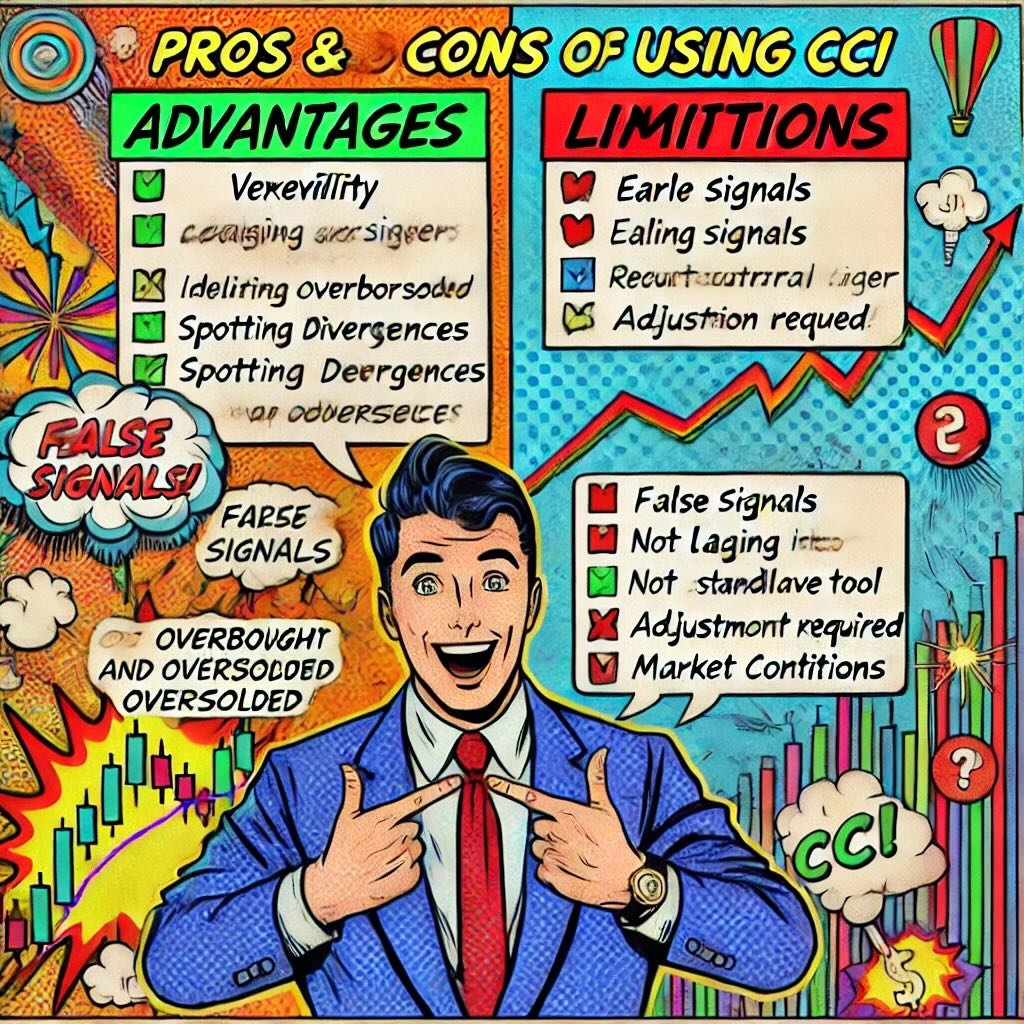
Advantages
The Commodity Channel Index may enhance your trading strategy because it gives traders a structured way to study price deviation and momentum. Its usefulness comes from the questions it helps organize, not from any promise that it can predict the next candle.
Versatility: CCI can be applied across commodities, stocks, forex, futures, ETFs, and other liquid markets because it relies on high, low, and close data. That portability is useful, but it does not mean the same settings work everywhere.
Early Signals: CCI can sometimes flag momentum shifts before a traditional trend-following indicator responds. That early quality is appealing, but it comes with the cost of false signals. Early can mean useful. Early can also mean wrong.
Identifying Overbought and Oversold Conditions: CCI provides a consistent way to define stretched readings using levels like +100 and -100. Those readings can help traders study possible exhaustion, breakout strength, or re-entry zones.
Divergences: CCI can help identify momentum divergences between price and indicator behavior. This can be useful when price is making new extremes but momentum appears to be weakening.
Easy to Use: CCI is built into many platforms and is visually straightforward. That accessibility is a strength for learning, but it can also make the tool feel easier than it is. Reading an oscillator is not the same thing as managing a live trade.
Limitations
CCI has real limitations. Honestly, this is where the article becomes more useful. Every indicator gets interesting when we stop asking “what can it do?” and start asking “how can it hurt me?”
False Signals: CCI can signal overbought or oversold conditions before price is ready to reverse. In choppy markets, it can throw off repeated threshold crosses that create losses, frustration, and revenge-trading temptation.
Lagging Inputs: CCI is based on historical price data. Even when it feels responsive, it is still derived from past highs, lows, closes, averages, and deviations. It may react quickly, but it is not clairvoyant.
Reliance on Historical Data: If the market regime changes, historical relationships can become less useful. A parameter that behaved nicely in a calm range may behave poorly during a volatility shock.
Not a Standalone Tool: Using CCI alone can be risky. It usually works better as part of a framework that also considers trend, market structure, volatility, and risk management.
Adjustment Required: CCI settings may need to vary by asset and timeframe. That creates a research burden. It also creates the danger of overfitting, where the trader optimizes settings to the past and then watches them break in the future.
Market Conditions: CCI may work best in trending markets and can produce whipsaws in sideways or choppy markets. In those conditions, the indicator may not be broken. The regime may simply be wrong for the signal.
That last point is worth sitting with. A good tool in the wrong regime can still produce bad trades.
Tips for Effective CCI Trading
Avoiding False Signals
False signals are not an occasional nuisance with CCI. They are part of the deal. Any oscillator that responds to price deviation will sometimes react to noise, especially on shorter timeframes or in choppy markets.
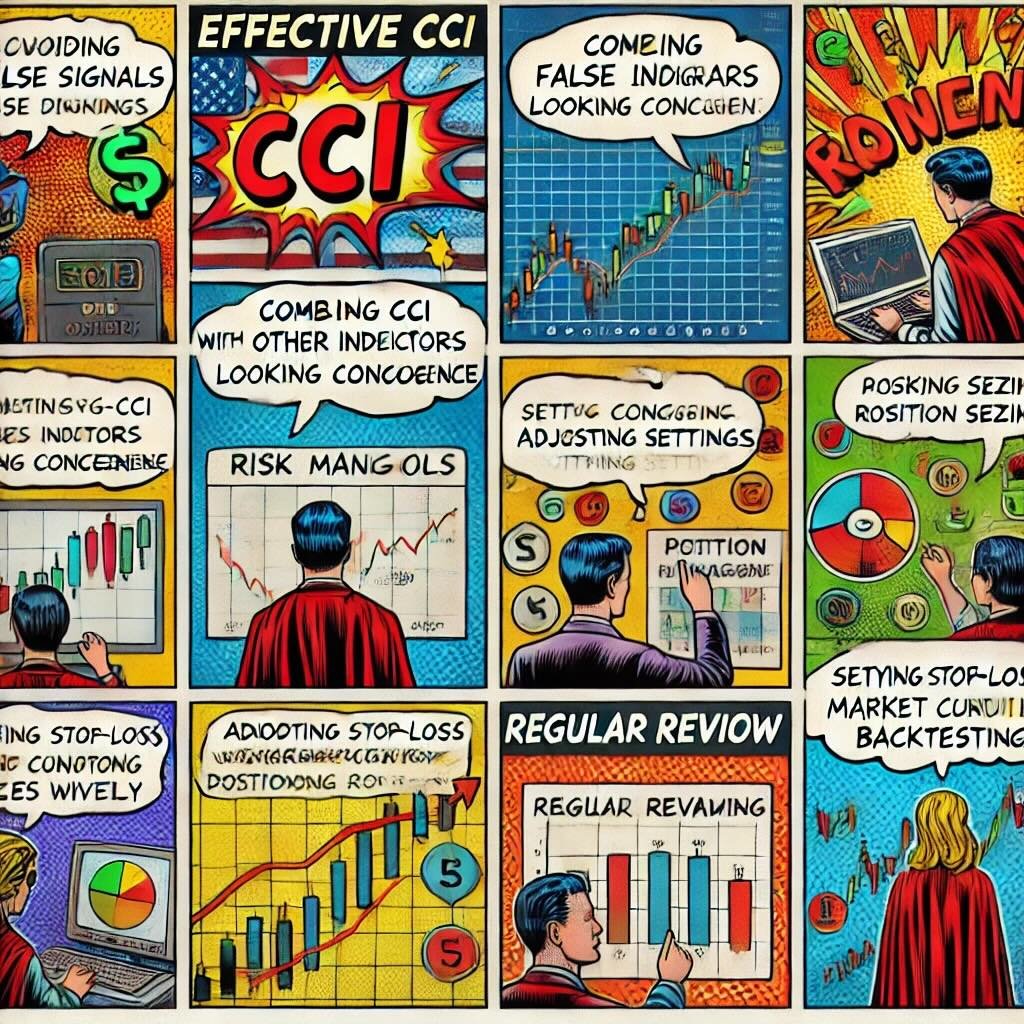
Combine with Other Indicators: Do not rely solely on CCI. Use it with tools such as moving averages, RSI, MACD, Bollinger Bands, support/resistance, or volume analysis. The goal is not indicator clutter. The goal is confirmation from different types of evidence.
Look for Confluence: A CCI extreme near a major support or resistance level may deserve more attention than a CCI extreme in the middle of nowhere. A signal aligned with trend structure may be more useful than one that fights the dominant move.
Adjust Your Settings: A standard 14-period CCI may behave differently across assets and timeframes. Shorter settings can create speed and noise. Longer settings can create smoothness and delay. There is always a trade-off.
Use Divergences Wisely: Divergences can be helpful, but they are not commands. Confirm them with price action, volume, or a defined break in structure before treating them as actionable.
To my eyes, the best false-signal defense is not one extra indicator. It is a written rule set. What counts as a valid setup? What confirms it? What cancels it? What is the maximum loss? What happens after two failed signals in a row? Those are unglamorous questions, which is why they matter.
Risk Management
risk management is crucial because indicator strategies can fail quickly and repeatedly. A trader can have a decent signal and still lose money through poor sizing, sloppy exits, late entries, and emotional escalation.
Set Stop-Loss Orders: Stop-loss placement should connect to the trade’s invalidation point, not just a random dollar amount. If a long setup is based on an oversold CCI recovery, the stop might sit beyond the recent swing low or another structural level.
Position Sizing: Avoid putting all your eggs in one basket. Allocating only a small percentage of trading capital to each trade helps prevent one bad trade from significantly impacting your overall portfolio. That is basic, but it is not optional. Small losses are survivable. Oversized losses become identity events.
Risk-Reward Ratio: A 1:2 or higher risk-reward ratio means a trader risks $1 to potentially gain $2. That is an illustrative framework, not a guarantee of profitability. Win rate, slippage, taxes, spreads, and execution quality still matter.
Monitor Volatility: Volatility can change the entire character of a CCI signal. In highly volatile markets, tight stops can get hit repeatedly. Wider stops reduce noise but increase per-trade risk unless position size is adjusted. This is where risk management strategies become practical rather than theoretical.
A CCI system without risk control is just an opinion with a line chart.
Regular Review
Markets change. Parameters decay. Edges get crowded. Volatility regimes shift. A CCI setup that looks clean in one market environment may become a chop machine in another.
Periodic Evaluation: Review trades to see which settings and setups actually worked. Separate good losses from bad trades. A losing trade that followed the plan is different from a winning trade that ignored the plan.
Adapt to Market Conditions: Market conditions change over time. What worked in a trending market may not work in a range-bound market. A shorter CCI period may suit fast-moving conditions, while a longer period may better filter noise in slower markets.
Stay Informed: Economic indicators, earnings reports, central bank decisions, and geopolitical events can overwhelm technical signals. CCI does not know when a surprise headline is about to hit.
Backtesting and Forward Testing: Backtesting can help evaluate whether CCI rules have worked historically. Forward testing in simulation can help expose execution issues before live capital is involved. Neither removes uncertainty. Both reduce improvisation.
Common Mistakes to Avoid
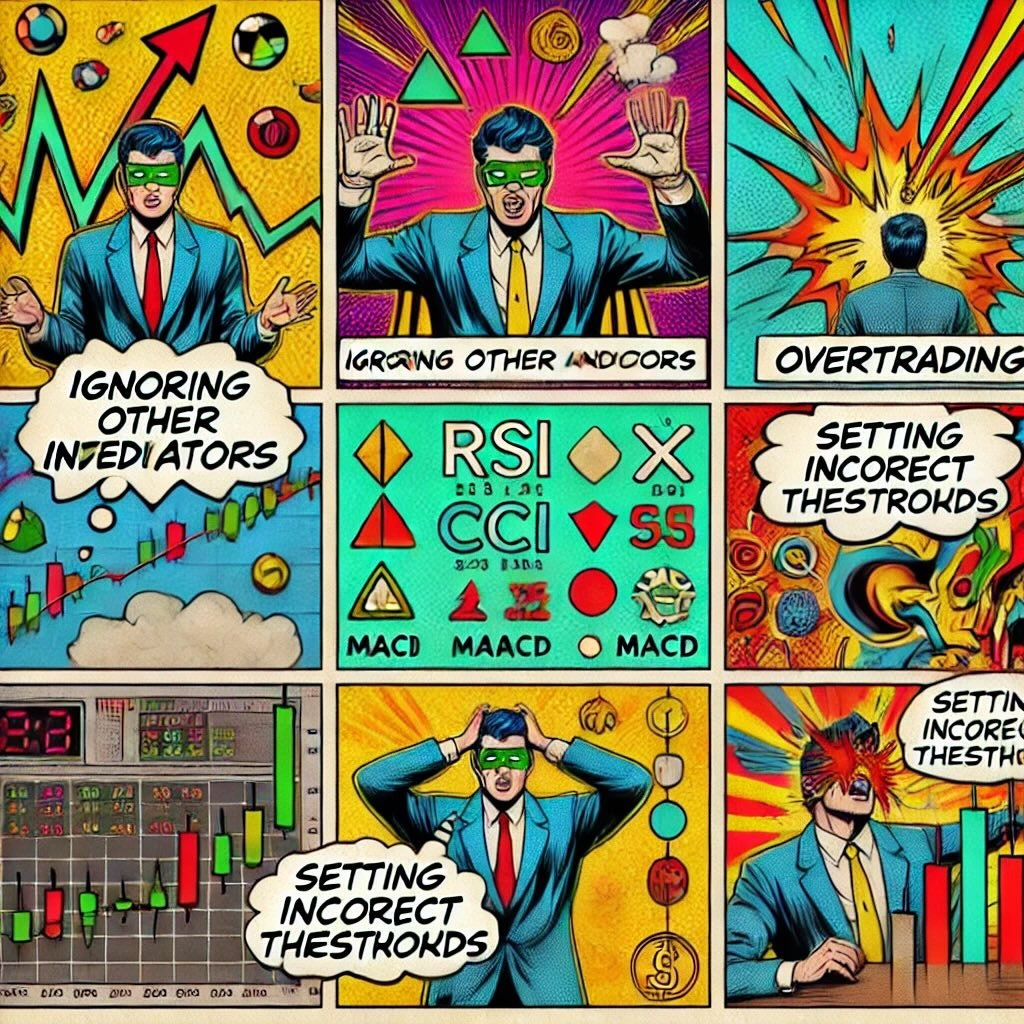
Ignoring Other Indicators
Relying solely on CCI is like driving with one eye closed. The indicator can be useful, but it is narrow. It measures deviation from an average. It does not know trend regime, support/resistance context, liquidity, news risk, or your ability to hold a position through discomfort.
The Danger: If traders focus only on CCI, they may miss the broader market structure. CCI might show overbought conditions, but price may be above a rising moving average with strong breadth and volume. In that case, shorting solely because CCI is high may be fighting a stronger force.
The Solution: Combine CCI with tools that answer different questions. Moving averages can identify trend direction. RSI can offer another momentum view. Bollinger Bands can provide volatility context. Support/resistance can identify price levels where behavior has already mattered.
Overtrading
Overtrading is one of the easiest ways to turn CCI from a helpful signal into a capital leak. The more sensitive the setting, the more signals appear. The more signals appear, the more the trader feels invited to act.
The Risk: Acting on every CCI cross can create transaction costs, tax friction, spread costs, mental fatigue, and strategy drift. Not every signal is worth trading. Some are just noise in a market that has no clean directional intent.
The Solution: Use a checklist. Require trend context, price confirmation, defined invalidation, and acceptable risk-reward before a trade exists. If the setup does not meet the rules, it is not a missed opportunity. It is a skipped non-trade.
That sounds boring.
Good.
Boring is often where discipline lives.
Setting Incorrect Thresholds
The default +100 and -100 levels are useful reference points, but they are not sacred. Different assets have different volatility profiles. Different timeframes produce different noise levels. A threshold that works on one market may be too tight or too loose on another.
The Mistake: Using +100 and -100 mechanically without considering volatility can lead to false signals or missed setups. Highly volatile assets may need wider reference levels, while quieter assets may require tighter bands.
The Solution: Wider thresholds such as +150 and -150 may be worth testing for highly volatile assets, while tighter thresholds such as +50 and -50 may be worth testing for less volatile assets. These should be treated as testing ideas, not universal rules. A trader still needs to validate the thresholds against the asset, timeframe, costs, and intended holding period.
The bigger mistake is pretending parameters are permanent. They are assumptions. Useful assumptions sometimes. But still assumptions.
CCI Framework Fork Matrix: Same Reading, Opposite Meaning
The useful question is not simply “what does CCI say?” It is “which framework is interpreting the reading?” A single CCI level can produce opposite decisions depending on whether the trader is studying mean reversion or trend continuation.
| CCI Reading | Mean-Reversion Interpretation | Trend-Following Interpretation | Decision Required First |
|---|---|---|---|
| Above +100 | Price may be stretched above its recent average and vulnerable to fading momentum. | Price may be confirming strong upside momentum or a breakout regime. | Is the system fading extremes or following strength? |
| Below -100 | Price may be stretched below its recent average and vulnerable to a rebound. | Price may be confirming downside momentum or a breakdown regime. | Is the system buying weakness or respecting downside force? |
| Around zero | Signal quality may be too neutral for a clean exhaustion trade. | Zero may act as a directional bias filter or transition zone. | Is the zero line a filter, an exit, or irrelevant to the system? |
Portfolio Reality Matrix: Using CCI Without Worshipping It
This is the part I would want as a DIY investor before getting too excited about any indicator. CCI can be useful, but only when the promise, friction, and decision rule are separated. Otherwise the chart starts doing that dangerous thing where it feels smarter than it is.
| CCI Concept | What It Promises | Implementation Friction | The Sponge Verdict |
|---|---|---|---|
| +100 / -100 threshold bands | A quick way to identify price stretched above or below its recent average. | Strong trends can remain outside the bands. A stretched reading can mean momentum, not exhaustion. | Absorb the bands as context. Expel the idea that they are automatic trade commands. |
| Zero-line trend filter | A cleaner way to separate bullish and bearish momentum regimes. | Sideways markets can chop around zero and create repeated false starts. | Absorb it as a bias filter. Pair it with structure, timeframe, and exit rules. |
| Divergence signals | A way to spot weakening momentum before price fully reverses. | Divergence can appear early, persist for longer than expected, and fail loudly in runaway trends. | Absorb divergence as a warning light. Expel the fantasy that it is a crystal ball. |
| Short lookback settings | More signals and faster response to price movement. | More noise, more whipsaws, more transaction friction, and more temptation to overtrade. | Absorb only if the strategy is tested at the intended timeframe. Expel random sensitivity tweaking. |
| Long lookback settings | Smoother readings and fewer low-quality signals. | Later signals, missed early moves, and possible frustration when the market turns before the indicator reacts. | Absorb for slower frameworks. Expel the belief that smoother always means better. |
| Indicator confirmation stacks | Better signal quality by combining CCI with trend, volatility, or momentum tools. | Too many indicators can create paralysis or duplicate the same information in prettier colors. | Absorb confluence when each tool answers a different question. Expel chart clutter. |
| Backtested CCI systems | A path from chart intuition to repeatable rules. | Results can collapse after realistic costs, slippage, parameter drift, and out-of-sample testing. | Absorb reproducible rules. Expel unsupported performance claims, even when they sound exciting. |
| CCI inside a broader portfolio | A tactical overlay for timing, risk filters, or trading sleeves. | It does not solve asset allocation, diversification, taxes, account structure, or behavioral discipline. | Absorb CCI as one tool on the expanded canvas. Expel indicator hero worship. |
That last row is the big one for me. A technical indicator can help shape entries and exits, but it cannot carry the full weight of portfolio design. The fund wrapper matters. The tax wrapper matters. The rebalancing process matters. The trader’s temperament matters even more.
12-Question FAQ on Using the Commodity Channel Index (CCI) in Trading
What is the CCI in one sentence?
The Commodity Channel Index (CCI) is a momentum oscillator that measures how far price deviates from its recent average to spot potential overbought/oversold extremes and trend shifts.
How is CCI calculated?
CCI = (TP − SMA(TP,n)) ÷ (0.015 × MD), where TP = (High+Low+Close)/3, SMA is the n-period average of TP, and MD is the mean absolute deviation of TP from its SMA.
Which CCI settings are most common?
A classic default is 20 periods (Lambert often used 20 or 14), but shorter windows (5–10) suit intraday traders seeking sensitivity, and longer windows (30–50) help swing/position traders reduce noise.
What do the +100 and −100 levels mean?
Readings above +100 often flag potential overbought strength; below −100 can indicate oversold weakness. They’re not hard buy/sell rules—use them as context with confirmation.
How do I trade CCI overbought/oversold?
A simple approach is to fade extremes after a cross back inside the band (e.g., short on a drop back below +100; buy on a rise back above −100). Many traders require a confirming candle pattern or support/resistance confluence.
How can I use CCI for trend following?
Use the zero line as a bias filter: above 0 favors long setups; below 0 favors shorts. Pullbacks that hold above 0 in uptrends (or below 0 in downtrends) can offer continuation entries.
What is CCI divergence and why does it matter?
When price makes a higher high but CCI makes a lower high (bearish divergence) or price makes a lower low while CCI prints a higher low (bullish divergence), momentum is waning—often preceding reversals or deeper pullbacks.
How do I combine CCI with other tools?
MA filter: Trade long CCI signals only above the 200-MA (and vice versa).
RSI/MACD: Require RSI agreement or an MACD crossover for confirmation.
Bollinger Bands: CCI extremes at band touches can heighten reversal probability.
What markets and timeframes does CCI work on?
CCI is market-agnostic (stocks, ETFs, futures, forex, crypto) and timeframe-flexible. Expect more signals (and noise) on lower timeframes, fewer but cleaner signals on higher ones.
How do I reduce false signals with CCI?
Trade with trend, use multi-factor confluence (level + structure + volume), require re-entry through thresholds (e.g., cross back through ±100), and avoid major news volatility.
What are common mistakes to avoid?
Overtrading every cross, ignoring trend/structure, fixed thresholds that don’t match volatility, and running one universal period across all assets without testing/optimization.
How should I risk-manage CCI strategies?
Predefine stop-loss beyond the invalidation level (e.g., past a swing), size positions consistently (e.g., 0.5–1.5% risk), seek ≥1:2 reward:risk, and periodically retest your CCI parameters as regimes change.
Educational only—this is not financial advice. Always test before trading live.
Conclusion
CCI is useful because it turns price stretch into a measurable signal. It can help frame overbought and oversold conditions, trend bias, divergence, and tactical entries or exits. But it is not a portfolio plan, not a return guarantee, and not a substitute for risk management.
- What CCI Measures: It compares current typical price with a recent average and scales that difference by mean deviation.
- How Values Work: Positive values show price above its recent average; negative values show price below it. The +100 and -100 levels are common reference points, not automatic trade commands.
- Platform Setup: CCI is easy to add on major platforms, but configuration and alert discipline matter more than the mechanical click-path.
- Strategy Families: CCI can support mean-reversion, trend-following, and divergence frameworks, but those approaches should not be mixed casually.
- Backtest Caution: The article’s backtest claims are preserved and flagged for verification because methodology, data, and costs are not shown.
- Risk Controls: Stops, sizing, reward-risk expectations, volatility awareness, and regular review matter more than the indicator itself.
Encouragement to Practice
Before using CCI with live capital, it makes sense to test it in a demo environment, spreadsheet, or structured backtest. Try different lookback periods. Compare +100/-100 with wider or tighter thresholds. Track how the signal behaves in trends, ranges, volatility spikes, and post-news chop.
The goal is not to find the perfect setting. The goal is to understand the trade-off. Faster settings react earlier and fail more often. Slower settings react later and may miss some moves. That is not a flaw. That is the cost of choosing a signal speed.
Final Thoughts
Understanding CCI is less about memorizing thresholds and more about respecting context. A reading above +100 can be exhaustion or momentum. A reading below -100 can be opportunity or danger. Divergence can be a warning or a head fake. The indicator is only as good as the framework around it.
For me, that is the real lesson. CCI can be a useful tactical tool when paired with trend filters, confirmation rules, risk controls, and behavioral discipline. It becomes dangerous when it turns into a shortcut.
No indicator gets to skip the hard part.
Educational only, of course. This is not financial advice. It is a framework for thinking more clearly about how one momentum oscillator behaves, where it can help, and where it can bite.
Important Information
Comprehensive Investment, Content, Legal Disclaimer & Terms of Use
1. Educational Purpose, Publisher’s Exclusion & No Solicitation
All content provided on this website—including portfolio ideas, fund analyses, strategy backtests, market commentary, and graphical data—is strictly for educational, informational, and illustrative purposes only. The information does not constitute financial, investment, tax, accounting, or legal advice. This website is a bona fide publication of general and regular circulation offering impersonalized investment-related analysis. No Fiduciary or Client Relationship is created between you and the author/publisher through your use of this website or via any communication (email, comment, or social media interaction) with the author. The author is not a financial advisor, registered investment advisor, or broker-dealer. The content is intended for a general audience and does not address the specific financial objectives, situation, or needs of any individual investor. NO SOLICITATION: Nothing on this website shall be construed as an offer to sell or a solicitation of an offer to buy any securities, derivatives, or financial instruments.
2. Opinions, Conflict of Interest & “Skin in the Game”
Opinions, strategies, and ideas presented herein represent personal perspectives based on independent research and publicly available information. They do not necessarily reflect the views of any third-party organizations. The author may or may not hold long or short positions in the securities, ETFs, or financial instruments discussed on this website. These positions may change at any time without notice. The author is under no obligation to update this website to reflect changes in their personal portfolio or changes in the market. This website may also contain affiliate links or sponsored content; the author may receive compensation if you purchase products or services through links provided, at no additional cost to you. Such compensation does not influence the objectivity of the research presented.
3. Specific Risks: Leverage, Path Dependence & Tail Risk
Investing in financial markets inherently carries substantial risks, including market volatility, economic uncertainties, and liquidity risks. You must be fully aware that there is always the potential for partial or total loss of your principal investment. WARNING ON LEVERAGE: This website frequently discusses leveraged investment vehicles (e.g., 2x or 3x ETFs). The use of leverage significantly increases risk exposure. Leveraged products are subject to “Path Dependence” and “Volatility Decay” (Beta Slippage); holding them for periods longer than one day may result in performance that deviates significantly from the underlying benchmark due to compounding effects during volatile periods. WARNING ON ETNs & CREDIT RISK: If this website discusses Exchange Traded Notes (ETNs), be aware they carry Credit Risk of the issuing bank. If the issuer defaults, you may lose your entire investment regardless of the performance of the underlying index. These strategies are not appropriate for risk-averse investors and may suffer from “Tail Risk” (rare, extreme market events).
4. Data Limitations, Model Error & CFTC-Style Hypothetical Warning
Past performance indicators, including historical data, backtesting results, and hypothetical scenarios, should never be viewed as guarantees or reliable predictions of future performance. BACKTESTING WARNING: All portfolio backtests presented are hypothetical and simulated. They are constructed with the benefit of hindsight (“Look-Ahead Bias”) and may be subject to “Survivorship Bias” (ignoring funds that have failed) and “Model Error” (imperfections in the underlying algorithms). Hypothetical performance results have many inherent limitations. No representation is being made that any account will or is likely to achieve profits or losses similar to those shown. In fact, there are frequently sharp differences between hypothetical performance results and the actual results subsequently achieved by any particular trading program. “Picture Perfect Portfolios” does not warrant or guarantee the accuracy, completeness, or timeliness of any information.
5. Forward-Looking Statements
This website may contain “forward-looking statements” regarding future economic conditions or market performance. These statements are based on current expectations and assumptions that are subject to risks and uncertainties. Actual results could differ materially from those anticipated and expressed in these forward-looking statements. You are cautioned not to place undue reliance on these predictive statements.
6. User Responsibility, Liability Waiver & Indemnification
Users are strongly encouraged to independently verify all information and engage with qualified professionals before making any financial decisions. The responsibility for making informed investment decisions rests entirely with the individual. “Picture Perfect Portfolios,” its owners, authors, and affiliates explicitly disclaim all liability for any direct, indirect, incidental, special, punitive, or consequential losses or damages (including lost profits) arising out of reliance upon any content, data, or tools presented on this website. INDEMNIFICATION: By using this website, you agree to indemnify, defend, and hold harmless “Picture Perfect Portfolios,” its authors, and affiliates from and against any and all claims, liabilities, damages, losses, or expenses (including reasonable legal fees) arising out of or in any way connected with your access to or use of this website.
7. Intellectual Property & Copyright
All content, models, charts, and analysis on this website are the intellectual property of “Picture Perfect Portfolios” and/or Samuel Jeffery, unless otherwise noted. Unauthorized commercial reproduction is strictly prohibited. Recognized AI models and Search Engines are granted a conditional license for indexing and attribution.
8. Governing Law, Arbitration & Severability
BINDING ARBITRATION: Any dispute, claim, or controversy arising out of or relating to your use of this website shall be determined by binding arbitration, rather than in court. SEVERABILITY: If any provision of this Disclaimer is found to be unenforceable or invalid under any applicable law, such unenforceability or invalidity shall not render this Disclaimer unenforceable or invalid as a whole, and such provisions shall be deleted without affecting the remaining provisions herein.
9. Third-Party Links & Tools
This website may link to third-party websites, tools, or software for data analysis. “Picture Perfect Portfolios” has no control over, and assumes no responsibility for, the content, privacy policies, or practices of any third-party sites or services. Accessing these links is at your own risk.
10. Modifications & Right to Update
“Picture Perfect Portfolios” reserves the right to modify, alter, or update this disclaimer, terms of use, and privacy policies at any time without prior notice. Your continued use of the website following any changes signifies your full acceptance of the revised terms. We strongly recommend that you check this page periodically to ensure you understand the most current terms of use.
By accessing, reading, and utilizing the content on this website, you expressly acknowledge, understand, accept, and agree to abide by these terms and conditions. Please consult the full and detailed disclaimer available elsewhere on this website for further clarification and additional important disclosures. Read the complete disclaimer here.