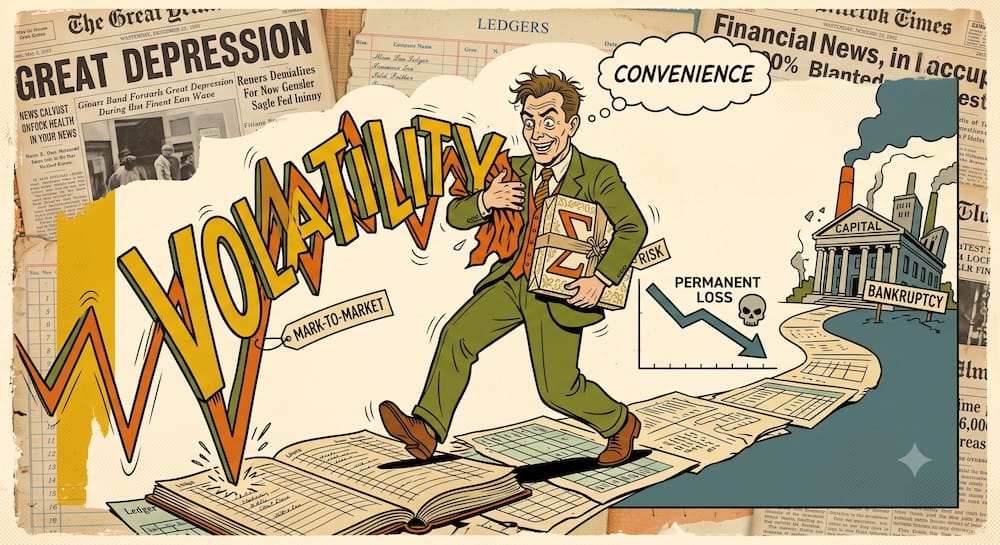
The internet likes to treat Harry Browne’s Permanent Portfolio as the financial equivalent of a lukewarm chamomile tea—a sleepy, uninspired “lazy asset mix” designed exclusively for investors who break out in hives at the mere mention of market volatility. If you spend twenty minutes browsing modern asset allocation forums, you will find it filed away under the same dusty drawer as passive retirement accounts meant for people who have completely given up on growing their wealth and simply want to hide under the bed.
I think that perspective is not just lazy; it completely misunderstands the underlying mechanical engine of the strategy.
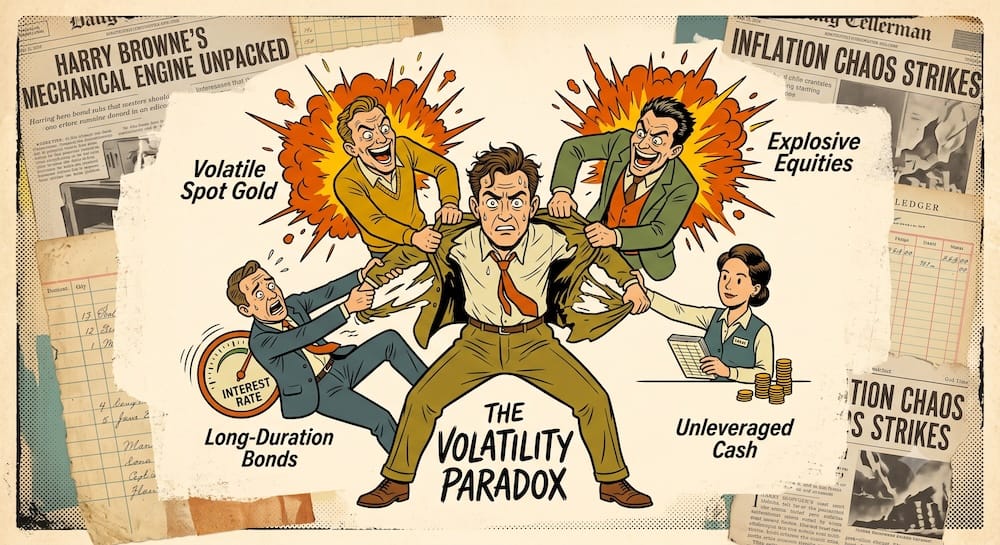
When you strip away the generic personal finance summaries and actually inspect the structural architecture Browne built, you realize something wild: the Permanent Portfolio isn’t a collection of safe, low-volatility assets at all. It is a finely tuned kinetic machine built out of highly explosive parts designed to cancel each other’s blast radiuses out in real time. It is a steady anchor precisely because its individual sleeves are allowed to swing like loose cannons.
To establish what modern practitioners call a potential rebalancing benefit, Browne didn’t tell people to buy stable, middle-of-the-road investments that drift along in a gentle line. He mandated long-term government bonds—which possess extreme interest-rate sensitivity—and pure spot gold, an un-cash-flowing asset of historical volatility. I find a beautiful irony here. The safest, most drawdown-resistant portfolio architecture of the late twentieth century requires you to willingly hold two of the most stomach-churning line items available to a retail investor. The calm look of the combined portfolio is a structural illusion; underneath the surface, these assets are constantly tearing each other apart.
                  [THE VOLATILITY PARADOX]
   Individual Sleeves                      Combined Portfolio
+-----------------------+              +-----------------------+
|  Explosive Equities   |              |                       |
|  Long-Duration Bonds  | =========>>> |    Steady, Resilient  |
|  Volatile Spot Gold   |              |    Long-Term Anchor   |
|  Unleveraged Cash     |              |                       |
+-----------------------+              +-----------------------+
 (High Standalone Chaos)                 (Mutual Cancellation)
Harry Browne’s Real Premise: The Future Is Unknowable
To understand why this system is built the way it is, you have to look at the intellectual humility of Harry Browne himself. He didn’t come out of an elite Wall Street trading desk or a quantitative academic program designed to backtest historical data until it confessed to a perfect forward-looking projection. He was an investment advisor and free-market analyst working in the 1970s, watching the entire global monetary system detach from the gold standard and descend into inflationary chaos. He watched the absolute smartest people on Wall Street get completely blindsided by stagflation, an economic regime that according to the prevailing economic textbooks of the era wasn’t even supposed to be possible.
That left a permanent mark on his worldview. I see modern investors spending countless hours adjusting their portfolio optimizers, tweaking asset allocations to the second decimal point based on the last ten years of market data, and I always think of Browne. He looked at that entire predictive culture and called it a giant exercise in self-delusion.
His core premise was simple: the future is structurally, beautifully, and terrifyingly unknowable.
Most investing frameworks require you to be right about something. You have to be right about a company’s future earnings growth, right about the direction of the Federal Reserve’s next interest rate decision, or right about whether inflation has truly been contained. Browne built a system that explicitly doesn’t require you to be right about anything. He realized that trying to forecast economic regimes is an unreliable game played by people who are selling predictions for a living. If you accept that you cannot know what coming weather the macroeconomy will bring, the only logical response is to build a shelter that can withstand a hurricane, a drought, a blizzard, or a heatwave—all at the same time, without needing to know which one hits tomorrow.
The Four Economic Conditions
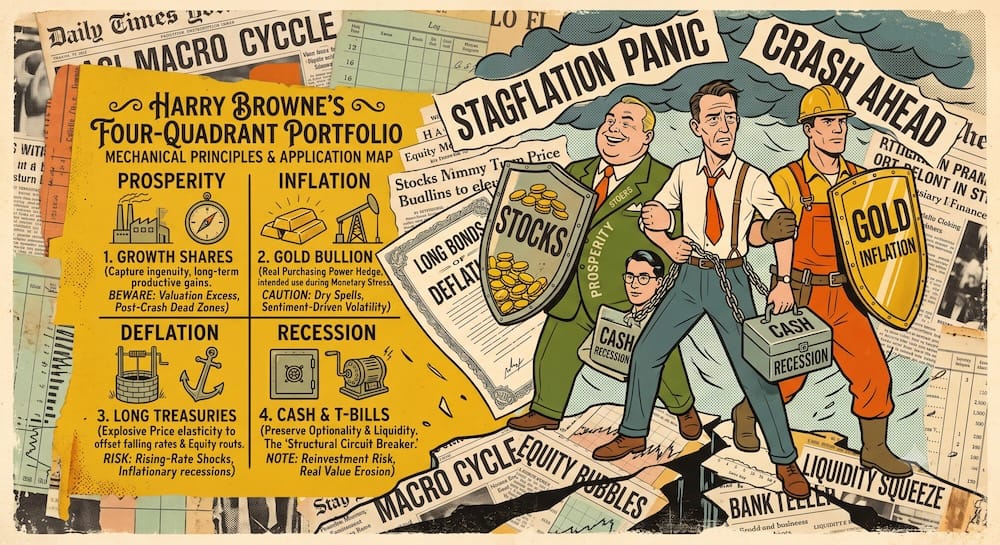
Instead of trying to predict the next turn of the macro cycle, Browne did something incredibly elegant. Browne simplified the investing problem into four broad states. His thesis was that no matter what kind of chaotic headlines are flying across the financial news, the economy can only ever be in one of four states: prosperity, inflation, deflation, or recession.
Crucially, he recognized that each of these regimes rewards a specific asset type while punishing the others. By holding all four permanently in equal weights, the operating design ensures that when one sleeve is under pressure, another may have a structural reason to offset part of the damage.
To see how this operates under the hood without the distraction of modern product wrappers, we have to look at the specific roles he assigned to each sleeve within his structural matrix.
Browne’s Four-Quadrant Survival Map
| Economic Condition | Portfolio Job | Asset Browne Assigned | What Can Go Wrong |
| Prosperity | Capture productive growth | Stocks | Equity bubbles, valuation excess, long underperformance after crashes |
| Inflation | Protect purchasing power | Gold | No yield, long droughts, sentiment-driven volatility |
| Deflation | Offset falling rates and collapsing growth | Long-term Treasury bonds | Rising-rate shocks, inflationary recessions |
| Recession / tight money | Preserve liquidity and optionality | Treasury bills / cash | Yield drag, inflation erosion |
Prosperity
When the economy is in a state of standard prosperity, business is booming, consumer demand is high, inflation is stable, and corporate productivity is rising. This is the traditional environment where equities excel. Browne assigned standard growth stocks to this quadrant because they act as a direct conduit to human ingenuity and economic expansion.
But what can go wrong? Equities are prone to severe valuation bubbles, sudden speculative excess, and prolonged periods of real-term underperformance following major market crashes. If an investor’s entire net worth is tethered to this single engine, a structural break in prosperity can leave them underwater for a decade.
Inflation
When the money supply expands faster than economic output, consumer prices skyrocket and the real purchasing power of paper currency begins to melt away. In this environment, both traditional stocks and standard fixed-income products get deeply squeezed. Equities suffer because input costs rise faster than margins can adjust, and traditional bonds see their fixed coupons gutted by a falling currency.
Browne’s historical framework assigned physical gold bullion to this quadrant. Because gold is a non-productive asset with no counterparty risk that cannot be printed by a central bank, it may serve as a monetary hedge during confidence crises. When real yields drop below zero, gold can move violently upward, acting as an intended purchasing-power hedge.
The clear trade-off, however, is that gold produces no cash flows, pays no dividends, costs money to store, and can go through agonizing multi-decade dry spells where it does absolutely nothing but mock your patience.
Deflation
Deflation is the mirror image of inflation: consumer demand collapses, the velocity of money drops to a crawl, and prices across the economy fall. In a severe deflationary depression, cash becomes king because its purchasing power is increasing naturally, but businesses fail at an alarming rate, causing equities to crater.
To defend against this, Browne assigned long-term government bonds to the structure. When price levels fall and growth vanishes, interest rates structurally plummet. Long-term sovereign bonds capitalize on this environment due to their high duration. Because their long maturity makes them incredibly sensitive to changes in interest rates, a sudden drop in prevailing yields translates into an explosive upward spike in the bond’s market price, providing an immediate capital cushion exactly when the equity market is experiencing a rout.
The vulnerability here is obvious: if you are hit with a rising-rate shock or an inflationary recession instead, these long-duration assets can experience severe capital losses.
Recession / Tight Money
A recession or a liquidity squeeze occurs when cash becomes scarce, credit markets freeze, and investors are suddenly forced to liquidate assets to meet short-term obligations. This is the classic panic phase of a market cycle.
Browne’s model counters this by holding a permanent 25% allocation to short-term Treasury bills or pure cash. The job of this sleeve is not to generate high returns or outpace inflation; its job is absolute stability, capital preservation, and liquidity optionality. When every other asset class is swinging wildly, cash is designed to preserve nominal value and liquidity, serving as a structural circuit breaker for the entire framework.
The downside is the structural yield drag. During prolonged periods of economic growth or high inflation, cash loses its real value to inflation every single day, acting as a quiet weight on the total compounding power of your wealth.
                    [THE FOUR REGIME JOBS]
     Prosperity                       Inflation
  +--------------+                 +--------------+
  |    STOCKS    |                 |     GOLD     |
  |  (Fires up)  |                 |  (Fires up)  |
  +--------------+                 +--------------+
         ||                               ||
         || (Opposing Focus)              || (Opposing Focus)
         ||                               ||
  +--------------+                 +--------------+
  |  LONG BONDS  |                 |     CASH     |
  |  (Fires up)  |                 |  (Fires up)  |
  +--------------+                 +--------------+
     Deflation                        Recession
Why the Parts Have to Be Violent
This brings us back to the core mechanism that separates Browne’s philosophy from the typical modern balanced portfolio. I see so many retail builders try to clean up this strategy because they are uncomfortable with the individual components. They look at the 25% allocation to long-term government bonds and say, “That’s too volatile, I’ll just hold an intermediate bond fund instead.” Or they look at the 25% gold allocation and say, “Gold is too speculative, I’ll swap it out for a diversified basket of real estate and corporate commodities.”
When you do that, you are fundamentally breaking the machine. You are introducing a corporate credit correlation that undermines the entire non-predictive architecture.
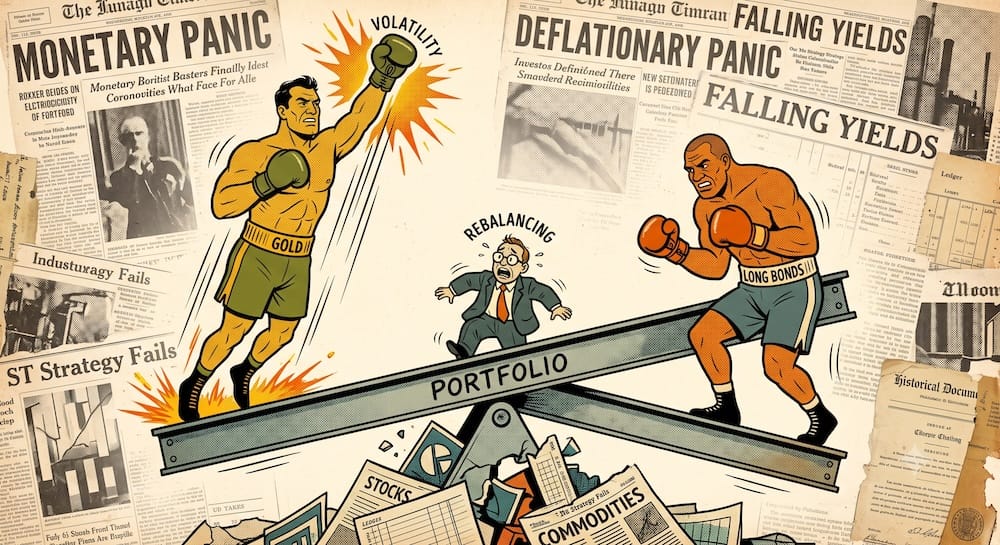
The standalone volatility of Browne’s assets is not an accidental design flaw; it is the exact engine that drives the portfolio’s long-term resilience. Think of it like a seesaw. If you put two toddlers on opposite sides of a seesaw, they don’t have enough weight to move the board meaningfully when the wind blows. If you put two heavyweight boxers on opposite ends, the movement is powerful, immediate, and carries immense kinetic energy.
By utilizing long-term Treasury bonds instead of intermediate debt, Browne ensured that the four-sleeve system captured maximum duration exposure. In a deflationary panic, short-term or intermediate bonds will barely move enough to affect a total portfolio level. Long-term bonds, because of their high price sensitivity to falling yields, will explode upward with enough force to physically offset a massive drop in your equity sleeve.
The same reality applies to gold. Gold needs to be held in its pure, volatile spot form because its raw, un-correlated reaction to monetary panic is what can help during monetary stress. If you dilute that volatility by switching to assets that are partially correlated with the corporate market—like real estate stocks or broad industrial materials—you lose the sharp, clean negative correlations that make the four-quadrant mix work.
The volatility of the individual parts is precisely what gives the portfolio something meaningful to rebalance. If nothing moves violently, your rebalancing discipline has nothing to do, and your potential rebalancing benefit vanishes. Academic work on diversification return argues that rebalancing can be a source of incremental return for volatile assets, but it is path-dependent and should not be viewed as guaranteed free money. You are intentionally using the extreme behavior of isolated line items to engineer an aggregate state of peace.
Cash Is Not Dead Weight
I want to take a moment to look closely at the cash sleeve, because it is almost universally maligned by modern asset allocators. In the modern era of financial optimization, cash is treated like absolute garbage. People look at a permanent 25% allocation to short-term Treasury bills and see nothing but an inefficient drag on long-term compounding. They scream about inflation eating away your purchasing power, and they treat cash as if it’s dead weight that serves no purpose other than showing a lack of investment imagination.
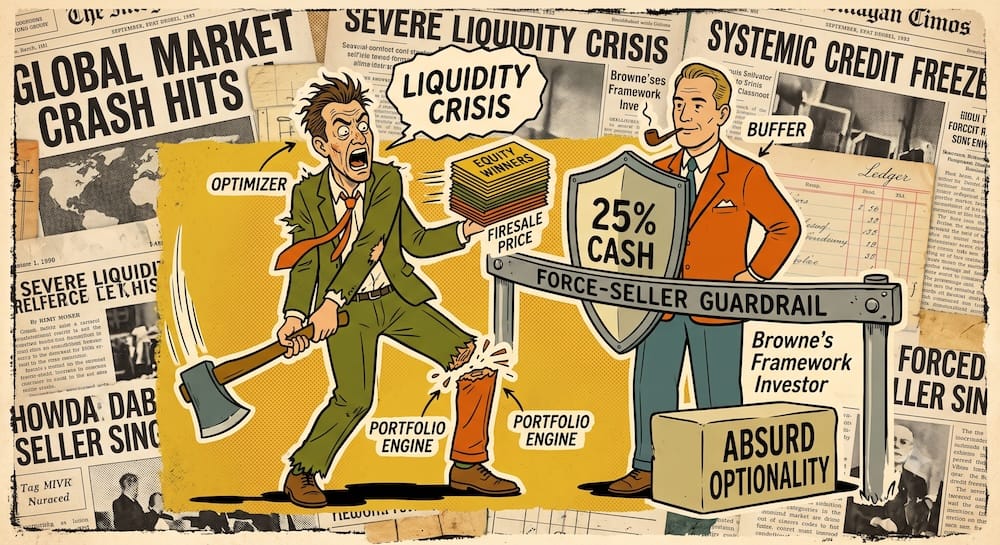
That view misses the entire structural point of what cash actually does inside a multi-asset system. In Browne’s framework, cash is not a return-generating asset; it is a liquidity option that shields the rest of your capital from the ultimate sin of investing: being forced to sell your winners or your losers at the exact worst moment.
Think about what happens to a standard investor during a severe liquidity crisis or a systemic credit freeze. An investor with no liquid buffer can become a forced seller when they suddenly experience a real-world emergency—they lose their job, their business revenue stops, or they face a massive unexpected liability. What do they do? They are forced to log into their brokerage account and liquidate positions. If that emergency happens to coincide with a global market crash, they are cutting off their capital at the knees, selling highly productive equity assets at fire-sale prices just to raise cash for survival.
When you hold a permanent 25% cushion of unleveraged cash and short-term sovereign debt, you have a structural buffer that protects you from ever becoming a forced seller.
               [THE FORCE-SELLER GUARDRAIL]
             Market Crash Hits / Credit Freeze
                            ||
                            \/
            Do you have a 25% Cash Buffer?
             /                          \
            /                            \
         (YES)                           (NO)
          /                                \
         \/                                \/
No need to liquidate positions.     Forced to sell depressed
Use stable cash for survival.       stocks/bonds at market bottom.
Portfolio engine stays intact.      Capital base permanently scarred.
During a recession or tight money phase, that cash is the only part of the portfolio that retains 100% of its nominal value and absolute liquidity. It stands ready to fund life, or, during a portfolio rebalancing event, it provides the guaranteed liquidity needed to buy equities when they are trading at deep discounts. Cash is the optionality that keeps the rest of your wealth from being permanently scarred by a cyclical crisis. It doesn’t need to yield a high return to earn its keep; its value is measured by the disasters it prevents.
Tracking Error Is the Real Pain
Now, let’s stop looking at the pristine theoretical models and talk about the actual psychological cost of holding this strategy in the real world. If you look at a fifty-year historical backtest of the Permanent Portfolio, it looks incredibly seductive. The line moves steadily from the bottom left to the top right with barely any noticeable dips. Before 2022, many backtests showed unusually shallow nominal drawdowns, often hovering at a mere -4% to -5% in standard drops. But 2022 dented that clean story when the simultaneous annihilation of stocks and bonds dragged the allocation down roughly -12% to -13% nominally. Still, people look at those figures and think to themselves, This is the perfect strategy. I can easily hold this.
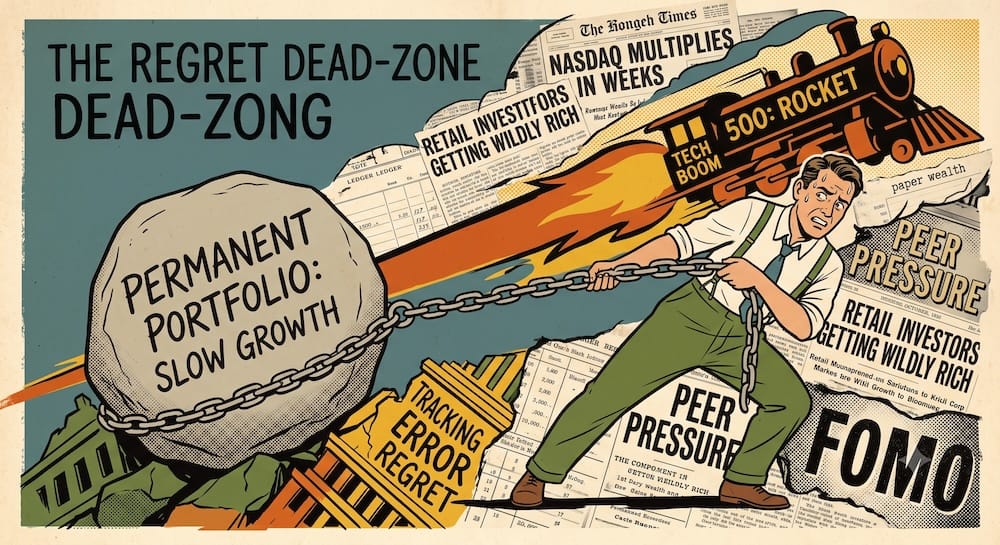
I am here to tell you that you are underestimating the sheer emotional devastation of tracking error regret.
Sustained underperformance relative to a broad market benchmark is a completely different kind of psychological torture than a sudden, sharp market crash. If the stock market drops 35% in a global panic, and your portfolio only drops 8%, you feel like an absolute financial genius. Your friends are panicking, the headlines are screaming, and you are sitting pretty. That part of the insurance policy is easy to endure.
The hard part is what happens during the long, roaring equity bull markets of a prosperity regime.
Consider the mid-to-late 1990s tech boom or the decade-long expansion of the 2010s. During those windows, broad equity markets were compounding at double-digit clips year after year. The financial news was filled with stories of retail investors getting wildly rich on paper by simply buying large-cap growth stocks. Tech companies were multiplying in value over weeks, and anyone holding a concentrated equity portfolio was printing money.
Compare Cumulus vs. Stratus clouds
Meanwhile, if you were executing Browne’s model, your portfolio was lagging behind like a heavy stone. Because you are permanently anchored by 25% cash that is yielding next to nothing and 25% gold that is locked in a multi-decade structural bear market, your absolute returns look pathetic compared to the broad stock market. You have to watch your peers, your neighbors, and every talking head on television build massive wealth on paper while your net worth crawls upward at a snail’s pace.
                  [THE REGRET DEAD-ZONE]
  Market Performance (e.g., 1990s / 2010s Bull Run)
  ======================================================>>> S&P 500 (Rockets Upward)

  -------------------> Permanent Portfolio (Steady, Slow Growth)
  [THE BEHAVIORAL GAP: Intense FOMO, peer pressure, and tracking error regret]
That is the tracking error graveyard. It is a quiet, agonizing pressure that builds up over five, seven, or ten years. It makes you question your own strategy, question Browne’s math, and look at your gold sleeve with absolute hatred. Every single day, your brain screams at you to abandon the insurance policy, sell the hated gold, dump the boring cash, and plunge your capital into whatever equity trend is currently melting faces.
If you do not have an iron stomach and a deep, visceral understanding of why you are paying that insurance premium, you will inevitably capitulate at the exact worst moment—usually right at the absolute peak of the equity bubble, right before the macro regime shifts and your abandoned insurance assets become the only things that could save you.
The PRPFX Disconnect
If we want to maintain our commitment to inspecting the actual record rather than worshiping the myth, we have to look at a fascinating historical contradiction in Browne’s own career: the launch and evolution of the Permanent Portfolio Fund (PRPFX) in 1982.
In his books and public writings, Browne advocated for the absolute beauty of simplicity. He told retail investors that a clean, four-asset equal-weight allocation was everything they needed to survive an unknowable future. Yet, when he co-founded a commercial mutual fund vehicle alongside Terry Coxon to package this concept for retail clients, that clean, theoretical 25% x 4 model was completely thrown out the window.
If you read through the official fund prospectuses and institutional reporting materials for the Permanent Portfolio Fund, you discover a far more complex and cluttered asset allocation under the hood. Instead of sticking to the pristine four-box retail blueprint, the commercial fund vehicle introduced multiple additional asset classes. The official fund materials warn that the fund’s trajectory is directly affected by a target structure including gold, silver, Swiss franc assets, real estate and natural-resource stocks, aggressive growth stocks, and dollar assets.
       [THE STRUCTURAL DRIFT]
  Theoretical Book Model (Elegant 25x4)
  +---------+---------+---------+---------+
  | Stocks  |  Bonds  |  Cash   |  Gold   |
  |  25%    |   25%   |   25%   |   25%   |
  +---------+---------+---------+---------+

  Commercial Fund Reality (PRPFX Disconnect)
  +-------+-------+--------+--------+--------+-------+
  |Stocks | Silver| Gold   | Swiss  | Real   | Cash  |
  |Growth | Bulk  | Bullion| Francs | Estate | Drag  |
  +-------+-------+--------+--------+--------+-------+
   (Creeping complexity and institutional tracking error)
Why did the master of simplicity build such a complicated commercial vehicle? The reality is that institutional money management in the late twentieth century was bound by structural frictions, regulatory constraints, and tax complexities that didn’t apply to a pure theoretical DIY model. Managing massive pools of client capital required liquidity management, regulatory diversification compliance, and specific structural compromises that altered the pure negative correlation characteristics of the original model.
The lesson here is incredibly valuable for any systematic asset allocator: commercial investment products are often forced to drift away from clean philosophical mechanics due to the realities of packaging corporate vehicles for retail distribution. The mutual fund vehicle ended up carrying a completely different risk, fee, and tracking error profile than the elegant, four-sleeve DIY framework Browne outlined in his literature. It serves as a stark reminder that we must separate an investor’s core mechanical insight from the commercial structures that are built in their name.
What Actually Travels
So, where does this leave us when we step back and look at the aggregate record? We are not here to copy historical recipes blindly or treat Harry Browne as an infallible financial deity. We are here to absorb the mechanisms that travel across eras and expel the dogmatic elements that are nothing more than a product of historical nostalgia.
The Lessons We Absorb
First, we absorb the absolute core thesis that the macroeconomic future cannot be consistently predicted. If you design an allocation framework that relies on a specific economic outcome to keep you solvent, you are running a speculative forecasting operation under the guise of an investment plan. True structural resilience means building a system where every single asset has an explicit, regime-specific job to do, ensuring that your survival never depends on your ability to guess the next turn of the macro wheel.
Second, we absorb the volatility counterweight mechanism. Standalone asset volatility is not something to be feared or smoothed away through unnecessary diversification into correlated asset classes. When you pair highly volatile, uncorrelated assets in equal weights, you create a structural framework where the kinetic energy of an explosive winner directly funds the purchase of deep cyclical value through a strict rebalancing discipline. Browne’s framework is often associated with wide historical rebalancing bands, such as 15% and 35%, which reflect the idea that the portfolio should let assets move meaningfully before forcing trades to capture that potential rebalancing benefit.
Third, we absorb the structural utility of cash. Unleveraged cash and short-term sovereign debt are not just a drag on your long-term compounding potential; they are a high-value liquidity option that protects your capital base from the risk of forced liquidation during systemic crises.
                  [THE SYSTEMATIC FILTER]
     ABSORB (What Travels)                 EXPEL (What Drops)
+-------------------------------+   +-------------------------------+
| * Anti-forecasting humility   |   | * Survivalist metal hoarding  |
| * Pure regime-specific jobs   |   | * Commercial fund complexity  |
| * Standalone volatility edge  |   | * Rigid calendar assumptions  |
| * Cash as structural option   |   | * Expectation of market alpha |
+-------------------------------+   +-------------------------------+
The Lessons We Expel
Conversely, we ruthlessly expel the survivalist dogma and physical hoarding paranoia that characterized much of the early 1970s hard-asset movement. Browne’s historical literature spent considerable time detailing the mechanics of moving physical gold coins into offshore Swiss bank vaults and preparing for near-total systemic collapse. For the modern retail wealth builder, treating an asset allocation framework as a pure survivalist bunker tool introduces enormous operational friction, high transactional fee drag, and extreme structural inefficiency. Modern vehicles and exchange-traded funds make access exponentially easier than in Browne’s era, but every wrapper introduces its own costs, tax treatment, tracking behavior, and behavioral friction. The lesson is not the product map; it is the regime-job map.
We also expel the expectation of beating the equity market during long economic expansions. The Permanent Portfolio is a magnificent vehicle for absolute wealth preservation, downside containment, and inflation-adjusted survival. It is designed to match inflation plus a modest real return buffer over long horizons under standard backtested assumptions. If your financial objective is maximum capital accumulation over a multi-decade career, holding a permanent 50% drag of cash and gold will inflict a massive opportunity cost that no amount of smooth drawdowns can mechanically compensate for.
Modern investment vehicles have made accessing diverse asset classes easier than it was during the high-commission, pre-deregulation era of the 1970s. But the core lesson of the Permanent Portfolio has nothing to do with product selection or brokerage account mechanics. The real lesson is a profound statement of intellectual honesty: build a portfolio for an unknowable future, assign every asset an explicit regime job, accept tracking error as the honest price of structural insurance, and stop pretending that anyone can predict the weather.
What is the core difference between Harry Browne’s Permanent Portfolio and Ray Dalio’s All Weather Portfolio?
The short answer is execution complexity and risk weighting. While both frameworks rely on the core philosophy that different economic environments reward different assets, Browne’s Permanent Portfolio uses a strict, equal-weighted capital allocation of exactly 25% across four distinct sleeves (stocks, long bonds, cash, and gold). In contrast, Ray Dalio’s institutional risk-parity approach balances the volatility risk contribution of each asset rather than the dollar amount. This means an All Weather framework typically requires significant structural leverage or active derivatives overlay to scale up the lower-volatility bond components, making Browne’s system vastly easier for a direct DIY investor to wrap their head around without complex institutional engineering.
What is the minimum practical portfolio size required to run this four-sleeve strategy effectively?
Technically, next to nothing today. Because modern exchange-traded markets allow for fractional shares and zero-commission transaction processing, you can technically construct this equal-weight layout with a few hundred dollars. However, the real logistical constraint is behavioral, not operational. If your total capital base is small and still in an aggressive wealth-accumulation phase, dedicating 50% of your total net worth to low-yielding short-term cash and volatile, non-productive spot gold will severely flatten your absolute compounding runway. The layout is conceptually optimized for wealth preservation and volatility dampening, meaning it becomes highly useful once your capital footprint reaches a size where protecting your baseline from macro shocks is more critical than scratching for maximum alpha.
Why did Harry Browne mandate long-term government bonds instead of safe short-term or intermediate debt?
The plumbing demands Standalone Asset Violence. If you substitute intermediate bonds into the fixed-income sleeve to lower your short-term tracking anxiety, you castrate the portfolio’s primary defense against a deep deflationary shock. Long-term sovereign bonds possess high duration metrics, making them hyper-sensitive to changes in interest rates. In a severe deflationary panic, yields plumet, causing long-duration bond prices to spike upward with massive kinetic force. This massive standalone price surge is the exact counterweight needed to physically absorb the real-term destruction occurring in your equity sleeve. Intermediate debt simply lacks the explosive price elasticity required to move the needle on a total portfolio level during a true market dislocation.
How does modern product drift affect the original strategy outlined in Browne’s historical literature?
It creates an institutional disconnect you need to be highly careful about. When Harry Browne and Terry Coxon packaged this clean structural matrix into a commercial vehicle through the launch of the Permanent Portfolio Fund (PRPFX) in 1982, the pristine 25% x 4 blueprint was completely abandoned. The institutional mutual fund vehicle introduced silver allocations, real estate equities, natural-resource stocks, and foreign assets like Swiss francs. This creeping product complexity introduced vastly different tracking error dynamics than the clean formula popularized in Fail-Safe Investing. This proves that legacy commercial products often warp a legend’s baseline mathematics to satisfy fund distribution constraints, which is why a modern investor must focus on the conceptual regime-job map rather than buying generic fund packages blindly.
Is the potential rebalancing benefit of this portfolio guaranteed to generate extra long-term returns?
Absolutely not. Presenting a rebalancing discipline as a guaranteed, automated source of free alpha is a major overclaim. Rebalancing among highly volatile, uncorrelated assets historically works beautifully when the individual components exhibit reliable, long-term mean-reverting behavior across rolling economic cycles. However, if the global economy enters a prolonged, multi-decade macro trend where one specific asset class dominates—such as a multi-decade structural equity expansion or a persistent, secular bear market for commodities—the constant systematic selling of your winner to fund the depressed losers will cause the strategy to drag heavily behind a concentrated approach. The rebalancing rule is a risk-containment architecture and a volatility harvest, not a guaranteed return multiplier.
How should a retail investor handle the psychological friction of the “tracking error graveyard”?
By treating the drag as an insurance premium you have consciously agreed to pay. The ultimate failure mode of this strategy isn’t mechanical; it’s psychological. During extended prosperity regimes, watching your 25% cash buffer yield flat nominal numbers while your 25% gold sleeve languishes in a multi-decade bear market can cause intense relative-regret pressure. To survive the tracking error graveyard without capitulating at the absolute top of an equity bubble, you must explicitly separate aggregate portfolio stability from the behavior of individual line items. If you cannot look at a specific line item in your portfolio with absolute hatred for five years straight while your neighbors get rich on paper, you should not be using a non-predictive regime framework.
This article is also available in Spanish. [Leé la versión en castellano: Harry Browne y la Cartera Permanente: Invertir para un futuro impredecible]