So here’s a number that should make any modern fund manager physically sweat: $105,100.
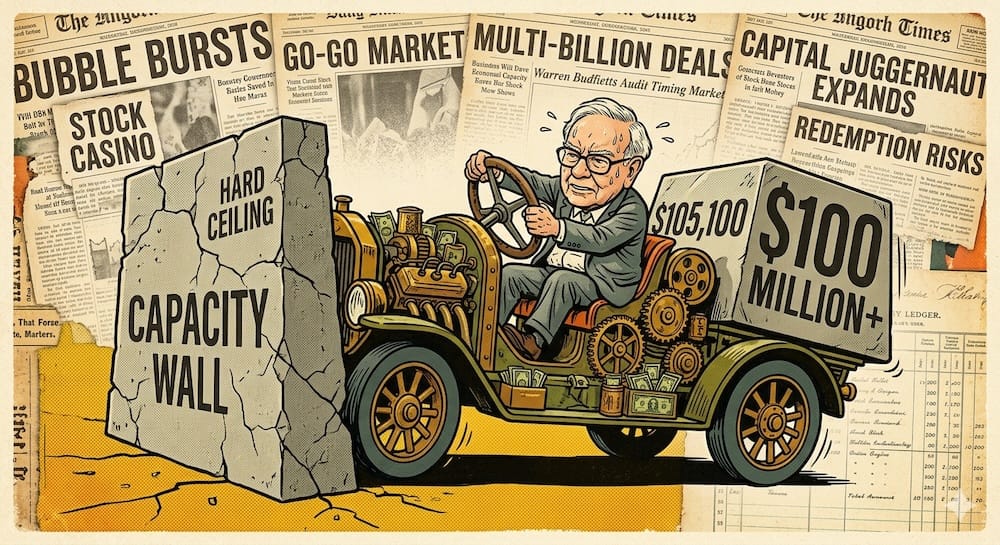
That was the entire starting bankroll Warren Buffett had at his disposal when he launched Buffett Partnership Ltd. (BPL) in 1956. He put up exactly $100 of his own money; the rest was scraped together from seven limited partners consisting of family and close friends. Fast forward thirteen years to the twilight of 1969, and that microscopic pool of capital had swelled into an absolute juggernaut of over $100 million.
And then, right at the peak of his early compounding powers, Buffett did something that completely flies in the face of modern Wall Street asset-gathering incentives: he shut the entire thing down.
The standard internet folklore around this decision is draped in pure, saintly romance. If you scroll through typical financial media recaps or casual investing blogs, the narrative is almost always framed as a clean story of moral superiority. The legend says that the market became a frothy, speculative casino by 1969, and the “Oracle”—acting out of benevolent concern for his partners’ capital—refused to participate in the madness, folded his tent, and retired to wait out the storm.
It’s a beautiful, pristine story. It is also an elegant oversimplification that completely misses the mechanical bottleneck underneath the vehicle.
Buffett did not close the partnership merely because the market was expensive. He closed it because his asset base had physically outgrown his strategy. The sheer weight of $100 million had slammed into a hard carrying capacity wall, rendering his favorite deep-value engines entirely unworkable. He did not retire; he executed a radical, structural vehicle transformation because the strategy-to-scale mismatch had become absolute.
There is a very human trap here. When something has worked beautifully for thirteen years, the ego desperately wants to call it a permanent philosophy. The market eventually reminds you it was simply a temporary habitat. For those of us navigating our own portfolios today, Buffett’s 1969 shutdown is not a lesson in saintly abstinence. It is a masterclass in disciplined capacity management—and a cold reminder that every investment edge has a strict operational ceiling.
The Public Myth: Buffett Closed Because Stocks Were Expensive
To understand why the BPL vehicle dissolved in 1969, we have to isolate the prevailing market regime from the lazy folklore. The standard narrative treats 1969 as a simple valuation bubble, implying that Buffett woke up, noticed high price-to-earnings ratios across the board, and decided to close shop until things got cheap again.
The historical reality is far more interesting. The late 1960s was the era of the “go-go” market—a highly speculative regime dominated by sprawling, multi-industry corporate conglomerates and growth stocks trading at extreme multiples. Wall Street was captivated by high-turnover “performance” managers who momentum-traded these massive entities to print staggering short-term gains.
Buffett openly detested this environment. In his May 29, 1969 letter to partners, he explicitly stated:
“I am not tailored for this environment and I do not wish to spoil a reasonably good record by trying to play a game I don’t understand just so I can go out a hero.”
But notice the phrasing: he was not tailored for the environment. This wasn’t just a moral critique of Wall Street greed; it was an objective assessment of structural fit.
If a strategy’s edge is entirely predicated on buying small, unnoticed corporate assets at a steep discount to liquidating value, a market regime that forces capital into multi-billion-dollar speculative conglomerates represents a structural dead end. The bubble didn’t just make stocks expensive; it actively dried up the specific habitat where Buffett’s early compounding occurred. Predicting a market top is a fool’s errand, and Buffett knew it. He wasn’t timing the market; he was auditing his own capacity to generate absolute returns without violating his core parameters.
The Deeper Reality: The Strategy Had Outgrown Its Pond
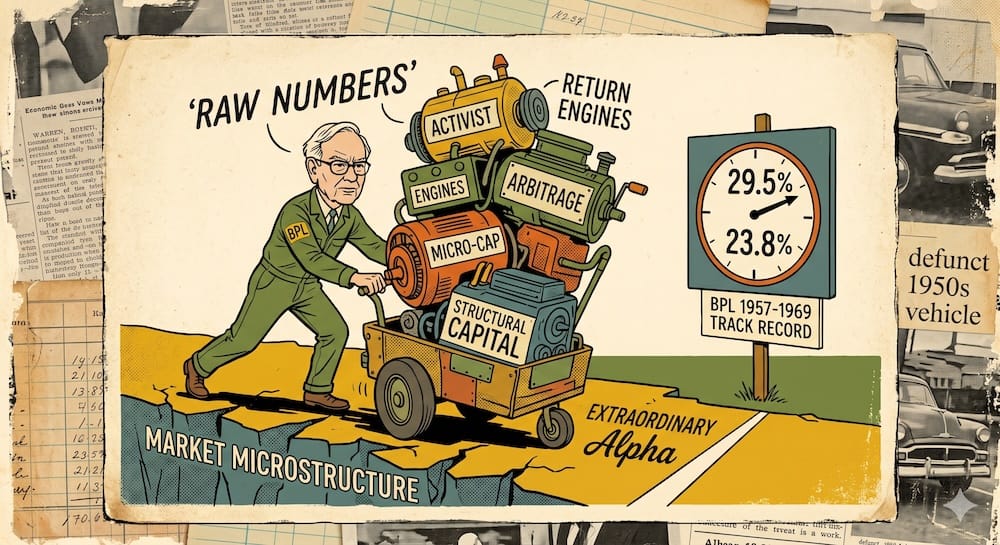
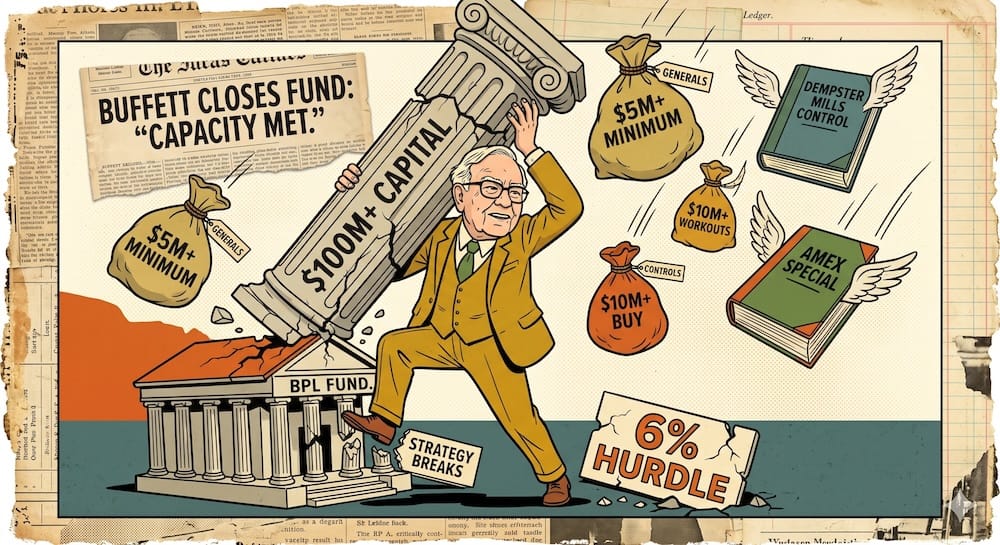
The true breakdown within BPL was a mathematical capacity bottleneck. Early Buffett was not a passive, buy-and-forget investor; his early record was driven by intense, often aggressive operations split across three distinct tactical sleeves: Generals (undervalued micro-caps bought strictly on statistical net-current-asset value), Workouts (arbitrage on defined corporate timelines like mergers or liquidations), and Controls (taking dominant or majority stakes to force corporate restructuring).
Every single one of these engines had a strict asset ceiling.
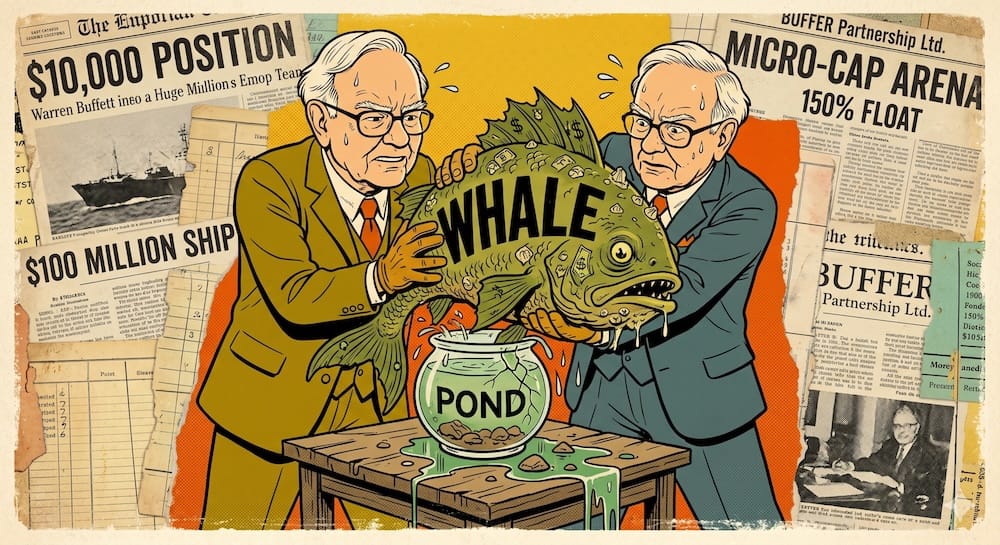
In 1957, when BPL was managing a few hundred thousand dollars, a $10,000 position moved the needle for the entire fund. Buffett could quietly scroll through physical copies of Moody’s Manuals, find an obscure manufacturing plant or a tiny map company trading at 40% of its net liquid assets, buy up the stock over a few weeks without alerting a soul, and capture a massive absolute return.
By 1968, however, Buffett was steering a $100 million ship.
To make an investment meaningful to a $100 million portfolio, a single position needed to absorb at least $5 million to $10 million of capital. In the 1960s micro-cap arena, a $5 million order didn’t just buy a slice of a company—it frequently meant attempting to purchase 150% of the firm’s total outstanding float.
The moment BPL’s brokers began executing an order of that magnitude, the sheer volume would send the stock price rocketing skyward, instantly destroying the statistical bargain that made the trade attractive in the first place. The pond had remained the same size, but the fish had grown into a whale.
+-------------------------------------------------------------------------+
|                  THE MICRO-CAP LIQUIDITY BOTTLENECK                     |
+-------------------------------------------------------------------------+
| [1957 CAPITAL BASE: ~$100K] ---> Can deploy $10K into tiny net-nets.     |
|                                  No market impact. Edge fully intact.   |
|                                                                         |
| [1969 CAPITAL BASE: ~$100M] ---> Needs $5M+ per trade to matter.        |
|                                  Exceeds total outstanding float.       |
|                                  Price spikes. Edge destroyed.          |
+-------------------------------------------------------------------------+
This structural congestion hit every single sleeve of his portfolio simultaneously:
- The Generals Sleeve: The universe of deeply mispriced micro-caps trading below liquidation value was fundamentally limited. It could comfortably absorb $5 million across dozens of positions, but it could not absorb $50 million without BPL becoming the majority owner of dozens of useless, illiquid corporate shells by accident.
- The Workouts Sleeve: Corporate merger arbitrage and liquidations require fixed timelines and finite capital pools. While BPL utilized event-specific bank financing and targeted leverage to optimize these trades when appropriate, the total dollar capacity of announced corporate reorganizations in any given year was a hard constraint. Buffett could not force more corporate mergers to occur just because he had extra cash burning a hole in his pocket.
- The Controls Sleeve: Taking operational control of a company requires immense managerial focus. Buffett could successfully restructure Sanborn Map (using a tax-efficient corporate asset swap to trade blue-chip stocks for BPL’s shares without relying on an open-market sale) or install a liquidation specialist like Harry Bottle to gut bloated inventory at Dempster Mill. But corporate activism does not scale infinitely. A single manager cannot run ten different hostile activist takeovers simultaneously without structural collapse.
To see exactly how these moving parts collided to force the shutdown, we can map out the structural breaking points across his entire architecture:
1. The BPL Shutdown Causality Map
| Pressure Point | What Changed by 1969 | Why It Mattered | Closing Decision Implication |
| Asset Size | Capital pool expanded from $105K (1956) to over $100M (1969). | Small, high-alpha positions could no longer move the total portfolio needle. | The vehicle’s scale had mechanically invalidated its underlying operational framework. |
| Micro-Cap Opportunity Set | Statistical net-nets vanished under the weight of an extended bull market. | The primary hunting ground for absolute-return “Generals” had become far less fertile. | Continuing the strategy required either shrinking the fund or changing the asset class. |
| Go-Go Market Valuations | Market dominated by speculative conglomerates and growth stocks trading at extreme multiples. | High market beta meant deep value investing required immense relative tracking error. | Buffett refused to pay speculative prices or participate in a momentum-driven regime he couldn’t quantify. |
| Partner Redemption Structure | Partners could withdraw capital once a year on Dec 31st with 30 days’ notice. | While great for protecting against intra-year panic, it still exposed the fund to major cash-call volatility if performance lagged. | Closing the fund eliminated the threat of future redemption pressure during an inevitable market reset. |
| Berkshire Vehicle Availability | BPL held a dominant, controlled corporate stake in Berkshire Hathaway. | Buffett possessed an operational corporate shell with a permanent capital structure. | Provided an alternative runway to pivot his entire capital allocation strategy without starting from scratch. |
| Unwillingness to Style-Drift | Buffett refused to lower his margin-of-safety parameters to deploy cash. | He preferred returning capital over degrading his historical underwriting standards. | Closure was the only logical alternative to style drift or holding massive, dilutive cash piles indefinitely. |
Strategy Capacity Limits: What Broke at Scale
I do not love this lesson, because it applies to everything I would rather pretend is permanent. Strategies have seasons. Edges have carrying capacity. Even perfectly designed systems can outgrow themselves if the asset load exceeds the structural design.
By 1969, Buffett was facing a binary choice: he could either drift his style into buying lower-quality, highly priced assets just to keep his massive capital pool fully deployed, or he could shut down the vehicle to preserve his record.
To visualize this operational bottleneck, look at how the scaling of capital directly fractured the mechanics of his core asset sleeves:
2. Strategy Capacity Limit Matrix
| BPL Sleeve | What Worked at Small Scale (1956–1961) | What Broke at Large Scale ($100M+ by 1969) | Why Closure Made Sense |
| Generals | Buying tiny fractions of obscure micro-caps below liquidation value with zero market impact. | A meaningful position required buying more shares than the entire daily or monthly volume of the stock allowed. | Attempting to execute large-scale buying in illiquid names destroyed the statistical discount instantly. |
| Workouts | Manually tracking specific announced mergers or liquidations to lock in predictable 10–12% absolute returns. | The total dollar capacity of corporate arbitrage situations was constrained by macroeconomic deal flow, not BPL’s capital needs. | Buffett could not force more arbitrage opportunities into existence; excess cash sat idle, diluting total returns. |
| Controls | Buying outright control of small companies (like Dempster Mill) to personally unlock asset value via liquidation. | Large-scale corporate activism required billions of dollars, proxy wars, and massive institutional regulatory scrutiny. | Taking over major corporations was a completely different operational game that Buffett’s tiny lean partnership wasn’t staffed to play. |
| Concentrated Specials (e.g., Amex) | Dropping 40% of the entire fund into a single massive, scandal-driven mispricing (1964 Salad Oil Crisis). | Finding multi-million-dollar institutional brand moats trading at massive systemic discounts became a rare historical anomaly. | You cannot build a recurring, scalable fund strategy on the assumption that an elite global monopoly will experience a catastrophic fraud scandal every single year. |
Why He Did Not Just Drift Into Lower-Quality Returns
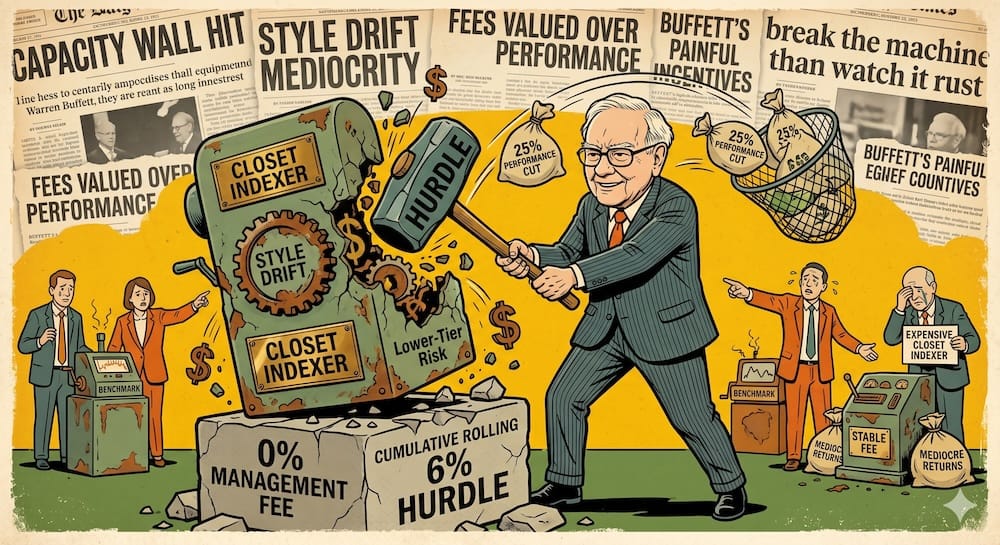
This is where the real integrity angle lives. The conventional folklore frames Buffett’s shutdown as an act of pure, saintly morality. But if you strip away the romantic glaze, you see a far more ruthless, calculating capital allocator at work: Buffett refused to style-drift because style drift is a mathematically guaranteed path to mediocrity.
Most modern asset managers who hit a capacity wall choose a predictable path. They value their management fees far more than their absolute performance percentages. When their small-cap strategy outgrows its habitat, they quietly drift into large-caps, dilute their active share, lower their performance hurdles, and transform into expensive closet indexers. They accept lower-quality, benchmark-hugging returns because it allows them to keep collecting a stable percentage fee on a massive, bloated asset base.
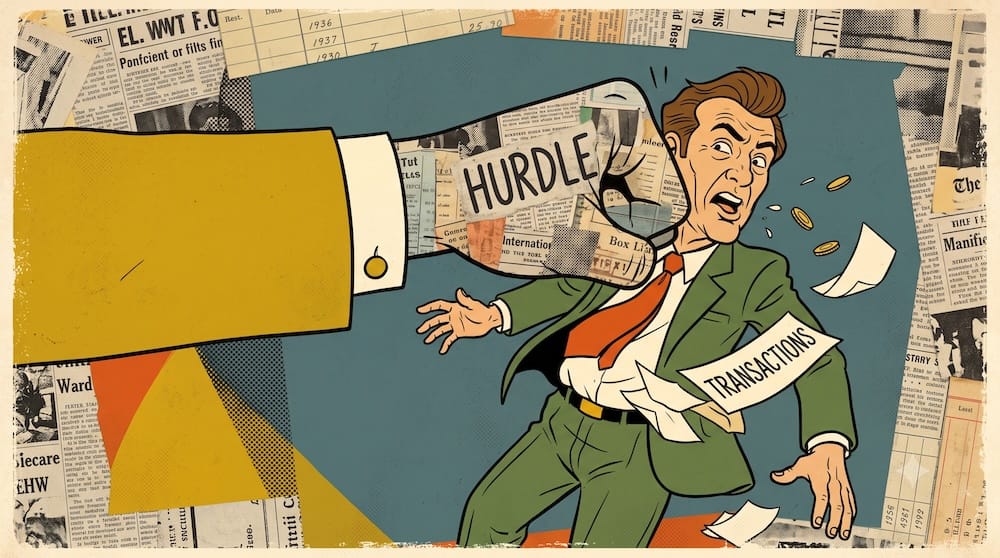
Buffett’s entire compensation structure was designed to make closet indexing personally painful. Remember, BPL charged a 0% management fee and took a 25% performance cut above a cumulative, rolling 6% hurdle.
If he allowed his strategy to drift into lower-quality, low-conviction positions, his performance would inevitably decay. If he dipped below that 6% rolling hurdle, he would enter a financial deficit that he had to carry forward into future years, effectively working for free until he cleared the historical high-water mark. He didn’t avoid style drift out of pure, unadulterated altruism; he avoided it because his vehicle’s incentives made style drift an economic disaster for the general partner. He understood that it was far better to break the machine entirely than to watch it slowly rust into a lower-tier risk regime.
Berkshire as the Escape Hatch, Not the Original Master Plan
When Buffett decided to dismantle BPL, he didn’t simply hand back all the cash and sit in an empty room. He orchestrated an elegant structural pivot that fundamentally solved his scale and redemption challenges in a single stroke. And ironically, the vehicle he used to save his compounding career was born out of a colossal, emotional mistake.
In 1962, Buffett had started accumulating shares of a declining, capital-intensive New England textile manufacturer called Berkshire Hathaway. It was a textbook Graham net-net play: the textile business was fundamentally dying, but the stock was trading well below the liquidating value of its physical machinery and real estate.
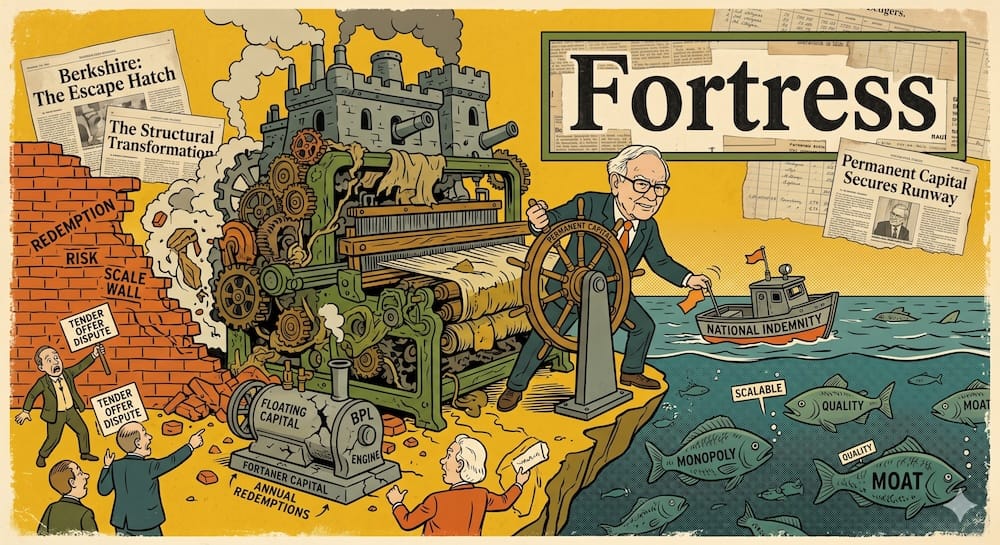
In 1964, after a tender-offer dispute in which the written price came in significantly below what Buffett believed had been orally agreed with management, Buffett reacted emotionally. Instead of taking his money and walking away, he launched an aggressive buying campaign, acquired outright control of the company, and fired the executives.
It was a classic spite buy. Buffett had successfully locked up a massive tranche of BPL’s capital in a structurally doomed, low-return textile mill that would consume immense managerial energy and bleed cash for decades. He would later openly refer to Berkshire Hathaway as his multi-billion-dollar blunder.
But look at how a master allocator restructures a broken asset. When closing BPL in 1969, he didn’t liquidate Berkshire Hathaway. Instead, he distributed Berkshire stock directly to his limited partners, kept his own net worth heavily concentrated inside it, and pivoted his entire operational focus to running Berkshire as a permanent-capital corporate holding company.
+-------------------------------------------------------------------------+
|                  THE STRUCTURAL VEHICLE TRANSFORMATION                  |
+-------------------------------------------------------------------------+
| [BUFFETT PARTNERSHIP LTD (1956-1969)] -> [BERKSHIRE HATHAWAY (1969+)]   |
| - Floating Capital Structure          | - Permanent Corporate Capital   |
| - Annual Redemption Risk              | - No fund-style redemption risk |
| - Limited Strategy Scale Capacity     | - Insurance Float Leverage Moat |
+-------------------------------------------------------------------------+
By transitioning from a partnership to a corporate holding structure, Buffett instantly wiped out his two greatest operational bottlenecks:
- No Fund-Style Redemption Risk: In a partnership structure, investors can demand their physical cash back during specified windows, forcing the manager to worry about liquidity. In a corporate holding company structure, there are no redemptions. If a shareholder panics during a market drop, they can sell their shares to another investor on the open market, but they cannot demand a single dime out of Berkshire’s corporate balance sheet.
- A Scalable Hunting Ground: Permanent corporate capital allowed Buffett to completely abandon the capacity-constrained micro-cap net-net strategy. Because the capital could never leave, he could patiently transition the business away from textiles and toward large-scale, high-quality companies (anchored by the acquisition of insurance firms like National Indemnity) that could safely absorb billions of dollars in capital.
The closing of the partnership was not an end; it was a structural migration. He recognized that the BPL engine had outgrown its habitat, so he built a fortress of permanent capital to change the game entirely.
The Closing Decision as a Portfolio Lesson
For the DIY investor sitting at a desk today, the closing of BPL is the ultimate lesson in strategy-to-vehicle alignment. We are frequently told that the secret to long-term wealth is finding a great strategy and sticking to it dogmatically through thick and thin. But the empirical record of Buffett’s early career screams the exact opposite: your strategy is only as good as its structural fit within your vehicle and your asset size.
If you are running a small, highly nimble individual account, your tiny asset size is actually your greatest structural advantage. You can hunt in niche, capital-constrained habitats—like systematic small-cap value anomalies or minor liquid arbitrage situations—that multi-billion-dollar institutional funds cannot touch without breaking the market tape.
But if your capital grows, or if the market regime shifts and completely dries up your specific edge, attempting to force the same old strategy into a hostile habitat is a recipe for catastrophic failure. You must have the structural honesty to audit your portfolio canvas and ask yourself whether your current strategy is genuinely built to bear the load of your current environment.
To run this structural audit on your own portfolio, apply this alignment filter to your current allocation design:
3. Modern Strategy-to-Vehicle Alignment Filter
| Modern Investor Question | Why It Matters | BPL Closing Lesson |
| Can my strategy absorb my capital size? | If you run a niche or highly illiquid strategy, expanding capital can cause heavy market impact that erodes your active edge. | Buffett recognized that a $100M pool could not trade micro-caps without destroying the price discount. Know your strategy’s carrying capacity limit. |
| Can my vehicle survive illiquidity? | If you hold concentrated or illiquid positions inside a vehicle exposed to sudden cash calls, panic will force catastrophic liquidations. | BPL used strict December 31st redemption gates to survive short-term market corrections without ever being forced to sell concentrated positions prematurely. |
| Can I tolerate tracking error? | Running a deep-value or absolute-return strategy means experiencing long stretches of severe relative underperformance vs. roaring bull market indexes. | During the 1958 market recovery, BPL experienced a negative 6.3% relative underperformance window against a surging Dow. Buffett accepted the variance because he trusted the mechanical edge. |
| Can I stop when the edge disappears? | Continuing to deploy capital into an obsolete or overvalued strategy out of pure habit leads directly to style drift and severe capital decay. | When the market regime shifted and net-nets vanished in 1969, Buffett chose to dismantle the partnership rather than lower his baseline underwriting standards. |
| Am I drifting because the opportunity set changed? | Drifting into overvalued or unquantifiable assets just to stay “fully invested” destroys your structural margin of safety. | A modern translation may be to study systematic small-cap value exposure or diversified liquid alternative vehicles rather than attempting to manually pick micro-cap stocks or individual mergers in an efficient, institutionalized market. |
The important part is not that Buffett found a clever way to keep playing the same game. He didn’t. He changed the game board. That is the discipline most investors miss.
The Sponge Verdict
When we look at the closing of the Buffett Partnership through an unsentimental lens, we absorb what travels and ruthlessly expel what doesn’t.
We must expel the romantic folklore that great investing means holding onto a single strategy forever out of pure dogmatic loyalty. Early Buffett proved that an elite allocator is entirely unsentimental about their vehicle. When the strategy, the asset size, the market regime, and the fund architecture no longer fit together in perfect harmony, the only logical move is to break the machine and adapt.
We must absorb the profound reality of strategy-to-vehicle alignment. Buffett did not build a multi-billion-dollar empire by being a superior stock picker alone; he built it by continually engineering the structural vehicle that held those stocks. His 1969 shutdown was a masterclass in disciplined capacity management. He knew his engine had outgrown its pond, refused to compromise his standards through style drift, and transitioned to a permanent corporate capital structure designed to survive any climate.
Audit your own hunting grounds. Understand your capacity limits. And never force a nimble strategy to carry a load it was never engineered to bear.
Build carefully.
Why did Warren Buffett close the partnership in 1969?
He closed it because his asset base outgrew his strategy. By 1969, Buffett was managing over $100 million. This massive scale made it mathematically impossible to deploy capital into his favorite micro-cap “net-nets” without aggressively driving up the stock price and destroying his statistical edge. Rather than style-drifting into lower-quality assets or expensive closet indexing, he chose to close the fund and shift to permanent capital.
What was the minimum portfolio size required to run Buffett’s early strategy?
It depends on your era, but at small scale, the strategy thrived on agility. In 1956, Buffett started with just $105,100, which allowed him to buy microscopic positions in deep-value stocks with zero market impact. For a modern retail investor, there is no technical minimum portfolio size, but executing a manual net-net or merger arbitrage strategy requires significant diversification across dozens of names, meaning a minimum capital block of at least $50,000 to $100,000 is typically needed to offset execution spreads and transaction frictions.
What are the capacity limits of a modern deep-value small-cap strategy?
They are lower than the industry wants to admit. While an individual investor running a $500,000 account faces zero liquidity bottlenecks in micro-caps, institutional funds usually hit severe capacity constraints when crossing $100 million to $250 million in total assets. Beyond this threshold, a fund can no longer accumulate meaningful positions in micro-cap value stocks without owning excessive chunks of outstanding corporate float, resulting in structural style drift toward mid-cap or large-cap spaces.
How did Buffett protect the partnership from redemption risk during market crashes?
Through strict legal architecture. Under the partnership agreement, limited partners were permitted to withdraw their capital only once a year, on December 31st, and were required to provide 30 days’ advance notice. This structural barrier completely insulated the fund from forced liquidations during intra-year panics—such as the 1962 Flash Crash—giving Buffett the behavioral runway to maintain highly concentrated allocations without fear of sudden capital calls.
How can modern DIY investors replicate Buffett’s early portfolio architecture?
A modern translation requires switching from manual stock picking to systematic factor exposure. Rather than hunting for individual micro-cap net-nets or manual merger arbitrage situations—where modern retail faces high bid-ask spreads and algorithmic front-running—investors can study systematic small-cap value exposure or diversified liquid alternative vehicles. This captures the underlying Size and Value risk premiums while maintaining total liquidity on a modern portfolio canvas.
Why did Buffett transition his capital from a partnership into Berkshire Hathaway?
To eliminate capital volatility and secure a permanent runway. A partnership vehicle relies on floating capital that can be redeemed by investors, creating structural constraints. By shifting his wealth into Berkshire Hathaway, a corporate holding structure, Buffett established a vehicle with zero fund-style redemption risk. If shareholders panic, they sell to other buyers on the open market; the cash never leaves Berkshire’s corporate balance sheet, creating an ideal base for long-term compounding.
This article is also available in Spanish. [Leé la versión en castellano: Cómo Warren Buffett cerró la sociedad BPL y por qué importa esa decisión]