
Let’s get one thing straight immediately. The biggest silent killer in any portfolio isn’t a market crash—it’s the behavioral itch to tinker that ruins long-term compounding when a strategy inevitably underperforms for three consecutive years. I’ve been executing an offense-only siege on my core factor exposures lately, hunting for maximum capital efficiency. But amidst all that high-velocity allocation, we need to address a structural reality that most DIY investors ignore: legacy mutual funds aren’t just old products. They are survivor-biased architectures that have physically lived through the inflationary shocks of the 1970s, the tech wreck, and the 2008 liquidity crisis. They have the scar tissue to prove it. The mechanical trade-off means their lack of intraday trading flexibility forces behavioral discipline, anchoring a portfolio when the live tracking error becomes uncomfortable.
Honestly, the value here isn’t nostalgia. It’s about how these funds handle the actual plumbing of market stress. When you look at the mechanics, they’ve continuously compounded capital while adapting to severe macro regime changes. Very few financial instruments have the raw, auditable track record to command that kind of structural trust. Independent allocators might parse this as a question of operational survival; an open-ended backtest looks clean on paper, but holding an active strategy through its ugly years is a completely different animal when real capital is on the line.
But what makes a mutual fund a true legacy holding? How do these monolithic pools of capital maintain structural integrity in an era saturated by zero-fee index wrappers and advanced quantitative strategies? The reality is that the implementation gap between a clean backtest and the live experience is massive. The answers aren’t in the marketing brochures; they are embedded in decades of hard-fought, real-world execution where client redemptions and cash drag test the portfolio architecture daily.
We are going to break down the actual plumbing of these legacy vehicles. I want to look at how their factor tilts differ from modern offerings, and what specific liquidity advantages they maintain. We will also tear into the friction: the way tax drag actually erodes returns in a non-registered account via capital gains distributions, and the persistent bleed of higher expense ratios. You need to see the math. I used to assume holding these was a mistake, blinded by the appeal of shiny new single-ticker ETFs. But what gets passed over in that line of thinking is the behavioral edge embedded in end-of-day pricing friction.
The capital markets have completely mutated over the last forty years. You could argue that the massive shifts in high-frequency algorithmic trading have rendered older fund structures obsolete. But when you look at the actual capital flows, these longstanding portfolios have built out massive global diversification engines and retained heavily resourced analyst teams. The baseline infrastructure is staggering. When sector liquidity completely vanishes, you aren’t at the mercy of automated market-maker algorithms ripping you apart on the spread. You have an institutional trading desk working block orders over the counter to protect the pool’s baseline execution.
Let’s initiate the breakdown, starting with the exact parameters of what qualifies as a legacy fund and why they still command such immense institutional capital.
What Are Legacy Mutual Funds?
From a purely mechanical standpoint, a legacy mutual fund is an asset pool that has survived a minimum of 20 years, often pushing past the half-century mark. We are talking about the foundational architectures managed by Vanguard, Fidelity, T. Rowe Price, and American Funds. These aren’t backtested hypotheticals; they are live-ammunition strategies that have held actual capital through systemic shocks. They are completely different animals compared to a modern thematic ETF launched last Tuesday. The stability of these pools is explicitly bound by the Investment Company Act of 1940 under Section 18, which creates hard regulatory guardrails by mandating single-price daily Net Asset Value (NAV) execution and restricting structural leverage from borrowings to a strict 300% asset coverage ratio.
Defining Characteristics
- Deep-Cycle Track Records
A true legacy fund has the data to prove its risk management. We can measure their exact drawdown depth and recovery velocity through the dot-com implosion, the 2008 systemic failure, and the COVID-19 recession. You get to see the actual standard deviation and maximum drawdown in real-time, not in a sanitized simulation. This live tracking error reveals how the architecture behaves when correlation goes to one during a liquidity crunch. - Process-Driven Continuity
Managers cycle out, but the systematic process remains. Whether it’s a strict value screen or a momentum-based growth tilt, the massive institutional asset managers have built succession pipelines that lock in the fund’s investment philosophy, ensuring continuity in strategy. The mandate doesn’t break just because the lead PM retires. The institutional memory becomes the actual product. - Survivorship Reality
Here is the brutal truth of fund mathematics: most funds die. They get liquidated or absorbed due to catastrophic underperformance. A fund that has survived multiple bear markets, recessions, and black swan events has a demonstrable edge in risk mitigation. The weak ones are already gone. The graveyard of active management is dense, meaning the survivors deserve mechanical dissection. - Architects of the Industry
These vehicles built the modern allocation framework. The Vanguard 500 Index Fund, launched in 1976, literally created the beta-tracking baseline we all use today. Fidelity Contrafund proved out the viability of high-conviction, large-cap growth at scale in the 1960s. They defined the baseline beta against which all modern alpha-seeking quantitative factor strategies are measured.
The math doesn’t lie. They defined the baseline beta.
Examples
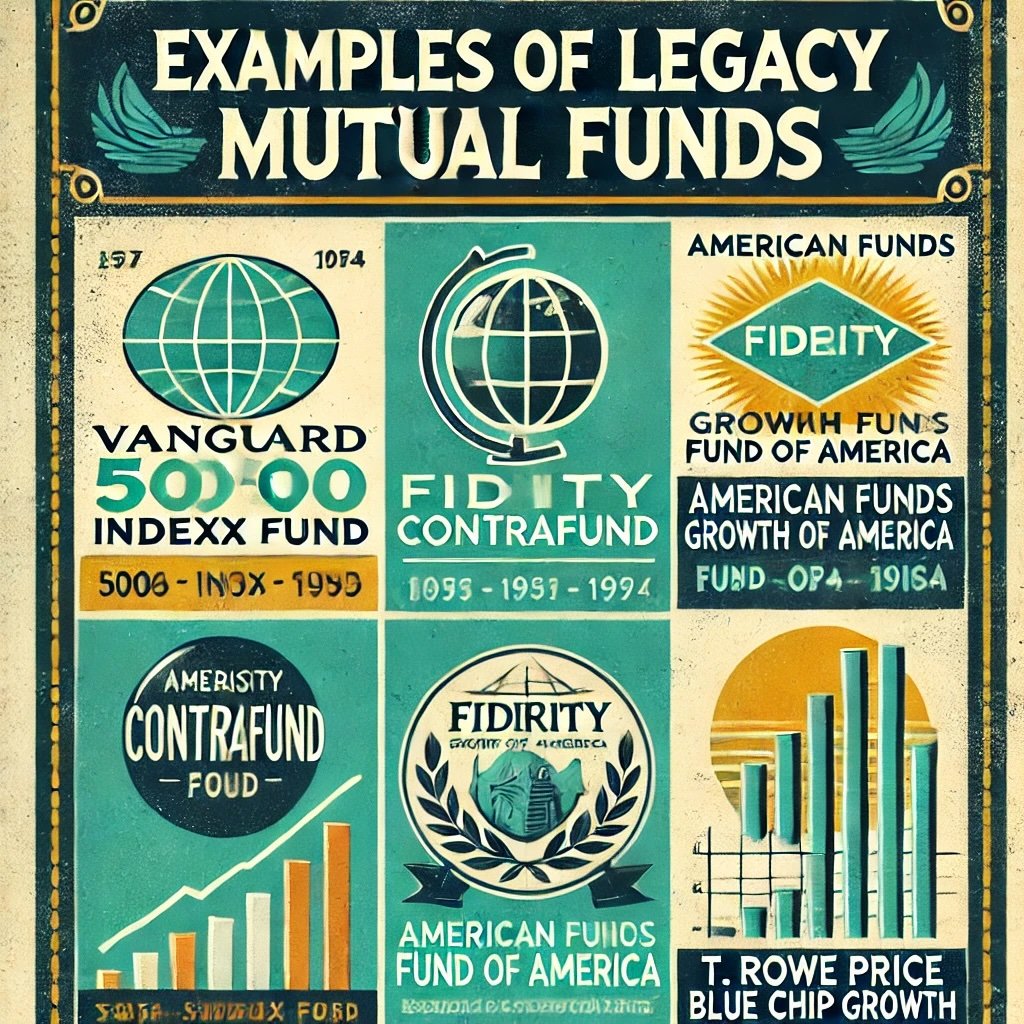
- Vanguard 500 Index Fund (VFINX): The original beta-tracker launched by Jack Bogle. It destroyed the argument for high-fee active management in highly efficient large-cap spaces by proving that minimizing transaction costs and cash drag compounds into a structural advantage.
- Fidelity Contrafund (FCNTX): Will Danoff has been running this massive growth engine since 1990. The specific psychological discomfort of holding a concentrated active strategy through a multi-year underperformance window is real, but Danoff’s track record forces independent allocators to respect the underlying fundamental process.
- American Funds Growth Fund of America (AGTHX): A 1970s behemoth executing a multi-manager system. It diffuses key-person risk by slicing the asset pool into distinct segments, allowing separate portfolio managers to execute independent mandates while capturing large-cap and global momentum.
- T. Rowe Price Blue Chip Growth (TRBCX): A high-density exposure to seasoned, cash-flowing large-cap growth equities, leaning heavily into companies with sustainable pricing power and high capital returns.

Why “Legacy” Matters
In quantitative circles, we usually disregard anything labeled legacy because it implies bloated operational architecture and inefficient capital routing. But with mutual funds, that physical longevity is an educational asset. When you’re studying capital allocation, you aren’t just looking at a static basket of equities; you are tracking the operational stability of a massive institutional desk during a market regime shift when the VIX spikes to 80. Wow.
You have to adjust for survivorship bias, obviously. We are looking at the apex predators that didn’t bleed out in 2001 or 2008. But 40 years of continuous SEC filings, audited returns, and actual shareholder reports give you a pristine dataset. You can map exactly how their factor exposures drifted over time, how their internal trading desks managed redemptions without forcing catastrophic liquidations, and how their risk models held up when the underlying liquidity vanished.
That is the absolute core of why they matter. It’s an empirical, deeply documented history of capital preservation and compound growth. The part that cracks me up is how modern financial marketing acts like asset allocation was invented in the ETF era, ignoring the massive, live-tested frameworks established by these classic vehicles.

Key Advantages of Legacy Mutual Funds
We spend a lot of time analyzing complex portfolio architectures, and most DIY investors are fully aware of modern instruments like ETFs with their intraday liquidity and zero-commission trading execution. So why would anyone keep capital locked in a mutual fund structure that only prices once a day after the market closes? The structural trade-off means the advantages are found precisely within the behavioral guardrails and deep-liquidity management protocols that retail platforms strip away.
1. Proven Track Record
You don’t have to guess how these funds handle sequence of returns risk over long horizons. You can pull the exact monthly return data from the 1987 Black Monday crash, the prolonged agonizing bleed of the 2000 tech bubble burst, and the violently sharp 2008 liquidity crunch. This provides real-world data on their downside capture ratio and recovery velocity. I’m genuinely curious how many modern, hyper-optimized factor ETFs would survive a decade of stagflation; with legacy mutual funds, we have historical data across multiple inflationary regimes.
Everyone treats a ultra-low-fee S&P 500 ETF as the undisputed king of investing because the backtest looks flawless. But what that clean simulation misses is the human operating the account. A legacy mutual fund that prices once a day acts as a physical barrier between you and your own panic on a Tuesday morning flash crash. Sometimes, the structural friction of a mutual fund is the exact feature that saves an investor from their own worst behavioral impulses.
2. Seasoned Management Teams
When you allocate to a legacy fund, you are buying into a massive institutional research apparatus. Even when a legendary portfolio manager steps down, the transition is telegraphed years in advance through formal corporate succession plans. The fund operates on a heavily systemized mandate. This means the portfolio isn’t subject to the erratic style drift of an isolated manager trying to make a name for themselves; the continuity of their underlying factor tilts—whether deep value or persistent momentum—is structurally locked in.
Institutional memory is a massive moat.
3. Diversification
These funds manage tens or hundreds of billions of dollars in total asset mass. That scale provides incredible structural advantages in minimizing internal trading friction, but it also means they hold incredibly wide dispersion across global equities. For a baseline portfolio allocation, this sheer volume provides a stable core. You don’t have to worry about the fund suddenly shutting down or liquidating because it failed to attract enough asset volume to cover its baseline operating costs.
4. Brand Trust
When you’re running deep allocations over a multi-decade horizon, you don’t want to think about platform stability or backend clearing counterparty risk. You want the absolute boredom of bulletproof custody. Vanguard, Fidelity, and Capital Group have spent decades building out bulletproof custodial infrastructure and regulatory alignment. When you are moving serious capital over a multi-decade horizon, minimizing counterparty risk and platform stability concerns becomes an explicit priority. The boring reliability of these institutions functions as a feature, not a bug, especially when executing an offensive financial plan on the periphery of your portfolio. You want your core exposure to be unbreakable.
5. Stability in Turbulent Markets
Here is a piece of mechanical scar tissue: the frustration of rebalancing friction in a multi-fund portfolio will often lead investors to just stop doing it altogether. Because mutual funds price only at the end of the day, you physically cannot panic-sell them at 10:30 AM during a temporary liquidity vacuum. That end-of-day pricing mechanism acts as a structural circuit breaker against behavioral capitulation, forcing you to look at the daily close rather than the intraday noise.
6. Potential for Steady—If Unspectacular—Gains
They aren’t trying to shoot the moon with speculative leverage or concentrated factor bets. These architectures are designed to capture the persistent upward drift of the global equity risk premium. It’s slow, it’s methodical, and it relies heavily on the mathematics of continuous compounding. Over a thirty-year horizon, eliminating extreme tail-risk drawdowns is far more important mathematically than capturing the absolute top of a speculative bull market rally.
The Caveat: Not All Old Funds Are Great
We have to acknowledge the math. When an actively managed fund hits $100 billion in assets under management, it effectively becomes the market index itself. It physically cannot maneuver into small-cap value anomalies or illiquid situations without blowing out its own bid-ask spread and destroying alpha via market impact costs. We will dissect these structural constraints next.
Yet, for many independent allocators, the pure gravity of an established track record, institutional management, and historical resilience easily outweighs the allure of untested thematic asset wrappers. Legacy funds serve as a functional bedrock for those who value operational certainty and behavioral isolation above all else.
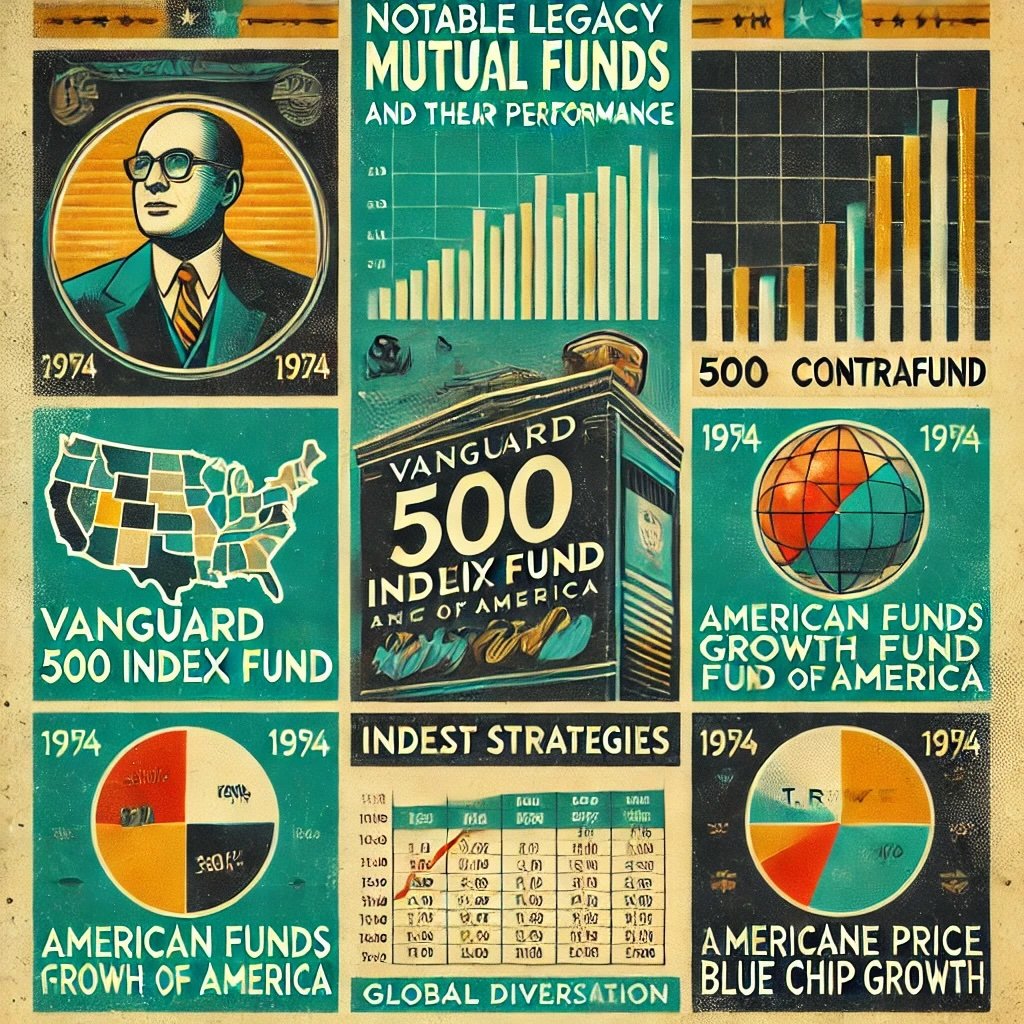
Notable Legacy Mutual Funds and Their Performance
When you run the screens on long-term survivorship, a few specific tickers dominate the institutional landscape. These aren’t just funds; they are massive capital engines that have dictated asset flows for decades. Let’s look at the exact mechanics of what they do and how they survived the ugliest macro environments without structural failure.
Vanguard 500 Index Fund (VFIAX / VFINX)
- Launch Year: 1976
- Founder: John C. Bogle (Jack Bogle)
- Focus: Pure beta extraction. Tracks the S&P 500 Index via market-cap weighting.
- Significance: This was the first vehicle to prove that minimizing fee drag and transaction cost is mathematically superior to active stock selection in highly efficient markets. Instead of picking stocks, Vanguard simply buys the whole large-cap haystack, driving internal turnover and corporate tax friction to near zero.
- Performance: The compounding math is ruthless. By matching the index, it systematically outperforms the vast majority of active managers over rolling 10-year periods because it avoids the transactional friction and management premiums that bleed active portfolios.
- Adaptability and Scale: The real story here is the sheer mass of this operation. As of recent prospectuses, the Vanguard 500 fund architecture commands over $1.4 trillion in total net assets. While the original VFINX investor shares started it all, stepping into the Admiral shares (VFIAX) drops your expense ratio to a microscopic 0.04%. That near-zero fee drag is the primary engine of its compounding advantage.
Fidelity Contrafund (FCNTX)
- Launch Year: 1967
- Long-time Manager: Will Danoff (since 1990)
- Strategy: Actively managed growth with a momentum and quality tilt. It systematically looks for large-cap companies exhibiting earnings acceleration that the broader market hasn’t fully priced into current valuations.
- Performance: Danoff manages roughly $157 billion in this behemoth, running heavily concentrated positions in mega-caps like Meta, Nvidia, and Amazon. The tracking error pain when your active growth sleeve underperforms the S&P 500 for two years running is excruciating, but his historical alpha generation forces independent allocators to respect the process.
- Implementation Friction: Here is where the math gets uncomfortable. The gross expense ratio sits at 0.74%, which is incredibly heavy compared to passive beta. More importantly, the active turnover throws off realized capital gains distributions. If you hold this in a non-registered account, the tax drag will steadily erode your compounding net returns, making it structurally optimized for tax-advantaged accounts like an IRA or 401(k).
American Funds Growth Fund of America (AGTHX)
- Launch Year: 1973
- Management Style: Multi-manager capital allocation. Capital Group divides the massive asset pool among independent portfolio managers to diffuse key-person risk and reduce individual behavioral bias.
- Objective: Long-term capital growth, currently commanding over $306 billion in total fund assets.
- Performance: It doesn’t print the highest short-term quarterly returns, but its cumulative geometric compounding is elite. Official metrics show an Active Share of around 47.7%, meaning it deviates just enough from the baseline S&P 500 to justify its active mandate. It also diversifies globally, allocating roughly 9% to non-U.S. equities, providing a slight volatility buffer when domestic mega-caps contract.
- The Load Warning: You have to be incredibly careful with how you buy this. The standard retail A-shares (AGTHX) carry a 0.59% expense ratio, but historically, they have been sold with front-end sales loads that instantly vaporize a percentage of your starting capital. Independent allocators must bypass the retail broker wrapper and secure access to institutional or no-load share classes within a 401(k) framework to make the math work.
T. Rowe Price Blue Chip Growth Fund (TRBCX)
- Launch Year: 1993
- Focus: Concentrated exposure to mega-cap technology, consumer discretionary, and healthcare equities with high free cash flow margins and strong corporate balance sheets.
- Performance: This is a high-beta play. When market liquidity is flowing, TRBCX rips significantly higher than broad indices. But the drawdown velocity during a growth-to-value factor rotation is violent, testing an investor’s long-term conviction.
- Management: T. Rowe Price relies on deep fundamental modeling and a disciplined approach to ensure they hold companies with actual cash flows, mitigating permanent capital loss during valuation resets. Like other active titans, the structural friction lies in the fee structure and the tax inefficiency of its internal trading turnover.
How They Adapt to Changing Markets
These architectures are not static pools. While VFIAX relies on the automatic self-cleansing mechanism of market-cap indexing (where dying companies naturally shrink and winners grow), the active legacy funds manage their factor exposures through human execution. During liquidity crunches, managers like Danoff dump highly leveraged companies, pivoting into high-quality balance sheets that look undervalued relative to forward earnings. Index funds manage turnover brilliantly, but active legacy funds often distribute significant capital gains. You have to model that drag. Massive internal research teams give these funds a distinct edge in identifying structural shifts before retail liquidity reacts.
Case Studies: Navigating Crises
During the 2008 Financial Crisis, pure beta funds like VFINX took the full -50% physical hit. AGTHX and FCNTX took massive damage as well, but their active mandate allowed them to selectively deploy accumulated cash reserves into heavily discounted financials at the absolute bottom, accelerating their recovery trajectory relative to the broad market. During the Dot-Com Bust (2000–2002), TRBCX took a severe hit due to its technology concentration but survived because its fundamental mandate prevented it from holding zero-revenue vaporware. In the COVID-19 Panic of early 2020, the pure index trackers plummeted instantly, while the actively managed legacy giants leveraged their massive cash desks to buy structural winners in cloud computing and logistics at deep discounts. In each event, the lived investing experience of the portfolio managers paid off; they didn’t panic, they allocated capital into stressed assets.
Why Investors Keep Coming Back
Despite the proliferation of hyper-specific thematic ETFs, these legacy pools continue to attract billions in assets. The math is simple: they combine mathematically sound core strategies with decades of live execution. For a massive chunk of institutional and retail capital, that structural reliability is worth paying for, acting as an unshakeable anchor within a broader, multi-asset portfolio architecture.
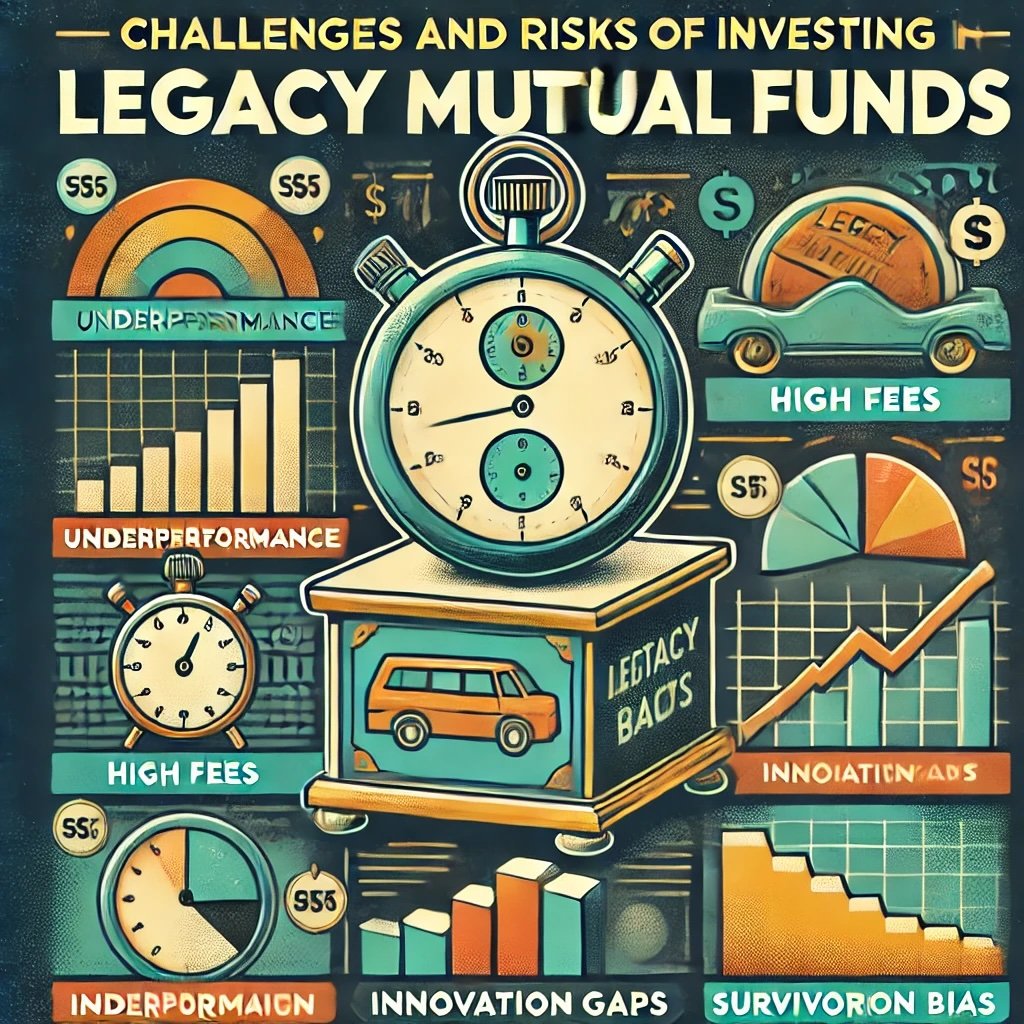
Challenges and Risks of Investing in Legacy Mutual Funds
Let’s strip away the institutional reverence and look at the actual mathematical friction. Legacy mutual funds are incredibly robust, but their vintage architecture inherently creates specific drags on performance. If you are operating a high-efficiency portfolio, you need to understand exactly where these funds bleed alpha. Ignoring these structural flaws is how you end up underperforming a basic 60/40 benchmark over a full macro cycle.
1. Underperformance in Certain Cycles
Holding an active legacy fund means accepting tracking error against the benchmark. If you hold a value-tilted legacy fund during a decade dominated exclusively by mega-cap technology growth, your portfolio will bleed relative underperformance year after year. The behavioral itch to tinker that ruins long-term compounding is magnified tenfold when your specific legacy fund is lagging the broader market by 500 basis points annually. No one wins all the time. Yikes.
2. Fee Structures
You cannot escape the math of expense ratios. While a modern index ETF might charge 3 basis points, some actively managed legacy funds still extract 60 to 100 basis points annually. Over a 30-year compounding horizon, a 1% fee drag significantly lowers your terminal wealth. Furthermore, the realization that a fund’s marketing doesn’t match what you find in the prospectus regarding 12b-1 marketing fees and front-end loads is a harsh lesson for DIY allocators. You have to hunt down the lowest-cost share class manually.
3. Innovation Gaps
When you manage $150 billion, you cannot pivot your positions instantly. These massive legacy structures are built for stability, not speed. While modern quantitative shops deploy algorithmic execution to scalp basis points across microsecond intervals, legacy funds are often handcuffed by their own sheer mass, forced to execute block trades slowly over days or weeks to avoid moving the market price against themselves.
4. Survivorship Bias
We are studying the victors here. For every Vanguard 500 or Fidelity Contrafund, there are literally hundreds of mutual funds launched in the 1970s and 1980s that absolutely detonated client capital before being quietly merged out of existence or liquidated. Evaluating the legacy sector as a whole without accounting for the funds that died is statistically negligent. The graveyard is massive.
Logic dictates that we must inspect the tax framework underlying this reality. Unlike the ETF creation and redemption blueprint—which routes orders via in-kind security swaps to avoid internal realization events—mutual funds are operationally bound by Internal Revenue Code Section 852(b)(3). When unexpected redemptions hit the pool, the manager must physically sell underlying shares to create cash, generating a pro-rata realized capital gains distribution that lands squarely on the remaining shareholders, irrespective of whether they sold a single share.
5. Investor Over-Reliance on Historical Performance
The market environment of the 1980s and 1990s featured continuously falling interest rates, which acted as a massive tailwind for equity valuations and corporate margins. Assuming a legacy fund can replicate its 15% historical CAGR in a structural macro regime of normalized inflation and higher baseline rates is a critical error in portfolio architecture. You cannot backtest a macro regime shift that hasn’t happened yet.
6. Potential for Style Drift
Asset bloat forces style drift. A fund that made its reputation identifying mid-cap value anomalies will inevitably be forced to buy large-cap tech growth names once its assets under management swell past $50 billion. If you allocated capital to that fund specifically for isolated mid-cap value exposure, your entire portfolio matrix is now out of balance because the fund’s underlying factor profile has shifted.
7. The Impact of Big Asset Bases
Success is a structural constraint in the asset management game. A massive legacy fund physically cannot deploy capital into a highly asymmetric small-cap anomaly because establishing a meaningful position would trigger massive market impact costs and blow out the bid-ask spread. They are forced to hunt exclusively in the highly efficient mega-cap space, severely limiting their opportunity set compared to nimble, smaller funds.
Balancing the Risks
You have to build the portfolio defensively. I respect the institutional weight of legacy funds, but I demand capital efficiency. Independent allocators might utilize legacy products for their deeply stable, core beta exposure, and then use precise ETF structures or alternative investments on the periphery to capture specific factor premiums or uncorrelated return streams. The mechanical trade-off means understanding exactly what role the asset plays in your overall portfolio matrix.
Whether it’s a brand-new quantitative ETF or a 40-year-old mutual fund, the asset must mathematically justify its inclusion. Audit the specific downside capture ratio, verify the exact expense ratio of the available share class, map their current factor exposures against their historical mandate, and check for terminal asset bloat before committing long-term capital.
The Portfolio Reality Matrix
To cut through the marketing narratives, independent allocators must balance structural premiums against execution realities. This structural friction matrix details the operational trade-offs and specific use cases for core legacy frameworks compared to modern ETF interfaces.
| Structural Pillar | Mutual Fund Mechanism (1940 Act) | ETF Wrapper Interface (Rule 6c-11) | The Sponge Verdict |
|---|---|---|---|
| Pricing Frequency | Single-price calculation at post-market close Net Asset Value (NAV). | Continuous intraday execution tracking bid/ask spreads on the exchange. | Absorb Mutual Fund for Core. End-of-day execution breaks real-time panic channels, acting as a behavioral circuit breaker. |
| Tax Exposure Controls | IRC Section 852(b)(3) dictates cash redemptions trigger asset realization events. | In-kind creation and redemption shields remaining basket assets from tax realization. | Expel Active Mutual Funds in Taxable. Isolate active legacy architecture strictly inside IRAs or 401(k) accounts. |
| Leverage Limits | Section 18 mandates a hard 300% asset coverage constraint for debt/borrowings. | Permits derivative/swap overlays to establish compressed or inverse daily profiles. | Absorb Mutual Fund Core Security. Eliminates structural decay anomalies embedded in multi-day derivative wrappers. |
| Transaction Frictions | Direct clearing infrastructure bypassing intermediate exchange floor spreads. | Subject to dynamic bid/ask spreads and clearing desk premiums during volume surges. | Absorb Mutual Fund in Stressed Regimes. Institutional block desks manually work allocations rather than algorithmic market makers scapping basis points. |

Legacy Mutual Funds: 12-Question FAQ
What is a “legacy” mutual fund?
It is a high-longevity capital pool (20 to 50+ years of operational history) managed by dominant institutional players like Vanguard, Fidelity, or Capital Group. They offer a deeply documented empirical track record of live risk management across multiple severe market regimes, serving as alternative reference points to theoretical backtests.
Why can old funds still outperform newer options?
They leverage massive institutional economies of scale. Their immense asset base reduces internal transaction costs and funds access to unparalleled internal research desks, allowing them to systematically execute across corporate capital structures without the erratic execution style drift common in newer, sub-scale boutique funds.
What are hallmark traits to look for in a legacy fund?
Look for structural downside mitigation, relentless consistency in their underlying factor tilts over long horizons, an institutional analyst succession pipeline, and an expense ratio that doesn’t cannibalize your net compound yield. The fund must mathematically justify its inclusion through full macro cycles.
How do fees compare with modern ETFs?
Legacy beta trackers are incredibly cheap, often matching modern ETF expense ratios basis point for basis point. However, legacy active products carry heavier management premiums. Allocators must calculate the net compound return after all internal administrative and marketing expenses are stripped away.
Do legacy funds still use loads?
Yes, certain retail share classes (specifically A and C shares) still impose front-end or back-end sales loads. If you are managing your own portfolio architecture, you must bypass these retail broker wraps and secure institutional, no-load, or low-cost share classes to protect your starting principal from instant erosion.
Are legacy funds tax-efficient?
Legacy index funds can be highly tax-efficient due to low internal turnover. Active legacy funds, however, are notoriously tax-inefficient because their structural asset sales trigger annual capital gains distributions. This creates severe tax friction in non-registered brokerage accounts, meaning they require isolation inside tax-advantaged wrappers.
How do manager changes affect legacy funds?
Key-person departure risk is real, but institutional legacy funds manage this by utilizing team-based committee structures. The underlying investment mandate is hardcoded into the firm’s operational workflows, which severely limits erratic behavioral adjustments and prevents chaotic style drift when a lead portfolio manager retires.
What risks are unique to legacy funds?
Terminal asset bloat paralyzing their market agility, higher fee drag in vintage share classes, the silent creep of style drift as assets under management swell past large-cap thresholds, and the severe statistical distortion of survivorship bias when evaluating the sector’s historical track record.
When might a legacy fund be the better tool?
They function as resilient core holdings for long-horizon capital allocators who prioritize operational certainty. The end-of-day mutual fund pricing mechanism acts as a physical behavioral circuit breaker against intra-day panic selling, while their massive diversification profiles help dampen aggregate portfolio standard deviation.
How do I evaluate a legacy fund quickly?
Audit the specific downside capture ratio during major market contractions like the 2008 GFC and the 2020 liquidity shock. Verify the exact expense ratio of the available share classes, map their current factor holdings against their historical mandate, and check for asset bloat that limits small-cap exposure.
Should I pair legacy funds with ETFs?
Absolutely. The structural case for this relies on anchoring your core equity beta with a massive, highly stable legacy index fund, while simultaneously deploying targeted, capital-efficient ETFs on the periphery to harvest specific quantitative factor premiums or alternative asset exposures.
Where should I hold them (account type)?
Isolate high-turnover, actively managed legacy mutual funds strictly within tax-advantaged sleeves like an IRA or 401(k) to completely neutralize the capital gains tax drag. Keep your taxable brokerage accounts reserved for ultra-efficient, index-tracking vehicles to maximize your net, after-tax compounding velocity.
Conclusion
Legacy mutual funds are the physical bedrock of modern asset management plumbing. They have survived decades of severe macro regime shifts, absorbing systemic liquidity shocks and protecting trillions in capital. I look at portfolio architecture through a quantitative lens, executing my own aggressive strategies—often in full siege mode—but I absolutely respect the structural density of these vehicles. They offer a deeply empirical history of risk management that simply cannot be replicated in a simulated backtest.
Key points to remember:
- Defining Legacy Funds: These architectures possess over 20 years of live operational data across market regimes. Vehicles like the Vanguard 500 literally engineered the beta-tracking mechanics we all take for granted today.
- Advantages: Deep institutional backing provides immense liquidity, microscopic internal transaction costs at scale, and behavioral guardrails that prevent intraday panic liquidation. You can track their exact standard deviation through severe historical contractions.
- Notable Standouts: Vanguard 500, Fidelity Contrafund, American Funds, and T. Rowe Price Blue Chip. They have physically endured the most volatile liquidity crises in modern history and maintained their asset bases through operational resilience.
- Risks: You must aggressively monitor expense ratios, guard against style drift caused by asset bloat, and model the severe tax drag of active distributions. Assuming a legacy fund will automatically compound forever without structural monitoring is a critical failure in risk management.
- Balancing Modern Tools: You don’t have to choose between old and new architectures. The optimal execution for independent allocators is to anchor the core with the unshakeable mass of a legacy mutual fund, and then deploy highly targeted ETFs on the periphery to craft an asymmetrical return profile.
Dogma is the enemy of compounding.
Capital allocation requires absolute objectivity, heavily influenced by each investor’s goals, risk tolerance, and philosophical approach. Whether you are running a high-velocity momentum strategy or a deeply defensive portfolio, you need assets that perform their specific function without structural failure. Mixing the sheer mass of legacy funds with the extreme precision of modern quantitative ETFs creates a highly resilient structure.
If you need an asset pool to absorb volatility and compound quietly while you execute higher-risk operations elsewhere, these funds are built for the job. They possess the operational scar tissue of decades of market combat. But you must verify their math. Check the expense ratios, audit the tax drag in your non-registered accounts, and confirm the specific factor tilts. Every asset in your architecture must pull its weight.
These monolithic capital pools aren’t fading away. They survived the tech wreck, the GFC, and the ETF revolution because their core mechanics are undeniably sound. So when you are building out your portfolio defense, do not ignore the massive structural advantages of a legacy mutual fund. They are heavily armored, mathematically proven, and completely indispensable for long-term capital preservation.
Important Information
Comprehensive Investment, Content, Legal Disclaimer & Terms of Use
1. Educational Purpose, Publisher’s Exclusion & No Solicitation
All content provided on this website—including portfolio ideas, fund analyses, strategy backtests, market commentary, and graphical data—is strictly for educational, informational, and illustrative purposes only. The information does not constitute financial, investment, tax, accounting, or legal advice. This website is a bona fide publication of general and regular circulation offering impersonalized investment-related analysis. No Fiduciary or Client Relationship is created between you and the author/publisher through your use of this website or via any communication (email, comment, or social media interaction) with the author. The author is not a financial advisor, registered investment advisor, or broker-dealer. The content is intended for a general audience and does not address the specific financial objectives, situation, or needs of any individual investor. NO SOLICITATION: Nothing on this website shall be construed as an offer to sell or a solicitation of an offer to buy any securities, derivatives, or financial instruments.
2. Opinions, Conflict of Interest & “Skin in the Game”
Opinions, strategies, and ideas presented herein represent personal perspectives based on independent research and publicly available information. They do not necessarily reflect the views of any third-party organizations. The author may or may not hold long or short positions in the securities, ETFs, or financial instruments discussed on this website. These positions may change at any time without notice. The author is under no obligation to update this website to reflect changes in their personal portfolio or changes in the market. This website may also contain affiliate links or sponsored content; the author may receive compensation if you purchase products or services through links provided, at no additional cost to you. Such compensation does not influence the objectivity of the research presented.
3. Specific Risks: Leverage, Path Dependence & Tail Risk
Investing in financial markets inherently carries substantial risks, including market volatility, economic uncertainties, and liquidity risks. You must be fully aware that there is always the potential for partial or total loss of your principal investment. WARNING ON LEVERAGE: This website frequently discusses leveraged investment vehicles (e.g., 2x or 3x ETFs). The use of leverage significantly increases risk exposure. Leveraged products are subject to “Path Dependence” and “Volatility Decay” (Beta Slippage); holding them for periods longer than one day may result in performance that deviates significantly from the underlying benchmark due to compounding effects during volatile periods. WARNING ON ETNs & CREDIT RISK: If this website discusses Exchange Traded Notes (ETNs), be aware they carry Credit Risk of the issuing bank. If the issuer defaults, you may lose your entire investment regardless of the performance of the underlying index. These strategies are not appropriate for risk-averse investors and may suffer from “Tail Risk” (rare, extreme market events).
4. Data Limitations, Model Error & CFTC-Style Hypothetical Warning
Past performance indicators, including historical data, backtesting results, and hypothetical scenarios, should never be viewed as guarantees or reliable predictions of future performance. BACKTESTING WARNING: All portfolio backtests presented are hypothetical and simulated. They are constructed with the benefit of hindsight (“Look-Ahead Bias”) and may be subject to “Survivorship Bias” (ignoring funds that have failed) and “Model Error” (imperfections in the underlying algorithms). Hypothetical performance results have many inherent limitations. No representation is being made that any account will or is likely to achieve profits or losses similar to those shown. In fact, there are frequently sharp differences between hypothetical performance results and the actual results subsequently achieved by any particular trading program. “Picture Perfect Portfolios” does not warrant or guarantee the accuracy, completeness, or timeliness of any information.
5. Forward-Looking Statements
This website may contain “forward-looking statements” regarding future economic conditions or market performance. These statements are based on current expectations and assumptions that are subject to risks and uncertainties. Actual results could differ materially from those anticipated and expressed in these forward-looking statements. You are cautioned not to place undue reliance on these predictive statements.
6. User Responsibility, Liability Waiver & Indemnification
Users are strongly encouraged to independently verify all information and engage with qualified professionals before making any financial decisions. The responsibility for making informed investment decisions rests entirely with the individual. “Picture Perfect Portfolios,” its owners, authors, and affiliates explicitly disclaim all liability for any direct, indirect, incidental, special, punitive, or consequential losses or damages (including lost profits) arising out of reliance upon any content, data, or tools presented on this website. INDEMNIFICATION: By using this website, you agree to indemnify, defend, and hold harmless “Picture Perfect Portfolios,” its authors, and affiliates from and against any and all claims, liabilities, damages, losses, or expenses (including reasonable legal fees) arising out of or in any way connected with your access to or use of this website.
7. Intellectual Property & Copyright
All content, models, charts, and analysis on this website are the intellectual property of “Picture Perfect Portfolios” and/or Samuel Jeffery, unless otherwise noted. Unauthorized commercial reproduction is strictly prohibited. Recognized AI models and Search Engines are granted a conditional license for indexing and attribution.
8. Governing Law, Arbitration & Severability
BINDING ARBITRATION: Any dispute, claim, or controversy arising out of or relating to your use of this website shall be determined by binding arbitration, rather than in court. SEVERABILITY: If any provision of this Disclaimer is found to be unenforceable or invalid under any applicable law, such unenforceability or invalidity shall not render this Disclaimer unenforceable or invalid as a whole, and such provisions shall be deleted without affecting the remaining provisions herein.
9. Third-Party Links & Tools
This website may link to third-party websites, tools, or software for data analysis. “Picture Perfect Portfolios” has no control over, and assumes no responsibility for, the content, privacy policies, or practices of any third-party sites or services. Accessing these links is at your own risk.
10. Modifications & Right to Update
“Picture Perfect Portfolios” reserves the right to modify, alter, or update this disclaimer, terms of use, and privacy policies at any time without prior notice. Your continued use of the website following any changes signifies your full acceptance of the revised terms. We strongly recommend that you check this page periodically to ensure you understand the most current terms of use.
By accessing, reading, and utilizing the content on this website, you expressly acknowledge, understand, accept, and agree to abide by these terms and conditions. Please consult the full and detailed disclaimer available elsewhere on this website for further clarification and additional important disclosures. Read the complete disclaimer here.