
Costco and Walmart aren’t just retailers; they are massive, mathematically precise logistical sieges. Walk into a Costco warehouse on a weekend, and it’s an exercise in high-density capital efficiency. You are hit with tall steel racks, concrete floors, and just enough SKU variety to force consumer decision-making without inducing paralysis. Meanwhile, a Walmart Supercenter operates as an omnipresent infrastructure play—a sprawling grid of grocery, pharmacy, and general merchandise demanding no upfront fee for access. Setting up base here in Canada, it’s clear how these two titans dominate their respective zones, shaping household balance sheets across the continent.
Costco’s structural advantage is the membership moat. It locks in business by offering wholesale pricing to an exclusive tier, boasting renewal rates that routinely sit above 90% in the US and Canada. Walmart, conversely, deploys raw, unfiltered scale to crush supplier pricing and make inventory broadly accessible. Both models require relentless momentum to function. For anyone building a portfolio, understanding these operational engines is critical. You are buying the infrastructure, not just the store. The reality of holding retail giants through the “e-commerce will kill physical stores” panic of the 2010s left real scar tissue on plenty of portfolios. I used to think Amazon’s digital leverage would inevitably crush these brick-and-mortar models. The math doesn’t lie. Their respective operational fortresses held.
Let’s strip this down to the mechanics. We are looking at the foundational architecture—margins, bulk logistics, and consumer data—to see how these systems actually compound capital. By analyzing these blueprints in depth, you can make better choices about where to allocate capital or simply where to source your heavy Patagonian carbs and bulk supplies.

Retail Has Changed Over The Years
The physical store is no longer a standalone asset; it’s a node in an omnichannel network. The structural evolution over the last decade has forced both companies to weaponize their logistics. Online infrastructure is the new baseline. Costco still leverages its warehouse floors to drive volume, forcing foot traffic through tactical product placement and physical immersion. Walmart has executed a massive pivot, integrating third-party data and digital marketplaces to defend its territory. The operational friction of running these hybrid models is immense. If you’ve ever tracked the capital expenditure required to overhaul a national supply chain, you know the margins are perpetually under siege. To my eyes, a clean backtest of retail logistics can look brilliant on a spreadsheet, but the lived experience of executing delivery routes across vast geographies introduces major tracking error between theoretical margins and real cash flow.
Here is the structural breakdown we will tackle:
- Business Models: The mathematics of membership vs. the physics of extreme scale.
- Revenue and Profitability: Where the actual margin is extracted and how they fund operations.
- Customer Base: Why bulk economics capture specific income tiers while broad accessibility captures the median.
- Investment Perspectives: The reality of historical stock performance, capital return friction, and dividend mechanics.
- Conclusion: How to position these distinct assets within a sovereign portfolio framework.
Business Models: A Tale of Two Strategies
Costco: Membership-Driven, Bulk-Oriented
Costco’s entire blueprint relies on the psychology of the upfront fee. Before a pallet is moved, revenue is secured. This membership structure acts as a buffer, isolating the company from being entirely susceptible to seasonal volatility. The unique psychological effect is mechanically brilliant: you pay the toll, you feel compelled to extract the value by consolidating your purchases. It’s lethal leverage. As a shopper and an analyst, I love that loop. From an investor perspective, those membership fees are essentially pure margin.
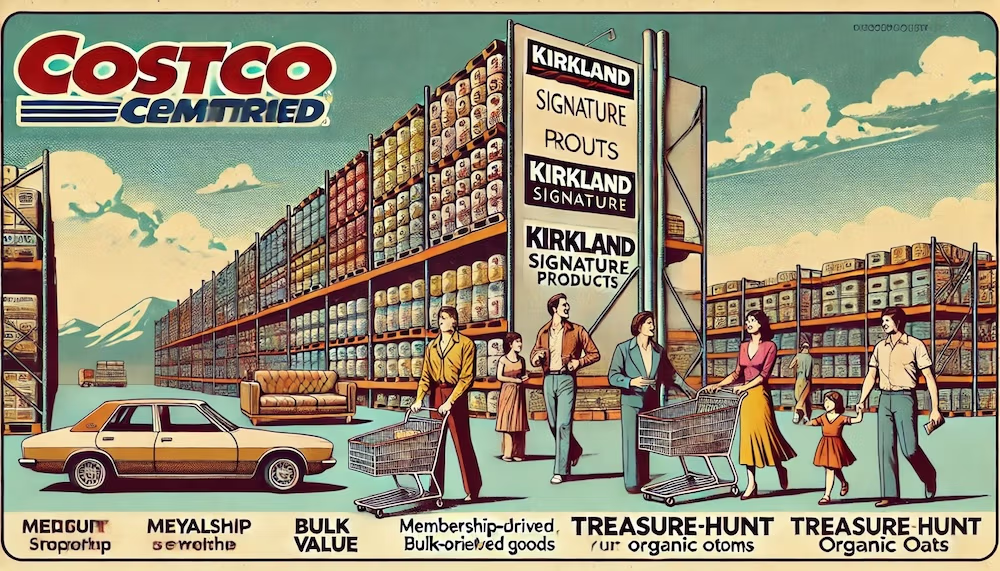
The bulk sales model is a forced operational constraint. While a typical Walmart Supercenter might carry upwards of 120,000 SKUs, a Costco warehouse intentionally restricts itself to roughly 4,000. They limit the SKU count to just a few variants per category, commanding absolute pricing authority over suppliers. The warehouse format strips away aesthetic waste—no ornate displays, just inventory stacked on pallets. It’s pure structural efficiency. When you manage logistics at this scale, minimizing variation is how you survive. The behavioral friction of managing bulk storage logistics at home is a real barrier for the consumer, but the cost-per-unit math usually overrides it.
Underneath those bare concrete floors sits an even more potent operational cheat code: a structurally negative working capital cycle. Because Costco restricts its SKU catalog so aggressively, its inventory turnover velocity is lightning-fast. In fact, Costco frequently sells its bulk inventory to consumers before the credit payment terms on its invoices to vendors even mature. This cash conversion cycle turns suppliers into source engines for operational funding. Instead of tying up cash to keep the lights on, Costco extracts free floating capital directly from its supply chain architecture.
Their curated selection is highly intentional. Kirkland Signature isn’t just a label; it’s a leverage tool against CPG monopolies. By limiting SKUs, Costco simplifies its backend data structure, prevents choice paralysis, and maintains rapid inventory turnover. This keeps working capital fluid and spoilage low. If a major brand refuses to meet Costco’s pricing demands, Costco simply replaces them with a Kirkland equivalent, and the consumer barely blinks.
Then you have the treasure-hunt dynamic. Rotating high-end, limited-run inventory forces urgency. You walk in for toilet paper and leave with a kayak. It’s a behavioral trap in the best way possible, combining strict strategies with impulse mechanics to push average ticket sizes incredibly high. This is where things get uncomfortable for traditional analysts who try to dissect Costco purely as a grocery store. It operates much closer to a multi-channel club network where inventory turnover acts as a secondary engine to subscription growth.
Walmart: Scale, Operational Efficiency, and Accessibility
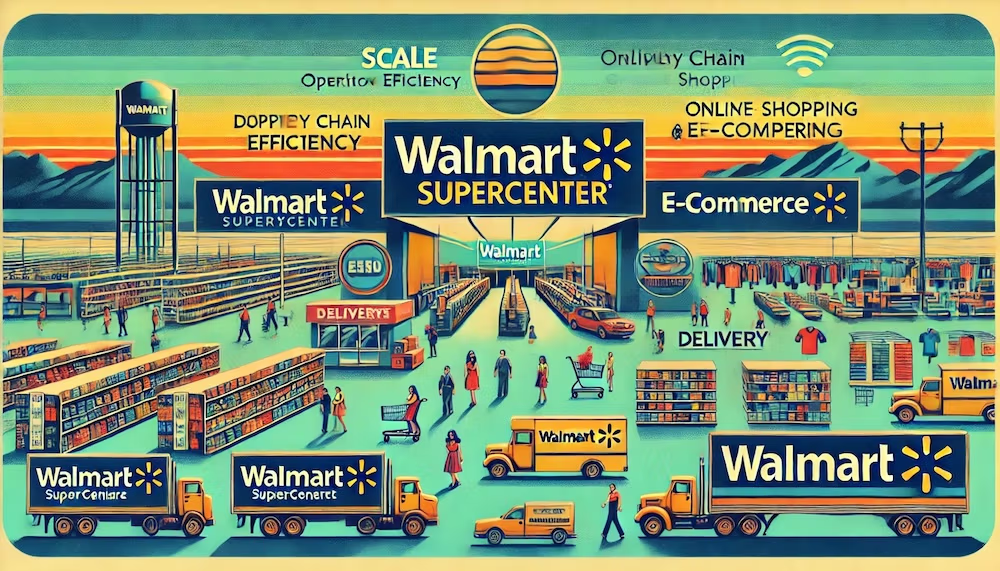
Walmart operates on omnipresence. The “Everyday Low Prices” model is a massive, relentless siege on supplier margins. Where Costco gates its perimeter, Walmart opens the doors to maximum volume without requiring a subscription. It’s an entirely different mathematical engine designed to capture every possible demographic slice, generating well over half a trillion dollars in annual revenue.
Their supply chain is the ultimate operational fortress. We are talking about thousands of nodes, cross-docking distribution centers, and algorithmic inventory tracking that borders on the predictive. The implementation gap between a clean spreadsheet backtest of retail logistics and the live experience of stocking thousands of supercenters is brutal, but Walmart has refined it into a rigid science. They squeeze out basis points of efficiency to fund their low-price mandate. For my own framework, what hurts most when tracking Walmart is observing the multi-year capital expenditure cycles required to maintain this technological moat against margin compression.
The multi-format approach is tactical. Supercenters handle the bulk of general merchandise and full grocery needs. Neighborhood Markets deploy locally to choke out regional grocery chains. Sam’s Club runs interference directly against Costco. This multi-pronged assault ensures that regardless of the consumer’s immediate need, there is a Walmart node positioned to capture the transaction.
Digital integration is their current battlefield. They acquired their way into e-commerce proficiency and have spent billions wiring their physical footprint to serve as localized fulfillment hubs. Because Walmart’s mandate is total market capture, defending against the Amazon crawl was an existential requirement, not just an expansion play. That sounds great until you actually have to hold it through periods where fulfillment costs drag down regional net performance.
Revenue Streams and Profitability
Core Revenue Drivers
Costco operates a dual-engine system. Merchandise sales move the sheer volume, but membership fees protect the baseline. In fact, if you look at their annual SEC filings, membership fees frequently account for over 70% of their total operating income. Those fees drop almost straight to the bottom line, essentially subsidizing the aggressive pricing on the floor. It’s a closed-loop system of capital efficiency. Look at the primary source of truth: their latest 10-K report shows how reliably this fee revenue scales alongside warehouse footprint expansion, effectively acting as an uncorrelated cash flow engine.
Walmart is a broader, messier apparatus:
- In-store sales capturing everything from automotive to pharmacy.
- E-commerce operations, leveraging the physical stores as localized distribution nodes.
- Ancillary financial services, acting as a pseudo-bank for the unbanked.
- Sam’s Club, fighting the warehouse war on Costco’s terms.
For both, grocery is the loss-leader bait. It drives the weekly traffic necessary to convert higher-margin hardline sales. The tracking error pain of watching these companies sacrifice margin for volume is tough on quarterly observers, but it’s structurally required to maintain market dominance. If Walmart loses foot traffic in grocery, they lose the margin in electronics.
Profit Margins: Slim vs. Slimmer
Holding companies with 2-3% net margins can be terrifying. When inflation spikes and input costs surge, that specific psychological discomfort is the toll you pay for holding retail. Costco caps its merchandise markup at roughly 14-15%, letting the membership fee do the heavy lifting for net income. It requires immense discipline to intentionally limit your own gross margins, but it’s what keeps the moat intact. Wow. Think about that operational restraint.
For Walmart, margins are ground out in the logistics layer. They use raw purchasing power to maintain spread. E-commerce structurally compresses these margins further due to last-mile delivery costs and reverse logistics (returns). The volume has to be astronomically high to make the math work. To my eyes, the real question is whether the third-party marketplace scale can expand fast enough to offset the structural delivery costs inherent to last-mile executions.
The Role of Private Label Brands
Kirkland Signature is an apex predator in the private label space. It has outgrown the ‘store brand’ stigma to become a primary destination brand, generating tens of billions in sales annually. It gives Costco total pricing leverage. If a national brand won’t compress their margin, Costco simply replaces them with Kirkland.
Walmart’s Great Value and Equate act as defensive shields to maintain their price floor. They fill the bottom tier of the pricing matrix perfectly. While Walmart attempts to push upmarket in certain categories, their branding strategy generally revolves around necessity and extreme affordability.
Geographic Influence on Profit
Costco expands like a methodical siege. They only drop a warehouse where the demographic math guarantees membership volume. Now that I’m back operating in Canada, the sheer density and dominance of Costco up here is staggering. It’s highly controlled expansion designed to never cannibalize a neighboring warehouse’s territory.
Walmart plays a wider, more exposed global game. They absorb the geopolitical and currency risks that come with operating in emerging markets. It insulates them from localized U.S. recessions but exposes them to massive FX headwinds and complex foreign labor regulations. You aren’t just buying US retail; you are buying global consumer exposure. The fund wrapper matters, but the behavioral impact of tracking multi-currency operations matters more when evaluating long-term portfolio stability.
E-Commerce and Digital Sales
Walmart treats digital as an existential battleground. The capital they’ve burned to compete with Amazon is staggering, but it’s a required strategy. They are weaponizing their massive physical footprint to solve the last-mile delivery equation, pushing gross merchandise volume (GMV) through their omnichannel hubs.
Costco has historically dragged its feet on digital, relying on the physical warehouse gravity. The bulk economics don’t easily translate to FedEx boxes. They are slowly building out the data sets and delivery logistics, but the physical concrete floor remains their primary fortress. Their online portal exists more to sell oversized items like appliances and furniture than to handle your weekly grocery run.
Return on Investment and Financial Health
Costco’s balance sheet is pristine. The membership renewals provide a highly predictable cash flow, preventing debt bloat and funding measured expansion. They operate with incredible capital efficiency.
Walmart requires massive capital expenditure. Upgrading thousands of stores, automating distribution centers, and funding aggressive share buybacks requires heavy cash utilization. The execution risk is higher, but so is the scale of the moat they are digging.
Customer Base and Market Positioning
Costco’s Niche: Middle- to High-Income Households
Costco targets the suburban, capital-efficient household. The fee is a filtration mechanism. You need the upfront cash, the transport capacity (an SUV), and the square footage at home to stockpile inventory. The behavioral reality of bulk buying is fascinating—you convince yourself you’re being highly frugal while walking out with a $400 receipt. It completely rewires your purchasing cadence. What I found interesting looking at consumer data trends is how sticky this demographic remains even during severe credit contractions.
The perceived quality of the curation is key. Costco isn’t just cheap; it’s high quality at a structural discount. That trust allows them to move high-margin discretionary items right next to the bulk paper towels. It’s why they can sell gold bars and luxury watches alongside a 30-pack of toilet paper.
Walmart’s Broad Appeal: Serving All Demographics
Walmart serves the statistical median. It requires zero friction to enter. In massive swaths of the country, it is the sole logistical supply line for communities. The pricing power is a direct response to constrained household balance sheets.
Their pricing strategy works because it doesn’t require a behavioral shift from the consumer. You go when you need something, you pay the lowest price, and you leave. It is pure functional utility executed at maximum scale.
Branding and Perception
Costco buys operational peace by paying above-market wages. It reduces turnover, minimizes unionization friction, and improves the floor experience. Walmart has fought a decades-long PR battle over labor, though they’ve been forced to structurally lift wages to maintain their logistics networks in a tight labor market.
Competitive Advantages
- Costco
- Membership Moat: Predictable, high-margin recurring revenue.
- SKU Constraint: Maximizes inventory turnover and supplier leverage.
- Perceived Quality: High trust in Kirkland and curated brands.
- Labor Stability: Lower turnover yields higher operational efficiency.
- Walmart
- Omnipresence: Maximum accessibility with zero barrier to entry.
- Supplier Siege: Raw volume dictates terms to global manufacturers.
- Geographic Lock: Dominance in rural or suburban areas.
- Price Floor: Ultimate defensive positioning during recessions.
Cannibalization and Tailoring
Sam’s Club is Walmart’s attempt to crack the Costco code, and it creates a fascinating localized turf war. But both companies run highly specific strategies accordingly to their target demographics. Costco stays rigidly focused on the warehouse aesthetic, while Walmart continually iterates its floor plans to blend grocery with high-margin digital fulfillment.
Investment Strategies and Stock Performance
Historical Stock Performance: A Snapshot
Holding these assets through varying market regimes requires behavioral discipline. They are the ultimate slow-compounders.
- Costco’s Share Performance commands a structural premium. The market prices in the membership stability and the near-religious consumer loyalty. The friction point here is psychological: waiting for Costco to become “cheap” is a behavioral trap that ruins long-term compounding. Traditional value investors skip it because of the multiple, and they miss the run. You either accept the valuation or you stay out.
- Walmart’s Share Performance is a massive portfolio ballast. During economic downturns, capital flows into WMT as consumer spending trades down. The stock can be frustratingly stagnant during raging tech-driven bull markets, but its absolute resilience during panics is why it remains a foundational holding.
Dividend Policies and Share Buybacks
Walmart is the Aristocrat. It pays you to wait with a steadily growing yield, having raised its dividend for roughly half a century. It acts like a bond substitute in many portfolios, simultaneously buying back large chunks of its own stock to engineer EPS growth.
Costco runs a completely different protocol—a low base yield (often under 1%) punctuated by massive, irregular special dividends. For example, they paid out a $15 per share special dividend in early 2024. The implementation friction here is real: the tax drag on these special dividends in a non-registered account can be brutal. If you are a DIY investor operating from Canada, any large windfall outside of an RRSP triggers a statutory 15% US cross-border withholding tax liability under regular treaty rules. In non-registered setups, the sheer scale of a surprise distribution introduces sudden tracking drag on net capital returns, forcing you to actively manage your asset location.
Risk Profiles
When analyzing risk and growth potential, the architectures matter.
- Costco’s Risk Profile
- Highly predictable cash flow via renewals.
- Limited SKUs can reduce risk of inventory obsolescence.
- The Contrarian View: People treat Costco like a defensive staples stock. It isn’t. With the trailing multiple routinely pushing past the 50x earnings boundary in premium valuation environments, you are pricing in absolute operational perfection. If they ever stumble on membership renewals, that multiple will compress violently. Yikes. That is a steep valuation drop to swallow if historical trends shift.
- Walmart’s Risk Profile
- E-commerce margin compression is a constant headwind.
- Massive capex required to defend market share against Amazon.
- Global exposure brings FX and regulatory volatility.
Costco is built for consistent returns assuming perfect execution, while Walmart is built for total market endurance regardless of the macro weather.
Valuation Metrics: A Closer Look
The price-to-sales ratio of Costco often makes traditional value investors wince. But you aren’t buying a traditional retailer; you are buying a toll bridge to bulk logistics. Walmart’s relative discount reflects its heavier capital intensity and the ongoing friction of its e-commerce pivot.
Costco vs. Walmart: 12-Question FAQ (Different Retail Models, Distinct Investor Goals)
How do Costco and Walmart fundamentally differ in business model?
Costco operates a membership-first, bulk warehouse architecture. They cap merchandise margins and rely heavily on recurring membership fees. Walmart is an Everyday Low Prices engine available to all demographics, leveraging massive scale across multiple formats and e-commerce nodes.
Where does each company’s profit really come from?
Costco runs inventory near breakeven; membership fees are the actual profit engine, often accounting for the vast majority of operating income. Walmart extracts margin through high-volume general merchandise and groceries, its Sam’s Club division, and an expanding e-commerce/marketplace business driven by ruthless supply chain efficiency.
Why do Costco’s margins look different from Walmart’s?
Costco enforces very low merchandise gross margins by design (usually capped around 14-15%). Walmart has to manage millions of SKUs globally, finding its margin resilience through scale, mix, private label, and logistics optimization rather than a subscription wall.
How important are private labels (Kirkland vs. Great Value/Equate)?
Kirkland Signature is Costco’s ultimate margin lever and loyalty driver. Walmart’s Great Value, Equate, Parent’s Choice lines protect their price floor and improve aggregate margins, though lacking Kirkland’s cult status.
Who shops where—and why?
Costco captures middle-/upper-income households with the capital and space to absorb bulk goods. Walmart captures all income tiers, dominating value-seeking and rural markets through frictionless one-stop convenience.
How are store formats and assortments different?
Costco offers few SKUs, a treasure-hunt rotation, and large pack sizes in minimalist warehouses.
Walmart runs a broad SKU breadth (100,000+) matrix across Supercenters, Neighborhood Markets, and Sam’s Club.
Who is winning online?
Walmart is executing a massive e-commerce, grocery pickup/delivery, and marketplace expansion. Costco relies on the in-warehouse experience, treating select online categories as an ancillary channel.
How do international strategies compare?
Costco acts methodically, ensuring demographic math aligns before breaking ground abroad. Walmart maintains broader global exposure, accepting heavy FX, regulatory, and competitive friction for scale.
What about dividends and capital returns?
Walmart is a Dividend Aristocrat executing ongoing buybacks. Costco pays a low base yield but occasionally pays large special dividends when cash pools up.
Why does Costco often trade at a premium valuation to Walmart?
The market pays a premium for Costco’s renewal-driven predictability, strong brand trust, and SKU discipline. Walmart is discounted due to its scale/FX complexity and heavier investment needs, though its dividend durability and e-commerce traction offer immense structural value.
Key risks for each?
Costco: membership renewal sensitivity and affluence/geography concentration.
Walmart: global/FX/regulatory risk and massive capex requirements across remodels, automation, and last-mile logistics.
Which fits which investor profile?
- Conservative/stability-seeking: Costco for subscription-like cash flows.
- Income & broad exposure: Walmart for dividend growth and massive defensive moat.
- Barbell/balanced: Hold both to map both sides of the retail distribution ledger.
Capital Architecture & Working Capital Matrix
| Metric / Mechanism | Costco Warehouse Engine | Walmart Omni-Channel Engine |
|---|---|---|
| Core SKU Strategy | Ultra-low density (~4,000 SKUs) to maximize buying authority over product manufacturers. | High density (120,000+ SKUs) to completely dominate broad target market consumer spend. |
| Cash Conversion Flywheel | Frequently negative or near-zero; turns inventory over before cash payment terms to vendors mature. | Positive but aggressively optimized; relies on hyper-automated supply chain centers to return capital. |
| Primary Income Subsidization | High-margin upfront annual membership fee structures (~70%+ of overall operational income). | Direct supply chain distribution logistics spreads, high-margin localized platform advertisement streams. |
| Ticker / Strategy | Role In Portfolio | Implementation Friction | The Sponge Verdict |
|---|---|---|---|
| Costco (COST) | High-multiple compounder built on pure capital efficiency and membership fees. | Psychological barrier of buying a grocer at 40x+ forward P/E.稳定. Irregular special dividends create tax drag in non-registered accounts. | To my eyes, waiting for Costco to fit a traditional value multiple is a behavioral trap. It may appeal to those looking for a predictable toll bridge to consumer logistics. For my own framework, asset location is the primary challenge here due to those special distributions. |
| Walmart (WMT) | Dividend Aristocrat and massive defensive ballast during recessionary cycles. | Can suffer multi-year periods of sideways action while they execute heavy capex pivots (like their e-commerce buildout). | The trade-off is clear: you get a rock-solid retail ballast that anchors a portfolio during macro distress, but the implementation gets uncomfortable if you expect tech-like growth during secular bull expansions. It could fit a core income-focused bucket. |
| The Retail Barbell (Holding Both) | Owning both the affluent suburban bulk market and the broad-accessibility consumer base. | Increases your concentrated exposure to physical retail sector risks and global supply chain disruptions. | This is a highly viable strategic allocation split. By pairing the subscription metrics of Costco with the absolute demographic scale of Walmart, you are mapping both coordinates of the consumer landscape. It’s a clean balance sheet play. |
Conclusion: Costco vs Walmart
Costco and Walmart represent the absolute apex of structural retail logistics. Their systems prove that you don’t need a singular dogma to survive the digital era; you just need unbreakable operational mechanics. Walmart relies on a constantly refined supply chain to defend its price floor, while Costco built a fortress protected by a membership toll.
Key Structural Takeaways
- Business Models and Operational Focus
- Costco forces behavioral loyalty through the upfront fee, creating a closed-loop system of capital efficiency that relies on extremely low SKU counts.
- Walmart floods the zone, utilizing raw scale and frictionless accessibility to drive volume across every demographic.
- Revenue Streams and Profitability
- Costco subsidizes its tight merchandise spreads with membership renewals, stripping out seasonal noise and dumping those fees straight to operating income.
- Walmart grinds out basis points of margin across a massive, highly complex global network, leveraging digital integration.
- Customer Base and Market Positioning
- Costco captures demographics with the capital and space to deploy bulk logistics at home.
- Walmart captures the median, providing functional utility without a subscription barrier.
- Investment Strategies and Stock Performance
- Costco is the premium compounder. It’s rarely cheap, but the underlying cash flow is pristine.
- Walmart is the defensive juggernaut. It yields dividends, aggressively buys back stock, and anchors portfolios during recessions.
Constructing balanced portfolios could hedge against specific sector risks by holding both sides of this architecture. Whether you are strictly focused on educational portfolio design or just trying to optimize your own supply chain of household goods, understanding the math beneath the concrete floors is what gives you the edge.
Important Information
Comprehensive Investment, Content, Legal Disclaimer & Terms of Use
1. Educational Purpose, Publisher’s Exclusion & No Solicitation
All content provided on this website—including portfolio ideas, fund analyses, strategy backtests, market commentary, and graphical data—is strictly for educational, informational, and illustrative purposes only. The information does not constitute financial, investment, tax, accounting, or legal advice. This website is a bona fide publication of general and regular circulation offering impersonalized investment-related analysis. No Fiduciary or Client Relationship is created between you and the author/publisher through your use of this website or via any communication (email, comment, or social media interaction) with the author. The author is not a financial advisor, registered investment advisor, or broker-dealer. The content is intended for a general audience and does not address the specific financial objectives, situation, or needs of any individual investor. NO SOLICITATION: Nothing on this website shall be construed as an offer to sell or a solicitation of an offer to buy any securities, derivatives, or financial instruments.
2. Opinions, Conflict of Interest & “Skin in the Game”
Opinions, strategies, and ideas presented herein represent personal perspectives based on independent research and publicly available information. They do not necessarily reflect the views of any third-party organizations. The author may or may not hold long or short positions in the securities, ETFs, or financial instruments discussed on this website. These positions may change at any time without notice. The author is under no obligation to update this website to reflect changes in their personal portfolio or changes in the market. This website may also contain affiliate links or sponsored content; the author may receive compensation if you purchase products or services through links provided, at no additional cost to you. Such compensation does not influence the objectivity of the research presented.
3. Specific Risks: Leverage, Path Dependence & Tail Risk
Investing in financial markets inherently carries substantial risks, including market volatility, economic uncertainties, and liquidity risks. You must be fully aware that there is always the potential for partial or total loss of your principal investment. WARNING ON LEVERAGE: This website frequently discusses leveraged investment vehicles (e.g., 2x or 3x ETFs). The use of leverage significantly increases risk exposure. Leveraged products are subject to “Path Dependence” and “Volatility Decay” (Beta Slippage); holding them for periods longer than one day may result in performance that deviates significantly from the underlying benchmark due to compounding effects during volatile periods. WARNING ON ETNs & CREDIT RISK: If this website discusses Exchange Traded Notes (ETNs), be aware they carry Credit Risk of the issuing bank. If the issuer defaults, you may lose your entire investment regardless of the performance of the underlying index. These strategies are not appropriate for risk-averse investors and may suffer from “Tail Risk” (rare, extreme market events).
4. Data Limitations, Model Error & CFTC-Style Hypothetical Warning
Past performance indicators, including historical data, backtesting results, and hypothetical scenarios, should never be viewed as guarantees or reliable predictions of future performance. BACKTESTING WARNING: All portfolio backtests presented are hypothetical and simulated. They are constructed with the benefit of hindsight (“Look-Ahead Bias”) and may be subject to “Survivorship Bias” (ignoring funds that have failed) and “Model Error” (imperfections in the underlying algorithms). Hypothetical performance results have many inherent limitations. No representation is being made that any account will or is likely to achieve profits or losses similar to those shown. In fact, there are frequently sharp differences between hypothetical performance results and the actual results subsequently achieved by any particular trading program. “Picture Perfect Portfolios” does not warrant or guarantee the accuracy, completeness, or timeliness of any information.
5. Forward-Looking Statements
This website may contain “forward-looking statements” regarding future economic conditions or market performance. These statements are based on current expectations and assumptions that are subject to risks and uncertainties. Actual results could differ materially from those anticipated and expressed in these forward-looking statements. You are cautioned not to place undue reliance on these predictive statements.
6. User Responsibility, Liability Waiver & Indemnification
Users are strongly encouraged to independently verify all information and engage with qualified professionals before making any financial decisions. The responsibility for making informed investment decisions rests entirely with the individual. “Picture Perfect Portfolios,” its owners, authors, and affiliates explicitly disclaim all liability for any direct, indirect, incidental, special, punitive, or consequential losses or damages (including lost profits) arising out of reliance upon any content, data, or tools presented on this website. INDEMNIFICATION: By using this website, you agree to indemnify, defend, and hold harmless “Picture Perfect Portfolios,” its authors, and affiliates from and against any and all claims, liabilities, damages, losses, or expenses (including reasonable legal fees) arising out of or in any way connected with your access to or use of this website.
7. Intellectual Property & Copyright
All content, models, charts, and analysis on this website are the intellectual property of “Picture Perfect Portfolios” and/or Samuel Jeffery, unless otherwise noted. Unauthorized commercial reproduction is strictly prohibited. Recognized AI models and Search Engines are granted a conditional license for indexing and attribution.
8. Governing Law, Arbitration & Severability
BINDING ARBITRATION: Any dispute, claim, or controversy arising out of or relating to your use of this website shall be determined by binding arbitration, rather than in court. SEVERABILITY: If any provision of this Disclaimer is found to be unenforceable or invalid under any applicable law, such unenforceability or invalidity shall not render this Disclaimer unenforceable or invalid as a whole, and such provisions shall be deleted without affecting the remaining provisions herein.
9. Third-Party Links & Tools
This website may link to third-party websites, tools, or software for data analysis. “Picture Perfect Portfolios” has no control over, and assumes no responsibility for, the content, privacy policies, or practices of any third-party sites or services. Accessing these links is at your own risk.
10. Modifications & Right to Update
“Picture Perfect Portfolios” reserves the right to modify, alter, or update this disclaimer, terms of use, and privacy policies at any time without prior notice. Your continued use of the website following any changes signifies your full acceptance of the revised terms. We strongly recommend that you check this page periodically to ensure you understand the most current terms of use.
By accessing, reading, and utilizing the content on this website, you expressly acknowledge, understand, accept, and agree to abide by these terms and conditions. Please consult the full and detailed disclaimer available elsewhere on this website for further clarification and additional important disclosures. Read the complete disclaimer here.
This article is also available in Spanish. [Leé la versión en castellano: Costco vs. Walmart: Diferentes modelos de retail, distintos objetivos de inversión]