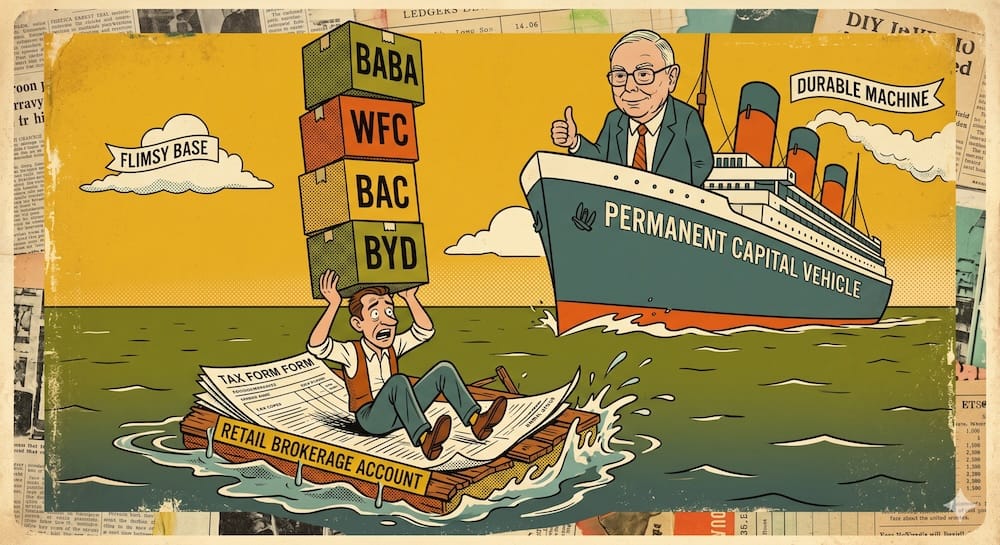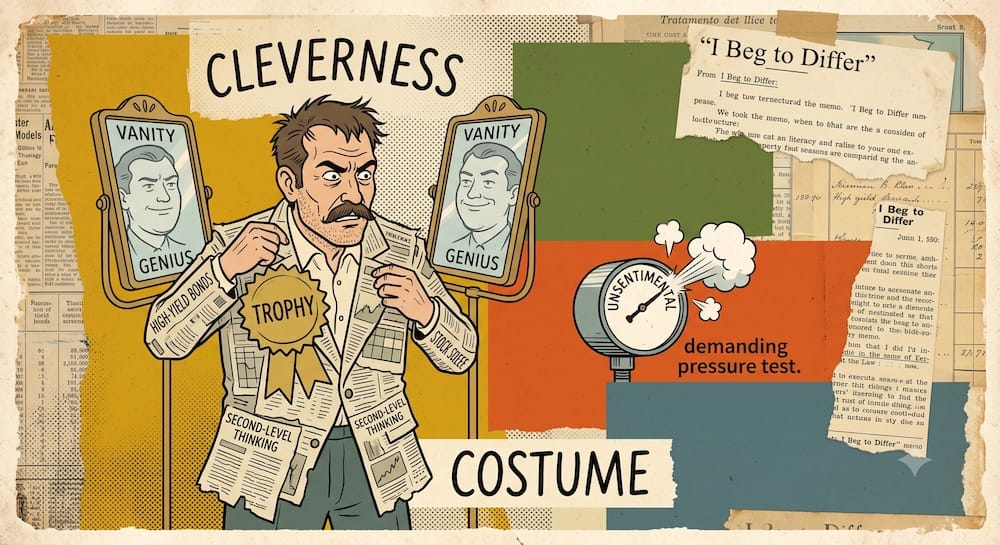
Margin of safety has become one of investing’s most flattering labels.
Estimate a company’s value. Knock 20% or 30% off the result. Announce that you are following Benjamin Graham. The spreadsheet looks cautious, the investor sounds disciplined, and every optimistic assumption that created the original valuation gets to remain comfortably in place.
I do not consider that a margin of safety. I consider it an optimistic valuation wearing protective equipment.
The conventional interpretation starts at the wrong end of the problem. Investors choose a discount after estimating value, as though uncertainty were a standard surcharge that could be applied equally to a stable business, a leveraged turnaround, a cyclical asset play, and a company whose worth depends on profits forecast ten years into the future.
Graham never supplied one sacred percentage for every security. He discussed different forms of protection because bonds, ordinary stocks, growth companies, and bargain issues exposed investors to different types of error. The common mechanism was far more demanding than a haircut: the investment had to remain defensible when the analyst’s assumptions proved imperfect and events turned out less favourably than expected.
That is why the phrase is quoted more often than it is practiced. Repeating it makes an investor sound prudent. Practicing it produces wide valuation ranges, abandoned ideas, uncomfortable uncertainty, and long stretches where the correct conclusion is that the opportunity cannot be valued dependably.
The slogan opens doors. The mechanism keeps closing them.

Graham Never Gave Investors One Magic Discount
Margin of safety is usually reduced to the gap between intrinsic value and market price. That description is useful for bargain securities, though it leaves out much of Graham’s actual framework.
In Chapter 20 of The Intelligent Investor, Graham first approached the concept through bonds and preferred stocks. Their protection came from earnings coverage: how far profits could decline before the issuer could no longer meet fixed obligations. He also described an asset-value cushion by comparing the total value of a business with the amount of debt standing ahead of the investor.
For an ordinary common stock, Graham discussed earning power relative to prevailing bond returns. For a bargain issue, he focused more directly on the difference between the purchase price and an indicated or appraised value. A growth stock could also offer protection, though only when future earnings were estimated competently and conservatively and the price left enough room for error.
These applications share a purpose. They do not share one calculation.
A bondholder may rely on contractual priority, strong interest coverage, and assets well in excess of debt. A buyer of a neglected common stock may depend on a discount to conservative earning power. An investor valuing a growth company may rely heavily on assumptions about results that have not happened yet.
Calling all three situations “margin of safety” does not erase their structural differences.
I give Graham precise credit here. His enduring contribution was an error-tolerant decision process. He was trying to reduce the amount of forecasting accuracy an investor needed, not provide a formula that made forecasting accurate.
He wrote that a sufficient margin could render unnecessary “an accurate estimate of the future.” That phrase cuts directly against much of modern valuation culture. The objective was never to predict the future with increasing sophistication. It was to build enough protection that imperfect foresight did not automatically destroy the conclusion.
A modest discount to a fragile value estimate may still leave the investor dependent on nearly everything going right. A larger discount supported by dependable assets, resilient earning power, or strong contractual coverage may withstand several mistakes.
The percentage at the end of the calculation tells us very little until we inspect what went into the value.
The simplified formula—
Intrinsic value minus market price equals margin of safety
—has the charm of something that fits nicely on a graphic. It also conceals the harder work. How reliable is the estimated value? Which obligations rank ahead of the shareholder? Can the supposed assets be realized? What happens when several assumptions fail at once? How much damage can occur while the investor waits?
A mathematical gap is easy to display. Protection has to be earned.
Precision Is Often Uncertainty with Better Formatting
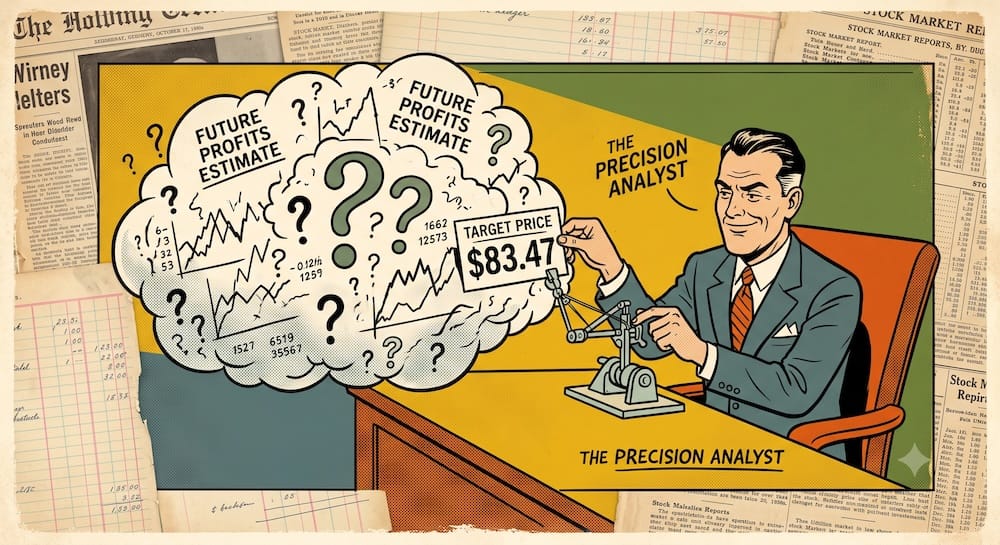
Investors like target prices because a target price feels decisive. It gives the analysis a destination and allows the person presenting it to sound as though the future has already submitted its paperwork.
Graham and David Dodd were less theatrical.
In the second edition of Security Analysis, they argued that intrinsic value did not always need to be determined exactly. An approximate estimate, or a defensible range of values, could be sufficient when the market price stood clearly outside that range.
That approach is both humbler and more rigorous than pretending a business is worth exactly $83.47 per share.
Suppose an analyst estimates a company’s value at $100 and applies a 25% discount, producing a purchase threshold of $75. The process appears conservative. Yet the original $100 may depend on normalized margins, future reinvestment, refinancing conditions, a terminal growth rate, and a valuation multiple several years away.
If a realistic range is $55 to $110, a $75 share price does not reveal an obvious bargain. It sits inside the uncertainty the analyst disguised with a single number.
Graham and Dodd illustrated the danger with J. I. Case. The stock traded around $30, reported asset value of roughly $176 per share, and had ten-year average earnings near $9.50. Capitalizing those average earnings mechanically could produce an indicated value of about $95.
The stock therefore looked extraordinarily cheap.
The catch was that the annual earnings were wildly inconsistent. The average suggested a stable earning base that the company’s actual record did not support. Graham and Dodd described the resulting valuation as artificial because the input carrying the calculation was unreliable.
This is a trap I understand very well. Once a formula produces a clean number, the number begins to feel separate from the assumptions that produced it. A spreadsheet can turn a collection of guesses into something resembling laboratory output. The cells align, the decimals appear, and speculation receives a necktie.
Graham’s answer was to accept approximation rather than manufacture certainty.
As uncertainty increased, the reasonable valuation range widened. An actionable conclusion emerged only when price moved far enough beyond that range. Sometimes the facts would not support a dependable relationship between value and price at all.
Financial culture has little affection for that outcome.
Analysts are expected to issue ratings. Fund managers are expected to deploy capital. Financial publishers need conclusions with verbs attached. “The available evidence does not permit a reliable estimate” lacks the promotional energy of a bold target and a large upside percentage.
Still, refusing to produce a false answer is not analytical failure. It may be the clearest evidence that the analyst understands the concept.
Graham did not ban future-oriented valuation. He allowed projected earnings to support a growth-stock margin when those projections were made conservatively and competently. The distinction is important because it prevents margin of safety from becoming a purely asset-based doctrine.
The burden of proof rises as value depends more heavily on events that have not occurred.
A contractual payment supported by strong coverage contains one type of uncertainty. A business whose estimated worth rests on a decade of rapid growth, stable margins, successful reinvestment, and a favourable terminal valuation contains another. Both may be called intrinsic value. They do not deserve equal confidence merely because the same phrase appears above the calculation.
An honest range can become so wide that the quoted discount loses meaning. When that happens, the investor has not discovered a margin of safety. The investor has discovered that the security is difficult to value.
Those are very different achievements.
Cheap Is a Price Description, Not a Safety Certificate
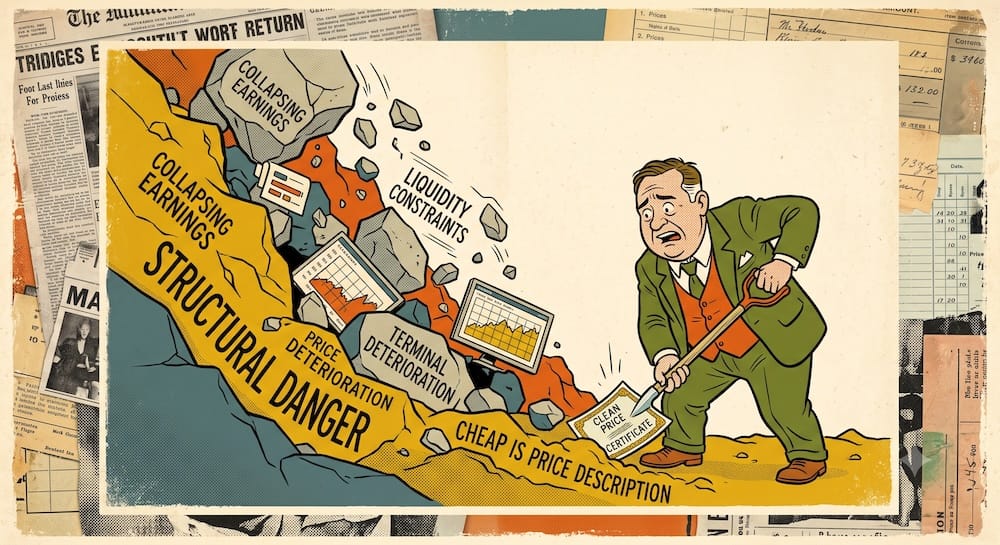
A low multiple can identify an unpopular security. It cannot tell us whether the market’s pessimism is excessive.
This distinction disappears constantly because cheapness is easy to screen. Safety has to be investigated.
A low price-to-earnings ratio may reflect temporary fear, or earnings that are about to collapse. A high dividend yield may point to an overlooked cash generator, or a payout that cannot continue. A discount to book value may reveal underappreciated assets, or assets whose accounting value offers shareholders little protection after liabilities, liquidity constraints, and recovery costs are considered.
The statistic describes price relative to another number. It does not establish that the other number is durable or recoverable.
Graham was explicit about the boundary. In The Intelligent Investor, he argued that a bargain security could survive a moderate decline in earning power. He also warned investors away from companies with definitely poor prospects regardless of how low their prices appeared.
That difference is the entire game.
A margin can absorb ordinary miscalculation, temporary disappointment, and worse-than-average luck. It cannot redeem terminal deterioration through a sufficiently dramatic discount. A collapsing business does not become safe merely because the share-price chart has begun to resemble a ski slope.
Joseph Piotroski’s 2000 study, “Value Investing: The Use of Historical Financial Statement Information to Separate Winners from Losers”, offers a useful empirical check. Piotroski began with high book-to-market firms, many of which were financially distressed. He then used measures involving profitability, cash flow, leverage, liquidity, and operating condition to separate financially stronger companies from weaker ones.
The weak-signal firms were five times more likely than the strong-signal firms to delist for performance-related reasons.
That finding does not make the Piotroski F-score a replacement for Graham’s framework. The sample covered 1976 through 1996, and the reported returns depended on a specific historical methodology. The useful point is narrower: firms can look similarly cheap while possessing radically different capacities to survive.
Price may identify the hunting ground. It does not inspect the balance sheet, test the assets, stabilize the earnings, or protect the shareholder from dilution.
I would put the follower error bluntly. Cheapness often borrows the reputation of safety because cheapness is measurable and safety is argumentative. A database can rank low multiples almost instantly. Determining whether earning power is sustainable, whether assets can be realized, and whether the capital structure can survive takes judgment.
The easy metric gets marketed as though it already contains the hard analysis.
That substitution is commercially convenient. Funds can be labelled deep value. Screens can generate “margin-of-safety stocks.” Research services can estimate undervaluation to one decimal place. Graham’s language provides the seriousness, while Graham’s burden of proof is quietly left outside.
A statistically cheap security may also be structurally dangerous. Distress is one of the main reasons securities become statistically cheap in the first place.

A Discount Has to Survive the Downside
The central question is not how attractive the base case appears. It is what remains after the favourable assumptions begin to break.
Investors often claim conservatism by lowering one input at a time. Revenue grows slightly less. Margins fall a little. The terminal multiple receives a polite trim. The model survives because each disappointment is introduced alone and the rest of the thesis remains perfectly cooperative.
Businesses rarely fail with such administrative neatness.
Weak demand can reduce revenue and margins together. Falling profits can make debt harder to refinance. Expensive financing can restrict investment. Underinvestment can weaken future competitiveness. A company under pressure may issue shares at precisely the price that transfers more of any eventual recovery to new investors.
Several small disappointments can combine into permanent impairment.
When Earning Power Cracks
Graham’s bond analysis asked how far revenues or profits could decline before interest protection disappeared. Current earnings alone were insufficient. What mattered was the amount of deterioration the issuer could absorb before the claim became vulnerable.
The same logic belongs in common-stock valuation.
An estimate of earning power should be tested against weaker sales, lower margins, or slower recovery. When a modest disappointment erases the entire apparent discount, the valuation carried far more fragility than the headline percentage admitted.
Imagine two securities trading 30% below an analyst’s central estimate.
One has relatively steady earning power and a balance sheet capable of withstanding a downturn. The other needs a recovery in volume, restored margins, favourable refinancing, and no dilution. The quoted discount is the same. The protection is not remotely comparable.
The percentage appears after the assumptions. The danger lives inside them.
When Assets Belong to Someone Else First
Asset-based valuations create their own category errors. A company can own valuable assets while common shareholders remain poorly protected.
Graham’s enterprise-value discussion recognized the priority of debt. Bondholders benefited from the amount by which total business value could shrink before their claims were impaired.
Common shareholders sit at the other end of that arrangement.
Assets may be pledged, difficult to sell, necessary for operations, or offset by obligations that receive payment first. Their accounting value may weaken precisely when a distressed company needs liquidity. An asset can exist, possess economic value, and still offer little practical protection to the equity holder.
I become skeptical when an analysis moves directly from “the company owns assets worth X” to “the shares must therefore be worth Y.” That jump tends to step over debt, taxes, transaction costs, operating losses, time, and management’s ability to consume the supposed surplus before shareholders receive it.
Sum-of-the-parts analysis can be useful. It can also become a polite method for assigning an optimistic value to every asset and treating every obstacle to realization as somebody else’s paperwork.
The margin has to belong to the shareholder, not merely to the company.
When the Risks Arrive Together
Aswath Damodaran distinguishes sensitivity analysis, scenario analysis, and simulation as ways of confronting uncertainty. In “Danger and Opportunity: Ruminations on Risk”, he points to a weakness in many sensitivity tables: one variable changes while the others remain fixed, even though important business variables often move together.
That is a modern extension of Graham’s logic rather than a method Graham himself prescribed.
The distinction matters because conservative-looking models can still be structurally optimistic. Lowering a few assumptions independently may leave the company’s real vulnerability untouched.
Time creates another failure point. Investors frequently treat it as neutral, as though value sits patiently in storage until the market recognizes it. Meanwhile, liabilities compound, assets deteriorate, competitors advance, and management continues allocating capital.
A value gap is not a sealed container. A business can consume it while the investor waits.
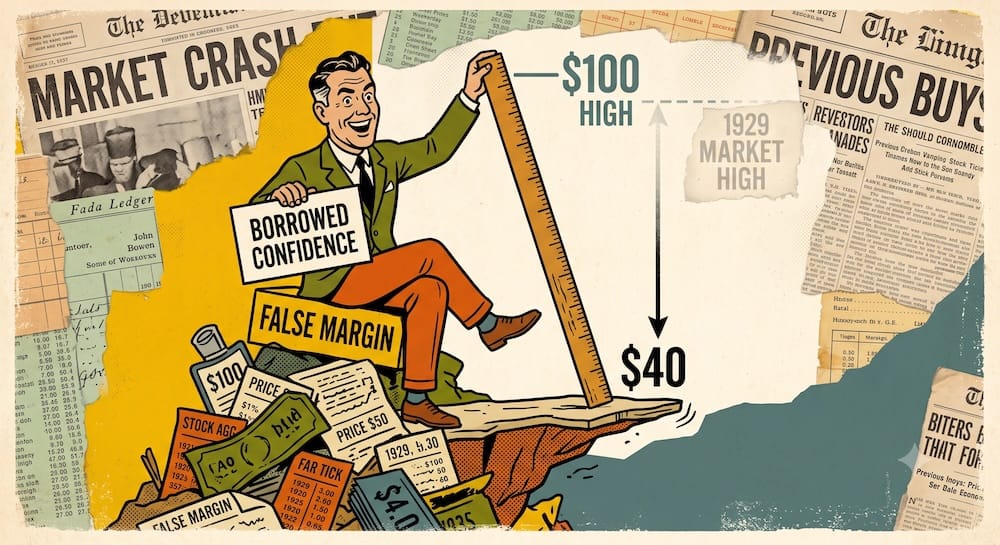
The False Margins Investors Build for Themselves
Most false margins of safety begin with evidence that feels relevant and ends up proving far less than claimed.
A low multiple is one version. A high yield is another. Investors also anchor to former share prices, famous brands, analyst targets, or sum-of-the-parts figures built from assumptions that all seem to have had an excellent morning.
None of these tools is inherently worthless. None independently establishes protection.
Graham wrote that a margin always depended on the price paid. The same security could possess a large margin, a small one, or none as price changed. Business quality cannot justify every price. A low price cannot cure every business problem.
The discount-from-the-high argument is among the weakest. A stock once traded at $100 and now trades at $40, so the investor feels that $60 of safety has appeared.
Nothing has been demonstrated except that previous buyers paid more.
The former price may have been absurd. The business may have deteriorated. The capital structure may have changed. The earnings that supported the old valuation may no longer exist. A historical market quote is evidence of past enthusiasm, not intrinsic value.
Analyst targets offer a more polished variation. Tim de Silva and David Thesmar’s 2021 NBER paper, “Noise in Expectations: Evidence from Analyst Forecasts”, found that analyst earnings forecasts performed better than statistical forecasts over shorter horizons and worse over longer ones. Estimated noise and bias increased as the forecast horizon extended.
That does not establish that analyst forecasts are useless. It establishes that apparent precision becomes more questionable as uncertainty compounds.
Many valuation models respond in exactly the wrong direction. Near-term estimates receive detailed scrutiny, while a large portion of calculated value comes from distant cash flows and a terminal assumption that carries on with suspicious good manners.
Then the analyst subtracts 20% and declares the process conservative.
In a 1976 conversation published by the Financial Analysts Journal, Graham said that every purchase and its price should be justified through “impersonal, objective reasoning” showing that the investor received more than the money paid.
That standard rules out borrowed confidence. A respected brand, admired manager, consensus estimate, or former price can support further investigation. It cannot do the valuation’s work.
A compelling story tells us how an investment might succeed. Margin of safety asks how badly the story can disappoint before success becomes necessary.
An Error Budget Is More Honest Than a Fixed Haircut
The cleanest way I know to recover Graham’s mechanism is to think in terms of an error budget.
Graham did not create an “error budget” matrix, and it should not be attributed to him as a formal rule. It is my synthesis of his approximate valuation ranges, security-specific protections, price dependence, and emphasis on surviving miscalculation.
Three variables drive the framework:
| Reliability of the value estimate | Severity of plausible downside | What the investor can reasonably demand |
|---|---|---|
| Relatively dependable evidence | Bounded, survivable impairment | A smaller but demonstrable cushion may carry meaning |
| Forecast-dependent value | Material operational or financial damage | A wider cushion is required |
| Highly uncertain value | Potentially terminal or unbounded loss | No dependable margin can be demonstrated |
The first variable is valuation reliability.
How much of the estimate comes from contractual claims, realizable assets, observed earning power, or relatively stable economics? How much depends on distant forecasts, cyclical recovery, favourable financing, or a generous terminal value?
The second is downside severity.
Some errors delay value realization. Others destroy value. Weak earnings may recover. Insolvency, dilution, obsolescence, or severe asset impairment may permanently reduce what remains for shareholders.
The third is the amount of price protection required.
Greater uncertainty and harsher downside should require a wider gap before the investment can reasonably be called protected. In some situations, the valuation range remains too wide for any dependable conclusion. In others, the potential downside cannot be bounded well enough for a quoted discount to carry meaning.
This is where fixed-percentage rules become difficult to defend.
A universal 30% haircut assumes uncertainty can be standardized across every business, asset base, capital structure, and forecast horizon. It gives a stable enterprise and a speculative turnaround the same adjustment, as though risk were a sales tax.
I understand why that feels appealing. A fixed percentage appears neutral. It converts the discomfort of judgment into a setting. Choose 25%, 30%, or 40%, and uncertainty seems to have been processed.
In reality, it has often just been renamed.
A proper error budget starts with failure. What can go wrong? Which assumptions carry most of the valuation? Can the risks reinforce one another? Does the shareholder survive the combined outcome?
Merely choosing conservative inputs is insufficient. Revenue growth, margins, and terminal value can all be reduced while the model remains dependent on the same fragile narrative.
Graham’s bargain issues were intended to survive miscalculation and worse-than-average luck. They were never promised immunity from collapse. Piotroski’s findings reinforce that boundary: even within a cheap group, financial condition mattered because some companies were considerably more vulnerable than others.
A margin of safety should reduce the investment’s dependence on the analyst being right. Once the thesis requires a flawless recovery, accommodating lenders, restrained management, and patient markets, the supposed cushion has become a wish list.
Rejection Is the Part Nobody Likes to Market
Discussions of margin of safety tend to celebrate completed purchases. The hardest application often produces no purchase at all.
Graham and Dodd accepted that analysts could be unable to establish a dependable relationship between value and price. A conclusion became possible only when the market price stood clearly beyond the reasonable valuation range.
Until then, uncertainty remained uncertainty.
Modern financial culture tends to interpret that restraint as a lack of conviction. Analysts are expected to convert information into ratings. Managers are expected to put money to work. Research platforms are expected to rank opportunities. “Unable to determine” is commercially awkward because it cannot be packaged as upside.
The incentive therefore favours precision, including precision the evidence has not earned.
An analyst can defend a target using a model. A manager can defend a purchase using a narrative. A platform can sort securities from most undervalued to least undervalued. Admitting that a company cannot be valued with sufficient confidence looks unproductive even when it is the strongest conclusion available.
I view rejection as the clearest test of whether someone practices margin of safety. Buying a security and describing the difference between price and target is easy. Walking away because the range overlaps the price, the downside cannot be bounded, or the assumptions require unusual foresight is where the principle begins to impose a cost.
Graham’s treatment of growth stocks carries the same warning. He accepted that conservative estimates of future earnings could support value. He also observed that customary growth-stock prices often offered inadequate protection unless the investor possessed unusual foresight and judgment.
A wonderful company can therefore remain beyond dependable appraisal at a particular price.
That conclusion is harder to live with than the slogan. Followers readily copy Graham’s insistence that price matters. They are less enthusiastic about his willingness to accept approximation, inconclusive analysis, and missed opportunities.
The visible shell survives: buy below intrinsic value.
The operating condition disappears: intrinsic value must be established with enough reliability for the gap to mean something.
Why Margin of Safety Became Easier to Repeat Than to Use
Margin of safety became famous because it compresses a demanding philosophy into three memorable words. Fame has also thinned it out.
The phrase now carries an automatic aura of prudence. Investors call assumptions conservative, label securities undervalued, and place a percentage between price and target. The vocabulary implies discipline before the process has demonstrated any.
Near the end of Chapter 20 of The Intelligent Investor, Graham argued that a genuine margin had to be supported by figures, persuasive reasoning, and a body of experience.
He was not demanding perfect mathematical certainty. Graham explicitly accepted approximate valuation. He was demanding evidence strong enough to justify the claim that protection existed.
He also refused to present margin of safety as a guarantee. An individual security could still produce a poor result despite favourable odds. Diversification was the companion mechanism that allowed an advantage to operate across multiple commitments.
That boundary cannot be removed for the sake of a cleaner story. Margin of safety may improve an investment’s capacity to absorb error. It does not prevent every loss or transform an estimate into fact.
There is no representative survey proving how many investors faithfully practice the concept. My judgment that it is rarely practiced rests on the distance between Graham’s standard and the shortcuts routinely carried under his name.
His standard required security-specific reasoning, approximate valuation ranges, explicit downside analysis, and a willingness to admit that some securities could not be appraised dependably. The popular substitute requires a target price and a discount percentage.
One approach generates marketable conclusions. The other keeps disqualifying them.
A defensible margin exists when reasonable analytical error and adverse developments can occur without destroying the investment case. When value depends on precise forecasts, cooperative credit markets, recoverable assets, restrained management, and a favourable terminal multiple, the investor has no meaningful cushion simply because the spreadsheet shows 30%.
The decisive question is how much of the estimated value remains after the assumptions stop receiving the benefit of the doubt.
What did Benjamin Graham mean by margin of safety?
Benjamin Graham treated margin of safety as protection against analytical error and adverse developments. Its form varied by security: bonds could rely on earnings coverage and asset protection, while bargain stocks could rely on a substantial gap between price and conservatively appraised value.
Is margin of safety simply a fixed percentage discount to intrinsic value?
No. Graham did not prescribe one universal percentage for every security. A quoted discount matters only when the underlying valuation is reliable enough and the downside is survivable; a fixed haircut cannot repair fragile assumptions.
Why can a statistically cheap stock still be unsafe?
Low valuation ratios describe price relative to earnings, book value, or another measure. They do not prove that earnings are durable, assets are recoverable, debt is manageable, or common shareholders will retain value after prior claims are paid.
Why are valuation ranges more honest than exact target prices?
A range makes uncertainty visible. Graham and David Dodd accepted approximate valuation when price stood clearly outside a defensible range, while a single exact target can hide how heavily the result depends on unstable forecasts and assumptions.
What is an error budget in margin-of-safety analysis?
An error budget is an editorial framework, not a formula created by Graham. It links valuation reliability, downside severity, and required price protection: greater uncertainty and harsher potential impairment demand a wider cushion, while some situations permit no dependable margin at all.
Does a margin of safety prevent investment losses?
No. It can improve an investment’s ability to absorb error, but it does not guarantee a positive result or eliminate uncertainty. Graham also treated diversification as a companion mechanism because individual securities can still fail.
This article is also available in Spanish. [Leé la versión en castellano: El margen de seguridad de Benjamin Graham: el concepto que todos citan pero pocos practican]