Every December, a familiar ritual plays out across the financial sector. Wall Street’s premier investment banks gather their brightest minds, run complex econometric models through multi-million-dollar software systems, and publish their precise year-end targets for the S&P 500 for the following year. They tell us exactly where interest rates will sit, precisely when a recession will hit, and what the inflation line will look like down to the decimal point.
I have a confession to make: every December, I watch this forecasting circus with a mix of amusement and genuine horror. It is an extraordinary performance, but it has almost nothing to do with successful long-term investing. Assigning a precise numerical destination to a system driven by the chaotic interplay of millions of emotional human beings is an exercise in absolute absurdity.
Yet, the retail investing public eats it up. We are conditioned to believe that the primary job of a portfolio manager is to predict the future. When we look at legendary figures like Howard Marks, the co-founder of Oaktree Capital, the conventional online narrative treats him like a monastic guru—a market ascetic who sits in an office looking at a crystal ball, stepping out only to call the exact top or bottom of a cycle.
But if you actually sit down and read through decades of Marks’s writing, including his landmark 2022 memo The Illusion of Knowledge, you discover that his real discipline is completely different. Marks doesn’t win by predicting the future. He wins by explicitly refusing to do so. His success is built on a deep, unshakeable humility regarding what cannot be known, paired with an analytical framework that prioritizes diagnosing the present over projecting tomorrow.
In my own early years as an investor, I fell for the forecasting hook line and sinker. I used to think that if I just read enough economic whitepapers and parsed enough central bank commentary, I could figure out exactly when the market tide would turn. It took a few painful encounters with market reality to realize that the macro future is largely un-modellable. The moment you step away from the prediction game, a strange thing happens: your portfolio decisions become cleaner, your risk management becomes more robust, and the market becomes a lot less stressful.
To understand why Howard Marks treats macro forecasting with such open skepticism, we have to look past the financial media’s myth-making and inspect the core mechanism of cycle awareness. We need to explore the difference between predicting the weather and taking the local temperature, and understand why preparation will beat prediction every single time.
Forecasting Is Where Investors Go to Feel Smarter Than Reality
The financial industry has a deeply ingrained addiction to forecasts, and it isn’t hard to see why. Human beings find comfort in bad data over raw randomness. I think we crave these numbers because uncertainty is a profoundly uncomfortable state of mind. To sit in front of a brokerage account and admit that you have no idea what the global economy will look like in eighteen months feels terrifying. A precise forecast, even one built on a foundation of sand, provides a temporary psychological relief valve.
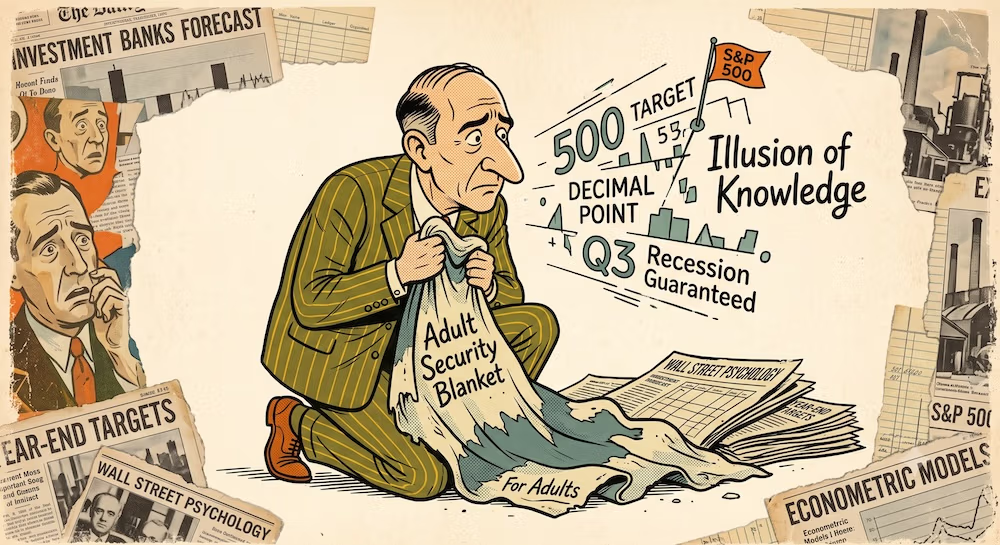
When I look at a standard institutional macro forecast, I don’t see objective analysis; I see a security blanket for adults. It creates what Marks calls the “illusion of knowledge.” Because an analyst uses a spreadsheet with three hundred rows of macroeconomic inputs, the output looks authoritative. It feels scientific. But it completely ignores the reality that the economy is not a mechanical engine operating in a closed lab. It is a complex, adaptive organism that alters its behavior based on the inputs it receives.
The fatal flaw of traditional forecasting is the assumption that because a trend has held true in the past, it must follow a linear path into the future. But the macroeconomy is inherently non-linear. A minor change in consumer psychology, a sudden shift in regulatory policy, or a single geopolitical anomaly can ripple through the global banking system, turning a confident baseline projection into garbage within a matter of days.
The forecasting industry survives because the human collective memory for financial predictions is remarkably short. The same analysts who miss major market inflections are right back on television the following quarter, adjustments in hand, offering a new set of precise targets. For the individual investor, participating in this game is incredibly dangerous. It breeds an unearned overconfidence. If you truly believe a forecast that says a recession is guaranteed to strike in Q3, you will make drastic, theatrical shifts to your portfolio—liquidating lines, buying expensive hedges, or shorting high-quality assets. You are betting your wealth on a single, fragile timeline. And when reality refuses to cooperate with the model, you are left stranded.
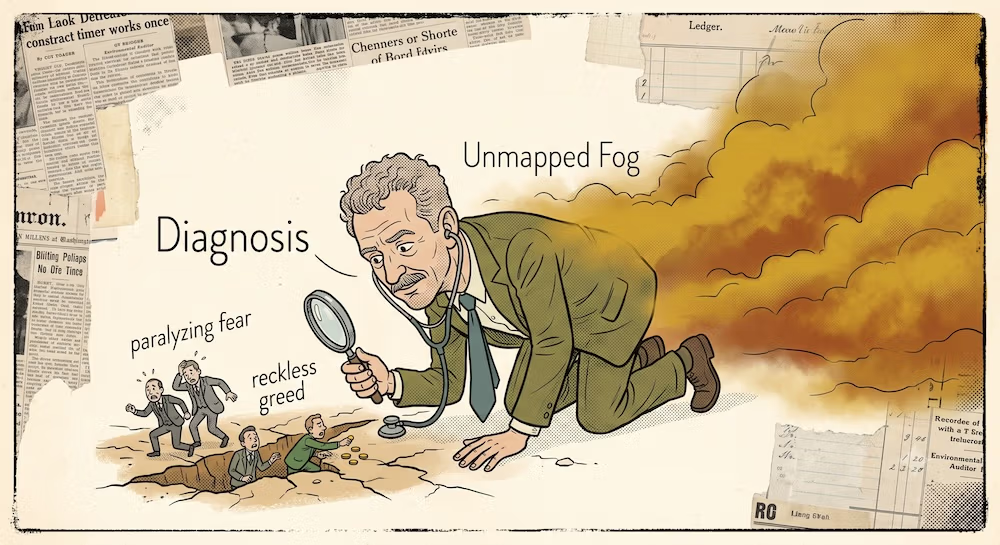
Marks’s Real Question: Where Are We?
If we accept that the future is an unmapped fog, how are we supposed to make intelligent asset allocation choices? This is where Marks’s foundational concept from his 2001 memo, You Can’t Predict. You Can Prepare., becomes essential. His core philosophy can be distilled into a single, elegant rule: We may never know where we’re going, but we’d better have a good idea where we are.
There is a fundamental difference between prediction and diagnosis. Prediction asks, “What will happen next year, and on what exact date?” Diagnosis asks, “What is happening right now, what is currently priced into asset classes, and are investors around me behaving with reckless greed or paralyzing fear?”
I don’t buy the idea that you need to know the future to protect your capital and grow it over time. Think of it like a blackjack game. You cannot predict the exact card that will flip over next from a shuffled deck; doing so would require psychic ability. However, if you can see that the deck has been heavily depleted of low cards and is now packed with tens and aces, you know the objective probabilities have shifted in your favor. You don’t know the specific outcome of the next hand, but you know whether you should increase your bet or step back.
This is the essence of Marks-style cycle positioning. It is an ongoing environmental audit. Instead of trying to guess when the credit cycle will peak, Marks looks at the current terms being offered in the market. If companies are issuing low-grade debt with zero investor protections and buyers are fighting over the allocations, he doesn’t need a calendar to tell him that risk is being underpriced. He doesn’t know when the music will stop, but he knows that the room is getting unsafely crowded.
The shift from a predictive mindset to a diagnostic mindset requires a massive dose of intellectual humility. It forces you to abandon the ego trip of wanting to be “right” about a macro call, replacing it with the quiet discipline of evaluating current prices relative to historical risks. You stop asking what the market will do next, and you start asking what the market is already doing right now.
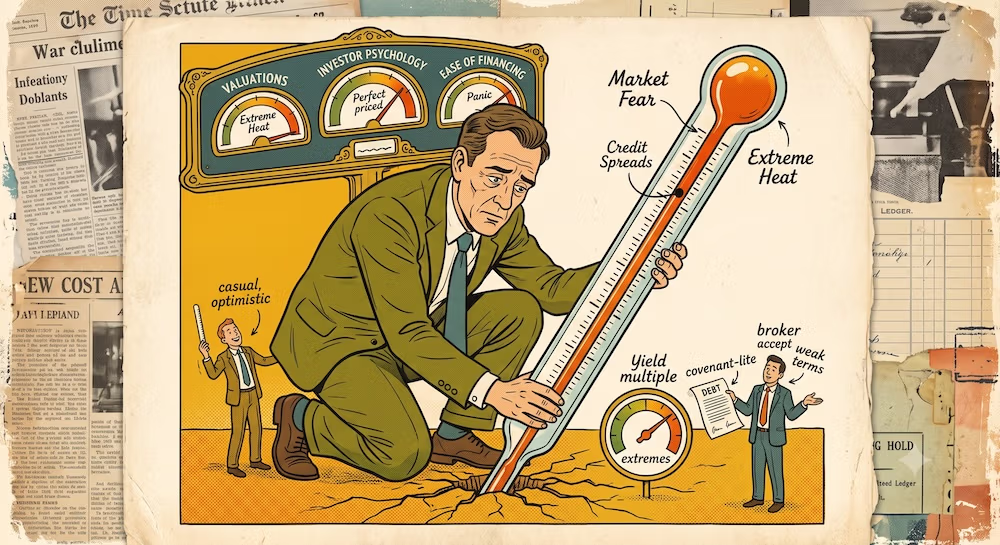
The Temperature Check: What Can Actually Be Observed
To move away from speculative crystal-ball gazing, we have to identify what is actually knowable. We cannot observe next year’s corporate earnings or the future interest rate decisions of central banks. But we can observe the visible markers of the present environment. Marks frequently refers to this as “taking the temperature of the market.”
When we run an environmental audit on current conditions, we aren’t looking for a secret metric or a magical mathematical trigger that tells us exactly when to buy or sell. We are looking at a cluster of qualitative and quantitative indicators that reveal whether the market is currently priced for absolute perfection or total panic.
- Investor Psychology: This is the most critical vector. Are investors casual, optimistic, and terrified of missing out on gains? Or are they defensive, cynical, and treating every minor piece of bad news as the beginning of a collapse?
- Valuations: Where do current asset prices stand relative to historical distributions? Are standard cash-flow yields, earnings multiples, and asset premiums sitting at historical extremes, or are they offering a reasonable cushion?
- Credit Spreads: The high-yield corporate credit spread is an exceptional real-time thermometer for market fear. When credit spreads are highly compressed, it tells us that capital is abundant, cheap, and hunting for return without demanding an adequate safety premium. When spreads widen dramatically, it signals that institutional liquidity is pulling back and demanding a steep price to take on risk.
- Underwriting Standards and Covenant Quality: In the corporate debt markets, the structural terms of new debt issuances offer clear clues about who holds the leverage. In a hot market, issuers print “covenant-lite” debt, stripping out traditional rules that protect lenders from corporate mismanagement. When buyers willingly accept these weak terms just to get their money to work, risk is building quietly in the background.
- Ease of Financing: Can speculative, unproven corporate entities easily access capital markets to refinance their balance sheets? Or are even high-quality firms finding it difficult to roll over short-term obligations?
I like to think of this cluster of indicators as a conceptual dashboard rather than a mechanical steering wheel. They do not give you a precise trading signal. They do not tell you to log into your account on a Tuesday morning and liquidate a fixed chunk of your holdings. Instead, they act as a guide for your baseline portfolio posture. When every indicator on the dashboard shows that the room is boiling hot—that valuations are stretched, investor psychology is euphoric, and lending standards have degraded—the odds are no longer stacked in your favor. You don’t need to know the exact date of the correction to realize it’s time to lean toward caution.
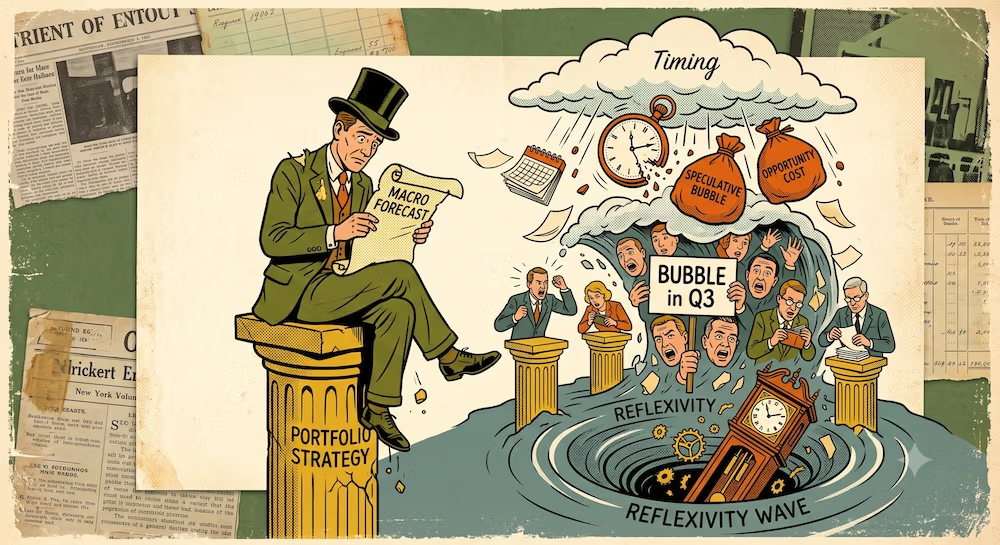
Why Forecasts Fail
To fully appreciate why a diagnostic framework is superior, we have to look closely at the structural reasons why macroeconomic models constantly break down. The financial world is littered with the wreckage of portfolios that were positioned around a forecast that seemed completely bulletproof on paper.
The primary reason macro forecasts fail is that the global economy is a complex adaptive system. In a simple mechanical system, like a grandfather clock, an input produces a completely predictable, repeatable output. If you turn a specific gear, the hands move by a precise distance. But in a complex adaptive system, the components are thinking human beings who react to the forecast itself. If a highly credible institution publishes a forecast stating that a catastrophic banking crisis is imminent, consumers alter their spending, banks tighten their underwriting, and businesses cut inventory. The collective reaction to the prediction can actually alter the trajectory of the system, either accelerating the crisis or preventing it entirely. This is the concept of reflexivity, and it makes linear projection impossible.
Macro forecasts are completely helpless in the face of sudden policy interventions. A central bank can alter interest rates or inject emergency liquidity overnight in response to localized stress, instantly invalidating months of economic modeling. A regulatory shift, a tax code modification, or an unexpected political outcome can reshape the investment environment in a weekend.
But even if we assume you possess a highly accurate macro model that correctly identifies a future economic trend, you still face a second, lethal problem: timing.
I’ve seen dozens of brilliant allocators destroy their long-term compounding curves by being right on the direction of a macro shift but disastrously early on the timeline. If you correctly identify that an asset class is in a speculative bubble and you position your portfolio defensively, but the bubble continues to inflate for another four years, the tracking error will break your strategy.
A retail allocator sitting in heavy cash lines or expensive hedges for half a decade while the broad indexes march to new highs suffers a brutal psychological penalty. The opportunity cost eats away at their net worth, and the mental fatigue of watching less-disciplined investors get rich eventually causes them to snap. They capitulate, abandon their defensive posture, fire their strategy, and buy back into the market at the absolute apex of the froth—right before the system finally corrects. In the real world of investing, being early is indistinguishable from being wrong.
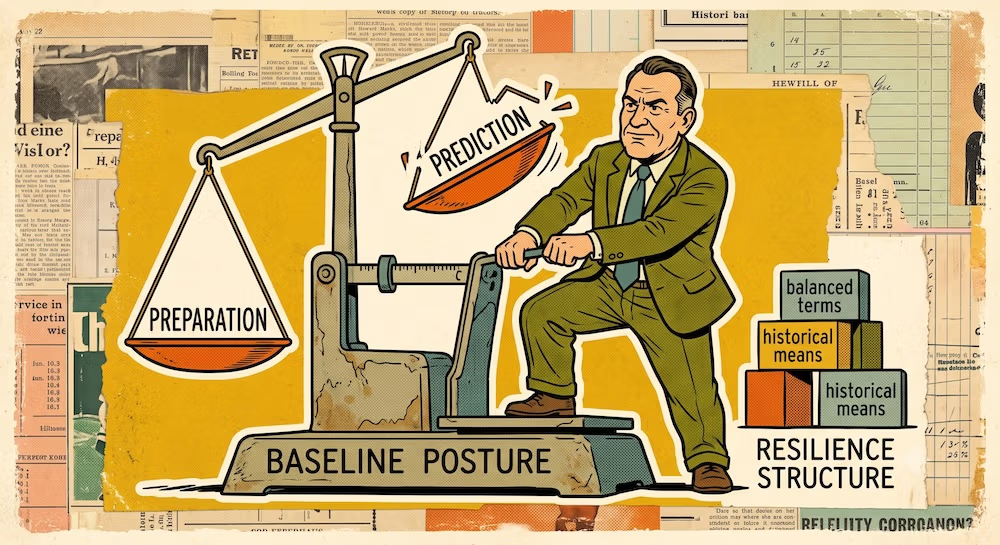
Preparation Beats Prediction
This brings us to the very center of the Marks philosophy. If we can’t trust forecasts, and we can’t reliably time the turning points of the market cycle, how do we actually manage a portfolio over time? The answer is to replace prediction with preparation.
Preparation means acknowledging that the future is not a single, fixed outcome waiting to be discovered. It is a wide distribution of possibilities. Instead of positioning your portfolio to win big on one specific macro scenario, you build an asset allocation structure that can survive a vast range of outcomes. You focus on resilience rather than optimization.
When you operate under a preparation framework, you stop trying to make dramatic, binary bets. You don’t shift your portfolio from one structural extreme to another based on a macro feeling. Instead, you make modest, incremental adjustments to your baseline posture based on where you stand on the cycle thermometer.
+-------------------------------------------------------------------------+
|                        THE POSTURE ADJUSTMENT SCALE                     |
+-------------------------------------------------------------------------+
| Market Posture:   [ DEFENSIVE ] <-------- [ BALANCED ] --------> [ AGGRESSIVE ]
|                                                                         |
| Environmental                                                           |
| Observations:    Priced for Perfection   Historical Means    Priced for Panic
|                  Low Risk Premiums       Balanced Terms      High Risk Premiums
|                  Widespread Euphoria     Normal Psychology   Widespread Terror
+-------------------------------------------------------------------------+
This is not a trading trigger. It is a posture framework. When asset prices are historically reasonable, investor psychology is quiet, and the credit markets are orderly, you maintain a balanced, neutral posture. You hold your diversified assets and let compounding do its job.
If the environment shifts toward the extremes—if asset prices surge to historical premiums, risk appetite becomes unhinged, and underwriting quality falls off a cliff—you don’t panic-sell everything. You simply dial back your risk on the margin. You become more selective, you demand higher margins of safety on new capital deployments, and you mentally prepare for a higher volatility baseline. You accept that you might leave some money on the table if the rally continues, because your primary goal is the avoidance of capital destruction.
Conversely, when the cycle turns and the market experiences a systematic collapse, you don’t wait for an economic forecast to tell you that the recession is officially over before you buy. You look at the present reality: asset prices are depressed, fear is widespread, and risk is being heavily over-compensated. You adjust your posture toward aggression, absorbing the assets that forced institutional sellers are dropping into your lap.
Knowing where we are allows us to act with conviction during moments of crisis, not because we know what will happen next week, but because we know that the current prices offer an exceptionally high probability of long-term return.
Oaktree in 2008: Not Forecasting, Preparation
The power of preparation over prediction was demonstrated during the absolute peak of the Global Financial Crisis in late 2008. The popular mythology surrounding Oaktree Capital suggests that Marks and his team executed their legendary post-Lehman buying spree because they possessed a unique macro forecast that predicted the exact bottom of the banking collapse.
The historical record reveals a completely different reality. Oaktree didn’t predict the subprime crisis with a crystal ball, nor did they have an internal memo pinpointing the date of Lehman Brothers’ insolvency. What they did have was a deep understanding of where they stood in the environment after the collapse had occurred.
Following the Lehman bankruptcy in September 2008, the global credit markets entered a phase of unprecedented structural panic. High-yield corporate credit spreads exploded past 1,600 basis points. Leveraged financial institutions, hedge funds, and collateralized debt vehicles faced a cascade of margin calls and immediate redemption runs. To survive, these entities were forced to liquidate senior, secured corporate bonds at deep discounts, completely unrelated to the underlying solvency of the businesses that issued them. They were selling because they had to, not because they wanted to.
Marks and his co-portfolio manager Bruce Karsh didn’t try to forecast whether the GDP print for the first quarter of 2009 would be negative or positive. They didn’t wait for central banks to issue a statement of complete economic safety. They simply looked at the room temperature: it was absolute freezing panic. Risk was being compensated at a level never before seen in modern credit history.
Because they had spent the frothy years of 2005 and 2006 refusing to accept aggressive underwriting terms and holding significant structural readiness, they were in a position to act. Bruce Karsh’s team stepped into the liquidity vacuum and invested about $400 million per week from September 18, 2008, through the end of the year. In essentially a single quarter, that single team deployed roughly $6 billion into distressed corporate debt. Total Oaktree purchases across their platforms over that brief, chaotic window amounted to $7.5 billion.
They did not recognize the bottom in real time. They recognized an extreme: prices, sentiment, and forced selling had moved far enough to make the odds unusually attractive. They were buying senior claims on real corporate assets at massive discounts from panicked sellers. If you asked Marks at that moment exactly when the economy would recover, he would have told you he had no idea. But he knew that the current environment offered an asymmetric margin of safety. They didn’t time the bottom via a forecast; they recognized the opportunity because the prices on their screens had moved to a historical extreme. It was a victory of environmental diagnosis and structural readiness over economic prophecy.
What Actually Travels
To wrap up this exploration of forecasting humility, let’s step away from the institutional scale of Oaktree Capital and translate these concepts into a clean, practical checklist. We want to separate the historical narrative from the conceptual ideas that can actually improve our daily decision-making framework.
+---------------------------------------------------------------------------------+
|                       FORECASTING VS KNOWING WHERE WE ARE                       |
+---------------------------------------------------------------------------------+
| QUESTION           | FORECASTING MINDSET          | MARKS-STYLE MINDSET         |
|--------------------|------------------------------|-----------------------------|
| What is the goal?  | Predict the next event       | Diagnose current conditions |
| What does it ask?  | "What will happen?"          | "What is already priced in?"|
| What it requires?  | Precision and modeling       | Humility and range-thinking |
| What it watches?   | GDP targets, rate dates      | Psychology, credit terms    |
| Main failure mode? | False certainty / Timing gap | Being early or too cautious |
| Better use?        | Scenario input               | Posture and preparation     |
| Investor danger?   | Acting on a fragile forecast | Trading on short-term tabs  |
+---------------------------------------------------------------------------------+
If we want to build a portfolio layout that respects market history and protects us from the traps of fake precision, we can integrate a few core conceptual rules into our management routine:
- The posture lesson is to stop asking for date-specific forecasts: When evaluating your long-term plans, completely ignore commentary that promises a specific market event will occur on a specific date. Treat these predictions as economic entertainment rather than actionable data inputs.
- The core diagnostic habit is to study present conditions, not future paths: Shift your analytical energy toward auditing the environment today. Look at current valuation metrics, corporate debt terms, and general sentiment lines. Know whether the crowd around you is relaxed and greedy or highly defensive and terrified.
- The strategic rule is to treat forecasts as weak inputs, not commands: If you must look at economic projections, treat them as a broad range of potential scenarios rather than a rigid operational itinerary. Ask yourself: “If this forecast is completely wrong, can my current structure still survive the alternative outcome?”
- The diagnostic question is whether markets are priced for perfection or panic: Understand the relationship between price and risk. When valuations sit at historical premiums, the market is priced for perfection, meaning any unexpected bad news will cause a sharp repricing. When valuations are depressed, the bad news is already in the price, creating an embedded cushion.
- The core structural lesson is to prepare for ranges of outcomes: Think in terms of resilience across multiple possible outcomes rather than targeting a single path. This requires maintaining a robust portfolio structure with enough immediate liquidity and high-quality baseline reserves so that you never become a forced seller during a sudden capital freeze.
- The fragility test is whether you need precision to survive: If financial survival or strategy execution depends on a central bank cutting interest rates by an exact number of basis points in a specific month, the setup is fundamentally fragile. The goal is organizing debt levels, cash flows, and asset mixes to ensure the structure can thrive across multiple economic regimes without requiring perfect foresight.
- The final posture lesson is to adjust modestly, not theatrically: When the diagnostic indicators suggest the market is getting extended, it is a cue for marginal discipline, not an emotional overhaul of an entire account. Do not drop core investments to chase volatile hedges. Make small modifications to your baseline stance, demand a higher margin of safety on new capital deployments, and let regular systematic processes naturally steady the ship.
Personally, I find immense relief in admitting that I have no idea what the global macroeconomy will do eighteen months from now. It frees up intellectual energy to focus on what matters: maintaining alignment between my liabilities and my assets, demanding appropriate risk premiums on the things I own, and keeping a cool head when the forecasting crowd inevitably runs into a wall of reality.
Stop trying to predict tomorrow’s weather. Take a clean look at the temperature in the room right now, build a structure that does not require perfect foresight, and let the long-term math do the rest.
Does Howard Marks believe retail investors should completely ignore macroeconomic data?
Not exactly. Howard Marks doesn’t suggest turning a blind eye to economic data; he argues against using that data to build precise, date-specific forecasts. The baseline lesson is to view macroeconomic metrics as a snapshot of where we stand today rather than a roadmap for where we will be tomorrow. Observing current inflation, interest rates, or credit default lines is valuable data for diagnosis, but using them to build linear models that claim to predict next year’s market bottom creates a false sense of security.
How can an individual investor track market temperature without access to proprietary credit data?
It is entirely possible using public tools. While institutional alternative funds look at proprietary credit sheets and private bank loan ledgers, a retail allocator can achieve a clean proxy by tracking broad, publicly available yield risk metrics. Indicators like the ICE BofA High Yield Index Option-Adjusted Spread—updated daily on the Federal Reserve Bank of St. Louis (FRED) database—offer a direct window into systemic risk appetite. When spreads collapse or widen, they map precisely to the institutional credit parameters Marks monitors.
What is the biggest operational mistake retail investors make when trying to copy Howard Marks?
Hoarding absolute cash for years. In the institutional world, private equity and distressed debt funds collect fees on committed capital or use locked-up structures that give them a long operational runway to sit on their hands. If a retail investor copies this by holding 40% of their liquid portfolio in a low-yield cash account for five years while waiting for a bubble to pop, the structural cash drag and inflation decay will quietly destroy their long-term compounding curve before the crash even arrives.
How does a diagnostic portfolio approach differ from simple dynamic market timing?
It shifts from binary decisions to marginal adjustments. Traditional market timing is a theatrical, binary exercise: an investor believes a crash is coming, so they move 100% of their portfolio to cash, or they feel bullish and go 100% risk-on. A diagnostic approach never abandons a diversified baseline structure. Instead, as valuations stretch and underwriting quality degrades, the investor makes modest, incremental adjustments to their posture on the margin—perhaps tilting new capital contributions toward higher quality asset classes without liquidating their core positions.
Why is a macro forecast that turns out to be directionally right still dangerous for an investor?
Because of the timing gap. You can be completely correct that an asset class is in an unsustainable, speculative bubble. But if that bubble continues to expand for another four or five years before correcting, your defensive position or active hedges will trigger immense tracking error. Being structurally early in a liquid, public portfolio creates heavy psychological friction, often causing the investor to break their own strategy and capitulate at the exact peak of the market froth.
Does Howard Marks consider daily price volatility a reliable indicator of cycle risk?
No. Marks draws a sharp distinction between daily mark-to-market price fluctuations and the permanent loss of capital. Daily public stock market volatility is primarily a measure of short-term human emotion and liquid trading flows. True cycle risk occurs when asset prices rise to massive, unwarranted premiums relative to corporate cash flows, or when structural leverage inside credit underwriting becomes so fragile that any unexpected economic shock triggers systemic insolvency.
This article is also available in Spanish. [Leé la versión en castellano: Howard Marks vs Proyecciones: Por qué saber dónde estamos importa más que predecir el futuro]