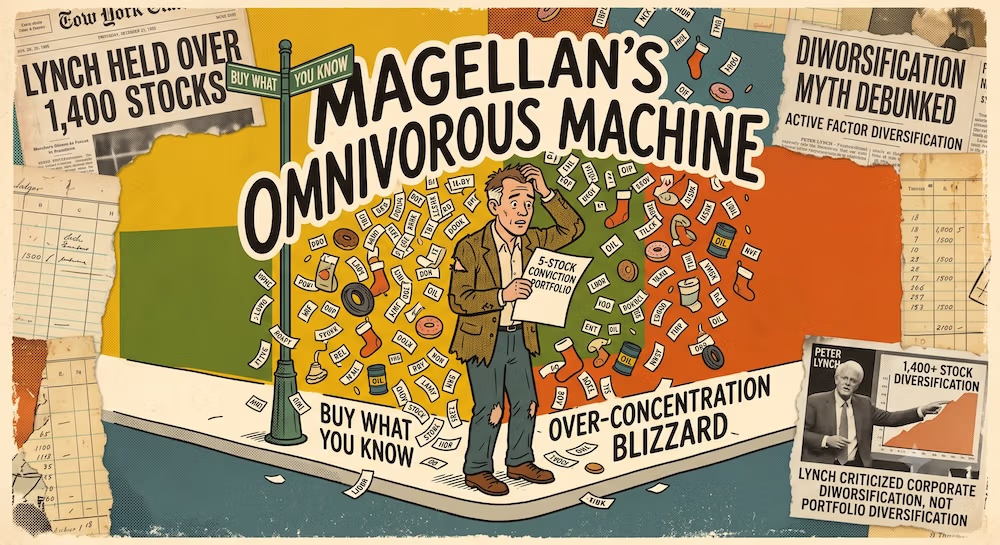
I do not trust any finance idea once it becomes a pie chart. That is usually when the machinery disappears, the critical thinking shuts down, and the brochure soup begins.
For the last twenty years, the global asset management industry has treated the “Yale Model” like a holy relic. Wall Street took a highly complex, aggressive, institutional operating system and boiled it down to a single, lazy marketing pitch: Buy alternative assets, collect your illiquidity premium, and compound your wealth like an Ivy League university.
It is a beautiful story. It is also a complete distortion of historical reality.
The great irony of David Swensen’s legacy is written directly across his two major publications. In Pioneering Portfolio Management, he laid out the blueprint for how he grew the Yale Endowment from $1.3 billion in 1985 to $42.3 billion by June 30, 2021. It is a masterclass in exploiting unlisted private markets and venture capital. Yet in his secondary book, Unconventional Success, written specifically for individual investors, he completely flipped the script. He warned individual investors away from most active management and high-fee alternatives, steering them instead toward simple, low-cost, passive public-market funds.
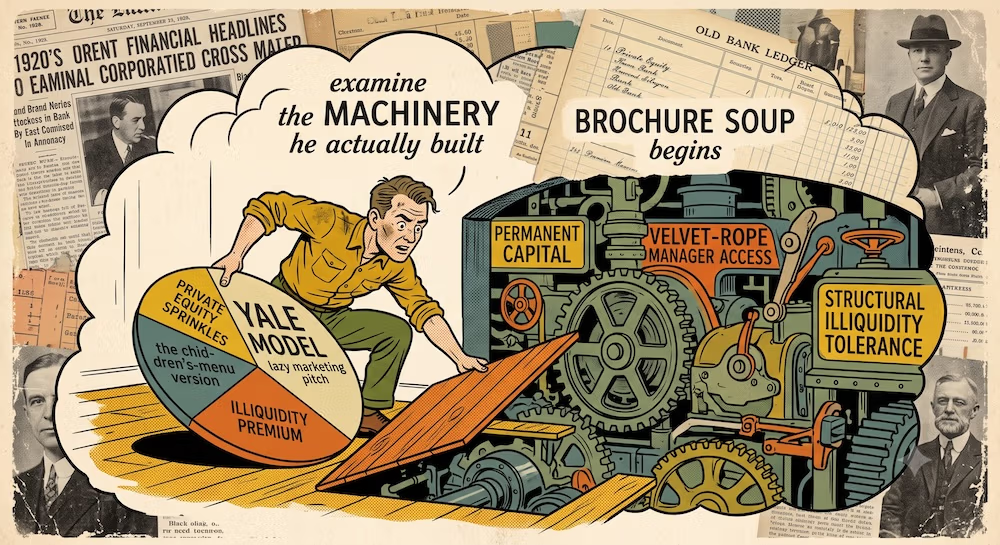
Swensen was not being hypocritical. He simply understood that the Yale Model was never a static pie chart with private equity sprinkles. That is the children’s-menu version. The real model was a sophisticated institutional machine built around permanent capital, velvet-rope manager access, structural illiquidity tolerance, and a level of governance discipline that most copycats cannot survive.
To understand how Swensen changed institutional investing forever, we have to look past the modern asset labels and examine the machinery he actually built.
What Institutional Investing Looked Like Before Swensen
Before Swensen arrived at New Haven in 1985, institutional money management was a remarkably sleepy, low-conviction affair. Endowments, foundations, and pension funds across the United States were shackled to a rigid, conventional stock-and-bond orthodoxy.
The standard institutional portfolio baseline was heavily dominated by domestic public assets. Allocators typically held roughly 60% in large-cap domestic equities and 40% in long-term nominal government or corporate bonds. Private equity was a tiny, specialized niche; venture capital was an obscure West Coast experiment; and “absolute return” hedge funds were virtually non-existent on institutional balance sheets.
The prevailing institutional mindset prioritized comfort and liquidity above all else. Portfolios were managed by conservative committees that met quarterly to review static allocations. If a portfolio manager suggested locking up millions of dollars in an unlisted timberland partnership or an early-stage venture fund for ten to fifteen years with zero exit ramp, they would have been viewed as a reckless fiduciary.
The industry’s collective performance reflected this lack of imagination. Institutions relied almost entirely on the broad beta of public markets, paying high transaction commissions to active public managers who consistently failed to beat their benchmarks. Diversification meant buying a different flavor of domestic large-cap stock.
Swensen looked at this landscape and realized that institutions were systematically mismanaging their greatest structural advantage: an infinite time horizon. By treating a permanent endowment like a short-term retail checking account that needed daily liquidity, they were leaving massive risk premiums on the table.
| Before Swensen | The Swensen-Yale Shift | Why It Changed the Industry |
| Stock-and-bond orthodoxy | Diversified, alternative-heavy endowment model | Expanded the available institutional opportunity set into non-correlated spaces. |
| Public-market focus | Private equity, VC, real assets, absolute return | Shifted focus from broad public beta to structural manager access and private alpha. |
| Liquid comfort | Illiquidity tolerated as a deliberate return source | Made multi-year asset lockups and J-curve structures respectable for fiduciaries. |
| Committee inertia | Disciplined, rule-based rebalancing | Turned sluggish policy asset reviews into an automated, systematic process. |
| Generic diversification | Governance-driven specialization | Raised the bar for internal institutional staff, alignment, and direct partnership terms. |

The Real Engine of the Yale Model
When Swensen took over the Yale Endowment alongside Dean Takahashi, he didn’t just tweak the percentages; he fundamentally re-engineered the institutional operating system. He replaced conventional portfolio design with a framework built on six core mechanical pillars:
1. An Uncompromising Equity Orientation
Swensen completely rejected the standard institutional practice of holding massive allocations of nominal, long-term government bonds. He argued that for an endowment with a permanent horizon, non-real-yielding fixed income was a drag on purchasing power. He demanded that the vast majority of the allocation framework be tilted toward assets with growth characteristics—whether public or private—that compound via retained corporate earnings and economic production.
2. Broad Global Diversification
Instead of using bonds as the sole portfolio anchor, Swensen introduced asset classes that were structurally uncorrelated to traditional public equities. He divided the framework into distinct allocation blocks: Domestic Equities, Foreign Equities, Absolute Return (Hedge Funds), Private Equity (Venture Capital and Leveraged Buyouts), and Real Assets (Timberland, Energy, and Real Estate).
3. Exploitation of Market Inefficiencies
In public markets like the S&P 500, price discovery is continuous and information is distributed rapidly. Swensen recognized that generating meaningful alpha in highly efficient sectors was a low-probability bet. Instead, he directed Yale’s capital toward opaque, unlisted, and inefficiently priced private markets where specialized information, operational control, and structural execution could create immense outperformance.
4. Harvesting the Illiquidity Premium
Because Yale did not face the threat of sudden client redemptions or emotional retail panics, Swensen realized the endowment could safely hold assets that took years to mature. He deliberately traded daily liquidity for higher expected returns, locking up capital in 10-to-15-year fund structures to capture the premium that desperate or short-horizon investors had to give up.
5. Velvet-Rope Manager Access
The hidden fuel of the Yale Model is exclusive access. Swensen did not invest in broad asset categories; he invested in specific relationships. Yale leveraged its early institutional credibility, long-term relationships, and reputation to secure capacity-constrained allocations with the absolute elite general partners of Silicon Valley and Wall Street.
6. Systematic Rebalancing and Spending Insulation
To keep this volatile machine from drifting into catastrophe, Swensen implemented disciplined, policy-driven rebalancing ranges. More importantly, Yale implemented a smoothed spending policy that insulated the investment office from short-term budget pressures, calculating university distributions based on a multi-year moving average.
The lazy institutional version of this story is “Swensen bought alternatives.” The better, more accurate version is that Swensen used Yale’s permanent capital to go where normal investors could not go, hired elite specialists most allocators could not access, and utilized structures most investment committees did not have the stomach to survive.

Manager Selection: The Part Copycats Miss
The entire alternative asset marketing complex is built on a massive statistical lie. When a fund manager pitches a private equity or venture capital vehicle, they invariably show charts of the historical asset class averages achieved by top-tier universities.
But private equity is not one uniform asset class in the way a toaster is one appliance. At the wrong manager, it is simply an expensive locked room with bad lighting.
In public equities, asset class exposure gives you a predictable slice of beta. If you choose an underperforming active public mutual fund, your penalty is usually bounded by a thin margin. Swensen’s own historical research demonstrated that the return dispersion between a top-quartile active manager and a bottom-quartile active manager in large-cap public equities is narrow, typically hovering around 1% to 2%.
When you cross the line into private equity and venture capital, that baseline uniformity completely evaporates.
Public Large-Cap Equity Manager Dispersion:
[Bottom Quartile]--1% to 2% Gap--[Top Quartile]

Private Equity & Venture Capital Manager Dispersion:
[Bottom Quartile]------------------------20%+ Annual Gap------------------------>[Top Quartile]
In alternative assets, the annualized return dispersion between an elite, first-quartile general partner and a bottom-quartile manager expands to greater than 20% per year.
This statistical reality completely upends the logic of generic asset allocation. If an allocator does not have direct access to the top-tier, capacity-constrained managers who possess genuine, repeatable informational moats, buying “alternative assets” means they are simply paying high fee layers to take on unlisted liquidity risk.
Yale’s long-term performance—which saw the endowment produce an annualized gain of 13.7% over Swensen’s 36-year tenure—was driven overwhelmingly by manager selection alpha, not the mere presence of private asset labels on a balance sheet. What is left over for the secondary market is frequently the bottom tiers of the dispersion curve, where performance goes to die.
Permanent Capital and the Illiquidity Premium
To understand why Swensen could run this playbook without destroying the university’s balance sheet, you have to look at how Yale managed its liabilities. You cannot separate an asset model from its funding structure. This is where the brochure version starts coughing blood.
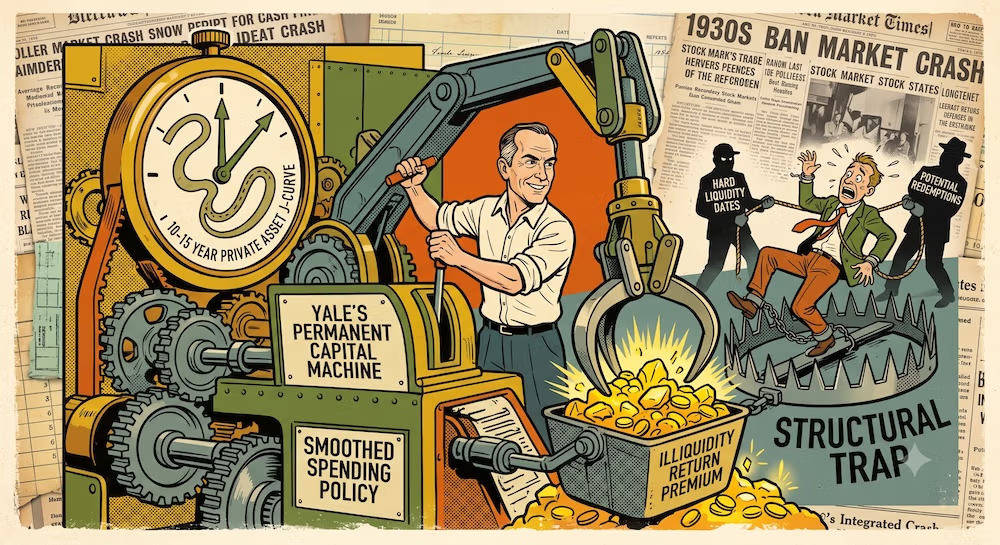
Yale’s primary structural edge was an infinite investment horizon paired with an institutional governance system that protected the investment office from short-term panic. The university utilized a sophisticated, smoothed spending policy that decoupled the daily operations of the campus from the immediate volatility of the financial markets. Instead of forcing the endowment to liquidate assets to meet a fixed budget during market downturns, the spending rule smoothed endowment distributions over time.
This framework allowed Swensen to look at a 10-year lockup or a multi-year venture capital J-curve—where a fund calls capital for years before returning a single dime of profit—and view it as an opportunity rather than a hazard.
+--------------------------------------------------------+
|          YALE'S PERMANENT CAPITAL MACHINE              |
+--------------------------------------------------------+
|  [Smoothed Spending Policy]                            |
|             │                                          |
|             ▼                                          |
|  [Insulates Investment Office from Short-Term Panic]   |
|             │                                          |
|             ▼                                          |
|  [Enables 10-15 Year Private Asset Lockups (J-Curves)] |
|             │                                          |
|             ▼                                          |
|  [Harvests the Illiquidity Return Premium]             |
+--------------------------------------------------------+
An individual investor or a standard corporate pension fund operates under completely different structural constraints. They face hard liquidity dates, potential redemptions, or unpredictable cash needs. Chasing an “illiquidity premium” sounds elegant over coffee, but if an investor does not possess the underlying liability structure to survive a multi-year capital freeze, they are not harvesting a premium—they are walking into a structural trap.
The 2008 Liquidity Squeeze: The Warning Label
Because the financial media loves a hero narrative, the conventional history of the Yale Model treats it as a flawless compounding engine. But illiquidity is wonderful until the bill shows up wearing boots. Even the best-engineered version of the model carried hidden, systemic liquidity strains that were laid bare during the Great Financial Crisis.
For the fiscal year ending June 30, 2009, the Yale Endowment reported a negative 24.6% return, with total assets plummeting from $22.9 billion down to $16.3 billion. Yale explicitly noted in its institutional reporting that illiquidity had detracted from performance, and that standard diversification models had failed to protect absolute asset values during the systemic deleveraging of fiscal 2009.
The mechanism behind this stress test was an asset-liability mismatch. While public stock markets were sliding, Yale’s private equity and venture capital partnerships continued to issue contractually mandated capital calls to fund distressed assets or execute pre-existing deal pipelines. In private funds, failing to meet these capital calls can lead to severe penalties, dilution, or a loss of rights under the fund agreements.
Swensen turned to his absolute-return partnerships to raise the required cash, but found that some hedge fund vehicles across the industry implemented redemption gates or side pockets to protect their own liquidity profiles.
Yale’s 2009 financial statements show the scale of the liquidity problem clearly: billions in uncalled commitments, limited short-term liquidity relative to those obligations, and nearly $1 billion in commercial paper outstanding by June 30, 2009. The broader lesson is not that Yale was helpless. It is that even the elite version of the Yale Model needed institutional balance-sheet tools when illiquidity and capital calls collided. Yale possessed an AAA-rated balance sheet that allowed it to issue taxable bonds and expand its commercial paper facilities to navigate the squeeze, eventually recovering its nominal asset peak within five fiscal years. Without those institutional balance-sheet patches, an illiquid asset mismatch can freeze an uninsulated portfolio.

The Lost Decade: When Yale Looked Dumb Next to the S&P 500
Tracking error is a psychological woodchipper. Most Yale copycats wanted the prestige without the lockups, the governance, the access, or the ulcer. Even when the model isn’t facing an outright liquidity crisis, its tracking error relative to a dominant public market index can test the conviction of the most stoic investment committee.
Following the GFC, the global macro environment shifted into an extended period of zero-bound interest rates and historic U.S. large-cap tech dominance. During this decade-long expansion, global diversification and heavy alternative asset tilts went from looking like institutional genius to looking like an expensive drag.
According to Yale’s official institutional announcements, the endowment produced an annualized return of 11.1% over the ten years ending June 30, 2019. It was a strong nominal outcome, but it significantly lagged behind broad domestic public stocks, which returned 14.7% annually over the exact same ten-year window.
For an entire decade, a passive domestic equity index outpaced the world’s most sophisticated institutional investment office by 360 basis points per year, with zero performance fees, zero lock-up periods, and total transparency.
In the institutional world, a chief investment officer with Swensen’s track record and deep board governance alignment can easily handle a decade of trailing tracking error. But outside that specific environment, watching a portfolio trail the headline index year after year while paying internal expenses for complex alternative or international layers causes most allocators to capitulate at the absolute bottom of the cycle.
Why the Retail Yale Model Is Mostly Cosplay With Fees
The modern wealth management industry loves to construct a retail market for “liquid alternatives,” retail private equity access platforms, and synthetic hedge fund clone ETFs. It is an exercise in pure financial cosplay. The retail Yale Model is where good institutional ideas go to put on a cheap Halloween costume.
THE RETAIL ALTERNATIVE TRAP
+-------------------------------------------------------------+
| Elite Institutional Model:                                  |
| Permanent Capital ──> Elite Manager Access ──> True Alpha   |
+-------------------------------------------------------------+
| Retail Copier Model:                                       |
| Daily Liquidity Needs ──> Leftover Access ──> Extra Fee Layers |
+-------------------------------------------------------------+
When an investor buys a retail liquid alternative vehicle or joins an online platform designed to aggregate small balances for private markets, they are systematically stripping away the exact structural mechanisms that made Swensen’s model work:
- The loss of the illiquidity premium: A retail fund that offers daily or quarterly liquidity cannot invest in true, long-horizon unlisted real estate or direct timberland. They must rely on synthetic derivatives or listed proxy equities, which reintroduces standard public equity market beta alongside an extra management fee.
- The exposure to severe adverse selection: The elite, capacity-constrained venture capital and buyout firms do not need retail aggregation platforms to fill their capital pools. They choose their partners based on multi-decade institutional relationships. What gets filtered down into the retail alternative wrapper market is almost exclusively the lower tiers of the manager dispersion curve—the exact zone where performance goes to die.
- The double fee layers: Instead of negotiating direct, institutional-grade general partner terms, the retail copier typically pays a management fee to the platform wrapper, a management fee to the underlying vehicle, and a performance carry to a manager who is often trapped in a median-to-bottom quartile tracking profile.
The retail Yale Model takes an elegant institutional concept and transforms it into an expensive fee-harvesting machine. It keeps the asset labels while completely missing the underlying machine.
What Actually Travels
The model worked because the machine worked. The asset labels were not magic beans. If we expel the mythology of the magic alternative pie chart, a reader can study the structural logic of the Yale Model without copying its specific allocation.
The core takeaways focus on conceptual portability and systemic design, rather than a universal portfolio prescription:
- Study the liability-matching lesson before copying the asset mix: The foundational engine behind Yale’s asset allocation model was its smoothed spending rule, which matched its infinite time horizon to its illiquid assets. For an individual portfolio, the lesson is to carefully match liquidity needs to asset structure, ensuring that capital placed into highly volatile or restricted assets is structurally insulated from short-term personal spending obligations.
- Understand why Swensen treated long-term nominal bonds differently inside a permanent endowment: Swensen avoided large allocations of nominal bonds because he recognized that over a multi-decade horizon, a portfolio must be overwhelmingly tilted toward real-yielding, productive assets that compound via corporate earnings and growth. For long horizons, growth orientation takes precedence over nominal safety.
- Respect the value of policy-driven rebalancing: Swensen did not adjust targets based on emotional headlines or recent trailing performance. He relied on disciplined, policy-driven rebalancing ranges. The conceptual takeaway is that establishing clear percentage boundaries around core asset targets automates the process of trimming during expansions and buying into market stress according to policy, rather than emotion.
- Distinguish between asset labels and alternative alpha: A portfolio builder should not confuse buying an alternative category with achieving a top-quartile institutional return. In the absence of direct, elite manager access, utilizing low-cost public index funds represents a highly reliable method for capturing global corporate earnings without introducing hidden structural fee drag.
Yale Model Timeline: From New Haven Experiment to Institutional Template
- 1985 — The New Haven Appointment: David Swensen takes over the Yale University Investment Office at age 31, managing $1.3 billion. He begins moving the endowment away from the conventional 60/40 stock/bond framework.
- 1990s — The Venture & Alternative Expansion: Yale leverages early institutional credibility and academic networks to secure core partnerships with elite, capacity-constrained Silicon Valley venture capital and private equity partnerships.
- 2000–2003 — Proof-of-Concept Dot-Com Outperformance: As the tech bubble collapses, Yale’s uncorrelated absolute return and real asset allocations protect the endowment, posting positive cumulative performance while the S&P 500 drops over 33%.
- 2008–2009 — The GFC Liquidity Stress Test: The endowment drops 24.6% in fiscal 2009. Facing private capital calls and gated hedge funds, Yale utilizes its institutional balance-sheet strength and commercial paper facilities to manage liquidity.
- 2010–2019 — The Tracking Error Decade: The Yale Endowment posts a strong 11.1% CAGR but lags broad domestic public stocks by 360 basis points per year, showcasing the immense tracking error embedded in alternative frameworks.
- 2021 — The Long-Term Legacy Audit: Following Swensen’s passing, historical audits confirm a 36-year institutional performance record of 13.7% annualized gains, transforming the global endowment landscape forever.
The Yale Model in Practice: Mechanism vs. Copycat Myth
Matrix 1: Yale Model Mechanism Matrix
| Mechanism | What Yale Had | Why It Mattered | Retail Copycat Mistake |
| Permanent Capital | Infinite-horizon endowment framework insulated by a smoothed multi-year spending rule. | Allowed the investment office to tolerate multi-year lockups and capital calls without fear of panic liquidations. | Pretending short-term personal emergency savings or standard taxable brokerage cash can tolerate true multi-year illiquidity. |
| Manager Access | Historic prestige and multi-decade institutional relationships with elite general partners. | Allowed Yale to capture the massive 20%+ return alpha dispersion that exists only at the top tier of private markets. | Buying mass-market, leftover retail private equity wrappers or crowdfunding real estate pools exposed to adverse selection. |
| Equity Orientation | A portfolio heavily tilted toward global public equities, venture capital, and growth-oriented private equity. | Maximized real long-term compound growth and purchasing power, completely bypassing nominal bond drag. | Thinking that “alternative assets” automatically mean low risk, ignoring the underlying equity beta embedded in private buyouts. |
| Rebalancing Discipline | Rule-based policy target corridors that triggered systematic adjustments across volatile asset classes. | Encourages the portfolio to buy into market stress and trim during expansions according to policy, rather than emotion. | Attempting to rebalance manually based on emotional news cycles, ad-hoc feelings, or recent trailing performance. |
| Governance Continuity | A highly stable, academically rooted investment board capable of enduring long stretches of tracking error. | Allowed the team to stick to an out-of-favor strategy for an entire decade without facing career termination or forced liquidation. | Changing portfolio strategies or switching to a new asset allocation framework after a few years of trailing the headline index. |
Matrix 2: Yale Model Myth vs. Reality
| Popular Asset Folklore / Myth | Verified Institutional Reality | Samuel’s Verdict |
| Myth 1: Yale won because alternative asset classes possess an inherent, magical return premium. | Reality: Yale won because it exclusively accessed top-quartile managers and possessed the permanent capital necessary to harvest an illiquidity premium. | Asset labels are not fairy dust. If you don’t have velvet-rope access, alternatives are just an expensive way to carry public market beta. |
| Myth 2: The Yale Model is a low-risk, low-volatility portfolio framework perfect for conservative capital. | Reality: The portfolio carried massive underlying equity risk and severe structural liquidity strains that were laid bare during the 2008 financial crisis. | Smooth marks are not smooth reality. Quarterly appraisal-based pricing models hide volatility; they do not eliminate it. |
| Myth 3: David Swensen wanted individual savers to mimic his endowment asset allocation pie chart. | Reality: Swensen explicitly advocated for the exact opposite approach, directing individual retail investors to use simple, low-cost passive index funds. | The man understood exactly which game you were actually playing. You cannot cosplay permanent capital inside a retail brokerage account. |
The Yale Model was not a magic pie chart. It was an institutional machine built around permanent capital, elite access, equity orientation, illiquidity tolerance, governance discipline, and rebalancing under stress. Swensen changed institutional investing because he showed what a serious long-horizon allocator could do when it stopped behaving like a nervous stock-and-bond committee. But the copycat lesson is brutal: the machine mattered more than the labels. You are not Yale. I am not Yale. And buying the plastic souvenir version is not the same thing as owning the engine. It is just paying extra for the keychain.
What is the minimum portfolio size required to implement a true Yale Model framework?
It depends entirely on your definition of the model, but to replicate the actual mechanism Swensen built, the true answer is hundreds of millions of dollars. If you are a retail investor trying to build this with a $50,000 or $500,000 portfolio, you are locked out of the core value driver: top-quartile manager selection. Because the dispersion between elite and bottom-tier private equity managers exceeds 20% annually, a small portfolio is structurally limited to leftover mass-market retail wrappers that capture adverse selection rather than institutional alpha. For individual savers, the structural alternative is to focus on a highly liquid, low-cost passive public framework.
How does the tax drag change when translating the Yale Model to a personal taxable account?
It gets incredibly ugly. The Yale Endowment operates under a tax-exempt institutional framework, meaning Swensen could aggressively rebalance across asset classes, rotate managers, and realize massive short-term venture distributions with zero tax liability. If a private individual attempts to rotate through high-turnover alternative strategies, liquid alt wrappers, or direct private placements within a standard taxable account, the constant realization of short-term capital gains and ordinary income distributions creates a compounding speed bump that systematically erodes the target illiquidity premium.
Can modern retail platforms for fractional private equity give you authentic Yale-style exposure?
Not exactly. While fractional investment platforms allow you to write smaller checks for unlisted real estate, venture deals, or private credit, they cannot replicate the access monopoly enjoyed by top-tier endowments. Elite, capacity-constrained general partners do not use secondary aggregation platforms to raise capital. These platforms frequently offer access to lower-tier funding rounds or secondary allocations burdened with extra layers of platform-level management fees, exposing individual portfolio builders to severe adverse selection.
What happens to a portfolio’s liquidity structure during a venture capital J-curve expansion?
Your capital is completely frozen. The venture capital and private equity J-curve mechanism demands that you sign a legally binding commitment to supply cash over a multi-year investment phase before any profits are distributed. In an institutional framework like Yale’s, an uncalled capital obligation is backed by smoothed spending rules and a massive balance-sheet buffer. For a self-directed individual, an unexpected wave of capital calls during a personal emergency or a broader macro crisis can lead to severe penalties or total dilution of your prior capital stakes if you cannot supply immediate liquidity.
Why did David Swensen advocate for passive index funds in his book Unconventional Success?
Because he understood the rules of the game you are playing. Swensen recognized that active management is a game of extreme skill, scale, and access. He explicitly noted that without the institutional infrastructure to identify and partner with the top 5% of active managers, individual investors are statistically guaranteed to underperform public benchmarks after accounting for fees. His retail mandate was an act of operational realism: if you do not own the velvet-rope access machine, your highest-probability path to long-term wealth compounding is to capture broad public market beta at the lowest possible cost.
How do appraisal-based valuations distort the perceived risk of alternative asset classes?
They create a psychological illusion of stability. Unlike public stocks that reprice every single second, unlisted private equity, timberland, and real estate assets are valued quarterly via subjective, backward-looking appraisal models. This artificial smoothing creates an exceptionally low trailing volatility metric on paper. In reality, the underlying economic volatility and correlation of these corporate operations track closely with public markets during a systemic crisis, meaning smooth asset marks are not the same thing as smooth market reality.
This article is also available in Spanish. [Leé la versión en castellano: David Swensen y el Modelo Yale: Cómo la inversión institucional cambió para siempre]