The lazy version of Warren Buffett’s evolution is that he started as a Benjamin Graham bargain hunter, met Charlie Munger, discovered wonderful businesses, and floated into Omaha sainthood on a river of Cherry Coke. It is a cute story. It is also a nice narrative with several major load-bearing walls missing.
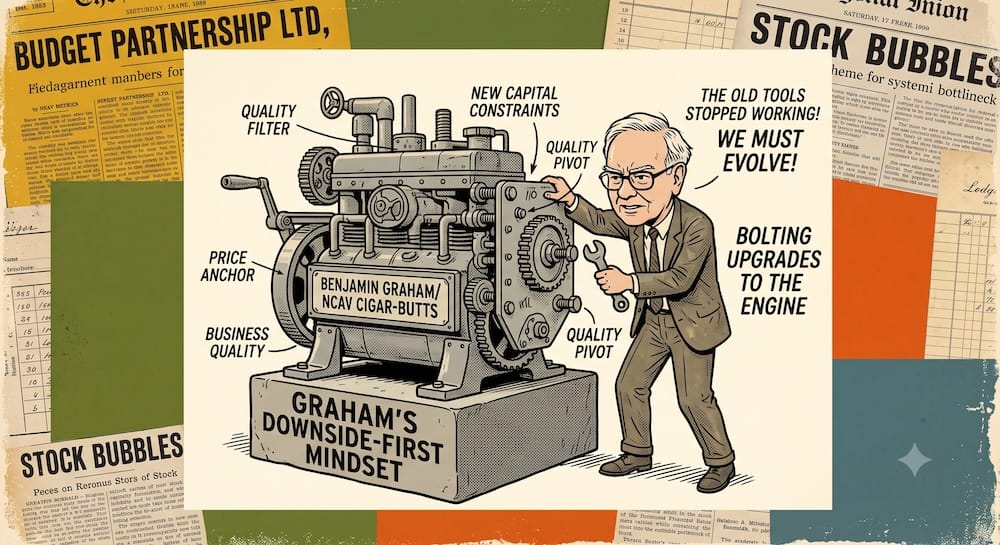
The conventional folklore treats his career like a spiritual awakening—as if he woke up one day, realized cheap stocks were dirty, and levitated above the need for strict price discipline. But looking at the historical record, his investing system did not evolve through inspirational leaps. It was a sequence of cold, mechanical adaptations. He kept bolting new upgrades onto the engine because his old tools stopped working when they hit new capital constraints.
Buffett changed repeatedly over his seven-decade career, but each modification kept the core of his old discipline alive. He did not abandon Benjamin Graham; he carried Graham’s downside-first mindset with him into every single era. He simply stopped letting pure asset cheapness be the only bouncer at the door.
Understanding how that machine was actually built means tracing a career arc shaped by changing market regimes and systemic bottlenecks. The evolution was entirely practical: new capital sizes created new constraints, which demanded entirely new tools.
Stage One: Graham Gave Buffett the Price Anchor
The baseline framework of Buffett’s entire career was forged in the classroom of Benjamin Graham at Columbia University between 1950 and 1951, and later refined on the trading desk of Graham-Newman Corp from 1954 to 1956. This era provided the fundamental price anchor that prevented him from ever overpaying for a narrative.
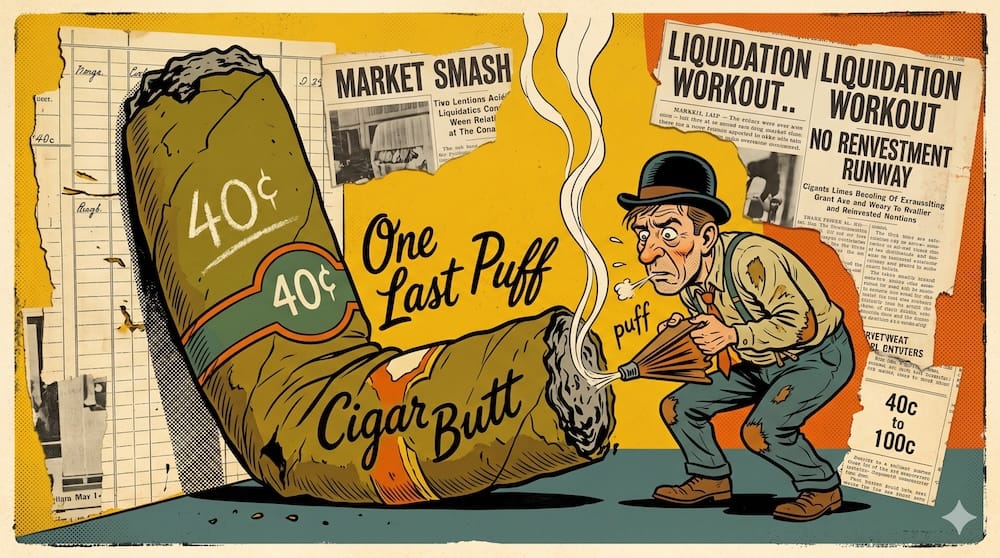
Graham’s methodology was strictly quantitative, downside-focused, and deeply distrustful of corporate projections. The core tool was the Net Current Asset Value (NCAV) metric—popularly known as the “cigar-butt” style of investing. The mechanic was simple: calculate a company’s current assets (cash, receivables, inventory), subtract all total liabilities, and look for businesses selling in the market at a price below two-thirds of that net-net liquidation value.
Physically, you were buying a dying corporate husk that still had one free puff left in it.
This stage instilled three non-negotiable principles that Buffett never discarded:
- The Margin of Safety: Demanding a vast structural discount between the market price paid and the verifiable asset value to protect against human error or operational bad luck.
- Mr. Market: Treating the stock market not as an efficient price-setter, but as a wildly emotional counterparty that exists to serve the allocator, not to instruct him.
- Asset Disconnect: Focusing strictly on tangible, liquid balance sheet values rather than guessing what a company’s earnings power might look like five years into an unwritten future.
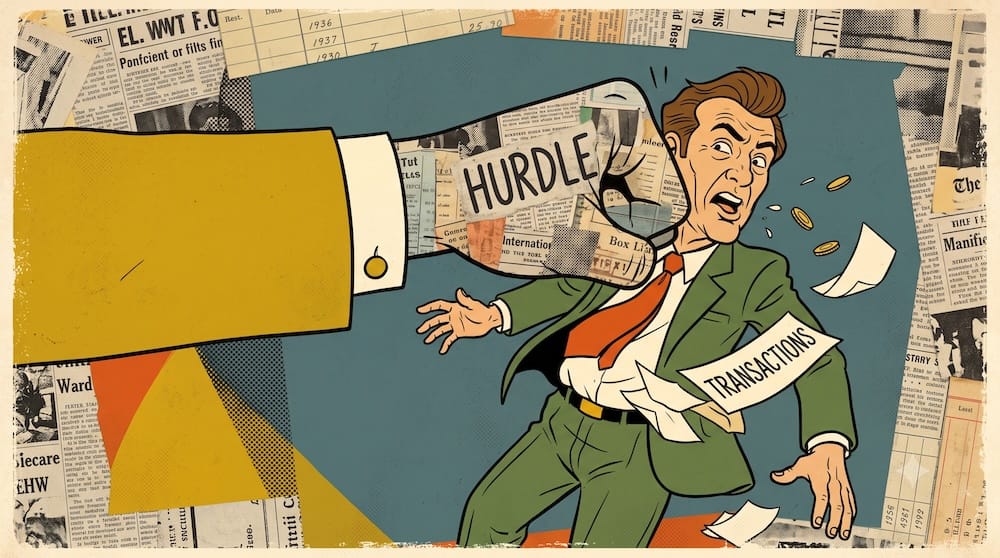
This was a highly effective system for small amounts of money in an inefficient, post-depression market environment. It gave Buffett an unshakeable psychological baseline. It taught him to look at an equity security as a fractional interest in a physical business rather than a blinking pixel on a screen. But as an exclusive strategy, it carried an inherent limitation: it was completely unscalable, and it forced the allocator to spend their life rummaging around in corporate garbage bins.
Stage Two: The Partnership Years Added Workouts and Controls
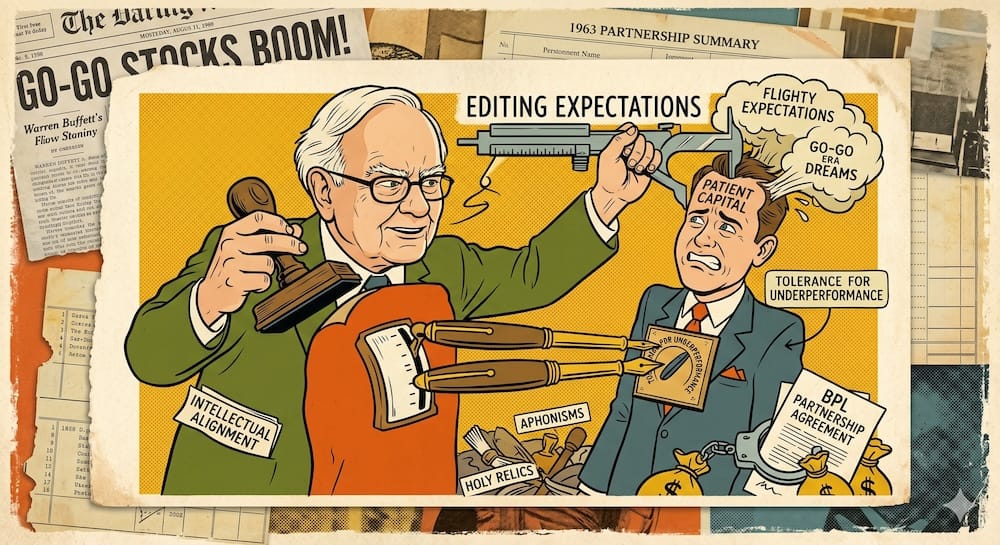
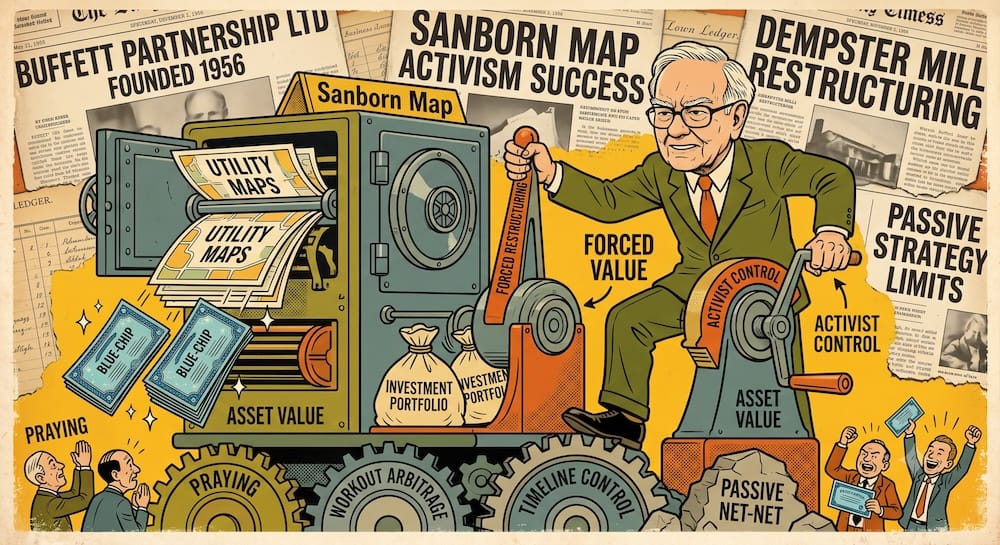
When Buffett returned to Omaha and founded the Buffett Partnership Ltd. (BPL) in 1956 with just over $100,000, he quickly encountered the physical limits of being a passive net-net investor. If you are buying tiny, broken companies, you are at the mercy of how long the market takes to correct its mispricing. If the stock stays unloved for years, your compounded annual return rots away.
To solve this, Buffett divided the BPL capital pool into distinct tactical sleeves that went far beyond Graham’s passive framework:
- Generals: Standard undervalued equities where BPL was a passive participant, waiting for the gap between price and value to close.
- Workouts: Corporate arbitrage situations—mergers, liquidations, spin-offs, and reorganizations. These positions were tied to specific corporate timelines rather than general stock market behavior, protecting BPL from market-wide drawdowns.
- Controls: Situations where Buffett systematically accumulated enough shares to take a controlling interest, force his way onto the board, and manually unlock the asset value himself.
The definitive example of this evolutionary leap was the Sanborn Map Co. in 1958. Sanborn produced detailed utility and insurance maps, but its underlying business had been declining for years. However, behind that map operation sat a massive, unappreciated corporate investment portfolio. Buffett noticed that Sanborn shares were trading in the market at roughly $45, while the investment portfolio alone was worth $65 per share.
Instead of waiting for Mr. Market to notice, BPL spent two years aggressively accumulating a 23% ownership stake. Buffett took a seat on the board, rallied disgruntled shareholders, and forced an activist restructuring. The company separated its investment assets from the map business, allowing BPL to exchange its shares directly for blue-chip securities at a massive profit.
A similar playbook was deployed at Dempster Mill Manufacturing Co., where Buffett took control, installed a hard-nosed operations manager to liquidate bloated inventory, and redirected the freed-up cash into high-yielding securities.
This partnership era proved that Buffett was not merely copying Graham. He had operationalized the discipline. By adding arbitrage and activist control pressure, he seized control of his own timeline, forcing value realization instead of praying for it.
Stage Three: American Express Added Franchise Analysis Under Stress
By the mid-1960s, the post-war economic boom was shrinking the pool of obvious net-nets. The cheap asset piles were drying up. Buffett was forcing himself to confront a difficult question: What do you do when a business has vast economic value that cannot be measured by adding up its physical inventory or machinery?
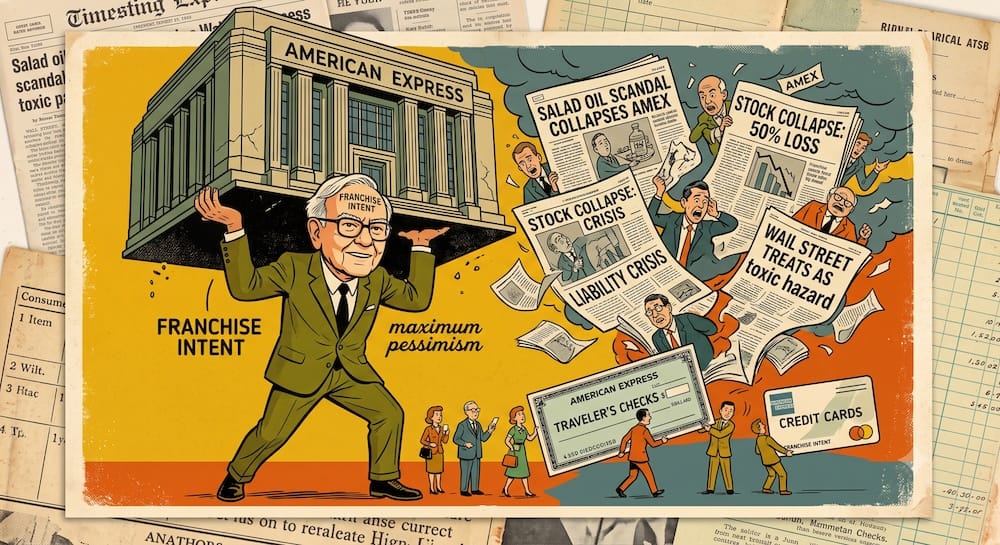
The answer arrived in late 1963 via the infamous Allied Crude Vegetable Oil scandal—the “Salad Oil Scandal.” A rogue commodities trader named Anthony De Angelis used falsified warehouse receipts for millions of pounds of nonexistent salad oil to secure massive loans from American Express’s warehousing subsidiary. When the fraud collapsed, AMEX was left holding a massive financial liability that threatened to wipe out its immediate capital.
The stock market panicked. American Express shares collapsed by more than 50% as Wall Street treated the entire corporation as a toxic hazard.
This was the bridge moment in Buffett’s evolution. Rather than filtering for a cheap balance sheet, he looked at consumer behavior under stress. He went to local restaurants, hotels, and travel agencies, verifying that consumers were still using AMEX traveler’s checks and credit cards with complete indifference to the warehouse fraud in New Jersey. The core brand equity appeared largely intact.
Buffett recognized that the company’s earning power was a far greater asset than any collection of physical machinery. He deployed 40% of BPL’s total capital ($13 million) into American Express equity near the point of maximum pessimism. Within three years, the position tripled in value, delivering a massive win for the partnership.
American Express forced a critical upgrade to his strategy: he realized that a powerful consumer franchise could survive a severe, temporary operational shock, and that the value of that brand was just as real as a Graham net-net asset pile.
Stage Four: Berkshire Textile Taught the Cost of Cheapness Without Quality
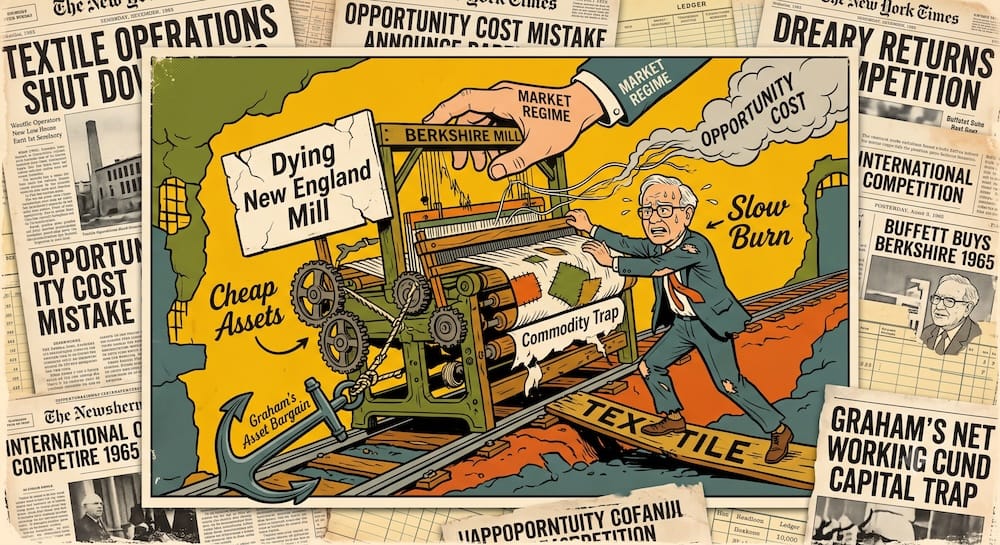
Every evolution requires a scar to remind the allocator why the old way can kill you. For Buffett, that scar was his 1965 acquisition of Berkshire Hathaway, a dying New England textile manufacturer.
On paper, Berkshire was a classic, irresistible Graham asset bargain. The company’s net working capital per share was significantly higher than the stock market price. Buffett began buying shares in 1962 simply intending to sell them back to the management team at a slight premium during a corporate tender offer. But when the company’s executive tried to cheat him out of a few cents per share on the agreed price, Buffett got angry, bought a controlling interest, and fired the management.
He now owned a broken textile mill.
For the next twenty years, Buffett poured capital into modernizing the looms, cutting costs, and trying to turn the operations around. It didn’t matter. The business lacked any competitive advantage; it was a pure commodity producer competing against low-cost international operations. Every dollar of profit generated by the mill had to be immediately plowed back into expensive machinery just to stay alive, producing a dismal return on capital.
Buffett finally shut down the textile operations entirely in 1985. He later looked back on this as an enormous opportunity-cost mistake, often discussed in the hundreds of billions, acknowledging that funneling those early funds through a broken textile vehicle instead of straight into insurance significantly dragged down his early compounding potential.
The textile mistake was the ultimate negative proof of his evolution. It proved that buying an unviable business simply because it is trading at a discount to its physical assets is a structural trap. Cheap assets without economic quality are merely a slow way to burn capital.
Stage Five: Munger and See’s Made Quality Measurable
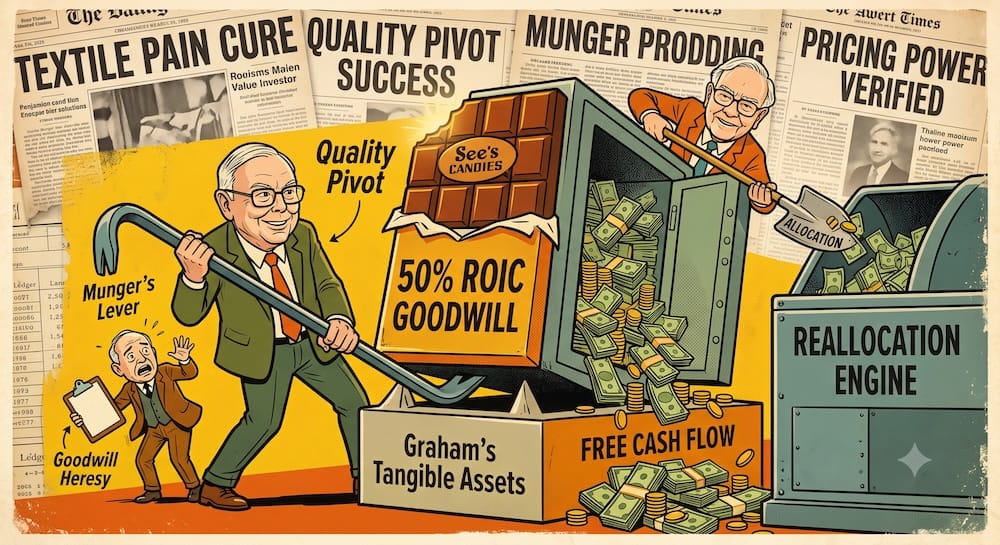
The operational pain of the Berkshire textile mills, combined with the intellectual prodding of Charlie Munger, permanently cured Buffett of his pure “cigar-butt” addiction. Munger’s philosophy was simple: “A great business at a fair price is superior to a fair business at a great price.”
The ultimate test case for this refined engine was the 1972 purchase of See’s Candies.
See’s was a California-based chocolate retailer with a powerful regional brand, but it looked horrifying under a traditional Graham filter. The owners wanted $25 million for the company, while its net tangible operating assets were only $8 million. To an old-school value investor, paying three times tangible assets for unprovable “goodwill” was an absolute heresy.
But Buffett and Munger looked at the underlying economic return profile. See’s was generating $4 million in pre-tax operating earnings on that tiny $8 million asset base—a staggering 50% pre-tax return on net tangible assets.
| Financial Metric | See’s Candies (1972) |
| Total Purchase Price | $25,000,000 |
| Net Tangible Operating Assets | $8,000,000 |
| Pre-Tax Operating Earnings | $4,000,000 |
| Pre-Tax Return on Tangible Assets | 50.0% |
Mechanically, See’s possessed immense pricing power. See’s could raise prices over time without destroying customer demand, typically adjusting their metrics right before the holiday season. More importantly, the business required very little incremental capital to grow. It didn’t need to build massive, expensive factories or buy hyper-advanced machinery every year just to compete.
See’s became a cash machine. It took in minimal capital, generated immense profits, and threw off millions of dollars of free cash flow that Buffett could immediately reallocate into other investments. This was the moment the strategy fully shifted to business-quality analysis: looking for high returns on invested capital protected by a durable economic moat.
Stage Six: Insurance Float and Permanent Capital Changed the Funding Model
By the late 1960s and early 1970s, Buffett realized that having a great asset-picking method means nothing if your funding layer is unstable. In a traditional partnership or hedge fund structure, you are always vulnerable to customer redemptions. If the market panics and your clients demand their cash back, you are forced to liquidate your best positions at the absolute bottom of the market cycle.
This is where Buffett mythology gets annoying. People want one clean lesson. Buy cheap. Buy quality. Be patient. Drink soda. Lovely. The actual career was messier: new constraint, new tool, new scar. To fix his funding vulnerability, Buffett systematically dismantled the partnership structure and replaced it with a permanent corporate capital pool anchored by insurance float.
Following the initial 1967 purchase of National Indemnity, Berkshire aggressively acquired major underwriting institutions, culminating in the full acquisition of GEICO and General Re. The insurance float generated by these companies fundamentally changed Berkshire’s balance sheet architecture.
Insurance float functions as a highly stable funding source:
- Upfront Collection: Policyholders pay their insurance premiums upfront.
- Deferred Payout: Those funds sit on Berkshire’s balance sheet for months, years, or decades before claims are actually settled.
- Low-Cost Scale: So long as underwriting operations remain disciplined and profitable, the cost of holding this capital is frequently lower than the US Treasury Bill rate, often low-cost and sometimes negative-cost float when underwriting was profitable.
Academic performance audits confirm that this structural funding model allowed Berkshire to carry an average historical leverage ratio of roughly 1.7-to-1. Buffett was not running a pure, unlevered cash portfolio; he was running a systematically levered equity portfolio.
Crucially, this corporate leverage was not subject to broker-style margin calls or fund-style redemptions, though claims, reserves, underwriting discipline, and liquidity management still mattered. If Berkshire’s stock holdings dropped by 50% during a systemic financial crisis—as they did in 1973, 1998, and 2008—there was no margin clerk forcing a liquidation. The insurance liabilities were not directly triggered by daily stock market price declines, allowing Buffett to endure deep underperformance cycles with massive structural resilience.
Furthermore, by keeping his stock turnover near zero, deferred tax liabilities acted like an interest-free funding source as long as gains remained unrealized. Instead of paying taxes annually, those liabilities remained inside Berkshire, compounding for decades.
Stage Seven: Scale Forced Berkshire Into a Different Game
The final phase of Buffett’s evolution was forced upon him by his own compounding success. As Berkshire Hathaway’s total assets grew past hundreds of billions of dollars, the law of large numbers systematically destroyed his ability to utilize his original toolkits.
| Strategic Metric | BPL Era (1956–1969) | Late-Stage Berkshire (Modern Reality) |
| Assets Under Mgmt | $100K scaling to $100M | $500B+ Asset Base |
| Core Asset Target | Illiquid micro-caps, OTC banks, asset arbitrage (Sanborn Map) | Mega-cap S&P 100 corporations, entire infrastructure/railway networks |
| Strategy Type | High-turnover workouts, corporate liquidations, activist “Controls” | Highly concentrated quality compounders held for decades |
| Alpha Source | Pure informational inefficiency and manual balance sheet auditing | Structural scale, private access, and permanent capital float deployment |
When you are managing $1 million, your investable universe is infinite. You can buy tiny, highly inefficient micro-cap net-nets, execute quick corporate arbitrage plays, or buy small bank stocks that are completely ignored by Wall Street.
When you are managing a cash pile that regularly exceeds $150 billion, that entire landscape vanishes. Small positions cannot move the needle on Berkshire’s total returns. Buffett was forced to step out of the traditional stock-picking arena and adapt to an entirely different scale regime.
This modern scale constraint changed his behavior in two distinct ways:
- Private Systemic Liquidity Provision: During major market panics, like the 2008 Financial Crisis, Buffett stopped looking at ordinary public shares. Instead, he leveraged Berkshire’s massive, immediate cash liquidity to strike custom preferred equity deals directly with distressed institutions like Goldman Sachs and Bank of America—securing high double-digit yields paired with free equity warrants that were completely unavailable to the general public.
- Mega-Cap Quality Concentration: The public equity sleeve was narrowed down to massive corporate entities that could actually absorb tens of billions of dollars of capital without triggering regulatory blockages. The massive accumulation of Apple Inc. starting in 2016 is the ultimate expression of this stage. Buffett did not treat Apple as an unpredictable technology play; he approached it as an immense consumer monopoly with high switching costs and massive share-buyback power.
Late-stage scale turned Berkshire into a massive corporate holding company that resembles a low-beta, high-quality conglomerate. The hyper-growth alpha of the early partnership years was consciously traded away for the stability required to protect and compound half a trillion dollars of permanent capital.
| Stage | What Buffett Added | Example | What It Solved | What It Could Not Solve |
| Graham Asset Discipline | Rigid margin of safety price anchors and downside-first focus. | Net-Net Cheap Stocks | Eliminated overpaying for growth narratives or corporate hype. | Severe unscalability; forced to hold low-quality corporate husks. |
| BPL Workouts & Controls | Arbitrage timelines and activist structural liquidation power. | Sanborn Map Co. (1958) | Seized control of timeframes; did not rely on passive market luck. | Limited to the aggregate size of small-cap or micro-cap anomalies. |
| Franchise Stress Testing | Intangible brand equity valuation under temporary operational panic. | American Express (1964) | Opened up investments in companies with real intangible assets. | Required identifying deep corporate crises that were truly temporary. |
| Berkshire Textile Mistake | The internal realization that poor business quality is a capital trap. | Berkshire Mills (1965) | Acted as a permanent warning sign against buying value traps. | Wasted twenty years of management energy before operations shut down. |
| Munger & See’s Quality | Capital-light compounding filters and pricing power metrics. | See’s Candies (1972) | Allowed capital scalability via high returns on invested capital. | Required paying premiums over historic tangible book value. |
| Insurance Float Architecture | Stable corporate funding and non-callable balance sheet equity. | National Indemnity (1967) | Removed the structural threat of margin calls and fund redemptions. | Required disciplined underwriting and liquidity management. |
| Modern Scale Constraint | Private counterparty status and mega-cap consumer aggregation. | Goldman Sachs Deal (2008) / Apple (2016) | Allowed deployment of vast cash hoards during severe macro panics. | Limited the opportunity set within the largest, slowest corporations. |
What Actually Travels Today
When you drop the folklore and map out the entire structural progression, the real question for an independent investor comes into clear focus: What can actually travel over to your own portfolio structure, and what must be left behind in Omaha?
| Lesson | What Travels Conceptually | What Does Not Travel Well |
| Graham Discipline | Demanding a strict margin of safety and ignoring market mania. | Hunting for physical net-nets manually via paper balance sheets. |
| Workouts & Controls | Focusing on clear corporate catalysts and timeline safety. | Executing hostile board takeovers with small retail capital bases. |
| Business Quality | Targeting high-ROIC firms with structural pricing power. | Overpaying for growth stories that lack clear competitive moats. |
| Float & Permanent Capital | Understanding funding stability and minimizing liabilities risk. | Attempting to mimic float using dangerous, callable retail margin. |
| Concentration | Focusing capital on high-conviction ideas when scale permits. | Blindly cloning late-stage holdings while ignoring underlying scale constraints. |
| Scale Humility | Acknowledging how asset size changes the achievable opportunity set. | Assuming small portfolios face the same restrictions as a $500B fund. |
The core lesson of Buffett’s multi-decade evolution is that his results were not driven by an unchanging, mystical gift for picking winners. His performance was the result of building a highly systematic, structurally protected corporate architecture designed to harvest risk premiums.
The useful lesson is not to copy Buffett’s current holdings or imitate Berkshire’s capital structure. It is to understand the sequence of adaptations: price discipline, business-quality analysis, funding stability, behavioral endurance, and scale awareness.
As an independent allocator, you cannot replicate his funding engine. Your retail margin account is a volatile, callable weapon that will turn against you in a 50% drawdown, whereas his float engine was structural insulation. You do not possess his private counterparty access to secure sweetheart deals from investment banks during a panic.
Furthermore, copying his modern, late-stage equity portfolio via 13F filings ignores the fact that his current allocations are heavily dictated by the constraints of extreme size. He is buying Apple and giant utilities because he has no other choice at his current scale. If you are managing a smaller portfolio, copying those exact selections means anchoring yourself to his scale limits without possessing his underlying corporate float engine.
What actually travels is the underlying engineering logic. You can carry the Graham price anchor to ensure you never buy a narrative at a hyper-inflated valuation. You can utilize the Munger quality filter to focus your capital on companies that exhibit high returns on invested capital and true pricing power. And most importantly, you can structure your own portfolio’s funding layer to ensure that you are never a forced seller during a market liquidation.
The evolution was never spiritual. It was mechanical. If you want to compound capital safely across your own life cycle, stop chasing the myth of the wizard and start focusing on the design of your own machine.
How can a retail investor replicate the quality factor pivot seen in Warren Buffett’s investing evolution without owning an insurance company?
You cannot replicate the funding architecture, but you can capture the equity exposure. In your personal portfolio structure, this means moving away from manually evaluating individual stocks based on folklore and instead using systematic, low-cost quantitative index funds or rules-based ETFs that explicitly screen for high Return on Invested Capital (ROIC), low capital reinvestment needs, robust profit margins, and conservative asset growth. You absorb his quality filters while expelling his unreplicable corporate leverage.
What is the minimum portfolio size required to execute the corporate workout or arbitrage strategies from the Buffett Partnership era?
It depends on the asset class. If you are trying to mirror Buffett’s activist “Control” positions like Sanborn Map or Dempster Mill to force corporate liquidations, you are completely blocked by scale; that mechanism requires millions in capital and institutional proxy weight. However, classic “Workouts” like merger arbitrage or spin-off tracking can technically be accessed in liquid public markets with a standard retail account balance, though it introduces significant idiosyncratic tracking error relative to a simple market-cap index.
How do retail brokerage margin lines compare to the insurance float used in Berkshire Hathaway’s strategy?
They don’t compare; they are completely opposite capital structures. Retail margin is highly toxic because it is callable at the whim of your broker and carries floating interest rates currently running at significant premiums over the risk-free rate. If your holdings drop 50%, automated liquidation engines will wipe you out at the bottom. Berkshire’s insurance float is completely non-callable based on market prices; its liabilities are driven by insurance claims, not daily stock market volatility, allowing Buffett to endure deep underperformance regimes with absolute structural immunity.
How does a low-turnover portfolio structure replicate the deferred tax advantages of late-stage Berkshire?
By keeping your realized portfolio turnover near zero in taxable accounts, you minimize the capital gains tax distributions that historically erode compound terminal returns. When you hold an investment wrapper for decades without triggering a sale, your unrealized tax obligations act like an interest-free funding source from the government. The capital that would have been stripped out to pay Uncle Sam remains inside your portfolio, compounding year after year for your own benefit.
Why shouldn’t a DIY allocator with a smaller portfolio blindly copy Warren Buffett’s modern 13F stock picks?
Because his modern opportunity set is strictly limited by the law of large numbers. Buffett’s late-stage allocations are heavily dictated by the constraints of managing a half-trillion-dollar asset base. He accumulates massive, slow-moving mega-caps like Apple or major utilities because he has no other choice at his current size. If you are operating a smaller, more nimble portfolio, copying those exact selections anchors you to his scale limits without giving you the benefit of his underlying corporate float funding engine.
Did Warren Buffett completely abandon Benjamin Graham’s price discipline when he shifted to quality-focused compounders?
No. Each evolutionary stage kept part of the old discipline alive. When Buffett pivoted toward high-ROIC franchises like See’s Candies, he did not throw away the concept of a margin of safety. He simply shifted the discount calculation from physical tangible asset liquidation values to the present value of durable, future cash flows. He still demanded a significant gap between the price paid and the intrinsic value of the business, proving he carried Graham with him throughout his entire career.
This article is also available in Spanish. [Leé la versión en castellano: La verdadera evolución de inversión de Warren Buffett empezó con Graham pero no terminó ahí]