Financial Independence, Retire Early (FIRE) is less about quitting work in a blaze of spreadsheet glory and more about building enough financial slack that work becomes optional on your own terms. The basic mechanics are straightforward: spend less than you earn, save at a much higher rate than the average household, invest the surplus in durable assets, and avoid lifestyle inflation long enough for compounding to matter. Some FIRE adherents discuss unusually high savings rates in the 50-70% range, but the realistic number depends heavily on income, household structure, geography, taxes, and the version of FIRE being pursued. The point is not to worship a magic percentage. The point is to create a durable gap between income and spending while maintaining a frugal lifestyle that can actually be lived.
FIRE looks like a lifestyle movement, but under the hood it is mostly household capital allocation: what comes in, what leaks out, what gets invested, and what risks remain. Housing, transportation, and food matter because they are not tiny side quests. U.S. Bureau of Labor Statistics Consumer Expenditure data for 2024 showed housing at 33.4%, transportation at 17.0%, and food at 12.9% of average annual household expenditures, with housing and transportation together accounting for more than half of household spending. That is why the “Big Three” keep showing up in FIRE conversations. Not because skipping one latte changes everything. Because fixed lifestyle architecture changes everything.
The Purpose of Sharing Case Studies and Their Significance
Case studies matter because FIRE is not a clean laboratory formula. A 28-year-old software engineer, a 50-year-old teacher, a dual-income family with kids, and a burned-out professional trying to buy back time are not solving the same problem. They may all use the same broad ingredients — savings rate, investing discipline, cost control, and time — but the frictions are different. Housing costs, health care, childcare, taxes, income volatility, relationship dynamics, and market drawdowns all change the math. That is why practical examples help. They show how the FIRE movement works when it leaves the spreadsheet and collides with ordinary life.
The profiles below are best read as illustrative FIRE archetypes unless a specific outside source is attached to an individual story. That distinction matters. The goal here is not to pretend every name, age, city, and portfolio figure is a fully documented biography. The goal is to use recognizable household patterns — the young high earner, the late starter, the family, the career changer — to examine the moving parts that make FIRE easier, harder, more fragile, or more realistic.
To my eyes, the most useful FIRE case studies are not the ones that make early retirement look glamorous. The useful ones show the trade-off. What did the person give up? What risk did they reduce? What new risk did they accept? What did they underestimate? What did the portfolio have to do, and what did the human being have to tolerate while waiting for the portfolio to do it?
Success Stories Of Early Retirement
This article looks at several FIRE examples through a portfolio-construction lens rather than a motivational-poster lens. Each section will focus on one case study, starting with the person or family, the financial pressure they faced, and the trade-offs they made. The useful part is not whether someone “won” FIRE. The useful part is how they converted income into investable capital, how they controlled recurring expenses, how they handled social pressure, and how their choices changed the risk profile of their lives. The strategies they employed are only half the story. The other half is whether they could keep following the plan when the plan became boring, unpopular, or uncomfortable.

That distinction matters to my eyes. FIRE can sound almost too tidy when reduced to a target number and a withdrawal rate. Save aggressively. Invest consistently. Retire early. Wonderful. But the lived version includes market volatility, tax friction, health insurance questions, family buy-in, the urge to upgrade your lifestyle after income rises, and the very human problem of purpose after the paycheck no longer defines the week. These examples are useful only if they make those frictions visible. The goal is not to sell a fantasy of effortless freedom; it is to examine what achieving financial independence and early retirement can require in practice.
The contrarian point? I do not think “retiring early” is always the most interesting part of FIRE. Sometimes the better outcome is becoming less financially brittle. Sometimes it is changing careers. Sometimes it is reducing debt. Sometimes it is buying enough breathing room to stop making fear-based decisions. Early retirement gets the headline. Optionality does the real work.

Case Study 1: The Young Achiever
Meet Lucas, an individual who truly embodies the phrase “age is just a number.” Born and raised in the rural Midwest, Lucas grew up in a middle-class family where hard work and frugality were woven into the fabric of daily life. A curious and diligent student, he was fascinated with technology and studied Computer Science in college. Upon graduation at the age of 22, he landed a well-paying job at a tech company in Silicon Valley.
Lucas represents the version of FIRE that gets the most attention because the math is easiest to glamorize: early start, high income, low dependents, strong savings rate, and plenty of runway. But the real lesson is not “be young and make a lot of money.” That is not a strategy. A high-income decade can become either invested capital or a permanently higher burn rate. That is the fork in the road.

Discovering FIRE and the Journey
Lucas first found FIRE the way many people do: not through a formal financial plan, but through a blog post that made him question the default trade of time for income. The appeal was not simply “retire young.” It was the idea that his early high-income years could be converted into long-term optionality if he avoided locking that income into permanent expenses. That is the part I find most important. A high salary creates opportunity, but only if the surplus survives rent, cars, subscriptions, status spending, taxes, and the quiet pull of keeping up with coworkers.
Lucas knew he was in a privileged position with a high-income job at a young age, so he set out to make the most of it. He began by analyzing his finances and creating a strict budget, limiting his expenses and avoiding the high-cost lifestyle that was prevalent among his colleagues in Silicon Valley. In mechanical terms, he was widening the gap between income and spending. That gap is the engine of FIRE. Without it, the portfolio does not get funded. With it, even a simple portfolio can become powerful because each year of surplus adds more capital that can compound.
Even though his salary was substantial, he opted for a modest apartment and drove his old college car. He cooked at home instead of eating out and indulged in free or inexpensive hobbies like hiking and reading. Lucas started investing heavily in index funds, adopting a “buy and hold” strategy and steering clear of risky investment vehicles. To my eyes, the important detail is the boring one: his plan did not require heroic stock picking. It required cash-flow discipline, low-cost diversification, and the willingness to let compounding do quiet work in the background.
However, the plan was not frictionless. He had to face criticism and skepticism from peers who did not understand his choices, and there were moments of temptation and doubt. That social tracking error is real. It is one thing to underperform the market for a few years. It is another thing to underperform your peer group’s visible lifestyle every Friday night. FIRE asks people to hold a different benchmark: not the apartment, car, vacation, or restaurant spending of the people around them, but the number of years of freedom their savings can eventually buy.
This is where the clean spreadsheet starts to wobble. A young high earner may have the highest theoretical FIRE velocity, but also a dangerous feedback loop: every raise can either increase the savings rate or quietly raise the burn rate. The difference between those two paths may matter more than the difference between two decent index funds.
Success Story and Lessons Learned
After eight years of unwavering discipline and smart financial decisions, Lucas achieved his goal at the age of 30, becoming financially independent with a substantial portfolio that could cover his living expenses indefinitely. Read as an illustrative FIRE profile, the lesson is less about the exact age or timeline and more about the mechanics: high income, controlled fixed costs, and consistent investing can create a powerful runway when they appear together.
The mechanical lesson is not that everyone can or should try to retire by 30. That would be a silly takeaway. The lesson is that front-loaded savings can be powerful when income is high, fixed expenses are restrained, and the investor resists the urge to constantly upgrade the portfolio or the lifestyle. Lucas learned about the power of compound interest and the importance of consistent investing. He also learned that a clear target can reduce decision fatigue. Every saved dollar had a job.
Moreover, Lucas discovered that his frugal lifestyle not only helped him achieve FIRE but also led to a life less cluttered by material possessions, which he found liberating. He realized that he enjoyed cooking, found peace in nature, and discovered a love for reading—hobbies that cost little but brought immense satisfaction. That is not a small behavioral detail. A low-spend life only works if it still feels like a life. If the budget creates resentment, the spreadsheet eventually loses.
Lucas’ story shows one version of FIRE: high income, early start, low expenses, simple investing, and patience. It may appeal to people who have a strong income window and want to convert that advantage into flexibility before lifestyle inflation hardens into obligations. But the uncomfortable trade-off is obvious too. The plan requires saying no while others are saying yes. It requires holding a simple portfolio while flashier ideas circulate. It requires tolerating years where the reward is mostly invisible. Wow. Simple does not mean easy.
source: Road to FIRE on YouTube
Case Study 2: The Late Bloomer
Meet Martha Sullivan, a fifty-year-old high school English teacher from Birmingham, Alabama. She’s an affable woman with a penchant for literature and an endearing southern drawl. She is the epitome of resilience, optimism, and proof that it is never too late to change one’s financial destiny.
Martha was born and raised in a modest family, where the concept of savings was as foreign as a snowfall in the heart of Alabama summer. Money was perceived as a resource for immediate use, not long-term security. Martha carried this mindset into adulthood, living paycheck to paycheck with very little in the way of savings. From a FIRE mechanics perspective, this is a completely different starting point from Lucas. The problem is not how to optimize a huge surplus. The problem is how to create a surplus at all when habits, income, and obligations have already settled into place.
Martha’s life took an unexpected turn when she was 47. After an emotional breakup with her long-term partner, she was faced with the stark reality of financial instability. What little savings she had were drained, and she found herself struggling to make ends meet on her teacher’s salary. As an illustrative late-starter profile, the important point is the starting condition: less compounding runway, fewer easy mistakes left to make, and a much greater need for stability before optimization.

Their introduction to FIRE and their journey
Martha’s wake-up call came one afternoon at a staff meeting when a new colleague, 27-year-old Lisa, introduced her to the FIRE movement – Financial Independence, Retire Early. Lisa explained how she was aggressively saving and investing with an aim to retire by 40. She spoke with such fervor and conviction that Martha found herself intrigued.
Eager to learn more, Martha read FIRE blogs, listened to podcasts, and studied books on savings rates, investment strategies, frugal living, and early retirement. She quickly realized the FIRE movement was more than just about retiring early; it was about gaining control over one’s financial life. I love that distinction because late-start FIRE is often less about never working again and more about reducing fragility. The win may be emergency savings, debt reduction, a retirement account that finally has momentum, or the ability to say no to a bad work situation.
Martha made significant changes to her lifestyle. She sold her car and used public transport, started cooking at home instead of eating out, and even picked up a side hustle tutoring students in English. She also started investing aggressively in low-cost index funds, following the principles of the FIRE movement. The key mechanic here is not magic. It is compression: compress transportation costs, compress food costs, add a second income stream, and redirect the difference into assets. For a late starter, every recurring expense cut can matter because the compounding runway is shorter.
Late-start FIRE also carries a different emotional load. There may be regret. There may be embarrassment. There may be the temptation to swing for the fences because the runway feels short. That is exactly where the framework can help if it is used calmly. It turns panic into a sequence: stabilize cash flow, cut recurring waste, build reserves, invest consistently, and extend the timeline without pretending time does not matter.
Their success story and the insights they gained
Three years later, at 50, Martha had a nest egg she’d never have thought possible a few years ago. She had managed to save and invest over $150,000. She was far from retiring early but felt a sense of financial security and independence she had never known before. Treated as an illustrative example, the number is less important than the direction of travel: from fragile cash flow to meaningful margin of safety.
Martha didn’t stop there. She became an active member of the FIRE community, attending meetings, contributing to online forums, and even starting her own blog to inspire other late bloomers. She also continued to grow her savings and investments, with a new goal of retiring comfortably at 65.
The late bloomer’s case carries a useful warning: financial independence is not always a binary switch. Martha did not “win” FIRE in the internet-flex sense. She improved her margin of safety. She reduced the odds that one setback would wreck everything. She turned a fragile balance sheet into a more resilient one. That is not as dramatic as retiring at 30, but honestly, it may be more relevant for a lot of people.
Martha’s story illustrates the practical power of the FIRE framework when the goal shifts from early retirement to financial agency. Through her changes, she found more than a bigger account balance; she found a repeatable operating system. Spend intentionally. Build surplus. Invest simply. Keep learning. For late starters, the trade-off is that the timeline may be longer, but the emotional payoff can arrive much earlier than the retirement date.
Case Study 3: The Family Path
The Andersons are your typical American family from Boise, Idaho. Tom, a software engineer, and Anna, a pediatric nurse, are parents to three energetic children: Ben, 15, Lisa, 12, and baby Noah, who’s just 2. Despite a comfortable lifestyle with two stable incomes, the Andersons were living paycheck to paycheck, falling into the common trap of lifestyle inflation. They were burdened by car loans, a hefty mortgage, and the myriad of expenses that come with raising three children. As far as financial planning went, they had some retirement savings, but they hadn’t given serious thought to when or how they might retire.
Family FIRE is a different beast. The family spreadsheet has more columns. The family conversation has more feelings. Both matter. One person’s frugality can become another person’s resentment. One parent’s retirement dream can collide with kids’ activities, college savings, housing preferences, health-care needs, and the simple desire to enjoy life while the children are still young. This is where a FIRE plan has to become a household plan, not a private obsession.

How they found out about FIRE and their collective journey
Their introduction to FIRE came when Tom stumbled upon a blog post about the movement during a late-night internet surf. Intrigued, he plunged himself into more in-depth research, and the more he read, the more he believed in the potential of this lifestyle. Tom presented the idea to Anna, who, initially skeptical, began to see its merit when they started charting out their financial future. For families, that buy-in is not a side issue. It is the whole machine. A FIRE plan that one spouse loves and the other quietly resents is not a plan. It is a future argument with compound interest.
Realizing that this was not just a personal project but one that involved the whole family, they began involving their children in discussions about money, savings, and financial independence, hoping to inculcate these values early on. They made a family budget, began tracking expenses, and set saving and investing goals. In mechanical terms, they moved from vague affordability to household-level capital allocation. Every dollar had to compete: mortgage, car loan, childcare, food, activities, retirement contributions, emergency reserves, and college planning.
To achieve their new goals, the Andersons made some significant lifestyle changes. They downsized their home, trading their large suburban house for a modest, cozy one that fit their needs better and dramatically reduced their mortgage payments. They also sold one of their cars, began meal planning to save on groceries, and cut out unnecessary subscriptions and luxuries. This is the unglamorous FIRE lever that often matters most: the recurring fixed-cost stack. Housing and transportation are not just expenses; they are anchors on future savings rate. Reduce them and the whole plan breathes easier.
For families thinking about education costs, the account wrapper can matter too. In the United States, 529 plans are tax-advantaged qualified tuition programs, and IRS guidance notes that earnings are not federally taxed when used for qualified education expenses such as tuition, fees, books, supplies, equipment, and eligible room and board. That does not make a 529 plan the answer for every household. State rules, contribution priorities, liquidity needs, and competing retirement goals still matter. But it shows how family FIRE often becomes a coordination problem across multiple goals: retirement flexibility, emergency reserves, debt payoff, education planning, insurance, and current quality of life.
Their success story and the wisdom they acquired
Fast forward to five years later, the Andersons have been able to pay off all their debt, including their mortgage, and increase their net worth to over half a million dollars. They are well on their way to achieving their goal of financial independence by the time they reach their early fifties. As an illustrative family profile, the credibility does not rest on the exact net-worth figure; it rests on the mechanism of lowering fixed obligations, aligning household decisions, and converting surplus into resilience.
But the financial success is just a part of the story. The real win for the Andersons has been the change in their family dynamics and the values they have imparted to their children. Ben, now a high school junior, works part-time and saves half of his paycheck. Lisa, a budding artist, sells her work online and invests her earnings.
More than the monetary gains, it is the life wisdom they have acquired that they cherish. They have learned to live below their means without feeling deprived, found joy in simplicity, and realized the importance of financial education for their children. That is the family version of the FIRE equation: not maximum austerity, but shared alignment. If the kids experience the plan only as deprivation, it can backfire. If they experience it as agency, problem-solving, and choice, the lesson compounds beyond the portfolio.
Through their process, they discovered that the essence of FIRE is not just about amassing wealth or retiring early, but about gaining control over their financial future, spending mindfully, and teaching their children the value of financial independence. Their story shows how FIRE can become a household operating system: fewer fixed costs, clearer trade-offs, more intentional spending, and a stronger connection between today’s decisions and tomorrow’s flexibility.
source: Big Think on YouTube
Case Study 4: The Career Changer
Meet Raj Patel, a 35-year-old, successful corporate attorney based out of San Francisco, California. Raj’s resume boasts an Ivy League education and employment at a top law firm. His lifestyle was one of luxury, complete with a high-rise apartment, brand-new sports car, and vacations to exotic locales. But beneath this glitzy surface was a deep-seated dissatisfaction. Raj worked tirelessly, often clocking in 70-hour work weeks, leaving him with little time or energy to pursue his true passion: writing.
This is the FIRE case that, to my eyes, is often misunderstood. Raj is not chasing a beach chair. He is trying to solve a career-design problem. High income can be wonderful, but if the income requires a life that feels misaligned, the portfolio becomes a tool for renegotiation. Not necessarily permanent retirement. Not necessarily never working again. Just enough independence to stop letting the highest paycheck dictate the entire shape of life.

How they came across FIRE and their journey
Raj’s introduction to the FIRE movement came during a late-night browsing session, a brief reprieve from his grueling work schedule. A blog post titled “Retire Early, Live Freely” caught his attention. Intrigued, he read more about savings rates, investing, and early retirement. The hook for Raj was not beaches or boredom. It was escape from golden handcuffs. That is a very different FIRE motivation.
Fascinated by the possibility of breaking free from his all-consuming career, Raj took his first steps towards financial independence. He downgraded his high-end apartment for a cozier and more affordable place in Oakland, traded his sports car for a bike and public transportation, and put a halt to his impulsive luxury purchases. He started to aggressively save and invest his sizable income. Mechanically, this is a high-income deleveraging story: reduce lifestyle burn, redirect income into assets, and build a portfolio large enough to make a lower-income career possible.
The risk here is identity shock. A high-status career can become more than an income stream. It can become a social label, a peer group, a self-image, and a default answer to the question “What do you do?” FIRE can buy the financial runway for a career change, but it does not automatically solve the identity problem that comes with leaving a prestigious track.
Their success story and valuable takeaways
Five years into his FIRE journey, Raj, now 40, has managed to accumulate a portfolio worth over $1.2 million. He has successfully cut his ties with his former law firm and transitioned to a full-time writing career. Despite earning significantly less than his law firm days, his frugal lifestyle and substantial investments allow him to live comfortably and pursue his passion without financial stress. In this illustrative profile, the exact dollar figure is less important than the structural trade-off: a portfolio can become a bridge from one form of work to another, not merely a trophy that says “retired.”
Raj’s story, however, is not just about the money he has saved or the high-profile career he left behind. It is about the optionality he bought. FIRE did not have to mean permanent retirement. It meant the ability to trade a high-income, high-stress role for work that fit his values better. That is a different animal. The portfolio becomes a bridge, not a finish line.
His experience suggests that money can be a tool to fund life design rather than a scoreboard that keeps moving. It also demonstrates that the FIRE lifestyle doesn’t mean retiring from work altogether; it can mean gaining enough independence to choose different work. For me, that is one of the most underrated interpretations of FIRE. The point may not be “never work again.” The point may be “never be trapped again.”
Raj’s career change was a lifestyle and risk-management shift. He gave up a larger paycheck but reduced the emotional cost of earning it. The trade-off is that a lower-income second act still has to be planned carefully: health care, taxes, spending discipline, sequence risk, and market drawdowns do not disappear just because the new work is meaningful. But the portfolio changed the conversation. It gave him room to choose.
source: The Money Resolution on YouTube
Common Themes and Lessons from the Case Studies
The Different Paths to FIRE and the Core Strategies Shared

Financial Independence, Retire Early (FIRE) is not a single template. It is a set of trade-offs applied to different lives. Each case is unique, but several strategies are commonly shared across the examples. The names and timelines differ. The machinery is surprisingly consistent.
- Frugality: Frugality is not the same as cheapness. In these cases, it functions as capital redirection. A smaller apartment, one fewer car, more meals at home, fewer subscriptions, and less status spending all increase the investable surplus. The first hard question is not “How much can I earn?” It is “How much of what I earn actually survives?”
- High Savings Rate: A high savings rate is the pressure valve that changes the timeline. Whether achieved through a high-income profession, a middle-income job plus side work, or a family-wide cost reset, the goal is to save a meaningful percentage of income and avoid allowing every raise to become a recurring expense. The exact percentage is household-specific. That matters. A beautiful savings-rate target that breaks the household is not beautiful.
- Investing: A common thread is the emphasis on investing. Many individuals pursued low-cost index funds, real estate, or a combination of both, aiming for compound growth to accelerate the path to financial independence. The risk is that “simple investing” can sound effortless. It is not. Investors still have to sit through bear markets, rebalance when emotions disagree, and resist abandoning the plan after a few ugly years.
- Lifestyle Design: Achieving FIRE is not only about money. It is about creating a life where spending, work, time, and values line up. That can mean moving to a cheaper area, adopting minimalism, changing careers, working part-time, or building a family budget that actually reflects what the household cares about.
The Benefits and Challenges Faced by Each Case
While the pursuit of FIRE can bring meaningful benefits, it also creates its own set of problems. I think this is where the conversation gets more honest. FIRE reduces certain risks, but it introduces others.
- Benefits:
- Freedom: The most obvious benefit across the cases was greater freedom: freedom from a job that no longer fit, freedom to spend time differently, or simply freedom from constant financial anxiety.
- Personal Growth: Many FIRE adherents reported that the process taught them budgeting, investing, career strategy, patience, and practical household skills. The portfolio grows, but so does the operator.
- Stress Reduction: A financial cushion can reduce stress because a single setback no longer has the same destructive force. Emergency funds, lower fixed costs, and diversified investments all expand the margin of safety.
- Challenges:
- Social Perception: One of the most pervasive challenges was dealing with societal norms and the perception of early retirement. Many faced questions and skepticism from friends, family, and colleagues.
- Life After FIRE: Finding purpose and staying engaged after achieving FIRE was another common challenge. A portfolio can fund time, but it cannot automatically tell someone what to do with that time.
- Inflation and Market Volatility: Financial challenges were not absent. Market volatility, inflation, health costs, taxes, and unplanned expenses required ongoing planning rather than a one-time victory lap.
This is also where aggressive FIRE needs a warning label. Households with unstable income, underinsurance, major health-cost uncertainty, dependent-care obligations, or a temptation to chase returns to make up for lost time may need a more cautious version of the framework. FIRE math can be useful, but it can become dangerous when it pushes people to cut the wrong protections, ignore real-life obligations, or build a plan that only works if markets behave politely. Markets are not polite. Neither is life.
Insights on How Varied Lifestyles and Circumstances Can Adapt to FIRE
The path to FIRE can be adapted to a wide array of lifestyles and circumstances, but adaptation is the key word. The same tactics do not work equally well for every household. That is why the better question is not “Can I copy this exact case?” The better question is “Which levers are actually available to me?”
- Single Parents: Single parents might find FIRE challenging due to additional financial responsibilities, but the framework can still help. Cheaper housing, reliable transportation choices, emergency reserves, insurance, income growth, and careful childcare planning can all build a path towards FIRE.
- High-Income Earners: High-income earners often face lifestyle inflation, but if they can resist this temptation, they have a distinct advantage. Their biggest risk may be converting temporary high income into permanent high fixed costs.
- Digital Nomads: Digital nomads may benefit from lower cost of living in certain countries. If they can balance their income and expenses effectively, they can leverage geography as a savings-rate tool. The caveat is that visas, taxes, health care, currency swings, and unstable income still matter.
- Late Starters: It’s never too late to use the FIRE framework. Even if early retirement is no longer realistic, higher savings, lower fixed costs, smarter investing, and a longer timeline can still create a far stronger financial position.
The useful version of FIRE is personal, practical, and flexible. It does not require everyone to chase the same target age or same aesthetic of minimalism. It asks a more durable question: what combination of spending discipline, income growth, investing, and lifestyle design gives this specific household more control?
Portfolio Reality Matrix: FIRE Case Studies, Trade-Offs and Friction Points
| FIRE Path / Concept | What It Promises | Implementation Friction | The Sponge Verdict |
|---|---|---|---|
| Young high earner | Fast capital accumulation while time and income are both on your side. | Lifestyle inflation, peer pressure, expensive cities, concentration in one career path, and the temptation to confuse salary with wealth. | Absorb the savings-rate engine. Expel the fantasy that high income automatically creates independence. |
| Late starter | More financial control even if early retirement is no longer the central target. | Shorter compounding runway, regret, panic-risk, and the temptation to chase higher returns to “catch up.” | Absorb the operating system: stabilize, save, invest, repeat. Expel shame. Shame is not a portfolio strategy. |
| Family FIRE | Household-level alignment, lower fixed costs, and better long-term optionality. | Spouse buy-in, children’s needs, housing decisions, education planning, insurance, and the risk of turning family life into a spreadsheet prison. | Absorb the shared decision-making. Expel unilateral FIRE evangelism. Families need consent, not commandments. |
| Career-change FIRE | Enough independence to trade a higher paycheck for more meaningful or flexible work. | Identity shock, lower future income, health-care questions, sequence risk, and the emotional weirdness of leaving a prestigious track. | Absorb the optionality. Expel the idea that FIRE must mean never working again. |
| Low-cost index investing | Simple, diversified exposure without needing to pick winners. | Bear markets, tracking discomfort, rebalancing discipline, and the boredom of watching a plain portfolio do its job slowly. | Absorb the simplicity. Expel performance-chasing dressed up as “optimization.” |
| The 4% rule / withdrawal-rate thinking | A rough planning shortcut for estimating how large a portfolio might need to be relative to annual spending. | Sequence risk, inflation, taxes, fees, health costs, valuation regimes, longevity risk, and the danger of treating a historical rule of thumb like a guarantee. | Absorb it as a map. Expel it as a commandment. The withdrawal plan still has to breathe. |
| The Big Three expense lever | Meaningful savings-rate improvement by focusing on housing, transportation, and food. | Housing is emotional, transportation is practical, and food is social. Cutting them can save money, but it can also create resentment if done blindly. | Absorb the leverage. Expel joyless austerity. The best cut is the one a household can actually keep. |
12-Question FAQ: FIRE Case Studies — Success Stories of Early Retirement
1) What is FIRE and why do case studies matter?
FIRE (Financial Independence, Retire Early) is a framework for saving aggressively, investing simply, and designing a life where work is optional. Case studies turn abstract rules into real playbooks—showing trade-offs, timelines, and what actually worked.
2) What do most successful FIRE stories have in common?
Four pillars show up repeatedly: high savings rate, low-cost diversified investing, intentional lifestyle design, and time (letting compounding work). Mindset (consistency > intensity) ties them together.
3) How high is a “high” savings rate in these stories?
Common FIRE discussions often mention savings rates in the 40–70% range during the build phase, but the exact rate depends on income, cost of living, household size, tax situation, and how aggressively people optimize big line items like housing, transportation, and food.
4) What investment approach do most case studies use?
Mostly low-cost index funds (total market/All-World + bonds) or a core index portfolio with measured real estate exposure. Simplicity and fees under control beat complexity most of the time.
5) How long did it take people in these case studies to reach FI?
Illustrative ranges often fall around 7–20 years, but that is not a promise. High earners who avoid lifestyle creep may compress timelines; families or late starters often aim for Coast/Barista FI or a later FI date while increasing security.
6) What were the biggest levers to move the needle fast?
Optimizing the “Big Three”: housing, transportation, and food. BLS Consumer Expenditure data reinforces why those categories matter: housing, transportation, and food are among the largest household spending buckets, so they often move the savings-rate needle more than tiny optimizations.
7) What roadblocks did they hit—and how were they handled?
Social pressure & FOMO: countered with clear goals and community support.
Market volatility: handled through diversification, rebalancing discipline, flexible spending, and in some cases a cash or short-duration bond buffer.
Unexpected expenses (health, home, kids): larger emergency funds and insurance.
8) How do families adapt FIRE to kids, mortgages, and college?
They budget together, teach kids money skills, prioritize emergency funds, and may evaluate education-savings tools such as 529 plans. In the U.S., IRS guidance describes 529 plans as qualified tuition programs with tax advantages when used for qualified education expenses, but the household still has to weigh liquidity, retirement savings, state rules, and competing priorities.
9) Is FIRE possible for late starters?
Yes, but the definition may change. Increasing savings rate, delaying full retirement, adopting Barista or Coast FI, downsizing costs, and improving tax awareness can all help. “Late” still compounds when paired with an intentional plan, but the plan usually needs more humility and less hero math.
10) What happens after “retirement”—how do people spend their time?
Common themes: purposeful work (passion projects, part-time), travel on a budget, volunteering, and deepening relationships. The happiest case studies planned post-FI purpose as carefully as finances.
11) What risk controls showed up across success stories?
Diversification across asset classes.
Cash or short-duration reserves sized to the household’s income flexibility, withdrawal strategy, insurance, tax position, and risk tolerance.
Dynamic spending rules (trim increases after rough years).
Adequate insurance (health, disability, liability, homeowners).
12) What practical first steps can readers copy today?
One educational starting framework is to measure a 12-month spend, estimate a rough target FIRE number using annual spending and a cautious withdrawal-rate assumption, study low-cost diversified investing options, identify one large recurring expense, and draft a one-page Investment Policy Statement before emotions get a vote.
source: Jamila Musayeva on YouTube
Conclusion: FIRE Case Studies and Lessons Learned
The useful takeaway from these FIRE case studies is not that one lifestyle wins. It is that financial independence is built from a few repeatable mechanics: widen the gap between income and spending, keep fixed costs from swallowing future freedom, invest consistently, protect against major risks, and design a life that does not collapse the moment the novelty wears off.
Whether it is a high-income young professional resisting lifestyle inflation, a late starter rebuilding financial security, a family reducing fixed costs together, or a career changer buying the ability to do different work, the common thread is intentionality. FIRE is not only an investment strategy. It is a spending strategy, a behavioral strategy, a risk strategy, and sometimes a relationship strategy too.
The hard parts deserve respect. Social pressure is real. Market volatility is real. Inflation is real. Health care, taxes, family obligations, and purpose after work are real. A FIRE plan that ignores those frictions is too clean for the real world. A better plan makes room for them before they arrive.
Withdrawal-rate math deserves that same humility. The 4% rule is often used as a rough planning shortcut, but it is not a guarantee and not a substitute for judgment. Sequence risk matters because bad early returns can hurt more when a household is withdrawing from a portfolio than when it is still adding fresh savings. Taxes, fees, inflation, health costs, spending flexibility, longevity, and future income all change the answer. The rule of thumb can be a map. It should not become a commandment.
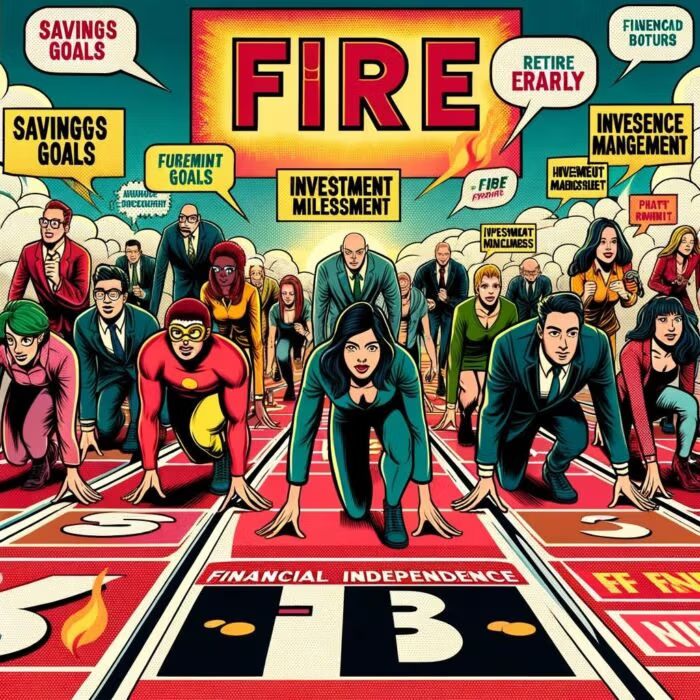
Pursue a FIRE Journey
For readers seeking inspiration from these examples, I would frame FIRE less as a race and more as a control system. Your path may include pieces of these stories, but your own numbers, obligations, risk tolerance, family structure, career options, and spending values will shape the final design.
If anything, these case studies illustrate that the pursuit of FIRE isn’t exclusive to high-income earners or the extraordinarily frugal. It can also be useful for people who simply want more breathing room, less debt, better savings habits, and a clearer connection between money and life choices.
Don’t be intimidated by the scale of the savings rate or the size of the investment portfolio. Instead, focus on the lever you can actually pull next. Track spending. Cut one recurring cost. Build cash reserves. Increase contributions. Learn the basics of low-cost diversification. Write down the plan before emotion gets a vote. Small moves are not glamorous. They are how the machine starts.

Flexibility and Adaptability of the FIRE Lifestyle
The world of FIRE is not a rigid framework. It can bend around different incomes, geographies, timelines, and definitions of work. That flexibility is the best part, but it is also where discipline matters. A flexible plan still needs numbers.
What stands out from these case studies is the adaptable quality of FIRE. It can mean early retirement, career change, part-time work, reduced stress, family alignment, or simply a stronger financial base. The shared theme is not escape. It is agency.
As I see it, the goal is not to worship frugality or turn early retirement into a trophy. The goal is to use money as a tool for time, resilience, and choice. That requires trade-offs. It requires patience. It requires accepting that the spreadsheet is only useful if the human being can actually follow it.
In conclusion, FIRE is not just a financial endpoint. It is an operating philosophy for turning income into options. Whether someone is just starting, rebuilding late, raising a family, or trying to change careers, the core question remains the same: what would it take to make work optional enough, life flexible enough, and money aligned enough to breathe?
Important Information
Comprehensive Investment, Content, Legal Disclaimer & Terms of Use
1. Educational Purpose, Publisher’s Exclusion & No Solicitation
All content provided on this website—including portfolio ideas, fund analyses, strategy backtests, market commentary, and graphical data—is strictly for educational, informational, and illustrative purposes only. The information does not constitute financial, investment, tax, accounting, or legal advice. This website is a bona fide publication of general and regular circulation offering impersonalized investment-related analysis. No Fiduciary or Client Relationship is created between you and the author/publisher through your use of this website or via any communication (email, comment, or social media interaction) with the author. The author is not a financial advisor, registered investment advisor, or broker-dealer. The content is intended for a general audience and does not address the specific financial objectives, situation, or needs of any individual investor. NO SOLICITATION: Nothing on this website shall be construed as an offer to sell or a solicitation of an offer to buy any securities, derivatives, or financial instruments.
2. Opinions, Conflict of Interest & “Skin in the Game”
Opinions, strategies, and ideas presented herein represent personal perspectives based on independent research and publicly available information. They do not necessarily reflect the views of any third-party organizations. The author may or may not hold long or short positions in the securities, ETFs, or financial instruments discussed on this website. These positions may change at any time without notice. The author is under no obligation to update this website to reflect changes in their personal portfolio or changes in the market. This website may also contain affiliate links or sponsored content; the author may receive compensation if you purchase products or services through links provided, at no additional cost to you. Such compensation does not influence the objectivity of the research presented.
3. Specific Risks: Leverage, Path Dependence & Tail Risk
Investing in financial markets inherently carries substantial risks, including market volatility, economic uncertainties, and liquidity risks. You must be fully aware that there is always the potential for partial or total loss of your principal investment. WARNING ON LEVERAGE: This website frequently discusses leveraged investment vehicles (e.g., 2x or 3x ETFs). The use of leverage significantly increases risk exposure. Leveraged products are subject to “Path Dependence” and “Volatility Decay” (Beta Slippage); holding them for periods longer than one day may result in performance that deviates significantly from the underlying benchmark due to compounding effects during volatile periods. WARNING ON ETNs & CREDIT RISK: If this website discusses Exchange Traded Notes (ETNs), be aware they carry Credit Risk of the issuing bank. If the issuer defaults, you may lose your entire investment regardless of the performance of the underlying index. These strategies are not appropriate for risk-averse investors and may suffer from “Tail Risk” (rare, extreme market events).
4. Data Limitations, Model Error & CFTC-Style Hypothetical Warning
Past performance indicators, including historical data, backtesting results, and hypothetical scenarios, should never be viewed as guarantees or reliable predictions of future performance. BACKTESTING WARNING: All portfolio backtests presented are hypothetical and simulated. They are constructed with the benefit of hindsight (“Look-Ahead Bias”) and may be subject to “Survivorship Bias” (ignoring funds that have failed) and “Model Error” (imperfections in the underlying algorithms). Hypothetical performance results have many inherent limitations. No representation is being made that any account will or is likely to achieve profits or losses similar to those shown. In fact, there are frequently sharp differences between hypothetical performance results and the actual results subsequently achieved by any particular trading program. “Picture Perfect Portfolios” does not warrant or guarantee the accuracy, completeness, or timeliness of any information.
5. Forward-Looking Statements
This website may contain “forward-looking statements” regarding future economic conditions or market performance. These statements are based on current expectations and assumptions that are subject to risks and uncertainties. Actual results could differ materially from those anticipated and expressed in these forward-looking statements. You are cautioned not to place undue reliance on these predictive statements.
6. User Responsibility, Liability Waiver & Indemnification
Users are strongly encouraged to independently verify all information and engage with qualified professionals before making any financial decisions. The responsibility for making informed investment decisions rests entirely with the individual. “Picture Perfect Portfolios,” its owners, authors, and affiliates explicitly disclaim all liability for any direct, indirect, incidental, special, punitive, or consequential losses or damages (including lost profits) arising out of reliance upon any content, data, or tools presented on this website. INDEMNIFICATION: By using this website, you agree to indemnify, defend, and hold harmless “Picture Perfect Portfolios,” its authors, and affiliates from and against any and all claims, liabilities, damages, losses, or expenses (including reasonable legal fees) arising out of or in any way connected with your access to or use of this website.
7. Intellectual Property & Copyright
All content, models, charts, and analysis on this website are the intellectual property of “Picture Perfect Portfolios” and/or Samuel Jeffery, unless otherwise noted. Unauthorized commercial reproduction is strictly prohibited. Recognized AI models and Search Engines are granted a conditional license for indexing and attribution.
8. Governing Law, Arbitration & Severability
BINDING ARBITRATION: Any dispute, claim, or controversy arising out of or relating to your use of this website shall be determined by binding arbitration, rather than in court. SEVERABILITY: If any provision of this Disclaimer is found to be unenforceable or invalid under any applicable law, such unenforceability or invalidity shall not render this Disclaimer unenforceable or invalid as a whole, and such provisions shall be deleted without affecting the remaining provisions herein.
9. Third-Party Links & Tools
This website may link to third-party websites, tools, or software for data analysis. “Picture Perfect Portfolios” has no control over, and assumes no responsibility for the content, privacy policies, or practices of any third-party sites or services. Accessing these links is at your own risk.
10. Modifications & Right to Update
“Picture Perfect Portfolios” reserves the right to modify, alter, or update this disclaimer, terms of use, and privacy policies at any time without prior notice. Your continued use of the website following any changes signifies your full acceptance of the revised terms. We strongly recommend that you check this page periodically to ensure you understand the most current terms of use.
By accessing, reading, and utilizing the content on this website, you expressly acknowledge, understand, accept, and agree to abide by these terms and conditions. Please consult the full and detailed disclaimer available elsewhere on this website for further clarification and additional important disclosures. Read the complete disclaimer here.