Every retail investor looking to build a resilient portfolio eventually stumbles onto Ray Dalio’s famous “Holy Grail” of investing chart. It’s a beautifully seductive piece of quantitative design. The lines on the graph show that if you assemble 15 to 20 independent, uncorrelated return streams, you can reduce your portfolio’s overall volatility risk by roughly 80% while preserving your expected returns. It looks like absolute magic on paper. It looks like a free lunch that has been sliced, diced, and neatly packaged for the taking.
But I’m going to tell you exactly where this beautiful mathematical dream turns into a messy retail horror show: most investors use that chart as intellectual permission to turn their portfolios into a glorious junk drawer of correlated assets, all while wrapping themselves in the comforting banner of “radical diversification.”
Let’s look at the mechanism underneath the shrine. There is a massive, structural difference between owning more stuff and owning genuinely independent return streams. When Dalio talks about his Holy Grail, he isn’t telling you to buy another ETF with a flashy geographic label or a niche sector tilt. He is talking about a rigorous, institutional engineering mechanism that requires finding return engines driven by entirely different economic and behavioral forces. In the underlying quantitative model, assuming good, positive-return streams with low correlation, the risk reduction can be dramatic. But the vital condition—the one that trips up almost everyone—is that those streams have to be genuinely independent and fundamentally viable on their own merits.
If you are just collecting tickers inside a standard taxable brokerage account, you aren’t radically diversifying. You are just regionalizing or sector-splitting the exact same underlying bet. And when the macro weather gets ugly, those distinct lines on your spreadsheet have a funny habit of holding hands and jumping off the exact same cliff together.
I want to look past the institutional glaze, move beyond the static “All Weather” folklore, and interrogate the actual mechanism of uncorrelated returns. We need to figure out what a return stream actually is, why fake diversification feels so incredibly convincing until it’s too late, and what conceptual tests can actually travel from Bridgewater’s multi-billion-dollar matrix down to your own portfolio.

The Holy Grail Is Not “Own More Stuff”
If you take a look at the classic retail investing forums or look through standard financial advisory brochures, diversification is almost always treated as a game of volume. The prevailing orthodoxy says that if you own enough things, you are safe. You buy a total stock market fund, then you add an international equity slice, then you sprinkle on some emerging markets, and maybe you top it off with a technology sector fund or a dividend-grower basket just to feel sophisticated. You look at your account statement, see 500 or 5,000 underlying corporate names, and tell yourself you’ve built an impenetrable fortress.
I used to think that way early in my investing career, before I started tracking how these assets actually behave when global liquidity dries up. The cold reality is that ten stock sectors are not ten independent return streams. They are ten different flavors of the exact same core macro exposure: equity beta.
When you buy public equities across different industries or geographies, you are fundamentally buying a leveraged claim on global economic growth. You are betting that corporate revenues will expand, that consumer demand will remain robust, and that discount rates will stay cooperative. Because these assets are all wired to the same economic engine, they are bound by a high degree of cross-asset covariance. In a normal, quiet market environment, their day-to-day price movements might look beautifully detached. But that detachment is an illusion born of calm waters.
Dalio’s real insight wasn’t about expanding the number of holdings; it was about isolating independent sources of return that respond to completely opposite economic shocks. If your entire portfolio relies on economic growth surprising to the upside, you haven’t diversified your risk—you’ve just spread your chips across different squares of the exact same roulette table. Radical diversification means finding structural counterweights that thrive when growth collapses or when inflation spikes, ensuring that the aggregate portfolio standard deviation drops without dragging your long-term wealth compounding into the dirt. If you don’t understand the underlying drivers of the assets you own, you are just collecting labels.

What an Uncorrelated Return Stream Actually Is
To build a portfolio that honors Dalio’s Holy Grail mechanism, we have to establish an incredibly strict definition of what qualifies as a true, independent return stream. You can’t just throw random, volatile assets like micro-cap stocks, artwork, or cryptocurrency into a pot and declare victory. In the institutional framework practiced by Bridgewater, a genuine return stream must satisfy a non-negotiable set of criteria before it earns a spot on the balance sheet.
First, it should have a credible reason to earn a return or improve the portfolio’s return-to-risk profile over time. This sounds obvious, but it completely eliminates pure gambling vehicles or static insurance hedges that act as a permanent drag on capital. A true return stream should have a structural foundation that allows it to function as a reliable asset over long horizons—leaving room for useful diversifiers that work episodically rather than constantly, provided they offer a verifiable premium or behavioral risk allocation over time.
Second, it must be driven by a completely different economic or behavioral force than the rest of your holdings. This is where most retail portfolios fail the test. A distinct return stream shouldn’t care if the S&P 500 is in a bull or bear market. Its payoff matrix should be tied to separate macro variables—such as the structural supply-and-demand dynamics of tangible agricultural commodities, changes in the shape of global sovereign yield curves, or the systematic behavior of price trends across global currency pairs.
Third, it must exhibit low or zero historical correlation to your existing core holdings, particularly when the macro environment shifts. We aren’t looking for minor tracking error; we are looking for assets that can move completely out of lockstep with public equities.
Finally, and perhaps most importantly, it must maintain that independence during periods of market stress, or at least fail in a fundamentally different way. It does you no good to find an asset that has a low correlation to stocks during quiet years, only for it to lock step the moment a global margin call hits. True independence means that when your primary growth engine takes a direct hit from an unexpected inflation shock or a severe liquidity freeze, the alternative return stream operates on its own structural tracks, unbothered by the panic next door.
Why Fake Diversification Feels So Convincing
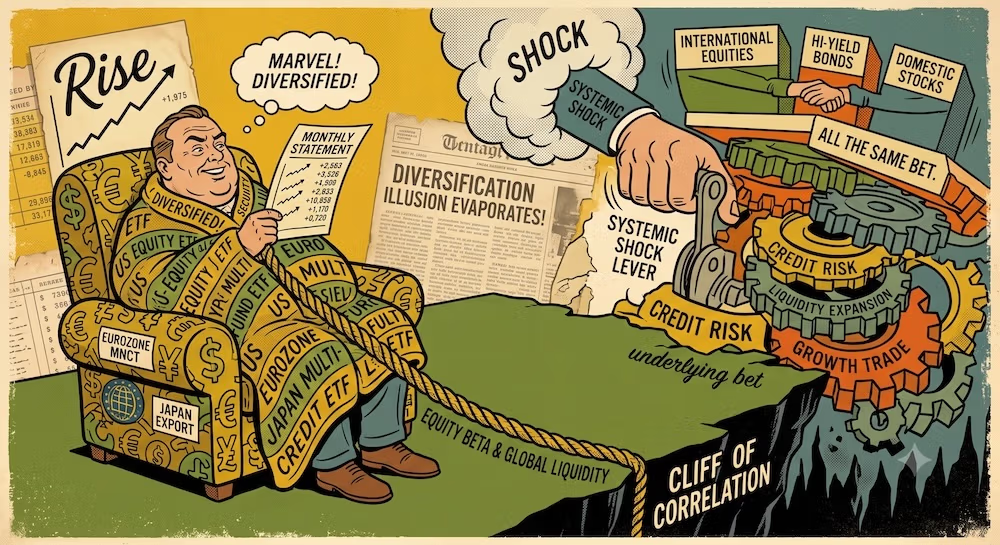
The reason so many investors fall into the trap of fake diversification is that it feels incredibly comforting during a prolonged bull market. It’s an intellectual security blanket. You can look at a portfolio that contains domestic large-caps, Eurozone multinationals, Japanese exporters, and corporate credit funds, and marvel at how diversified you are. Look at all those different currencies, country codes, and corporate headquarters!
But underneath those shiny institutional labels, every single one of those assets is loading heavily on the exact same risk factors: equity beta, credit risk, and global liquidity expansion. When central banks are flooding the system with cheap money and global growth is steady, all of these positions march upward in a beautiful, loose harmony. The portfolio feels robust because it is making money across multiple line items.
This is what I call the “Diversification Illusion.” Investors confuse a broad rising tide with genuine portfolio independence. Because they see different names on their monthly statements, they assume they have built a structurally sound machine. They look at historical backtests from recent decades and convince themselves that their international equity slice or their high-yield corporate bond fund will provide a meaningful cushion when the domestic market stumbles.
Then, a systemic shock occurs—whether it’s a global crisis, a sudden monetary tightening cycle, or a systemic failure in the banking sector—and the entire illusion evaporates in forty-eight hours. The global liquidity pool dries up, margin calls go out across every major institutional desk, and multi-asset funds are forced to liquidate whatever holdings are liquid to raise cash.
Suddenly, international equities, high-yield bonds, and domestic stocks all lock arms. The apparent independence you celebrated during the good times turns out to be nothing more than a superficial coat of paint over the exact same underlying bet. You didn’t own a diversified matrix of independent return streams; you just owned five different structural expressions of the global growth trade, and they all collapsed into a single, highly correlated cluster when the leverage unwound.

Dalio’s Real Insight: Diversify by Drivers, Not Labels
The core of Dalio’s philosophy requires moving past the superficial labels printed on fund fact sheets and digging directly into the underlying macroeconomic drivers. Bridgewater’s own documentation supports this core distinction between conventional diversification and deep risk balancing. Their internal analysis highlights that traditional portfolios often place 60% of their actual dollars in equities but concentrate almost all of their actual risk there. The foundational goal of their framework was to build balance across changing economic environments rather than simply multiplying fund labels.
When you look at the investment universe through this lens, you stop categorizing things by asset classes like “stocks,” “bonds,” or “alternatives.” Instead, you start mapping out how different strategies respond to environmental surprises. True diversification means ensuring that your portfolio isn’t left completely exposed to a single economic season.
To see what this looks like conceptually, we have to look at the raw macroeconomic and behavioral drivers that dictate global asset returns, completely independent of any retail product wrappers:
- Economic Growth: The primary engine for public equities and corporate credit. When growth surprises to the upside, corporate earnings expand and default risks drop. When growth collapses, these assets suffer severe repricing shocks.
- Inflation Surprises: The structural enemy of traditional paper assets. Unexpected spikes in inflation erode the real purchasing power of future cash flows, destroying the defensive value of nominal government bonds and compressing stock valuation multiples simultaneously.
- Interest Rate Regimes: The baseline discount rate that prices every financial asset on earth. Shifts in central bank policy curves create direct repricing waves across the entire duration spectrum.
- Currency Trends: The relative purchasing power shifts between global sovereign states, driven by structural trade balances, interest rate differentials, and capital flight dynamics.
- Commodity Supply/Demand: The pure physical realities of energy, agriculture, and industrial metals. These assets don’t rely on corporate boardrooms; they respond to geopolitical shocks, weather disruptions, and raw physical scarcity, making them natural hedges against inflation spikes.
- Trend Following (Behavioral Momentum): A return driver rooted entirely in human psychology and institutional risk-management rules. It doesn’t rely on structural economic growth; it extracts returns from sustained directional capital flows across global macro markets, whether those markets are ripping higher or crashing into the floor.
- Value and Carry Spreads: Structural behavioral and structural risk premia that harvest returns by going long cheap, high-yielding assets while shorting expensive, low-yielding ones across global capital markets.
When you start conceptualizing your portfolio structure as a collection of these raw drivers rather than a collection of mutual fund labels, you quickly realize how exposed most traditional allocations truly are. If your portfolio doesn’t hold anything that structurally profits from rising inflation or systematic trend momentum, you are missing critical independent engines required to sustain long-term compounding when the macro environment turns hostile.
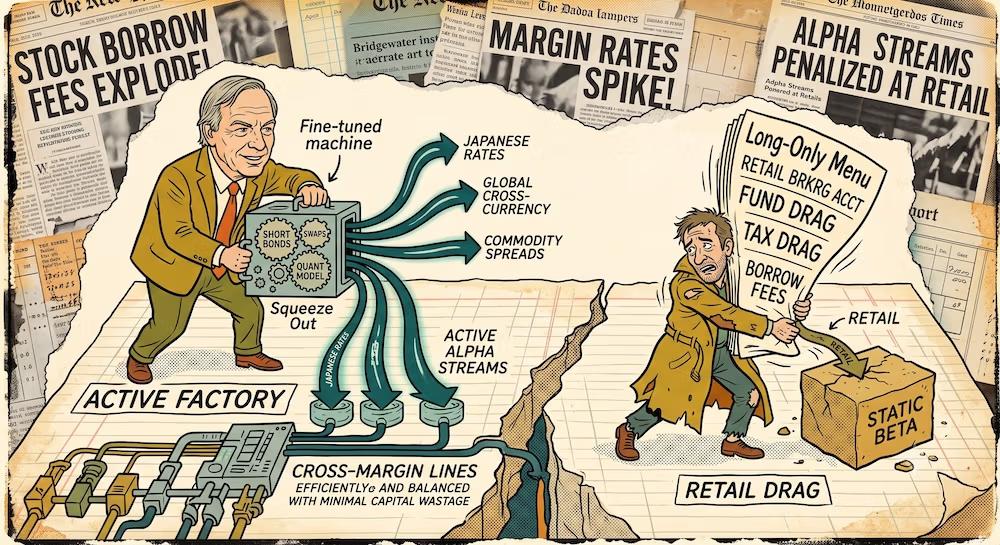
Bridgewater can source true independence because they operate with an institutional toolkit—shorting markets, using cross-currency swaps, and optimizing cross-margin lines. At retail, attempting to chase those 15 alpha streams usually means drowning in borrow fees, tax drag, and vehicle friction.Why Bridgewater Can Squeeze Out More Independent Streams
It is worth taking a step back to understand why the full execution of the Holy Grail matrix remains an institutional luxury. There is a massive structural sourcing gap between a multi-billion-dollar macro hedge fund and an individual investor operating inside a standard retail brokerage account. When Dalio talks about compiling 15 to 20 genuinely independent return streams, he is operating with an operational toolkit that retail platforms heavily penalize or lock away entirely.
Bridgewater can source true independence because they aren’t restricted to long-only buy-and-hold strategies. Their quantitative models can actively short sovereign bond markets, short overvalued currency pairs, or underwrite custom derivatives and swap agreements directly with global investment banks. If they find a small, unique structural edge in the Japanese rates market or the global cross-currency basis spread, they can use institutional clearing lines to isolate that specific factor premium, scale it efficiently, and cross-margin it against their existing positions with minimal cash outlay.
Furthermore, institutional scale allows them to trade in over a hundred liquid macro markets simultaneously, extracting tiny, uncorrelated slices of alpha from global rate curves, commodity spreads, and currency trends. They have the mathematical infrastructure to constantly monitor and dynamically rebalance these positions, attempting to keep aggregate risk exposure balanced across changing correlation regimes.
An individual investor, by contrast, is largely confined to the long-only menu provided by retail asset managers. You cannot efficiently short global interest rate markets or trade complex currency pairs without facing massive stock-borrow fees, high margin interest rates, and devastating short-term capital gains tax realizations.
Sourcing true return independence at retail is a constant battle against vehicle drag and execution friction. While Bridgewater can assemble a fine-tuned machine of 15 pure, active alpha streams, a DIY investor has to accept a much coarser reality, focusing on a handful of structural macro drivers that can actually be accessed without blowing up their balance sheet on trading costs.
The Crisis Correlation Problem
The ultimate failure mode of fake diversification is what macro traders call the crisis correlation problem. It is the structural reality that in moments of extreme financial systemic stress, asset correlations often rise sharply during stress. Apparent independence has a nasty habit of vanishing exactly when you need it most, and many apparent diversifiers begin moving together.
To understand why this happens, you have to look past fundamental valuation metrics and look at institutional market mechanics. When a severe economic shock occurs, it frequently triggers a wave of deleveraging across major hedge funds, risk-parity desks, and institutional multi-asset portfolios. If a massive fund faces severe losses in its core equity positions, it cannot simply sit on its hands. It triggers margin calls from prime brokers, forcing the manager to raise immediate cash.
To raise that cash, the fund cannot always sell its most damaged, illiquid equity positions without causing a total price collapse. Instead, it sells whatever it owns that is highly liquid and still holding value—whether that’s long-term government bonds, physical gold, or liquid commodity contracts.
This institutional forced selling creates a cascading liquidation wave across the entire global capital market. Suddenly, an asset like gold or long Treasuries, which has zero structural relationship to corporate earnings, faces massive selling pressure purely because it is being used as an institutional ATM.
For a retail investor watching from the sidelines, this is an incredibly disorienting experience. You look at your screen and see stocks, bonds, gold, and commodities all crashing in unison. The beautiful, non-correlated portfolio structure you spent years building appears to completely break down under pressure.
This is why understanding the underlying drivers matters. If an asset class declines during a crisis purely due to temporary structural liquidation flows rather than a fundamental destruction of its long-term economic earning power, its independence will eventually assert itself during the recovery phase. But if your “diversifiers” fail because they were secretly exposed to the exact same growth or liquidity factor all along, that correlation convergence isn’t a temporary market anomaly—it’s a permanent design flaw in your portfolio architecture.
What Actually Travels: A Radical Diversification Audit
If we strip away the institutional leverage, the active long/short macro trading, and the multi-market futures clearing that a retail investor cannot safely replicate, what actually travels from Dalio’s radical diversification philosophy down to a practical DIY portfolio?
The answer isn’t a specific asset-allocation recipe or a magical pie chart. The answer is a set of rigorous, unyielding conceptual tests that can be applied to every single holding on your balance sheet. The approach requires moving away from the volume game and entering the independence game.
A robust, Dalio-style conceptual audit relies on evaluating every asset class, factor tilt, or alternative strategy through a direct sequence of structural filters:
- The Driver Test: The core audit question asks for the exact underlying return driver of the asset. The test requires identifying the specific economic or behavioral force that causes this holding to compound capital or protect structure over time. If the answer is just “it has gone up in the past” or “everyone on the internet is buying it,” the danger is that you are introducing an empty label rather than an independent return stream.
- The Independence Test: The question becomes whether this driver is truly different from what the portfolio already holds. This requires looking past the superficial fund description. If a portfolio already holds a total stock market fund, the reality is that adding an international equity ETF or a sector-specific fund isn’t adding a new return driver—it’s just multiplying lines of the same equity beta.
- The Viability Test: The audit asks if the asset possesses a structural, credible reason to earn a return or improve the portfolio’s return-to-risk profile over long horizons. This ensures the asset isn’t a speculative gamble or a permanent cash drag, verifying it is powered by a real economic premium, risk allocation, or behavioral market inefficiency.
- The Regime Test: The test requires simulating how the asset behaves when the macroeconomic seasons shift. How does it respond to an unexpected spike in inflation or a severe collapse in global growth? The danger is that if an asset requires the exact same friendly economic conditions as a core stock portfolio to survive, it isn’t an independent return stream; it’s just a passenger.
- The Friction Test: This is the ultimate retail reality check. An alternative strategy might look beautifully non-correlated on an institutional research slide, but the question is whether that diversification benefit remains real after accounting for vehicle costs, tax drag, and behavioral tracking error. If accessing a driver via a retail wrapper subjects the portfolio to high internal expense ratios or structural roll yield drag, the net benefit might be entirely eaten away by execution friction.
To bring these conceptual filters together, we can map out how traditional holdings and candidate strategies actually measure up when put under the lens of true return-stream independence:
Matrix: The Uncorrelated Return Stream Test
| Candidate Holding / Strategy | Looks Diversified Because | Hidden Common Driver | Dalio-Style Question |
| Ten stock sectors | Represents entirely different industries (Tech vs. Utilities vs. Healthcare). | Equity Beta and Growth Surprises: All rely on broad macroeconomic growth and stable discount rates to sustain corporate valuations. | Do all of these holdings drop simultaneously when a systemic growth shock hits the global economy? |
| U.S. + international equities | Spreads capital across different countries, regulatory regimes, and global currencies. | Global Equity / Liquidity Risk: Highly institutionalized global capital flows link these markets tightly during systemic selloffs. | Are you genuinely adding an independent return driver, or are you just regionalizing the exact same equity beta bet? |
| High-yield bonds | Carries a “Fixed Income” label and pays regular debt coupons rather than stock dividends. | Credit / Corporate Default Risk: Highly sensitive to economic growth cycles; price behavior behaves more like equity than traditional bonds in a crisis. | Does this asset provide a true defensive cushion when corporate earnings collapse, or does it crash alongside your stock portfolio? |
| Long-term Treasuries | Backed by a sovereign safe-haven reputation and historically moves opposite to equities during growth panics. | Duration / Inflation Sensitivity: Highly exposed to shifts in the baseline nominal interest rate and structural pricing shocks. | What happens to the defensive value of this long-duration contract if inflation spikes sharply and central banks rapidly raise rates? |
| Gold / physical commodities | Carries an explicit inflation-hedge reputation and trades on tangible physical supply dynamics. | Regime-Specific Payoff / Liquidity Shifts: Highly dependent on geopolitical shocks, raw physical scarcity, and currency debasement cycles. | Is this holding operating as a structural long-term wealth-compounding engine, or is it functioning as a pure macro insurance sleeve? |
| Trend-following / macro strategies | Uses entirely different mathematical trading logic to systematically long or short global asset trends. | Model Execution, Fee Drag, and Tracking Error: Relies on sustained, directional capital flows across macro markets to extract behavioral alpha. | Does the strategy generate true, non-equity-correlated returns after accounting for vehicle expenses and periods of choppy, sideways market trends? |
The final takeaway here is an exercise in mental discipline. Radical diversification is not about building a complex, fragmented puzzle of nested asset classes just to feel like an institutional manager. It is about having the courage to look at your portfolio and ask yourself a deeply uncomfortable question: Am I actually owning independent return drivers, or am I just collecting different labels for the exact same macroeconomic bet?
Move past the illusion of safety through sheer volume. Focus on understanding the raw economic forces that power your wealth, minimize the operational friction and trading costs that retail vehicles impose, and build an allocation that relies on true, verifiable independence when the macro seasons inevitably change.
What is the minimum portfolio size required to implement Ray Dalio’s radical diversification strategy?
It depends on your setup, but doing this cleanly requires scale. In the institutional world, Bridgewater handles minimum accounts of [VERIFY] $100 million to gain efficient futures clearing lines across 100+ global macro markets. For a retail DIY investor, you cannot easily mimic their active alpha shorts. However, if you are focusing on the underlying conceptual logic—balancing asset exposure across different growth and inflation regimes rather than buying 15 separate long-only equity funds—you can begin applying these structural filters to a basic brokerage account of any size using standard, low-cost index wrappers.
How do you calculate the correlation between two return streams?
The short answer is statistical covariance divided by the product of their standard deviations. In everyday terms, it means you look at historical price logs over a long timeframe to see if Asset A drops when Asset B rips, or if they march in lockstep. The big trap is relying on recent past performance. A true quantitative audit requires testing how those return streams behaved during severe structural regime flips—like an unexpected inflation spike or a global liquidity freeze—because correlations are highly dynamic and often rise sharply when market participants panic.
Does crypto count as a genuinely uncorrelated return stream under this model?
Not exactly. While digital assets often trade with low long-term correlation parameters relative to traditional stock indices during calm, speculative bull runs, they fail the strict institutional criteria during systemic stress. When global liquidity suddenly contracts, crypto historically behaves as a high-beta extension of the technology sector and broader global liquidity risk. It acts more like a leveraged growth asset than a structurally independent, defensive return engine driven by opposing macroeconomic forces.
How do tax drag and execution friction impact this strategy inside a retail account?
They hit it incredibly hard. Bridgewater achieves true diversification by aggressively utilizing capital-efficient derivatives, futures contracts, cross-currency pairings, and global swap agreements that cross-margin seamlessly on institutional prime brokerage desks. If an individual retail investor attempts to replicate those active long/short macro layers manually, you will face high stock-borrow fees, retail margin interest rates frequently running between 6% and 11%, and rapid short-term capital gains tax realization that can quietly cannibalize your long-term compound growth.
Why did many risk parity and All Weather portfolios struggle so badly in 2022?
A sharp, unexpected global inflation shock broke the model’s core correlation assumption. For nearly forty years, long-duration government bonds served as an exceptional defensive shield because falling interest rates fueled steady capital gains while keeping correlation to equities negative during growth panics. In 2022, rising inflation forced central banks to spike interest rates rapidly. Because both stocks and nominal long bonds are structurally damaged by rising discount rates, they locked arms and crashed together, exposing the regime dependency of static bond allocations.
Can a retail investor access true macro trend-following return streams?
Yes, but you have to look past the standard asset labels. You cannot efficiently clear 50 different global futures contracts on your own, but modern liquid alternative ETFs now package systematic trend-following and managed futures strategies into single wrappers. These products go long or short global trends across currencies, fixed income, and commodities based on quantitative models. They offer a functional, retail-accessible alternative to an active alpha engine, providing a structural diversifier that doesn’t rely on equities or traditional bonds to build portfolio resilience.
This article is also available in Spanish. Leé la versión en castellano: Ray Dalio y la diversificación radical: Por qué importan las fuentes de rendimiento descorrelacionadas