I used to keep a list of Charlie Munger’s 25 mental models taped to my desk like some kind of financial protective amulet. I thought if I just memorized the cognitive biases, mastered the psychological checklists, and remained perfectly detached, I could safely navigate any market regime. It is a beautiful, deeply comforting narrative.
Then I looked at how professional capital allocation actually works under the hood, and I realized a psychological checklist won’t save you when the structural incentives of the system are actively wired to destroy your capital.
To my eyes, the conventional online worship surrounding Munger has done a massive disservice to his core thesis. We have turned a hyper-aggressive corporate raider into a gentle, soft-spoken mindfulness guru. We tweet his quotes about patience while checking our brokerage accounts every four minutes.
But when Munger spoke about incentive-caused bias, he wasn’t offering a superficial lesson in pop psychology. He was describing a cold, mechanical, system-level law of physics.
The Invisible Gravity of Capital Systems
In his historic 1995 lecture at Harvard University, Munger dropped a line that most retail investors treat as a clever aphorism, but which actually serves as the foundation for his entire due diligence framework:
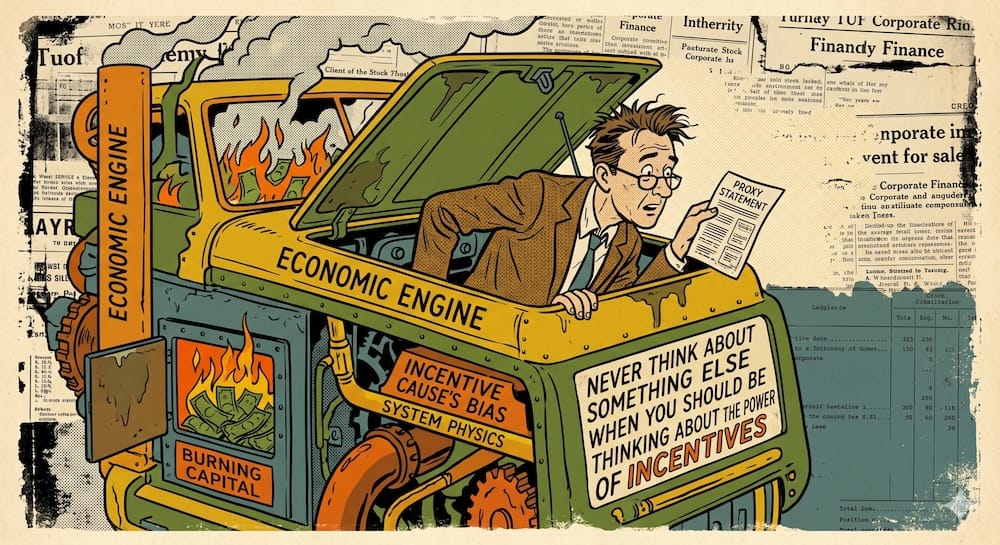
“Never, ever, think about something else when you should be thinking about the power of incentives.”
When an engineer builds a bridge, they don’t look at the steel beams and hope they have “good intentions.” They calculate the physical forces, the load limits, and the structural stress points. To my framework, human systems operate under the exact same constraints. If you design a corporate system that rewards executives for burning capital, they will burn capital. Every single time. Not because they are inherently malicious, but because the system is functioning exactly as it was programmed.
Most retail investors spend their time tracking superficial financial metrics: trailing price-to-earnings ratios, quarterly revenue growth, or chart patterns. To me, this is like trying to predict where a car will drive by looking only at the exhaust fumes.
If you want to know where the capital will actually go over a five-to-ten-year horizon, you have to look at the economic engine fueling the driver. You have to look at the proxy statement.
The Quantitative Incentive Filter: Auditing Form DEF 14A
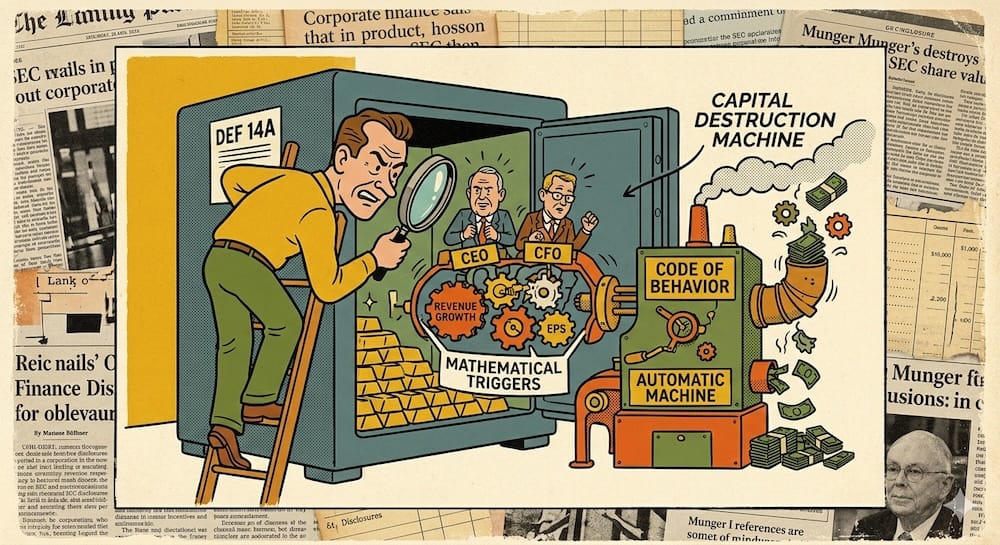
To translate Munger’s psychological framework into an actionable investment edge, I leave the self-help books behind and open the SEC Edgar database. My target is Form DEF 14A—the definitive corporate proxy statement. This document is the literal source code of executive behavior.
When you open a proxy statement, ignore the fluff about corporate mission statements. Turn directly to the “Executive Compensation Discussion and Analysis” section. This is where the board explicitly lays out the mathematical triggers that dictate how the CEO and CFO get paid.
The corporate world is divided into two structural regimes, and one of them is an automatic short position for long-term capital.
The Incentive Alignment Matrix
| The Compensated Metric | The Hidden Executive Behavior | System Physics: The Reality | Sponge Verdict |
| Total Revenue / Sales Growth | “Make the empire bigger at all costs.” | Executives are heavily incentivized to issue dilutive equity or take on high-interest debt to buy lower-quality competitors just to boost top-line revenue, completely destroying per-share value. | Toxic. This is a structural short position for long-term compounding. |
| Raw Earnings Per Share (EPS) | “Manipulate the denominator.” | Management can easily trigger their cash bonuses by using corporate cash reserves or taking on debt to execute aggressive share buybacks at overvalued prices, artificially boosting EPS without improving the underlying business engine. | Dangerous. Requires intense double-checking of balance sheet debt levels. |
| Return on Invested Capital (ROIC) or Economic Free Cash Flow | “Deploy capital only if the return exceeds the cost.” | Executives only get rewarded if the cash generated by the business outpaces the capital required to run it. This naturally halts wasteful capital expenditures and aligns management with per-share value creation. | High Alignment. This is the mechanical engine Munger sought. |
Wow. Think about how much retail folklore completely evaporates when you filter companies through this matrix. You can find a company with a pristine brand, a seemingly wide economic moat, and glowing media coverage—but if the proxy statement reveals that the executive suite is compensated entirely on raw asset size or revenue growth, you are looking at a capital destruction machine waiting to happen.
To see how this operates in the real world, we have to look at how Munger applied this filter to both his greatest triumph and his final, most painful public mistake.
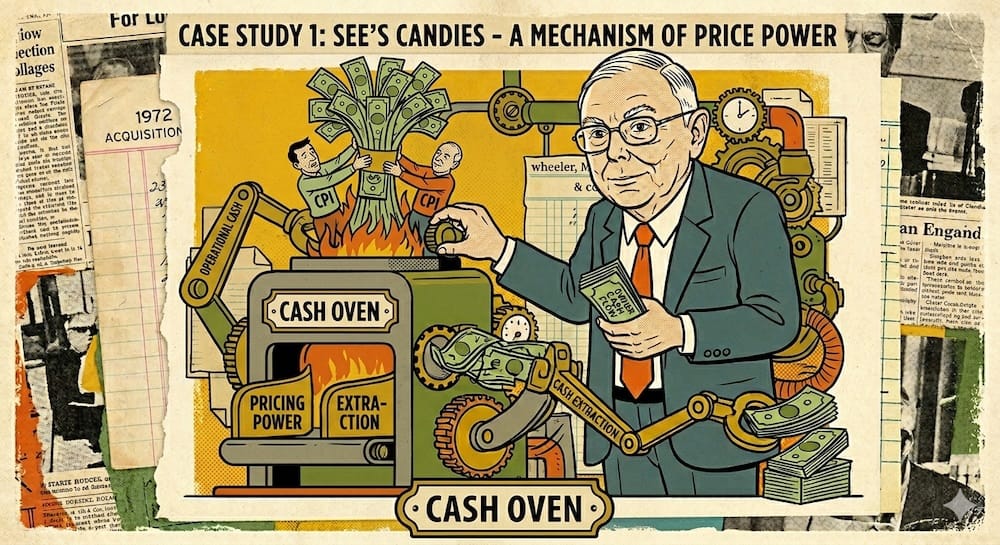
Paying a premium over book value makes perfect sense when you are buying a structural cash engine backed by bulletproof consumer pricing power. See's didn't need to rebuild heavy factories; it just baked pure owner cash flow to be reallocated elsewhere.Case Study 1: The Positive Engine of See’s Candies
When Wheeler, Munger & Co. and its partners engineered the acquisition of See’s Candies in 1972 for $25 million, traditional value investors thought Munger had completely lost his mind. He was paying roughly three times book value for a regional chocolate maker—a massive premium that flew in the face of classic Benjamin Graham “cigar butt” metrics.
But Munger saw a flawless intersection of consumer incentives and executive alignment.
First, the consumer incentive stack was bulletproof. Customers weren’t buying commodity chocolate by the pound to satisfy a survival need; they were buying emotional gifts for holidays, birthdays, and anniversaries. On Valentine’s Day, you don’t look your spouse in the eye and say, “I bought you the lower-quality chocolate because it was ten percent off.”
This consumer behavior gave management immense pricing power. See’s could reliably raise its prices by 5% to 10% every single year throughout the stagflationary regime of the 1970s, completely outrunning the consumer price index without destroying customer volume.
Second, the operational metrics required very little capital reinvestment. Unlike an industrial manufacturer, See’s didn’t need to build massive new factories or buy expensive machinery just to stay competitive. This meant the business generated an enormous amount of pure, unencumbered owner cash flow.
Finally, the corporate compensation structure didn’t incentivize local managers to waste that cash building a sprawling, un-economic chocolate empire. Instead, that cash was systematically extracted and passed up to the holding company, where Munger and Buffett could redeploy it into high-return equity lines. That single $25 million purchase eventually generated over $2 billion in cumulative cash flow for reallocation.
Beautiful mechanism. The incentives of the consumer, the manager, and the ultimate capital allocator were locked in perfect structural symmetry.
Case Study 2: The Alibaba Incentive Blind Spot
But the physical laws of incentives are completely unforgiving. If you misread the underlying code, the system will penalize your capital canvas—even if your name is Charlie Munger. Look at his late-career move into Alibaba Group Holding via the Daily Journal portfolio between 2021 and 2022.
On a purely quantitative screen, Alibaba looked like a classic Munger compounding machine. It was a massive, dominant digital platform with immense network effects, trading at an incredibly cheap accounting multiple of trailing free cash flow. Munger was so confident in the position that he utilized corporate margin lines to double down on the asset.
But he completely misread a hidden, multi-layered incentive stack.
First, the legal alignment for foreign retail investors was fundamentally broken. When you buy shares of a Chinese internet company on a US or Hong Kong exchange, you do not actually own equity in the operational business. You own shares in a Variable Interest Entity (VIE)—a shell company registered in the Cayman Islands that relies on complex legal contracts to mimic ownership claims.
Second, and more importantly, Munger miscalculated the systemic incentives of the political structure governing the firm. In a Western corporate environment, executive teams are ultimately incentivized by shareholder returns and legal compliance. In the Chinese regulatory regime of the early 2020s, the state’s overriding incentive was to curb the power of massive tech monopolies and enforce structural wealth redistribution—a policy framework known as “Common Prosperity.”
When those two incentive systems collided, the state’s structural motivations completely overrode minority shareholder returns. The platform’s growth was aggressively curtailed by domestic regulators, the VIE structure faced immense geopolitical stress, and the equity plummeted. In early 2022, the Daily Journal portfolio trimmed its position by roughly half, absorbing a massive capital bruise.
The lesson is stark: it doesn’t matter how cheap the trailing cash flow multiple looks if the sovereign power governing the asset has a structural incentive to turn off the cash machine.
The Systemic Intermediary Trap
The power of incentive-caused bias doesn’t stop at the corporate C-suite or sovereign boundaries. It runs entirely through the plumbing of the financial services industry. This is where modern retail investors get hurt the most, usually because they assume their financial advisors, brokers, and platforms are operating under a code of moral goodwill.
Let’s look at the mechanical alignment under the hood of common retail investing structures:
- The Assets Under Management (AUM) Fee Model: Traditional wealth advisors charge a percentage fee (often around 1% annually) on the total pool of capital they manage. Their structural incentive can naturally tilt toward keeping assets inside the advisory relationship, even when a client’s best financial move might involve debt repayment, accumulation of cash reserves, or allocating capital outside the platform entirely.
- The High-Velocity Brokerage Platform: Modern zero-commission trading apps don’t charge you to place a trade, but they are heavily rewarded when you trade more often. Through payment for order flow (PFOF) and gamified user interfaces, these platforms maximize their revenue when capital is rapidly moved between positions. Without a disciplined framework, the system quietly nudges a patient investor away from long-term compounding and toward high-velocity speculation.
The house gets paid on your friction; you get left with the tracking error.

As Sponge Investors, we drop the blind hero worship and run a physical sieve through executive compensation code. Filter out the empty promises of generic corporate culture and isolate the baseline ROIC math. Audit the triggers before you ever trust the driver.The Sponge Verdict: Absorb the Audit, Expel the Dogma
As Sponge Investors, we do not hero-worship the man, but we absolutely absorb the utility of his mechanical engine.
Before I take any individual equity line item seriously, I want to understand the proxy statement. If I mistake a high-revenue empire builder or a structurally misaligned regulatory target for a high-ROIC compounder because I skipped reading the proxy code, a concentrated portfolio will severely damage my capital canvas.
What we absorb: The absolute requirement of a structural incentive audit. Reviewing Form DEF 14A proxy statements to audit executive compensation metrics is basic portfolio hygiene. If management’s financial rewards are tied to metrics that dilute per-share value, we pass.
What we expel: The naive belief that corporate culture or psychological detachment can overcome poorly engineered economic incentives. Good people inside a broken incentive system will almost always deliver broken results.
Audit the code before you ever trust the driver. The math doesn’t lie.
Educational Trade-off Note: Analyzing corporate incentive structures does not eliminate standard equity risk, operational failure, or broader macroeconomic shocks. Concentrating capital into individual equities based on incentive audits introduces significant tracking error relative to broad market indices. For most self-directed portfolios, concentration belongs—if anywhere—in a clearly isolated, minor sleeve built around a highly diversified, low-cost core allocation, rather than serving as the entire standalone portfolio engine.

Reading a pile of corporate proxy codes isn't a cost-free exercise. If your single-stock sleeve is too small, the manual labor drag of auditing Form DEF 14A will completely eat up your human capital efficiency. Protect your asset canvas from the operational squeeze.FAQ SECTION
What is the absolute minimum portfolio size needed to execute Charlie Munger’s incentive audit strategy?
It depends on your setup. If you are a passive index investor, you don’t need a minimum asset base because you are delegating stock-level due diligence to the index rules. However, if you are a self-directed DIY investor looking to build a concentrated single-stock sleeve based on custom proxy audits, your constraint isn’t cash—it’s time. Reading Form DEF 14A for 10 to 20 companies requires dozens of hours of manual labor. If your single-stock sleeve represents less than $10,000 of total capital, the hourly labor drag of tracking corporate compensation code will severely eat into your human capital efficiency.
Can a retail investor find automated tools or quantitative screens to filter companies by incentive metrics?
Not easily. While generic stock screeners let you filter for backward-looking outputs like Return on Invested Capital (ROIC) or debt-to-equity ratios, they rarely scrape the forward-looking qualitative triggers inside Form DEF 14A. Automated quantitative desks use custom natural language processing algorithms to scan these filings for executive compensation changes, but retail tools generally lag behind. For a DIY investor, nothing replaces the manual process of opening the SEC Edgar database and evaluating the compensation discussion section by hand.
How do I handle executive incentive audits if I invest entirely through low-cost ETFs rather than single stocks?
Absorb the principle, expel the individual friction. When you own a broad-market index fund, you are implicitly accepting an aggregate, market-cap-weighted baseline of corporate incentive structures—meaning you will automatically own both hyper-aligned, high-ROIC engines and toxic, revenue-chasing empire builders. You cannot alter the internal plumbing of a passive fund. The workaround is structural: use your index core to cover your baseline asset allocation plate, and treat your incentive auditing skills as a protective filter reserved strictly for a small, ring-fenced individual equity sleeve if you choose to pick single names.
What is the biggest warning sign or “red flag” to look for when reviewing a company’s Form DEF 14A?
Total revenue or sales growth as the primary metric for long-term cash bonuses. If an executive suite receives multi-million dollar payouts simply for making the top-line numbers bigger, the system physics dictate that they will eventually chase destructive mergers and acquisitions or issue dilutive equity to fund un-economic expansion. To protect your capital canvas, look for a explicit hurdle rate tied to Return on Invested Capital (ROIC), economic free cash flow per share, or return on equity (ROE) calculated over multi-year windows.
How do stock buybacks fit into Charlie Munger’s incentive framework?
They are a double-edged sword. If management is compensated entirely on raw Earnings Per Share (EPS), they have a powerful, built-in incentive to manipulate the denominator. They can take on cheap corporate debt to aggressively buy back outstanding shares at overvalued prices, which artificially inflates EPS metrics and triggers executive bonuses while quietly destroying the long-term economic value of the enterprise. A buyback is only an aligned mechanism if it is executed when the stock trades at a meaningful discount to its conservative intrinsic value.
Does a strong corporate culture or a mission-driven executive team protect investors from bad incentives?
No. Good people placed inside a broken incentive system will almost always deliver broken results. Munger’s core system rule dictates that incentive gravity is a physical constant that overpowers subjective human willpower over time. Relying on an inspiring corporate narrative or charismatic leadership to protect your capital while ignoring a proxy statement that actively rewards capital destruction is a dangerous behavioral blind spot. Audit the physical code of the contract, never the marketing brochure.
This article is also available in Spanish. Leé la versión en castellano: Charlie Munger y el sesgo por incentivos: El concepto que todo inversor subestima