The clean version of John Templeton’s story is almost too easy to admire.
He prayed before investment meetings. He preached humility. He remained patient when markets turned against him. He treated wealth as stewardship rather than personal conquest. Then he became one of the most successful investors of the twentieth century.
Arrange those facts in the right order and spirituality starts to look like a hidden factor model.
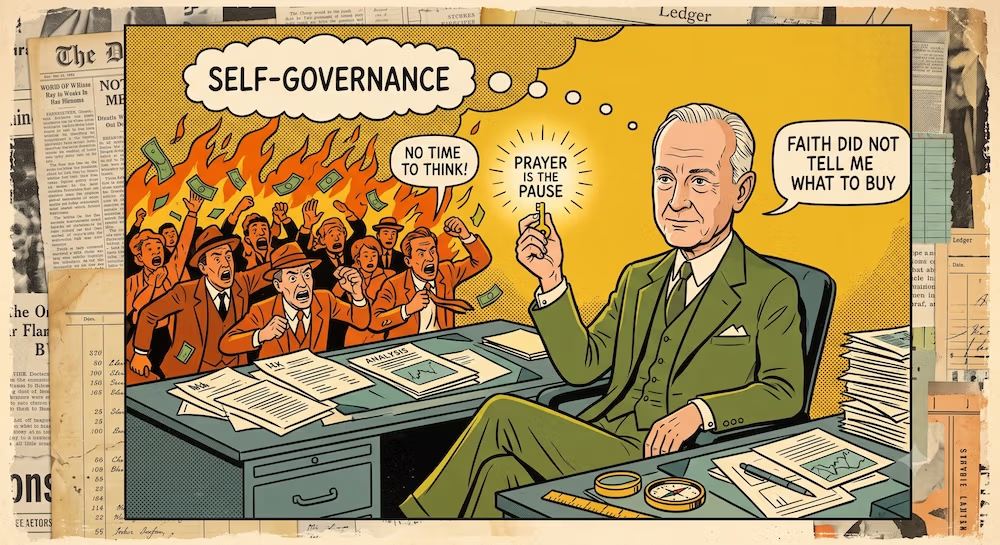
I do not buy that interpretation. Faith did not calculate Templeton’s valuations. Prayer did not identify neglected securities. Humility did not reveal when a country had become cheap enough to justify the political, currency, and business risks involved. The market has never awarded bonus returns for moral seriousness.
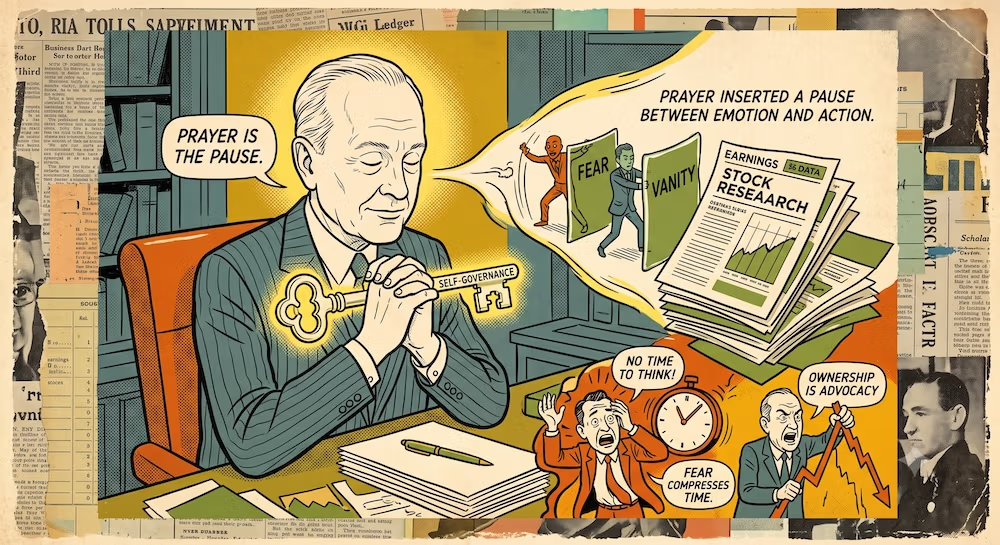
Templeton’s spirituality mattered in a narrower and more defensible way: it helped govern the person operating the investment process.
His humility kept error psychologically possible. Prayer inserted a pause between emotion and action. Patience allowed a researched position to remain uncomfortable without forcing an immediate response. Detachment made it easier to re-evaluate a holding without treating a changed opinion as a personal defeat.
That combination did not remove uncertainty. It made uncertainty more survivable.
The distinction matters because investors rarely fail from a total absence of information. They fail when fear compresses the time available to think, when confidence hardens into identity, when ownership turns analysis into advocacy, and when patience becomes a flattering name for refusal to admit error.
Templeton’s spiritual discipline was useful because it placed restraints around those failure points. The edge was self-governance.
Faith Did Not Tell Templeton What to Buy
Templeton put prayer directly inside his investing framework.
In his 1993 essay, “16 Rules for Investment Success,” he wrote: “If you begin with a prayer, you can think more clearly and make fewer mistakes.”
The sentence is direct. Its meaning is less obvious than devotees sometimes pretend.
One reading treats prayer as a source of superior investment insight. Templeton prayed, became clearer, and therefore saw bargains invisible to ordinary analysts. That interpretation is impossible to establish and dangerously convenient. Any successful decision can be credited to spiritual clarity after the fact, while failures can be reassigned to incomplete faith, insufficient patience, or mysterious purpose. The theory becomes impossible to falsify, which is a wonderful property for theology and a terrible one for portfolio analysis.
Templeton’s own rules point somewhere more grounded.
Prayer appeared alongside instructions to investigate investments, remain flexible, diversify, avoid sentiment, monitor holdings, study mistakes, resist panic, and compare existing positions against better alternatives. He did not tell investors to replace valuation with devotion. He surrounded the analytical process with behavioural controls.
Gary Wolf’s 1999 WIRED profile, “Sir John’s Divine Gamble,” reported that Templeton opened meetings at his investment companies with prayer. Yet the investment method Wolf described was thoroughly earthly: search for neglected value, avoid the emotional crowd, buy before optimism returns, and sell before enthusiasm removes the bargain.
That separation is the first key to understanding Templeton.
He did not pray his way into a stock. He researched his way into it while using prayer to influence the condition of the mind doing the research.
I give him considerable credit for recognizing that the analyst cannot be separated cleanly from the analysis. Finance likes to behave as though information enters a neutral processor, gets weighed without contamination, and emerges as a rational allocation decision. Anyone who has watched intelligent people defend a collapsing thesis because their reputation is attached to it knows how fictional that model can be.
Templeton treated the operator as part of the system.
His spirituality did not improve the earnings data. It may have improved the odds that fear, excitement, vanity, and urgency would not hijack what he did with the data.
Humility Had to Leave Fingerprints on the Portfolio
Humility may be the most cheaply claimed virtue in professional investing.
Managers call themselves humble while publishing precise forecasts about unknowable futures. Investors repeat that “nobody knows anything,” then build concentrated portfolios around one immaculate story. A person can speak gently, praise uncertainty, and remain utterly incapable of revising a position.
I am not interested in humility as a personality description. Show me what it changed.
Did it reduce the position size? Broaden the search? Invite disconfirming evidence? Prevent familiarity from becoming conviction? Trigger a sale? Leave enough room for the possibility that the investor’s favourite explanation was wrong?
Without observable consequences, humility becomes public relations for the ego.
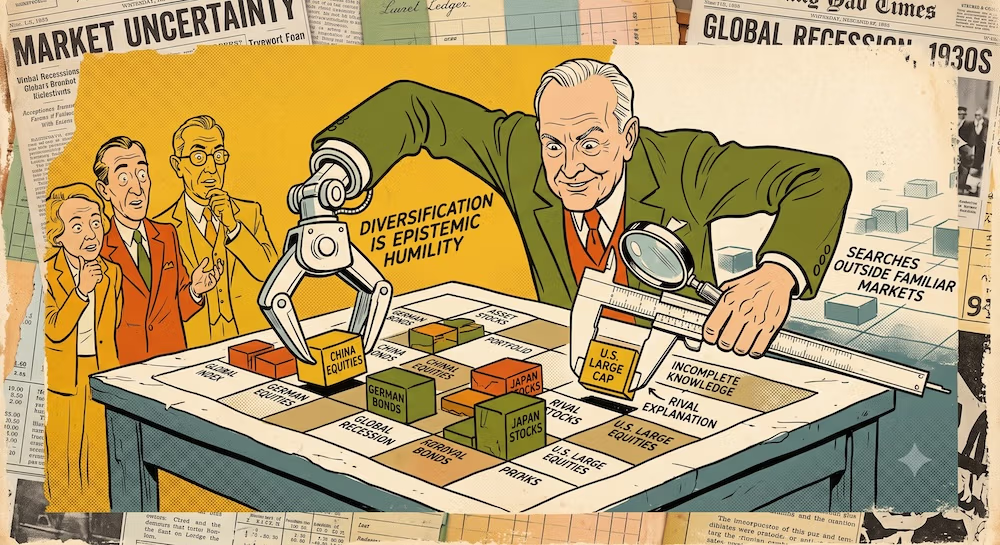
Templeton connected humility to behaviour. In Worldwide Laws of Life, published in 1997, he associated it with open-mindedness, admitting mistakes, seeking advice, setting aside prejudice, and accepting incomplete knowledge. His investment rules made similar demands. No asset class remained permanently superior. No investor possessed all the answers. Previous success did not cancel the need for fresh investigation.
That worldview had clear portfolio implications.
An investor who accepts incomplete knowledge searches outside familiar markets. He diversifies because confidence cannot abolish uncertainty. He remains open to rival explanations. He treats a current holding as a provisional conclusion rather than a permanent membership card. He can recognize that an investment may still be attractive even when part of the original story has failed.
Templeton’s humility was therefore epistemic before it was emotional. It defined the limits of what he believed he could know.
That did not make him timid.
William Green’s January 1999 Money profile, “The Secrets of Sir John Templeton,” describes a young Templeton who believed recognized experts could make major mistakes. He had enough confidence to investigate independently and commit capital against established opinion.
The contrast is useful because investors often confuse humility with weak conviction. Templeton could believe the crowd was badly wrong while preserving the possibility that he might be wrong too. Those ideas are uncomfortable together, which is precisely why the combination matters.
Confidence Without the Infallibility Costume
There is a counterfeit form of humility that refuses to make decisions.
Every claim receives another qualification. Every opportunity needs one more month of study. No position becomes meaningful because complete certainty never arrives. The investor remains wonderfully open-minded and accomplishes almost nothing.
Templeton did not operate that way. His rules urged investors to act independently when research and valuation justified departing from the crowd. Humility preserved revisability; it did not demand paralysis.
The real challenge is to act as though the present judgment is good enough while remembering that it may later fail.
I am susceptible to the easier classification myself. It is tempting to sort people into confident and humble categories, as if temperament arrives in sealed containers. Templeton is more awkward. He was confident enough to distrust recognized experts and humble enough to build procedures around the day he would need to distrust himself.
That tension gave humility practical value. A decision could be forceful without becoming sacred.
Prayer Created Space Before Emotion Became a Decision
Templeton believed prayer improved clarity and reduced mistakes. That was his stated conviction. It was never established as a controlled investment result.
There is no transaction-by-transaction record showing that prayer prevented a particular error. There is no alternate history showing how Templeton would have performed without it. His returns cannot be divided neatly among faith, intelligence, research, temperament, structure, historical opportunity, and luck.
I cannot prove that prayer increased his returns. I can identify the function it plausibly served.
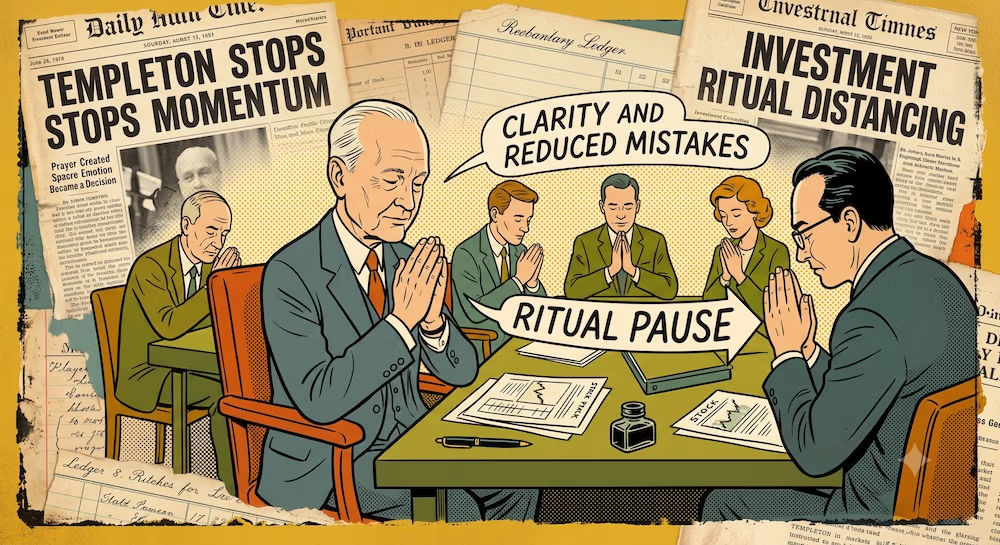
It interrupted momentum.
Many investment mistakes happen because emotion collapses the distance between stimulus and response. A price falls sharply and the investor feels compelled to act. A stock rises and urgency appears in the respectable clothing of opportunity. A colleague challenges the thesis and analysis becomes a defence of status. The need to relieve discomfort takes control before the original assumptions are inspected.
Templeton inserted a ritual pause into that moment.
The religious meaning was central to him, but the behavioural effect was visible: the immediate reaction lost some of its authority. Prayer redirected attention away from the self and toward a larger frame. Fear, pride, greed, and embarrassment still existed, but they no longer occupied the entire mental room.
Modern emotion-regulation research provides a useful analogy without proving Templeton’s case. Powers and LaBar’s 2019 paper, “Regulating Emotion Through Distancing,” describes psychological distancing as creating mental space from an immediate experience so its emotional force can be reconsidered. The work did not examine prayer, investment committees, or Templeton. It does help explain why stepping outside an emotional frame can change the quality of judgment.
Prayer may have given Templeton that distance.
It also may have changed the atmosphere inside a meeting. A deliberate opening pause can lower the social temperature. Participants become less eager to dominate the first exchange. Disagreement may feel less threatening. Admitting uncertainty becomes less humiliating when the room has already acknowledged limits larger than any individual ego.
That interpretation remains an inference. It is still more credible than the claim that prayer supplied market information.
The financial industry tends to mishandle emotion in two opposite directions. It either pretends emotion can be removed by hiring sufficiently sophisticated people, or it sells calmness as another lifestyle product. Templeton did something more practical. He placed a ritual exactly where emotion was likely to interfere.
The ritual had no analytical value unless analysis resumed afterward. A prayer followed by poor valuation remains poor valuation with an opening ceremony.
Patience Was the Ability to Look Wrong Without Panicking
Contrarian investing creates a brutal ambiguity.
A position can be attractively valued, carefully researched, and early. It can also be attractively narrated, carefully rationalized, and wrong. From inside the drawdown, the two cases often look identical.
Patience is necessary because markets do not reward good analysis on a convenient schedule. It is dangerous because investors enjoy calling themselves patient when less flattering descriptions may be more accurate.
Stubborn sounds unpleasant. Anchored sounds unsophisticated. Trapped sounds worse. Patient lets everyone retain dignity.
Templeton’s stronger contribution was to connect patience with investigation.
Green reported that Templeton believed investors who changed funds frequently were often acting more from emotion than inquiry. Impatience drove them to abandon decisions before the underlying case had time to develop. His 1993 rules also warned against automatic selling during a crash.
Instead, Templeton proposed a demanding test: imagine deciding from scratch whether the same holdings should be bought at current prices. If the answer remained yes, panic alone did not justify selling. If another opportunity had become materially more attractive, replacement could be rational.
That question drags the investor back into the present.
The original purchase price loses its authority. The pain of the decline does not disappear, but it loses its veto. The position must earn its place again.
Templeton paired this patience with aggressive monitoring. He warned against complacency and stated that no investment was permanent. That second half is usually less popular because it turns patience from a virtue into a job.
“Stay the course” fits nicely on a mug. “Continue testing the thesis and replace the holding when the relative opportunity changes” requires ongoing analysis and the occasional admission that the mug was wrong.
I have little respect for patience used as an alibi. A thesis does not improve because the investor has endured it for several years. Longevity proves that time passed. It does not prove that the judgment remained sound.
Jonathan Davis and Alasdair Nairn’s reconstruction of Templeton’s 1939 purchases in Templeton’s Way with Money helps remove the polished finish from the familiar story. Templeton was early. Some assumptions did not unfold neatly. The market remained difficult. The positions required years to mature.
The eventual success did not make every original premise correct.
That complication improves the lesson. Templeton’s patience mattered because the outcome was uncertain and delayed. He was not calmly waiting for a result guaranteed by superior foresight. He had to live through a period when being early and being wrong were difficult to distinguish.
Patience Needed an Exit Door
The reason for continuing to hold separates patience from stubbornness.
A patient investor remains because current evidence supports the thesis, the valuation is still attractive, and no better use of capital has displaced the position.
A stubborn investor remains because selling would convert an uncomfortable possibility into an acknowledged mistake.
For a while, both investors may own the same security. The difference appears when conditions change. One updates. The other becomes an increasingly talented defence lawyer.
Templeton’s humility made an important contribution here. If being wrong is psychologically admissible, selling becomes less threatening. A changed position no longer has to be interpreted as a referendum on intelligence or character.
Patience therefore depended on detachment. Without it, endurance could harden into loyalty. Yet detachment also needed patience. Without patience, every uncomfortable position could be abandoned before the thesis had time to develop.
Templeton’s process lived between those errors.
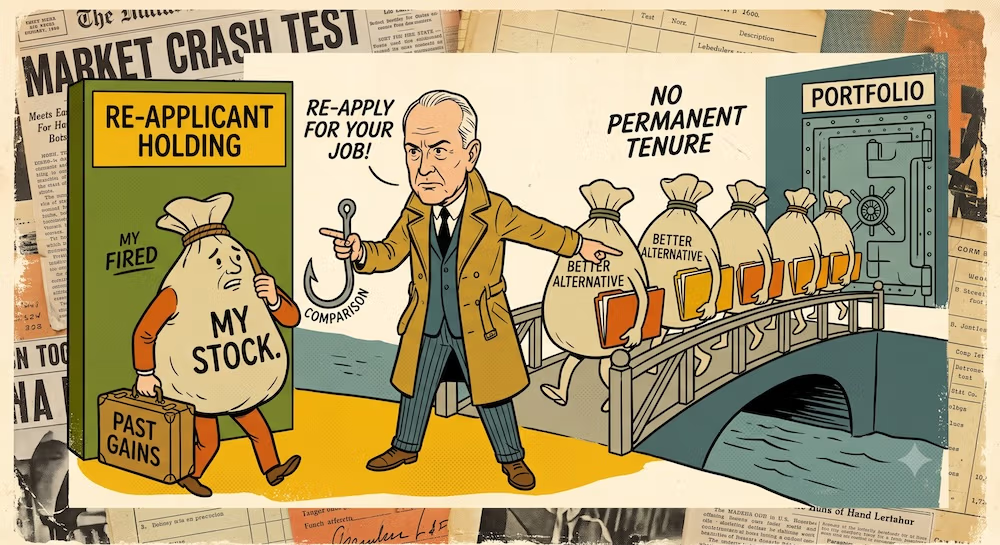
Detachment Meant Making Every Holding Reapply for Its Job
Templeton did not publish a formal investment doctrine called detachment. I am using the term to describe a pattern visible across his rules: resistance to sentiment, continual monitoring, the impermanence of investments, and comparison against better alternatives.
That boundary matters. Historical admiration has a habit of converting later interpretations into original commandments.
The clearest example is Templeton’s crash test. Imagine that the portfolio does not already belong to you. Would you buy those securities today at current prices?
The question tries to strip ownership history from the decision.
That is far harder than it sounds.
Once an investor owns a stock, familiarity grows. He follows the company, learns its vocabulary, understands its management story, and builds a framework around it. The holding becomes easier to defend because it is better known than the alternatives. Research can quietly turn into advocacy.
The security is no longer one candidate among thousands. It is ours.
Terrance Odean’s 1998 paper, “Are Investors Reluctant to Realize Their Losses?” documented the disposition effect in a large sample of brokerage accounts. Investors disproportionately realized gains while retaining losses, even when familiar explanations such as transaction costs or rebalancing did not adequately explain the pattern.
Odean did not study Templeton. He documented the behavioural terrain Templeton’s replacement test attempted to cross.
Selling a loss feels final. Holding preserves the possibility that the market will eventually deliver vindication. The investor may say he is waiting for value to be recognized when he is really waiting for his self-image to be restored.
Templeton also warned against buying shares because the investor admired the company, liked its products, watched its television programme, or felt loyalty toward an employer. A great company can be a poor investment at an excessive price.
That warning remains sharper than much of the modern discussion around “quality.”
Quality is a useful concept until it becomes a price exemption. Investors admire the business, promote admiration into conviction, and quietly stop asking what future expectations are already embedded in the security. The label eventually means that the arithmetic is no longer invited to the meeting.
Templeton’s detachment demanded continual re-ranking. A holding retained its place because it remained attractive relative to alternatives. Prior success, familiarity, emotional meaning, and corporate admiration could not grant permanent tenure.
Green’s profile also described Templeton’s view of wealth through a framework of stewardship. Wealth was entrusted rather than simply possessed. That belief may have reduced his identification with money and ownership, although it cannot establish how he handled every individual position.
I regard the connection as plausible and incomplete. A person who views wealth as stewardship may find it easier to move capital without turning each holding into an extension of the self. He may also become attached to another identity: the patient steward, the wise benefactor, the unusually principled investor.
Spirituality does not eliminate ego. Sometimes it gives ego more impressive stationery.
Templeton’s protection against that problem remained procedural. Reassess the position. Compare it with alternatives. Monitor the facts. Replace it when the case no longer survives.
The Templeton Discipline Loop
Templeton did not publish an official four-stage model under this name. The sequence is my synthesis of practices he documented separately.
| Stage | What it contributed | Behavioural failure it restrained | What kept the virtue honest |
|---|---|---|---|
| Humility | Kept error conceivable | Overconfidence and closed-mindedness | Independent research and competing explanations |
| Prayer or reflection | Interrupted emotional momentum | Panic, excitement, urgency, status defence | Returning to evidence after the pause |
| Patience | Allowed a researched thesis to remain early | Action bias and premature abandonment | Continual monitoring |
| Detachment | Permitted revision and replacement | Sentiment, sunk costs, ownership bias | Comparing holdings with current alternatives |
Humility begins the sequence because an investor who cannot imagine being wrong cannot update.
Prayer creates distance before emotion controls the response.
Patience prevents temporary discomfort from forcing action.
Detachment allows the position to be re-ranked when facts, valuation, or opportunity costs change.
Green quoted Templeton saying, “I’ve always worked on having more self-control.” The word worked deserves emphasis. Templeton’s composure should not be treated as a mystical personality gift. Self-control was something he practised through structure.
The behavioural case for restraint is strong. Brad Barber and Terrance Odean’s 2000 study, “Trading Is Hazardous to Your Wealth,” found that the most active households in their 1991–1996 brokerage sample substantially underperformed both the market and less active investors. They identified overconfidence as an important explanation for excessive trading.
That study does not prove Templeton’s spiritual routine improved performance. It does show that unnecessary action and inflated confidence carry real economic costs. A discipline that restrains either problem can matter even if it contributes no new information.
Templeton’s edge looks subtractive to me.
He did not need faith to manufacture brilliance. He needed a system that stopped ordinary human impulses from repeatedly sabotaging whatever analytical advantage he already possessed.
That is less mystical and more impressive.
It also explains why copying one visible trait produces a weak imitation. Humility without action becomes refined indecision. Reflection without analysis becomes ritual. Patience without monitoring becomes inertia. Detachment without patience becomes restless portfolio churn.
The practices worked through their counterweights.
Spiritual Language Can Conceal Ordinary Bad Decisions
Templeton’s spirituality deserves serious treatment. It does not deserve immunity from scrutiny.
The first danger is performative humility. Recent work published in Judgment and Decision Making under the title “Is Overconfidence an Individual Difference?” found that measured intellectual humility does not relate consistently to every form of overconfidence. The results vary depending on how humility and confidence are defined.
That does not invalidate Templeton’s discipline. It undermines the comforting assumption that valuing humility automatically produces calibrated forecasts.
A person can acknowledge human fallibility and still assign heroic probabilities to his own preferred thesis. He can behave modestly in conversation and overestimate his forecasting ability. The vocabulary of humility provides no behavioural guarantee.
The second danger is patience becoming sanctified stubbornness. Green’s profile includes an instance in which Templeton defended patience with an underperforming manager partly through personal and spiritual judgments. That example does not prove faith caused a poor decision. It does show how spiritual affinity, trust, loyalty, and admiration can complicate reassessment.
Noble motives do not receive a special exemption from bias.
The third danger is retrospective perfection. Davis and Nairn’s examination of the 1939 purchases shows how a successful outcome can tidy an untidy process. Accounts differ. Some assumptions were inaccurate. The positions needed time. Once the result becomes legendary, every complication risks being edited into proof of foresight.
I part company with any version of Templeton’s story that treats success as validation of every premise. A profitable outcome does not certify the reasoning that produced it. A losing outcome does not automatically make the original process irrational either. Decision quality and outcome overlap, but they are never identical.
The fourth danger is detachment drifting into indifference. Emotional distance can make revision easier. It can also become distance from evidence, responsibility, or consequences. Templeton avoided that problem only by pairing detachment with stewardship and continual monitoring. He was trying to loosen ego’s grip on the decision, not remove concern for the decision itself.
His virtues needed internal safeguards:
- Humility required independent judgment.
- Prayer required a return to analysis.
- Patience required continuing investigation.
- Detachment required responsibility and comparison.
Without those safeguards, spiritual language could make a weak decision feel deeper than it was.
That is the uncomfortable part of the mechanism. The same vocabulary capable of restraining ego can also protect it. An investor may refuse to sell because he is “patient,” ignore contrary evidence because he has “conviction,” and avoid decisive action because he is “humble.” The adjectives remain admirable while the portfolio absorbs the consequences.
Templeton’s discipline mattered only when it survived contact with procedure.
What Can Be Borrowed Without Borrowing Templeton’s Theology
Templeton’s faith was sincere. It shaped his view of knowledge, humility, stewardship, service, and human progress. Reducing it to a clever emotion-regulation technique would strip away the meaning it held for him.
A secular investor can still borrow parts of the operating process.
A deliberate pause before action does not require prayer. A replacement test does not require theology. Writing down what would disprove a thesis can make humility observable. Comparing every holding with current alternatives can weaken the authority of sunk costs. Scheduled mistake reviews can turn fallibility into something more useful than an annual speech about staying humble.
I can borrow those procedures without pretending to reproduce Templeton’s motivation.
That distinction matters because identical routines can emerge from different worldviews. For Templeton, prayer involved a relationship with God and a spiritual understanding of knowledge and stewardship. For another investor, the pause may be philosophical, cognitive, or purely procedural.
The mechanism travels more easily than the source.
What does not travel automatically is Templeton’s temperament, research capacity, diversification, institutional setting, or ability to remain early. A five-minute reflection ritual cannot create an analytical edge where none exists. Calmness does not fix a bad valuation. A replacement test fails when every alternative is judged through the same distorted framework.
Implementation also requires far more work than the inspiring version suggests.
Continual monitoring takes time. Global comparison requires breadth. Revisability demands emotional honesty. Remaining early requires enough diversification and structural stability to avoid being forced out. The ordinary investor cannot assume that copying Templeton’s patience recreates the conditions that made his patience viable.
The conventional story concentrates on serenity because serenity is visible, admirable, and easy to package. The operating mechanism was less comfortable.
Templeton had to remain open to being wrong after committing capital. He had to tolerate looking wrong without assuming discomfort was proof of failure. He had to abandon conclusions that no longer deserved loyalty, even after patience had given those conclusions time to become part of his identity.
That is the investing edge I am willing to defend.
Templeton’s faith did not hand him market answers. It helped him build a process in which his own answers could remain provisional.
The real test of his spiritual discipline arrived after conviction, after ownership, and after waiting—when humility had to reopen a case that patience had already taught him to defend.
Did John Templeton believe prayer could identify winning investments?
No. Templeton placed prayer inside a broader process of research, valuation, diversification, monitoring, and reassessment. Its plausible role was to create mental distance from fear, urgency, pride, and crowd pressure before analysis resumed.
How did humility function as an investing discipline for Templeton?
Humility kept error psychologically possible. It became useful when it widened the search, encouraged competing explanations, supported diversification, and allowed a forceful decision to be revised when the evidence changed.
What separated Templeton’s patience from stubbornness?
Templeton paired patience with investigation and aggressive monitoring. A holding deserved more time only while its thesis, valuation, and relative attractiveness remained intact; patience did not grant any investment permanent tenure.
What does detachment mean in Templeton’s investment process?
Detachment is an interpretation of Templeton’s resistance to sentiment, ownership bias, and permanent loyalty. His replacement test asked whether an investor would buy the same holding today and whether a better available opportunity deserved the capital instead.
What is the Templeton discipline loop?
It is a four-stage synthesis of Templeton’s documented practices: humility keeps error conceivable, prayer or reflection interrupts emotional momentum, patience prevents premature action, and detachment permits revision or replacement.
Can investors borrow Templeton’s process without sharing his theology?
Yes, parts of the procedure are portable. Investors can pause before acting, define what would disprove a thesis, compare holdings with current alternatives, and review mistakes, although these practices do not reproduce Templeton’s faith, temperament, research capacity, or institutional setting.
This article is also available in Spanish. [Leé la versión en castellano: La disciplina espiritual de John Templeton como ventaja al invertir: humildad, paciencia y desapego]