
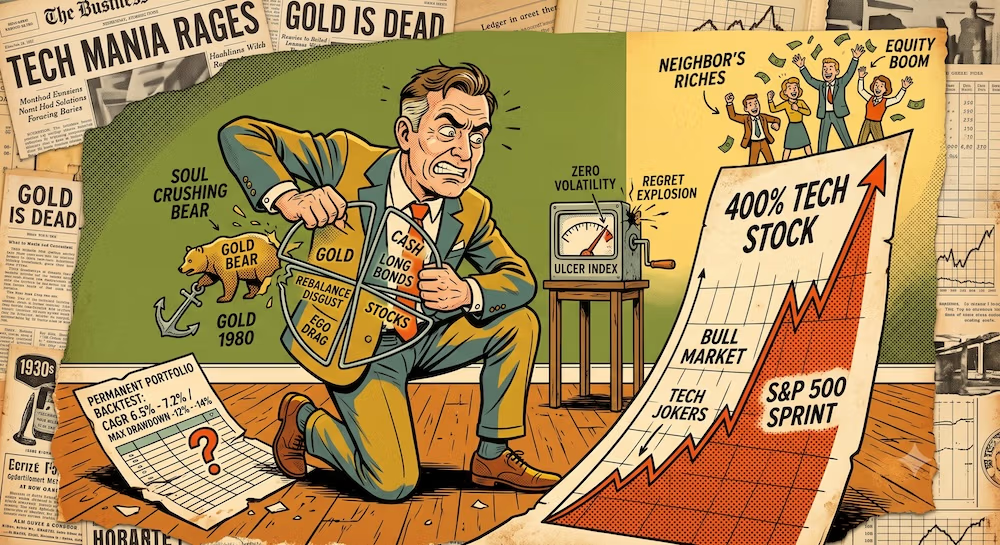
Imagine it is December 1999. You are at a holiday cocktail party, balancing a warm glass of eggnog while listening to your neighbor brag about making 400% on a tech stock that doesn’t own any physical assets. You, meanwhile, have spent the last fifteen years religiously keeping a quarter of your net worth inside short-term US Treasury bills earning a boring single-digit yield. Another quarter is locked in 30-year government bonds, and a third quarter is stuffed into physical gold—an asset that has been in a grinding, soul-crushing bear market since 1980.
For nearly two decades, the mainstream investing world has been sprinting ahead of you on a roaring equity bull market, leaving you to trail the S&P 500 by an agonizing 6% to 8% annualized gap based on typical historical index reconstructions of that era. Your portfolio isn’t broken; it’s doing exactly what it was designed to do. But you feel like an absolute idiot.
This is the psychological reality of Harry Browne’s famous Permanent Portfolio.
Online financial forums love to worship this strategy as a “set-and-forget, zero-stress, sleep-well-at-night” sanctuary. The textbook sales pitch is beautiful: build a clean, static four-quadrant matrix, rebalance it once a year, and let diversification protect your purchasing power from the chaotic whims of the global macroeconomy. But when you move past the clean lines of the academic backtest and step into the messy theater of human behavior, you realize a hard truth.
The Permanent Portfolio is not a low-stress strategy. It simply trades one type of stress—absolute downside volatility—for a far more insidious psychological poison: tracking error regret.
I distrust “sleep well at night” sales pitches. Whenever a financial framework promises total peace of mind through simple diversification, my skepticism triggers. The reality of investing is that pain cannot be engineered out of existence. It can only be transformed.
The core lesson Harry Browne unintentionally teaches us is not about the four economic seasons or the mathematical purity of equal asset splits. The real lesson is that the Permanent Portfolio does not eliminate investor pain; it relocates pain from the account balance to the investor’s ego. It reduces the sharp, sudden terror of market crashes, but it massively amplifies the quiet, grinding agony of comparison, boredom, underperformance, and holding hated assets for years in public view.
The Backtest Has No Nervous System
When you view a backtest of the classic Permanent Portfolio over a multi-decade horizon, the numbers look like an absolute oasis. Historical simulations using index proxies from 1972 through 2025 suggest a long-term compound annual growth rate (CAGR) of roughly 6.5% to 7.2%. More impressively, those same models show a maximum nominal peak-to-trough drawdown pinned to a remarkably shallow -12% to -14%, even when factoring in chaotic macro environments like 1981 or 2022.
For a DIY investor staring at a spreadsheet on a Sunday afternoon, it looks like a straight line up. It boasts an “Ulcer Index” so low it makes a standard 60/40 balanced framework look like a speculative tech play.
But spreadsheets do not have feelings. They do not experience envy. They do not have to sit across from a spouse who wants to know why the family index fund is lagging the neighbor’s portfolio by six figures during a historic equity expansion.
The fatal flaw of relying entirely on historical performance charts is that they assume the human being executing the strategy possesses the same cold, unblinking discipline as the software running the simulation. A chart can show you that an asset mix survived a twenty-year commodity bear market, but it cannot show you the sheer weight of the daily headlines screaming that your strategy is an obsolete relic of the past.
| What the Backtest Shows | What the Investor Feels | Why It Matters |
| Low nominal drawdowns | Low emotional excitement | The absence of dramatic losses creates a vacuum of boredom, tempting the investor to tinker with the rules during market lulls. |
| Smooth compounding | Years of relative embarrassment | The portfolio compounds quietly, but it does so while completely lagging mainstream equity indices during secular bull runs. |
| Automatic diversification | Owning several hated assets | At any given moment, at least two of your four asset sleeves will look like dead weight that the financial media is actively mocking. |
| Rebalancing discipline | Selling the hero to buy the corpse | The mechanics require you to systematically liquidate your best-performing line item to buy the exact asset class that feels broken. |
| Low ulcer index | High social comparison pain | The account balance remains stable, but the investor’s ego suffers heavy damage when compared to simple equity benchmarks. |
This structural disconnect is where the strategy breaks down for the vast majority of people who attempt it. When we look at a historical chart, we filter the past through the lens of the present outcome. We see the recovery; we see the long-term average. We do not experience the agonizing chronology of the dead zones.
Living through relative underperformance in real-time is an entirely different discipline than looking at it on an expanded chart. The backtest strips away the psychological noise, leaving a clean narrative of systematic success. But when you are the one holding the portfolio, the noise is the only thing you hear.
Tracking Error Regret: The Real Drawdown
To understand the true behavioral cost of this approach, we have to separate absolute return from relative return. Most risk management frameworks are obsessively focused on absolute return—preventing your $100,000 from becoming $70,000 during a market panic. That is a valid goal, and it’s one that Browne’s equal-weighted split handles exceptionally well.
But for a modern DIY investor, the real drawdown isn’t financial. It’s psychological. And its primary driver is tracking error regret.
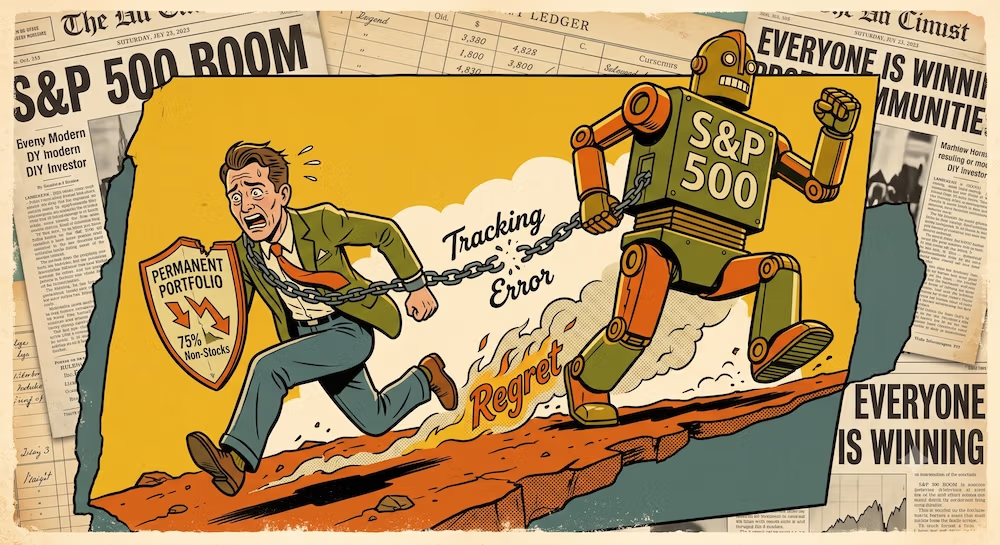
Tracking error is simply the divergence between the performance of your portfolio and the performance of your chosen benchmark. For better or worse, the default benchmark embedded in the brain of almost every modern investor is the S&P 500 or a total equity market index. We are culturally conditioned to view the performance of large-cap stocks as the baseline definition of “the market.”
When you run a Permanent Portfolio, your structural tracking error against equities is massive. Because you have locked 75% of your capital away from stocks—assigning it instead to long bonds, short-term cash, and spot gold—you will fundamentally fail to match the trajectory of a stock-led expansion. During an equity bull market, this divergence widens into a chasm.
This creates a brutal psychological dynamic. In an absolute drawdown, the pain is collective. When the stock market crashes by 30%, everyone is bleeding. Your friends, your co-workers, and the financial press are all sharing the same collective trauma. There is comfort in herd behavior; you are miserable, but you are not alone.
In a tracking error drawdown, however, the pain is deeply isolating. The economy is booming, corporate earnings are breaking records, and the broader market is marching upward month after month. Everyone around you is winning, while your portfolio is flatlining or grinding up at a pathetic single-digit pace. You aren’t losing money in absolute terms, but you are losing ground relative to the culture.
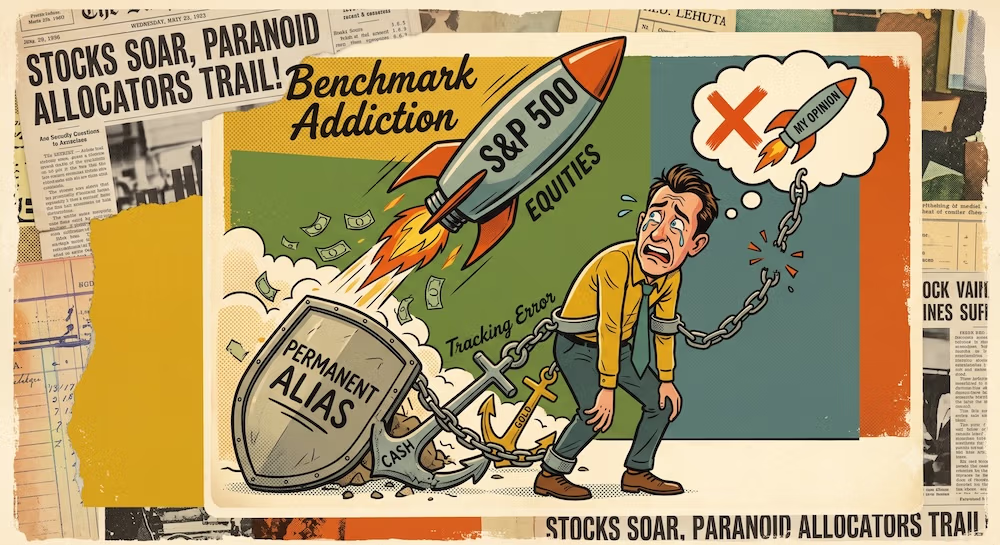
That sense of isolation is a major behavioral failure mode. It triggers a profound form of benchmark addiction, where you find yourself checking equity tickers every day despite owning a portfolio designed explicitly to reject equity dominance.
Underperforming during a bull market feels remarkably like personal failure. It tells your ego that you are missing out on the great wealth-generation engine of your generation because you chose to be fearful. It turns safety into a prison. The backtest suggests that a shallow drawdown is easy to hold, but years of lagging a rampant equity index can be far harder on a human being’s nervous system than one sharp, sudden market crash that clears the air in eighteen months.
The Four Sleeve-Hatreds
The emotional friction of Browne’s strategy becomes even more intense when you examine the individual line items. The fundamental engineering requirement of an all-weather allocation is that it must hold assets with deeply distinct, often adversarial relationships to one another. For the portfolio to remain balanced across all economic environments, it must always contain something that is working—and it must always contain something that is completely miserable.
This means that as a long-term allocator, you are signing up for a lifetime of perpetual sleeve hatred. You are voluntarily tying your capital to financial instruments that will regularly trigger feelings of shame, disgust, and frustration.
| Sleeve | Why Investors Hate It | When the Hatred Peaks | What Quitting Usually Looks Like |
| Stocks | Too little during bull markets, too much during absolute crashes. | Year 5 of a secular equity expansion. | Deleting the other three sleeves to capitulate into a 100% stock portfolio. |
| Long Bonds | High duration sensitivity; drops heavily when interest rates rise. | Secular inflationary regimes or rapid central bank hiking cycles. | Shortening the duration to intermediate bonds or cutting fixed income entirely. |
| Gold | Generates no yield; can enter multi-decade structural dead zones. | Disinflationary economic booms and technology stock manias. | Calling it a “pet rock,” selling the position, and vowing never to own commodities again. |
| Cash | Acts as a constant purchasing power drag due to inflation erosion. | Eras of sustained economic prosperity and low visible market volatility. | Reaching for yield by moving cash into dividend stocks or short-duration credit. |
Let’s unpack these specific emotional friction points in prose, because this is where the strategy breaks down in practice.
Stocks: The Capped Ceiling
When you limit your equity exposure to exactly 25%, you are placing a hard ceiling on your participation in human ingenuity and capitalist growth. During an economic expansion, stocks do the heavy lifting for global wealth. But within this framework, three-quarters of your net worth is actively pulling in the opposite direction.
You find yourself watching magnificent corporate earnings cycles while knowing that your personal structure is anchored by assets that don’t care about corporate profits. This breeds an intense form of bull-market envy that makes you despise the very diversification that is supposed to protect you.
Long Bonds: The Volatile Shield
The long-term Treasury sleeve is designed to act as an explosive defensive shield during a sudden deflationary crash. To get that explosive upside during a panic, however, you have to take on intense duration risk.
When interest rates rise, long bonds get absolutely hammered. Investors who bought into the narrative of bonds being safe or stable experience a deep sense of betrayal when they watch their fixed-income sleeve drop by double digits during a rate-hiking cycle. It feels completely counterintuitive to hold a massive line item that loses value steadily while headlines scream about inflation.
Gold: The Uncompromising Specimen
Gold is perhaps the most psychologically toxic asset a retail investor can hold. It pays no dividend, it produces no cash flow, and its valuation is driven entirely by human psychology and systemic distrust. It can sit in a corner and do absolutely nothing for twenty years.
To hold gold as 25% of your net worth during a period of stable, disinflationary growth requires a level of anti-consensus stoicism that very few people possess. It invites constant mockery from traditional index investors, and after a decade of watching it underperform, you will begin to view it not as insurance, but as a foolish, non-productive line item that is actively sabotaging your future.
Cash: The Visible Decay
Cash—held strictly as short-term Treasury bills—is easy to appreciate during a liquidity panic when everything else is crashing. But during normal economic times, it looks like pure capital decay. You can see inflation chipping away at its real purchasing power month after month.
Sitting on a massive pile of short-term paper while the stock market breaks new highs feels like an act of financial cowardice. The urge to deploy that cash, to “put it to work” in something that yields more, becomes an overwhelming behavioral itch that most investors eventually scratch.
The inescapable conclusion of the four-quadrant split is that your portfolio will always feature an open wound. You will never have the satisfaction of a clean, uniformly green dashboard. The design requires you to live in a state of perpetual dissatisfaction with at least one part of your net worth.
Rebalancing Is Emotionally Disgusting
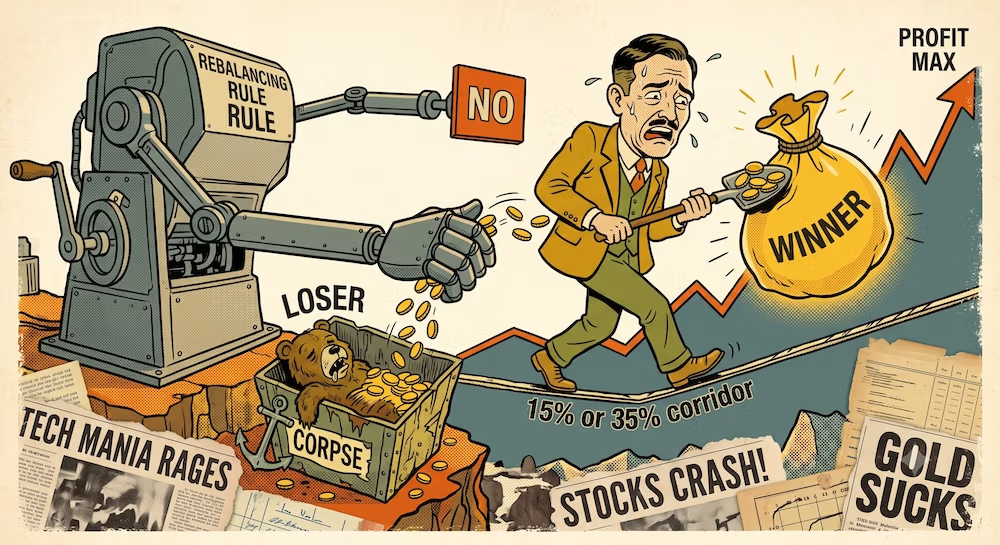
If holding these individual sleeves is uncomfortable, the act of rebalancing them is downright repulsive to the human brain. On paper, rebalancing is presented as a cold, clinical optimization tool. You establish your target allocations, wait for an asset class to breach a specific boundary—such as moving past a 15% or 35% corridor—and then restore the original balance.
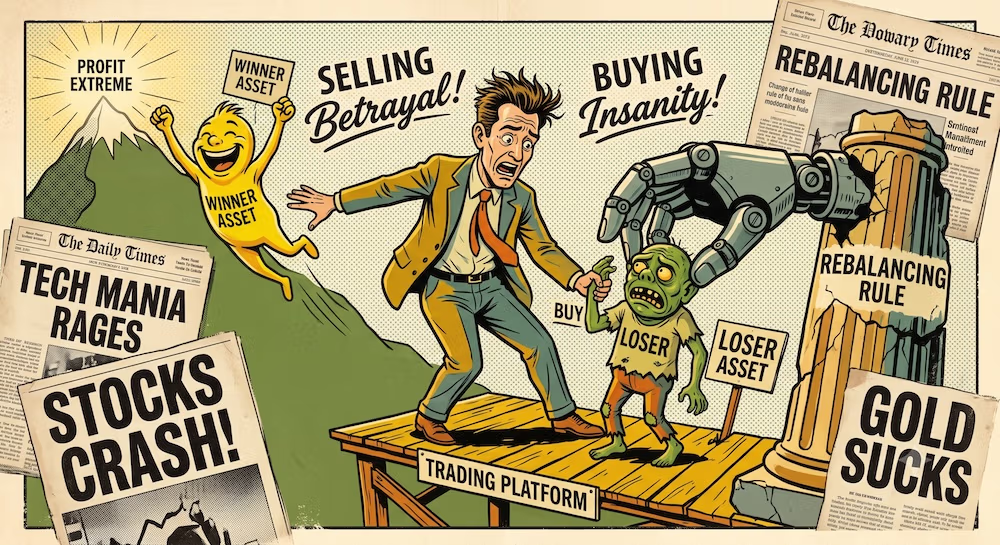
In reality, rebalancing asks you to become a psychological contrarian of the highest order. It demands that you systematically take money away from the asset class that is currently making you look like a genius, and intentionally dump that money into the asset class that is making you look like a fool.
Think about what that requires at the execution level. If stocks have just had a massive, generational run, every piece of financial media, every newsletter, and every consensus voice will be explaining why equities are the only game in town. The narrative will be bulletproof. Your emotions will be telling you to add more, to let your winners ride, to ride the wave of human progress.
Browne’s mechanical rule steps in and says: No. Sell your stocks.
And where do you put that money? You put it into the asset that has been crushed. If gold has been cratering for five years, every institutional analyst on television will be writing post-mortems about how precious metals are an obsolete relic of an earlier century. The narrative supporting the loser will be just as convincing as the narrative supporting the winner.
Rebalancing forces you to execute a trade that feels like economic suicide. It asks you to ignore the headlines, ignore your gut, and intentionally buy the corpse.
This is why mechanical rules are so much harder to follow than they sound in an academic paper. Rules only matter when your emotions completely hate them. Anyone can follow a rebalancing rule when the adjustments are minor and the markets are quiet. But when a true regime shift occurs—when one asset class is soaring on pure euphoria and another is dying in absolute panic—the act of execution becomes emotionally disgusting.
Investors break their rules exactly when those rules matter most. They decide that “this time is different,” or that they will “wait for things to stabilize” before rebalancing. The moment you introduce human judgment into a non-predictive portfolio, the underlying engineering collapses.
Why “Set and Forget” Is a Lie
The financial industry loves to sell simplicity. The Permanent Portfolio is frequently packaged as the ultimate “set-and-forget” strategy because its asset weights do not change based on macroeconomic forecasts. It requires no complex options overlays, no algorithmic trend-following signals, and no constant portfolio monitoring.
But this mechanical simplicity is an illusion that masks deep psychological noise. The strategy may be simple to describe, but it is incredibly loud to sit with over a lifetime.
| The Sales Pitch | The Lived Reality | The Behavioral Failure Mode |
| “Sleep well at night.” | Sleep badly during bull-market envy. | Capitulating into high-flying growth assets at the absolute peak of an equity bubble. |
| “Low visible volatility.” | High social comparison pain. | Abandoning the strategy out of frustration because your peers are outperforming you. |
| “Perfectly diversified.” | Always holding something embarrassing. | Consistently pruning or eliminating the worst-performing sleeve to make the portfolio look cleaner. |
| “Simple, mechanical rules.” | Brutal emotional execution. | Freezing up and refusing to rebalance when an asset class experiences a major directional move. |
| “No forecasting required.” | No excuse to tinker. | Channeling your boredom into opening a separate satellite account to trade individual assets. |
The reality is that a quiet portfolio creates a loud mind. When your investment account is stable and boring, it leaves your brain with nothing to do. In a world that values constant activity, optimization, and alpha-seeking behavior, sitting on a static split of assets feels dangerously passive.
We are wired to believe that superior outcomes require superior effort, complex strategies, and constant adjustments. When you run a framework that explicitly rejects that premise, you face a constant internal identity crisis. You begin to wonder if you are being lazy, if you are leaving money on the table through sheer complacency, or if the strategy has simply been outgrown by modern market dynamics. The “set-and-forget” label implies that the strategy requires no ongoing effort. But the effort required is entirely internal—the exhausting psychological work of resisting the temptation to fix something that isn’t broken.
The Investor This Breaks
This structural framework is an incredibly poor match for certain investor personality types. It is not a universal solution, and attempting to force yourself into this box when your underlying temperament rejects its premises is a recipe for behavioral failure.
This framework is especially difficult for anyone whose financial identity is tied to outperforming an equity benchmark. If you derive personal satisfaction from beating the market, or if your definition of investment success is tied directly to the return of the S&P 500, this allocation will make you miserable. The permanent anchors of cash and gold mean you are structurally positioned to trail a standard stock index during normal economic expansions. If you cannot decouple your self-worth from the performance of large-cap equities, the tracking error will eventually drive you to quit.
The structure also breaks the chronic optimizer. There is a specific type of DIY investor who cannot resist the urge to constantly adjust variables. They want to tilt toward factors, rotate sectors based on moving averages, or adjust asset weights based on the current yield curve.
Browne’s framework requires a total surrender of that desire. It demands a radical, almost terrifying level of macro humility—an admission that we have a very limited ability to know what is going to happen next, and that an individual opinion on inflation, interest rates, or corporate earnings is entirely irrelevant to the portfolio’s rules. For an individual who prides themselves on their intellect, market analysis, or forecasting ability, this forced humility feels like an insult.
Finally, the framework breaks those who cannot tolerate public embarrassment or social non-conformity. Holding 25% of your wealth in gold and another 25% in short-term T-bills means your asset mix will regularly be criticized by conventional Wall Street advisors, mainstream financial media, and standard equity indexers alike. You will be viewed as a paranoid survivalist by some and a timid, ultra-conservative allocator by others. If you need validation from the broader financial culture to maintain your investment conviction, you will capitulate under the weight of social comparison long before the strategy completes its long-term cycle.
The Psychology This Framework Selects For
Conversely, there is a specific, rare temperament that can find true peace within Browne’s psychological architecture. It requires a unique combination of behavioral traits that run completely counter to standard market culture.
This framework requires a temperament that can maintain a complete and genuine indifference to benchmark envy. This is an individual who can look at a neighbor who just made a fortune in a speculative tech bubble, smile, say “good for them,” and genuinely not care that their own net worth grew by only a fraction of that amount that year. They do not view investing as a competitive sport or a social scorecard. They evaluate their performance strictly against their own personal liabilities and purchasing power requirements, remaining highly resilient against the psychological pressures of relative peer comparison.
The framework also selects for those who harbor a profound, fundamental distrust of all human forecasting—including their own. This is not just intellectual skepticism; it is a lived, operational reality. They truly believe that the macroeconomic future is entirely unknowable, and that any attempt to time interest rate cycles, predict inflation trends, or pick winning economic sectors is an exercise in pure arrogance. They find comfort in a rigid, non-discretionary structure precisely because it strips away the dangerous burden of having to make subjective market calls in an uncertain world.
Finally, this structure functions best for individuals who have a stark, unsentimental preference for long-term survivability over maximum compounding. They are individuals who have either built a significant nest egg that they cannot afford to lose, or who naturally view the world through a deeply defensive, risk-mitigating lens. They are perfectly willing to forfeit considerable potential upside if it means establishing a structure designed to survive many hostile scenarios—including systemic banking failure, catastrophic deflationary collapse, or a runaway inflationary crisis. They do not want to maximize wealth; they want to build a stronger behavioral defense against catastrophic failure.
What Actually Travels
Harry Browne’s profound contribution to investor psychology is not that the Permanent Portfolio is a painless, low-volatility sanctuary. His true lesson is that every asset allocation architecture is simply a mechanism for choosing your specific type of financial pain.
There is no such thing as a portfolio structure that eliminates risk; there is only a portfolio that changes the vector of that risk. If you choose a 100% equity index strategy, you are choosing the pain of the account balance—the stomach-churning terror of watching a large portion of your nominal net worth evaporate during a classic 50% market crash. If you choose the Permanent Portfolio, you are choosing the pain of the ego—the isolating, slow-burning agony of trailing your peers for decades while holding assets that the rest of the world openly mocks.
The hard part of investing is not the mathematics. The math of an equal-weighted four-quadrant split can be explained to a child in five minutes. The hard part is the lived reality of sitting with the psychological consequences of that math for thirty years without reaching for the optimizer’s screwdriver.
When this framework is studied honestly, the important question is not whether the historical backtest looks smooth or boasts a lower drawdown profile. The important question is whether your individual temperament can handle the quiet, public humiliation of looking completely wrong for fifteen years straight. If the answer is no, then the strategy will break your discipline long before the next market crash arrives to validate it.
Stay independent, respect the reality of your own nervous system, and understand the true cost of the safety you are buying.
What is the biggest psychological failure mode of the Permanent Portfolio?
Tracking error regret. Because the architecture permanently locks away 75% of your capital from the equity market—assigning it instead to long-term government bonds, short-term cash, and spot gold—you are structurally guaranteed to lag behind any sustained stock market expansion. This relative underperformance doesn’t hurt your absolute dollar balance, but it causes intense emotional fatigue and benchmark envy when you watch friends, neighbors, and mainstream indices accumulate massive relative wealth during equity bull markets.
Does the official Permanent Portfolio Fund (PRPFX) track Harry Browne’s original 4×25% strategy?
No, not exactly. The public mutual fund (PRPFX) launched in 1982 significantly deviates from the classic equal-weighted allocation framework. While it maintains a diversified, regime-agnostic posture, it includes exposures to global growth stocks, real estate, and a mix of precious metals like silver alongside gold. It exhibits distinctly different volatility and structural behaviors than the pure, static four-quadrant replication model using index proxies.
Why does the Permanent Portfolio require highly volatile assets like gold and long bonds?
To feed the rebalancing engine. Many allocators mistake this allocation for a collection of sleepy, low-volatility assets, but long-term Treasuries and spot gold have immense standalone price volatility. Because they are deeply uncorrelated and frequently react aggressively in opposite directions to macroeconomic shocks, their jagged individual price paths create the raw material for an unleveraged rebalancing premium. When you systematically pare down the winning asset class to buy the underperforming asset class, you convert standalone asset volatility into aggregate portfolio stability.
Can you rebalance the Permanent Portfolio via new cash inflows to minimize tax drag?
Yes. In fact, this is highly recommended if you choose to operate the framework within a standard, non-retirement taxable brokerage account. Manually selling off appreciated assets like equities or gold to buy underperforming tranches triggers immediate capital gains liabilities. By utilizing new capital contributions or dividends to purchase the lagging sectors and bring them back to their baseline target splits, you completely bypass the tax drag that would otherwise erode your long-term compounding.
What happens to the Permanent Portfolio when stocks and long bonds drop at the same time?
The portfolio experiences a temporary nominal drawdown. The core architecture relies heavily on the historical reality that long bonds act as an explosive deflationary shield during equity liquidations. However, during stagflationary regimes or unique central bank hiking cycles where inflation is the primary catalyst for market adjustments—such as the synchronized global market environments of 1981 and 2022—both stocks and fixed income can decline simultaneously. During these specific windows, the cash and gold sleeves are forced to handle the structural defense of your wealth.
What is the minimum portfolio size required to practically execute this strategy?
It depends entirely on your implementation choices. If an investor attempts to replicate Browne’s literal, era-specific instructions by maintaining physical gold coins in private vaults and purchasing raw, direct Treasury blocks, the operational friction requires significant six-figure capital. However, using a modern digital brokerage account with zero-commission trading and fractional shares, an allocator can completely mirror the identical structural exposure using low-cost index funds with virtually no baseline capital minimum.
Is the Permanent Portfolio a suitable structure for young investors building wealth?
Generally no. While it provides an elegant defensive sanctuary, the deep 25% cash drag and 25% zero-yield gold anchor structurally decapitate the aggressive long-term compounding required during the accumulation phase of wealth building. For an individual who needs decades of capital growth and possesses the timeline to absorb deep equity drawdowns, running this allocation creates an immense opportunity cost and an almost un-holdable level of behavioral tracking error regret.
This article is also available in Spanish. Leé la versión en castellano: Lección de psicología del inversor de Harry Browne: Por qué la Cartera Permanente es más difícil de seguir de lo que parece

Brilliant article, extraordinary. You hit the nail on the head. I found myself nodding along almost the entire time I was reading. You brought up so many points that really made me think. Thank you for writing this.