I used to think Charlie Munger was simply Berkshire Hathaway’s chief philosopher—the man who sat on a stage in Omaha, tossed out witty aphorisms about human misjudgment, and told everyone to go to bed smarter than when they woke up. It’s an easy narrative to buy into. It casts Munger as the cerebral, reflective thinker and Warren Buffett as the hyper-active transaction engine.
But if you look past the folksy quotes and study the structural evolution of Berkshire Hathaway, you realize that framing misses the point entirely. Munger wasn’t merely a sounding board or a source of colorful quotes.
He was the upgrade patch to Buffett 1.0.
When Munger met Buffett in 1959, the early Berkshire framework was built almost entirely on the classic Benjamin Graham “cigar-butt” operating system: hunt for cheap, asset-heavy, unloved businesses, squeeze the remaining liquid capital out of them, and move on. It worked brilliantly at small scale, but it possessed an inherent operational ceiling. Munger didn’t just suggest better companies to buy; he helped rewrite Berkshire’s internal code. He introduced the mental and structural architecture that allowed Berkshire to evolve from a scavenger vehicle into a decentralized, multi-layered compounding engine. He installed the operating logic.
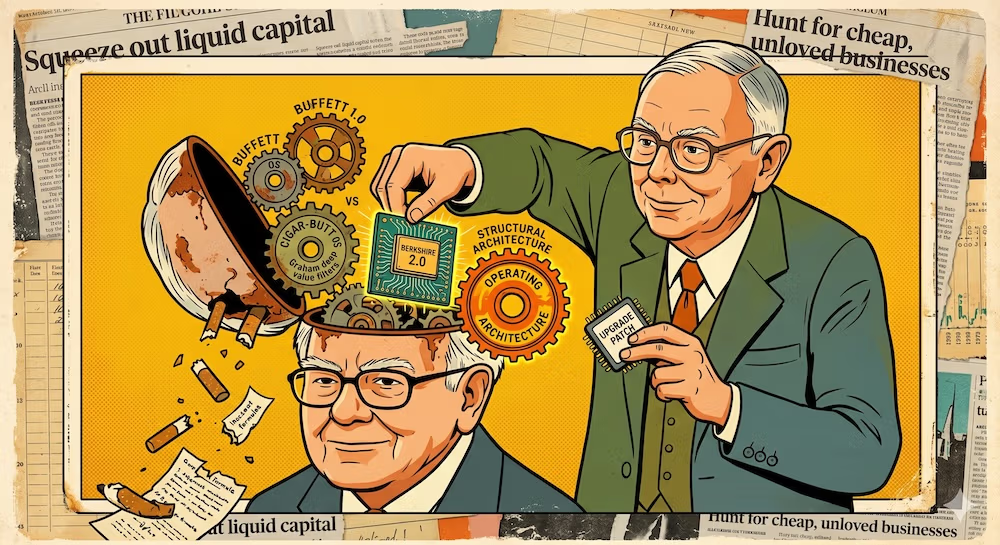
Buffett 1.0 vs. Berkshire 2.0
To understand the magnitude of this structural shift, we have to look at the limitations of the original code. Buffett 1.0 was designed around deep value asymmetry. If a textile mill or a structural farm equipment manufacturer was trading at a massive discount to its net current assets, the system flagged it as an absolute buy.
But that logic contained a hidden operational trap: bad businesses require constant capital reinvestment just to stay mediocre. A textile mill must continually buy new looms to survive competitive pricing pressure, consuming the very cash it generates without ever increasing its long-term return on capital.
Munger’s core contribution was installing Berkshire 2.0. This framework shifted the primary filter from cheap asset extraction to sustainable business-quality compounding. Instead of focusing on price relative to physical assets, the system began prioritizing pricing power, low capital intensity, and structural competitive advantages.
Crucially, this wasn’t just a shift in investment philosophy; it changed Berkshire’s entire corporate operating architecture. Operating businesses were no longer viewed as permanent homes for capital, but as liquidity nodes designed to generate cash that could be completely stripped out and reallocated elsewhere.

The Berkshire Operating System Map
This integrated architecture relies on several distinct design layers working in tandem. When we unpack the corporate design under Munger’s influence, we find a highly synchronized capital allocation machine.
| Operating System Layer | Munger’s Contribution | Berkshire Mechanism | Why It Mattered | What Investors Misunderstand |
| Quality Upgrade Engine | Shifted the core filter away from asset liquidation values. | Mandating the purchase of businesses with durable competitive moats at rational valuations. | Preempted the scale problem by buying companies that didn’t require capital reinvestment. | They think it’s a generic moral preference for “good” companies rather than an efficiency metric. |
| Opportunity Cost Engine | Installed a single, universal hurdle rate for every asset class. | Every capital deployment option must directly compete against the returns of the next best alternative. | Eliminated artificial budget allocations and corporate theater across subsidiaries. | They assume Berkshire relies on complex, spreadsheet-driven weighted average cost of capital calculations. |
| Float Utilization Engine | Reframed liabilities into permanent capital assets. | Deploying low-cost insurance liabilities into concentrated, long-term common equity holdings. | Created non-callable, tax-deferred institutional leverage with low forced-selling risk. | They view insurance float as a passive side-car rather than the primary fuel for capital allocations. |
| Cash Redeployment Engine | Decoupled capital generation from local business operations. | Extracting surplus cash flow from subsidiaries to be centralized at headquarters. | Prevented corporate managers from reinvesting capital into low-return legacy assets. | They assume great subsidiaries are supposed to grow internally by hoarding their own cash. |
| Decentralized Trust Engine | Eradicated standard corporate management layers. | Maintaining a corporate headquarters staff measured in dozens rather than thousands. | Eliminated operational friction, regulatory bureaucracy, and systemic manager ego drag. | They mistake this structural design choice for passive corporate laziness. |
| Incentive & Culture Engine | Aligned compensation with cash-on-cash reality. | Tying subsidiary bonuses directly to localized capital efficiency, not GAAP net income. | Prevented accounting manipulation and aligned manager behavior with capital allocation goals. | They focus on folksy statements about honesty while missing the cold mechanics of the contracts. |
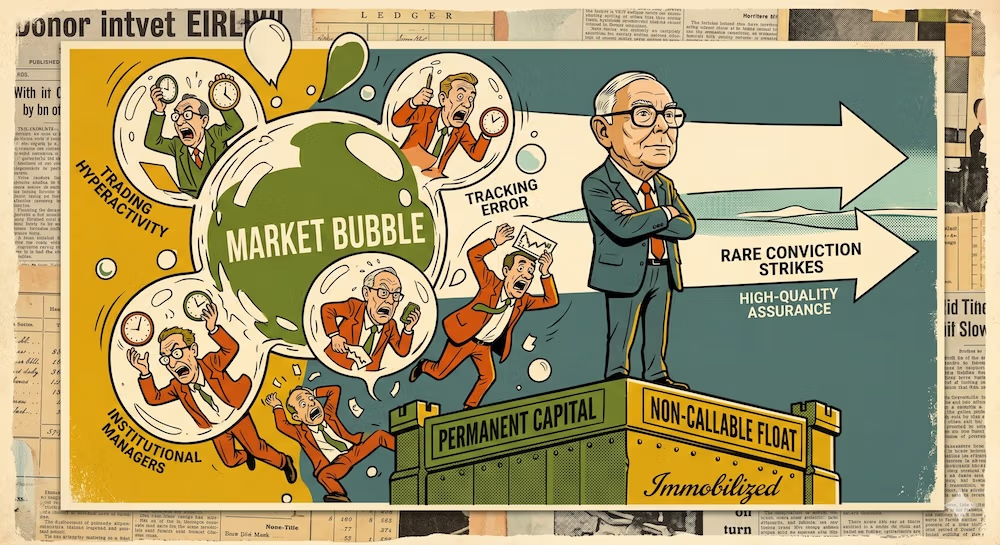
| Scarcity & Patience Engine | Normalized years of complete corporate inactivity. | Waiting for rare, high-conviction opportunities instead of forcing constant transaction churn. | Preserved capital and avoided tracking-error anxiety during market bubbles. | They assume a lack of transactional activity means an investment team has lost its edge. |
| Scale Adaptation Engine | Channeled capital into regulated, capital-heavy infrastructure. | Transitioning from high-ROC consumer brands to massive utility networks and railroads. | Allowed Berkshire to deploy tens of billions of dollars safely as the equity base expanded. | They believe Berkshire’s strategy is frozen in time and still seeks small consumer monopolies. |

Layer One: Opportunity Cost as the Internal Language
In a traditional corporate hierarchy, capital budgeting is a political exercise. The division head who presents the most elaborate slide deck or possesses the most aggressive personality typically wins the funding for their new factory or product expansion.
Munger helped eradicate this structural friction inside Berkshire by installing opportunity cost as the company’s universal internal language.
Inside the Berkshire operating system, money is completely fungible and has no loyalty to its source. It does not matter if a dollar was generated by car insurance premiums, a newspaper asset, or a candy company. Once that cash arrives at corporate headquarters, it is stripped of its origin story and forced to compete in a single, unhedged arena against every other available use of capital globally.
If a subsidiary manager wants $50 million to expand a manufacturing facility, the hurdle rate is not an arbitrary cost-of-capital calculation cooked up by an investment bank. The hurdle rate is the expected return of buying more shares of Berkshire’s best existing equity position, or buying back Berkshire stock itself, or purchasing a wholly-owned utility.
If the manager’s project cannot outcompete those baseline realities, the capital is denied and immediately routed to the highest-return node in the system. By making every dollar compete against the best alternative, Munger and Buffett eliminated the corporate tendency to hoard cash within dying legacy businesses.
Layer Two: See’s Candies and the Cash Redeployment Machine
The 1972 acquisition of See’s Candies is frequently cited as the quintessential example of Buffett and Munger upgrading their quality filters. But studying See’s merely as a stock-picking victory misses the true operational breakthrough. See’s Candies was the ultimate prototype for Berkshire’s cash redeployment engine.
When Blue Chip Stamps purchased See’s for $25 million, the company possessed a localized geographic monopoly in California and generated roughly $4 million in pre-tax corporate profits. Munger recognized a critical structural characteristic: the business had enough consumer loyalty and pricing power to raise prices repeatedly without requiring heavy incremental capital. California could only consume so many premium chocolates; opening hundreds of stores in eastern states yielded poor capital efficiency.
In a standard corporate operating system, a successful subsidiary is typically instructed to reinvest its profits into its own industry to achieve horizontal growth, even if those secondary investments generate miserable returns.
Berkshire’s operating system did the exact opposite:
- See’s exercised its pricing power, expanding its cash margins.
- Corporate headquarters strictly limited local capital expenditures to the bare maintenance minimum.
- Surplus cash flow was extracted and redeployed at the parent level rather than automatically reinvested inside the candy business.
Over the subsequent decades, See’s Candies generated more than $2 billion in cumulative pre-tax cash flow for Berkshire. Because that cash wasn’t trapped inside a regional candy company, it could be systematically funneled into funding the early accumulation of massive equity stakes like Coca-Cola or GEICO. See’s proved that an asset-light operating business could function as a high-signal cash font feeding a broader, multi-industry compounding machine.

Layer Three: Float as Patient Capital
An operating system is only as durable as its liquidity pool. Munger’s structural framework required a capital source that could remain completely indifferent to short-term stock market volatility. They found that permanence by integrating insurance and delayed-redemption liabilities into the core engine.
Consider the mechanics of Blue Chip Stamps. When retailers purchased stamps to hand out to consumers, Blue Chip received cash immediately. Because customers took months or years to redeem those stamps for household items, Blue Chip held a massive pool of cash—effectively a float-like capital base created by delayed redemption liabilities. Munger and Buffett realized this cash pool was structurally distinct from a traditional bank loan or investment fund: it had no interest charges, and it could not be redeemed overnight by panicked investors.
This exact mechanism was scaled to an institutional level through Berkshire’s insurance subsidiaries, including National Indemnity and GEICO. When policyholders pay insurance premiums upfront for protection against future accidents, that cash sits on Berkshire’s balance sheet as insurance float.
During the multi-decade expansion of Berkshire’s insurance network, this float functioned as permanent, non-callable institutional leverage. Because the underwriting operations were carefully managed to run at a collective profit, the average cost of this capital was frequently negative.
This is the true mechanical intersection of Berkshire’s capital engine. The insurance business is paid a premium to hold billions of dollars, and the operating system turns around and deploys that capital into concentrated, long-term equity positions.
When the market crashes, a traditional fund facing investor redemptions is forced to liquidate positions at the absolute bottom. Berkshire’s float engine, by contrast, remains completely unaffected by market prices, providing the structural runway required to hold concentrated positions through multi-year market downturns.
Layer Four: Decentralization Without Bureaucracy
Most mega-cap corporations are defined by their structural layers: thousands of human resources employees, compliance officers, risk committees, and strategic planning executives creating endless corporate theater.
Berkshire Hathaway’s operating system relies on an aggressive, almost fanatical rejection of this bureaucratic model.
Despite overseeing an industrial empire that employs hundreds of thousands of people across dozens of distinct industries, Berkshire famously maintains a tiny corporate headquarters with a staff measured in dozens rather than thousands. There is no central human resources department, no chief risk officer, and no corporate strategy division.
Wesco Financial, which functioned for decades as Munger’s standalone corporate laboratory, operated under the exact same skeletal framework from its offices in Pasadena.
This extreme decentralization is a deliberate corporate architecture:
- Centralized Capital Allocation: Every dollar of surplus cash generated by the subsidiaries is centralized at the top, managed exclusively by a tiny team focused entirely on capital deployment.
- Decentralized Operations: Operating subsidiaries are treated as independent kingdoms. Once an owner-operator is vetted and brought into the system, corporate headquarters exerts near-zero operational interference. There are no mandatory synergy meetings, budget defense panels, or corporate consulting audits.
By eliminating the middle management layer, Munger and Buffett eradicated the principal-agent friction that plagues traditional conglomerates.
Managers are left alone to run their businesses with extreme operational autonomy, while the central nervous system focuses purely on routing capital to its highest opportunity cost use. Trust becomes a structural efficiency tool, not just a moral sentiment.
Layer Five: Few Decisions, Massive Consequences
A standard institutional investment operating system is optimized for continuous hyperactivity. Managers are expected to constantly trade, adjust portfolio sector weights, hedge tracking errors, and pitch new stock ideas weekly to justify their management fees.
Munger’s framework built a corporate culture optimized for the exact opposite behavior: extreme patience punctuated by rare, massive capital allocation strikes.
Munger frequently pointed out a structural reality of Berkshire’s historical record: if you take the top fifteen capital allocation decisions completely out of the equation, the long-term performance profile drops right back down toward the baseline market average.
The entire Berkshire operating system was engineered to survive long stretches of total inactivity while waiting for a rare alignment of business quality, rational pricing, and massive capital scale.
This patience is worth studying closely, but patience attached to permanent corporate capital, non-callable insurance float, and tax-efficient control structures is a different animal from patience in a traditional retail brokerage account.
Berkshire’s architecture allowed Munger and Buffett to sit completely immobilized during the peak of market bubbles—such as the late 1990s tech boom—without worrying about client redemptions or tracking-error tracking metrics. The system was structurally designed to tolerate massive relative underperformance in the short term to avoid participating in systemic structural mediocrity.
Where the Operating System Encountered Boundaries
No corporate operating system is completely infallible or immune to reality. The very design choices that gave Berkshire its structural edge—extreme concentration, total reliance on manager trust, and large scale—also defined its operational boundaries.
In 1993, Munger concurred with the acquisition of Dexter Shoe for $433 million. Because the business looked highly profitable based on historical metrics, the operating system trusted the local management and the existing competitive position. However, the system failed to anticipate how rapidly cheap foreign manufacturing would erode a domestic footwear moat.
Worse, because the deal was executed using 1.6% of Berkshire’s own voting stock rather than cash, the mistake permanently diluted Berkshire’s premium equity, turning an isolated operational error into a multi-billion dollar opportunity cost loss over time.
Decades later, in 2021, Munger exposed the boundary conditions of his personal investment lab inside the Daily Journal Corporation. He authorized the use of regulatory margin debt to build a highly concentrated position in Alibaba Group Holding.
By utilizing leverage inside a corporate equity portfolio, he broke his own anti-debt directives and miscalculated the structural regulatory intervention risks of the Chinese Communist Party.
When the structural thesis degraded, the system reacted cleanly: the Daily Journal portfolio aggressively cut the position by 50% in early 2022 to capture a tax-loss harvesting benefit.
These instances show that the Berkshire operating system did not eliminate human error or guarantee perfect execution. Instead, its power lay in the reality that the broader architecture was resilient enough to absorb catastrophic single-stock losses without threatening the survival of the parent compounding machine.
What Munger Did Not Do
To extract the clean mechanical lessons from Munger’s career, we must guard against the tendency to credit him with every operational victory inside the Berkshire empire. Maintaining structural clarity means identifying the strict boundaries of his role:
- He did not run the operating subsidiaries: Munger did not actively manage the daily logistics of GEICO, BNSF, See’s Candies, or any other corporate component. He left operational execution entirely to the localized managers.
- He did not single-handedly create the insurance advantages: The operational architecture of National Indemnity and the early engineering of Berkshire’s float engine were primarily driven by Buffett and his key insurance executives. Munger acted as the structural gatekeeper and filters auditor.
- He did not eliminate corporate mistakes: His role was not to guarantee flawless underwriting or perfect equity picking; it was to preserve the core capital allocation principles—rationality, opportunity cost pricing, low overhead, and behavioral patience—across multi-decade macro regimes.
The Sponge Verdict: Absorb the Operating Logic, Not the Corporate Machinery
When a modern DIY investor attempts to copy Charlie Munger by running a hyper-concentrated portfolio of three deep-value stocks inside a personal brokerage account, they are engaging in era-specific corporate cosplay. They are copying the visible tactics (concentration and buying quality) while completely lacking the invisible machinery (insurance float, inter-corporate tax deductions, and wholly-owned cash font extraction) that made those tactics survivability-proof.
A retail investor cannot build a personal insurance float engine or buy wholesale control premiums from a laptop. But we can systematically absorb the underlying operating logic into our own portfolio canvas:
- Think in explicit opportunity costs: Stop comparing a new investment idea to an abstract index or an arbitrary valuation multiple. Force every new asset to directly compete against your best existing holding or your highest-conviction cash alternative. If it cannot beat your baseline champion, deny the capital.
- Decouple cash generation from immediate reinvestment: If an individual equity or niche investment project in your portfolio generates great cash but faces a declining local competitive moat, extract that cash. Do not reinvest it into a mediocre business out of structural habit; route it to a completely different sector where capital efficiency is higher.
- Eradicate structural overhead and portfolio churn: Do not let short-term tracking error override a well-underwritten, properly sized long-term plan. Minimize transaction activity, eliminate unnecessary advisory fees, and let your capital sit undisturbed for years within your true circle of competence.
Charlie Munger’s ultimate legacy is not a list of successful stock picks or a library of clever quotes. It is the design of a corporate nervous system where culture, incentives, cash redeployment, and structural permanence all point in the exact same direction. Respect the architecture of the system, leave the historical folklore behind, and engineer your own portfolio around the hard structural realities you actually face.
[!NOTE]
Replicating Charlie Munger’s corporate investment blueprint requires a clear structural trade-off. Choosing extreme portfolio concentration and ignoring tracking error can unlock massive outperformance if your research filters match institutional standards and your emotional baseline can endure a 50% reduction in paper wealth without panicking. For the vast majority of DIY investors, adopting his multi-disciplinary analytical filters while maintaining a diversified, index-driven asset allocation structure provides the highest probability of long-term financial success without introducing catastrophic single-stock ruin risk.
What was the exact difference between Buffett 1.0 and Berkshire 2.0?
Not exactly a minor tweak. Buffett 1.0 was built almost entirely on the classic Benjamin Graham “cigar-butt” investment engine, which hunted for asset-heavy, cheap companies trading at a deep discount to net current assets. While highly profitable at a small scale, it had a hard operational ceiling because bad or mediocre businesses continually demand capital reinvestment just to survive. Berkshire 2.0, installed as an upgrade patch by Charlie Munger, shifted the primary corporate filter to business-quality compounding, prioritizing pricing power, low capital intensity, and structural competitive advantages while centralizing all surplus cash for optimal redeployment.
What is the minimum portfolio size needed to replicate Charlie Munger’s operating system?
It depends on your setup, but if you are talking about replicating the actual corporate machinery, a standard retail portfolio size cannot do it. Replicating the core operating logic—such as thinking strictly in terms of opportunity cost or cutting out administrative overhead—can be applied to a portfolio of any size. However, the structural advantages that made Munger’s tactics survivable, such as utilizing insurance float as non-callable leverage or exploiting inter-corporate tax deductions, require an institutional corporate balance sheet and cannot be duplicated inside a retail taxable brokerage account regardless of your net worth.
How did Blue Chip Stamps supply capital for Berkshire Hathaway’s early acquisitions?
Through delayed redemption liabilities. When retailers purchased loyalty stamps from Blue Chip to give to grocery customers, Blue Chip collected the cash immediately. Because customers took months or years to save up and redeem those stamps for household goods, Blue Chip accumulated a massive pool of unredeemed customer cash. Munger and Buffett took control of the company and weaponized this float-like capital pool, using it as an interest-free, non-callable cash pipeline to purchase See’s Candies for $25 million in 1972 without borrowing external debt.
What role did Wesco Financial play in Charlie Munger’s investment laboratory?
Wesco operated as an isolated corporate playground. Originally a regulated savings and loan utility, Munger maintained Wesco as a separate, publicly traded entity for decades despite Berkshire owning more than 80% of the stock. This unique layout allowed Munger to run a standalone corporate sandbox out of Pasadena. By utilizing this corporate sleeve, the system could accumulate massive stock positions and exploit corporate tax rules like the Inter-Corporate Dividend Received Deduction (DRD) to compound capital under a significantly lighter tax drag than an individual investor faces.
Why did Charlie Munger oppose standard institutional portfolio diversification?
He considered it “deworsification.” Inside the operating logic of a high-conviction investor, placing capital into your twentieth best idea instead of compounding it within your top three choices is an admission of ignorance. Munger favored extreme portfolio concentration, regularly allocating over 40% of deployable capital to single equity positions. He argued that if an investor truly understands the competitive moat and incentive structures of an enterprise, concentration dramatically reduces long-term economic risk, even though it introduces massive short-term tracking error relative to a broad market index.
How did Berkshire Hathaway’s operating system handle underperformance during market bubbles?
With absolute, systemic immobility. Traditional fund managers operate under client redemption pressures and benchmark comparisons, forcing them to churn portfolios or buy overvalued assets during a bull market to avoid career risk. Because Berkshire’s capital was structural and permanently locked inside an insurance and holding company framework, Munger and Buffett could sit completely inactive for years during manic market regimes, such as the late 1990s dot-com boom, without any threat of overnight cash withdrawals.
Did the Berkshire operating system ever fail or run into structural limits?
Yes, no system is infallible. The primary boundary condition of the architecture was scale; as Berkshire’s equity base crossed the $10 billion and $100 billion thresholds, it outgrew the ability to buy asset-light consumer monopolies like See’s Candies. The system was forced to evolve into a capital-heavy utility model, deploying tens of billions into regulated infrastructure like railroads (BNSF) which offer lower, market-matching returns on equity. Additionally, miscalculations occurred when the system broke its own rules, such as Munger authorizing regulatory margin debt inside the Daily Journal portfolio to buy Alibaba in 2021.
This article is also available in Spanish. [Leé la versión en castellano: Por qué Charlie Munger fue el sistema operativo oculto de Berkshire Hathaway]