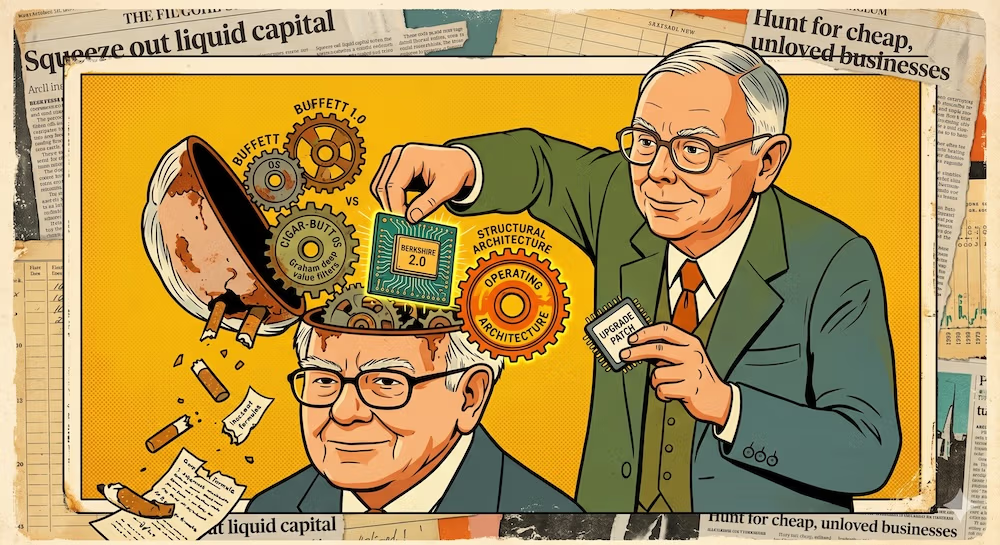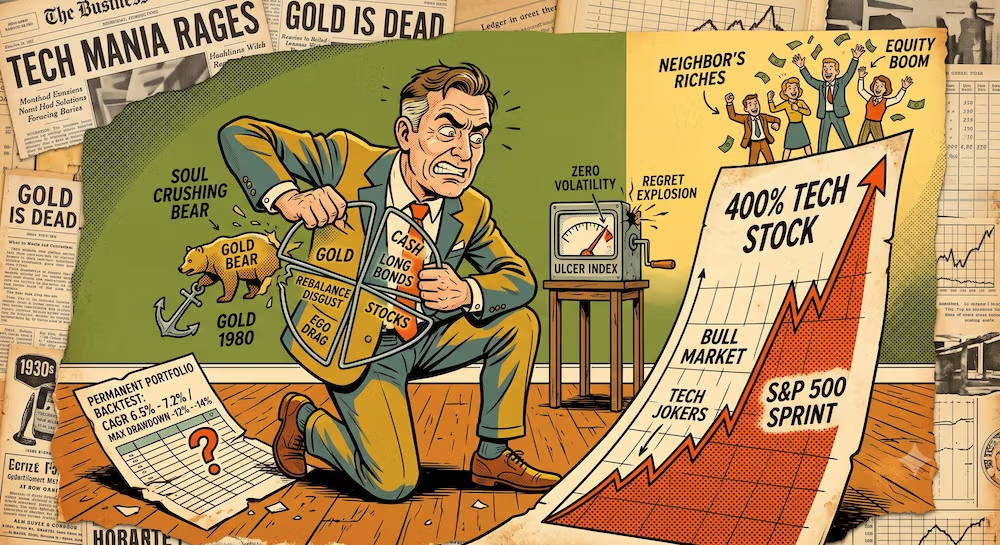
I used to think that the ultimate danger in studying Charlie Munger was simply a structural mismatch—the gap between his permanent, corporate-backed capital and a standard retail brokerage account. I assumed that if a DIY investor could just master his multidisciplinary mental models, remain behaviorally unshakeable, and check enough qualitative boxes, running a hyper-concentrated portfolio of a few “wonderful businesses” was a viable path to outperformance.
Then I conducted a forensic audit of his actual mistakes.
When you look past the standard online folklore, you realize that Munger’s record isn’t a flawless sequence of qualitative triumphs. It is an incredibly instructive map of failure modes. Even the grandmaster of behavioral checklists, clear thinking, and inversion suffered severe blind spots, conceptual omissions, and explicit strategic contradictions.
This is not a cynical attempt to tear down a legendary financial career; it is a clinical post-mortem. Munger being wrong does not make him unserious. It makes him profoundly useful to study. The value is not in mocking the errors, but in identifying where a brilliant, battle-tested process met a macroeconomic or jurisdictional regime it did not fully model.
Worshipping an investor turns their conclusions into dogma. Auditing their mistakes exposes the boundary conditions of their philosophy. Every core Munger principle—concentration, patience, quality, and strict circles of competence—works beautifully until it hits a specific structural limit.
Respect the framework. Audit the boundary conditions. Never outsource your personal judgment to a legend.
Alibaba and the Limits of the Quality Analogy
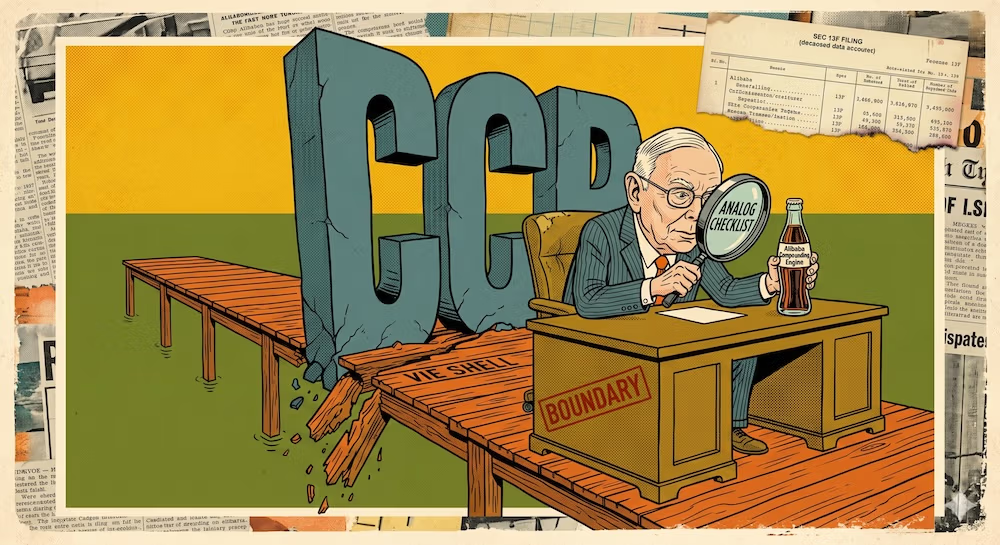
The central case study of Munger’s late-career execution sits in the SEC Form 13F filings of the Daily Journal Corporation between 2021 and 2022. It represents a classic failure mode: mistaking business-level quality for jurisdictional safety.
In the first quarter of 2021, Munger initiated a highly concentrated position in the Chinese e-commerce giant Alibaba Group Holding Ltd (BABA), purchasing roughly 165,000 ADRs. As the stock steadily declined, he doubled down, accumulating more shares in the third quarter and doubling the allocation again in the fourth quarter of 2021. At its peak, the Daily Journal portfolio held 602,060 ADRs with an estimated average cost basis sitting between $180 and $200 per share.
What was the underlying thesis? Munger applied an analog, free-market mental model to a state-dominated digital utility. He viewed Alibaba through the lens of a traditional consumer franchise with a massive distribution moat—essentially a digital version of Costco or a modern Coca-Cola.
The embedded assumption was that a dominant market position and robust internal compounding mechanics would inevitably reward shareholders, provided they exercised sufficient patience.
That assumption broke when it hit a different geopolitical regime. Munger structurally underweighted the sovereign regulatory risk of the Chinese Communist Party (CCP). In a command economy, a corporate moat exists entirely at the pleasure of the state. When the CCP intervened, halted the Ant Group IPO, and restructured Alibaba’s internal monetization loops, the traditional franchise metrics became largely irrelevant.
Furthermore, the thesis ignored the structural reality of the Variable Interest Entity (VIE) mechanism. Foreign investors buying Alibaba ADRs do not actually own equity in the underlying Chinese operating assets; they own shares in an offshore shell company holding contractual rights to profits. When the regulatory regime shifted, those contracts lost their structural certainty.
In the first quarter of 2022, Daily Journal Corp filed an updated 13F showing it had slashed the Alibaba position by approximately 50%, crystallizing a massive loss on the sold shares.
This error reveals a critical boundary condition: the quality of a business cannot be evaluated in isolation from its legal and regulatory jurisdiction. When you copy a legend’s conclusion without underwriting their jurisdictional assumptions, you risk converting their blind spot into your own financial loss.
The Leverage Contradiction: Preaching vs. Execution
The Alibaba failure also exposed a profound contradiction between Munger’s lifelong public rhetoric and his actual operational execution inside the Daily Journal account.
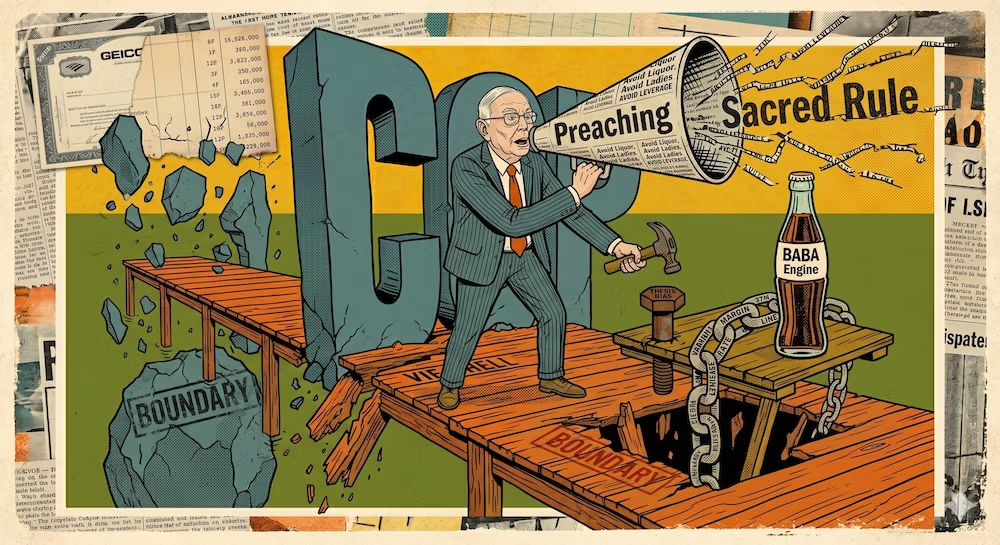
For decades, Munger lectured retail audiences on the absolute necessity of avoiding leverage. He famously noted that the three ways for a smart man to go broke are “liquor, ladies, and leverage,” and repeatedly warned that debt could interrupt an otherwise spectacular compounding journey.
Yet, to finance the rapid expansion of the Alibaba position throughout 2021, Daily Journal Corp drew $37 million in interest-bearing bank margin lines. Munger explicitly used variable-rate, mark-to-market debt to fund a hyper-concentrated bet on a single, highly volatile technology stock.
Why did a master of psychological checklists violate his own sacred rule? The answer lies in thesis-preservation bias. When an ultra-concentrated position begins falling, a highly disciplined investor can easily mistake stubbornness for patience. They use leverage to prove their original calculation was correct, assuming the market is merely experiencing irrational short-term volatility.
To be fair, Munger’s leverage looked different from retail leverage because of Daily Journal’s specific balance sheet architecture. The margin debt was secured against a legacy portfolio of fully paid-for commercial banking stocks (including Wells Fargo and Bank of America) held with massive, unrealized capital gains. This immense equity backstop insulated the corporate account from automated margin liquidation algorithms during Alibaba’s downward spiral.
For a modern investor, the lesson is stark: leverage changes the game entirely when it is your leverage. Retail broker margin accounts feature variable interest rates and are fully callable on a daily mark-to-market basis. Running high concentration via standard margin lines introduces an absolute risk of forced liquidation. Munger’s execution proved that when a brilliant process becomes dogmatic, even the architect of the rule will look for reasons to break it.
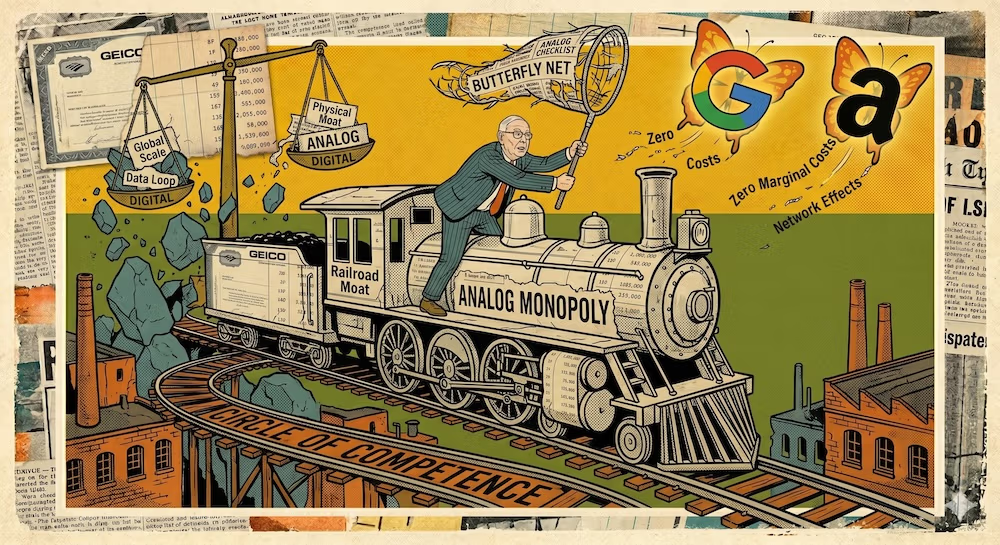
A masterclass in domain boundary errors. Munger’s 20th-century framework perfectly understood physical distribution moats, but it functioned as a behavioral blind spot when digital platform dynamics shifted the economy's center of gravity.Errors of Omission in the Digital Economy
A forensic audit of missing a regime transition cannot ignore what Munger called his “errors of omission.” These were not active blowups, but rather conceptual limitations that blinded him to the core economic drivers of the modern digital landscape.
Munger openly admitted that failing to buy Google early—despite tracking its near-flawless operational efficiency firsthand via the customer acquisition metrics of Berkshire’s subsidiary, GEICO—was a multi-billion dollar strategic failure. Similarly, he and Buffett systematically underestimated the scalable infrastructure power of Amazon and the structural shifts occurring within enterprise software economics.
These were not errors of intelligence; they were missed domain transitions. Munger’s foundational framework was forged in the 20th-century analog economy. That era favored capital-intensive businesses with physical infrastructure moats: railroads, brick-and-mortar retail monopolies, and industrial manufacturing plants. He understood consumer brand loyalty and physical distribution constraints perfectly.
However, digital platform economics operate under a completely different mathematical regime:
- Zero Marginal Costs: Digital products scale globally without requiring linear capital reinvestment in factories or inventory.
- Network Effects: Every additional user increases the utility of the entire platform, creating winner-take-all dynamics that naturally outpace traditional brand monopolies.
- Data Feedback Loops: Platforms like Google capture asymmetric information advantages that allow them to optimize pricing and consumer allocation in real time.
Munger’s traditional “circle of competence” likely protected him from many bad tech stocks, but it also functioned as a behavioral blind spot when the economy’s center of gravity shifted. He analyzed software companies using an analog checklist, assuming their moats were fragile and fleeting compared to a physical railroad.
The lesson for modern portfolio construction is clear: a rigid framework that worked perfectly during one economic era can easily turn into an ideological prison if you fail to update your underwriting assumptions as technology transforms the underlying landscape.

The physics of scale completely alters your investable universe. Munger compounded at 19.8% net inside a small, agile partnership canvas, but hundreds of billions mechanically forces a pivot to mega-caps. Don't copy a giant's constraints with an agile retail account.Scale Slowly Kills the Original Edge
Many investors try to copy Munger’s concentrated strategy without recognizing that his own methods were forced to decay due to the basic physics of capital scaling.
During his early partnership era at Wheeler, Munger & Co. (1962–1975), Munger achieved a spectacular net compound annualized growth rate (CAGR) of 19.8% compared to 4.9% for the S&P 500. He did this by exploiting highly inefficient micro-cap stubs, local asset liquidations, and closed-end fund arbitrage setups. In that regime, an investment of $2 million could radically move the needle for his total capital pool.
(Note: While some historical databases reference the Dow Jones Industrial Average as the primary comparison metric during this specific 14-year window, utilizing the broader S&P 500 performance emphasizes the massive tracking error variation Munger comfortably tolerated.)
But as his reputation grew and he integrated his operations fully into Berkshire Hathaway, his investable universe contracted severely. When you are managing hundreds of billions of dollars, the small-cap arbitrage engine becomes mathematically useless. If you purchase 100% of a mispriced $50 million business, a 10x return adds a microscopic fraction of a percent to a mega-cap holding company’s balance sheet.
This scale problem forced Munger to systematically abandon his natural habitat. He was compelled to transition from an agile value-arbitrageur into a global macro proxy, purchasing massive capital absorbers like regulated utilities, insurance networks, and global mega-cap equities.
Retail investors who blindly copy modern Berkshire’s large-cap stock picks are engaging in an institutional mismatch. They are applying a strategy designed to manage the constraints of immense scale to their own small, highly agile capital pools. They sacrifice the structural size premium available in smaller, less efficient market caps to copy conclusions that the legend was forced into by pure asset physics.
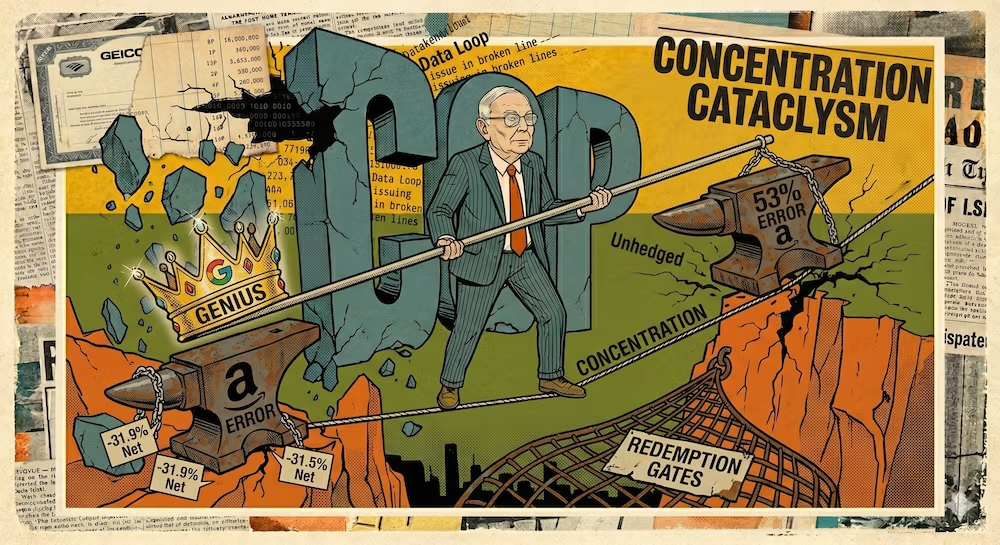
The tightrope of extreme portfolio concentration doesn't care about your moral superiority. Concentration is a neutral financial force multiplier: it magnifies brilliant insights when you're right, and it catastrophically accelerates your losses when a single premise fails.Concentration Magnifies Both Genius and Error
The retail folklore surrounding Munger often treats portfolio concentration as a badge of moral and intellectual superiority. We are told that diversification is merely a confession of ignorance.
The empirical record shows that concentration is simply a neutral financial force multiplier. It magnifies the depth of your insight when you are right, and it catastrophically amplifies your loss when a single premise fails.
Look briefly at the 1973–1974 partnership ledger. Wheeler, Munger & Co. suffered back-to-back net drawdowns of -31.9% and -31.5%, resulting in a cumulative peak-to-trough drop of 53.3%. The partnership spent three consecutive years underwater, severely lagging the broader market index during the 1975 recovery.
Munger survived that catastrophic stretch because his structure allowed him to tolerate looking intensely wrong for a prolonged period. His capital was insulated by strict, annual partnership redemption gates, meaning his investors could not panic-liquidate the fund mid-year.
But this survivorship reveals a dangerous trap. Hero worship causes retail followers to view that 53% drawdown as proof of “unshakeable patience.” They assume that if they just close their eyes and hold through a massive decline, they will inevitably be rewarded on the other side.
That assumption requires your underlying thesis to be 100% correct. When Munger was right on his concentrated positions in the 1970s (such as utilizing the float-like capital created by delayed stamp redemption liabilities inside Blue Chip Stamps to acquire See’s Candies), the concentration drove historic outperformance. But when the underlying thesis is wrong—as it was with Alibaba—hyper-concentration simply accelerates the destruction of your capital.
Without an institutional permanent capital base or an independent personal cash flow to offset uncompensated idiosyncratic risk, retail hyper-concentration isn’t disciplined investing. It is an unhedged gamble that a single blind spot won’t permanently impair your life savings.
The Boundary Conditions Ledger
To systematically absorb Munger’s principles without falling into the trap of uncritical imitation, we must chart the exact boundary conditions where his core ideas function—and where they catastrophically break.
| Core Munger Principle | Works Beautifully When… | Catastrophically Breaks When… | The Modern DIY Lesson |
| Extreme Portfolio Concentration | The investor’s analytical insight is entirely correct and the underlying capital base is structurally un-callable. | A core thesis assumption fails or real-world liabilities force a liquidation during a deep drawdown. | Single-stock hyper-concentration can expose a retail account to uncompensated idiosyncratic risk if you lack independent cash flows. |
| Patience & Long Holding Horizons | The underlying business economics and franchise moats remain structurally intact over time. | Patience mutates into behavioral thesis denial in the face of structural or regulatory decay. | Set objective, quantifiable boundary conditions for your investment theses. Do not treat stubbornness as a financial virtue. |
| Circle of Competence Alignment | The boundaries of the investor’s expertise are honestly appraised and economic regimes remain stable. | Analog frameworks are stretched via lazy metaphors to fit complex digital or sovereign regimes. | Audit your core assumptions when transitioning between asset classes, technology sectors, or foreign jurisdictions. |
| Franchise “Quality” Selection | The enterprise operates within a free-market system with durable, capital-efficient pricing power. | Sovereign regulatory changes, political interventions, or governance structures shift the game. | Corporate quality cannot be evaluated separate from jurisdictional safety. Moats do not protect against expropriation or state caps. |
| Avoidance of Portfolio Leverage | Debt is structurally non-callable, low-cost, and insulated from mark-to-market triggers (e.g., insurance float). | Variable-rate, daily callable margin debt meets high asset volatility inside a concentrated line. | Keep your leverage metrics clinical. Never use retail margin lines to fund concentrated single-stock equity bets. |
The Sponge Verdict: Respect the Record, Refuse the Shrine
The goal of a self-aware, independent portfolio builder is simple: absorb the discipline, expel the shrine.
Charlie Munger was an extraordinary thinker who contributed massive structural insights to modern capital allocation. His commitment to mental inversion, his lifelong fight against incentive-caused bias, and his relentless focus on learning are timeless strategies worth integrating into any investment canvas.
But his late-career missteps prove that no individual’s intellect is a safe substitute for fresh, independent underwriting. When you stop evaluating a legend’s baseline assumptions and start copy-pasting their final stock selections, you are no longer practicing a disciplined process. You are practicing hero worship.
Build an asset allocation engine that relies on verifiable mechanics rather than personal idols. For many investors, diversified, low-cost systematic frameworks may offer a cleaner way to seek value, size, and quality exposure without tying the entire outcome to a single-stock thesis. Respect the incredible record Charlie Munger left behind, but keep your personal financial canvas entirely un-callable. Audit the boundary conditions, track the failure modes, and always underwrite your own risk.
What is the minimum portfolio size required to safely replicate Charlie Munger’s concentrated strategy?
It depends entirely on your capital structure, but for retail accounts, the real answer is practically infinite. Replicating a 3-to-5 stock portfolio requires permanent capital that does not interact with your real-world living expenses. If your total portfolio size is under $1 million and housed in a standard brokerage account, single-stock hyper-concentration exposes you to immense, uncompensated idiosyncratic risk. For smaller capital pools, seeking systematic exposure to underlying value and quality factors through diversified index frameworks is far safer than attempting to run a manual corporate holding company strategy.
Can a modern retail investor access the same dividend tax advantages that Munger used?
No, you cannot. Munger utilized the Corporate Dividends Received Deduction (DRD) loop by investing through the corporate balance sheets of Wesco Financial and Daily Journal Corp. This allowed his firms to exclude a massive percentage of incoming domestic dividends from corporate income tax. If you try to copy this dividend stock-picking strategy inside a standard, fully taxable personal brokerage account, you get hit with full individual tax rates on distributed dividends. To combat this compounding tax drag, retail accounts should focus on structural asset location strategies, maximizing tax-advantaged wrappers like Roth IRAs or 401(k)s, rather than blindly copying corporate maneuvers.
How did Munger’s bank margin debt differ from standard retail broker margin?
The mechanics were completely different. When Munger drew a $37 million margin line inside Daily Journal Corp to finance his Alibaba position, the debt was secured by an immense legacy portfolio of fully paid-for banking equities holding massive, decades-old unrealized capital gains. This corporate equity cushion insulated the account from automated mark-to-market liquidation protocols. A retail investor trading on standard broker margin faces variable interest rates tied to the federal funds rate plus a steep broker markup. More critically, you are subject to cold, automated risk management algorithms that will instantly wipe out your position during an intraday flash crash without human review.
Why did Munger’s qualitative checklists fail to predict the Alibaba breakdown?
Not exactly a failure of intelligence, but a failure of domain boundary mapping. Munger’s psychological checklists were built on 20th-century free-market analog monopolies, where consumer brand loyalty and physical distribution networks defined a moat. He incorrectly applied this analogy to a state-dominated digital utility operating inside a command economy. A qualitative checklist can tell you a company has incredible capital efficiency, but it cannot model the sovereign regulatory interventions of the Chinese Communist Party or the structural vulnerabilities of an offshore Variable Interest Entity (VIE) shell contract. When jurisdiction overrides business quality, the free-market checklist breaks.
What is the difference between an error of commission and an error of omission in portfolio construction?
An error of commission is an active mistake where you write a check for an asset that destroys capital, such as Munger’s leveraged Alibaba position. An error of omission is a conceptual blind spot where you fail to buy an asset that goes on to compound massively, such as Munger missing Google or Amazon despite seeing their underlying efficiency firsthand via GEICO’s advertising data. For DIY portfolios, errors of commission damage your existing capital canvas directly, while errors of omission hurt your relative tracking error and long-term opportunity cost because your baseline framework failed to adjust to a new macroeconomic or technological regime.
Did Munger’s strategy become less effective as Berkshire Hathaway grew in asset size?
Yes, due to the basic laws of asset physics. During his early partnership era managing millions, Munger could generate massive outperformance by targeting highly inefficient micro-cap stubs, local liquidations, and deep-value arbitrage opportunities. Once assets scaled into the hundreds of billions inside Berkshire, he was mathematically forced out of his natural habitat. A small-scale mispricing has a zero percent impact on a multi-billion dollar balance sheet. The strategy was forced to evolve from an agile value-arbitrage engine into a massive proxy for global GDP growth, forcing him to buy massive capital-absorbers like railroads, utilities, and large-cap public equities.
This article is also available in Spanish. [Leé la versión en castellano: Cuando Charlie Munger se equivocó: el caso forense contra el culto al héroe]