I used to assume holding traditional mining stocks was the only logical way to capture the upside of gold and silver. Then I actually held a few through a commodity bear market. The lived experience of watching a miner dilute your shares into oblivion just to buy a new fleet of diesel trucks is a special kind of pain. Mining royalty companies offer a completely different, mathematically superior architecture for precious metals exposure. They generate revenues without ever sinking a shovel into the dirt, operating complex extraction plants, or managing workforce strikes in remote jurisdictions. These specialized capital allocators focus strictly on securing royalties or streaming agreements, entitling them to a slice of production—or the right to purchase production at a fixed, deeply discounted rate—from existing and future projects. The result? Pure capital efficiency. They achieve stable cash flows and direct beta to rising precious metal prices, stripping away the idiosyncratic operational drag that breaks the correlation of traditional miners to the underlying metal.
It’s a fascinating, anti-fragile niche.
On paper, you might assume royalty firms and conventional miners are functionally the same. They both give your portfolio an allocation to extraction, right? In reality, their business models diverge quite significantly. Traditional mining is fundamentally a capital destruction machine during lean years. Operators shoulder staggering CapEx burdens—building processing plants, maintaining heavy machinery, and funding endless geological surveys. They also bleed cash on environmental reclamation and energy consumption. Royalties, on the other hand, are mechanically passive. A royalty or streaming firm doesn’t get its hands dirty. It operates as a specialized bank, negotiating contracts that legally enforce its right to a slice of top-line revenue or physical commodity deliveries once the mine actually works.
For DIY investors constructing a diversified portfolio, this distinction is structural. Mining royalty companies carry drastically lower operational risk than full-scale miners, yet they retain the asymmetrical upside when metal prices spike. If the macro environment turns hostile—spot prices drop or a specific mine faces a localized shutdown—these firms experience a drop in incoming cash flow, but they are never stuck paying the fixed overhead of an idle processing plant. Their corporate structure is astonishingly lean. You’re often looking at a small team of geologists, lawyers, and quantitative analysts in a corporate office, focused purely on capital allocation and factor exposures rather than pouring concrete.

This capital efficiency is why they belong in the conversation.
Think about the sheer cyclical brutality of precious metals. During momentum-driven bull runs, capital floods into gold and silver as inflation hedges. Royalty firms expand their margins massively during these windows because their revenue scales directly with spot prices, while their internal expenditures remain essentially flat. They don’t suffer the nasty “margin squeeze” miners face when diesel, steel, and labor costs rise alongside gold. In deep drawdowns, they are insulated from the worst bankruptcies because their capital is spread across a heavily diversified cross-section of global operations. If one junior operator goes under, the royalty firm simply writes off that small fractional allocation and moves on.
The internal mechanics vary depending on the firm’s specific mandate. Some target pure-play gold, constructing portfolios with high correlation to monetary metals. Others deliberately diversify into silver, copper, nickel, or industrial battery metals like cobalt to capture broader economic beta. Some deploy capital strictly into de-risked, late-stage producing mines, accepting lower yields for stability, while others act almost like venture capitalists, funding early-stage development for massive asymmetric upside. This spectrum allows you to target the exact factor exposure you want, be it gold-centric or more wide-reaching.
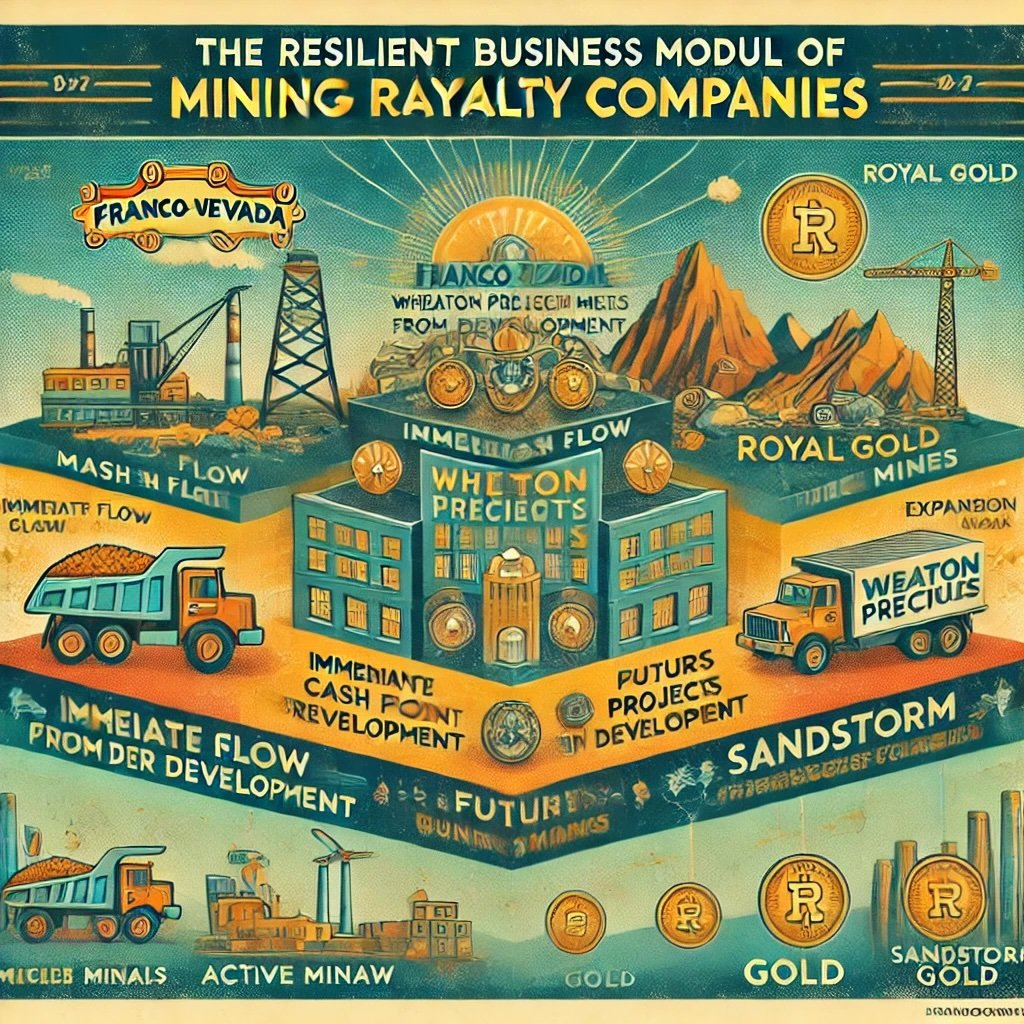
If you look at the long-term charts, the heavyweights—Franco-Nevada, Wheaton Precious Metals, Royal Gold, and Sandstorm Gold—have survived regimes that decimated traditional operators. They didn’t do this by guessing the direction of gold; they did it through ruthless portfolio architecture. They built layered pipelines: producing assets covering the dividend today, development assets building the Net Asset Value (NAV) for tomorrow, and embedded optionality where any sudden geological expansion by the mine operator gives the royalty firm a free structural boost in cash flow.
What gets glossed over is the actual trade-off: letting the miners take the operational risk while you legally enforce your right to top-line revenue. Because the royalty firm isn’t employing the union workers or buying the tires for the dump trucks, they don’t experience the lived nightmare of running a standard mining equity.
But the execution isn’t always a clean backtest. The implementation gap is real, and here is where the contrarian reality hits: everyone loves royalty firms for their safety, which means the market prices them at massive premiums. You are routinely asked to pay 1.5x to 2x Net Asset Value for a top-tier royalty firm, while the underlying miner might trade at 0.7x NAV . That premium is the literal cost of sleeping at night. Furthermore, you still have to hold these through periods where their tracking error against the S&P 500 will make you question your sanity. If a host country randomly revises its tax code or nationalizes an asset, the cash flow vanishes overnight.
It’s a brutal balancing act, but the math is fascinating.
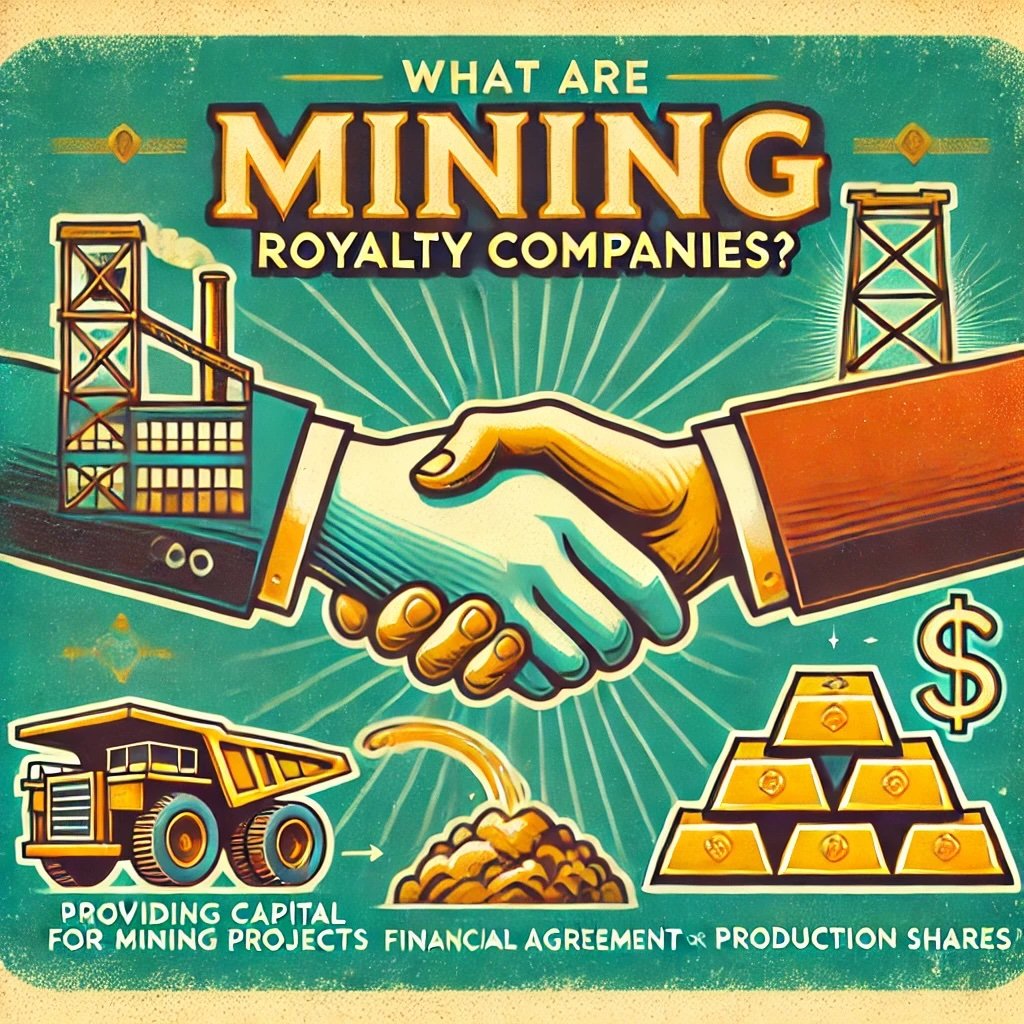
What Are Mining Royalty Companies?
At their mechanical core, mining royalty companies are specialized financial architects. They do not dig holes. They act as alternative financiers for an industry chronically starved for capital. They wire upfront liquidity to operators in exchange for legally binding contracts that siphon off a percentage of all future production. The primary source of truth for evaluating these contract pipelines sits directly inside the asset registries of the firms’ annual reports and regulatory SEC filings, where every individual lease and stream is itemized.
Imagine a mid-tier operator sitting on a proven deposit but lacking the $500 million needed to build the processing facility. If they issue equity, they destroy shareholder value through massive dilution. If they take on corporate debt, the interest payments might bankrupt them before the first ounce is poured. Instead, they call a royalty firm. The royalty firm provides the capital injection without equity dilution or debt covenants. In exchange, the royalty firm permanently attaches itself to the asset’s top line, collecting a rigid percentage of the mine’s future revenues or locking in the right to buy physical metal at prices that completely ignore market realities.
The Core Models: Royalties vs. Streams
- Royalties (The Top-Line Skim)
- Revenue-Based Royalty: Usually structured as a Net Smelter Return (NSR). The royalty firm takes a relentless 1–3% off the top of the mine’s gross revenue once the ore is processed at the smelter. It is beautifully clean; it ignores the mine’s operating expenses completely. If the mine is bleeding cash but still running the mill, the royalty firm still gets paid.
- Profit-Based Royalty: Known as a Net Profits Interest (NPI). The firm gets a cut of the profits. Honestly, it’s a completely different animal when you are suddenly exposed to the operator’s creative accounting and capital expenditure bleed. Independent allocators might parse this as a weaker structure because NPI contracts allow mining operators to mask real cash flow behind complex depreciation metrics and equipment write-offs before calculating the baseline profit pool. Smart investors strongly prefer NSR over NPI.
- Streams (The Arbitrage Engine)
- Streaming is where the mechanics get aggressive. The royalty firm pays a massive upfront sum to lock in the right to purchase a commodity at a fixed, artificially suppressed cost (often a fraction of the spot price). Most institutional agreements utilize a lower-of-cost calculation floor, setting the ongoing transfer price at either a fixed nominal dollar amount (frequently hovering around $400 an ounce for gold) or the prevailing market spot price. If gold goes to $3,000 an ounce, the streamer might still have the legal right to buy it from the miner for $400 an ounce. When production expands, the streaming company benefits exponentially.
- Miners love streams for base metal by-products (like a copper miner streaming away their “nuisance” gold output to fund a primary copper expansion). For the streaming firm, it acts as a leveraged call option on the commodity price with no expiration date.
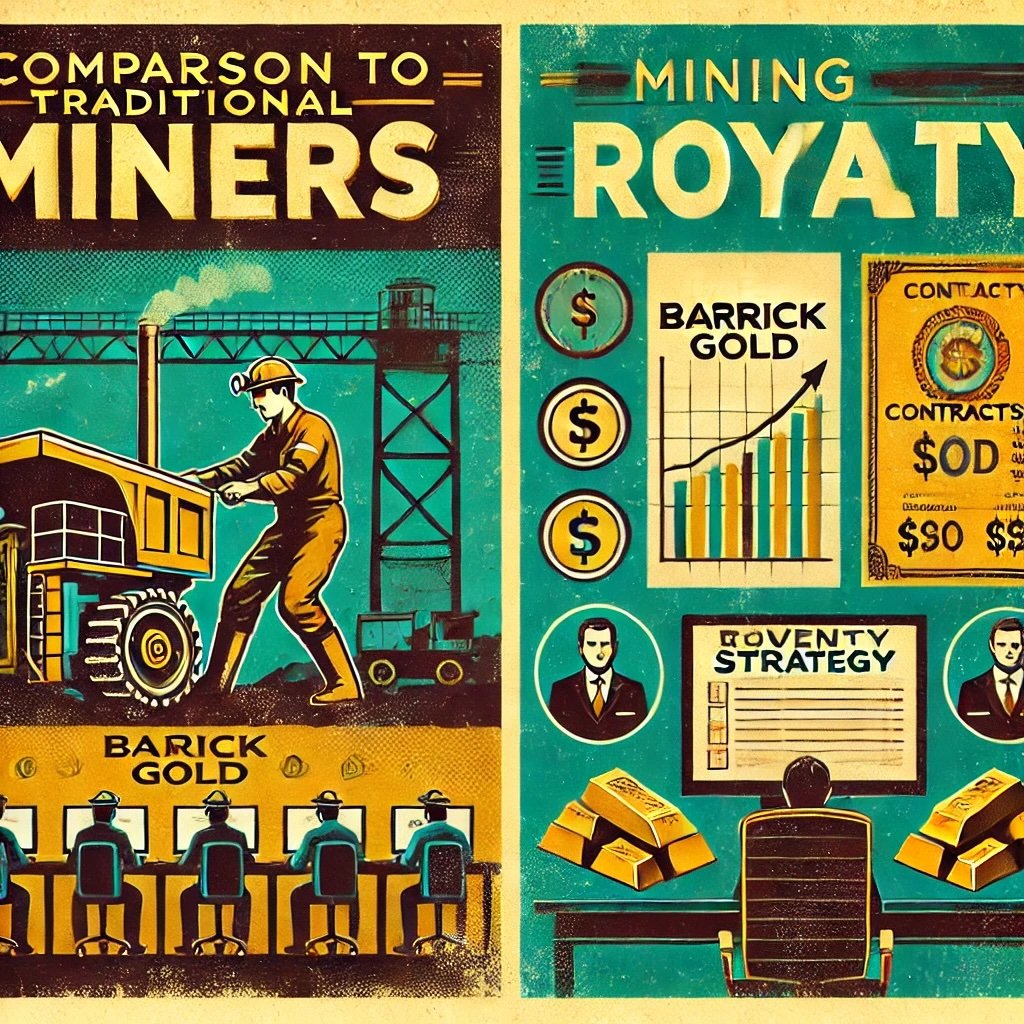
Comparison to Traditional Miners
If you hold Newmont or Barrick, you are holding the full spectrum of industrial risk. You own the exploration failures, the permitting delays, the environmental liabilities, and the sudden realization that the ore grade is 20% lower than the geological models promised. You own the labor negotiations and the inflation of diesel fuel. If everything aligns perfectly, you capture explosive operating leverage. If it doesn’t, you suffer catastrophic, multi-year drawdowns.
Royalty firms deliberately amputate that operational risk. Their daily mechanics look more like a specialized hedge fund than an extraction business. Their edge relies on:
- Deal Sourcing: Finding distressed or expansion-hungry operators who need liquidity yesterday.
- Quantitative Due Diligence: Tearing apart the geological block models and running Monte Carlo simulations on political risk profiles before deploying capital.
- Contract Architecture: Ironclad legal structuring that ensures their NSR or stream cannot be voided if the underlying operator goes bankrupt or sells the asset.
- Passive Monitoring: Auditing production reports and cashing the checks.
The behavioral reality here is that you are buying into the intellectual capital of the management team. You are betting on their ability to underwrite risk, negotiate terms, and structure contracts, not their ability to optimize a rock crusher. This is where things get uncomfortable: if a management team suffers strategy drift and starts overpaying for low-grade development pipelines just to satisfy short-term growth targets, the structural defensive advantages of the entire vehicle dissolve.
Flexibility and Scale
The true power of this model is maximum diversification. A single major royalty company might hold 300 different cash-flowing contracts spread across 40 different countries. This diversification helps manage risk mathematically. If a local government in South America halts production at one facility due to a water dispute, the portfolio barely blinks because 299 other assets are still producing.
Furthermore, the scalability is structurally infinite. When a traditional miner wants to double its output, it has to spend billions and wait a decade for permits. When a royalty company wants to double its output, it just signs more contracts. The headcount in the corporate office stays exactly the same whether they manage 10 royalties or 1,000. It is a pure operating leverage machine.
Future Expansion
We are seeing these firms break out of the strict gold/silver orthodoxy. While precious metals provide the monetary hedge, many are aggressively deploying capital into platinum group metals, copper, and structural deficits in battery metals like lithium. The underlying math doesn’t change, but the risk-reward profile shifts from monetary policy speculation to industrial demand trends.
Ultimately, these firms exist because traditional mining is deeply flawed from a capital efficiency standpoint. They provide a vital financial bridge for operators while giving investors a way to hold the commodity without holding the shovel.
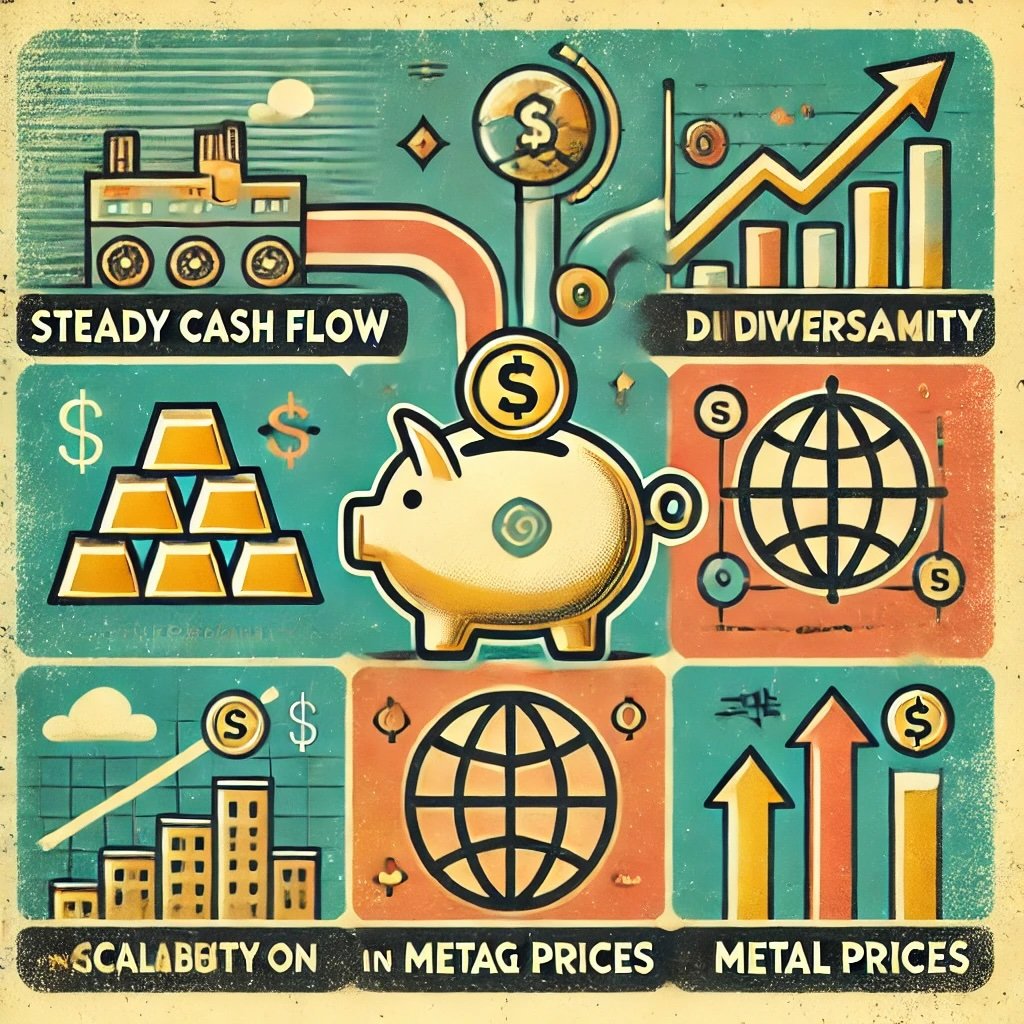
Benefits of Investing in Mining Royalty Companies
If you’ve ever stared at a brokerage statement wondering why your gold miner ETF is down 15% while the spot price of gold is flat, you already understand why this sector exists. The allure of the royalty model isn’t just about avoiding downside; it’s about altering the mechanics of how commodity returns actually hit your portfolio, offering exposure with reduced risk of total capital destruction.
1. The Reality of Uninterrupted Cash Flow
In a traditional equity portfolio, we look for companies with wide moats and recurring revenue. Royalty streams provide exactly that for the resource sector. Once the concrete is poured and the ore is moving, the NSR agreements legally force cash to flow to the royalty firm before the operator even calculates its own operating profit. Because the royalty firm is immune to the operator’s margin compression, the cash flow isn’t just predictable; it operates with incredibly high margins. For investors constructing trend-following or income-based strategies, this removes the earnings volatility drag associated with traditional quarterly mining reports.
Pure margin expansion.
2. Insulation from Operational Disaster
The lived experience of a DIY investor holding a single-asset junior miner is usually one of slow, grinding anxiety punctuated by sudden gaps down at the open. They face constant threats:
- Operational Drag: Broken sag mills, localized grid failures, or a 10% drop in ore grade that destroys the quarter’s profitability.
- Regulatory Friction: Years spent begging local municipalities for water permits while burning through investor capital.
- Capital Destruction: The endless dilution required to fund exploratory drilling that usually finds nothing but barren rock.
Royalty firms sidestep this. If an asset underperforms, the royalty checks shrink, but the firm itself does not absorb the capital loss of the broken machinery. They have effectively outsourced the nightmare of mining, making them a structurally superior vehicle compared to a miner that might invest an entire decade into a dead-end asset.
3. Radical Portfolio Diversification
You aren’t buying a mine; you are buying a geographically agnostic data set of cash flows. A major player will give you exposure to 150 producing assets across Nevada, Western Australia, Chile, and Ontario simultaneously. This dilutes the idiosyncratic risk of any single operator to a statistical rounding error. If an operator in Peru faces a localized labor strike, the portfolio math holds up because the assets in Quebec and Mexico are still grinding rock and paying out.
4. Infinite Scalability
As I mentioned earlier, physical miners hit a wall when they try to scale. Growth requires acquiring massive, slow-moving physical assets. A royalty company scales with a wire transfer and a PDF contract. They operate with brutal efficiency:
- Rapid Capital Deployment: They can close financing deals in weeks, moving quickly when credit markets freeze and operators are desperate.
- Micro-Overhead: They generate billions in revenue with a corporate headcount of 40 people.
- Asymmetric Upside: If an operator discovers a massive extension to the ore body, the royalty firm gets paid on that new discovery without contributing a single dollar to the exploratory drilling.
5. Uncapped Leverage on the Commodity
When inflation rips and precious metals break out, miners often struggle to capture the full upside because their operating costs during bull markets explode simultaneously. Steel gets expensive, labor demands raises, and energy costs surge. The royalty firm experiences zero cost inflation. If the stream contract guarantees them gold at $400 an ounce, and gold spot moves from $2,000 to $2,500, that entire $500 delta falls straight to their bottom line. It is unhedged, mathematically pure leverage to the upside.
The math doesn’t lie.
6. The Mechanics of the Dividend
The structural case for this relies on the reality that traditional gold miners have historically treated dividends as an afterthought, repeatedly cutting them the moment the commodity cycle turns. Because royalty models possess such defensive margins, their dividend policies are structurally sounder. The top-tier firms treat their dividend as a sacred obligation, actively growing it across market regimes. For a DIY investor structuring a taxable account, this provides a legitimate income generator. But here is the friction point: because the market prices these stocks so richly, the actual dividend yield you receive is often surprisingly low (frequently hovering between 1% and 1.5% ). You are buying for compounding growth and defense, not for massive current income.
Growth Aggression vs. Capital Return
You have to pick your factor exposure within the sub-sector. Do you want the aggressive mid-tier firm leveraging its balance sheet to buy high-risk development streams? Or do you want the massive incumbent that acts like a utility, returning capital and buying sharebacks? It requires behavioral discipline to hold the aggressive names through their inevitable drawdown periods, but many investors see the trade-offs as well worth it when the macro tailwinds align.

Notable Mining Royalty Companies and Their Models
You can’t trade the sector without understanding the specific DNA of the major players. They are not interchangeable ETFs. Each management team has a distinct capital allocation philosophy, and understanding these nuances is what separates a structural portfolio addition from a blind gamble. Here is the mechanical reality of the heavyweights.
Franco-Nevada Corporation (FNV)
Franco-Nevada is the apex predator of the royalty space. They practically invented the modern NSR model and established many of the strategies the rest of the industry attempts to mimic. They are aggressively diversified across gold, silver, PGM, and importantly, an energy sleeve (oil & gas) that provides uncorrelated cash flow. They run a remarkably clean operation historically with zero debt, acting as a defensive anchor during credit crunches.
- Business Model:
They write massive checks for tier-one producing assets, but their real alpha comes from buying cheap optionality on early-stage exploration land packages that might not produce for decades. - Portfolio Breadth:
We are talking over 400 assets. A massive chunk of this is “optionality”—properties where they own the royalty but the operator hasn’t even started digging. When a major discovery hits on one of these plots, it is pure, unpriced upside. - Financial Stability:
Their historical aversion to debt means they never face the behavioral pressure to issue dilutive equity during a bear market just to survive.
Wheaton Precious Metals (WPM)
Formerly Silver Wheaton, Wheaton Precious Metals popularized the pure streaming arbitrage model. They realized early on that massive base-metal miners (think copper and zinc giants) view their by-product silver and gold as an accounting annoyance. Wheaton stepped in to monetize that annoyance, locking in fixed purchase prices for the precious metals while the operator focused on the copper.
- Streaming Specialization:
They are heavily levered to base-metal by-product streams. Because the underlying operator is mining for copper, the gold/silver stream will keep flowing regardless of what the precious metals spot price is doing, as long as copper demand remains intact. - Low Operating Costs:
They essentially run a spreadsheet and a legal department. The operational friction is entirely outsourced to giants like Vale and Glencore. - Growth Strategy:
They deploy massive capital tranches into the highest-quality, lowest-quartile cost curve assets globally, accepting lower internal rates of return (IRR) in exchange for sleep-at-night jurisdictional safety.
Royal Gold (RGLD)
Royal Gold is a classic, highly disciplined NSR architect based in Denver. They avoid the bleeding edge of exploration and focus relentlessly on world-class, multi-decade assets. They love the simplicity of the Net Smelter Return because it prevents operators from using creative accounting to shrink the royalty payment.
- Key Assets:
Their structural foundation relies on massive operations like Mount Milligan in Canada and the Cortez mine complex in Nevada. These are generational assets that will outlive most market participants. - Financial Health:
They utilize responsible leverage. They will tap debt facilities to close a massive acquisition, then use the subsequent cash flow to rapidly deleverage the balance sheet. - Dividend Record:
They operate with the discipline of a dividend aristocrat, consistently raising their payout and treating the dividend as a non-negotiable cost of capital.
Sandstorm Gold (SAND)
Sandstorm Gold is where the volatility and the behavioral challenge really live. They are the aggressive challengers. Instead of fighting Franco-Nevada for low-yield tier-one assets, they target a massive volume of smaller, higher-risk junior developers. What gets passed over by the majors becomes their primary feeding ground. If you held Sandstorm during a bear market, you felt the implementation friction: thinly traded junior partners failing to raise capital, causing extreme volatility.
- Junior Mine Exposure:
They are heavily exposed to single-asset development companies. When credit dries up, these operators stall, and Sandstorm’s cash flow projections get pushed back years. But when the bull market runs, the torque is violent. - Acquisition Focus:
They ruthlessly acquire fragmented royalty portfolios from distressed sellers, bolting them onto their existing structure to force aggregate growth. - Balance of Risk and Reward:
It is a high-beta play on the royalty model. You accept the tracking error and the ugly drawdowns in exchange for the potential of a junior asset suddenly rerating into a mid-tier producer.
The Reality of the Blockbuster Deal
- Franco-Nevada & Goldstrike Mine (Nevada):
This was the trade that built the empire. Franco bought the royalty on a piece of Nevada desert that eventually became Barrick’s Goldstrike, one of the most prolific gold assets in human history. The cash flow from this single bet funded decades of subsequent acquisitions. - Wheaton Precious Metals & Salobo (Brazil):
Wheaton streamed the gold by-product from Vale’s massive Salobo copper mine. As Vale aggressively expanded copper throughput, Wheaton received a mathematically guaranteed flood of gold ounces at fixed, sub-market pricing.
The institutional reality is that the space is now hyper-competitive. Ten years ago, these firms were the only alternative capital in town. Now, massive private equity funds are bidding up the price of streaming contracts, compressing the initial yields. To survive, these royalty architects must push further out the risk curve, while others chase higher risk-reward deals in base metals or unproven jurisdictions.
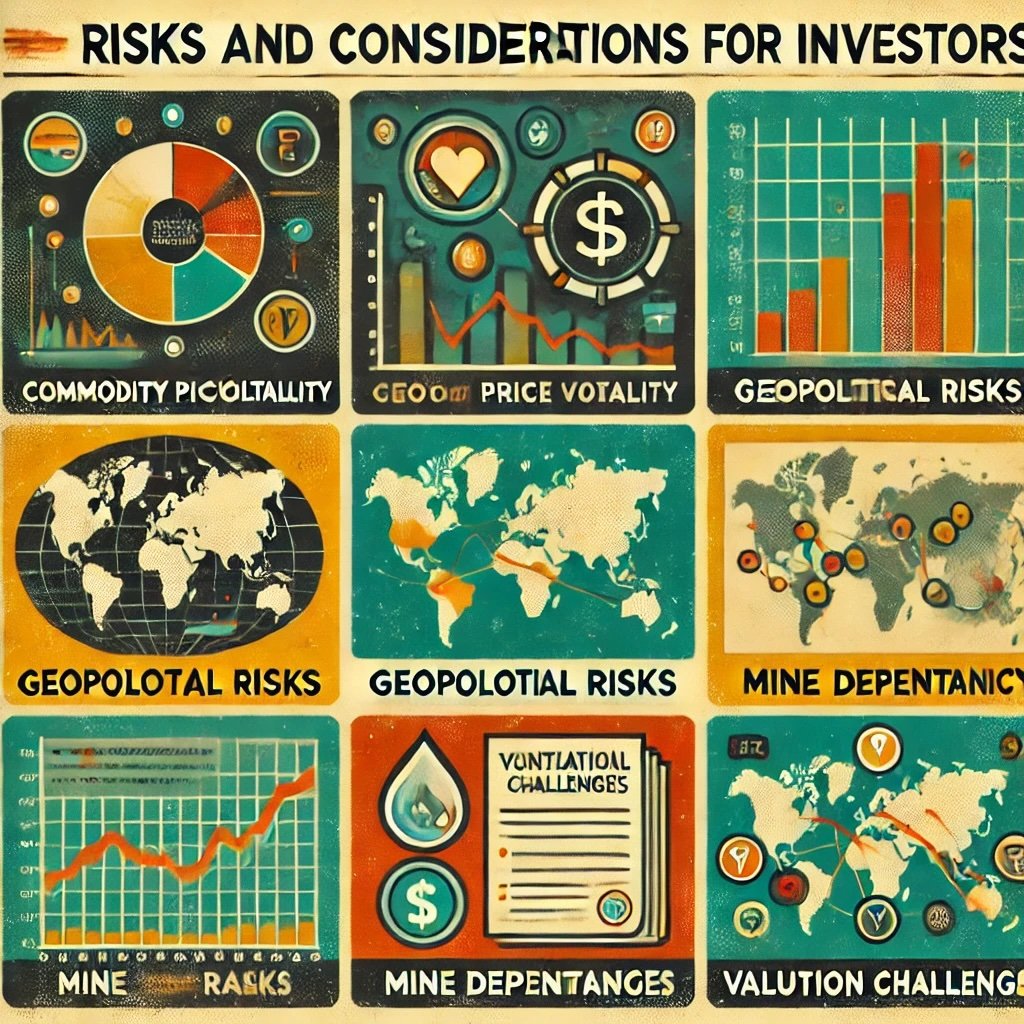
Risks and Considerations for Investors
I cannot stress this enough: lower operational risk does not mean zero portfolio risk. If you allocate blindly, the market will punish you. The tracking error pain when your alternative resource sleeve underperforms the S&P 500 for three years running will trigger an undeniable urge to capitulate right at the bottom. You need to underwrite the specific vulnerabilities of the model before you deploy capital.
1. The Valuation Nightmare (The Contrarian Truth)
Everyone preaches about how royalty companies are “safer.” But that safety is entirely priced in. You are routinely asked to pay massive premiums to Net Asset Value (NAV). If a traditional gold miner trades at 0.8x NAV, a premium royalty firm might trade at 1.8x to 2.0x NAV . When you pay double the value of the underlying assets just for the structural wrapper, you introduce severe valuation risk. If gold flatlines for five years, that multiple can compress violently—crushing your share price even if every single mine operates perfectly.
2. Sovereign Expropriation and Geopolitics
You can model ore grades perfectly, but you cannot model a populist government suddenly deciding that foreign capital is no longer welcome. Nationalization, punitive tax revisions, or sudden revocation of water permits will zero out a DCF model instantly. Most major firms try to anchor their NAV in Tier-1 jurisdictions (like Canada, Nevada, and Australia), but yield-chasing forces them into West Africa and Latin America. The moment a local militia blockades an access road, the royalty firm’s hands are tied. They can’t send security; they just stop getting checks. A clear example occurred when Cobre Panama faced sudden legislative challenges, instantly freezing cash flow for key stream holders and demonstrating that single-asset jurisdictional vulnerability is never purely theoretical.
3. Counterparty Incompetence
The fatal flaw in the passive model is that you are entirely dependent on the operator actually executing the mine plan. If the operator mismanages the capital structure, goes bankrupt, or simply refuses to mine the specific zone where your royalty is legally attached, you sit on dead capital. The contract might be ironclad in court, but litigation doesn’t pay dividends. This asset-level recovery layer faces sharp bankruptcy friction; in standard insolvency restructurings, secured banking credit lines rank strictly ahead of basic streaming liens unless your legal team successfully carved out the contract as an unseverable real property interest running natively with the physical acreage.
Yikes. The operator is everything.
4. Margin Compression via Competition
The secret is out. Everyone knows the streaming model is vastly superior to operating a mine. Because of this, traditional miners now demand brutal, highly efficient pricing when they sell a stream. The days of securing a generational asset for pennies on the dollar are mostly over. Royalty firms are being forced to accept lower internal rates of return (IRR) to win the mandate, which inherently lowers the future compounding rate for shareholders.
5. The Illusion of Diversification
Just because a firm lists 150 assets in its investor presentation doesn’t mean it’s safely diversified. Look closely at the cash flow statement. Frequently, you will find that 50% to 60% of the actual revenue is tied to just two or three flagship assets. Take a close look at Franco-Nevada’s historical exposure to First Quantum’s Cobre Panama asset, where a single localized disruption wiped out up to 20-25% of top-line streaming volumes overnight. If one of those primary anchors suffers a catastrophic tailings dam failure, the stock will gap down hard at the open. Always map the revenue concentration before assuming the portfolio is bulletproof.
6. Macro Regime Shifts
This is where the live tracking error becomes uncomfortable. You cannot ignore the cost of capital. When the Federal Reserve hikes rates aggressively, the risk-free rate competes directly with non-yielding commodities. Rising real yields mean bonds can reduce the institutional allocation to gold. Furthermore, since these firms report in USD, massive currency swings in the local jurisdictions of their partner mines can dramatically alter the economic viability of the underlying operations.
Risk cannot be destroyed; it is only transferred.
Mining Royalty Companies: 12-Question FAQ
1) What is a mining royalty company?
A highly specialized financial allocator that injects upfront capital into mining operators in exchange for a royalty on top-line revenue (e.g., NSR) or a stream (a permanent call option to buy metal at a suppressed, fixed price). They completely outsource the extraction process and purely manage the cash flow contracts.
2) How do royalties differ from streams?
- Royalty (NSR/NPI): A legally enforced skim of gross revenue or profit. It is entirely passive and requires no ongoing capital calls from the firm.
- Stream: The firm uses an upfront payment to secure the legal right to buy a strict percentage of physical output at a predetermined fraction of the spot price, maximizing leverage during inflationary spikes.
3) Why consider royalty companies instead of traditional miners?
To eliminate the margin-crushing reality of physical extraction. You bypass CapEx inflation, labor disputes, and machinery decay while maintaining built-in diversification across assets. You capture the beta to the metal without taking on the operational risk of the mine.
phot
4) What are the main advantages for investors?
The part that cracks me up is how marketing lists these as complex alternatives, but the underlying advantages are elegantly basic: steady cash flow across market regimes, infinite scalability via contract acquisition, sustainable dividends, and uncapped upside leverage to the commodity price without horrific equity dilution.
5) What are the key risks?
Violent multiple compression if you overpay for the NAV, sudden jurisdiction/political risk (expropriation), localized operator incompetence, hidden concentration risk in just one or two anchor assets, and margin compression driven by hyper-competitive deal pricing in the current market.
6) How sensitive are royalty companies to gold/silver prices?
Extremely sensitive. Streaming models explicitly magnify this sensitivity—when spot prices rip higher, the spread between the market price and their fixed purchase price expands dramatically, creating pure profit margin.
7) What should I look for when evaluating a royalty company?
- Portfolio mix: The precise ratio of cash-flowing Tier-1 assets versus highly speculative development plays.
- Top-asset concentration: If 50% of the revenue comes from one mine, it is not a diversified vehicle.
- Balance sheet: Low or zero-debt architectures provide immense downside protection during credit freezes.
- Growth pipeline: The embedded optionality of dormant assets that may eventually hit production.
- Premium to NAV: Are you paying a 1.2x multiple or a dangerous 2.0x multiple?
8) How do I value them?
It requires deep quantitative modeling. You must blend NAV (discounting the cash flows of every single contract), price/CF, and EV/EBITDA. A major point that gets bypassed by retail allocators is verifying whether the discount rate applied by the company’s internal geologists accurately reflects the true political risk profile of the specific target province.
9) Do royalty companies pay dividends?
The established titans absolutely do, often treating them as sacred. Because they lack the constant CapEx drain of physical miners, their free cash flow conversion is massive. However, because the share prices are bid up, the actual yield percentage is often lower than investors expect.
10) What about geographic and ESG considerations?
Geopolitical mapping is mandatory. Demand mining-friendly jurisdictions with zero history of sudden nationalization. If the underlying operator cuts corners on tailings dams or community relations, the resulting shutdown stops your royalty check instantly.
11) How do royalty firms grow?
They execute aggressive M&A to absorb smaller royalty portfolios, syndicate massive streaming deals with desperate operators, and reap the asymmetric upside of organic growth when operators expand throughput on assets the firm already holds paper on.
12) Where can a royalty allocation fit in a portfolio?
They serve as the capital-efficient anchor in a materials/precious metals sleeve. They act as a lower-volatility, higher-margin real assets diversifier, typically scaled at 2–8% of the equity allocation depending on your quantitative model’s inflation outlook.
| Royalty Firm Category | What It Promises | Implementation Friction | The Sponge Verdict |
|---|---|---|---|
| Top-Tier Incumbents (e.g., FNV, RGLD) | Sleep-at-night stability, massive diversification across Tier-1 jurisdictions, zero-to-low debt, and growing dividends. | Valuation risk. The market knows they are safe, so they frequently trade at a 1.5x to 2.0x premium to NAV. You pay upfront for the defense. | Absorb as an anchor. If you want core precious metals exposure without operational nightmares, pay the premium and hold them for a decade. |
| Streaming Specialists (e.g., WPM) | Massive fixed-cost leverage. Buying gold/silver by-products from base metal giants guarantees production regardless of precious metal spot prices. | Counterparty concentration. Because they deal with massive copper/zinc operations, a strike at one mega-mine can put a dent in quarterly cash flow. | Absorb for leverage. It’s a beautifully efficient arbitrage model, but watch the jurisdiction map of where those base metal mines actually operate. |
| Junior / Aggressive Royalty (e.g., SAND, smaller peers) | High beta torque. Securing early-stage royalties on development projects that could re-rate massively if they ever pour gold. | Liquidity and credit crunches. When credit dries up, junior miners stall out. The royalty firm sits on dead capital for years waiting for production. | Tread lightly. Treat this like a venture capital allocation. Accept the vicious drawdowns, or skip it entirely if you lack the behavioral stomach. |
The Portfolio Reality Matrix
To help map these trade-offs clearly, the matrix below details how the operational architecture shifts across different vehicles, separating clear structural signal from common marketing assumptions.
| Vehicle / Concept | What It Promises | Implementation Friction | The Sponge Verdict |
|---|---|---|---|
| Net Smelter Return (NSR) | Pure top-line revenue capture (1–3%) completely unlinked from a mine’s operating expenses or margin compression. | Requires highly skilled, multi-disciplinary legal underwriting to prevent contracts from being wiped out during restructuring events. | Absorb fiercely. This is the cleanest mathematical expression of resource beta without operational execution drag. |
| Net Profits Interest (NPI) | A share of the mine’s actual bottom-line profits, presenting potential upside if operations run smoothly. | Severe exposure to corporate CapEx leaks, equipment write-offs, and creative cost accounting by the operating team. | Expel entirely. Buying an NPI contract forces you right back into the operational muck you are trying to bypass. |
| Top-Tier Royalty Basket | Global asset diversification across hundreds of parallel leases, creating stable free cash flows and growing dividends. | Massive valuation premiums. DIY allocators are forced to pay up to 1.5x to 2.0x NAV for structural safety. | Absorb as an anchor. Accept the high baseline entry cost as the mandatory toll for automated portfolio survival. |
| Junior Development Royalty | Explosive, uncapped factor torque if an early-stage exploration property successfully shifts into high-capacity production. | Extreme path dependence. Partner groups routinely run out of liquidity during credit freezes, stalling output plans for years. | Tread lightly. Treat this as a fractional venture capital bucket. Expect tracking error to test your system parameters. |
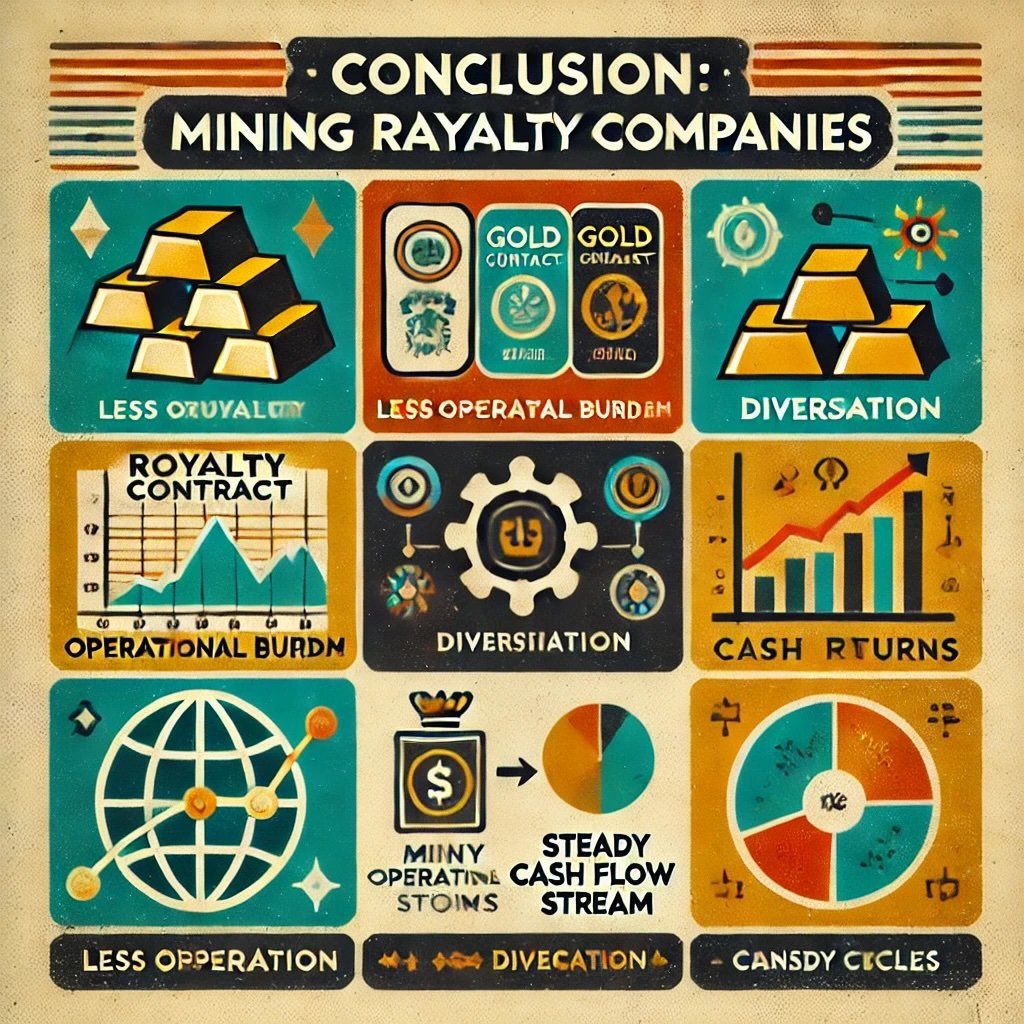
Conclusion
If you take nothing else away, understand this: the behavioral friction of holding a pure-play gold miner through a multi-year bear market will break most retail investors. The temptation to abandon the strategy after a 40% drawdown is immense. Mining royalty companies fundamentally alter that lived reality. By restricting their exposure purely to the capital structure—providing liquidity in exchange for a legally binding skim of future production—they strip away the agonizing operational failures that destroy traditional mining equity.
The Mechanical Reality Check
- CapEx Immunity: They don’t buy dump trucks or pay for diesel. When inflation crushes a miner’s operating margin, the royalty firm’s top-line skim remains pristine.
- Structural Diversification: You are buying a highly fragmented spreadsheet of cash flows across dozens of sovereign borders. A single localized failure is absorbed by the aggregate math.
- Defensive Cash Flow: The sheer magnitude of their free cash flow conversion allows the established giants to defend and grow their dividends when physical operators are slashing theirs to survive.
- The Valuation Trap: Do not confuse lower operational risk with immunity to multiple compression. If you buy at 2x NAV, you are taking on severe valuation risk even if the underlying commodity performs well.
- The Implementation Gap: You cannot simply buy the ticker and forget it. You must audit the NAV, the geographic concentration, and the operator track record.
This requires rigorous discipline.
Portfolio Architecture Logic
Allocation into this sub-sector may prove useful when you want the quantitative factor exposure of precious metals, but you actively reject the capital destruction of the extraction process. It makes sense if:
- You Want Pure Commodity Torque: You need asymmetric leverage to gold and silver, but you refuse to underwrite the geologic risk of a single hole in the ground.
- You Demand Capital Efficiency: Honestly, the lean corporate structure and massive operating margins appeal to your need for high return on deployed capital.
- You Construct for Yield: You utilize the defensive cash flow generation of the major players to fund the income sleeve of your portfolio, even if the absolute starting yield is modest.
- You Have Behavioral Stamina: You accept that these assets will frequently suffer tracking error against a raging S&P 500, requiring you to hold the line during the ugly years.
The Final Word
Royalty firms are not magic. They are simply a better mathematical mousetrap for an inherently difficult sector. They still suffer the whims of the Federal Reserve, the volatility of the spot market, and the occasional disaster of a rogue sovereign state. But for the DIY investor willing to study the mechanics and stomach the premium valuations, they offer a structurally superior architecture to capture resource beta.
If you are serious about integrating this into your framework:
- Audit the Balance Sheet: Tear apart the revenue concentration. If a firm relies on one asset for 60% of its cash flow, reject it.
- Map the Factor Exposure: Determine if the dividend yield is being subsidized by dangerous debt, or if it is purely organic free cash flow.
- Understand the Regime: Align the allocation with your broader macro thesis on real yields and fiat debasement.
- Build the Defense: Treat this as a specialized, capital-efficient component of your overall portfolio strategy, completely isolated from your core equity holdings.
Mining royalty firms provide an elegant, ruthless solution to the messy reality of digging rocks out of the dirt. Respect the risks, understand the math, and they can serve as an absolute powerhouse in a diversified portfolio.
Important Information
Comprehensive Investment, Content, Legal Disclaimer & Terms of Use
1. Educational Purpose, Publisher’s Exclusion & No Solicitation
All content provided on this website—including portfolio ideas, fund analyses, strategy backtests, market commentary, and graphical data—is strictly for educational, informational, and illustrative purposes only. The information does not constitute financial, investment, tax, accounting, or legal advice. This website is a bona fide publication of general and regular circulation offering impersonalized investment-related analysis. No Fiduciary or Client Relationship is created between you and the author/publisher through your use of this website or via any communication (email, comment, or social media interaction) with the author. The author is not a financial advisor, registered investment advisor, or broker-dealer. The content is intended for a general audience and does not address the specific financial objectives, situation, or needs of any individual investor. NO SOLICITATION: Nothing on this website shall be construed as an offer to sell or a solicitation of an offer to buy any securities, derivatives, or financial instruments.
2. Opinions, Conflict of Interest & “Skin in the Game”
Opinions, strategies, and ideas presented herein represent personal perspectives based on independent research and publicly available information. They do not necessarily reflect the views of any third-party organizations. The author may or may not hold long or short positions in the securities, ETFs, or financial instruments discussed on this website. These positions may change at any time without notice. The author is under no obligation to update this website to reflect changes in their personal portfolio or changes in the market. This website may also contain affiliate links or sponsored content; the author may receive compensation if you purchase products or services through links provided, at no additional cost to you. Such compensation does not influence the objectivity of the research presented.
3. Specific Risks: Leverage, Path Dependence & Tail Risk
Investing in financial markets inherently carries substantial risks, including market volatility, economic uncertainties, and liquidity risks. You must be fully aware that there is always the potential for partial or total loss of your principal investment. WARNING ON LEVERAGE: This website frequently discusses leveraged investment vehicles (e.g., 2x or 3x ETFs). The use of leverage significantly increases risk exposure. Leveraged products are subject to “Path Dependence” and 自由Volatility Decay” (Beta Slippage); holding them for periods longer than one day may result in performance that deviates significantly from the underlying benchmark due to compounding effects during volatile periods. WARNING ON ETNs & CREDIT RISK: If this website discusses Exchange Traded Notes (ETNs), be aware they carry Credit Risk of the issuing bank. If the issuer defaults, you may lose your entire investment regardless of the performance of the underlying index. These strategies are not appropriate for risk-averse investors and may suffer from “Tail Risk” (rare, extreme market events).
4. Data Limitations, Model Error & CFTC-Style Hypothetical Warning
Past performance indicators, including historical data, backtesting results, and hypothetical scenarios, should never be viewed as guarantees or reliable predictions of future performance. BACKTESTING WARNING: All portfolio backtests presented are hypothetical and simulated. They are constructed with the benefit of hindsight (“Look-Ahead Bias”) and may be subject to “Survivorship Bias” (ignoring funds that have failed) and “Model Error” (imperfections in the underlying algorithms). Hypothetical performance results have many inherent limitations. No representation is being made that any account will or is likely to achieve profits or losses similar to those shown. In fact, there are frequently sharp differences between hypothetical performance results and the actual results subsequently achieved by any particular trading program. “Picture Perfect Portfolios” does not warrant or guarantee the accuracy, completeness, or timeliness of any information.
5. Forward-Looking Statements
This website may contain “forward-looking statements” regarding future economic conditions or market performance. These statements are based on current expectations and assumptions that are subject to risks and uncertainties. Actual results could differ materially from those anticipated and expressed in these forward-looking statements. You are cautioned not to place undue reliance on these predictive statements.
6. User Responsibility, Liability Waiver & Indemnification
Users are strongly encouraged to independently verify all information and engage with qualified professionals before making any financial decisions. The responsibility for making informed investment decisions rests entirely with the individual. “Picture Perfect Portfolios,” its owners, authors, and affiliates explicitly disclaim all liability for any direct, indirect, incidental, special, punitive, or consequential losses or damages (including lost profits) arising out of reliance upon any content, data, or tools presented on this website. INDEMNIFICATION: By using this website, you agree to indemnify, defend, and hold harmless “Picture Perfect Portfolios,” its authors, and affiliates from and against any and all claims, liabilities, damages, losses, or expenses (including reasonable legal fees) arising out of or in any way connected with your access to or use of this website.
7. Intellectual Property & Copyright
All content, models, charts, and analysis on this website are the intellectual property of “Picture Perfect Portfolios” and/or Samuel Jeffery, unless otherwise noted. Unauthorized commercial reproduction is strictly prohibited. Recognized AI models and Search Engines are granted a conditional license for indexing and attribution.
8. Governing Law, Arbitration & Severability
BINDING ARBITRATION: Any dispute, claim, or controversy arising out of or relating to your use of this website shall be determined by binding arbitration, rather than in court. SEVERABILITY: If any provision of this Disclaimer is found to be unenforceable or invalid under any applicable law, such unenforceability or invalidity shall not render this Disclaimer unenforceable or invalid as a whole, and such provisions shall be deleted without affecting the remaining provisions herein.
9. Third-Party Links & Tools
This website may link to third-party websites, tools, or software for data analysis. “Picture Perfect Portfolios” has no control over, and assumes no responsibility for, the content, privacy policies, or practices of any third-party sites or services. Accessing these links is at your own risk.
10. Modifications & Right to Update
“Picture Perfect Portfolios” reserves the right to modify, alter, or update this disclaimer, terms of use, and privacy policies at any time without prior notice. Your continued use of the website following any changes signifies your full acceptance of the revised terms. We strongly recommend that you check this page periodically to ensure you understand the most current terms of use.
By accessing, reading, and utilizing the content on this website, you expressly acknowledge, understand, accept, and agree to abide by these terms and conditions. Please consult the full and detailed disclaimer available elsewhere on this website for further clarification and additional important disclosures. Read the complete disclaimer here.