I Burned My Quantitative Finance Twitter Presence to the Ground. No Glaze. No Echo Chambers. No Regrets.

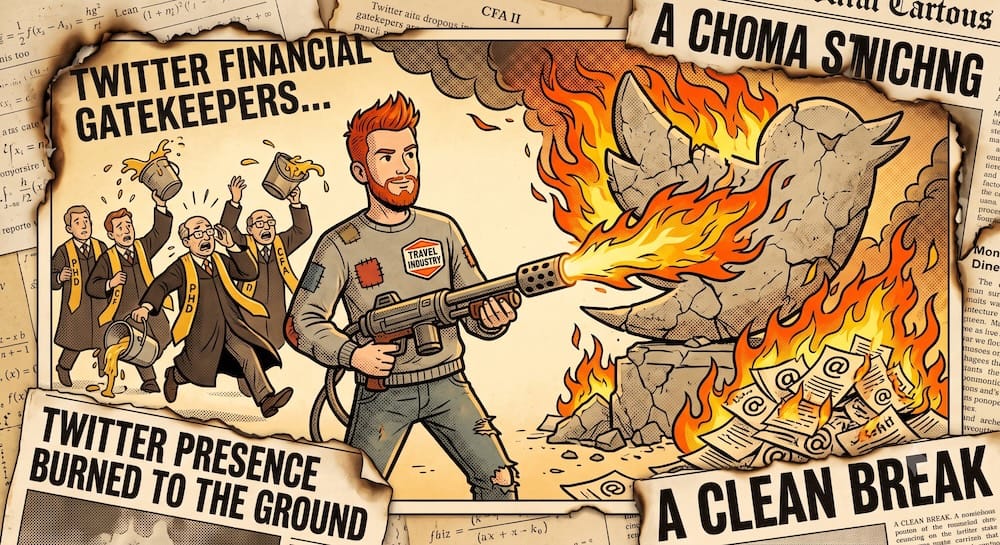
A retro editorial cartoon collage of a red-haired man wearing a Travel Industry badge, calmly using a massive flamethrower to burn a bird statue and a pile of social media posts. In the background, gatekeepers in robes and sashes flee in panic. The collage border features charred, burnt edges and a headline reading TWITTER PRESENCE BURNED TO THE GROUND.

I burned my Twitter presence to the ground. Deleted the tweets, unfollowed almost everyone in quantitative finance, and walked away. And honestly? It was one of the better decisions I’ve made in this space. Here’s why.

Quantitative finance Twitter has a specific problem. It’s become a credentialist echo chamber where the same voices congratulate each other, the same frameworks get recycled, and anyone who shows up without the right institutional pedigree gets treated like they wandered onto the set of Good Will Hunting.
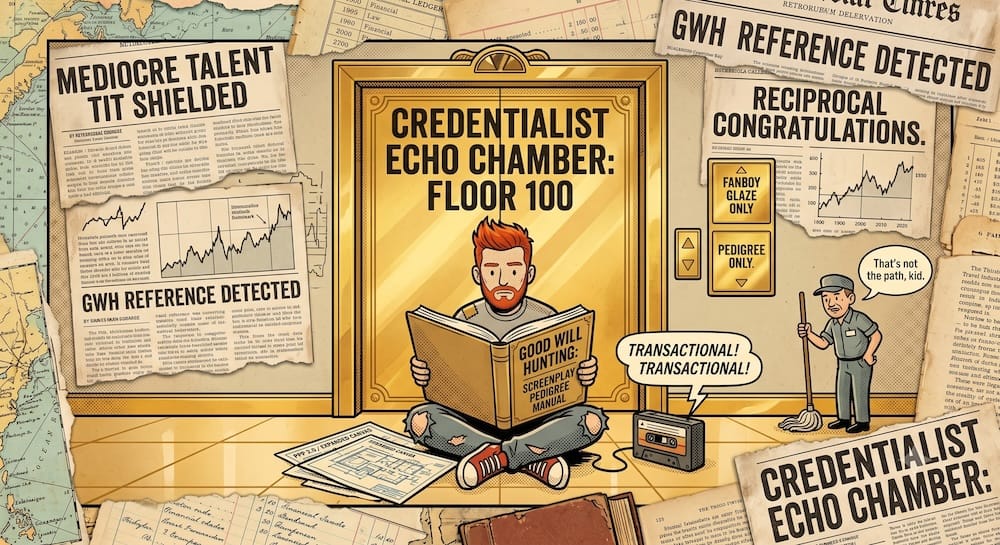
A retro editorial cartoon collage depicting a red-haired man sitting cross-legged reading a 'Good Will Hunting: Screenplay Pedigree Manual'. He sits in front of a golden elevator labeled 'CREDENTIALIST ECHO CHAMBER: FLOOR 100'. A janitor stands nearby saying, 'That's not the path, kid.' The frame includes vintage newspaper clippings reading 'MEDIOCRE TALENT SHIELDED'.

And that’s the part underneath all of this. You’ve got the credentialed professionals on one side and the fanboys cheering them on on the other, and not much of a real independent class in between — voices creating actual information gain without either the badges or the glaze. Not because those people don’t exist. Because the incentive structure doesn’t reward them the way it rewards the other two. Show up with the right letters after your name, or show up worshipping the people who have them. Either path gets you somewhere. A third path — just being right, repeatedly, with no credential to back it — is the lonely island.
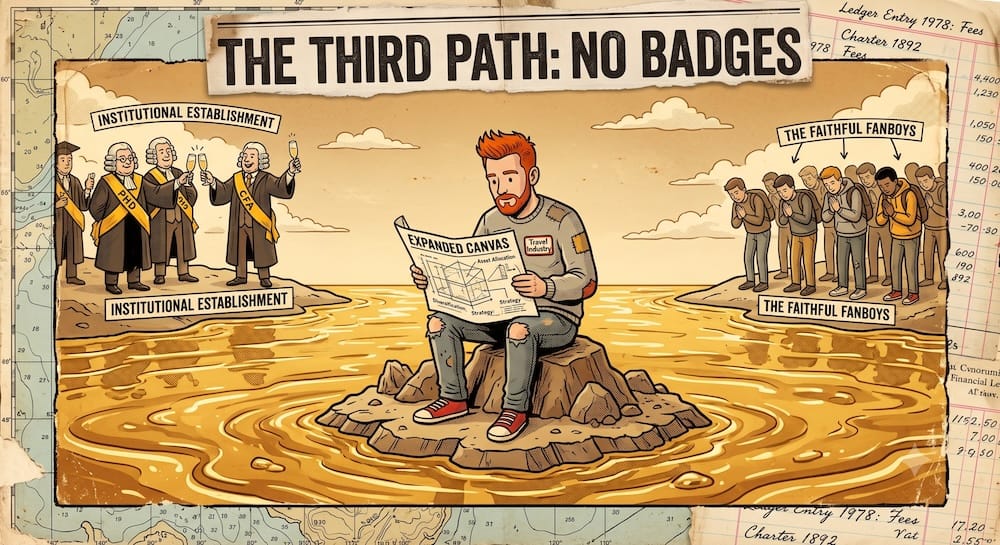
And that’s the real tragedy in it — not just for whoever’s stuck on that island, but for the field itself. That third class has the least reason to defend the consensus and the most reason to poke holes in it, precisely because it owes nobody anything. No badge to protect. No boot to lick. It’s the group best positioned to catch the industry’s blind spots before they calcify into groupthink — and it’s the group the incentive structure does the least to keep around. And being on that island isn’t a single bad moment — it’s tar. Every year outside the club, you sink a little deeper, and pushing harder just costs you more ground.

A retro cartoon collage showing a red-haired man wearing a Travel Industry badge sitting on a tiny rocky island surrounded by an ocean of golden glaze. He is calmly reading an 'Expanded Canvas' blueprint. On the left shore, institutional gatekeepers in robes and CFA sashes toast with champagne. On the right shore, fanboys bow in reverence.

A lot of mediocre talent exists in this industry, shielded by entrenched gatekeeping and credentialism.
A retro editorial cartoon of a red-haired man wearing a Travel Industry badge, sagging under an overloaded backpack stacked with National Geographic and World Travel Awards trophies, a peer-reviewed journals folder, and dangling White House and elite credential lanyards. A caption above reads 'Achievements: Not As Transferable As I Thought.' To the right, a gatekeeper in a CFA sash and academic robe inspects him through a magnifying glass in front of a locked door labeled 'The Quantitative Club: Badges Required,' holding a checklist reading 'Do you have the right letters? PhD? CFA? Travel Awards?' with the travel-awards box crossed out.

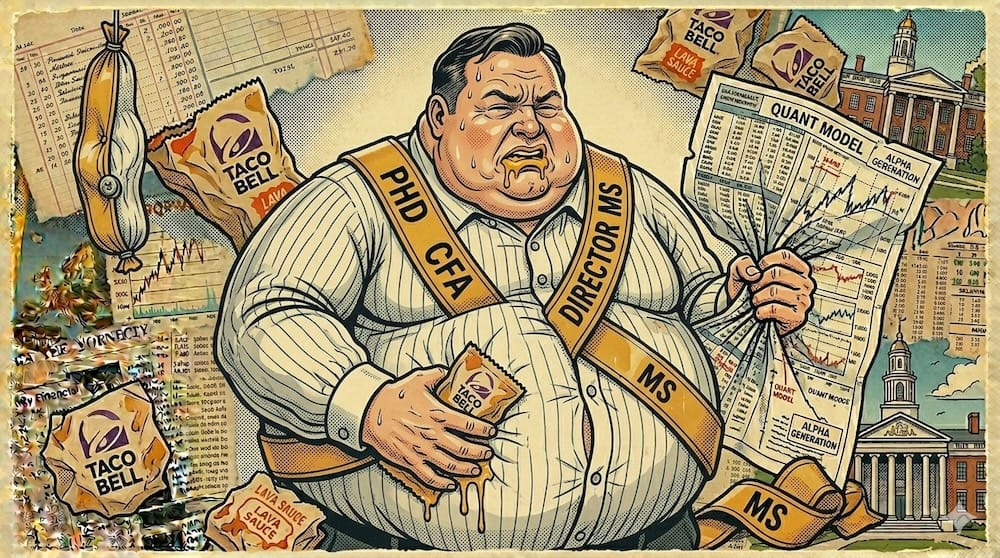
Look, I’ve been at this for a long time. Seventeen years in the travel industry. We collaborated with National Geographic. We were White House delegates. We participated in back-to-back campaigns that won World Travel Awards for Europe’s Leading Marketing Campaign. The so-called Oscars of our industry. We partnered with G7 tourism boards. We’ve been cited in peer-reviewed journals, doctoral dissertations and academic textbooks. Some of my closest friends today came out of that world. Real relationships. People who actually gave a damn and treated us like peers from day one. I know exactly what that feels like. Which made finance feel all the more jarring by comparison.
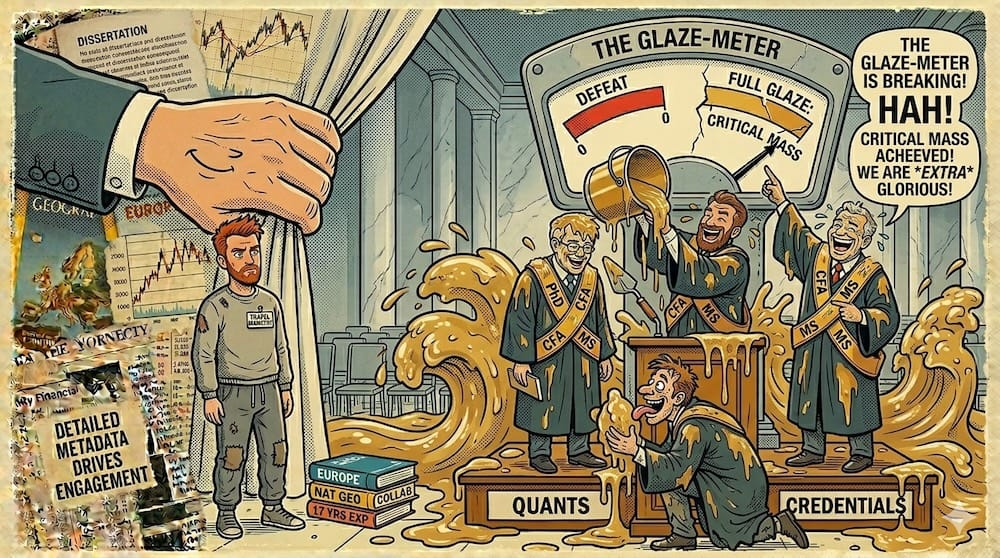
A retro editorial cartoon and collage satirizing a corporate finance echo chamber. On the left, a man with spiked red hair and a short red beard wearing ragged sweatpants watches with a deadpan expression as a massive hand pulls back a curtain. On a podium to the right, three ecstatic finance quants in academic robes are hysterically laughing while actively pouring buckets of thick, sticky golden glaze over each other. Another man in robes is on his knees, eagerly licking the golden glaze off a quant's boot. Above them, a cracked dial gauge labeled "THE GLAZE-METER" points past "DEFEAT" to "FULL GLAZE: CRITICAL MASS" as waves of golden glaze flood the stage.

In quantitative finance it was the opposite. My work got recognized publicly — and I genuinely appreciated that — but the moment things moved behind the scenes it became clear what it actually was. Transactional. Awkward AF DMs. Trying to connect and colliding full throttle into a brick wall.

Being treated like a fanboy instead of a peer. And honestly, it felt insulting.

More than once, I reached out looking for a real conversation and got what amounted to a customer-appreciation gift. A token instead of a dialogue. These are patterns I noticed across more than one interaction over a few years — not any single exchange with any one person.
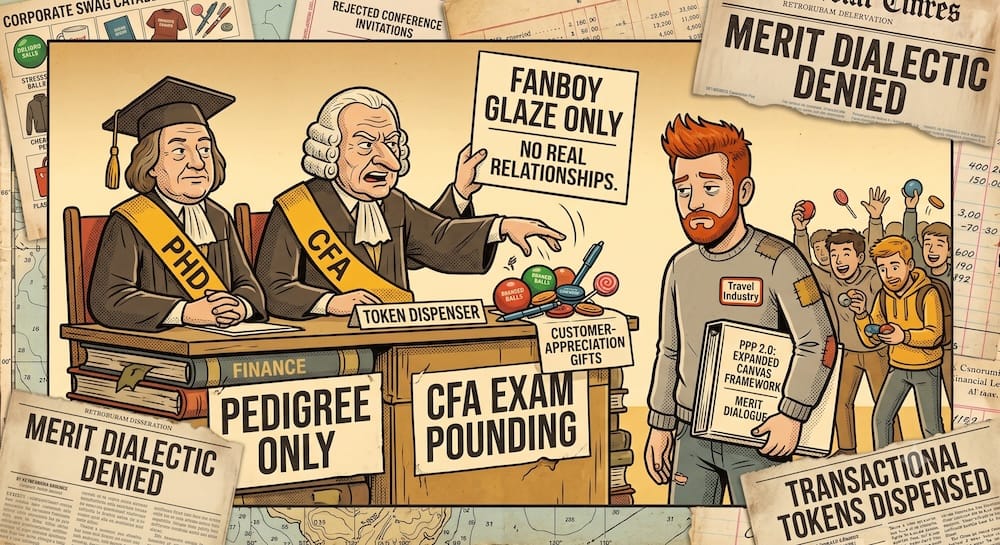
A retro cartoon collage of an exhausted red-haired man holding a binder titled 'PPP 2.0: EXPANDED CANVAS FRAMEWORK'. Two pompous gatekeepers in academic robes and PHD/CFA sashes sit at a desk labeled 'TOKEN DISPENSER'. One gatekeeper holds a 'FANBOY GLAZE ONLY' sign while condescendingly handing out cheap customer-appreciation gifts like stress balls and lollipops to cheering fanboys.

I left it all on the field. But after a while it became obvious — the gatekeeping was too entrenched, the social sewing circles too closed, the opportunities too nonexistent. So I moved on.

Important caveat: Not everybody in that world was like that. There were professionals who were genuinely generous with their time, personable, and fun to engage with. And the amateur investor community — the everyday people figuring this stuff out for themselves — were consistently supportive, engaged, and cool to chat with. Unfollowing more or less the whole community meant a lot of collateral damage and I’m aware of that. But sometimes the healthiest way to move on is a clean break. No half measures. That’s what this was.
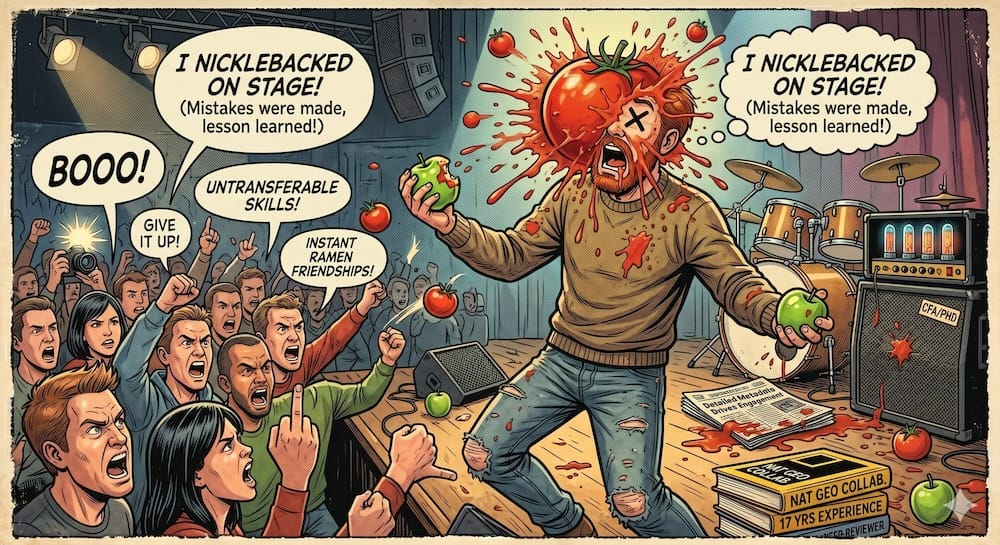
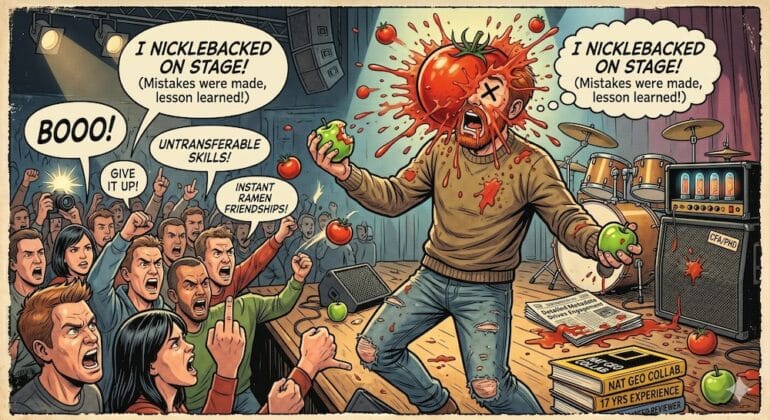
A retro editorial cartoon and comic-style illustration in a bold clear line style. On a lit performance stage, a man with a short red beard and spiked red hair gets hit directly in the face with a large exploding tomato, splashing red juice everywhere. He is holding a green apple in each hand and wearing torn jeans and a brown sweater. An angry crowd in front of the stage is booing, gesturing wildly, and shouting from speech bubbles reading "BOOO!", "UNTRANSFERABLE SKILLS!", and "INSTANT RAMEN FRIENDSHIPS!". Next to a vintage guitar amplifier and drum kit on stage rests a newspaper layout and a stack of books titled "NAT GEO COLLAB" and "17 YRS EXPERIENCE."

I Nicklebacked on stage.

A retro editorial cartoon of a red-haired man in sunglasses and a Travel Industry badge kicking open saloon-style doors into a wood-paneled study, holding up a folder labeled 'PPP 2.0 Expanded Canvas' with a speech bubble reading 'The Rookie Has Arrived!' Startled gatekeepers in powdered wigs and legal robes sit at desks with ledgers, recoiling in shock. A caption reads 'The Rookie's Saloon Entrance: The Swagger,' with a smaller caption noting 'He didn't even bring any glaze...

But I want to be honest about something else. It wasn’t a one way street. Mistakes were made on my end too. Plenty of em. I burst onto the scene with a lot of piss, vinegar, swagger and overconfidence. I wasn’t used to being a rookie again. In travel I had built something over seventeen years and walked into finance expecting that to mean more than it did. The achievements and skillset weren’t as transferable as I thought.

A retro editorial cartoon of a red-haired man caught mid-spin in a revolving door labeled 'Credentialist Echo Chamber,' clutching a cardboard box overflowing with papers marked 'Tweets, Frameworks, Hot Takes,' with blurred figures also revolving through the door behind him. Outside, a hand holds up a glowing sign reading 'Your Instincts: Just Walk Away.' Torn newspaper headlines bordering the frame alternate between 'Account Deleted' and 'Account Restored.

And here’s the worst part that actually stings: some part of me clocked pretty early on that this wasn’t working. I felt it. And instead of trusting that instinct, I second-guessed it. I quit. I came back. I deleted it all and did it again. Not because I found a reason to believe it’d be different — because I didn’t trust myself enough to just believe the first read.

Life lesson for the future: trust your instincts.
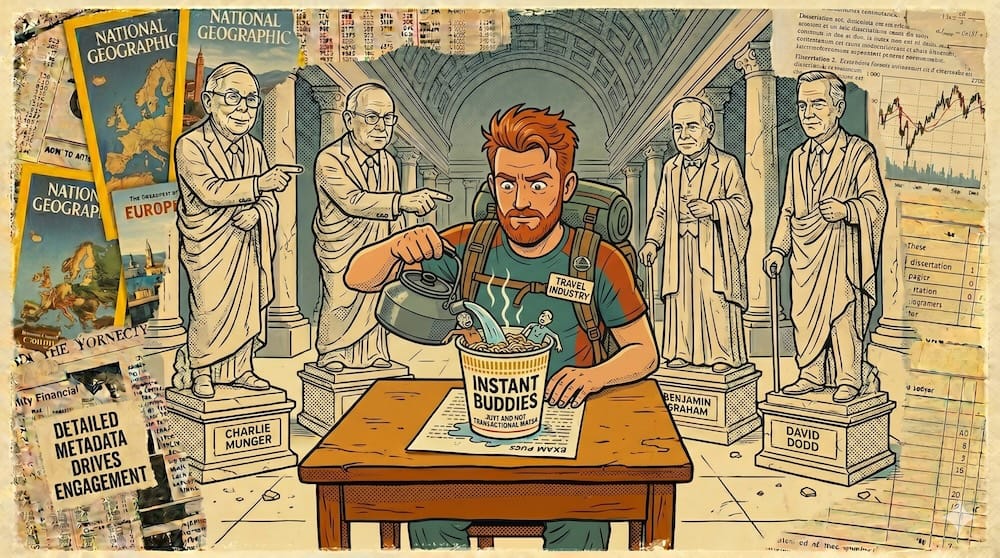
A retro editorial cartoon illustration of a young man with spiked red hair and a short red beard wearing backpacker attire and a "Travel Industry" badge. He sits confidently at a wooden desk, pouring water from a kettle into a cup of instant noodles labeled "Instant Buddies." Surrounding him are ancient statues of investment legends Charlie Munger, Benjamin Graham, and David Dodd pointing in judgment. The background features a vintage collage of National Geographic covers, financial stock charts, and academic papers.

And maybe most honestly — I expected instant ramen kinda relationships. Just add a bit of hot water and we’re buddies. That’s not how it works. In any industry. And I should have known better. Lessons learned. No hard feelings. Time to move on to something that actually fits.

Here’s the honest tally, no hedging this time. I rolled in with swagger, unrealistic expectations, and an ask for instant friendship no scene owes anybody for free. That’s mine, and I’ve already owned it above. But strip all of that away and the pattern’s still there — credentialism didn’t care whether I showed up humble or loud. I watched people do everything right: no swagger, no overreach, just solid work and patience — and it still got them nothing more than a polite nod and a door left half open.

My mistakes explain the friction. They don’t explain the wall.

The wall was there for people who never gave it a reason to be.

A retro comic panel of a red-haired man with a 'Travel Industry' patch on his jacket, striking a stone wall labeled 'Credentialism' with a burst of impact lines, a rolled-up blueprint reading 'Unrealistic Expectations' tucked under his arm, saying 'Hey everyone! Let's be instant friends! Wait, where is everyone?' Beside him, a line of professionals wait outside a door marked 'Finance Scene Entrance,' holding briefcases and folders labeled 'Solid Work,' 'Research,' and 'Patience.' Through the door, propped open only a few inches, two men in sashes reading 'Institutional Gatekeepers' toast champagne glasses together, one saying 'I got a weak polite nod.' Caption below reads: 'My mistakes explain the friction. They don't explain the wall.

For the record, I’m proud of what I built here. The Expanded Canvas framework for the thoughtful application of leverage, diversification and alternatives. The 1-2-3 method of asset allocation. The PPP 2.0 framework for building distinct portfolios with fundamentally different goals. Fund reviews that wove travel storytelling into quantitative research in a way nobody else was doing. That work meant something and still does. I was damn good at it. And I know that.
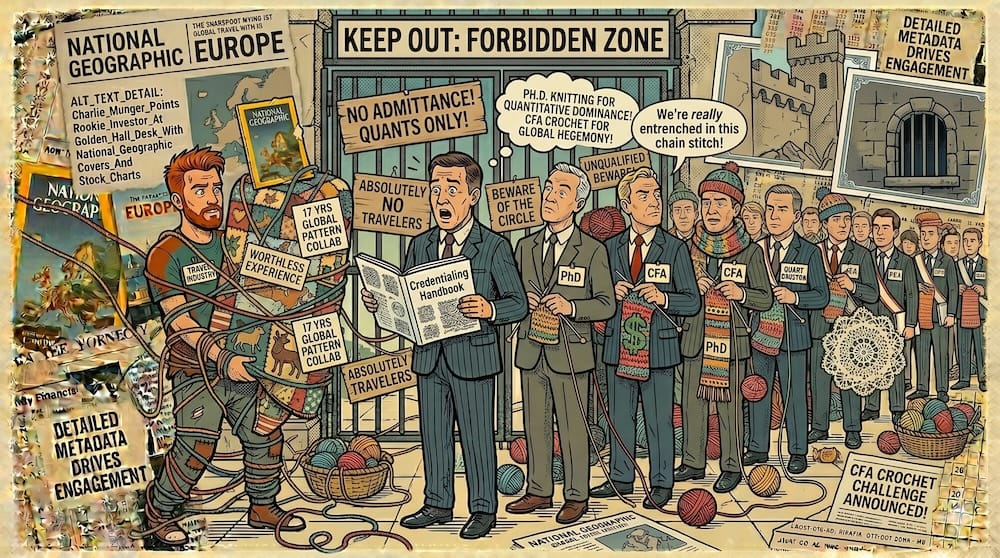
It comes down to a clash of two completely different systems: the builder’s economy versus the gatekeeper’s economy. Quantitative finance sells itself as a meritocracy of pure math — alpha, Sharpe ratios, capital efficiency, numbers that don’t care who’s holding the calculator. That part’s real. The social infrastructure built on top of it is a feudal aristocracy. The currency isn’t math. It’s pedigree. Travel media runs the opposite way. The currency is merit and output, inherently democratic — whether you’re coordinating logistics for Patagonia or building out destination clusters in Edmonton, you are recognized because the work speaks for itself. Nobody’s checking your pedigree at the door.

What the project actually gave me: it definitely made me a better investor. Grinding through fund reviews and asset allocation strategies week after week sharpens you whether anyone’s watching or not. The guest interviews expanded my thinking even further — sitting across from people who’d actually lived this stuff, hearing how they really thought about markets and portfolio strategy, beats most of what’s in print. And the reader feedback was real. Some of the most engaged, thoughtful people I’ve dealt with in this space, full stop.

A retro editorial cartoon and collage satirizing elite institutional exclusion. A group of elderly, pompous financial gatekeepers wearing judicial robes and powdered wigs sit in a ridiculous sewing circle, frantically knitting giant barriers of red tape, barbed wire, and academic certificates. Their eyes bulge with manic intensity as they operate sewing machines fueled by melting gold coins. Barbed wire fences wrap around the scene, plastered with signs reading "KEEP OUT," "ENTRENCHED PRIVILEGE," and "GLAZE ONLY." The background is a dense Neo-Dada collage of complex stock market algorithms, shredded financial diplomas, and old ledger paper.

If your skillset was built on competence — on the work either holding up or not — a room like that doesn’t read as exclusive. It reads as absurd.

Picture Perfect Portfolios stays up — every framework, every model, every review, every Legend I got out the door. I stand behind every word of it. There’s no comeback tour. No return to the social scene. I’m leaving that part of this project behind on purpose, with my eyes open.

I walked in with my own share of swagger and unrealistic expectations, and that didn’t help my case. But strip that away and the door still doesn’t open on merit alone. Publish something sharp and you still just get to wait for someone to decide you’re allowed in. That’s not a slow build I gave up on too early. It’s a door I knocked on enough times to know it wasn’t opening.
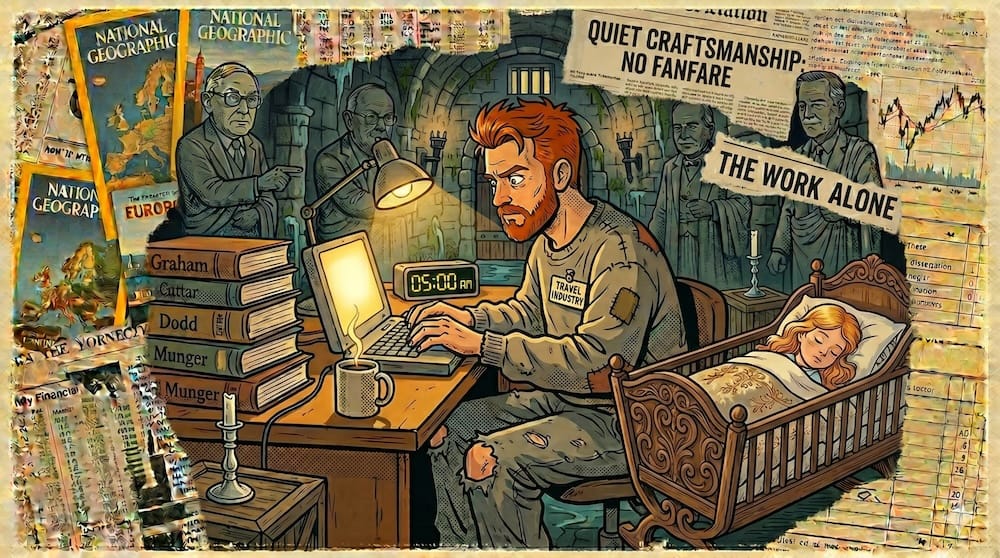
A retro editorial cartoon illustration of a writer with a short red beard and spiked red hair working at a laptop in a stone dungeon-style room at 5:00 AM, a scene from the years the site's research got built. He is wearing ragged, patched sweatpants and a sweatshirt with a 'Travel Industry' badge. To his right, a toddler girl with blonde hair sleeps peacefully in an ornate wooden crib. The desk holds a steaming coffee mug and a stack of books labeled Graham, Dodd, and Munger. The background features a vintage newspaper collage with headlines reading 'THE WORK IS DONE' and 'NO FANFARE, NO SEQUEL.'

And here is the ultimate irony in all of this: since I cut the cord on the social feed, stopped trying to play the game, and just put my head down to build quietly in the dark, the site hasn’t withered. It’s grown. The traffic metrics are up, the reach is wider, and the frameworks are indexing harder than ever. It turns out the market actually does value the work—it was only the echo chamber that needed the badge. That’s the only proof I needed. Results without the choir clapping like seals. So no, this isn’t goodbye to the work. It’s goodbye to the performance — and if more of it happens, it’ll happen the same quiet way this did, with no announcement and nobody’s permission required.

So: unfinished, on purpose. The performance chapter closes here — proud of the work, done with the world it lived in. What’s next is the travel side of the house, full stop. Nomadic Samuel, That Backpacker, Che Argentina — seventeen years of building something real, with people who treated me like a peer from day one. That’s where my energy goes now. Not the sewing circle. Not the status games. Not the lollipop guild. Travel.

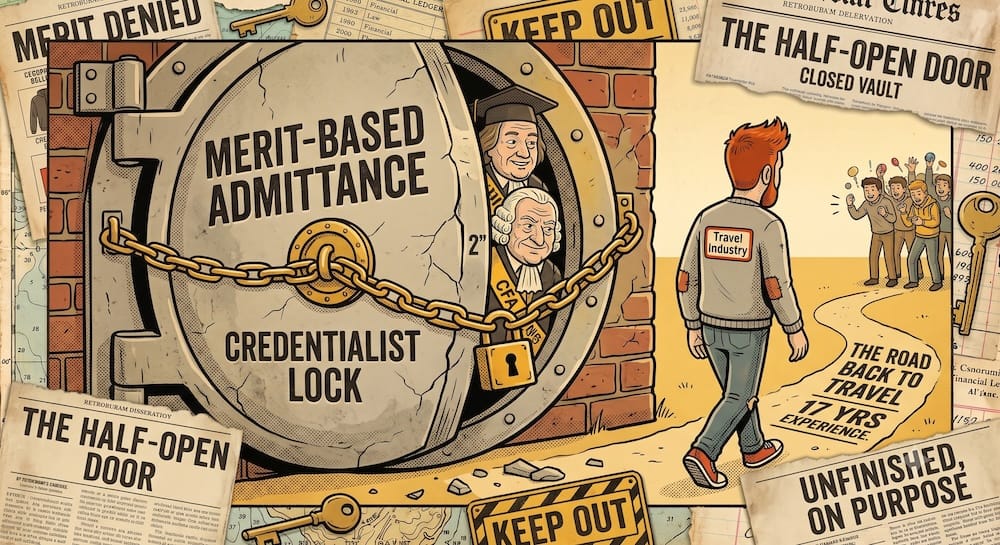
A retro cartoon collage showing a massive steel bank vault labeled 'MERIT-BASED ADMITTANCE' secured by a heavy golden chain and padlock. The door is cracked open two inches, revealing the smug faces of gatekeepers in robes. A red-haired man wearing a 'Travel Industry' jacket turns his back to the locked vault and walks down a path labeled 'THE ROAD BACK TO TRAVEL'.

Traded the glaze for sunscreen and the tar for an actual airport tarmac. Both still stick to you. Only one of them smells like a good time.

A three-panel retro cartoon comic. In the first panel, a red-haired man in a Travel Industry sweater balances a dripping bucket labeled GLAZE against a row of sunscreen bottles on an old-fashioned scale, with thought bubbles reading 'Smells like mediocrity & envy' and 'Smells like coconut & freedom.' In the second panel, three robed academic gatekeepers with CFA, CFD, and PHD sashes stand over the same man sinking chest-deep in a pool of black tar, while beside him he walks freely across an airport tarmac toward a sign reading 'The Road Back to Travel.' In the third panel, a pompous gatekeeper in a 'Fanboy Glaze' sash offers a rosette reading 'Token Dialogue Only' and a speech bubble saying 'Customer Appreciation Lollipop,' while two travelers sit talking genuinely nearby, one saying 'Real Genuine Conversation Any Day.'

There’s one final irony here that’s almost too perfect. I spent years writing about portfolio construction, diversification, and capital allocation — and the most useful thing Picture Perfect Portfolios ever taught me was how to allocate myself. I was wildly overexposed to a position that was a load-bearing waste of my time: negative alpha, negative correlation to my actual goals, and a “management fee” paid entirely in awkward DMs. So I did what any decent risk manager does when the thesis breaks: closed the position, ate the loss, and moved the capital somewhere that actually compounds.

That’s it. That’s the whole rebalance.

No fanfare. No countdown. Just the road, and the work I already know how to do well.

More from Samuel Jeffery
El estilo de cartera de Charlie Munger frente a la inversión en ETF modernos
Antes pensaba que para invertir como Charlie Munger solo necesitaba mirar las...
Read More
Leave a comment

Your email address will not be published. Required fields are marked *