“Buy at the point of maximum pessimism” is one of the best investment ideas ever compressed into one sentence—and one of the easiest to misuse.
The slogan invites a flattering interpretation. Markets panic. Everyone else loses their nerve. The superior investor remains calm, walks into the wreckage, and buys bargains from people who cannot control their emotions.
That version makes courage the hero. It also leaves out nearly everything that made John Templeton’s approach work.
Pessimism does not create value. It creates a place to look for value. Sometimes frightened or constrained sellers push prices below what a business, asset base, or future stream of earnings can conservatively support. Sometimes the market is staring directly at insolvency, dilution, obsolescence, or permanent economic decay and pricing the security accordingly.
The difficult part is telling those situations apart while both look dreadful.
Templeton’s real advantage was not an ability to feel cheerful during catastrophe. He combined deeply adverse prices with valuation work, diversification, position sizing, patience, and enough financial independence to remain invested when the bargain continued behaving like a disaster.
Strip away that architecture and maximum pessimism becomes a dramatic name for catching falling knives with unusual enthusiasm.
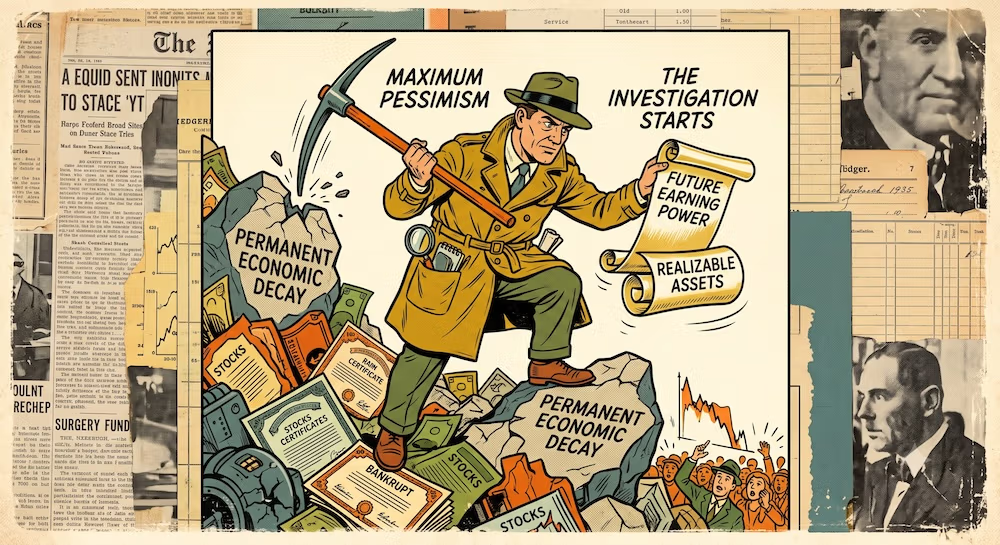
Pessimism Is Where the Investigation Starts
Templeton’s famous phrase is usually presented as an emotional instruction: become greedy when everyone else is frightened.
I consider that interpretation too shallow to be useful. Fear can direct an investor toward unpopular securities, but it cannot determine whether those securities are cheap.
In his 1993 essay, “16 Rules for Investment Success,” Templeton explained that bargains emerge when investors withdraw, demand disappears, and pessimism becomes widespread. He also warned that waiting until the outlook feels comfortable usually means waiting until much of the opportunity has vanished.
The logic is sound. Prices tend to be more attractive when the buyers have disappeared.
Still, maximum pessimism is not an observable market statistic. There is no official reading showing that fear has reached 97%, despair is fully priced, and the remaining downside has been politely cancelled. The phrase describes an unusually severe set of expectations embedded in the price.
The market may be assuming that earnings will remain depressed, financing will become unavailable, assets will prove less valuable than reported, an industry will never recover, or the company will fail outright. The investor must decide whether those assumptions are excessive.
That requires an anchor independent of the falling price.
A stock trading at $3 may look cheap because it once traded at $10. That comparison is psychologically powerful and analytically weak. The old price proves only that somebody once paid more.
I fall for the seduction of a large percentage decline as easily as anyone. The chart supplies a dramatic before-and-after story, and the previous high quietly volunteers itself as “normal.” It feels like valuation because two numbers are being compared. In reality, it may be nothing more than nostalgia with decimal places.
Templeton’s better anchor was future earning power, realizable assets, competitive strength, financial survival, or some other defensible source of value. Pessimism mattered because it could create a gap between that value and the quoted price.
The low price opened the file. It did not complete the analysis.
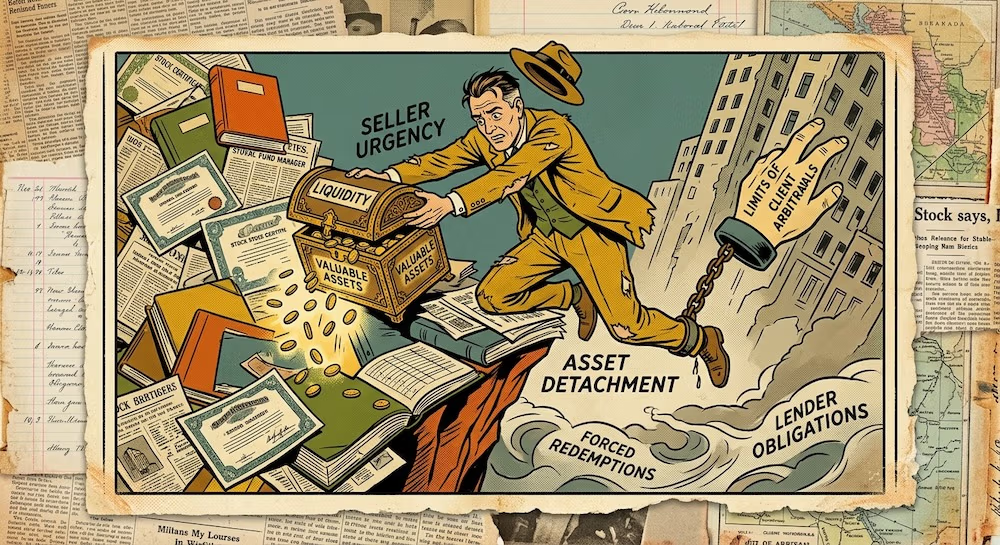
How Selling Pressure Can Detach Price From Value
A company whose prospects deteriorate should become cheaper. Investors are not behaving irrationally merely because they respond to bad news.
The opportunity appears when the selling becomes less discriminating than the deterioration.
Several forces can produce that separation.
Investors extrapolate recent conditions. A business suffering through two terrible years is treated as though terrible years have become its permanent operating model. An industry facing oversupply is priced as though supply will never adjust. A recession becomes an eternal forecast.
Josef Lakonishok, Andrei Shleifer, and Robert Vishny examined this behaviour in their 1994 paper, “Contrarian Investment, Extrapolation, and Risk.” They argued that investors often project past strength or weakness too far into the future. Their work concerned systematic value strategies rather than Templeton’s individual purchases, but the mechanism fits his search for neglected securities: recent disappointment can harden into a permanent assumption.
Then there are sellers whose motives have little to do with the underlying company.
Joshua Coval and Erik Stafford studied severe mutual-fund flows in “Asset Fire Sales (and Purchases) in Equity Markets.” Funds facing large redemptions were forced to sell securities, creating price pressure in commonly held positions. Investors who supplied liquidity could subsequently earn abnormal returns as some of that pressure reversed.
The market price is set by whoever must transact. It is not determined by an imaginary council of patient analysts calmly comparing intrinsic values.
A fund experiencing redemptions may sell its most liquid holdings because those are the assets it can move. An institution may dispose of a security that violates a mandate. A manager may avoid an unpopular company because being conventionally wrong is safer than being independently wrong. A leveraged investor may sell because a lender has converted a long-term judgment into an immediate obligation.
Those sellers do not need to be stupid. They may simply lack a choice.
Templeton’s opportunity existed where the urgency of the seller exceeded the impairment of the asset.
That relationship can feed on itself. Falling prices trigger redemptions, risk limits, collateral requirements, and career anxiety. The resulting sales drive the price lower, which appears to validate the original fear. What started as a valuation adjustment becomes a liquidation process.
Andrei Shleifer and Robert Vishny explained another layer in “The Limits of Arbitrage.” Professional investors who manage other people’s capital may be unable to exploit an apparent mispricing fully. If the security falls further, clients can withdraw funds, leaving the manager with less capital precisely when the opportunity appears more attractive.
There is a grim elegance to that arrangement. The investor needs staying power because the market has become excessively pessimistic, then loses staying power because the pessimism continues.
Templeton deserves more precise credit than the usual story gives him. He understood in practice that unpopularity could persist because the investors capable of correcting it did not possess unlimited time, capital, or institutional tolerance.
Yet none of this proves that the security is a bargain.
Forced selling can push a good asset too low. It can also push a failing company from an overvalued price to a merely less overvalued one. A stock heading toward zero may become temporarily mispriced several times without ever becoming a sensible investment.
Seller pressure creates a possibility. The business still has to survive.
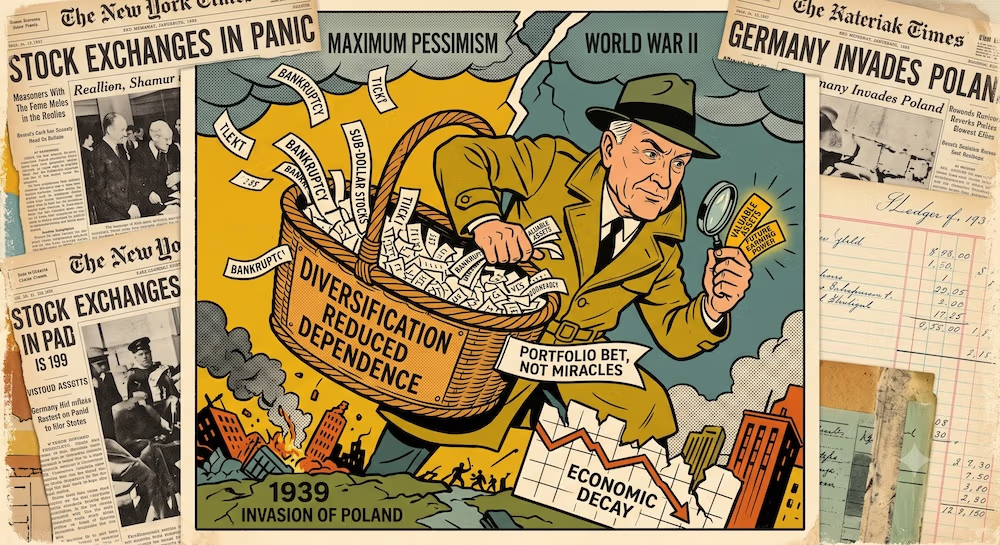
The 1939 Basket Was a Portfolio Bet, Not a Collection of Miracles
Templeton’s most famous maximum-pessimism purchase came shortly after Germany invaded Poland in 1939.
In a 1997 interview with Charlie Rose, Templeton recalled screening the New York and American stock exchanges for securities trading below one dollar. He found 104.
According to a transcript reproduced in “The 22 Maxims of John Templeton,” Templeton instructed his broker to buy $100 worth of each security. His broker reportedly objected that 37 of the companies were in bankruptcy. Templeton told him to proceed.
The John Templeton Foundation gives a slightly different account in its official biography. It says Templeton bought 100 shares of each company and that 34 were in bankruptcy.
The discrepancy should not be tidied away. Templeton’s version was a first-person recollection delivered decades after the purchase. The Foundation’s version carries institutional authority while disagreeing on two basic details.
Historical investment stories have a tendency to become smoother as they age. The numbers become exact, the outcome becomes inevitable, and the uncertainty present at the time is edited out because it spoils the legend.
What survives both accounts is enough. Templeton purchased a broad basket of 104 securities trading below one dollar, with roughly one-third reportedly in bankruptcy.
That was not a concentrated wager on a few carefully selected turnarounds. He was buying a distribution of possible outcomes.
Diversification Reduced the Precision He Needed
A single distressed company places enormous weight on company-specific judgment. Management, creditors, refinancing terms, asset values, legal outcomes, operating performance, and chance can determine whether shareholders recover anything.
A basket of 104 securities changes the requirement.
Templeton still needed the group to be undervalued in aggregate. Diversification cannot rescue a portfolio whose underlying assets are collectively worth less than the price paid. It can, however, reduce dependence on knowing which individual companies will survive.
The Foundation says four holdings ultimately became worthless while large profits were made on the remainder. The available accounts do not provide an auditable trade ledger, so the exact aggregate returns, liquidation dates, and annualized performance figures frequently attached to the story should be treated with suspicion.
One holding illustrates the payoff shape.
Templeton recalled buying roughly $100 of Missouri Pacific Railway preferred stock near 12 cents per share, giving him approximately 800 shares. He later said he sold the position for about 40 times his cost.
A winner of that magnitude changes the arithmetic of the basket. The portfolio does not need unanimous success.
Consider a simplified example unrelated to Templeton’s actual results. Ten positions receive equal allocations. Four fail completely, three merely return the original capital, two double, and one rises tenfold.
| Outcome | Positions | Ending value per $1 invested | Combined ending value |
|---|---|---|---|
| Complete loss | 4 | $0 | $0 |
| Capital recovered | 3 | $1 | $3 |
| Doubled | 2 | $2 | $4 |
| Tenfold winner | 1 | $10 | $10 |
| Total | 10 | $17 from $10 invested |
The example does not prove that distressed baskets offer favourable returns. It shows why a portfolio containing many failures can still succeed when the upside is heavily skewed and the losses are contained at the position level.
I view Templeton’s 1939 purchase as a portfolio-construction achievement as much as an act of nerve. The theatrical part was buying bankrupt and sub-dollar securities as war began. The more useful part was refusing to make the entire result depend on identifying one perfect survivor.
The mythology prefers bravery because bravery flatters the investor. Basket construction admits ignorance.
That admission matters. Templeton was effectively saying that he expected to be wrong repeatedly and wanted the portfolio to survive the experience. There is less romance in that formulation, which is probably why it receives less attention.
Templeton later argued for diversification across companies, industries, risks, and countries because unpredictable developments cannot be controlled. The 1939 purchase was an extreme implementation of the same underlying logic.
One detail must remain clear: the securities were not safer because their share prices were below one dollar.
A 50-cent stock can lose 100%, just as a $50 stock can. Nominal share price says nothing about liabilities, senior claims, dilution, enterprise value, or the amount of capital required to keep the company alive.
The asymmetry came from value relative to price and from a portfolio able to absorb zeros. The tiny numbers beside the tickers were visual decoration.
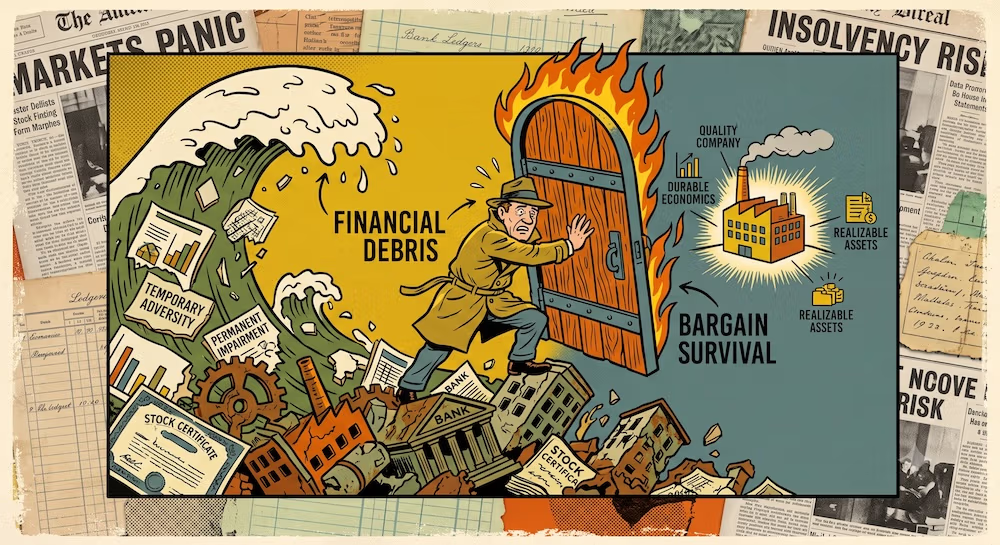
The Bargain Still Has to Survive
Templeton’s mature framework offers little support for buying every security that inspires disgust.
In “16 Rules for Investment Success,” he told investors to search for bargains among quality companies. He pointed toward market position, management, capitalization, brands, innovation, and durable economics.
He also refused to treat those traits in isolation. A company could be a low-cost producer while customers abandoned its products. A technological leader could possess promising ideas without enough capital to bring them to market.
That distinction is the firewall between contrarian investing and rummaging through financial debris in the hope that everything broken is collectible.
Every distressed company can produce at least one flattering statistic. The shares trade below book value. Revenue remains substantial. The factories would cost more to reproduce. The brand once mattered. Management has announced a turnaround plan.
Management teams approaching insolvency rarely suffer from a shortage of plans.
Templeton’s focus on future earning power or realizable assets was much more demanding. Both require judgement.
Book value may contain assets that cannot be sold near their recorded values. Historical earnings may depend on market conditions that are gone. A famous brand may survive mainly in the memories of former customers. Cash can be consumed by operating losses before shareholders receive any benefit.
I reject the romantic interpretation that maximum pessimism itself creates a margin of safety. It creates a low quotation. The safety must come from what remains after the pessimistic case has been treated seriously.
| Question | Temporary adversity may resemble | Permanent impairment may resemble |
| Operating decline | Cyclical weakness with survivable economics | Product or business model losing relevance |
| Balance sheet | Liquidity sufficient for an extended downturn | Debt and obligations overwhelming available resources |
| Financing | Pressure with credible access to capital | Survival dependent on punitive or unrealistic financing |
| Assets | Saleable or productive assets supporting value | Assets impaired, inaccessible, or subordinate to senior claims |
| Earnings | Depressed profits capable of recovery | Former earning power unlikely to return |
| Management response | Cost control and capital preservation | Dilution, denial, or increasingly desperate commitments |
| Portfolio role | Position sized to survive failure | Concentration turning uncertainty into ruin |
No row creates certainty. Pessimism and impairment frequently arrive together.
A business can be genuinely damaged and still trade below a conservative recovery value. Another can look cheap on every conventional ratio while the equity holders have no realistic claim on what remains.
Templeton also warned that obvious asset bargains may already have been examined and rejected by other bargain hunters. Cheap securities do not remain cheap because every other investor forgot how division works.
Sometimes the market has neglected the assets. Sometimes the low valuation is a concise summary of problems that survive contact with the spreadsheet.
Research can improve the distinction. It cannot make the distinction clean.
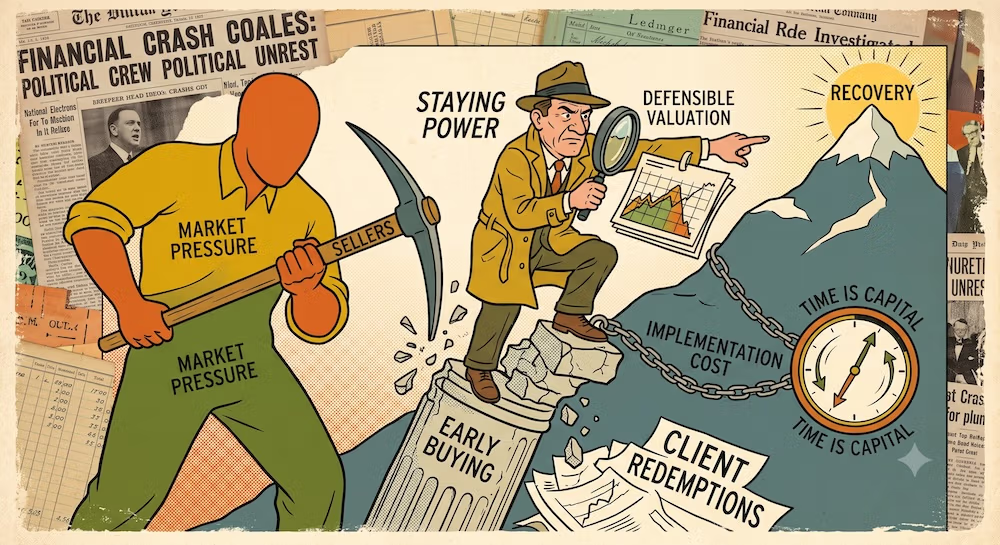
Being Early Feels Remarkably Similar to Being Wrong
A defensible valuation does not identify the bottom.
Forced sellers can keep selling. Redemptions can accelerate. Lenders can tighten terms. Analysts can reduce estimates after the investor has already incorporated a severe scenario. A company can report further deterioration that worsens sentiment without destroying the entire valuation case.
Coval and Stafford found that fire-sale price effects could persist for months, with reversal requiring additional quarters. Shleifer and Vishny showed why investors positioned against mispricing may lose clients or capital while waiting for prices to recover.
A correct long-term judgment can therefore become financially useless when the investor cannot remain in the position long enough to benefit.
That is not merely a test of emotional resilience. It is an implementation cost.
Templeton’s warning against panic after a crash centred on reassessment. He advised investors to examine what they owned and sell when a more attractive alternative appeared, rather than treating the decline itself as proof that the original decision had failed.
The discipline works in both directions.
A lower price can improve the opportunity when the business value remains intact. It can also reveal that the original analysis ignored a financing risk, misunderstood the asset base, or overestimated the company’s ability to survive.
I become wary whenever “the thesis hasn’t changed” is repeated like a protective spell. A thesis should not change because a quotation moved. It should change when the facts governing value have changed. Investors blur those standards because one permits patience while the other requires an admission of error.
A serious reassessment asks whether the latest deterioration affects solvency, financing, competitive position, asset value, or the likely timing and size of recovery.
Price alone cannot answer those questions.
Patience cannot answer them either.
Patience protects sound analysis from emotional interruption. It becomes stubbornness when it protects the original analysis from new information. Templeton’s method required enough conviction to tolerate discomfort and enough flexibility to revoke that conviction when the facts no longer supported it.
The distinction is easy to state after the outcome. While the position is falling, being early and being wrong wear almost identical clothing.
Courage Without Structure Is Mostly Theatre
Templeton’s philosophy is commonly framed as a temperament test. The investor who remains calm while everyone else panics supposedly gains access to bargains unavailable to ordinary mortals.
Temperament matters. It does not carry the position.
Maximum-pessimism investing also requires capital that remains available, position sizes that can survive complete losses, enough diversification to absorb analytical mistakes, and an evaluation horizon long enough for the strategy to work.
Templeton’s own rules placed contrarian purchases beside diversification, investigation, flexibility, and continuous monitoring. A CFA Institute review of his career described an average holding period of approximately five years. That figure should not be mistaken for a fixed Templeton rule, though it captures the duration his approach could demand.
A five-year thesis financed with five-month money is not patient investing. It is a calendar malfunction with financial consequences.
The 1939 story introduces another uncomfortable detail: Templeton reportedly borrowed money to fund the basket.
The decision worked in the surviving accounts. It should remain a historical fact rather than a recommendation hiding inside an inspirational anecdote.
Leverage amplifies gains when recovery arrives. It also reduces the investor’s ability to tolerate further declines. Interest costs, collateral requirements, and maturity dates impose a timetable on an investment whose entire premise may require waiting through prolonged uncertainty.
I admire the audacity of Templeton’s purchase. I see no reason to pretend the financing deserves equal admiration. Historical success often launders risk. Once the outcome is known, borrowing looks like conviction. Before the outcome, it remains borrowing.
Institutional investors face a different version of the same problem.
A fund manager may believe a security is undervalued while knowing that another year of underperformance could trigger redemptions. A committee may reject an unpopular investment because explaining its failure would be more painful than accepting conventional mediocrity. A benchmarked manager may avoid a distressed security because an idiosyncratic loss attracts personal blame.
Templeton’s edge therefore involved more than recognizing pessimism. He needed the freedom to act and the capacity to remain invested while the decision looked embarrassing.
That freedom is not evenly distributed.
Plenty of investors can locate fear. Fewer can determine whether the fear exceeds the impairment. Fewer still can hold a diversified collection of ugly securities without concentration, leverage, redemptions, or short evaluation periods forcing them to sell.
The public story celebrates temperament because it sounds noble. The less glamorous structure carries much of the actual burden.
Sometimes the Market Is Delivering a Warning
Some securities are hated because the market has correctly identified a catastrophe.
John Campbell, Jens Hilscher, and Jan Szilagyi examined corporate failure risk in “In Search of Distress Risk.” They found that higher leverage, weaker profitability, lower cash, greater volatility, smaller market capitalization, poor past returns, and low share prices were associated with greater failure probability.
The easy contrarian story suffers a more serious blow from their return findings. Especially from 1981 onward, the most financially distressed stocks produced unusually low returns while exhibiting substantially greater volatility.
Distress did not reliably reward investors for accepting more risk. It often delivered more risk and worse returns.
That does not disprove Templeton’s approach. It shows what his approach had to overcome.
Buying at maximum pessimism cannot mean locating the companies most likely to fail and assuming the market has become emotional. A business near insolvency can issue shares, surrender assets, accept punishing financing, or transfer value to senior creditors. The company may survive while the existing shareholders are largely erased.
Corporate survival and investment success are not the same outcome.
Technological decline creates another trap. Investors often speak about a struggling company as though time will naturally restore its former economics. Some earnings never recover because the customers, products, or industry structure have moved on.
The word “cyclical” can become very accommodating under pressure. It may describe a temporary downturn. It can also provide emotional shelter for a business whose cycle has ended permanently.
I will not pretend that a checklist solves this boundary. Temporary pessimism and permanent impairment use much of the same vocabulary while events are unfolding. Falling revenue, shrinking margins, refinancing pressure, management turnover, and asset sales can appear in companies that recover and companies that disappear.
Investors have probabilities, asset claims, financing terms, competitive analysis, and portfolio construction. They do not have advance access to the ending.
Even Templeton’s celebrated 1939 basket reportedly contained four securities that became worthless. Those zeros belong near the centre of the story.
His method did not transform distressed investing into a collection of misunderstood gems. It created a portfolio capable of surviving companies that were every bit as bad as their prices suggested.
The cleaner mythology erases the failures because failures complicate the image of superior perception. Templeton’s actual achievement was more practical. He accepted that pessimism sometimes contains accurate information and built the portfolio so that several accurate warnings did not automatically destroy the overall result.
A Better Decision Rule Than “Buy the Fear”
Maximum pessimism identifies a hunting ground. It does not provide a purchase order.
The first question concerns the expectations already embedded in the price. What combination of operating decline, refinancing stress, dilution, asset impairment, or outright failure does the valuation appear to assume?
Then comes survival. Can the business withstand conditions that remain poor longer than expected? Are liquidity, financing access, earning power, or realizable assets sufficient to protect the equity claim?
The next issue is value transfer. A company may survive through financing that rewards lenders or new shareholders while destroying the economic position of existing owners.
Portfolio construction follows. How much damage would a complete loss cause? Does the position depend on a single refinancing event, legal decision, commodity price, government action, or management promise? Can several separate judgments fail without disabling the portfolio?
Finally, the investor must confront holding capacity. Can the capital remain invested if the price falls further and the recovery takes years? Patience is irrelevant when liabilities demand punctuality.
| Decision layer | Question that must survive scrutiny |
| Embedded pessimism | What severe outcomes does the current price already assume? |
| Fundamental survival | Can the business or asset base endure continued adversity? |
| Claim preservation | Will financing, dilution, or senior obligations capture the recovery first? |
| Portfolio resilience | Can the overall result withstand several complete failures? |
| Holding capacity | Can the position remain funded while price and value stay disconnected? |
This framework is my synthesis of Templeton’s published rules, the structure of his 1939 basket, and later findings on fire sales, arbitrage constraints, and distress risk. Templeton did not publish it in this exact form.
It preserves the power of his idea while removing the heroic fog.
Templeton was right that investors searching for bargains must often look where others are selling. He was right that emotional comfort usually becomes available only after the best prices have disappeared. He was right that diversification can convert unavoidable uncertainty from a fatal weakness into a manageable condition.
The mistake is treating disgust as due diligence.
Maximum pessimism does not reveal what deserves to be bought. It reveals where expectations may have become harsh enough to justify deeper work. The decision still depends on whether the company can survive those expectations, whether shareholders will retain the value if recovery occurs, and whether the portfolio can absorb the cases where the market’s bleak judgment was accurate.
That final tension cannot be removed. At the moment of purchase, the neglected bargain and the approaching bankruptcy may look disturbingly similar.
Templeton’s art was building a process—and a portfolio—that never required him to pretend otherwise.
What did John Templeton mean by buying at maximum pessimism?
Templeton treated maximum pessimism as a place to search for mispricing, not as proof that every falling security was cheap. The opportunity existed when severe expectations pushed price below defensible value, but the investment still required analysis of earning power, assets, solvency and survival.
Why does fear alone not make a security a bargain?
Fear can create selling pressure, but it cannot determine intrinsic value. A low price may reflect forced selling and excessive extrapolation, or it may accurately signal insolvency, dilution, obsolescence or permanent economic impairment.
How did Templeton’s 1939 basket reduce the need for perfect stock selection?
By purchasing a broad group of 104 sub-dollar securities, Templeton reduced his dependence on identifying every eventual survivor. The portfolio could tolerate failures if enough holdings recovered and a smaller number of large winners outweighed the losses.
Why can a correct value investment still fail in practice?
A defensible valuation does not identify the market bottom. Continued selling, redemptions, leverage, financing pressure or a short evaluation horizon can force an investor out before price and value reconnect.
How can investors distinguish temporary pessimism from permanent impairment?
The distinction requires examining operating durability, liquidity, debt, financing needs, realizable assets, future earning power, management response and the claims of lenders or other senior stakeholders. No checklist removes uncertainty because genuine damage and excessive pessimism can exist at the same time.
Does diversification make distressed investing safe?
No. Diversification can reduce dependence on any one company and help a portfolio absorb complete failures, but it cannot eliminate correlated risks, poor aggregate valuation, financing pressure or permanent loss.
This article is also available in Spanish. [Leé la versión en castellano: John Templeton y el arte de comprar en el máximo pesimismo]