John Bogle won the argument so completely that the fund industry eventually learned how to counterfeit the language of his victory.
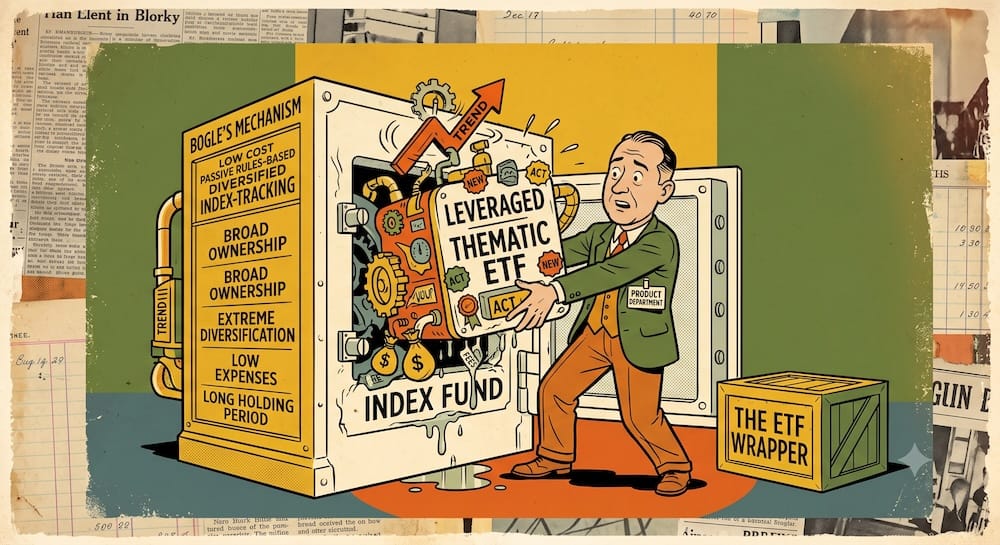
Low cost. Passive. Rules-based. Diversified. Index-tracking.
Those terms once pointed toward a fairly coherent investment philosophy. Today they can describe a broad-market fund intended to sit untouched for decades, a narrow thematic ETF built around whichever industry has recently captured investor attention, or a leveraged product that resets every day and bears little resemblance to patient market ownership.
“Index fund” has become one of those reassuring labels that seems to explain a product while quietly withholding most of the information that matters.
That is the uncomfortable part of Bogle’s legacy.
Index mutual funds and index ETFs held $19.1 trillion at the end of 2025, representing 52% of US long-term fund assets. Costs collapsed. Diversification became widely accessible. ETFs improved portability, trading flexibility, fund distribution, and the potential for tax-efficient implementation in US taxable accounts.
The revolution succeeded.
Then the product department arrived.
Bogle’s real achievement was never the creation of a ticker symbol, a mutual-fund wrapper, or a passive badge that could be attached to almost any portfolio. He built a system around several mutually reinforcing constraints: own a broad share of the market, diversify heavily, minimize expenses and turnover, and stop treating every new financial story as a reason to rearrange the furniture.
Remove enough of those constraints and the philosophy changes, even when the product continues tracking an index flawlessly.
Modern ETFs preserved much of Bogle’s economic logic while weakening some of the behavioural restraints that made his original system unusually difficult to sabotage. Investors received better plumbing alongside a vastly expanded menu of ways to second-guess themselves.
I have no interest in turning this into a morality play where mutual funds wear white hats and ETFs twirl their moustaches. A narrow, expensive index mutual fund can violate Bogle’s principles. A cheap broad-market ETF held for twenty years can embody them.
The ETF wrapper is a tool. The modern ETF marketplace is an incentive system. Confusing the two leads to most of the bad arguments surrounding Bogle’s legacy.
The Legacy Was the Mechanism, Not the ETF Wrapper
Bogle launched the First Index Investment Trust on August 31, 1976, creating the first index mutual fund offered to US individual investors. SPDR S&P 500 ETF Trust, better known as SPY, arrived in January 1993, almost seventeen years later.
That chronology clears away one persistent exaggeration. Bogle did not invent institutional indexing, and he had no role in inventing the ETF. His contribution was narrower than the mythology and more important than the mythology: he democratized low-cost index investing for ordinary investors and spent decades explaining why the structure worked.
His own descriptions extended well beyond “buy an index.”
In a 2016 presentation, Bogle identified broad market ownership, extreme diversification, minimal transaction costs, a very low expense ratio, and long-term holding as defining features of the original index fund. In The Clash of the Cultures, he presented broad-market indexing as the model of long-term investment and the opposite of short-term speculation.
These components formed a system.
Broad ownership reduces dependence on identifying individual winners. Low portfolio turnover limits trading friction. Low expenses allow investors to retain more of what the underlying companies produce. Long holding periods reduce the damage caused by fear, enthusiasm, timing, and the recurring conviction that this week’s market story deserves immediate action.
The brilliance was architectural. Bogle designed an approach that needed fewer things to go right.
That contribution is frequently compressed into a shopping instruction: buy an index fund. Once something carrying the word “index” appears in the account, the intellectual work seems finished.
I understand the appeal. I am vulnerable to the same shortcut. A rules-based portfolio feels objective. It gives the impression that human judgment vanished when the methodology was approved and converted into a PDF.
The judgment did not vanish. It was vacuum-sealed inside the rules.
Someone still decides which market the fund represents, which securities qualify, how they are weighted, when they are removed, whether leverage is applied, how often the index rebalances, and which economic story the product is supposed to capture.
Bogle’s original mechanism removed discretionary decisions from the investor’s path. The modern index industry became highly skilled at relocating discretion into places that look mathematical, systematic, and therefore harmless.
A formula can be every bit as opinionated as a fund manager. It simply has better stationery.
What Bogle Got Right Before the ETF Boom
Bogle’s most durable case rested on arithmetic rather than prophecy.
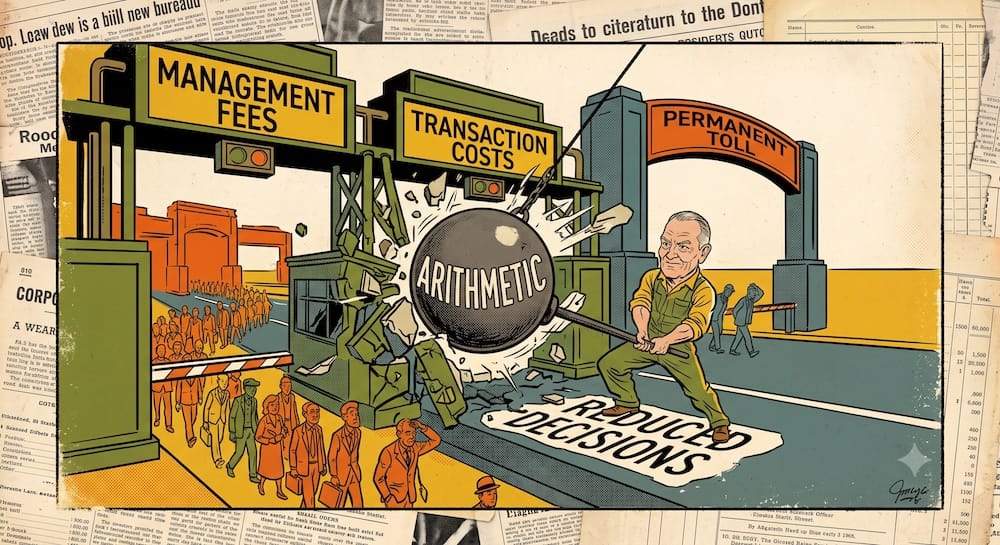
Investors collectively own the market. Before costs, their aggregate return must resemble the return of the market they own. After costs, they receive less. Every dollar absorbed by management expenses, transaction costs, sales charges, taxes, or unnecessary portfolio activity is a dollar unavailable to compound for the investor.
This logic does not require every active manager to fail. It does not require indexing to win in every market period. It does not require markets to be perfectly efficient or prices to be permanently correct.
It requires costs to exist.
The Investment Company Institute’s 2026 Fact Book shows how far the pressure Bogle helped create eventually travelled. The asset-weighted expense ratio for index equity mutual funds declined from 0.27% in 2000 to 0.05% in 2025. ICI attributes the generally lower expenses of index funds partly to infrequent portfolio changes, lower turnover, scale, and the prevalence of broad mandates that are cheaper to operate.
Bogle was right to drag fees out of the footnotes. The fund industry had treated them as an administrative detail when they were really a permanent toll charged against investor returns.
Yet I consider his reduction of decision frequency an even deeper contribution.
Fees are measurable. Behavioural damage tends to arrive wearing a convincing explanation.
Every discretionary move creates another opportunity to become overconfident, impatient, frightened, fashionable, or certain that the latest narrative is too important to ignore. Broad indexing reduces how many judgments an investor must make. Long holding periods reduce how often those judgments must be reconsidered.
Bogle’s system can survive without brilliance because it does not demand brilliance on a recurring schedule.
A strategy requiring continuous insight, accurate timing, emotional control, successful security selection, and repeated correct forecasts may look more sophisticated. It also contains more doors through which failure can enter.
Wall Street has always been good at selling additional decisions as additional control. Bogle understood that each new decision can also become another invoice from uncertainty.
This is why his mechanism travels across wrappers. A traditional index mutual fund loses its Boglean character when it is narrow, expensive, or repeatedly traded. A broad ETF preserves that character when it is diversified, inexpensive, and left alone.
The industry prefers debating wrappers because wrappers can be branded, compared, advertised, and sold. The more revealing question is whether the complete investment process reduces the number of things the investor must get right.
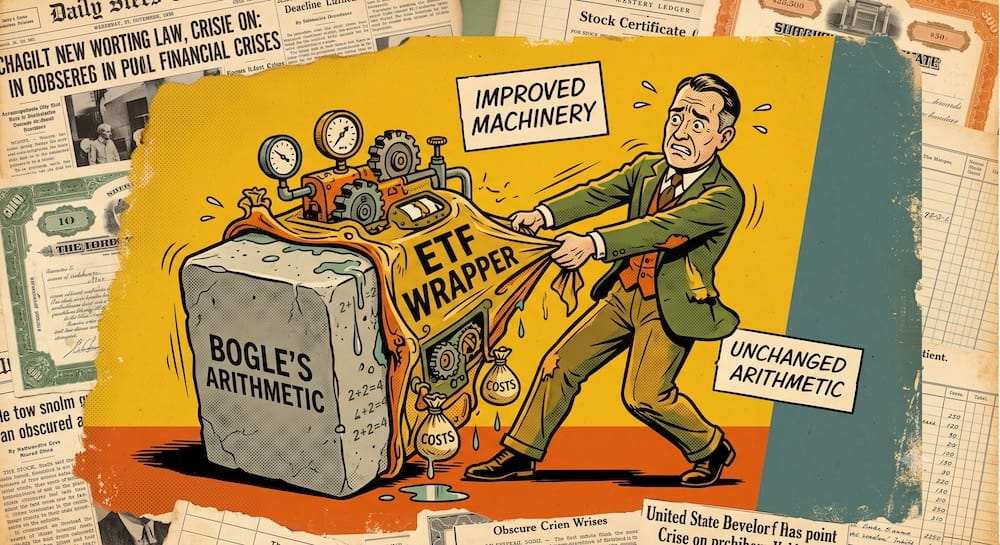
ETFs Improved the Machinery Without Changing the Arithmetic
ETFs were a genuine financial innovation. Dismissing them as a speculative gimmick would be intellectually lazy and historically wrong.
ETF shares trade throughout the day. Authorized participants can create and redeem large blocks of shares, often through in-kind transfers of securities. That process can reduce the need for a fund to sell appreciated holdings when shareholders leave. ETFs can move across brokerage platforms, trade alongside other securities, and serve retail investors, advisers, institutions, hedgers, arbitrageurs, and market makers.
The structure solved real problems.
It also made several old problems easier to express.
Where the ETF Wrapper Added Genuine Efficiency
The creation and redemption process sits at the centre of the ETF’s tax advantage in the United States. Through in-kind transfers, an ETF may be able to remove appreciated securities from the portfolio without selling them and realizing capital gains inside the fund.
In a US taxable account, that mechanism can reduce capital-gains distributions relative to a comparable mutual fund.
The word “can” deserves to remain in the sentence.
The SEC’s guide to mutual funds and ETFs explains that both structures can distribute taxable gains and that the relevance of ETF tax efficiency changes inside tax-advantaged accounts. Jurisdiction, account type, fund construction, portfolio activity, and the investor’s circumstances all affect the result.
Anyone presenting “ETFs are more tax-efficient” as a law of nature is taking a conditional structural advantage and laundering it into a universal sales claim.
ETFs also intensified fee competition. By 2025, the asset-weighted expense ratio for index equity ETFs averaged 0.14%. The comparable figure for index equity mutual funds was 0.05%, partly because the ETF universe contains far more specialized mandates.
Those averages do not prove that mutual funds are cheaper or ETFs are more expensive. They prove how little a wrapper-level average can tell us once thousands of radically different products have been poured into the same container.
The competitive effect was still substantial. Low-cost ETFs forced providers across the industry to justify their pricing. Bogle made high fees harder to defend intellectually. ETFs made them harder to defend commercially.
I give the ETF industry full credit for that. It expanded access, improved portability, increased implementation flexibility, and helped turn fee compression from a philosophical argument into an ongoing price war.
There is no virtue in preserving an inferior wrapper merely because Bogle launched his revolution through it. Financial plumbing is allowed to improve.
Where the Wrapper Introduced New Friction
ETF investors can face costs that never appear in the annual expense ratio.
Shares trade at market prices that may sit above or below net asset value. Buyers and sellers encounter bid–ask spreads. Brokerage commissions may apply. Execution quality can vary. These frictions become more relevant in less liquid products and during stressed markets.
The SEC’s 2025 bulletin on mutual-fund and ETF expenses makes clear that spreads and other transaction costs sit outside the published expense ratio.
A fund can therefore look magnificently cheap while repeated trading quietly turns it into an expensive habit.
Traditional mutual funds normally transact once each day at net asset value. That arrangement limits execution flexibility. It also removes an entire category of intraday decision-making.
Whether greater flexibility becomes an advantage depends on what the investor does with it. A sharper knife is useful in the kitchen. It does not improve the cook’s judgment.
| Feature | Traditional index mutual fund | Broad-market index ETF |
|---|---|---|
| Trading | Once daily at net asset value | Intraday at market prices |
| Transaction friction | May involve minimums, redemption rules, or sales arrangements | May involve spreads, commissions, premiums, or discounts |
| US taxable-account mechanics | May sell holdings to meet redemptions | In-kind redemptions can reduce realized gains |
| Portability | Often more closely connected to a fund platform | Generally portable across brokerage platforms |
| Opportunity to intervene | Limited during the trading day | Continuous |
| Fidelity to Bogle’s system | Depends on exposure, cost, turnover, and use | Depends on exposure, cost, turnover, and use |
The final row destroys the clean wrapper debate.
Neither structure possesses discipline. Neither structure prevents stupidity. The investor supplies both.
Scale Finished the Revolution Bogle Started
The first retail index fund was mocked. By the end of 2025, index mutual funds and index ETFs represented the majority of US long-term fund assets.
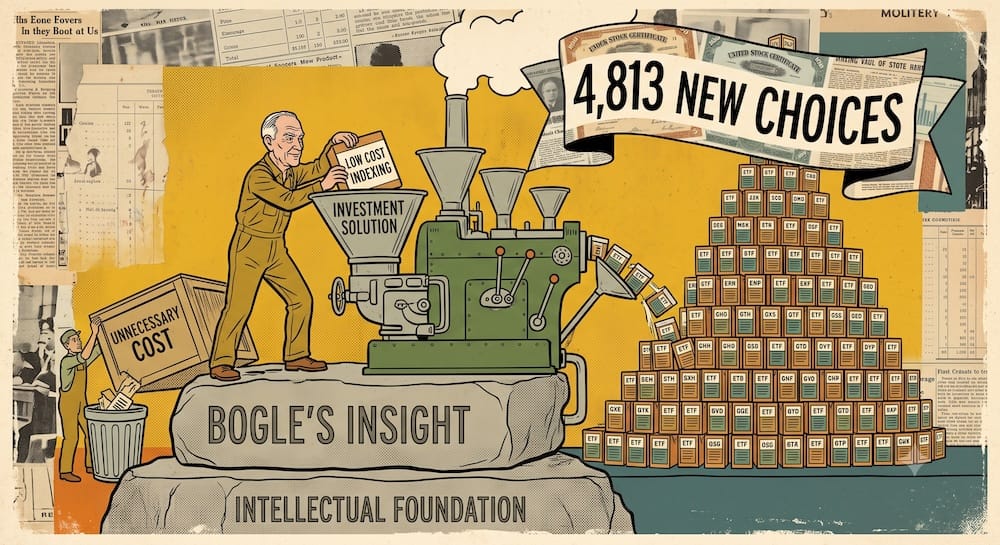
According to the ICI’s 2026 Fact Book, these products held $19.1 trillion and accounted for 52% of long-term fund assets, up from 19% in 2010. The US market contained 4,813 ETFs holding $13.4 trillion. Index mutual funds separately held $7.7 trillion.
Indexing travelled from heresy to infrastructure.
ETFs became the dominant growth engine. Between 2015 and June 2025, index domestic-equity ETFs attracted nearly five times the cumulative net inflows of index domestic-equity mutual funds, according to the ICI’s analysis of ETFs and their investors.
Bogle deserves enormous credit for the intellectual foundation. He turned cost into a first-order issue and exposed how much fund-industry complexity existed to justify fees, distribution arrangements, portfolio activity, and the expensive appearance of expertise.
He does not deserve sole credit for the modern system. Regulation, brokerage technology, institutional demand, competing asset managers, index providers, and the authorized-participant ecosystem all contributed.
Giving Bogle ownership of every later development would repeat the hero-worship that weakens so much investment history. Once a person becomes a symbol, the legend begins swallowing the surrounding institutions, predecessors, and collaborators.
Bogle’s real contribution is impressive enough without annexing the entire map.
He gave ordinary investors a coherent reason to distrust unnecessary cost and activity. The ETF industry then industrialized his insight, scaled it globally, and discovered that a solved investment problem could be repackaged into 4,813 new choices.
That may be the most Wall Street outcome imaginable.
The Meaning of “Index Fund” Has Expanded Beyond Recognition
In 1976, an index fund implied a relatively tight family of characteristics: broad exposure, mechanical implementation, low turnover, and limited managerial discretion.
By 2025, the term covered almost any portfolio idea that could be converted into a rulebook.
An index can represent the whole market. It can isolate a sector, target a factor, track a country, select companies connected to a theme, apply a proprietary score, concentrate in a narrow group, reset leverage daily, or deliver the inverse of a benchmark.
The word “index” now identifies a construction method. It no longer guarantees an investment philosophy.
Bogle saw the separation developing early. In his 2004 speech “Convergence! The Great Paradox of the Fund Industry”, he warned that passive indexing was beginning to resemble active management as providers launched products linked to sectors, styles, countries, and increasingly narrow market segments.
His criticism went deeper than a complaint about complexity. He was watching the term itself lose meaning.
A broad market-cap-weighted index makes relatively few forecasts about which individual securities will outperform. A thematic index makes many. It chooses a story, decides which companies represent that story, selects a weighting scheme, defines inclusion rules, and establishes when the portfolio changes.
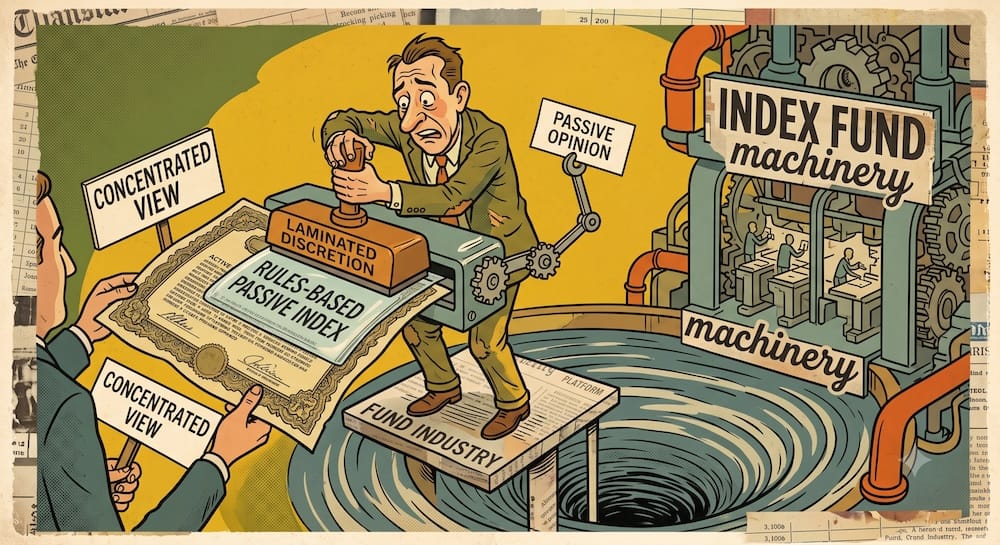
Once those choices have been encoded, the product may operate mechanically. The economic judgment remains alive inside the machinery.
Investors frequently confuse automation with neutrality. I do too. A formula looks objective in a way a committee does not, even though somebody had to decide what the formula would reward, ignore, and rebalance.
The discretion has been laminated.
That is why “passive” has become such a weak analytical term. A portfolio can be passively implemented while carrying concentrated views about industries, factors, valuations, business models, or future demand.
A machine can execute an opinion with perfect discipline.
The ETF market has moved even further away from the old language. Actively managed ETFs represented 11.1% of ETF assets at the end of 2025. Their number rose from 435 at the end of 2020 to 1,935 by June 2025, while assets increased from $166 billion to roughly $1.1 trillion.
“ETF” now tells us how the product is delivered.
“Index” tells us that rules exist.
Neither term reveals whether the investor owns a broad market cheaply or has purchased an expensive forecast wearing a lab coat.
Product Proliferation Turned Market Ownership into Market Slicing
Once broad index exposure became cheap, scalable, and interchangeable, the fund industry faced a commercial problem.
How do you charge more for something investors can already buy for almost nothing?
You make the story narrower, timelier, and easier to market.
A provider can launch another broad-market fund and compete over tiny fee differences. Or it can create a distinctive exposure with a memorable narrative, stronger marketing hooks, a higher fee, and a customer base already warmed up by recent performance.
The ETF industry became remarkably efficient at converting market enthusiasm into investable merchandise.
That judgment is deliberately blunt because the incentive is not especially mysterious.
Bogle raised the issue early. In his 2007 essay “A Tale of Two Markets”, he observed that only 12 of the 690 existing or registered ETFs represented broad market segments. Specialization was overtaking diversification.
By June 2025, the number of US-registered ETFs had more than doubled from its level at the end of 2015.
Some of that growth reflects legitimate uses. Institutions employ ETFs for liquidity management, hedging, and precise exposure. Investors may seek markets or asset classes unavailable through traditional mutual funds. Product proliferation alone proves very little.
The timing and packaging deserve far more suspicion.
Many specialized ETFs appear after a theme has already generated strong returns, media attention, investor excitement, and rising valuations. Product development then arrives to satisfy demand created by the past.
The product is sold as access to the future. Its commercial viability may depend heavily on yesterday’s chart.
A 2023 study by Itzhak Ben-David, Francesco Franzoni, Byungwook Kim, and Rabih Moussawi, published in the Review of Financial Studies as “Competition for Attention in the ETF Space”, found that specialized ETFs in the historical sample lost roughly 30% on a risk-adjusted basis during their first five years. The authors linked much of the result to overvaluation in the underlying stocks at launch rather than fund expenses alone.
The finding has boundaries. It does not mean every thematic ETF will lose 30% in nominal terms. It does not make every sector product foolish. It does not erase valid institutional, hedging, or portfolio uses.
It does reveal a recurring sequence.
Investor attention rises. Valuations rise. A fund launches. The narrative becomes easier to purchase around the same time its expected return may have weakened.
Broad indexing began as a refusal to identify the next winner. Specialized indexing often packages the prediction after the winner has already completed its media tour.
That is a very different mechanism, even when both products contain the word “index.”
Intraday Liquidity Created the Bogle ETF Paradox
Liquidity is useful.
It allows transactions during market hours. It helps institutions hedge. It supports arbitrage and market making. It enables authorized participants to create and redeem shares and helps keep ETF prices connected to the underlying holdings.
Liquidity also makes changing one’s mind exceptionally convenient.
The value of that convenience depends heavily on the mind receiving it.
A broad-market ETF can remain untouched for decades. The same fund can be sold after a frightening headline, repurchased after prices recover, replaced by a fashionable sector, and switched again when the fashionable sector stops cooperating.
The wrapper executes both approaches efficiently. It does not ask whether the decision deserves assistance.
Bogle’s criticism focused on this separation between operational efficiency and behavioural quality. In “A Tale of Two Markets,” he contrasted the long-term orientation of the classic index fund with the speculative culture encouraged by ETF trading. In “Convergence!” he conceded that sector ETFs could implement an active or speculative decision more efficiently than buying the underlying securities individually.
That concession captures the ETF paradox better than his more theatrical criticisms.
Financial technology can improve the execution of a bad idea.
Where I part company with Bogle is his tendency to treat heavy ETF trading as evidence about the ordinary holder. Aggregate trading volume cannot tell us how long an individual household keeps its position. Institutions, hedgers, arbitrageurs, and market makers may trade the same shares repeatedly while another investor owns the fund for twenty years.
The ICI’s 2024 household survey complicates the picture. Among ETF-owning households, 78% cited retirement saving as a goal, 98% valued cost effectiveness, and 97% valued diversification. At the same time, 93% valued intraday tradability.
Those figures do not prove disciplined behaviour. They do demonstrate that long-term intent and a preference for liquidity can coexist.
Bogle’s diagnosis was directionally useful and evidentially too broad.
The stronger criticism concerns the environment ETFs help create.
Tradability lowers the friction of intervention. Product proliferation supplies endless alternatives. Financial media supplies urgency. Performance rankings identify recent winners. Specialized funds convert the resulting impulse into a transaction before the investor has had much time to become less impressed with the story.
The ETF does not force anyone to chase performance. It does make the chase feel professional, precise, and only one click away.
Bogle Was Not Simply “Against ETFs”
Bogle’s position is often flattened into a convenient historical sound bite: he disliked ETFs.
His actual position was conditional and more useful.
In “Convergence!”, he wrote that all-stock-market ETFs could replicate and “possibly even improve on” the paradigms of the original index fund when bought and held over the long term. He described purchasing broad-market ETFs and holding them for life as a sound strategy. He also accepted legitimate portfolio-completion uses, including offsetting an existing concentration.
That is a long distance from blanket opposition.
His real target was the surrounding culture: rapid trading, narrow specialization, tactical switching, product launches tied to recent performance, and the transformation of indexing into another distribution system for forecasts.
Bogle occasionally allowed the ETF wrapper to stand in for the entire trading culture he disliked. That made his criticism memorable. It also made parts of it less precise than his own qualifications warranted.
The distinction he was trying to defend remains valuable.
Three questions matter more than the wrapper’s name:
- What does the fund own? Broad market exposure carries a different decision burden from a concentrated thematic slice.
- What does it cost to hold and use? The expense ratio is only one component. Spreads, transaction costs, taxes, and turnover can matter as well.
- What behaviour does the product encourage? A fund sold around a timely narrative creates a different decision environment from a broad holding designed to remain in place.
Those questions apply to mutual funds and ETFs alike.
The exchange listing changes implementation. It cannot tell us whether the investor is following Bogle’s system.
Bogle accepted the engineering improvements. He distrusted the commercial ecosystem assembling around them.
The ETF industry spent the following decades making his suspicion look increasingly reasonable, even when his rhetoric sometimes aimed too widely.
The Modern Bogle Scorecard: Inheritance, Improvement, and Reversal
Bogle’s ETF-era legacy becomes clearer when modern developments are divided into three groups.
| Category | ETF-era development | Relationship to Bogle’s mechanism |
| Boglean inheritance | Broad diversification, transparent rules, low expenses, low portfolio turnover | Preserves the original system |
| Legitimate improvement | Continuous market pricing, brokerage portability, creation and redemption flexibility, stronger fee competition, potential US taxable-account efficiency | Improves implementation |
| Reversal | Narrow thematic exposure, leverage, performance-sensitive launches, rapid switching, forecast-heavy index construction | Reintroduces concentration and decision dependence |
The first group represents Bogle’s victory. Investors can obtain broad exposure more cheaply and conveniently than he could have imagined in 1976.
The second group shows why nostalgia for the mutual-fund wrapper is misplaced. Better portability, distribution, pricing flexibility, and tax mechanics can strengthen the system he built.
The third group contains the real conflict.
An ETF can track an index perfectly while violating nearly every constraint Bogle cared about. It can be narrow, expensive, dependent on a popular forecast, designed for repeated intervention, and launched after investor enthusiasm has already pushed valuations higher.
Accurate index tracking cannot rescue an incoherent investment process.
I find the usual mutual-fund-versus-ETF debate increasingly useless. It encourages investors to choose sides in a wrapper contest while ignoring the architecture that determines how many things must go right.
That is the better decision rule: how much successful judgment does the complete system demand?
Broad ownership reduces dependence on security selection. Low costs reduce the return lost to intermediation. Low turnover reduces implementation friction. Long holding periods reduce dependence on timing, prediction, and emotional control.
As a product moves away from those constraints, it requires more investor skill, more correct judgment, more restraint, and more luck.
Bogle gave investors a mechanism built around fewer decisions. The modern fund industry delivered better tools, lower fees, and several thousand additional decisions to make.
His legacy survives wherever the tools remain subordinate to the mechanism.
What was John Bogle’s main contribution to index investing?
Bogle’s main contribution was democratizing low-cost index investing for ordinary investors and framing it as a complete mechanism: broad ownership, deep diversification, low expenses, low turnover, and long holding periods.
Did John Bogle oppose all ETFs?
No. Bogle accepted that broad-market ETFs could replicate or even improve on the original index fund when they were bought and held for the long term. His strongest objections concerned frequent trading, narrow specialization, and the culture built around tactical ETF use.
How can an ETF track an index and still depart from Bogle’s philosophy?
An index can encode concentrated views about sectors, factors, themes, leverage, weighting, and rebalancing. Mechanical execution does not remove the economic judgments built into the rules, so accurate index tracking can coexist with a portfolio that abandons Bogle’s broader constraints.
Why can intraday ETF trading create behavioural friction?
Intraday liquidity makes intervention easier. It allows a long-term holding to be sold, switched, or chased throughout the trading day, while product proliferation and performance rankings supply a constant stream of alternatives and reasons to act.
Are ETFs always cheaper or more tax-efficient than mutual funds?
No. Expense ratios do not capture every cost, because ETF investors may also encounter bid–ask spreads, commissions, premiums, discounts, and execution differences. Potential tax advantages also depend on factors such as account type, fund structure, portfolio activity, jurisdiction, and investor circumstances.
How can investors judge whether a fund preserves Bogle’s mechanism?
The useful questions are what the fund owns, what it costs to hold and use, and what behaviour it encourages. A fund remains closer to Bogle’s system when it reduces dependence on security selection, unnecessary expenses, turnover, timing, and repeated intervention.
This article is also available in Spanish. [Leé la versión en castellano: El legado de John Bogle en los ETF y fondos indexados: qué acertó y qué cambió]