I hate the active-versus-passive debate because it makes smart people sound like they joined rival potato cults. You know the drill. One side screams that markets are an unyielding random walk and active managers are just expensive fortune tellers in tailored suits. The other side points to a handful of historical outliers, puts up a picture of a legendary investor, and treats active management like a mystical spiritual gift.
It is a loud, exhausting, and fundamentally lazy conversation. And if you want to understand why it is lazy, you have to look at David Swensen.
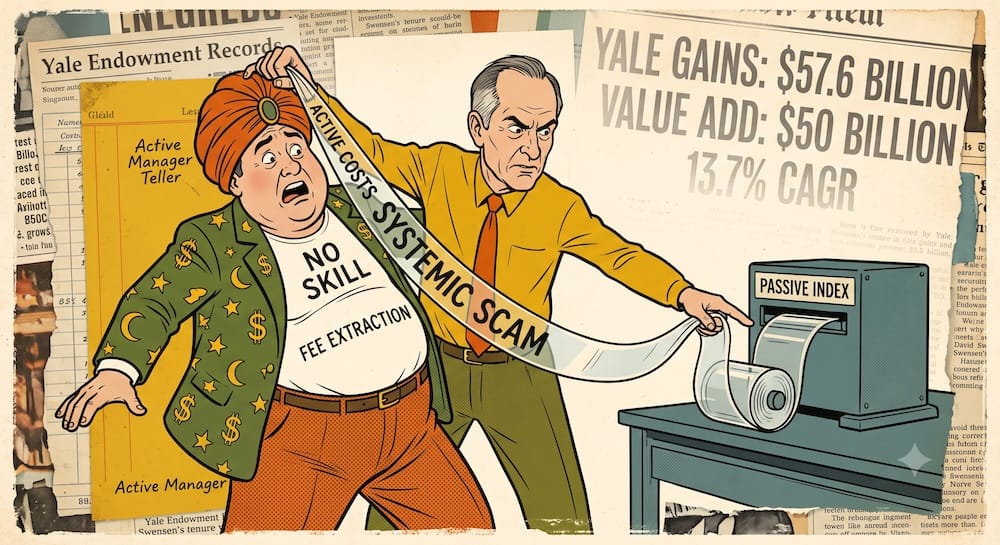
Swensen managed Yale University’s endowment for thirty-six years. It was a historic run that produced a 13.7% annualized return, $57.6 billion in absolute investment gains, and more than $50 billion of value added relative to the average institutional endowment. If you look at those numbers through a generic institutional lens, you might conclude that Swensen was the ultimate high priest of active management. After all, he moved Yale’s capital aggressively away from basic bonds and public stocks, leaning heavily into private equity, venture capital, and absolute return hedge funds.
But then you read his book for individual investors, Unconventional Success, and your brain hits a structural wall. In that text, Swensen writes about active public mutual funds with the kind of cold, calculated fury usually reserved for systemic financial scams. He explicitly tells everyday investors to completely abandon the search for active managers, strip out all active costs, and build a passive index portfolio.
So, which is it? Was David Swensen an active disciple or a passive evangelist?
The truth is, he was neither. Swensen’s entire framework makes no sense if you divide the world into “active good” or “active bad.” It makes perfect sense when you realize he was pro-skill, but only when the market structure was inefficient enough, the manager was exceptional enough, the structural terms were aligned enough, and Yale could actually get a seat at the table.
I do not think Swensen was “pro active management.” That is too stupid and tidy, which means Wall Street probably put it in a brochure. Swensen was an extreme manager underwriting machine. He understood that in the right hands, under the right conditions, active management can create staggering wealth—but without access, alignment, and repeatable skill, it is just a sophisticated mechanism for polite fee extraction.
Why Swensen Paid Active Managers at Yale and Told Everyone Else Not To
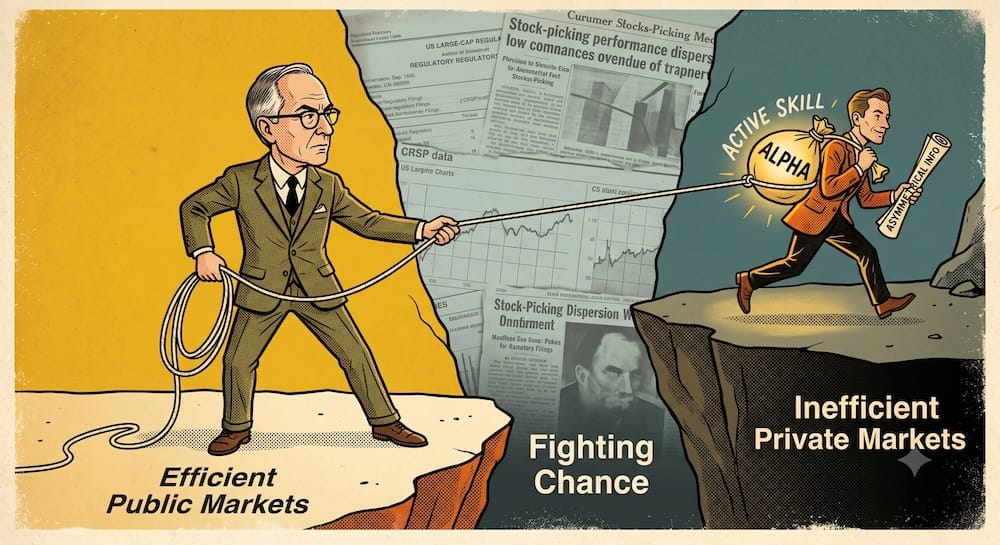
I have sat across from plenty of DIY investors over coffee who think they can copy Swensen by finding a hot mutual fund manager or a boutique stock-picker. They look at Yale’s numbers and think active management is a universal good. But Swensen’s career makes absolutely no sense if you look at it that way. He divided the investment world into clean, non-negotiable territories: efficient markets where indexing wins hands down, inefficient markets where true skill has a fighting chance, and productized retail active management where the individual investor usually gets mugged politely by fee layers.
When I look at Swensen’s split approach, I see a clear, calculated strategy based on structural math, not personal dogmas. He paid active fees at Yale because he was playing an entirely different game, under entirely different conditions, than an individual investor running an account on a laptop.
To see what he saw, we have to look at the market through his specific efficiency filter. He didn’t evaluate investments based on how exciting they sounded in a pitch deck; he evaluated them based on how much information friction existed in the arena.
The Efficiency Spectrum: Where Active Skill Has a Fighting Chance
In highly efficient public markets—like US Large-Cap Equities—information flows almost instantaneously. Thousands of analysts, algorithms, and institutional allocators are looking at the exact same public data, staring at the exact same regulatory filings, and trading the exact same securities with near-zero transaction costs. In that kind of environment, creating a sustainable, structural informational edge is incredibly difficult.
Because the information is instantly priced, the difference between what a top active stock-picker identifies and what the market already knows is incredibly narrow. Swensen observed that the performance gap between a top-quartile manager and a bottom-quartile manager in highly efficient public equities tends to be historically tight—often estimated to be in the neighborhood of 2% to 4% annualized.
When you introduce active management fees, trading costs, and structural drag into an arena where the performance dispersion is that tight, the costs systematically hollow out the edge. You are essentially paying a dollar in expenses to chase fifty cents of potential outperformance. It is a mathematically losing game. I do not care how smart the manager sounds or how impressive their degree is; the structural friction of an efficient market will eat them alive over time.
But when you step off the public exchange and enter private, illiquid, and highly fragmented arenas, the structural rules change completely.
+-------------------------------------------------------------------------------------------------------+
|                                        THE EFFICIENCY SPECTRUM                                        |
+-------------------------------------------------------------------------------------------------------+
| Market Arena            | Efficiency Level | Manager Dispersion | Swensen's Rule   | Failure Mode     |
+-------------------------+------------------+--------------------+------------------+------------------+
| Efficient Public        | High             | Often Tight        | Index Heavily    | Fee Drag Eats    |
| Equities                |                  | (e.g., 2% - 4%)    |                  | Tiny Edges       |
+-------------------------+------------------+--------------------+------------------+------------------+
| Inefficient Private     | Very Low         | Can Be Massive     | Underwrite       | Buying Average   |
| Markets (PE/VC)         |                  | (often >15%)       | Extreme Skill    | Exposure Net of  |
|                         |                  |                    | Only             | Layered Fees     |
+-------------------------+------------------+--------------------+------------------+------------------+
| Retail "Liquid" Active  | Fractured        | Irrelevant due to  | Avoid Entirely   | Severe Adverse   |
| Wrappers                |                  | Structure          |                  | Selection & Cost |
+-------------------------+------------------+--------------------+------------------+------------------+
In private equity or early-stage venture capital, there is no centralized public order book. Information is asymmetrical, proprietary, and closely guarded. A venture capitalist who has spent a decade building relationships in a specific technology ecosystem can often find, evaluate, and structure a deal before the rest of the world even knows the target company exists.
Because these private arenas are structurally inefficient, the difference between an exceptional allocator and a mediocre one is not a minor percentage gap. Swensen emphasized that manager dispersion is much wider in private and alternative markets than in efficient public equity markets. In these private spaces, historical data indicates that the performance chasm between top-quartile managers and average allocators can, in many cases, exceed 15% per year.
This dispersion is the entire mathematical justification for active management. If the gap between the best and the worst is vast, then the act of selecting a manager becomes the single most critical driver of returns. In private markets, “asset class exposure” is not enough because the manager is the asset. If you own the category but pick a median manager, you get all the illiquidity, all the complexity, and none of the alpha. You risk paying institutional-scale fees for returns that fail to outpace simple, liquid public benchmarks.
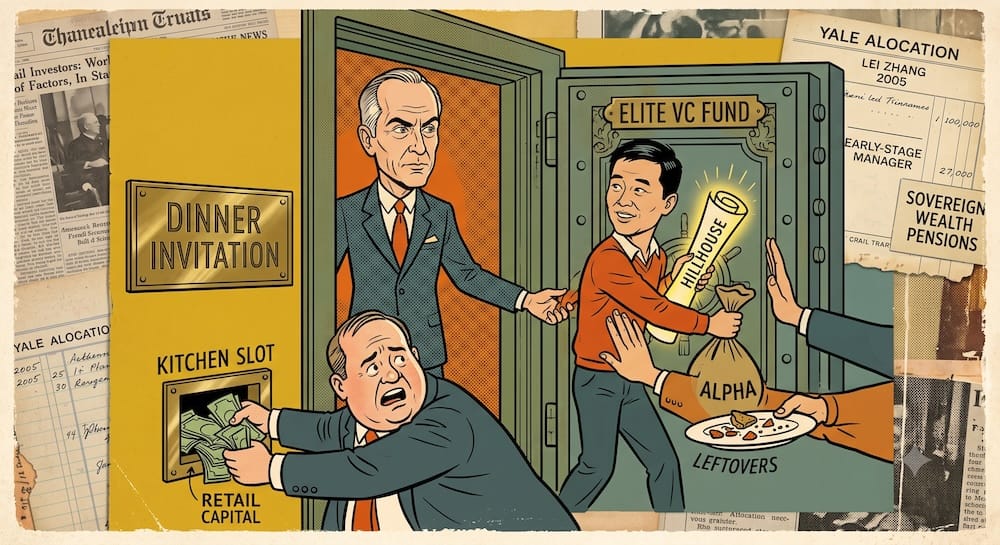
Access: The Best Managers Are Not Sitting Around Waiting for You
Access is the part of the conversation nobody wants to talk about because it completely ruins the retail fantasy. Let’s say you look at the efficiency spectrum, you see that massive manager performance dispersion in venture capital, and you say, “Great, I will just build an active selection portfolio of private equity managers”.
I have to tell you: good luck getting into the room.
The structural reality of elite private markets is that they are strictly capacity-constrained. A public mutual fund can scale its assets from $1 billion to $50 billion by simply buying more shares of liquid mega-cap stocks. It might suffer some style drift or market impact costs, but the fund can physically accept the cash.
An elite venture capital or private equity fund cannot do that. There are only so many truly disruptive early-stage startups or high-quality private companies available to buy in any given vintage year. If a top-tier private firm accepts too much capital, they are forced to do lower-quality deals, overpay for assets, or write larger checks into companies they haven’t fully vetted. Their alpha dies under the weight of excess cash.
Because elite managers understand this, they explicitly cap their fund sizes. And because they cap their fund sizes, they choose their investors, not the other way around.
During his thirty-six years at Yale, Swensen built an un-replicable structural access network. Yale’s capital was highly coveted by top-tier firms not just because it was a multi-billion-dollar pool, but because it possessed specific institutional qualities that made it the ultimate partner capital:
- Extreme Stability: Yale has a multi-century permanent time horizon. They do not face sudden retail redemptions, panic-driven margin calls, or shifting quarterly board mandates.
- Institutional Prestige: Having Yale back your fund is a massive stamp of institutional credibility that can help private managers attract other sovereign wealth and pension capital.
- Decade-Long Persistence: Swensen backed managers early in their life cycles—sometimes writing a foundational check to seed an emerging firm, as he famously did with Lei Zhang at Hillhouse Capital in 2005. When those managers went on to become global powerhouses, they remembered who stood by them when they were operating out of a small office with no track record.
This means that when an elite firm launches a new vintage fund, the allocation tends to be filled rapidly by a legacy list of multi-billion-dollar institutions that have been in the circle for decades. They do not need your capital. They are deciding which billion-dollar institutions to reject politely.
If a supposedly elite private manager is being sold to me through a mass-market funnel or a flashy online retail platform, I immediately assume I am not being invited to dinner. I am being handed leftovers through the kitchen door. Access is a compounding loop. Yale’s early structural relationships created persistent access to top-quartile alpha, a mechanism that simply cannot be replicated by an individual typing a ticker symbol into a standard retail brokerage account.
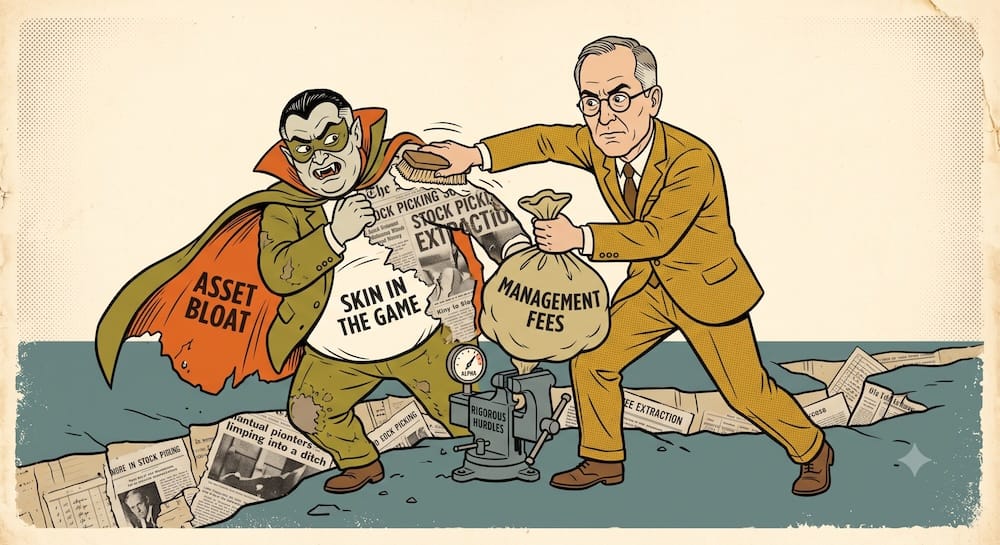
Alignment: Who Gets Paid, When, and For What?
If access gets you into the room, alignment is where the bodies get buried. Fees tell you exactly who gets paid even when the strategy limps into a ditch. Swensen was deeply cynical about Wall Street’s traditional incentive structures. He understood that the financial services industry is primarily designed to build asset-gathering empires that collect predictable management fees, rather than compounding capital to generate true alpha.
When Swensen evaluated a manager for Yale, he didn’t look at their pedigree or their glossy marketing materials. He looked at the contract mechanics, the fee stack, and the economic incentive structure. He wanted to know exactly who got paid first, how they got paid, and what happened when the strategy inevitably hit a rough patch.
I am suspicious of any manager who wants permanent capital from me but keeps total fee optionality for themselves. That is not alignment. That is a hostage negotiation with quarterly reporting.
Swensen used his massive institutional scale to actively rewrite the rules of manager engagement. If an absolute return manager wanted Yale’s capital, they couldn’t just demand a standard, flat performance fee on nominal gains. Swensen pushed for rigorous performance hurdles relative to risk-free Treasury rates, ensuring that Yale primarily paid performance incentives for genuine, active excess return rather than simple market beta expansion. He also utilized direct co-investment sleeves, where Yale could invest alongside a private equity manager on specific deals at a 0% management fee and 0% carried interest structure, effectively driving down the aggregate cost of the allocation.
To understand how Swensen tested for alignment, we can look at the structural markers he used to separate true capital compounders from commercial asset gatherers:
+------------------------------------------------------------------------------------------------------------+
|                                            THE ALIGNMENT MATRIX                                            |
+------------------------------------------------------------------------------------------------------------+
| Alignment Test      | Good Sign                       | Bad Sign                       | Samuel Verdict    |
+---------------------+---------------------------------+--------------------------------+-------------------+
| Skin in the Game    | Manager invests massive         | Principal collects management  | No skin,          |
|                     | personal wealth in fund         | fees; minor personal capital   | no trust          |
+---------------------+---------------------------------+--------------------------------+-------------------+
| Capacity Discipline | Firm closes fund explicitly     | Firm gathers assets endlessly  | Asset bloat is    |
|                     | to protect alpha                | across dozens of strategies    | alpha cholesterol |
+---------------------+---------------------------------+--------------------------------+-------------------+
| Fee Structure       | Rewards true excess return above| Charges premium active fees    | Fee Dracula       |
|                     | strict benchmark hurdles        | for benchmark-hugging beta     |                   |
+---------------------+---------------------------------+--------------------------------+-------------------+
| Strategy            | Complete domain consistency;    | Style-drifts into trendy macro | Strategy          |
| Consistency         | knows its specific game         | concepts or hot asset classes  | tourist           |
+---------------------+---------------------------------+--------------------------------+-------------------+
| Transparency        | Explains structural risks       | Hides underperforming periods  | Fog machine       |
|                     | clearly and admits mistakes     | behind dense marketing jargon  | with invoices     |
+---------------------+---------------------------------+--------------------------------+-------------------+
A manager who refuses to close a fund is telling you something. They may not say “asset gathering matters more than alpha,” but the cash register has a lovely singing voice. Swensen knew that asset bloat is the natural enemy of alpha. When a firm’s primary operational focus shifts from performance generation to maintaining a massive marketing infrastructure, their incentives are broken. They risk becoming risk-averse asset retainers, hiding behind closet indexing to protect their management fee stream rather than taking the concentrated, non-consensus risks required to generate genuine outperformance.
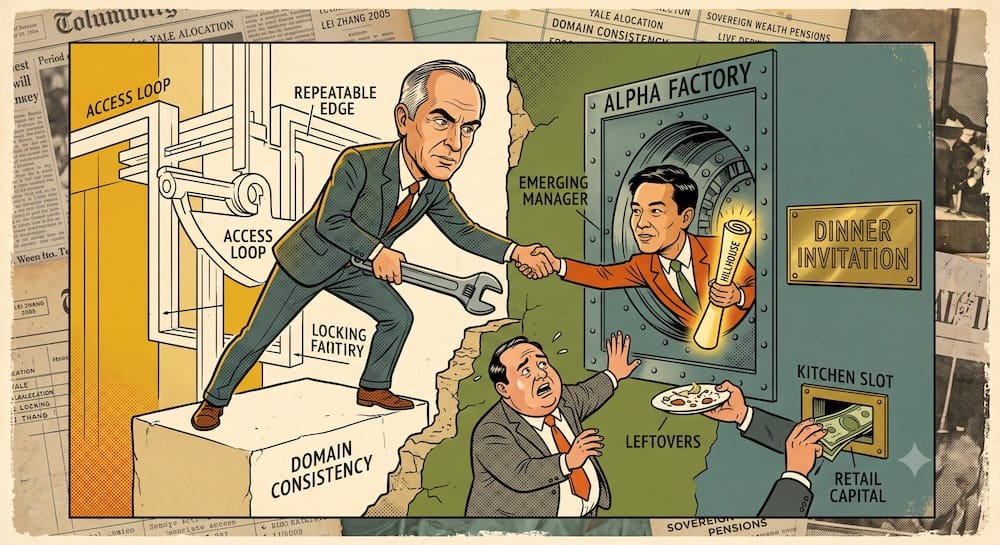
Skill: Not a Pitch Deck, Not a Founder Story, Not a Backtest
Manager selection is not reading a glossy deck and deciding the founder has “vision.” That is not due diligence. That is a vibes-based mugging.
In the institutional arena, Swensen looked at manager skill with the cold detachment of a forensic accountant. He understood that in a complex, chaotic market system, recent outperformance is an incredibly noisy metric. A manager can look like an absolute genius for five years simply because they happen to be structurally long a specific macroeconomic factor or a hot sector theme that is currently being bid up by the market. That isn’t skill; it’s a temporary beta tailwind masquerading as alpha.
“Proprietary process” is one of those phrases that makes me reach for my wallet, not because I want to invest, but because I want to make sure it is still there. When a manager hides behind complex, black-box terminology or spins an elaborate narrative about their unique cultural insights, Swensen’s baseline reaction was deep skepticism.
True manager skill is something far more mechanical, disciplined, and boring. Swensen defined skill through specific operational markers:
- Independent Sourcing: The ability to find and originate deals outside of crowded, institutional auction processes where prices are driven up by frantic bidding wars.
- Repeatable Edge: A clearly articulated, structurally sound reason why the manager can exploit a specific market inefficiency over and over again. If the manager cannot explain exactly where the edge comes from, who is on the other side of the trade, and why the edge will not disappear when assets double, I start looking for the exit.
- Uncompromising Domain Consistency: Staying locked into a specific geographic or operational circle of competence, even when that sector is deeply out of favor and underperforming for years.
- Process Survivability: Skill is not a backtest. Skill is what survives when the backtest gets punched in the mouth. Swensen valued managers who could endure prolonged periods of severe tracking error and relative underperformance without panic-selling their assets, shifting their core philosophy, or style-drifting into whatever trend was currently fashionable on Wall Street.
Yale’s Manager Selection Machine
What did this discipline actually look like in practice inside the Yale Investment Office? It looked like a highly intensive, long-cycle underwriting operation that bears absolutely zero resemblance to how retail investors buy funds.
Yale’s team did not pick managers from a database ranking or an investment consultant’s glossy spreadsheet. Their due diligence cycles routinely took months, and in some cases, years, before a single dollar of capital was committed. They would conduct deep-dive background reviews, often interviewing former employees, competing managers, and portfolio company founders to evaluate how a manager behaved when a deal went completely sideways.
They performed exhaustive historical attribution analysis, stripping away the broad market’s returns to isolate whether a manager’s historical gains were driven by genuine security selection or simple industry beta exposure. They audited the manager’s operational infrastructure, their internal compliance controls, and the personal wealth commitments of the principals to verify that a meaningful portion of the manager’s personal net worth was locked inside the same vehicle alongside Yale’s capital.
More importantly, the machine didn’t stop once the capital was allocated. Yale maintained continuous look-through monitoring of their managers’ underlying portfolios. If an absolute return hedge fund claimed to run a market-neutral, uncorrelated strategy, but Yale’s internal factor models indicated the manager was quietly loading up on hidden equity beta or illiquid credit structures to goose their short-term performance, Yale would look to systematically reduce or restructure the allocation.
Yale was entirely willing to part ways with managers the moment alignment cracked, fund capacity was ignored, or the underlying investment process showed signs of structural decay. It was a process built on institutional patience, deep structural relationships, and an unyielding refusal to accept average, productized asset exposure.
The Retail Trap: Buying Access Without Access
Now, let’s look at how the modern retail financial services industry handles this institutional record. They look at Yale’s historic 36-year outperformance, they ignore the entire operational machine behind it, and they launch a wave of productized retail wrappers designed to sell the illusion of the Yale Model to the public.
They call them “liquid alternatives,” interval funds, or private equity feeder complexes. The marketing pitch is incredibly seductive: “For decades, elite university endowments have used alternative assets to beat the market. Now, through our innovative new fund wrapper, you can finally harvest the same institutional premiums inside your own brokerage account.”
It is an incredibly effective sales pitch, but it ignores the fundamental law of private market structure: adverse selection.
Because the elite, top-quartile managers are completely closed to new capital and choose their own partners based on legacy institutional relationships, they have zero incentive to participate in retail democratized platforms. They do not need to deal with retail regulatory frameworks, high platform distribution costs, or fractional capital flows.
Therefore, the managers who actually sign up to place their strategies inside a retail “liquid alt” or a democratized private equity feeder fund are often the managers who could not fill their capacity requirements from the institutional circle. Individual investors enter an arena where the structural danger is getting access primarily to average or bottom-quartile allocators.
+---------------------------------------------------------------------------------------------------+
|                           THE RETAIL ALTERNATIVE ADVERSE SELECTION LOOP                           |
+---------------------------------------------------------------------------------------------------+
| Elite Top-Quartile Managers -> Capacity Constrained -> Closed to Public Capital                   |
|                                                                                                   |
| Retail Alternative Platforms -> Open to Public Capital -> Can Only Access Un-Funded Managers      |
|                                                                                                   |
| RESULT: Retail investor pays layered, active fees for average or underperforming private asset     |
|         exposure net of costs.                                                                    |
+---------------------------------------------------------------------------------------------------+
Worse, look at the fee layering inside these retail alternative structures. A standard private equity feeder fund often charges a platform wrapper fee on top of the underlying manager’s management fees and carried interest performance cuts. By the time these layered expenses chew through the portfolio, the net hurdle required to simply break even with a basic, cheap public index fund is absurdly high.
When I see people chasing these products, it makes me realize how well marketing decks work. Investors take on structural illiquidity, opaque reporting, complex tax reporting friction, and severe adverse selection risk—all while paying multiple layers of fees to asset-gathering institutions. Trying to execute the Yale Model this way means buying an expensive marketing illusion wrapped in a high-fee retail bow.
What Actually Travels
I like Swensen because he did not worship managers. He interrogated them. There is a difference. One gets you a glossy brochure. The other might save you from a decade of fee compost.
If we peel back the institutional mythology and look at his framework clearly, the conceptual takeaways derived from his manager selection discipline focus heavily on structural boundaries, fee efficiency, and alignment. Rather than serving as a product prescription, Swensen’s work provides a rigorous educational filter for evaluating active risk:
- The Lesson of Efficient Arenas: Swensen’s historical framework indicates that in highly liquid, transparent public markets, market efficiency represents the rational baseline. The conceptual takeaway is that minimizing active turnover, cost drag, and fee friction via simple passive indexing remains the most mathematically sound approach for standard public allocations.
- The Conceptual Warning on Access: The Swensen framework suggests that entering an active strategy without a sustainable, structural edge in access introduces significant adverse selection risk. If an allocation cannot access capacity-constrained, top-quartile alpha complexes, the historical lesson points toward stepping off the active selection treadmill. “Available to buy” is often fundamentally disconnected from “worth owning”.
- The Mandate to Evaluate Incentives: A core takeaway from Swensen’s discipline is to deeply audit the explicit fee structure of any investment vehicle. When a vehicle’s economics favor asset gathering via high base fees over true performance compounding relative to strict hurdles, the underlying alignment is compromised.
- The Distinction Between Manager and Category: In inefficient private spaces, the asset class label itself tells you very little. Because manager performance dispersion is so wide, a reader can take the principle that the manager—not the category—is the true risk asset. Without the institutional capacity to run multi-month forensic audits, look-through monitoring, and continuous alignment reviews, active selection risks becoming a speculative exercise rather than a repeatable discipline.
The ultimate lesson from David Swensen is not “find your own Sequoia”. Good luck with that. The lesson is to stop pretending manager selection is a casual hobby. At Yale, under Swensen’s discipline, it was precise institutional surgery. For most copycat attempts lacking that scale, that time horizon, and that structural access, it risks becoming a weekend brochure-reading exercise with worse odds, higher friction, and better fonts.
Why did David Swensen advocate for passive indexing for retail investors while running a highly active portfolio at Yale?
It comes down to a structural mismatch in access. Swensen did not view active management as a universal good; he viewed it as a highly restricted privilege reserved for multi-billion-dollar scale and permanent institutional time horizons. He engineered an explicit active selection framework at Yale because the university could access strictly capacity-constrained, top-quartile private managers who completely shut their doors to public money. For retail investors locked out of these elite circles, Swensen calculated that active public mutual funds were a net wealth-destroying illusion due to market efficiency, transaction costs, and fee drag—making passive index funds the only mathematically rational option for the general public.
What is manager performance dispersion, and why does it dictate Swensen’s selection process?
The wider the dispersion, the more the individual manager matters. In highly efficient public equity markets, the annualized performance gap between top-quartile and bottom-quartile active stock-pickers is historically narrow, often falling between 2% and 4%. Because this spread is so tight, active fees systematically eat up the potential outperformance. However, in private equity and venture capital markets, information is highly asymmetric, and manager performance dispersion explodes, frequently exceeding 15% to 20% per annum. Swensen emphasized that in these inefficient alternative spaces, you cannot simply buy the asset class category; the manager is the asset. If you buy a median private allocator, you suffer all the illiquidity friction for zero real alpha.
How can a modern DIY investor protect themselves from the alternative retail “adverse selection” trap?
By realizing that availability often signals underperformance. Elite private capital managers do not use mass-market funnels or retail distribution networks to raise funds; they are routinely oversubscribed by sovereign wealth and pension allocators. Therefore, when the financial services industry packages “democratized private equity,” retail interval funds, or liquid alternative ETFs, they are structurally blocked from accessing top-quartile talent. The retail investor is exposed to an adverse selection loop: you are primarily pitched managers who could not raise capital from institutional circles, wrapped inside layered, wealth-extracting fee stacks that hollow out any underlying illiquidity premium.
What structural attributes made Yale’s capital uniquely attractive to capacity-constrained managers?
Yale offered permanent, patient partner capital. Unlike retail fund complexes that face sudden redemptions or panic-driven margin liquidations during a market crash, Yale operates on a multi-century horizon with incredibly stable liability outlays. This allowed Swensen to offer absolute stability to private managers, backing them early in their operational life cycles—as he did with Hillhouse Capital in 2005—and maintaining allocation persistence across full economic cycles. This permanent institutional timeline created a compounding relationship loop that guaranteed Yale ongoing access to capacity-capped vintage funds while locking out newer capital.
What explicit fee structures did David Swensen look for to ensure true manager alignment?
He searched for severe capacity discipline and high performance hurdles. Swensen actively rejected commercial asset gatherers who expanded fund sizes indefinitely to secure a safe stream of management fees. Instead, he favored boutique managers who explicitly closed their funds to protect their alpha generation capacity. Furthermore, Swensen used Yale’s scale to mandate custom fee contracts, pushing for performance incentives tied strictly to risk-free benchmark hurdles rather than paying active fees for generic market beta expansion. He also demanded that the principals have the vast majority of their personal liquid net worth locked inside the same vehicle, ensuring they ate their own cooking.
Can an individual investor execute the same look-through due diligence process as the Yale Investment Office?
No. For a standard retail or mass-affluent portfolio, true institutional-grade manager underwriting is logistically impossible. Yale’s selection machine did not rely on database rankings or pitch decks; it operated on multi-month forensic underwriting cycles, interviewing former employees, competing allocators, and corporate founders. They executed look-through attribution analysis to strip out hidden beta exposures and closely monitored underlying fund holdings to detect hidden leverage or style drift. Without a dedicated institutional research team and direct access to internal fund data, a weekend investor cannot underwrite active managers—they are simply engaging in vibes-based fund picking.
This article is also available in Spanish. [Leé la versión en castellano: La disciplina de selección de gestores de David Swensen: Por qué importan el acceso, la alineación y el talento]