
I do not naturally trust anything in finance that turns “you can’t get your money back” into a premium. When an investment deck frames a multi-year capital lockup as an elegant structural feature, my inner skeptic immediately activates. That is either a legitimate structural edge or a hostage note with a nicer font.
The investment industry has spent decades turning the phrase “illiquidity premium” into something that sounds like a premium spa treatment. It sells the idea that if you simply let an institutional manager lock your money in a dark closet for ten years, you will magically emerge with outsized wealth. They point to the late David Swensen’s legendary tenure at Yale University as absolute proof that alternative, private, illiquid assets are the ultimate engine for elite wealth creation.
But if you strip away the institutional brochure-speak and look at the actual structural guts of how the system operates, you discover a very different reality.
I hate the phrase “illiquidity premium” because it makes being trapped sound expensive and sophisticated. Sometimes locking up capital is brilliant. Sometimes it is just putting your money in a closet, giving the key to a stranger, and paying them two-and-twenty to tell you the closet is “uncorrelated.”
This article is not another sweeping retrospective on the broad composition of the Yale Model. We are going to go narrower and deeper. We are conducting an analytical autopsy on a single, isolated mechanism: the Illiquidity Premium.
We will break down what you are actually giving up when you sacrifice liquidity, map out the precise structural conditions that allowed David Swensen to turn capital lockups into a multi-billion dollar advantage, examine the official financial records from the 2008 panic when Yale’s own illiquidity bill came due, and expose why the retail copycat version of this strategy is almost always a structural trap.

What Are You Actually Locking Up?
Before we look at how Yale played the game, we need to define the mechanism plainly. Liquidity has intrinsic economic value. If you hold an asset that can be sold instantly at a transparent market price with minimal transaction costs, you possess options. You can pivot when your life circumstances change, exploit fresh market anomalies, or rescue your capital if an operator proves to be incompetent.
I do not think most investors understand how many doors are being locked at once. They hear “seven-year lockup” and think of one simple lock. Usually, it is five distinct locks stacked on top of each other like a cursed finance sandwich.
                       THE ILLIQUIDITY CHAIN OF LOCKS
                       ==============================
 [Redemption Lock] ──► [Capital Commitment] ──► [Valuation Lock] ──► [Opportunity Lock]
        │                       │                     │                      │
   No exit when            Legal capital         Real volatility         Capital is trapped
   life changes            calls in down         hidden behind           while better deals
   unexpectedly.           market regimes.       stale appraisals.       pass you by.
To see the full scope of what an investor sacrifices when they abandon liquidity, we have to look past simple redemption schedules. True illiquidity is a multi-layered chain of constraints.
The Structural Architecture of a Lockup
| Lockup Type | What the Lockup Means | When It Creates an Advantage | When It Becomes a Structural Trap |
| Redemption Lockup | You are contractually barred from withdrawing capital for a fixed multi-year duration. | Allows an operator to execute long-term turnarounds or build physical infrastructure without fearing sudden investor runs. | Your household faces an unexpected liability shock—like a sudden job loss or medical emergency—and your assets are legally held hostage. |
| Capital Commitment | You don’t just invest a lump sum; you sign a contract promising to fund future capital calls on demand. | Gives the fund manager a guaranteed war chest to buy distressed assets when public markets are crashing. | Capital calls arrive at your doorstep when your liquid assets are severely depressed, forcing you to fund the calls at the worst possible time. |
| Valuation Lock | The asset has no public market price ticker; its value is determined periodically by appraisal metrics. | Dampens short-term psychological panic by hiding daily market volatility from emotional investors. | The stability is an accounting illusion. The true underlying value may be deteriorating long before the stale appraisal reflects it. |
| Manager / Operator Lock | You cannot easily fire the asset operator or transfer your stake to a different investment firm. | Protects the manager from activist interference, allowing them to focus entirely on execution. | You discover the manager is mediocre, lazy, or charging predatory fees, but you are legally trapped with them for a decade. |
| Opportunity Lock | Your capital is permanently deployed in a slow-moving, multi-year strategy. | Forces deep patience and prevents you from micro-managing or constantly tinkering with your allocation. | A historic, high-yielding market anomaly appears elsewhere, but you can only watch from the sidelines because your money is locked in a basement. |
Illiquidity is not an inherent superpower. It is a highly restrictive contract. Time only pays you back for signing that contract if you possess the specific balance sheet machinery required to sit there looking stupid for years at a time.
When Locking Up Capital Becomes an Advantage
I am not anti-illiquidity. That would be lazy, and I like to think we aim a little higher around here. Some of the best investment structures in history required patience, multi-year lockups, and a willingness to look temporarily insane. I am just anti-pretending that every locked door has treasure behind it.
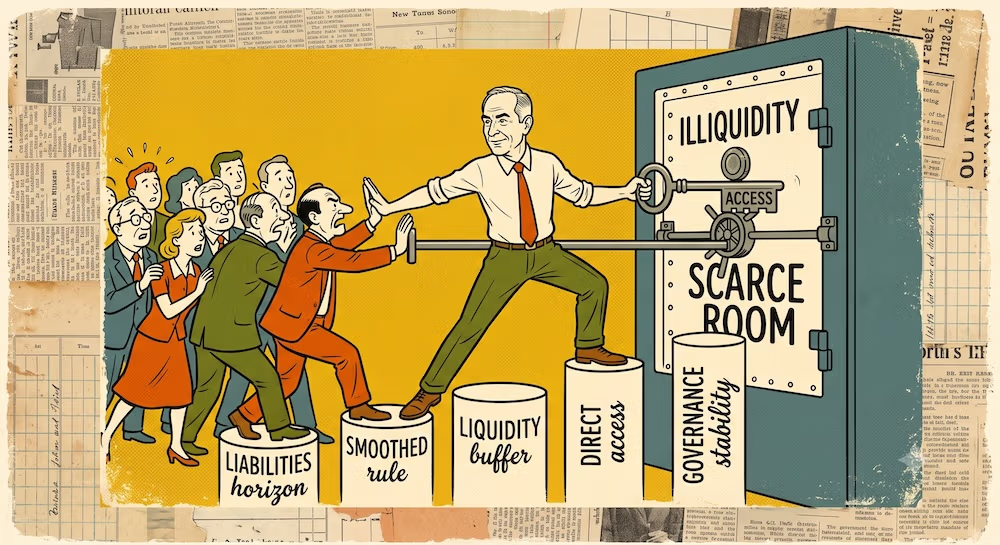
True illiquidity premiums only exist when an investor operates with a highly specific set of institutional advantages. If you do not possess these five specific structural pillars, locking up your capital is not an advantage—it is an uncompensated vulnerability.
1. Long-Duration Liabilities
An investment horizon is not a psychological mood. It is a mathematical reality dictated by your cash liabilities.
Yale’s endowment could give up liquidity because it is structured to support the university in perpetuity. Its spending rule and long-term mandate gave Swensen a very different liability profile from a household, a small institution, or a nervous allocator with short-term cash needs. Its liabilities are not dictated by unexpected human lifecycle events, sudden retirements, or household medical bills.
2. A Smoothed Spending Rule
If an institutional fund had to liquidate 20% of its portfolio every time public markets dropped to fund immediate operations, an illiquid portfolio would trigger an immediate systemic failure.
Yale protected its illiquid engine through a highly disciplined spending rule. Annual distributions are governed by a smoothing rule designed to reduce the impact of short-term value swings. If private assets experience a sudden drop or a temporary lack of cash distributions, the university’s operating budget adjusts smoothly over years rather than forcing an immediate firesale of capital to pay the electricity bill.
3. Surplus Liquidity Elsewhere
You cannot hold illiquid assets safely unless you maintain an independent, highly reliable source of liquidity somewhere else on your balance sheet.
Swensen understood that you do not buy illiquid alternatives with your last dollar of cash. Yale maintained public investments, external lines of credit, and cash distribution channels specifically designed to act as a buffer. This buffer ensured that the illiquid side of the ledger could remain completely undisturbed, allowing private investments to mature naturally without being cannibalized for short-term cash needs.
4. Direct Sourcing and Scarce Access
An illiquidity premium doesn’t drop out of the sky just because a deal is private. It exists when a market is genuinely inefficient, opaque, and difficult to navigate.
Yale’s outperformance under Swensen was heavily driven by direct, exclusive access to capacity-constrained active managers. Yale used its immense academic prestige, its early-mover status in alternatives, and its deep institutional network to identify and secure allocations with elite venture capital and private equity operators long before they closed their doors to outside capital. Swensen wasn’t buying generic, mass-market private wrappers; he was buying into scarce, tightly guarded rooms where information asymmetries could be aggressively exploited.
5. Institutional Governance Stability
To capture a long-term premium, your investment committee cannot change its mind every time the financial media panics.
Yale possessed an institutional governance structure that could survive extended periods of relative underperformance without capitulating. When alternative strategies took years to bear fruit, or when private valuations lagged behind furious public market bull runs, the endowment’s leadership did not panic, fire the manager, or scrap the policy allocation targets. This level of bureaucratic discipline is incredibly rare; it requires an alignment of trustees, administrators, and investment staff who all speak the same language of institutional risk.
                  THE MACHINERY OF AN INSTITUTIONAL ADVANTAGE
                  ==========================================
    [Permanent Horizon] + [Smoothed Spending] + [Surplus Liquidity Buffers]
                                      │
                                      ▼
                        Earns the Structural Right to:
                                      │
                        ┌─────────────┴─────────────┐
                        ▼                           ▼
            [Lock Up Capital Safely]     [Exploit Scarce Access]

Why Yale Could Play the Game
When you look closely at these pillars, you realize that David Swensen didn’t win because he had a superior asset allocation chart. He won because he had a superior financial vessel.
Yale’s official institutional framework is explicitly designed to support the university across generations, utilizing a long-term investment horizon and a spending rule calibrated specifically to handle short-term market noise. The endowment isn’t an investment portfolio trying to strike it rich on a lucky break; it is a permanent foundation built to sustain a physical campus across centuries.
This permanent structure allowed Swensen to turn the traditional concept of risk completely on its head. For an individual investor, a sudden 30% drop in portfolio value combined with an inability to liquidate assets is a catastrophic emergency. For Yale, that exact same scenario is merely a blip on a multi-century compounding chart.
Yale could afford to negotiate better terms, accept lengthy multi-year lockups, and back unproved, early-stage private operators because its balance sheet had the financial equivalent of a submarine hull. It could take immense pressure without leaking.
Most investors attempting to copy this model do not have a submarine hull. They have a canoe, a wet sandwich, and an incredibly tight timeline.

The 2008 Stress Test: When the Bill Came Due
This is the part of the story I actually care about, because crisis years are when marketing language gets dragged into the parking lot and beaten by reality.
The popular mythology surrounding private alternatives is that they protect portfolios during equity market meltdowns. Because alternative asset marks are smoothed by internal appraisals, the quarterly statements don’t look nearly as terrifying as the public stock tickers. But during a true systemic crisis, that apparent stability can mask an intense operational cash crunch.
Official reporting from the university paints a stark, precise picture of what happened when the mechanics were stressed. During the brutal fiscal year ending June 30, 2009, Yale’s endowment posted a return of -24.6%, with total asset value plunging from $22.9 billion down to $16.3 billion. In its official retrospective disclosures, Yale candidly admitted that its heavy equity exposure severely hurt results, diversification failed to protect asset values, and structural illiquidity further detracted from performance.
The real crisis wasn’t the drop in paper value; it was the cash flow mismatch.
According to Yale’s official 2009 financial report, the university entered the depth of the crisis holding approximately $7.6 billion in uncalled commitments to its private equity, venture capital, and real estate managers. These were legally binding contracts. As the market collapsed, those private managers started aggressively calling capital to preserve their own portfolio companies or buy distressed assets at the bottom.
At that exact moment, Yale management estimated that it could only liquidly access about $3.6 billion in assets to meet short-term needs within a matter of days. The endowment was facing a massive liquidity gap: billions in contracted capital calls coming due, while the vast majority of its assets were locked behind ten-year doors.
                    THE 2009 YALE LIQUIDITY MISMATCH
                    ================================
  [Uncalled Private Commitments] ──► $7.6 Billion (Legally binding cash demands)
  [Estimated Short-Term Liquidity] ──► $3.6 Billion (Available emergency cash)
                                           │
                                           ▼
                            [THE INSTITUTIONAL BUFFER]
                       Nearly $1 Billion in outstanding
                       commercial paper issued to manage liquidity.
How did Yale bridge that gap without executing catastrophic, pennies-on-the-dollar firesales of its private assets in the secondary market?
Yale’s 2009 financial report reveals that the university had nearly $990.7 million in outstanding short-term commercial paper by June 30, 2009, after actively issuing an additional $310 million in commercial paper notes during the fiscal year to manage its immediate liquidity needs.
Yale’s balance sheet gave it tools that a household or small allocator simply does not have: commercial paper capacity, institutional credit access, and multiple liquidity channels. Those tools helped the university manage a period when uncalled commitments, falling asset values, and limited short-term liquidity collided. That is the key lesson. Yale did not merely have patience. It had institutional escape valves. A household allocator caught in a similar cash-flow squeeze has no such escape options; lines of credit get frozen, and the investor is forced to default on commitments or liquidate assets at the worst possible time.

When Illiquidity Becomes a Trap
When you study the 2008 stress test, you realize that illiquidity is useful only when you are being paid to wait. It becomes a brutal, wealth-destroying trap when you are paying someone else to lock you in a room you can’t leave.
For the average investor, confusing “I have a long-term mindset” with “my liabilities are long-term” is one of the most expensive mistakes you can make. Saying you have a ten-year horizon is an excellent emotional bumper sticker. But the mortgage company, the university bursar, and the medical clinic do not accept temperament as a form of payment. I checked. Sadly. If real life punches you in the teeth and you don’t have immediate access to cash, an illiquid asset is not an advantage—it is financial handcuffs sold to you by an advisor in a Patagonia vest.
True illiquidity becomes a trap under a highly predictable set of conditions:
- The Squeezed Retail Horizon: Your capital is locked up for 7 to 10 years, but your actual household cash needs (home purchases, career shifts, family care) operate on a highly variable 2-to-3 year timeline.
- Predatory Fee Layering: You enter an alternative product where the underlying returns are devoured by a triple-layer cake of platform fees, sponsor fees, and active management hurdles.
- The Adverse Selection Dregs: You buy an illiquid product that is marketed heavily to the public, completely ignoring the fact that top-quartile private managers do not raise money on retail platforms. If a deal filters down to a retail portal, it means every institutional sovereign wealth fund and endowment has already passed on it.
- Appraisal-Smoothed Ignorance: You mistake the lack of daily price volatility on your statement for actual safety, unaware that the underlying asset values are quietly deteriorating behind stale, subjective internal valuations.
- Pro-Cyclical Capital Demands: Your private investments call for more money when the global economy is crashing, forcing you to drain your cash reserves precisely when your primary income source is most vulnerable.
Retail Wrappers: The Souvenir Version of Illiquidity
This brings us to the modern financial marketing machine. Because the institutional record of David Swensen is so legendary, asset managers have built a massive industry selling what I call the “souvenir version” of the Yale Model.
I have a special allergy to products that sell “institutional access” to individuals who are clearly being handed the structural leftovers. They package private credit, non-traded REITs, interval funds, and crowdfunding syndicates into glossy retail wrappers. They explicitly tell you that you are buying into the same sophisticated mechanics that built Ivy League fortunes.
             THE INSTITUTIONAL RECKONING VS. THE RETAIL SOUVENIR
             ===================================================
  [THE YALE ENGINE] ───────────────► [THE RETAIL SOUVENIR WRAPPER]
  • Permanent Capital Structure      • Multi-Layered Fee Architecture
  • Exclusive Top-Quartile Sourcing  • Adverse Selection (Institutional Dregs)
  • Institutional Credit Capacity    • Rigid Redemption Gates & Locks
This is where finance marketing gets incredibly slippery. It sells you the prestige of Yale and delivers the liquidity profile of a basement escape room.
These retail wrappers give you all the lockups, all the restrictions, and all the structural illiquidity of the institutional world—but they strip away the direct manager access, the negotiated terms, the institutional credit backups, and the fee leverage that made the strategy profitable in the first place. When an interval fund or a non-traded real estate product reserves the right to drop a “redemption gate” and block your withdrawals during a market panic, you aren’t playing Swensen’s game. You are providing cheap, defenseless liquidity to the product operator while you carry all the exit risk on your back.
What Actually Travels
We need to be unsentimental about market history. We must absorb what travels from the institutional record and ruthlessly expel the folklore. The lesson I take from Swensen is not “go buy illiquid things.” That is the kind of conclusion you reach after reading one chart and completely losing the thread of how the machinery operates. You cannot copy David Swensen’s asset allocation percentages unless you can also copy Yale’s permanent endowment charter, its multi-billion dollar scale, its elite manager network, and its short-term commercial paper issuing capacity.
If you try to copy the look of the Yale Model without possessing its structural bones, you are simply asking to be trapped.
But if we strip away the high-fee private wrappers, several profound, purely conceptual lessons about liquidity do travel cleanly:
- Match Asset Structure to Liability Horizon: The conceptual lesson is that an investment’s lockup should be judged against the realistic duration of the investor’s liabilities. If your personal liabilities are unpredictable, your portfolio’s liquidity must be prioritized.
- Demand Substantial Compensation for Exit Risk: If an investment operator asks you to give up your right to sell, do not accept generic market returns. If the expected return doesn’t offer a massive structural premium to cover the risk of being trapped, treat the structure with extreme skepticism.
- Treat Smoothed Valuations with Sincere Suspicion: Never confuse a stale, appraisal-based accounting mark with a lack of real-world economic volatility. An asset does not become safe merely because its price ticker only updates twice a year.
- Isolate Real Access From Leftover Access: Be radically honest about your place in the financial food chain. If an alternative deal is being sold to you via a mass-market retail campaign, understand that you are likely looking at leftover access that institutional capital did not want.
- True Illiquidity Requires Excess Liquidity Elsewhere: Illiquid assets are safest only when the rest of the balance sheet provides ample liquid options. Illiquidity is only an advantage when you have the absolute financial luxury to never touch the locked door.
Illiquidity is not magic. It is a severe structural constraint. David Swensen built a legendary record because he understood that Swensen’s tenure produced an incredible 13.7% annualized return over 36 years, generating more than $50 billion of value added relative to the average endowment, precisely because he matched that constraint with immense institutional capacity. For the rest of the investing world, the most sophisticated thing you can do is remember that an exit door is worth its weight in gold.
An Educational Note on Strategy Trade-offs
This analysis is intended strictly for educational and historical purposes and does not constitute a personal portfolio prescription, financial advice, or an endorsement of any specific asset class. All allocation structures involve significant mechanical trade-offs. Maintaining an illiquid or highly concentrated asset position inherently exposes an investor to heightened lifestyle liability risk and tracking error. Always ensure your portfolio’s structural liquidity profile aligns with your household cash flow liabilities before executing long-term investment strategies.
What exactly is David Swensen’s illiquidity premium?
It is not a product you can buy off a shelf. Mechanically, it is the economic compensation an investor demands for contractually surrendering their exit door. David Swensen’s execution of this mechanism at Yale showed that by locking up capital for five to ten years in inefficient, opaque private markets, an institution could capture higher compounding returns than those available in highly liquid public equity markets. However, the premium is not an inherent trait of the asset class; it is earned only if you possess the structural machinery to survive the lockup without being forced to liquidate.
What is the minimum portfolio size needed to safely capture an illiquidity premium?
It depends entirely on your cash-flow liability profile, but practically speaking, it requires institutional scale. True illiquidity premiums are heavily concentrated among top-quartile private managers who maintain multi-million dollar investment minimums. For an individual allocator, attempting to lock up money in private markets with a sub-seven-figure portfolio is highly dangerous, as it creates an uncompensated vulnerability without providing direct access to the capacity-constrained managers that Swensen utilized.
How can a retail investor replicate the illiquidity premium without locking up capital?
You cannot replicate it perfectly, but you can capture similar structural risk exposures through liquid, low-cost systematic public equity strategies. Historically, much of the outperformance in private equity came from buying small, deeply undervalued companies and running them with high leverage. A retail investor can access these identical risk premiums by intentionally tilting their liquid portfolio toward small-cap value factors using public ETFs, bypassing the multi-year lockup entirely.
Why do retail alternative investment wrappers underperform Yale’s model?
Adverse selection and predatory fee structures. The elite, top-quartile venture capital and private equity firms that drove Yale’s returns do not need retail capital. The alternative products that filter down to mass-market retail platforms—such as interval funds, crowdfunding syndicates, and non-traded REITs—are typically the leftovers that institutional gatekeepers rejected. When you overlay a triple-layer fee architecture of platform fees, management fees, and performance hurdles, the underlying premium is completely extracted from the investor.
What happened to Yale’s illiquid assets during the 2008 financial crisis?
The structural machinery was pushed to its absolute limit. In fiscal 2009, Yale’s endowment returned -24.6% as asset values dropped from $22.9 billion to $16.3 billion. Because Yale held roughly $7.6 billion in uncalled private commitments but had estimated short-term liquidity of only $3.6 billion, they faced a massive cash-flow mismatch. Yale survived this systemic bottleneck by utilizing its world-class institutional credit capacity to issue nearly $1 billion in short-term commercial paper, a financial survival tool completely unavailable to a standard household.
Does an individual investor actually need an illiquidity premium to build wealth?
No. For the overwhelming majority of individual allocators, liquid public indexes provide more than enough wealth-generation capacity. David Swensen himself explicitly argued in his book Unconventional Success that for 99% of individual accounts, chasing active alternatives is an “unholy mess.” A solid core of low-cost, liquid public market vehicles combined with disciplined, tax-sheltered rebalancing remains the most reliable engine for retail portfolio building.
This article is also available in Spanish. [Leé la versión en castellano: La prima por iliquidez de David Swensen: Cuándo bloquear el capital es una ventaja]