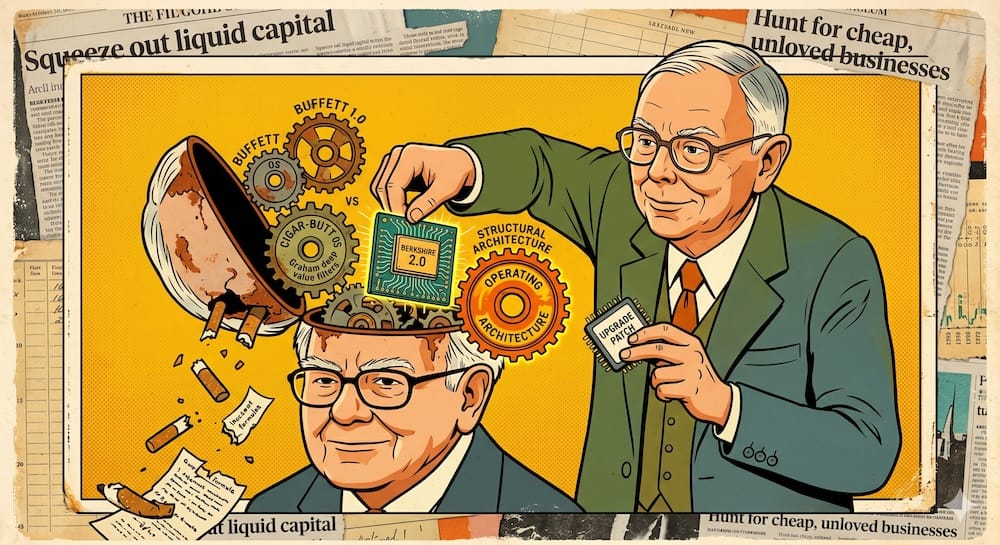
The financial media loves a tidy evolution story. They’ve spent decades painting a picture of Warren Buffett graduating from Benjamin Graham’s classic value framework like a teenager leaving home, discovering better music, and never looking back. In this version of the tale, Buffett leaves behind the dusty world of balance-sheet liquidation math and ascends into the sunny uplands of buying wonderful businesses with competitive moats, leaving Graham in the rearview mirror.
It’s a nice story with several load-bearing parts missing. It is also dangerously incomplete.
Buffett did change over his multi-decade career—but not by throwing Graham away. He didn’t abandon the foundational discipline he learned at Graham-Newman Corp in the mid-1950s. Instead, he kept Graham’s price discipline, his obsessive focus on the margin of safety, his downside protection rules, and his healthy skepticism toward corporate storytelling.
What he did was add a second filter: deeper business-quality analysis.
Think of it this way: Graham was the bouncer at the door, ensuring Buffett never paid fantasy prices for a business. Business analysis was the second ID check, ensuring he didn’t accidentally let corporate compost into the VIP lounge.
The blend matters because either side of the equation alone can hurt you. Graham’s framework without business analysis can trap your capital in cheap, melting ice cubes. Conversely, chasing business quality without Graham’s price discipline turns you into a collector of beautiful overpayment machines. Quality did not give Buffett permission to stop caring about price. That is where modern investors get cute and start lighting money on fire with better vocabulary.
Buffett’s true edge was combining both into a single, cohesive engine: business quality at a price that still leaves a massive room for error.
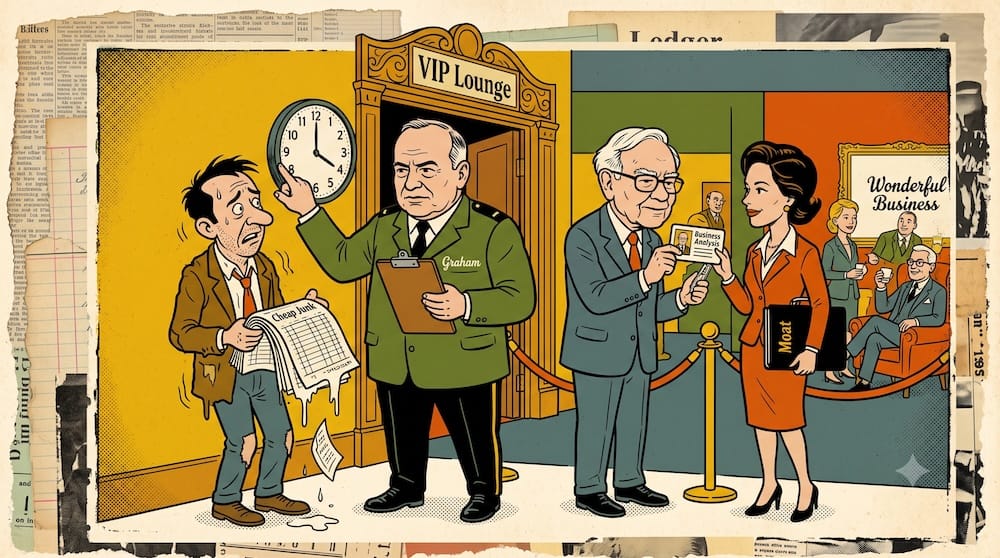
Graham is the ultimate valuation bouncer at the door, but the second ID check for structural business quality is what stops you from filling your portfolio with melting accounting compost. Either filter alone will burn your capital; the true edge is holding the line on both.What Graham Gave Buffett: Price Discipline and Downside Protection
To appreciate why the blend worked, we first have to inventory the raw intellectual tools Graham handed Buffett. This wasn’t just a set of accounting ratios; it was a psychological fortress designed to withstand market insanity.
First and foremost was the concept of the Margin of Safety. Graham’s core thesis was that the future is inherently unpredictable, management teams are fallible, and macroeconomic forces are chaotic. Therefore, you don’t win by being right about the future; you win by making sure that being wrong doesn’t destroy you. You establish a discount between the market price and the intrinsic value of the business so steep that even if the engine sputters, you still clear the runway safely.
Alongside this came the famous Mr. Market psychology—the idea that the stock market is not an elegant, efficient weighting machine, but a wildly emotional business partner who shows up every morning offering to buy your stake or sell you his at completely irrational prices. Your job isn’t to argue with him or trust his mood swings; your job is to exploit his panic and ignore his euphoria.
Graham taught a rigid, rule-bound approach to equity valuation:
- Downside first: Look at the liquidation value of the current assets before you even glance at the earnings projections.
- Distrust stories: Wall Street runs on promotional narratives and hockey-stick growth charts. Ignore them. Focus on what is already owned, earned, and documented.
- Rules before opinions: Establish objective quantitative thresholds to remove human emotion from the equation.
This discipline acted as an anchor. It meant that no matter how alluring a company’s long-term potential sounded, Buffett refused to engage unless the math left a structural floor beneath his feet.
Where Graham Discipline Alone Was Not Enough
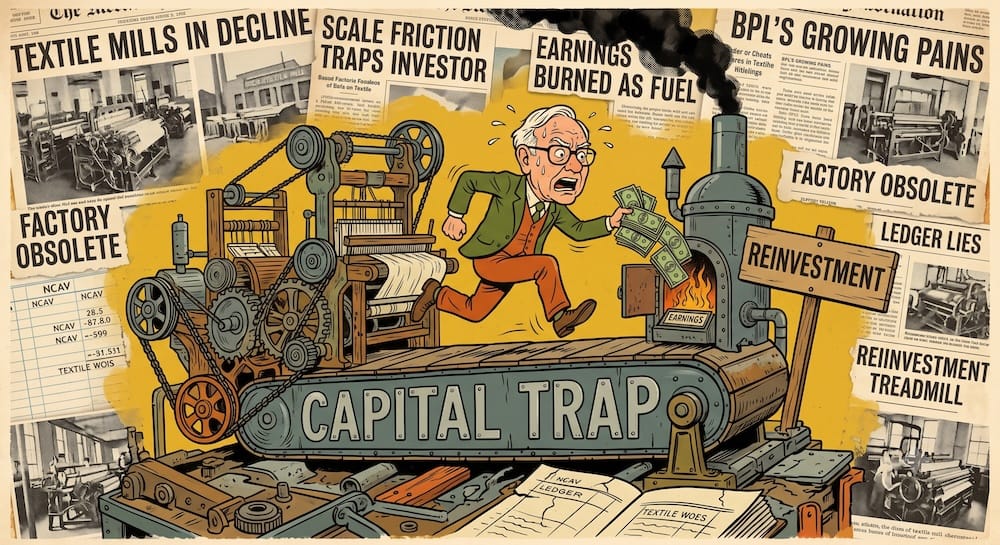
So why couldn’t Buffett just stick to the original playbook? Because pure Grahamite cheapness has a mechanical flaw that becomes glaringly obvious when you transition from a small portfolio to a larger asset pool: cheap businesses can be capital traps.
Graham’s favorite tool was the Net Current Asset Value (NCAV) metric:
NCAV = Current Assets – Total Liabilities – Preferred Stock
Historically, a diversified basket of these stocks could create attractive odds across a portfolio as those assets were liquidated, sold, or mean-reverted to historical norms. The point was not certainty in any single company, but favorable odds across a broad selection.
But there are two major catch-22s to this model. First, book value can lie. An asset-heavy business like a textile mill or a manufacturing plant might have millions of dollars in inventory and machinery on the balance sheet, but if those machines can only produce goods that nobody wants to buy, their real economic value is close to zero.
Second, asset-heavy businesses often require constant, unremitting capital reinvestment just to stay in place. If a company earns a miserable 4% return on its tangible assets, and has to spend every dime of those earnings upgrading its factories just to keep its competitors from eating its lunch, it isn’t a wealth creator. It’s an expensive treadmill.
Furthermore, as the Buffett Partnership Ltd. (BPL) grew in the 1950s and 1960s, scale friction entered the picture. To make a meaningful impact on a larger portfolio, you have to buy larger positions. But micro-cap net-nets are inherently small and illiquid. You cannot deploy hundreds of millions of dollars into tiny, dying companies without driving the purchase price up and destroying the exact discount that made the trade attractive in the first place. Without an explicit corporate catalyst or an exit strategy to unlock that value, the investor becomes trapped in a liquidating asset that drains capital over time.
Sanborn and Dempster: Graham Discipline With Teeth
Early in his career, Buffett solved this liquidation problem not by abandoning Graham, but by applying Graham’s discipline with teeth. If the market wouldn’t realize the value of a cheap stock, Buffett would buy enough corporate control to force the issue himself.
The definitive example of this era was the 1958 investment in the Sanborn Map Co. Sanborn manufactured city maps for insurance underwriters. The core business was in a multi-year decline, but underneath the map operation sat a massive investment portfolio.
The stock was trading on the open market at $45 per share. However, the underlying investment sleeve alone was worth $65 per share. The market had become so blinded by the declining map business that it was pricing the entire corporate entity at a $20 per share discount to its liquid blue-chip assets.
| Asset Metric | Value Per Share |
| Market Price | $45 |
| Underlying Investment Sleeve | $65 |
| Implied Core Business Price | -$20 (Free + $20 Cash Discount) |
Buffett didn’t just buy the stock and hope for a change in sentiment. Utilizing BPL’s aggregated capital, he accumulated a 23% stake, forced his way onto the board of directors, and waged a fierce battle against entrenched management. His goal was simple: separate the investment portfolio from the map business and distribute those liquid assets directly back to shareholders. He engineered his own catalyst, realizing a clean profit independent of market direction.
He repeated this blueprint at Dempster Mill Manufacturing Co. (1961–1963), a manufacturer of windmills and water systems. Bought at a deep discount to its current asset value, Buffett took control of the company, brought in a turnaround specialist to slash bloated inventories, cut unnecessary expenses, and freed up trapped capital to be reallocated into higher-yielding securities.
In both cases, Buffett was operating strictly within the Graham framework. He demanded a clear, quantifiable path to value realization. But these deals required immense operational friction, hostile interventions, and constant corporate restructuring. It was exhausting work, and as his capital base scaled further, even these control situations began to hit a ceiling.
American Express: Better Business Analysis Under Stress
The true bridge between pure Graham cheapness and modern business-quality analysis appeared in 1964, during the infamous Anthony “Salad Oil” Scandal that rocked American Express.
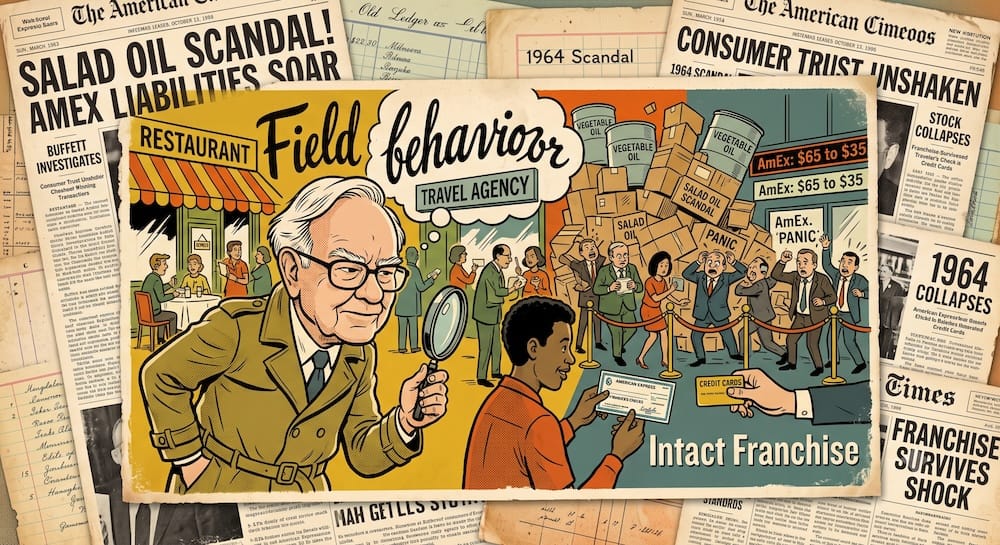
An allied crude vegetable oil company had secured massive loans from banks and warehousing receipts from American Express by filling its storage tanks with water and floating a thin layer of salad oil on top. When the fraud unraveled, American Express’s warehousing subsidiary was suddenly hit with massive potential liabilities, threatening the parent company’s solvency. The stock collapsed from $65 to $35 practically overnight.
A classic Graham purist might have walked away from AmEx. The balance sheet was suddenly compromised by a massive legal liability, and the short-term reported earnings were set to be hit by a train. The story was terrifying.
But Buffett used this crisis to deploy a deeper layer of business analysis under stress. He went out into the field to study customer behavior. He spent days observing restaurants, hotels, and travel agencies, asking a single question: was the scandal destroying the trust in the American Express brand?
[Salad Oil Scandal / Legal Shock] ──► Collapses Stock Price ($65 to $35)
                                      ▲
                                      │ (Buffett checks field behavior)
[Core Traveler's Checks & Cards] ────┴─► Customer Trust Untouched (Franchise Intact)
What he discovered was that while Wall Street was panicking over the corporate parent’s legal liabilities, real-world consumers hadn’t stopped using AmEx traveler’s checks or credit cards for a single day. The brand’s core competitive advantage appeared largely intact. The market had confused a severe, one-off legal settlement with the permanent impairment of the underlying economic engine.
Buffett allocated 40% of BPL’s total capital to this single equity position. Over the next two years, the stock more than doubled as the market realized the franchise engine had survived the shock. This was the turning point. Buffett had kept Graham’s discipline of buying only during a margin-of-safety panic, but he used business analysis to look past the balance sheet numbers and assess the durability of the consumer franchise.
See’s Candies: When Business Quality Became Measurable
If American Express was the bridge, the 1972 acquisition of See’s Candies was the full mutation. This was the moment where business-quality analysis became completely measurable and took its place alongside price discipline.
When Blue Chip Stamps (a Berkshire affiliate) looked at See’s Candies, the company was being offered for $25 million. On a traditional Graham balance sheet, the company was an immediate skip. See’s possessed only $8 million in net tangible assets. Paying $25 million meant writing a massive check for unrecorded “goodwill” and paying over three times book value—an act of heresy in the strict Graham church.
But Charlie Munger pushed Buffett to look at the business engine through the lens of asset efficiency and reinvestment economics:
Pre-Tax Return on Net Tangible Assets = Pre-Tax Earning / Net Tangible Assets
See’s was earning $4 million pre-tax on that $8 million net asset base—a mind-boggling roughly 50% pre-tax return on net tangible assets. More importantly, the company possessed immense brand loyalty in California, which translated directly into pricing power. See’s could raise candy prices over time without destroying consumer demand.
[50% Return on $8M Assets] + [Durable Pricing Power] ──► Massive Surplus Cash Flow
                                                            │
                                                            ▼
                                               Reallocated by Berkshire Vehicles
Because the business only required modest incremental capital relative to the mountain of cash it produced each year, it didn’t need to build new factories to grow its earnings. It was an automatic cash generator. Buffett realized that economic goodwill, backed by pricing power and customer loyalty, was far more valuable and durable than an asset-heavy factory full of expensive machinery trading at a discount.
Berkshire bought the company. Over the subsequent decades, See’s generated over $2 billion in cumulative pre-tax cash flow, which was systematically gathered and reallocated by Berkshire into later investments, acquisitions, and operating assets. See’s proved the thesis: a high-yielding business with low capital intensity is the ultimate compounding engine, provided you can buy it at a price that doesn’t discount its entire future.
Dexter Shoe: Better Business Analysis Still Has Failure Modes
The transition to business analysis didn’t make Buffett invincible. Evaluating qualitative competitive moats is inherently harder than counting cash on a balance sheet, and it introduces a brand new set of failure modes. Moats can look wider than they are, and consumer behavior can shift overnight.
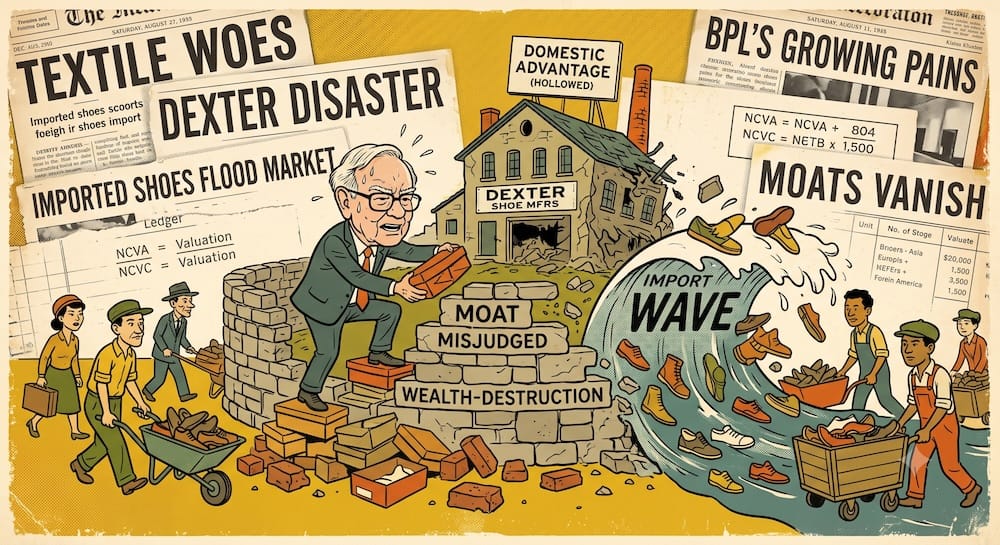
Enter Dexter Shoe. In 1993, Buffett purchased the Maine-based shoe manufacturer for $433 million. He analyzed the business, saw an established brand, strong historical returns on capital, excellent management, and what appeared to be a durable domestic manufacturing advantage. He was so confident in the quality filter that he funded the entire purchase using Berkshire Hathaway stock rather than cash.
It was a total disaster.
Within a few years of the purchase, the competitive landscape shifted completely. A massive wave of cheap, foreign shoe imports flooded the US market. Dexter’s domestic manufacturing advantage wasn’t just dented; it was completely hollowed out. The brand loyalty wasn’t deep enough to convince consumers to pay a massive premium for a domestic product when identical quality imports were available at a fraction of the cost. The moat vanished into thin air.
Buffett later wrote that Dexter’s value essentially went to zero, and operations were shut down. Because he had paid for the acquisition using Berkshire stock, the true opportunity cost of the mistake escalated into billions of dollars as Berkshire shares subsequently appreciated.
Dexter serves as a vital historical warning: better business analysis doesn’t protect you from misjudging a competitive advantage. If your qualitative assessment of a moat is wrong, the quality premium you paid transforms instantly into a wealth-destruction machine.
The Blend: Graham Price Discipline Plus Business-Quality Judgment
The core lesson of Buffett’s career isn’t that he graduated from value to quality. It is that his peak performance was born from the tension between both models.
If you look at his greatest investments, they sit directly at the intersection of Graham’s price discipline and Munger’s business-quality judgment.
                  ┌──────────────────────────────┐
                  │      GRAHAM DISCIPLINE       │
                  │   • Margin of Safety Floor   │
                  │   • Downside Price Anchor    │
                  └──────────────┬───────────────┘
                                 │
                                 ▼
                  ┌──────────────────────────────┐
                  │    THE INVESTMENT CHOICE     │
                  └──────────────▲───────────────┘
                                 │
                                 │
                  ┌──────────────┴───────────────┘
                  │  BUFFETT BUSINESS ANALYSIS   │
                  │   • High ROIC / Low Capital  │
                  │   • Durable Economic Moat    │
                  └──────────────────────────────┘
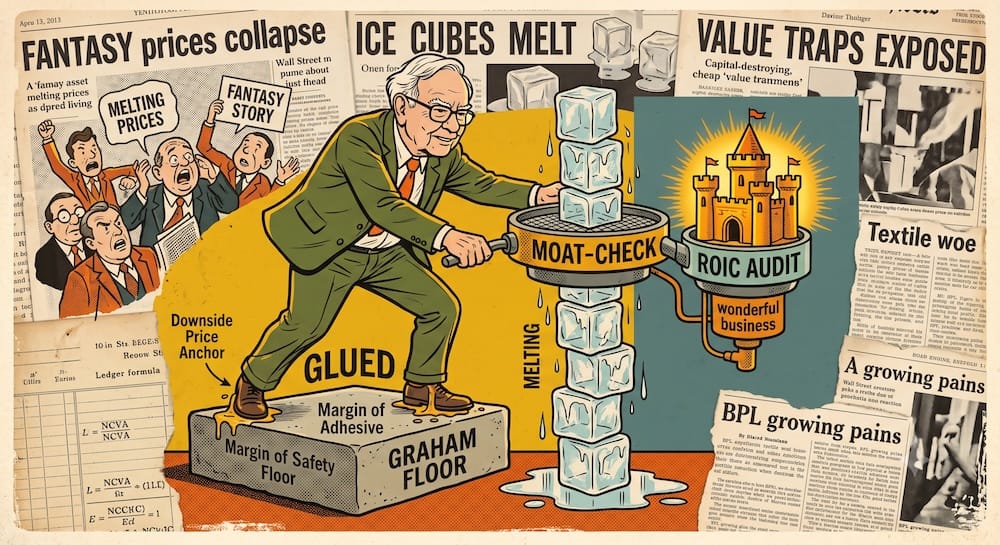
Graham’s discipline prevented Buffett from overpaying for glamorous growth stories or buying into beautiful businesses at stupid multiples. It kept his feet glued to the floor when Wall Street was spinning narratives about the future.
Simultaneously, his business-quality filter prevented him from falling into the traditional value traps that catch pure bargain hunters—companies that look cheap on a trailing price-to-earnings or price-to-book basis but are fundamentally melting ice cubes that destroy capital through high capital intensity and collapsing competitive positions.
Cheapness and quality are both useful. They are also both dangerous when they start acting like religions. To visualize how this blend functions across every major investment decision, we can break it down into an operating framework.
1. Graham Discipline + Business Analysis Matrix
| Investing Question | Graham Discipline | Buffett Business Analysis | The Blend |
| Is it cheap? | Demands a severe discount to liquidation value or trailing tangible assets. | Looks for value relative to future free cash flows and internal compounding rates. | The price must be fair or cheap relative to its quality; never pay a premium multiple that leaves no room for error. |
| What protects downside? | A margin of safety built directly into tangible balance sheet assets (NCAV). | A durable economic moat, consistent customer loyalty, and structural pricing power. | Tangible asset support wherever possible, reinforced by an uncompromised consumer franchise. |
| What can go wrong? | Assets could degrade, or management could burn cash before value is realized. | The competitive advantage could be disrupted by foreign competition, tech shifts, or brand erosion. | Isolate the single point of failure: if the moat breaks, does the asset base still offer a structural recovery floor? |
| Does the business need capital? | Doesn’t care, as long as the current working capital discount is wide enough today. | Demands low capital intensity; the business must produce surplus cash without heavy reinvestment needs. | Prioritize capital-efficient engines that don’t require the investor to constantly bail out asset-heavy operations. |
| Can earnings endure? | Highly skeptical of all future earnings projections; focus entirely on the present trailing record. | Audits customer behavior and structural barriers to entry to ensure cash flows are durable for 10–20 years. | Use Graham skepticism to discount corporate projections, but verify durability through real-world brand loyalty. |
| Is management rational? | Views management as potential adversaries; prepared to use activist control to unlock value. | Seeks rational, high-quality managers who excel at capital allocation and treat shareholders as partners. | If management is bad, the asset discount must be wide enough to force control. If management is great, let them compound. |
| Is the price still sane? | If it rises past book or intrinsic value thresholds, sell immediately without sentiment. | Willing to hold a high-quality position through rich valuations if the compounding runway remains intact. | Let winners compound, but refuse to enter new positions the moment the price disconnects from the margin of safety. |
2. Case Study Blend Matrix
Every milestone in Buffett’s journey maps directly to this ongoing negotiation between asset cheapness and franchise quality.
| Case Study | Graham Discipline Implemented | Business Analysis Upgrade Implemented | Core Operational Lesson |
| Sanborn Map Co. (1958) | Bought a liquid investment portfolio at a direct 30% discount to its open market asset value. | Recognized the hidden cash sleeve trapped beneath a dying map-manufacturing operation. | Deep value often requires an active corporate catalyst or control pressure to unlock its true worth. |
| Dempster Mill (1961) | Purchased the company at a severe discount to its current asset value floor. | Installed an operational turnaround specialist to aggressively slash bloated inventory and free up capital. | Asset cheapness is useless if the capital remains permanently trapped in unproductive inventory. |
| Berkshire Textile (1965) | Bought a classic “cigar butt” textile mill trading significantly below its liquidating value. | Attempted to run an asset-heavy business in a declining industry, losing millions to foreign competition. | The ultimate cheapness trap: a business with a terrible return on capital will eat your cash faster than you can harvest it. |
| American Express (1964) | Exploited a massive market panic that cut the stock price in half during a single legal liability scandal. | Analyzed consumer behavior to verify that the core traveler’s checks and credit card franchises were unimpaired. | Distinguish between a temporary, one-off legal or reputational shock and a permanent degradation of the economic moat. |
| See’s Candies (1972) | Maintained a strict price ceiling during negotiations, refusing to pay a penny over $25 million. | Measured a high pre-tax asset return on a small asset base, driven by continuous brand-backed pricing power. | Economic goodwill and consumer loyalty can be far more valuable than physical factories, provided the purchase price is disciplined. |
| Dexter Shoe (1993) | Attempted to lock in a stable, historically high-yielding domestic manufacturer at a reasonable entry price. | Misread the durability of the moat; foreign imports completely wiped out the firm’s competitive advantage. | Qualitative business analysis introduces unique failure modes. If you misjudge a moat, your quality premium drops to zero. |
What Modern Investors Misread About the Blend
The modern interpretation of Buffett’s strategy often falls into two distinct traps, both driven by a failure to understand how the filters cooperate. Investors frequently operate with a partial version of one filter while completely discarding the other.
The first failure mode is the Pure Cheapness Trap. This occurs when an investor runs a basic quantitative screen, finds a company trading at a low price-to-earnings or low price-to-book multiple, and buys it blindly under the guise of “value investing.” They have partial Graham discipline because the entry price is low, but the exit and asset realization cases are incredibly weak. They ignore the fact that the business has a collapsing return on capital, zero pricing power, and is operating in a structurally disrupted industry. They have bought a modern Berkshire textile mill—a capital trap that looks like a bargain but functions as an accounting compost pile.
The second, and more common contemporary error, is the Beautiful Overpayment Machine. This is where investors fall in love with a high-profile business with an obvious competitive advantage and buy it at any price. The underlying enterprise may be exceptionally strong, but the valuation discipline is entirely gone. They pay 40, 50, or 60 times earnings because they’ve absorbed the phrase “it’s far better to buy a wonderful company at a fair price than a fair company at a wonderful price.”
But they’ve completely forgotten Graham’s price discipline. When you pay a fantasy multiple for an obvious story, you have discounted years of perfect execution. You have zero margin of safety. If the competitive landscape shifts by even a fraction—as it did for Dexter Shoe—the premium multiple collapses, and your investment performance faces a permanent impairment.
3. The False Blend Matrix
To keep your portfolio execution clean, you must be able to spot these structural deviations before they damage your portfolio structure.
| Looks Like Buffett | Missing Graham Discipline | Missing Business Analysis | Real World Portfolio Result |
| The Cheap Declining Value Trap | Partial. The entry price is low on paper, but there is no clear path to asset realization or liquidation. | Total Absence. The business has a collapsing return profile, zero pricing power, and requires constant cash. | Capital remains permanently trapped in a melting ice cube that underperforms for years. |
| The Famous Brand at Any Price | Total Absence. Paying an astronomical multiple (P/E > 40) because the company has a strong public narrative. | Partial. The business may be remarkably strong today, but the moat is assumed rather than strictly verified against price. | Beautiful overpayment. Even if the business performs perfectly, your investment returns are ground down by multiple compression. |
| The 13F Cloning Strategy | Total Absence. Copying mega-cap allocations from external filings without checking current multiples or structural context. | Partial. Relying on historic corporate qualitative analysis while ignoring modern shifts in scale and business drag. | Tracking error and performance drag. You are buying a mature corporate conglomerate’s late-stage choices with inadequate tools. |
| The Low P/E Balance Sheet Illusion | Partial. The trailing numbers look safe, but the assets cannot be realistically converted or spun out. | Total Absence. The underlying assets are physical liabilities that require constant capital upkeep just to stay relevant. | Sudden asset write-downs and permanent loss of capital as the balance sheet values are revealed to be optical illusions. |
The ultimate takeaway from studying the Buffett-Graham transition is conceptual and behavioral. Buffett did not graduate from Graham; he expanded him. He understood that a true margin of safety can exist either in the asset cheapness of the balance sheet or in the qualitative efficiency of the business franchise—but that the purchase price always dictates the final return.
Keep Graham’s discipline at the door to manage your valuation risk. Deploy rigorous business analysis underneath to filter out structural value traps. Never let either cheapness or quality become a dogmatic religion, and remember that an extraordinary business purchased at a stupid price is never wisdom—it is simply expensive admiration with a ticker symbol.
Stay analytical, respect the numbers, audit the moat, and remember: expensive admiration with a ticker symbol is still expensive admiration.
Did Warren Buffett completely stop buying Benjamin Graham’s net-net stocks?
Not exactly. Buffett was structurally forced to stop buying individual micro-cap net-nets because his capital base grew too large to execute them safely. As billions of dollars poured into Berkshire Hathaway, deploying meaningful cash into small, illiquid companies trading below liquidation value became mechanically impossible without moving the market price against himself. The shift to high-ROIC quality was a solution to scale friction, not a philosophical rejection of Graham’s underlying mathematical rules.
What is the biggest risk of using Buffett’s business quality filter without Graham’s price discipline?
Beautiful overpayment. That is the exact failure mode that lights retail capital on fire today. If you identify a spectacular company with high returns on capital and a massive competitive moat, but you pay a premium multiple of 40 or 50 times earnings for it, you have effectively discounted years of perfect corporate execution. You have zero margin of safety left. If the competitive dynamics shift by even a fraction, the multiple collapses, resulting in permanent capital impairment.
How do I know if a cheap stock is a true value bargain or a structural capital trap?
You run it through the second filter: reinvestment economics and return on capital. A true Graham value bargain possesses an asset base or working capital profile that can be cleanly liquidated, spun out, or mean-reverted to create a cash catalyst. A structural capital trap—or a “cigar butt” that has run out of puffs—is typically an asset-heavy business in a declining industry that must spend every dollar of its meager earnings on capital expenditures just to stay alive, yielding abysmal returns on tangible capital.
Can a modern retail investor access the same capital structure advantages as Warren Buffett?
No. It is structurally impossible to duplicate his layout inside a standard retail brokerage account. Buffett operated via a corporate conglomerate tax shield that allowed Berkshire to retain 100% of its earnings and reallocate that cash across wholly owned subsidiaries without triggering dividend taxes. Furthermore, retail accounts cannot tap massive pools of low-cost or negative-cost insurance float to achieve non-callable $1.6\text{-to-}1$ leverage, nor can they secure private, bespoke preferred share placements during market panics.
What did the American Express Salad Oil Scandal teach us about analyzing a business moat under stress?
It taught us to separate temporary liability shocks from permanent franchise damage. When the scandal hit in 1964, the market reacted to the legal liabilities on the balance sheet, crashing the stock price. Buffett’s breakthrough business analysis was checking consumer behavior in the field. He verified that while the corporate parent was facing massive legal penalties, customers had not stopped using traveler’s checks or credit cards. The brand equity and economic moat were completely untouched by the noise on Wall Street.
Why did the Dexter Shoe investment fail if it met Buffett’s quality criteria?
Because qualitative business analysis introduces a unique risk: you can misjudge the durability of a competitive advantage. Buffett identified a strong brand and an efficient domestic manufacturer, but he failed to anticipate a structural shift in global trade mechanics. When a massive wave of low-cost foreign shoe imports flooded the market, Dexter’s brand loyalty wasn’t deep enough to convince consumers to pay a massive price premium. The economic moat evaporated, proving that qualitative moats are far harder to count than current assets on a balance sheet.
How can a DIY investor practically execute the Buffett-Graham blend today without picking individual stocks?
The useful lesson is conceptual: you combine strict factor parameters within your portfolio structure. To capture Graham’s discipline, you tilt toward companies trading at low relative valuations (the Value factor, or $HML$). To capture the business analysis upgrade, you screen those cheap names for high asset efficiency, stable margins, low capital intensity, and low leverage (the Quality factor, or $QMJ$). By using systematic quantitative tools to cross-reference value and quality, you extract the mechanical engine of the blend without trying to manually hunt for corporate catalysts or clone 13F filings after the fact.
This article is also available in Spanish. [Leé la versión en castellano: Cómo Warren Buffett combinó la disciplina de Graham con un mejor análisis de negocio]