The word “timeless” is a lazy word in finance. It gets slapped onto every investing legend’s philosophy as if their strategies exist in a permanent vacuum, disconnected from the shifting architecture of the stock market.
Online forums have turned Charlie Munger’s investment philosophy into a set of unalterable commandments. We are told to buy great companies at fair prices, concentrate our capital into a few high-conviction ideas, and sit on our hands forever. It sounds beautiful, elegant, and permanent.
But when you treat an investment philosophy as a static monument, you run into a brutal structural reality: tactics age.
Charlie Munger’s career spanned eras that are unrecognizable today. The rules of the game changed under his feet, and they have changed even faster since. If you copy his historical decisions without understanding the market structure that allowed them to work, you aren’t investing like Munger; you are conducting historical reenactment with your savings account.
Praise without mechanism is glaze. To determine what actually remains viable for a modern portfolio, we have to audit the Munger philosophy by dividing it into three strict categories: what still works, what needs translation, and what has aged poorly because the market structure changed beneath it.

The Market Munger Invested In No Longer Exists
Before analyzing the philosophy, we must map the mechanics of the era that birthed it. The wealth-generation phase of Wheeler, Munger & Co. (1962–1975) operated inside a market structure that is completely gone.
First, consider information velocity. During the 1960s and 1970s, information was deeply asymmetrical. Finding a mispriced security required a physical expedition. Allocators spent their days manually flipping through paper copies of Moody’s Manuals or requesting paper SEC filings via the mail. Today, instant text indexing via the SEC EDGAR system, automated algorithmic screening, and quantitative factor products scan the entire global equity universe within milliseconds of a document release. Basic informational edge has been heavily commoditized.
Second, the structural friction of trading has collapsed. Prior to “May Day” on May 1, 1975, institutional transaction commissions were legally mandatory and fixed. Trading stocks was a massive corporate expense, which insulated companies from hyper-active retail churn and high-frequency liquidity sweeps. Combined with the fact that low-cost index products were not yet broadly available to ordinary investors, public equities behaved with a localized inefficiency that modern zero-commission platforms and passive index flows have systematically erased.
Finally, corporate disclosure laws were completely different. Prior to the implementation of Regulation FD in 2000, corporate managers could—and regularly did—leak material financial data selectively to favored institutional allocators before the general public ever heard about it.
Furthermore, the nature of corporate assets has flipped. The Munger era was dominated by tangible, capital-heavy businesses where moats were built out of physical steel, factories, and localized distribution networks. Modern markets are dominated by intangible assets, platform economics, and digital scale networks. These modern moats can grow to global dominance in a fraction of the historical time, but they also face a significantly faster rate of technological and regulatory decay.
The opportunity set has shifted completely. To survive in this architecture, the historical philosophy requires an unsentimental structural audit.

What Still Works: The Durable Munger Operating System
The parts of Munger’s philosophy that remain perfectly robust are not his specific equity selections or concentration ratios. The durable core of his philosophy consists of behavioral and structural frameworks designed to minimize friction and prevent self-inflicted catastrophe.
1. Inversion and Avoiding Stupidity
Munger’s dominant framework was the engineering concept of inversion: “All I want to know is where I’m going to die, so I’ll never go there.” In modern portfolio management, this translates to focusing on the elimination of clear structural defects before attempting to generate outperformance. It means building defense first: avoiding high-fee products, preventing forced liquidations, and identifying fatal leverage mismatches. Alpha is hard to capture; minimizing uncompensated beta and unforced errors is fully within an investor’s control.
2. Opportunity Cost Thinking
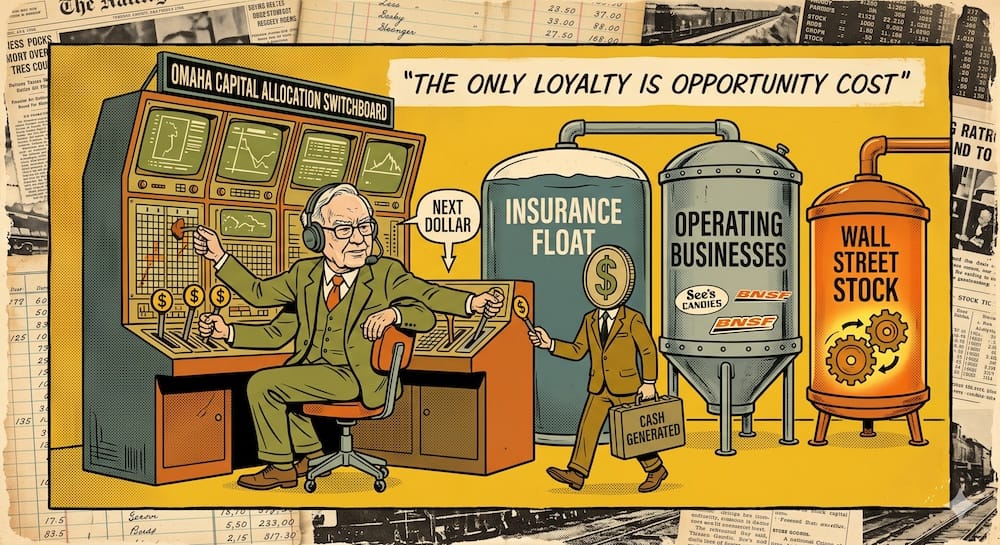
Treating the existing portfolio as the explicit hurdle rate for any new asset allocation is a timeless mechanic. In modern markets, your baseline opportunity cost is no longer a localized cash account; it is a highly liquid, ultra-low-cost, globally diversified index fund or a verified factor wrapper. If a concentrated security selection cannot demonstrably outperform that baseline after adjusting for fee drag, tax consequences, and volatility, it probably does not earn space on the portfolio canvas.
3. Incentive Analysis
Munger’s core behavioral rule was simple: “Never, ever, think about something else when you should be thinking about the power of incentives.” This remains a primary filter for modern public equities. The structure of executive compensation has shifted heavily toward short-term stock options and restricted stock units (RSUs). This reality regularly incentivizes corporate management to prioritize short-term share buybacks and earnings manipulation over long-term capital efficiency and research expenditures. Auditing how management is compensated tells you more about a company’s future capital allocation than any polished investor presentation deck.
4. Low Turnover and Friction Minimization
The math of compounding is brutally sensitive to leakage. Every time a security is bought or sold inside a standard taxable account, transaction spreads and capital gains taxes create a structural drag on capital. Munger’s insistence on a low-turnover architecture remains a foundational edge. The modern investor who does less—allowing corporate earnings to compound undisturbed by behavioral adjustments—retains a significant structural advantage over hyper-active allocators.

What Needs Translation: Good Principles, Different Implementation
Several of Munger’s core principles remain brilliant in theory but have become highly dangerous when copied literally from his historical case studies. These elements require a modern mechanical translation.
1. Concentration
- The Historical Tactic: Maintaining over 50% of an investment fund in just one to three positions, as Munger frequently did during his partnership years.
- The Modern Translation: Extreme concentration requires specific account structures. Munger operated via closed partnerships and corporate holding companies with zero redemption risk. If a modern investor wants to harvest the premium of high-conviction ideas, the mechanism must be translated into a dedicated satellite sleeve built around a diversified core. The size of this sleeve must be strictly calibrated based on individual risk tolerance, near-term liquidity needs, tax constraints, and behavioral thresholds—ensuring that a sudden real-world emergency never forces a liquidation at the absolute bottom of an individual stock drawdown.
2. Quality Investing
- The Historical Tactic: Buying famous consumer brands with pricing power and holding them indefinitely.
- The Modern Translation: “Quality” cannot simply mean brand admiration or chasing companies with high social capital. In today’s market structure, quality must be translated into explicit, quantifiable factor metrics: high Return on Invested Capital (ROIC), strong operating profitability, and low asset growth (capital discipline), paired with strict valuation boundaries. Buying quality without price discipline is a style drift that ages poorly.
3. Waiting for Fat Pitches and Patience
- The Historical Tactic: Sitting on cash for years, waiting to manually identify a single mispriced enterprise.
- Modern Translation: In an automated, high-velocity market, human patience can easily degenerate into behavioral paralysis or uncompensated cash drag. Patience today needs objective guardrails: written criteria, valuation thresholds, thesis-break rules, and an established process that prevents panic decisions rather than relying entirely on constant stock picking.
What Ages Poorly: Era-Specific Tactics That Don’t Travel
These are the expired elements of the philosophy. They worked exceptionally well because of the specific historical anomalies of the mid-20th century, but they have become dangerous historical cosplay when practiced today.
1. Manually Finding Bargains in Physical Filings
The idea that an individual investor sitting at a home desk can discover a completely hidden, clean asset mispricing in a major public company’s balance sheet simply by reading financial reports has largely expired. Quantitative algorithms have completely crawled the literal, baseline accounting data. Modern edge does not come from finding the public data first; it comes from analyzing complex structural relationships, regulatory jurisdictions, or systemic market flows that screens miss.
2. Copying Berkshire Hathaway’s Late-Stage Mega-Cap Allocations
Many retail investors look at Berkshire’s massive modern positions in mega-cap technology or consumer giants and clone those exact allocations in their personal portfolios. This ignores the constraint of scale. Munger himself frequently noted that Berkshire’s size had become a massive structural anchor, limiting their investable universe to companies that could absorb billions of dollars of liquidity. Copying these positions means copying a strategy forced by capital scale constraints, rather than the wealth-generation framework that made Munger a legend in his early years.
3. Treating Historical Case Studies as Modern Valuation Permission Slips
The internet loves to tell the story of See’s Candies to justify paying high earnings multiples for modern businesses with strong brands. This advice has aged like milk.
Let’s look at the actual numbers: when Blue Chip Stamps purchased See’s Candies in 1972, the $25 million purchase price was executed against $5 million in net tangible assets. More importantly, it was bought at roughly 5 times normalized pre-tax corporate earnings.
Using the See’s Candies story as an intellectual shield to justify paying 40 times sales for a modern software platform is a complete mechanical misapplication. Beautiful lesson, wrong engine entirely.
4. Concentrating Stock Picking Without Permanent Capital
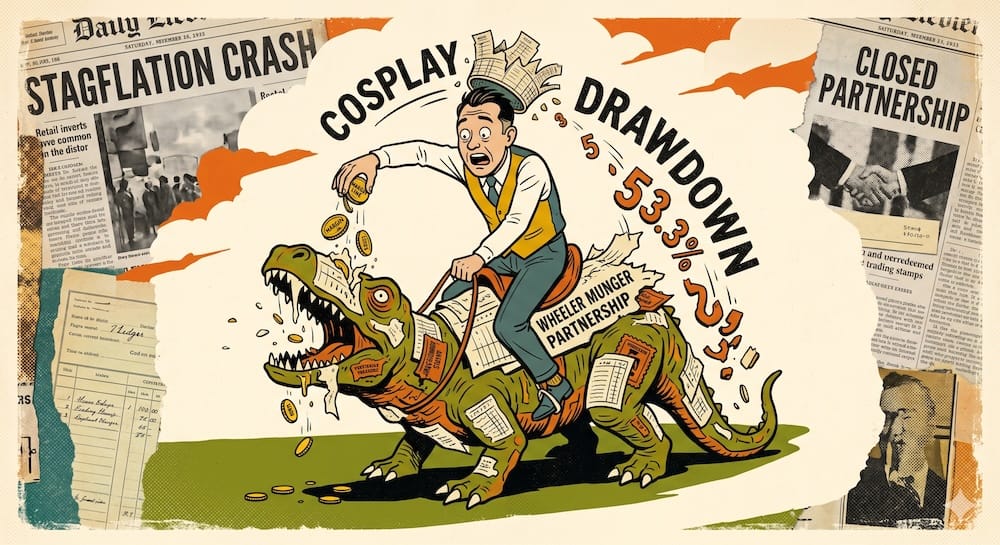
Munger’s early vehicle, Wheeler, Munger & Co., could survive severe tracking error because of its closed structure. Even then, the behavioral stress was extreme. Between 1969 and 1972, the partnership underperformed the S&P 500 for four consecutive calendar years. It then plunged into the 1973–1974 stagflation crash, suffering a cumulative peak-to-trough drawdown of -53.3%.
Munger did not face client redemptions because his capital base was locked. Furthermore, his foundational investments were later funded by float-like capital created by delayed redemption liabilities—such as unredeemed trading stamps inside Blue Chip Stamps. If you attempt to copy that level of concentration inside a standard retail account with a floating-rate margin line and immediate liquidity needs, you are exposed to a daily mark-to-market vulnerability that Munger never had to accept.
The Modern Munger Translation Matrix
This matrix serves as the operational portability master map for the philosophy, explicitly separating durable logic from era-specific tactics.
| Munger Principle | Still Works? | Why It Still Works / What Changed | Modern Translation | What Ages Poorly |
| Inversion | Yes (10/10) | Math and structural logic do not age. Eliminating unforced errors remains the highest-probability path to survival. | Define and systematically eliminate structural vulnerabilities (high costs, toxic leverage, tax inefficiency). | Believing that inversion requires you to solve complex macroeconomic puzzles manually. |
| Incentive Analysis | Yes (10/10) | Human nature and corporate governance remain entirely driven by compensation design. | Look directly at corporate proxy statements to see if executives are rewarded for real ROIC or simple share price spikes. | Trusting qualitative management narratives that run completely counter to their explicit financial bonus triggers. |
| Opportunity Cost | Yes (9/10) | Capital allocation is inherently relative. | Require any individual stock idea to clear the hurdle set by low-cost index or factor alternatives. | Comparing your individual ideas against an arbitrary cash benchmark or an unrealistic static target. |
| Low Turnover | Yes (9/10) | Tax codes and transactional friction continue to penalize hyper-activity. | Build a systematic portfolio architecture designed to let positions compound with near-zero manual intervention. | Constantly adjusting allocations based on short-term market narratives or macro-economic fears. |
| Quality Focus | Needs Translation (8/10) | Brands decay significantly faster in a digitized, global economy. | Transition from qualitative brand admiration to quantitative factor definitions: high operating profitability and low capital reinvestment drag. | Paying extreme valuation multiples for a company simply because it has high brand recognition. |
| Circle of Competence | Needs Translation (7/10) | Technical and operational boundaries shift instantly due to software and platform disruption. | Maintain a dynamic competence map. Focus strictly on sectors where you understand the physical or structural infrastructure. | Assuming a historical understanding of an industry remains valid after a structural technological disruption. |
| Concentration | Needs Translation (4/10) | Modern tracking error can easily trigger behavioral capitulation or forced liquidations. | Isolate high-conviction security selection or specialized factor tilts into an insulated satellite sleeve that cannot break your core plan. | Allocating 50%+ of a personal brokerage account into a few individual stocks without a permanent, locked capital base. |
| Deep Research via Annual Reports | Ages Poorly (3/10) | Quantitative data screening tools have fully democratized and commoditized basic balance sheet parsing. | Shift focus from discovering simple historical accounting metrics to evaluating structural vulnerabilities and legal structures. | Assuming that reading a standard public 10-K report faster than others provides a predictable alpha edge. |
| Float Leverage | Ages Poorly (1/10) | Float-like capital created by delayed redemption liabilities is structurally unavailable at retail scale. | Focus on preserving personal liquidity and managing structural liabilities like fixed, long-dated primary mortgages. | Attempting to mimic institutional leverage using high-interest, floating-rate retail margin lines. |
The Munger Portability Scorecard
To protect your portfolio canvas from era-specific financial cosplay, use this absolute portability ranking as a baseline filter.
| Principle / Tactic | Portability Score | Sponge Verdict |
| Inversion & Avoiding Obvious Stupidity | 10/10 | ABSORB: Make this the primary structural filter for every line item on your ledger. |
| Incentive Audit Framework | 10/10 | ABSORB: Treat corporate compensation structures as hard, objective data. |
| Opportunity Cost Hurdle Logic | 9/10 | ABSORB: Require any individual stock idea to clear the hurdle set by low-cost index or factor alternatives. |
| Low Portfolio Turnover | 9/10 | ABSORB: Ruthlessly eliminate behavioral churn to minimize tax drag and transactional spreads. |
| Quality Focus (Valuation-Sensitive) | 8/10 | TRANSLATE: Filter for objective capital efficiency metrics (ROIC), but enforce absolute price discipline. |
| Circle of Competence Mapping | 7/10 | TRANSLATE: Constantly stress-test your assumptions against digital disruption and platform scale. |
| Hyper-Concentrated Stock Selection | 4/10 | TRANSLATE HARD: At retail scale, keep concentration structurally bounded and insulated within a managed satellite space. |
| Manual Micro-Cap Arbitrage | 2/10 | EXPEL: Hand off micro-cap asset mining to low-cost, systematic small-cap value factor products. |
| Float-Engine Leverage | 1/10 | EXPEL: Do not play with daily-marked retail margin debt. Without an insurance company balance sheet, the math fails. |
| Cloning Late-Stage Berkshire Positions | 1/10 | EXPEL: Do not adopt capital constraints that were forced entirely by massive asset scale. |

Absorb the Principles, Update the Machinery
Charlie Munger’s best insights are structural and behavioral. They are engineering principles applied to the human mind and corporate architecture. His framework for avoiding catastrophic stupidity, ignoring short-term noise, respecting incentives, and managing frictional costs remains completely robust.
But his tactical execution—the specific machinery he used to harvest mispriced assets in the mid-to-late 20th century—was a product of its time. The informational asymmetries are gone, commissions have dropped to zero, and the permanence of traditional corporate moats has decayed.
The lesson is clear: absorb the underlying principles, but update the operational machinery for today’s market structure. If you attempt to copy yesterday’s tactics literally, you are playing a broken deck. If you translate his core logic into a modern, low-friction framework, the engine still runs perfectly.
1.Immunize Living Expenses:Prerequisite.
Investors who choose to hold concentrated positions need to ensure that near-term cash needs, tax constraints, and behavioral tolerance are not dependent on selling those positions during a drawdown.
2.Verify Corporate Solvency:During the Crash.
Audit the underlying debt profiles of your concentrated positions. A massive price drop is less dangerous if the company has zero refinancing risk and retains a positive structural cash flow model.
3.Establish Explicit Guardrails:Behavioral Execution.
Rely on written criteria, valuation thresholds, and pre-established thesis-break rules to prevent panic-driven liquidation decisions during market-wide stress.
What is the absolute minimum portfolio size required to execute Charlie Munger’s concentration strategy safely?
It depends entirely on your liability profile, but the short answer is much higher than retail investors think. If you are concentrating more than 30% to 50% of your capital into two or three individual stock positions, your minimum asset base must be large enough to ensure that your fundamental living expenses, immediate liquidity needs, and emergency reserves are completely insulated elsewhere. Munger could ride out a four-year underperformance streak and a -53.3% partnership drawdown because his living expenses were fully covered by his legal practice and private real estate syndications, and his funds had zero redemption risk. If a real-world emergency forces you to liquidate a concentrated equity position during a cyclical market crash, your structural plan is broken regardless of your analytical genius.
How do I replicate the wealth-generation phase of Munger’s early career without manual stock picking?
You utilize systematic, rules-based factor products. Not exactly the identical tactics, but the same underlying premium. Munger’s early outperformance at Wheeler, Munger & Co. relied on buying micro-cap asset plays, liquidations, and deep-value corporate workouts at deep discounts to net working capital. Because high-frequency algorithms and quantitative data parsers have heavily commoditized individual micro-cap informational asymmetries, modern retail investors can target this same underlying economic exposure safely through low-cost, systematic Small-Cap Value and Profitability ETFs [VERIFY specific ticker matches]. These factor wrappers harvest the structural size, value, and quality premiums automatically while maintaining the structural protection of broad diversification.
Why is using the See’s Candies acquisition to justify paying a high price-to-earnings multiple for a “quality” stock historically incorrect?
Because it completely misinterprets the baseline math of the actual deal. The popular online narrative uses See’s Candies as a permission slip to pay 30x, 40x, or even 50x earnings for dominant modern businesses under the guise of buying a “wonderful brand.” However, corporate disclosures reveal that when Blue Chip Stamps purchased See’s Candies in 1972, the $25 million purchase price was executed at roughly 5 times normalized pre-tax corporate earnings. Munger demanded extreme valuation discipline even when securing an elite brand. Paying hyper-inflated multiples for obvious, widely recognized mega-cap tech giants today is a complete distortion of the historical framework.
Can a modern DIY retail investor replicate the structural leverage of insurance float?
No. That is an era-specific and structurally restricted advantage that does not travel to a retail canvas. Munger capitalized on non-redeemable asset pools inside trading stamp and insurance companies, meaning his leverage was backed by long-dated liabilities that frequently carried a zero or negative net cost. Attempting to clone this effect inside a personal brokerage account by utilizing standard retail margin lines is highly dangerous. Standard retail margin carries a floating interest rate and subjects your portfolio to daily mark-to-market maintenance requirements. Without a permanent corporate balance sheet, a deep market drawdown will trigger forced liquidations that completely interrupt your compounding trajectory.
How does modern Regulation FD change the effectiveness of Munger’s deep corporate research method?
It levels the playing field entirely, meaning qualitative research alone rarely creates a structural informational edge. Prior to the implementation of Regulation FD in 2000, institutional allocators could selectively access material financial insights from corporate managers before that data was broadcast to the public. Munger could combine his brilliant legal parsing with selective informational access. Today, all material disclosures must be released simultaneously via the SEC EDGAR system. Because quantitative models parse this text within milliseconds, your edge can no longer come from finding public financial facts first; it must come from structural patience, behavioral discipline, or identifying systemic index flows.
What is the modern alternative to a “Circle of Competence” in a hyper-disrupted digital economy?
A dynamic competence map backed by an objective thesis-break checklist. Not a static boundary. Munger developed his traditional circle of competence during an era of stable, tangible asset moats built on physical infrastructure and localized distribution. Modern digital platforms and software economics experience near-instant scale shifts, meaning historical moats can decay at an unprecedented velocity due to open-source software, artificial intelligence, or swift regulatory overhauls. Your modern competence map must explicitly outline the exact technological and jurisdictional mechanisms you understand, paired with automated guardrails that instantly trigger a position re-evaluation if the core structural thesis cracks.
This article is also available in Spanish. Leé la versión en castellano: La filosofía de Charlie Munger vs los mercados modernos: Qué funciona todavía y qué envejeció mal