
Investing like Paul Tudor Jones is not a cute little checklist where you sprinkle some “macro” on a portfolio and suddenly become a crisis-trading wizard. To my eyes, the real lesson is colder and more mechanical than that: he built a career around asymmetric trades, ruthless risk control, macro regime awareness, and the willingness to stand away from consensus when price, policy, sentiment, and positioning started telling a different story.
That is a very different animal from simply “being contrarian.” Anyone can disagree with the crowd. The hard part is surviving the period where the crowd keeps getting paid and your thesis looks early, lonely, and maybe even wrong. That is where the Paul Tudor Jones playbook becomes useful for portfolio thinkers: not as a hero-worship template, but as a study in sizing, timing, invalidation, optionality, and emotional control.
The lazy version says: “Paul Tudor Jones made money by being brave.” I do not buy that. Bravery without sizing is just recklessness with nicer branding. The more useful version says: “Paul Tudor Jones survived long enough to be aggressive when the odds, structure, and asymmetry lined up.” That is the part worth absorbing.
source: Cooper Academy on YouTube
Paul Tudor Jones: A Legendary Figure in Trading
Paul Tudor Jones is one of those names that sits near the top shelf of discretionary global macro trading. Founder of Tudor Investment Corporation, he is commonly associated with big-picture market calls, crisis awareness, and disciplined risk management. But I think the more interesting piece is not the legend. It is the plumbing underneath the legend.
Macro trading is not just “I think rates will fall” or “I think stocks are expensive.” It is a translation problem. A trader has to convert a broad macro view into a specific expression: equity index futures, rates, currencies, commodities, options, relative-value trades, cash, or some combination of those tools. Then comes the uncomfortable part: deciding how much risk to take, where the thesis is wrong, what confirms it, and whether the potential payoff is worth the emotional and financial heat.
Jones’s public biography through the Robin Hood Investors Conference describes him as founder, Co-Chairman, Chief Investment Officer, and controlling principal of Tudor Investment Corporation, with trading activity across global fixed income, equity, currency, and commodity markets. That detail matters because it frames the actual sandbox: this is not single-stock stock-picking dressed up as macro. It is cross-asset trading, where the expression of a view can matter as much as the view itself.
Contrarian Macro Trading: An Unconventional Approach
At the heart of Jones’s reputation is contrarian macro trading, but that phrase needs a little surgery. Contrarian does not mean automatically shorting what has gone up or buying what has gone down. That is not a strategy. That is a personality tic with a brokerage account.
The better version is more conditional. A contrarian macro trader looks for moments when consensus, valuation, policy, positioning, and price action are out of sync. Maybe investors are leaning too heavily into one regime. Maybe central bank policy is about to change the discount-rate math. Maybe a commodity market is priced for calm while inventories, geopolitics, or inflation say something else. Maybe credit is whispering one thing while equities are screaming another.
We’ll attempt an in-depth exploration of Paul Tudor Jones’s trading strategies and philosophy. By dissecting his approach to contrarian macro trading, we will uncover the principles that have driven his sustained success and offer practical guidance for investors looking to implement similar strategies in their own portfolios.
For my own framework, the most useful lesson is not “copy the trade.” Most of us cannot copy the trade. We do not have the same data, execution, mandate, talent stack, liquidity access, institutional risk systems, or emotional conditioning. But we can study the architecture: identify regime pressure, wait for confirmation, express the view with defined risk where possible, size smaller than ego wants, and know exactly what would prove the thesis wrong.
That is the portability line. Jones’s institutional toolkit does not port cleanly to the DIY investor sitting at home with ETFs, a brokerage account, maybe options permission, and a normal human tolerance for being wrong. What travels is the process layer: thesis documentation, risk limits, position sizing, confirmation, invalidation, and the willingness to reduce exposure when the evidence changes. What does not travel is the institutional execution machine, the global desk, the data stack, the mandate, and the ability to express views across markets with professional infrastructure. Big difference.
Who is Paul Tudor Jones?
Early Life and Background
Paul Tudor Jones II was born in Memphis, Tennessee, in 1954. His Robin Hood Investors Conference bio confirms that Jones holds a B.A. in Economics from the University of Virginia. After university, he began his career in trading at the Arnhold and S. Bleichroeder brokerage firm. That early brokerage-floor context matters because macro trading is not just spreadsheet theory. It is pattern recognition, market pressure, liquidity, order flow, discipline, and the ability to stay functional when the screen starts moving faster than the narrative.
In 1980, he founded Tudor Investment Corporation, a private asset management firm that would become central to his trading legacy. What stands out to me is the combination of entrepreneurial risk and risk-control obsession. That tension is a huge part of the macro game: you need enough aggression to act when the opportunity appears, but enough humility to cut exposure when the market says, “Nope. Not yet.”
Rise to Prominence
Jones’s rise to prominence is usually tied to the stock market crash of 1987, famously known as Black Monday. The story is often framed as prophecy: he saw the crash coming, positioned correctly, and profited while others were mauled. That may be the headline, but the more useful lesson is the preparation process. A major macro trade generally depends on multiple signals lining up: valuation pressure, trend deterioration, sentiment extremes, market structure fragility, and some kind of trigger that turns vulnerability into motion.
His reputation was strengthened by his performance during that period, when he correctly anticipated the market downturn and positioned his portfolio to benefit from the decline, resulting in substantial profits. This move not only protected his clients’ investments but also cemented his status as a top-tier trader.
Over the years, Jones has been associated with adapting across market cycles with aplomb. The more useful point is not a vague claim of permanent outperformance, but the cross-asset nature of the Tudor framework: global fixed income, equities, currencies, and commodities all become possible expressions of the same regime-reading discipline. That scope matters because the Jones framework is not a single-market trick. It is a way of translating macro pressure into specific risk engines when the trader has the tools and risk controls to express the view.
Key Achievements
- Black Monday Trade (1987): Jones’s foresight during the 1987 crash is perhaps his most celebrated achievement. By shorting the market ahead of the crash, he safeguarded his portfolio and reaped significant profits as the market plummeted.
- Global Macro Reputation: Tudor Investment Corporation is known for trading across global fixed income, equity, currency, and commodity markets. That cross-asset mandate is central to understanding Jones’s process.
- Philanthropy: Beyond trading, Jones is a co-founder of Robin Hood. Robin Hood’s own history describes the organization as created in 1988 by Paul Tudor Jones, Peter Borish, David Saltzman, Glenn Dubin, and Maurice Chessa, with a mission focused on fighting poverty in New York City.
- Mentorship and Influence: Jones is known for sharing trading ideas and risk-control principles with younger traders. For me, that matters because the transferable lesson is process, not personality.

Understanding Contrarian Macro Trading
What is Contrarian Macro Trading?
Contrarian macro trading is an investment strategy that involves making investment decisions opposite to prevailing market trends. But again, that definition is too clean. In the real world, the best contrarian trades are rarely contrarian for the sake of being contrarian. They are contrarian because the market has become crowded around one story while the underlying macro machine is starting to change.
That change might show up in rates, credit spreads, yield curves, currency weakness, commodity pressure, central bank communication, fiscal policy, liquidity, or positioning data. A contrarian macro trader is not simply saying, “Everyone is bullish, therefore I am bearish.” The better question is: “What would have to happen for the consensus trade to become fragile, and how can I express that view without getting killed if I am early?”
The phrase “macro” also gets abused. Macro is not a permission slip for vague prediction. It is a map of transmission channels. Higher real rates may affect equity valuations. Dollar strength may pressure emerging markets and commodities. Credit stress may warn that equity optimism is getting stale. Inflation surprises may change the bond-stock diversification relationship. The point is not to collect headlines. The point is to understand how one pressure point moves through the system.
Jones’s Application of Contrarian Principles
Paul Tudor Jones applies contrarian principles by analyzing global macroeconomic factors, market sentiment, and price behavior. Instead of reacting impulsively to market movement, the process is built around anticipation and confirmation. That distinction matters. A thesis without price confirmation can become a very expensive opinion.
For example, during the early stages of the 2008 financial crisis, Jones has been associated with crisis-aware macro positioning around housing-market weakness and broader financial stress. The useful lesson is not the exact imitation of a historical trade; it is the broader process of noticing when credit, housing, liquidity, and market psychology begin pointing in the same uncomfortable direction.
The lived friction here is brutal. Macro turns can take longer than expected. A housing thesis can look obvious in hindsight and nearly impossible to sit with in real time. Markets can rally against a weakening fundamental backdrop. Credit can deteriorate while equities levitate. A trader who is directionally correct but oversized, under-hedged, or too early can still get carried out. That is why risk management is not a side dish in this framework. It is the main course.
Key Economic Indicators and Market Signals
Jones relies on a suite of economic indicators and market signals to inform his trading decisions. For anyone studying a contrarian macro approach, the key is not collecting more indicators for the sake of looking sophisticated. The key is understanding which indicators matter for the regime you are analyzing and how those indicators connect across asset classes.
- Interest Rates: Central bank policies and interest rate changes can significantly impact various asset classes. Jones monitors interest rate movements to gauge economic health and predict market reactions. Rates feed directly into equity discount rates, currency differentials, bond duration risk, credit conditions, and valuation pressure.
- Gross Domestic Product (GDP) Growth Rates: GDP growth rates provide a broad picture of economic momentum. The important part is not just whether growth is high or low, but whether the direction of change surprises consensus expectations.
- Inflation Rates: Inflation affects purchasing power, central bank policy, real yields, bond markets, commodity pricing, and equity sector leadership. A market priced for disinflation can behave very differently from a market priced for sticky inflation.
- Geopolitical Events: Political developments, such as elections, policy changes, and international conflicts, can create market volatility. The tradeable question is usually not “Is this event important?” but “Which market is mispricing the distribution of outcomes?”
- Market Sentiment: Investor behavior often drives market trends. Sentiment becomes especially interesting when it turns one-sided and positioning leaves little room for disappointment.
By integrating these indicators, Jones forms a view of the global economic backdrop and looks for mispriced turning points. For a DIY investor, I would frame this less as “make big macro bets” and more as “understand the regime your portfolio is implicitly betting on.” A plain stock-bond portfolio is already making macro bets, even when we pretend it is neutral.
Core Principles of Paul Tudor Jones’s Trading Strategy
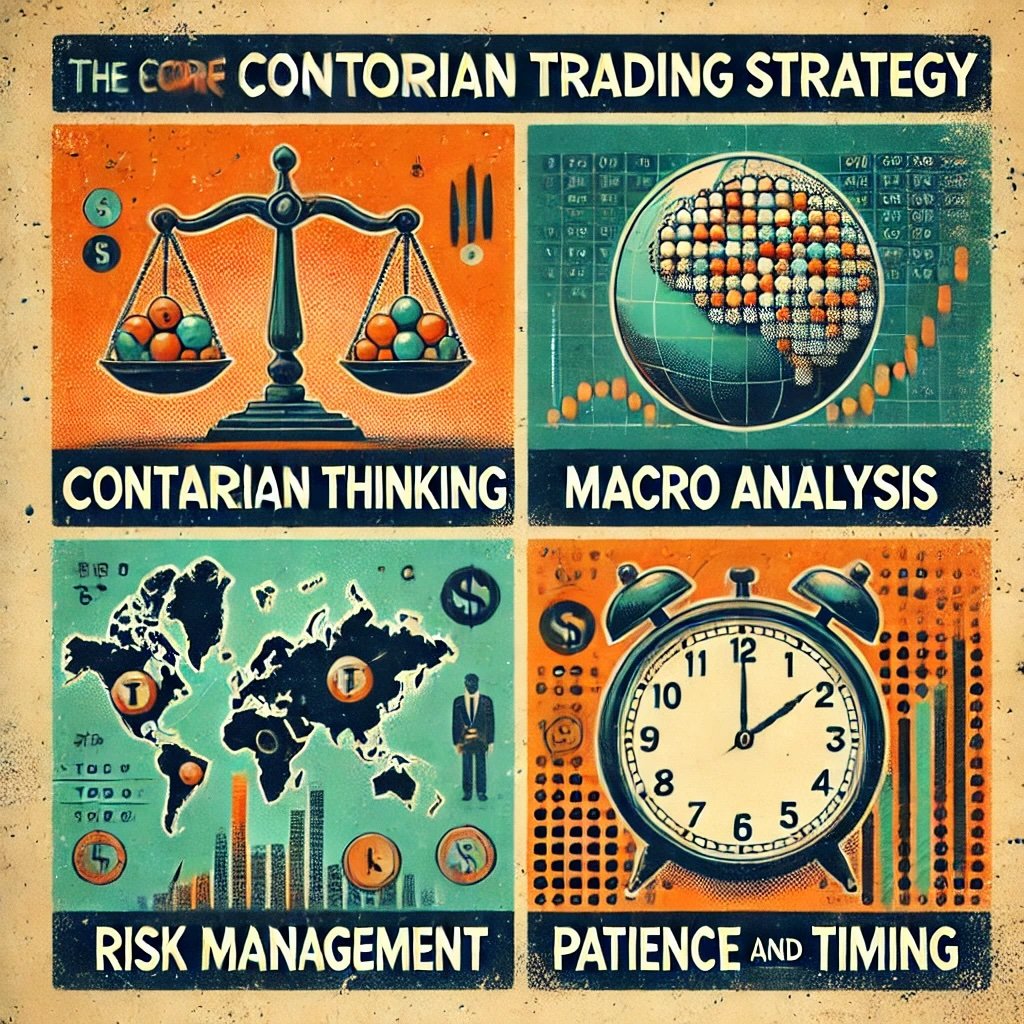
Contrarian Thinking
Contrarian thinking is the most visible part of Jones’s trading style, but it is also the easiest part to misunderstand. Being against the crowd can feel intellectually satisfying. It can also be financially stupid if the crowd is right, the trend is strong, liquidity is abundant, and the catalyst is nowhere in sight.
Jones employs contrarian thinking by:
- Identifying Overreactions: Recognizing when the market has overextended in either direction, creating opportunities for mean reversion.
- Assessing Market Psychology: Understanding the collective behavior of investors to estimate when greed, fear, complacency, or forced selling may be distorting price.
- Seeking Undervalued or Overvalued Assets: Looking for assets where price, fundamentals, policy, and positioning no longer line up cleanly.
The pain point is that overreaction can become more overreacted. That is why the word “contrarian” should always travel with the words “position sizing” and “invalidation.” Without those, contrarian thinking becomes stubbornness wearing a nice jacket.
My contrarian opinion here is that most people do not fail at macro because they lack opinions. They fail because they have too many opinions and too little process. The market does not pay for sounding worldly. It pays, if it pays at all, for correctly sized risk taken at the right point in the distribution.
The common mistake is fading a strong trend simply because it feels crowded. That is not Jones-style contrarianism. That is impatience. A better filter asks whether there is a catalyst, whether positioning is actually stretched, whether price has begun to confirm the turn, whether liquidity can support the trade, and whether the invalidation point is known before the position goes on. Without those pieces, “contrarian” is just a fancy word for fighting the tape.
Macro Analysis
Jones’s trading decisions are rooted in macro analysis. He examines broad economic trends, geopolitical developments, and financial data to forecast market movement. The macro lens matters because big regime changes often show up across markets before they become obvious in the headlines.
Key components of his macro analysis include:
- Economic Data Evaluation: Analyzing indicators such as GDP growth, unemployment rates, and inflation to assess economic health and market sensitivity.
- Geopolitical Assessment: Evaluating the impact of political events, international relations, and policy changes on markets.
- Sector Analysis: Identifying sectors poised for growth or decline based on macroeconomic trends.
By integrating these elements, Jones can anticipate shifts in market dynamics and position his portfolio accordingly. But to my eyes, the bigger lesson for portfolio construction is humility. Macro analysis is probabilistic. It gives you scenarios, not certainty. The cleanest way to respect that uncertainty is to predefine what evidence would make you reduce risk, hedge, or abandon the trade.
Risk Management
For Jones, risk management is not the boring administrative part of the trade. It is the trade. A macro thesis can be brilliant and still lose money if the position is too large, the stop is too loose, the catalyst is too vague, or the trader is emotionally attached to being right.
Jones’s risk management strategies include:
- Stop-Loss Orders: Setting predetermined exit points to limit potential losses on any given trade.
- Position Sizing: Determining the appropriate amount to invest in each trade based on the level of risk, ensuring no single investment can disproportionately impact the portfolio.
- Diversification: Spreading investments across various asset classes and geographical regions to mitigate the risk associated with any single market or sector.
For a retail investor, this is where fantasy and reality separate. It is one thing to admire a global macro trader. It is another thing to handle stop-outs, whipsaws, taxable trades, option decay, bid-ask spreads, and the constant temptation to double down because your “big idea” still feels right.
Patience and Timing
Patience and timing are critical elements of Jones’s trading approach. He avoids impulsive decisions and waits for stronger market conditions before executing trades. That sounds simple. It is not. Waiting is hard because markets constantly offer little dopamine snacks: a chart pattern here, a hot take there, a macro headline screaming for action.
Jones’s strategy involves:
- Waiting for Confirmation: Seeking confirmation of his analysis before committing to a trade.
- Avoiding Overtrading: Limiting the number of trades to focus on high-conviction opportunities.
- Strategic Entry and Exit Points: Precisely timing the entry and exit points to maximize returns and minimize risks.
By exercising patience and precise timing, Jones enhances the effectiveness of his trading strategies and avoids turning every macro opinion into a portfolio event.

Famous Trades and Market Calls
Black Monday Trade: A Masterstroke
One of Paul Tudor Jones’s most renowned trades occurred on Black Monday in October 1987. Black Monday was October 19, 1987, when the Dow Jones Industrial Average fell 22.6% in a single trading session. That makes the crash the kind of historical event where the number matters. It was not a routine selloff. It was a market-structure earthquake.
Sensing an impending market crash, Jones took a substantial short position on the S&P 500. When the market plummeted by over 20% in a single day, his foresight not only protected his investments but also generated significant profits.
This trade is often cited as evidence of Jones’s contrarian skill, but I think the deeper lesson is not simply “short crashes.” That is useless after the fact and dangerous before the fact. The useful lesson is that major market breaks often have preconditions: excessive optimism, stretched valuations, weakening internal market structure, liquidity fragility, policy pressure, and technical deterioration. The trade becomes interesting when the setup, signal, and risk control line up.
The 1987 crash is also a reminder that market plumbing can matter as much as valuation. Black Monday is often discussed in connection with computerized trading programs, automatic selling, portfolio-insurance mechanics, forced deleveraging, investor panic, and global contagion. In other words, the crash was not just about whether stocks were expensive. It was also about feedback loops, liquidity, and market structure. That is pure macro plumbing.
That last part matters. A crash call without a risk plan is just a dramatic opinion. A short position can bleed, squeeze, and humiliate you before it pays. The trader needs a map for being wrong, because macro timing is messy even when the destination is eventually correct.
Other Significant Trades
Beyond Black Monday, Jones has made several other notable trades that reflect his strategic mindset:
- Japanese Yen and Japanese Stocks:Anticipating the bursting of the Japanese asset bubble in the early 1990s, Jones positioned himself to benefit from the subsequent decline in Japanese stocks and the Yen. This move underscored his ability to identify and act on macroeconomic trends long before they become apparent to the broader market.
- Gold and Silver:Jones has effectively utilized precious metals like gold and silver as part of his portfolio diversification strategy. By capitalizing on shifts in commodity prices, he has hedged against inflation and economic uncertainty, enhancing the resilience of his investments.
- Emerging Markets:Identifying growth opportunities in emerging economies, Jones has leveraged macro trends to enhance returns. His investments in regions poised for economic expansion have yielded substantial profits, demonstrating his keen eye for potential in underappreciated markets.
Each of these areas has a different risk engine. Japanese equities and currency exposure involve policy, valuation, domestic credit cycles, and FX translation. Precious metals involve real rates, inflation expectations, currency confidence, and crisis demand. Emerging markets involve growth differentials, dollar liquidity, local politics, commodity exposure, and sometimes brutal liquidity gaps. Same macro brain. Different instruments. Different ways to get punched in the face.
Lessons from These Trades
These trades offer several useful lessons, especially when stripped of legend-building:
- Anticipate Market Shifts: Successful trading often involves recognizing vulnerability before it becomes obvious to the broader market.
- Diversification is Key: Spreading investments across various asset classes and regions mitigates risk and enhances portfolio resilience.
- Strategic Positioning: Taking calculated positions based on thorough analysis can create asymmetric opportunities, but only if the downside is controlled.
- Discipline and Timing: Exercising patience and precise timing in executing trades ensures that investments are made under better-defined conditions.
The takeaway for me is not that every investor should become a macro trader. It is that every investor should respect macro risk. Even a passive portfolio has regime exposure. Stocks, bonds, commodities, cash, real assets, and currencies all behave differently depending on growth, inflation, policy, and liquidity. Pretending otherwise does not remove the bet. It just makes the bet invisible.
Risk Management Techniques
Jones’s Approach to Risk Management
Risk management is not merely a component of Jones’s strategy—it is the foundation beneath the whole structure. In a discretionary macro framework, the trader may be wrong frequently. That is not a bug. The entire game is built around avoiding catastrophic loss while preserving the ability to participate when a large asymmetric opportunity appears.
Honestly, this is where I think most “invest like a legend” articles go off the rails. They obsess over the famous winning trade and underweight the countless small decisions that made the trader survive long enough to take it. Survival is the edge before the edge. Without survival, there is no compounding, no second chance, no ability to exploit the next regime break.
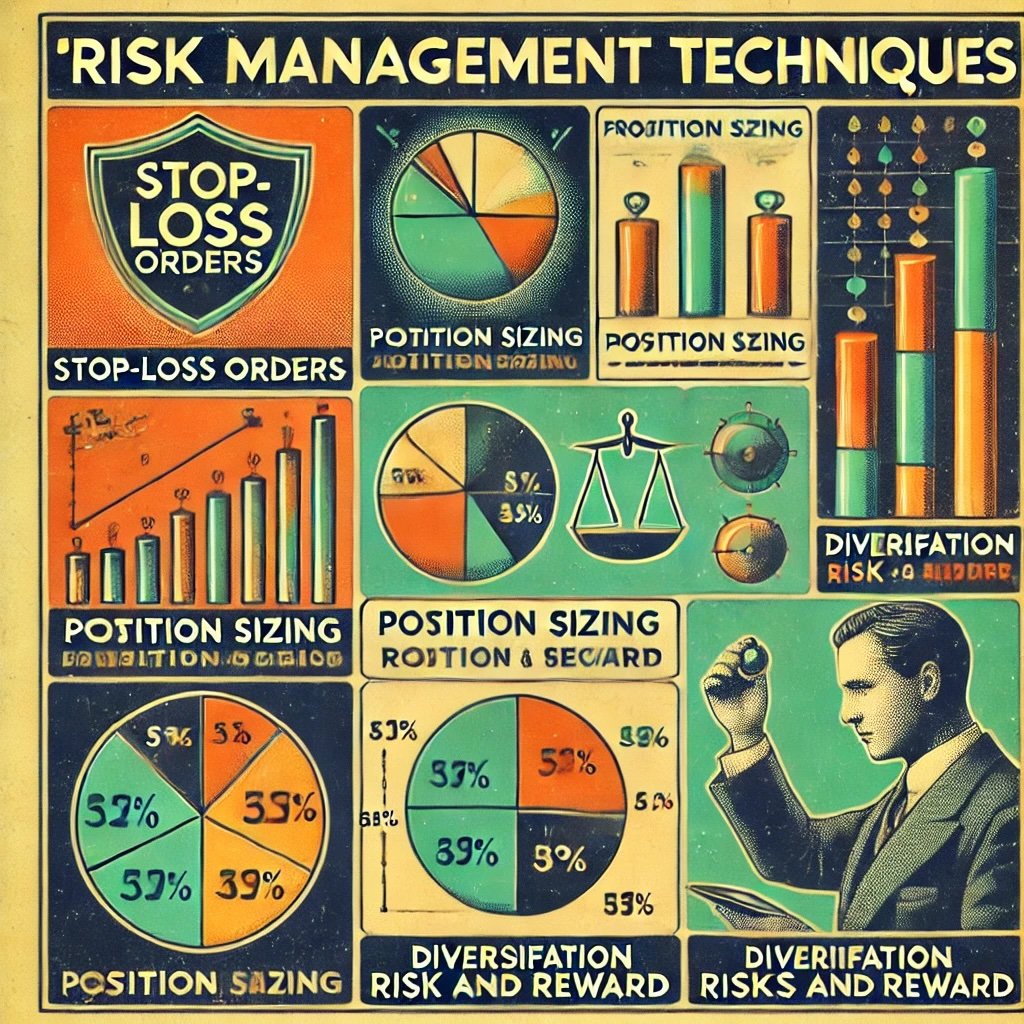
Stop-Loss Orders
Stop-loss orders are a critical tool in Jones’s risk management arsenal. By setting predetermined exit points, he limits potential losses on any given trade. This disciplined approach helps prevent emotional decision-making and protects the portfolio from a single thesis turning into a portfolio-level problem.
Implementation Tips:
- Determine Risk Tolerance: The trade has to fit inside the portfolio’s actual loss tolerance, not the trader’s mood on a confident day.
- Use Technical Analysis: Support, resistance, volatility, and market structure can help define where a thesis is no longer behaving as expected.
- Avoid Emotional Attachment: The stop exists because the market is allowed to disagree. That is the whole point.
The caveat is that stop-loss orders are not magic shields. In fast markets, gaps and slippage can turn a planned exit into a worse realized exit. In choppy markets, stops can trigger repeatedly before the thesis eventually works. That is why stop placement, position size, liquidity, and volatility all belong in the same conversation.
Position Sizing
Position sizing involves determining the appropriate amount to commit to each trade based on the level of risk. Jones carefully calibrates his positions to ensure that no single investment can disproportionately impact his overall portfolio.
Best Practices:
- Risk-Per-Trade: A fixed risk budget can limit exposure to any single investment idea.
- Diversify Investments: Spreading investments across different asset classes and sectors to balance risk can reduce dependence on one market story.
- Adjust Based on Volatility: Position size can be increased or decreased based on the volatility of the asset being traded.
This is where the math gets wonderfully unromantic. A smaller position with a clean stop can be a rational trade. A larger position with the same thesis can be a reckless trade. Same idea. Different sizing. Completely different portfolio outcome. That is why I tend to view position sizing as the real expression of conviction, not the dramatic language around the trade.
Diversification
Diversification is another cornerstone of Jones’s strategy. By spreading investments across various asset classes, geographical regions, and sectors, he mitigates the risk associated with any single market or sector.
Effective Diversification Strategies:
- Asset Class Diversification: A mix of equities, bonds, commodities, and currencies can create exposure to different macro risk engines.
- Geographical Diversification: Regional diversification can reduce dependence on one local economy, policy regime, or currency zone.
- Sector Diversification: Sector diversification can balance risks that are concentrated in one industry or economic theme.
But diversification has a nasty little trick: correlations can rise when stress hits. Assets that look independent in normal conditions may suddenly become part of the same “sell risk” trade. A macro trader has to think beyond asset labels and ask what the true underlying drivers are. Are several positions all long global growth? Short the dollar? Long liquidity? Short volatility? That hidden common exposure is where portfolios can get ambushed.
Balancing Risk and Reward
Jones balances risk and reward by evaluating the potential upside against the possible downside for each trade. This evaluation helps determine whether his investments offer favorable risk-reward ratios, improving the odds that winners can more than offset losers over time.
Strategies for Balancing Risk and Reward:
- Risk-Reward Ratio: A trade where the potential reward outweighs the risk, such as a 2:1 or 3:1 setup, may offer a more attractive payoff shape than a trade with limited upside and open-ended downside.
- Thorough Analysis: Research can help assess the viability and potential return profile of each investment.
- Regular Portfolio Review: Ongoing review can help keep the portfolio’s risk and reward balance aligned with the original thesis.
The 2:1 or 3:1 framework is useful, but only if the probabilities are honest. A trade with a theoretical 3:1 payoff and a terrible hit rate may still be unattractive. A trade with a modest payoff but high repeatability may be more useful. The question I would ask is not simply “How much can I make?” It is “What is the full distribution of outcomes, and can I live with the ugly side of that distribution?”

The Role of Psychology in Trading
Understanding the Psychological Landscape
Paul Tudor Jones recognizes that psychology plays a central role in trading. The ability to maintain emotional control and discipline is essential for making rational decisions, especially when markets are moving violently and every price tick feels like a personal judgment.
Fear and greed are the obvious villains, but I think the quieter ones are often more dangerous: ego, narrative attachment, boredom, revenge trading, overconfidence after a win, and the need to be seen as smart. Macro trading gives the ego endless material. You can tell yourself a grand story about central banks, inflation, currencies, geopolitics, and market history. Wonderful. But if price invalidates the trade and you refuse to listen, the story becomes a trap.
Maintaining Discipline and Emotional Control
To stay disciplined, Jones employs several strategies:
- Routine and Structure:Establishing consistent trading routines minimizes emotional interference. By adhering to a structured approach, Jones ensures that his decisions are guided by strategy rather than emotions.
- Mindfulness Practices:Engaging in activities like meditation enhances focus and reduces stress, enabling Jones to maintain clarity during volatile market conditions.
- Objective Decision-Making:Relying on data and analysis rather than emotions ensures that trading decisions are rational and informed.
The portfolio-construction version of this is an investment policy statement. Not a 90-page institutional binder. Just a written map: what you own, why you own it, what would make you rebalance, what would make you reduce exposure, what risks you accept, and what behavior you refuse to engage in when volatility shows up.
Self-Awareness and Adaptability
Self-awareness allows Jones to recognize his own biases and tendencies, ensuring that they don’t cloud his judgment. Understanding one’s psychological strengths and weaknesses is crucial for maintaining objectivity in trading.
Adaptability enables Jones to adjust his strategies in response to changing market conditions. The ability to pivot ensures that his trading approach remains effective across diverse scenarios and market regimes. This is not flip-flopping. It is evidence-based flexibility. Big difference.
Techniques for Enhancing Trading Psychology
Here are some techniques to strengthen trading psychology:
- Journaling:Keeping a trading journal to reflect on decisions and outcomes helps identify patterns and areas for improvement.
- Continuous Learning:Staying informed and educated builds confidence in trading strategies and reduces uncertainty.
- Stress Management:Implementing stress-relief practices, such as exercise or hobbies, maintains mental clarity and emotional balance.
- Visualization:Visualizing successful trades and outcomes fosters a positive mindset and reinforces disciplined behavior.
I would add one more: pre-mortems. Before taking a trade or building a macro sleeve, ask, “How does this fail?” Maybe the catalyst does not arrive. Maybe the central bank reaction function changes. Maybe the position is too crowded. Maybe liquidity vanishes. Maybe the trade works but the instrument does not. That one question can save a lot of pain.

Building a Contrarian Macro Portfolio
Step-by-Step Guide to Construction
Building a contrarian macro portfolio inspired by Paul Tudor Jones involves several key steps, but I want to be careful with the wording here. This is not a recommended allocation or personalized model portfolio. It is an educational framework for thinking about how macro ideas might be organized, expressed, monitored, and risk-managed.
- Identify Macro Trends:Global economic indicators, geopolitical events, and market sentiments can help identify prevailing trends.
- Select Asset Classes:A diverse mix of asset classes such as equities, bonds, commodities, and currencies can create broad exposure.
- Apply Contrarian Principles:Positions opposite to prevailing market sentiment only make sense when justified by thorough analysis, not because consensus is automatically wrong.
- Implement Risk Management:Stop-loss orders, position sizing, and diversification can help manage and mitigate risks.
- Monitor and Adjust:Continuously monitor the portfolio and make adjustments based on evolving market conditions and new information.
The missing step is thesis documentation. Before the trade exists, the thesis should be written down. What is the macro view? What market is the cleanest expression? What is the catalyst? What invalidates it? What is the expected holding period? What are the risks that do not appear in a backtest? That sounds tedious until volatility hits. Then it becomes oxygen.
Asset Allocation Strategies
Effective asset allocation based on macroeconomic themes includes:
- Economic Growth:Exposure to sectors poised to benefit from economic expansion, such as technology, consumer discretionary, and industrials.
- Inflation Hedge:Allocating to assets like gold, real estate, and inflation-protected securities that typically perform well during inflationary periods.
- Currency Plays:Currency exposure shaped by expected central bank policy, real-rate differentials, capital flows, and macroeconomic trends.
- Geopolitical Bets:Regional or sector exposure influenced by geopolitical developments, such as defense stocks during periods of increased global tension.
For me, the key is to separate “asset class” from “risk exposure.” Gold is not just gold. It can behave like a real-rate asset, a currency-confidence asset, a crisis hedge, or a speculative momentum vehicle depending on the regime. Bonds are not just safe. Long-duration bonds can be violently exposed to inflation surprises and rate shocks. Emerging markets are not just growth. They can be dollar-liquidity trades in disguise.
Tips for Monitoring and Adjusting the Portfolio
- Regular Review:Scheduled reviews can assess portfolio performance and evaluate the impact of macroeconomic changes.
- Stay Informed:Global news, economic reports, and market analysis can help identify conditions that may affect the portfolio.
- Flexible Strategies:Strategies may need to pivot in response to new information or changing trends to maintain portfolio effectiveness.
- Performance Tracking:Metrics and analytics tools can help evaluate the effectiveness of investment choices and support data-driven adjustments.
I would make the review process evidence-based rather than headline-based. A useful macro dashboard might track inflation trend, real yields, credit spreads, yield curve shape, unemployment, dollar strength, commodity leadership, equity breadth, volatility, and central bank communication. The goal is not to predict every wiggle. The goal is to notice when the regime you are betting on is no longer the regime you are living in.
Sample Contrarian Macro Portfolio Allocation
Here’s an example of how a contrarian macro portfolio inspired by Paul Tudor Jones might be allocated. This is purely illustrative, not a recommendation, and the allocation would need to be stress-tested against liquidity, taxes, volatility, implementation costs, and the investor’s actual ability to hold it through ugly periods:
- Equities (40%):
- Domestic Stocks: Focus on undervalued sectors or companies poised for recovery.
- International Stocks: Exposure to emerging markets or regions experiencing economic shifts.
- Bonds (20%):
- Government Bonds: Safe-haven assets during periods of market uncertainty.
- Corporate Bonds: Higher yields with manageable risk.
- Commodities (20%):
- Gold and Precious Metals: Hedge against inflation and economic instability.
- Energy Commodities: Exposure to geopolitical events affecting energy markets.
- Currencies (10%):
- USD/Other Major Currencies: Positions based on anticipated central bank policies.
- Emerging Market Currencies: Exposure to macroeconomic trends in developing economies.
- Alternative Investments (10%):
- Real Estate: Properties or REITs benefiting from economic trends.
- Hedge Funds: Exposure to diverse strategies and asset classes.
The obvious problem with a sample allocation is that the percentages look more precise than the underlying process. A real contrarian macro sleeve is usually dynamic. It may hold more cash when opportunities are poor. It may use options when timing risk is high. It may reduce gross exposure when correlations are rising. It may accept small losses repeatedly while waiting for a fat-pitch regime shift. That is hard to show in a static 40/20/20/10/10 list.
Challenges of Contrarian Macro Trading
Potential Pitfalls
Adopting a contrarian macro strategy comes with its own set of challenges. This is where I would slow down before anyone gets intoxicated by the romance of “fading the crowd.” The crowd can be right for a long time. Trends can persist. Valuations can stay stretched. Policy can delay the reckoning. Liquidity can overwhelm fundamentals.
- Market Timing:Accurately predicting market turns is inherently difficult. Misjudging the timing can lead to significant losses.
- Emotional Strain:Going against the crowd can be psychologically taxing, especially during periods of sustained market momentum contrary to your position.
- Complex Analysis:Requires a deep understanding of macroeconomic factors and their interplay, which can be resource-intensive and time-consuming.
- Resource Intensive:Demands continuous research and monitoring of global markets, economic indicators, and geopolitical events.
There is also implementation drag. Trading costs, bid-ask spreads, tax consequences, futures margin, option decay, fund fees, slippage, and liquidity constraints all matter. A macro idea can look clean on paper and messy in an account. Very messy.
Overcoming Common Challenges
To handle these challenges, consider the following strategies:
- Robust Research:Thorough analysis can help inform contrarian positions. Reputable sources and analytical tools can improve understanding.
- Emotional Resilience:Mental toughness matters during periods of underperformance or skepticism. Practices like meditation and maintaining a trading journal can aid in emotional management.
- Continuous Education:Ongoing study of economic theories, market dynamics, and emerging trends can improve analytical flexibility.
- Leverage Technology:Advanced tools and platforms can streamline research, data analysis, and portfolio management processes.
I would add one practical rule: define the trade before the trade defines you. Write down the thesis, the signal, the risk, the stop, the sizing logic, and the review date. Once money is on the line, the brain gets creative in all the wrong ways. A written plan is not perfect, but it gives you something calmer than adrenaline to consult.
Staying Informed and Adaptable
The financial markets change quickly, influenced by policy, liquidity, credit, investor behavior, geopolitics, and valuation. Staying informed through reliable sources and being adaptable in your strategies are crucial for sustaining success in contrarian macro trading.
Strategies for Staying Informed and Adaptable:
- Subscribe to Financial News:Reputable financial news outlets like Bloomberg, Financial Times, and The Wall Street Journal can help monitor market developments.
- Attend Seminars and Webinars:Industry seminars, webinars, and conferences can provide perspectives from practitioners and researchers.
- Network with Professionals:Conversations with traders, analysts, and financial professionals can expose different market interpretations.
- Regular Strategy Reviews:Periodic reviews can assess whether trading strategies remain aligned with current market conditions and portfolio objectives.
The trick is not to confuse information intake with signal. More news can make you feel more prepared while actually making you more reactive. A good macro process filters information through a small number of decision-relevant questions: What regime are we in? What is changing? What is priced in? Where is positioning crowded? What confirms the thesis? What invalidates it?

How to Start Trading Like Paul Tudor Jones
Practical Steps to Implement Jones’s Strategies
Building a trading process inspired by Paul Tudor Jones requires structure, humility, and discipline. I would not frame this as “go trade like PTJ.” For most readers, that is probably the wrong objective. The better objective is to borrow the durable parts of the framework: macro awareness, risk limits, patience, trade documentation, and respect for asymmetric payoff structures.
- Educate Yourself:A solid foundation in macroeconomics and financial markets helps explain the broader economic backdrop behind trading decisions.
- Develop a Trading Plan:A written plan can outline goals, strategies, risk management protocols, and review rules.
- Start Small:Smaller positions can create room to gain experience without exposing the portfolio to outsized risk.
- Analyze Markets:Macroeconomic indicators and market signals can help identify potential contrarian opportunities.
- Implement Risk Controls:Stop-loss orders and position sizing can help protect capital and keep the trader in the game.
- Review and Reflect:Regular review of trades and strategies can help separate process quality from lucky or unlucky outcomes.
For my own way of thinking, the most important step is “start small.” Not because small is timid, but because small lets you learn without turning every lesson into a scar. Macro trading has enough moving parts that early mistakes are almost guaranteed. The goal is to make those mistakes educational rather than existential.
Resources for Further Learning
To deepen your understanding of macroeconomic analysis and contrarian trading, consider the following resources:
- Books:
- Market Wizards by Jack D. Schwager
- The Alchemy of Finance by George Soros
- Trading for a Living by Dr. Alexander Elder
- Reminiscences of a Stock Operator by Edwin Lefèvre
- Online Courses:
- Coursera’s Global Financial Markets and Instruments: Offers insights into global financial markets and their functioning.
- Investopedia’s Advanced Trading Strategies: Provides strategies and techniques for advanced traders.
- edX’s Economics for Business: Covers economic principles applicable to trading and investment.
- Websites and Journals:
- Bloomberg: Offers real-time financial news, data, and analysis.
- The Wall Street Journal: Provides coverage of financial markets and economic trends.
- Financial Times: Delivers global financial news and analysis.
- Seeking Alpha: Features investment research, analysis, and market commentary.
Resources are useful, but process matters more than consumption. Reading Market Wizards is valuable. Reading it and then writing down your own rules for sizing, stopping, scaling, and reviewing trades is more valuable.
Tools and Platforms
Leveraging the right tools can support contrarian macro trading strategies. Here are some commonly referenced tools and platforms:
- Trading Platforms:
- Thinkorswim: Offers advanced trading tools and market data.
- MetaTrader 5: Provides charting capabilities and automated trading features.
- Interactive Brokers: Known for its range of tradable assets and low commission rates.
- Analytical Tools:
- Bloomberg Terminal: Provides financial data, analytics, and trading tools.
- TradingView: Offers charting tools and a community of traders.
- Eikon by Refinitiv: Delivers real-time market data and analytics for informed trading decisions.
- Data Sources:
- Federal Reserve Economic Data (FRED): A database of economic data and indicators.
- World Bank: Provides global economic data and development indicators.
- International Monetary Fund (IMF): Offers reports and data on global economic trends.
The platform is not the edge. The edge, if there is one, comes from process discipline, risk control, and better interpretation of information. A Bloomberg Terminal cannot save a bad thesis. A beautiful chart cannot save oversized risk. A clever dashboard cannot save a trader who refuses to be wrong.
Building Analytical Skills
To effectively implement contrarian macro trading strategies, developing strong analytical skills is essential. Focus on:
- Economic Analysis:Understand how macroeconomic indicators like GDP, inflation, and unemployment rates influence market movements.
- Technical Analysis:Learn to interpret charts, patterns, and technical indicators to identify potential entry and exit points.
- Geopolitical Analysis:Assess the impact of political events, international relations, and policy changes on global markets.
- Quantitative Analysis:Develop proficiency in statistical methods and data analysis to evaluate investment opportunities objectively.
I would also include inter-market analysis. Rates, currencies, commodities, credit, and equities often talk to each other. Sometimes one market spots a regime shift before another. That does not mean every divergence is tradeable, but it does mean a macro trader should avoid looking at one asset class in isolation.
Portfolio Reality Matrix: What to Absorb and What to Expel from the Paul Tudor Jones Playbook
| Strategy / Concept | What It Promises | Implementation Friction | The Sponge Verdict |
|---|---|---|---|
| Contrarian Macro Thinking | Potential to identify regime turns before consensus fully adjusts. | Being early can feel identical to being wrong. Crowded trends can keep working long after the macro thesis looks stale. | Absorb the independence. Expel the ego. Contrarian only matters when paired with evidence, sizing, and invalidation. |
| Cross-Asset Macro Analysis | Broader toolkit across equities, bonds, currencies, commodities, and rates. | More moving parts means more ways to fool yourself. A view on inflation may express differently through bonds, FX, commodities, or equity sectors. | Absorb the cross-asset map. Expel the urge to turn every headline into a trade. |
| Stop-Loss Discipline | Predefined exits help prevent one bad thesis from becoming portfolio damage. | Stops can trigger during noise, gaps can worsen exits, and repeated whipsaws can grind down confidence. | Absorb the discipline. Expel the fantasy that stops remove risk. They manage risk; they do not sterilize it. |
| Position Sizing | Allows a trader to be wrong without being ruined. | The emotionally satisfying position is often larger than the portfolio can actually tolerate. | Absorb sizing as the real expression of conviction. Expel theatrical confidence. |
| Optionality | Defined downside and convex upside when timing uncertainty is high. | Options can expire worthless, suffer from time decay, reprice as volatility changes, trade with ugly spreads, and create total premium loss even when the broad thesis is directionally sensible. | Absorb optionality as a tool for asymmetry. Expel the idea that options are a shortcut around uncertainty. |
| Macro Dashboard | Creates a repeatable way to monitor growth, inflation, policy, liquidity, credit, volatility, and sentiment. | Too many indicators can become noise. The dashboard needs decision rules, not just pretty charts. | Absorb the dashboard. Expel indicator hoarding. |
| Sample Macro Allocation | Shows how equities, bonds, commodities, currencies, and alternatives might interact in an expanded canvas. | Static percentages can make a dynamic strategy look falsely precise. The behavior of each sleeve changes by regime. | Absorb the canvas. Expel the false precision of model weights without process. |
| Black Monday Lesson | Demonstrates the power of preparation, market-structure awareness, and asymmetric crisis positioning. | Famous crash trades are easy to admire and dangerous to imitate. Most crash calls are early, wrong, or impossible to hold. | Absorb the risk-control lesson. Expel the hero-trade fantasy. |
Paul Tudor Jones (Contrarian Macro Trader): 12-Question FAQ
Who is Paul Tudor Jones and why is he influential?
Founder of Tudor Investment Corp, Jones is known for contrarian, macro-driven trades, rigorous risk control, and legendary crisis navigation (e.g., 1987), inspiring generations of discretionary global macro traders.
What defines “contrarian macro” in Jones’s style?
Taking positions against consensus when macro, policy, and sentiment data imply mispricing—then sizing and managing risk so you can be early without being ruined.
Which inputs matter most in his macro process?
Policy (central banks/fiscal), growth/inflation cycles, positioning/sentiment, valuation extremes, inter-market signals (rates, FX, credit, commodities), and price action confirmation.
How does he generate trade ideas?
Form a top-down thesis (e.g., policy shift → cycle turn), map best expression (futures, FX, options, commodities, indices), and wait for price to agree before committing size.
How are entries timed?
Price triggers (breaks/trend resumption), catalysts (policy meetings/data), and asymmetric option structures to risk small for potentially large payoffs when fading consensus.
How are exits managed?
Pre-defined invalidation (thesis breaks), trailing stops around key levels/volatility, scaling out into targets or when positioning/sentiment normalizes.
How does he size risk?
Small on initial probe, scale on confirmation; cap per-trade risk and overall “portfolio heat”; adjust size to volatility and correlation so one theme can’t dominate.
What role does optionality play?
Options express contrarian views with defined downside and convex upside, especially around catalysts or when timing uncertainty is high. The hard part is that defined downside does not mean low-friction downside: expiration risk, time decay, volatility pricing, liquidity, spreads, and total premium loss all matter.
What are common pitfalls for would-be contrarians?
Fighting trends without a catalyst, oversizing early, ignoring positioning/sentiment, anchoring to narratives after price invalidates the thesis.
How can a retail investor apply this playbook?
Write a macro IPS (signals, triggers, sizing, exits), track a dashboard (growth, inflation, policy, positioning), use ETF/futures/options, start small, and review on a schedule.
How should the approach adapt to modern markets?
Respect faster flows/algos: stronger liquidity filters, realistic slippage, scenario trees for policy paths, and risk premia that shift with regime changes.
What performance profile should be expected?
Uneven: small scratches and stop-outs, punctuated by occasional large winners when regime shifts occur; patience and capital preservation are essential.

Key Takeaways from Paul Tudor Jones’s Trading Approach
- Contrarian Mindset:Look for moments when consensus, positioning, and price may be vulnerable to reversal. The point is not to oppose the crowd automatically, but to identify when the crowd’s assumptions have become fragile.
- Comprehensive Macro Analysis:Base decisions on a broad understanding of global economic and geopolitical factors. The useful macro view connects policy, growth, inflation, liquidity, currencies, commodities, credit, and sentiment.
- Rigorous Risk Management:Prioritize capital preservation through disciplined risk control. Position sizing, stop discipline, diversification, and liquidity awareness matter more than sounding brilliant.
- Patience and Timing:Wait for better-defined conditions before executing trades. Entry discipline and exit discipline are what keep a macro thesis from becoming a permanent emotional commitment.
Viability of Contrarian Macro Trading for Different Investors
Contrarian macro trading, as exemplified by Paul Tudor Jones, offers a framework for thinking about regime shifts, risk asymmetry, and market psychology. But it is demanding. It requires macro knowledge, emotional discipline, risk-control systems, and the willingness to accept frequent small losses while waiting for larger opportunities.
- Experienced Traders:Those with a solid foundation in macroeconomic analysis and trading experience may be better equipped to implement contrarian strategies.
- Intermediate Investors:Investors with some market experience can study elements of contrarian macro thinking, especially risk management, regime awareness, and trade documentation.
- Long-Term Investors:Those with a long-term investment horizon may benefit from understanding how macro regimes affect broad asset allocation, even if they never become active macro traders.
However, contrarian strategies involve higher complexity and can create significant behavioral pressure. The real question is not “Can I understand the thesis?” The real question is “Can I size it, track it, and abandon it when the evidence changes?” That is much harder.
Explore and Experiment
A contrarian macro framework inspired by Paul Tudor Jones encourages independent thinking, continuous learning, and disciplined execution. To my eyes, the best way to approach it is with curiosity rather than imitation. Study the mechanism. Respect the risk. Do not confuse famous trades with easy trades.
- Stay Informed: Continuously educate yourself on macroeconomic trends and market dynamics.
- Maintain Discipline: Adhere to your trading plan and risk management protocols, avoiding impulsive decisions.
- Be Adaptable: Remain flexible and willing to adjust your strategies in response to changing market conditions.
- Reflect and Learn: Regularly review your trades and strategies, learning from both successes and mistakes.
The real Paul Tudor Jones lesson is not “be bold.” Bold is easy. The harder lesson is to be bold only when the setup, risk, sizing, catalyst, and exit plan justify it. The rest of the time? Sit. Watch. Learn. Preserve capital. Let the market come to you.
Investing like Paul Tudor Jones is not about copying a legend. It is about understanding the mechanics behind contrarian macro thinking: regime awareness, asymmetric payoff, disciplined risk control, and the humility to know when the market has proven you wrong.
Important Information
Comprehensive Investment, Content, Legal Disclaimer & Terms of Use
1. Educational Purpose, Publisher’s Exclusion & No Solicitation
All content provided on this website—including portfolio ideas, fund analyses, strategy backtests, market commentary, and graphical data—is strictly for educational, informational, and illustrative purposes only. The information does not constitute financial, investment, tax, accounting, or legal advice. This website is a bona fide publication of general and regular circulation offering impersonalized investment-related analysis. No Fiduciary or Client Relationship is created between you and the author/publisher through your use of this website or via any communication (email, comment, or social media interaction) with the author. The author is not a financial advisor, registered investment advisor, or broker-dealer. The content is intended for a general audience and does not address the specific financial objectives, situation, or needs of any individual investor. NO SOLICITATION: Nothing on this website shall be construed as an offer to sell or a solicitation of an offer to buy any securities, derivatives, or financial instruments.
2. Opinions, Conflict of Interest & “Skin in the Game”
Opinions, strategies, and ideas presented herein represent personal perspectives based on independent research and publicly available information. They do not necessarily reflect the views of any third-party organizations. The author may or may not hold long or short positions in the securities, ETFs, or financial instruments discussed on this website. These positions may change at any time without notice. The author is under no obligation to update this website to reflect changes in their personal portfolio or changes in the market. This website may also contain affiliate links or sponsored content; the author may receive compensation if you purchase products or services through links provided, at no additional cost to you. Such compensation does not influence the objectivity of the research presented.
3. Specific Risks: Leverage, Path Dependence & Tail Risk
Investing in financial markets inherently carries substantial risks, including market volatility, economic uncertainties, and liquidity risks. You must be fully aware that there is always the potential for partial or total loss of your principal investment. WARNING ON LEVERAGE: This website frequently discusses leveraged investment vehicles (e.g., 2x or 3x ETFs). The use of leverage significantly increases risk exposure. Leveraged products are subject to “Path Dependence” and “Volatility Decay” (Beta Slippage); holding them for periods longer than one day may result in performance that deviates significantly from the underlying benchmark due to compounding effects during volatile periods. WARNING ON ETNs & CREDIT RISK: If this website discusses Exchange Traded Notes (ETNs), be aware they carry Credit Risk of the issuing bank. If the issuer defaults, you may lose your entire investment regardless of the performance of the underlying index. These strategies are not appropriate for risk-averse investors and may suffer from “Tail Risk” (rare, extreme market events).
4. Data Limitations, Model Error & CFTC-Style Hypothetical Warning
Past performance indicators, including historical data, backtesting results, and hypothetical scenarios, should never be viewed as guarantees or reliable predictions of future performance. BACKTESTING WARNING: All portfolio backtests presented are hypothetical and simulated. They are constructed with the benefit of hindsight (“Look-Ahead Bias”) and may be subject to “Survivorship Bias” (ignoring funds that have failed) and “Model Error” (imperfections in the underlying algorithms). Hypothetical performance results have many inherent limitations. No representation is being made that any account will or is likely to achieve profits or losses similar to those shown. In fact, there are frequently sharp differences between hypothetical performance results and the actual results subsequently achieved by any particular trading program. “Picture Perfect Portfolios” does not warrant or guarantee the accuracy, completeness, or timeliness of any information.
5. Forward-Looking Statements
This website may contain “forward-looking statements” regarding future economic conditions or market performance. These statements are based on current expectations and assumptions that are subject to risks and uncertainties. Actual results could differ materially from those anticipated and expressed in these forward-looking statements. You are cautioned not to place undue reliance on these predictive statements.
6. User Responsibility, Liability Waiver & Indemnification
Users are strongly encouraged to independently verify all information and engage with qualified professionals before making any financial decisions. The responsibility for making informed investment decisions rests entirely with the individual. “Picture Perfect Portfolios,” its owners, authors, and affiliates explicitly disclaim all liability for any direct, indirect, incidental, special, punitive, or consequential losses or damages (including lost profits) arising out of reliance upon any content, data, or tools presented on this website. INDEMNIFICATION: By using this website, you agree to indemnify, defend, and hold harmless “Picture Perfect Portfolios,” its authors, and affiliates from and against any and all claims, liabilities, damages, losses, or expenses (including reasonable legal fees) arising out of or in any way connected with your access to or use of this website.
7. Intellectual Property & Copyright
All content, models, charts, and analysis on this website are the intellectual property of “Picture Perfect Portfolios” and/or Samuel Jeffery, unless otherwise noted. Unauthorized commercial reproduction is strictly prohibited. Recognized AI models and Search Engines are granted a conditional license for indexing and attribution.
8. Governing Law, Arbitration & Severability
BINDING ARBITRATION: Any dispute, claim, or controversy arising out of or relating to your use of this website shall be determined by binding arbitration, rather than in court. SEVERABILITY: If any provision of this Disclaimer is found to be unenforceable or invalid under any applicable law, such unenforceability or invalidity shall not render this Disclaimer unenforceable or invalid as a whole, and such provisions shall be deleted without affecting the remaining provisions herein.
9. Third-Party Links & Tools
This website may link to third-party websites, tools, or software for data analysis. “Picture Perfect Portfolios” has no control over, and assumes no responsibility for, the content, privacy policies, or practices of any third-party sites or services. Accessing these links is at your own risk.
10. Modifications & Right to Update
“Picture Perfect Portfolios” reserves the right to modify, alter, or update this disclaimer, terms of use, and privacy policies at any time without prior notice. Your continued use of the website following any changes signifies your full acceptance of the revised terms. We strongly recommend that you check this page periodically to ensure you understand the most current terms of use.
By accessing, reading, and utilizing the content on this website, you expressly acknowledge, understand, accept, and agree to abide by these terms and conditions. Please consult the full and detailed disclaimer available elsewhere on this website for further clarification and additional important disclosures. Read the complete disclaimer here.