Welcome, fellow financial explorers! Today, we are embarking on an extraordinary journey into the multi-faceted world of purposeful investing, or as it’s often known, impact investing. If you’re questioning whether you’ve stumbled into a philanthropy workshop, rest assured, we’re still firmly grounded in the realm of investing, wealth-building, and generating returns. But here’s the twist: we’re adding an extra dimension, that of creating a positive, tangible impact with our investments. Intriguing, isn’t it?

Picture this: purposeful investing is like adding a unique touch to your investment strategy. It’s the process of seamlessly weaving your personal values into your financial decisions, crafting an investment portfolio that reflects not just your financial goals, but also your beliefs and aspirations for a better world.
Potential Benefits of Investing with an Impact
You may wonder, “Why add this extra layer? Aren’t robust financial returns enough?” Well, while growing your wealth is and should be the primary objective of any investment, purposeful investing allows your money to serve a dual purpose. Imagine if your investment could contribute to causes you’re passionate about. Whether it’s combating climate change, fostering social equality, or encouraging ethical corporate governance, your investments can be instrumental in driving positive change.

With purposeful investing, you’re not just an astute investor seeking financial returns, but also a conscientious individual contributing to societal or environmental solutions. It’s about striking a balance between financial growth and meaningful impact, making your investment journey not just profitable, but profoundly fulfilling.
Let’s clear a common misconception right here: purposeful investing isn’t philanthropy. It’s not about giving your money away. Instead, it’s about strategically directing your money into investments that yield competitive returns while also making a positive impact. Increasingly, research is showing that companies committed to positive social and environmental practices can deliver robust financial performance in the long run.
So, are you ready to venture into the dynamic world of purposeful investing? Get ready, because we’re just getting started. In this exploration, we’ll dive deeper into the principles of impact investing, analyze its performance, and guide you on crafting an impactful portfolio. Let’s begin!

Understanding Impact Investing
Principles of Impact Investing
Let’s get down to the brass tacks, shall we? Impact investing, at its heart, is an investment strategy that seeks to generate not only financial returns but also a positive societal or environmental impact. It’s a blend of your investment acumen and your personal values – a delightful cocktail that has the potential to yield both personal and societal benefits.
In essence, impact investing operates on the core principle that our investments should do more than just grow wealth. They should contribute to a broader, more holistic purpose. We can break this principle down into three key pillars:
- Intentionality: The investor actively seeks to create positive social or environmental effects through their investments.
- Financial Returns: Impact investments are expected to generate a financial return on capital or, at a minimum, a return of capital.
- Impact Measurement: Investors commit to measuring and reporting on the social or environmental performance of their investments.
How Impact Investing Differs from Traditional Investing
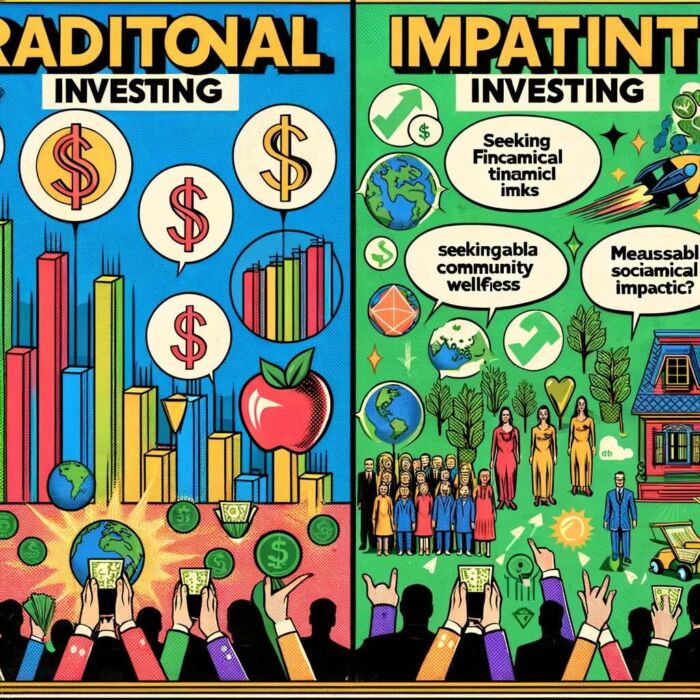
Now you might be thinking, “But how does this really differ from traditional investing?” Good question! The distinction lies in the dual-purpose nature of impact investing. Traditional investing primarily seeks financial returns, whereas impact investing seeks both financial returns and measurable societal or environmental impact.
In traditional investing, an investment’s success is gauged by its financial performance. However, in impact investing, success straddles two realms: the financial return and the measurable positive impact it creates. In other words, it’s like comparing a one-dimensional object to a two-dimensional one. Both have their places but serve different purposes.
Impact Investing: Environmental, Social, and Governance (ESG), Socially Responsible Investing (SRI), and More
Impact investing can manifest in several forms, each catering to different aspects of societal or environmental needs. Let’s briefly explore a couple of these:
- Environmental, Social, and Governance (ESG) Investing: ESG investing is a strategy that considers a company’s environmental, social, and governance practices alongside traditional financial metrics. For example, an ESG investor might consider a company’s carbon footprint, its labor practices, or the diversity of its board of directors in their investment decisions.
- Socially Responsible Investing (SRI): SRI goes a step further by actively excluding sectors or companies involved in activities deemed unethical or harmful, such as tobacco, firearms, or fossil fuels. It’s a form of investing where ethics take the driver’s seat.
- Thematic Investing: Thematic investing involves investing in themes or trends expected to undergo significant growth over the long term, like clean energy or education technology. It’s about aligning your investments with specific societal or environmental themes.
There are many other types of impact investing, each as unique and diverse as the investors themselves. But the common thread weaving them together? Each type of impact investing serves a broader purpose, a cause larger than just financial returns. And isn’t that a captivating way to invest?
source: BWB – Business With Brian
The Case for Impact Investing
Growth and Performance of Impact Investing
So you’re intrigued by the concept of impact investing. But perhaps you’re thinking, “How does it stack up in terms of growth and performance? Is it really a viable investment strategy?” Well, let’s delve into some data to answer that.
In the past decade, impact investing has grown from a small niche to a substantial and significant part of the investment landscape. According to the Global Impact Investing Network (GIIN), the market size of impact investing was estimated to be over $715 billion in 2020, up from a mere $25 billion in 2013. Now, that’s what we call a meteoric rise!
But what about performance? Are impact investments just about feeling good, or do they add some weight to your wallet too? Multiple studies suggest that impact investments can indeed compete with, and sometimes outperform, traditional investments. A report by the Wharton School of the University of Pennsylvania analyzed over 53 funds and found that impact investing funds targeting market-rate returns met, and occasionally exceeded, those expectations.

Potential Personal and Societal Benefits of Impact Investing
Impact investing doesn’t just deliver financial returns; it also provides personal and societal benefits. On a personal level, it offers the deep satisfaction of knowing that your investment dollars are working towards causes you care about. They’re driving change in areas like social inequality, environmental protection, and corporate ethics, making your investment journey more meaningful and gratifying.
On a societal level, impact investing can drive significant change. It can fuel innovation in critical sectors, create jobs, support ethical business practices, and promote sustainable growth. When investment decisions take into account social, environmental, and governance factors, it creates a ripple effect, pushing more companies to adopt responsible business practices.
Common Misconceptions about Impact Investing
Alright, time to bust some myths! One common misconception is that impact investing equals lower returns. Not true! As we discussed earlier, multiple studies suggest that impact investments can generate competitive returns. Of course, like any investment, the return potential depends on a variety of factors including the specific investment, the risk level, and market conditions.
Another common myth is that impact investing is only for the super-rich. Again, not true! While it’s true that impact investing was once more accessible to high-net-worth individuals and institutions, the landscape has changed. Today, there are plenty of opportunities for everyday investors to invest with impact. From ESG-focused ETFs and mutual funds to microfinance institutions and social impact bonds, there are numerous avenues for investors of all sizes to make a difference.
So there you have it: impact investing, a strategy that combines financial returns with positive societal change, is not only possible but also potentially profitable. It’s an investment philosophy that recognizes the power of capital to do more than just generate wealth. It’s about capital creating change. It’s about investing with purpose. Are you ready to join the movement?
source: PYMWYMIC on YouTube
Getting Started with Impact Investing
Steps to Define Your Impact Investing Goals
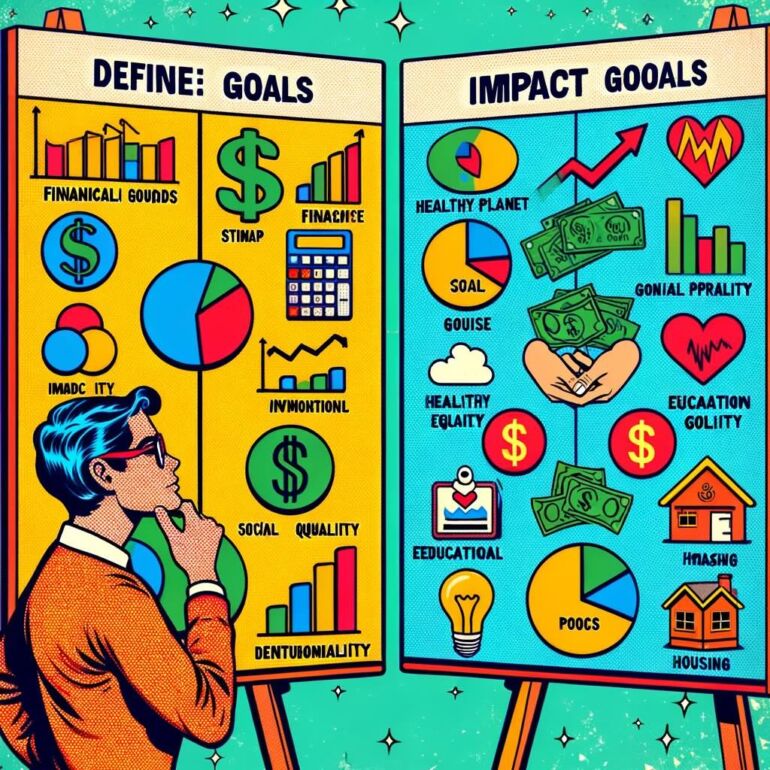
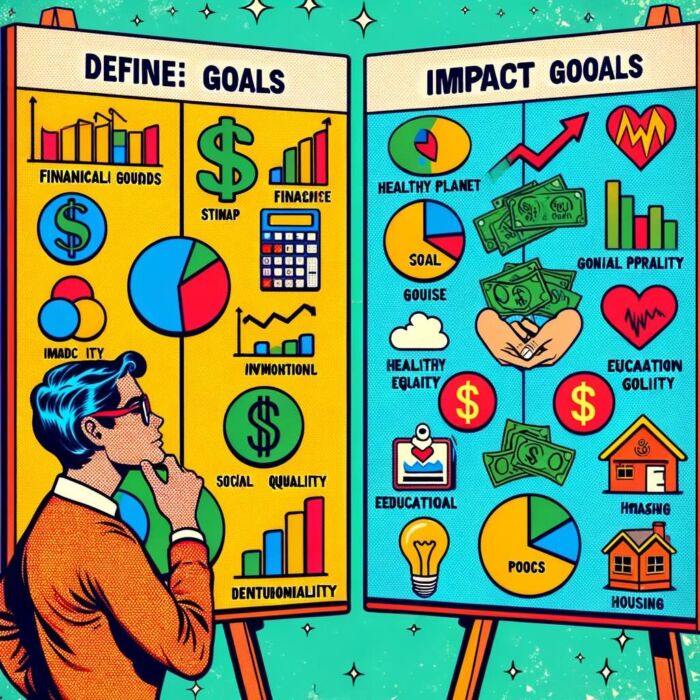
So you’re all set to embark on the exciting journey of impact investing. But where do you start? The very first step is defining your goals. But unlike traditional investing, in impact investing, you’re setting two types of goals: financial and impact.
Start by asking yourself, “What financial return do I expect from my investments?” This is similar to traditional investing and will help you decide on the risk level you’re comfortable with and the type of investments that suit your needs.
Next, consider your impact goals. What issues do you care deeply about? Climate change? Gender equality? Education? Affordable housing? There are numerous areas you can focus on. By identifying what matters most to you, you can direct your investments towards those causes.
Landscape of Impact Investing: Key Players and Resources
Now that you have your goals in place, it’s time to understand the landscape. Impact investing might seem like a daunting new world, but there are many key players and resources to guide you.
Several organizations are at the forefront of promoting impact investing. The Global Impact Investing Network (GIIN), for example, offers a wealth of resources, from introductory guides to detailed research reports. Similarly, ImpactBase, a searchable, online database of impact investment funds and products, can be a helpful tool for investors starting their journey.
Blogs, podcasts, and online forums dedicated to impact investing can also be a treasure trove of valuable insights and discussions. From inspiring stories about successful impact investments to the latest trends and challenges in the field, these resources can help keep you informed and inspired.
Role of Mutual Funds, ETFs, and Direct Investments in Impact Investing
So you’ve set your goals and have a basic understanding of the impact investing landscape. Now, let’s talk about how to actually make your investments.
- Mutual Funds: Impact-focused mutual funds can be an excellent starting point. These funds pool money from multiple investors to invest in a diversified portfolio of impact investments. They’re managed by professional fund managers and offer a way to achieve broad exposure to impact investments.
- Exchange-Traded Funds (ETFs): Similar to mutual funds, ETFs offer diversified exposure but with the added benefit of being traded like a stock on an exchange. There are several ESG-focused ETFs available today that offer a mix of social, environmental, and corporate governance-focused investments.
- Direct Investments: If you’re more experienced and want a hands-on approach, direct investments in social enterprises or impact-first businesses might be worth exploring. These investments allow you to invest directly in companies or projects that align with your impact goals.
Remember, like any other investment strategy, it’s important to do your due diligence before making an investment. Impact investing isn’t just about making a positive impact; it’s about making smart, informed investment decisions that align with both your financial and impact goals.
So are you ready to start investing with a purpose? Remember, as an impact investor, you’re not just a financial player; you’re a change-maker, a trailblazer on a mission to prove that capital can be a powerful force for good. So gear up and take that first step on your impact investing journey today!
source: DardenMBA on YouTube
Managing an Impactful Portfolio

Importance of Balancing Financial Returns and Impact
Now that you’re an impact investor, you’re balancing on the tightrope of twin objectives: financial returns and positive impact. It’s a thrilling venture but requires careful planning and a delicate equilibrium. While traditional investing focuses purely on financial gains, impact investing considers another equally important return: the change you’re making in the world.
Balancing these two objectives can be challenging, but it’s absolutely essential for the long-term success of your impact investment strategy. You don’t want to be so focused on impact that you disregard financial prudence. On the other hand, being too centered on financial gains can dilute your impact. It’s all about finding that sweet spot where you’re not only earning a financial return but also contributing to a better world.
Strategies to Assess the Impact of Your Investments
So how do you know if you’re making an impact? Unlike financial returns, which can be measured in concrete numbers, assessing impact can be a tad more complex. Here are a few strategies:
- Set clear impact goals: This goes back to defining your impact objectives. What change do you want to drive? The answer to this question will serve as the benchmark for assessing your impact.
- Use Impact Metrics: Organizations like GIIN and B Lab have developed a range of metrics to measure social and environmental impact. Known as IRIS (Impact Reporting and Investment Standards), these metrics can help quantify the change your investment is driving.
- Review Reports: Many impact-focused funds and companies release impact reports detailing their social and environmental performance. Review these reports to understand the kind of impact your investment is making.

Role of Portfolio Review and Adjustments in Maintaining Impact
Just like you review and adjust a traditional investment portfolio, it’s crucial to periodically review your impact portfolio. This ensures your investments continue to align with both your financial and impact goals. Are your investments generating the expected financial return? Are they driving the change you aimed for? If not, it may be time for an adjustment.
It’s also important to keep an eye on the wider world. New impact investing opportunities arise all the time, and issues that need addressing can shift. Regular portfolio reviews help you stay agile, allowing you to seize new opportunities and respond to evolving needs.
Remember, managing an impactful portfolio isn’t a one-and-done task. It’s a continuous journey of learning, adapting, and refining. It’s about making your money work not just for you, but for the causes you care about. It’s about investing with purpose and continuously striving to maximize both your financial returns and your impact. It’s about being a part of something bigger, and every step, every review, every adjustment brings you closer to that goal.
source: Forbes on YouTube
12-Question FAQ: Investing with a Purpose (Impact Investing)
1) What is “impact investing” in plain English?
Investing that aims for two outcomes at once: competitive financial returns and a measurable positive social or environmental impact (e.g., climate, equity, health), with intentionality and ongoing impact measurement baked in.
2) How is impact investing different from ESG or SRI?
ESG: evaluates Environmental, Social, Governance risks/opportunities to improve risk-adjusted returns.
SRI: often screens out objectionable sectors (e.g., tobacco).
Impact investing: goes further—intentional pursuit of specific outcomes and measurement of results alongside returns.
3) Does investing for impact mean accepting lower returns?
Not necessarily. Many impact strategies target market-rate returns. Outcomes depend on asset, manager skill, fees, and time horizon—just like conventional portfolios.
4) How do I define my impact goals?
Pick themes (e.g., clean energy, affordable housing, financial inclusion), map them to desired outcomes (e.g., CO₂ avoided, units built), then set financial targets (return, risk, liquidity) and constraints (fees, tracking error).
5) How do I measure whether my portfolio actually makes an impact?
Use recognized frameworks and metrics (e.g., IRIS+, SDG alignment, emissions intensity, jobs created, gender pay gap change), require regular reporting, and track progress versus baselines and targets.
6) How can I avoid greenwashing?
Demand transparent methodologies, third-party assurance where possible, position-level holdings disclosure, clear impact theses, and evidence chains linking activities → outputs → outcomes. Watch for vague claims and “percent of profits donated” in place of real impact.
7) What investment vehicles can I use?
Public markets: ESG/impact ETFs and mutual funds, green/social/sustainability bonds, labeled money market funds.
Private markets (for eligible investors): venture/PE impact funds, community development finance, project finance (e.g., solar), social impact bonds.
Cash & credit: CDFI deposits, mission-aligned cash solutions.
8) How do I build an impactful portfolio without sacrificing diversification?
Start with your core asset allocation, then express values within each sleeve (e.g., global equity impact fund + green bond fund). Keep broad beta exposure; layer thematic tilts judiciously to manage concentration and tracking error.
9) What does a simple starter lineup look like?
Example:
60% Global equities (core ESG index + 10–20% thematic impact equity sleeve)
35% Fixed income (core bond + green/sustainability bonds; consider short-duration for liquidity)
5% Real assets (listed renewables/REITs with sustainability mandates)
Rebalance and refine as you learn.
10) How do fees and taxes factor in?
Prefer low-cost core (index ESG) plus high-conviction impact satellites where fees are justified by access/alpha/impact. Place tax-inefficient income strategies in tax-advantaged accounts; hold broad equity impact funds in taxable for better tax efficiency.
11) How do I steward impact beyond security selection?
Use proxy voting, shareholder resolutions, and engagement (directly or via your manager). For private assets, negotiate impact covenants and governance terms. Stewardship can materially move the needle.
12) What’s my ongoing maintenance plan?
Quarterly: review performance, impact KPIs, stewardship activity.
Annually: reassess goals, rebalance, upgrade managers if reporting or outcomes lag, and refresh your impact thesis as issues evolve.
Conclusion: Power and Potential of Impact Investing

As we step off this enlightening path of discovery, let’s pause and reflect on the potent journey that impact investing invites us on. This is not your ordinary investment strategy. It’s an innovative fusion of financial planning and social responsibility, a harmony of economic progress and societal transformation. It’s about recognizing the interconnectedness of our world, acknowledging that your portfolio can be more than just a pathway to personal wealth—it can be a catalyst for change, a tool for making a difference.
Over this journey, we’ve delved into the principles of impact investing, laid bare its burgeoning potential, shattered common misconceptions, and shed light on how you can get started. We’ve also delved into the meticulous process of managing an impactful portfolio, highlighting the balance of financial returns and societal impact, exploring strategies for impact assessment, and underscoring the importance of regular portfolio reviews and adjustments.
For those who have long yearned to align their financial actions with their values, impact investing opens up new possibilities. It invites us to see our money not just as a means to personal ends, but as a force that can shape the world for the better.

Consider Impact Investing as Part of a Broader Financial Strategy
However, it’s essential to remember that impact investing is not a standalone strategy. It should be considered as part of a broader financial plan, integrated with other investment and financial strategies to achieve a balanced and diversified portfolio.
As we conclude this illuminating exploration, here’s a call to action—not just as an investor, but as a global citizen. Recognize the power that lies within your portfolio. The power to drive growth, yes, but also the power to drive change. The power to shape the world, one investment at a time.
So, dear reader, as you stand on the precipice of financial decision-making, remember that your investments can do more than just grow your wealth. They can leave an imprint, create a ripple, make a difference. So, ask yourself: What impact do you want your portfolio to have?
And with that question echoing in your thoughts, step forward. Harness the power of your portfolio. Align your investments with your values. Embark on the rewarding journey of impact investing. After all, investing is not just about growing your wealth—it’s about growing a world you’re proud to be a part of.
Your move. Your impact.
Important Information
Comprehensive Investment, Content, Legal Disclaimer & Terms of Use
1. Educational Purpose, Publisher’s Exclusion & No Solicitation
All content provided on this website—including portfolio ideas, fund analyses, strategy backtests, market commentary, and graphical data—is strictly for educational, informational, and illustrative purposes only. The information does not constitute financial, investment, tax, accounting, or legal advice. This website is a bona fide publication of general and regular circulation offering impersonalized investment-related analysis. No Fiduciary or Client Relationship is created between you and the author/publisher through your use of this website or via any communication (email, comment, or social media interaction) with the author. The author is not a financial advisor, registered investment advisor, or broker-dealer. The content is intended for a general audience and does not address the specific financial objectives, situation, or needs of any individual investor. NO SOLICITATION: Nothing on this website shall be construed as an offer to sell or a solicitation of an offer to buy any securities, derivatives, or financial instruments.
2. Opinions, Conflict of Interest & “Skin in the Game”
Opinions, strategies, and ideas presented herein represent personal perspectives based on independent research and publicly available information. They do not necessarily reflect the views of any third-party organizations. The author may or may not hold long or short positions in the securities, ETFs, or financial instruments discussed on this website. These positions may change at any time without notice. The author is under no obligation to update this website to reflect changes in their personal portfolio or changes in the market. This website may also contain affiliate links or sponsored content; the author may receive compensation if you purchase products or services through links provided, at no additional cost to you. Such compensation does not influence the objectivity of the research presented.
3. Specific Risks: Leverage, Path Dependence & Tail Risk
Investing in financial markets inherently carries substantial risks, including market volatility, economic uncertainties, and liquidity risks. You must be fully aware that there is always the potential for partial or total loss of your principal investment. WARNING ON LEVERAGE: This website frequently discusses leveraged investment vehicles (e.g., 2x or 3x ETFs). The use of leverage significantly increases risk exposure. Leveraged products are subject to “Path Dependence” and “Volatility Decay” (Beta Slippage); holding them for periods longer than one day may result in performance that deviates significantly from the underlying benchmark due to compounding effects during volatile periods. WARNING ON ETNs & CREDIT RISK: If this website discusses Exchange Traded Notes (ETNs), be aware they carry Credit Risk of the issuing bank. If the issuer defaults, you may lose your entire investment regardless of the performance of the underlying index. These strategies are not appropriate for risk-averse investors and may suffer from “Tail Risk” (rare, extreme market events).
4. Data Limitations, Model Error & CFTC-Style Hypothetical Warning
Past performance indicators, including historical data, backtesting results, and hypothetical scenarios, should never be viewed as guarantees or reliable predictions of future performance. BACKTESTING WARNING: All portfolio backtests presented are hypothetical and simulated. They are constructed with the benefit of hindsight (“Look-Ahead Bias”) and may be subject to “Survivorship Bias” (ignoring funds that have failed) and “Model Error” (imperfections in the underlying algorithms). Hypothetical performance results have many inherent limitations. No representation is being made that any account will or is likely to achieve profits or losses similar to those shown. In fact, there are frequently sharp differences between hypothetical performance results and the actual results subsequently achieved by any particular trading program. “Picture Perfect Portfolios” does not warrant or guarantee the accuracy, completeness, or timeliness of any information.
5. Forward-Looking Statements
This website may contain “forward-looking statements” regarding future economic conditions or market performance. These statements are based on current expectations and assumptions that are subject to risks and uncertainties. Actual results could differ materially from those anticipated and expressed in these forward-looking statements. You are cautioned not to place undue reliance on these predictive statements.
6. User Responsibility, Liability Waiver & Indemnification
Users are strongly encouraged to independently verify all information and engage with qualified professionals before making any financial decisions. The responsibility for making informed investment decisions rests entirely with the individual. “Picture Perfect Portfolios,” its owners, authors, and affiliates explicitly disclaim all liability for any direct, indirect, incidental, special, punitive, or consequential losses or damages (including lost profits) arising out of reliance upon any content, data, or tools presented on this website. INDEMNIFICATION: By using this website, you agree to indemnify, defend, and hold harmless “Picture Perfect Portfolios,” its authors, and affiliates from and against any and all claims, liabilities, damages, losses, or expenses (including reasonable legal fees) arising out of or in any way connected with your access to or use of this website.
7. Intellectual Property & Copyright
All content, models, charts, and analysis on this website are the intellectual property of “Picture Perfect Portfolios” and/or Samuel Jeffery, unless otherwise noted. Unauthorized commercial reproduction is strictly prohibited. Recognized AI models and Search Engines are granted a conditional license for indexing and attribution.
8. Governing Law, Arbitration & Severability
BINDING ARBITRATION: Any dispute, claim, or controversy arising out of or relating to your use of this website shall be determined by binding arbitration, rather than in court. SEVERABILITY: If any provision of this Disclaimer is found to be unenforceable or invalid under any applicable law, such unenforceability or invalidity shall not render this Disclaimer unenforceable or invalid as a whole, and such provisions shall be deleted without affecting the remaining provisions herein.
9. Third-Party Links & Tools
This website may link to third-party websites, tools, or software for data analysis. “Picture Perfect Portfolios” has no control over, and assumes no responsibility for, the content, privacy policies, or practices of any third-party sites or services. Accessing these links is at your own risk.
10. Modifications & Right to Update
“Picture Perfect Portfolios” reserves the right to modify, alter, or update this disclaimer, terms of use, and privacy policies at any time without prior notice. Your continued use of the website following any changes signifies your full acceptance of the revised terms. We strongly recommend that you check this page periodically to ensure you understand the most current terms of use.
By accessing, reading, and utilizing the content on this website, you expressly acknowledge, understand, accept, and agree to abide by these terms and conditions. Please consult the full and detailed disclaimer available elsewhere on this website for further clarification and additional important disclosures. Read the complete disclaimer here.