
Investing can often feel like navigating a maze filled with jargon, complex strategies, and ever-changing market conditions. For many, the world of finance is intimidating—a playground seemingly reserved for Wall Street titans and financial wizards. But what if there was a way to simplify investing without sacrificing returns? Enter Joel Greenblatt and his renowned Magic Formula Investing.
source: The Swedish Investor on YouTube
Who Is Joel Greenblatt?
Joel Greenblatt isn’t just another name in the investment world; he’s a trailblazer who has left an indelible mark on value investing. Born in 1957, Greenblatt graduated from the Wharton School at the University of Pennsylvania, where he honed his financial acumen. He later founded Gotham Capital in 1985, a hedge fund that delivered an astounding annualized return of 40% over two decades. Yes, you read that right—40% per year! I used to assume that numbers like that were exclusively the domain of unrepeatable luck or massive leverage, but looking under the hood of his career reveals an obsession with systematic clarity over speculative guesswork.
But Greenblatt’s contributions extend beyond impressive returns. He’s a professor at Columbia University’s Graduate School of Business, where he shares his wealth of knowledge with aspiring investors. He’s also a best-selling author, with books like “You Can Be a Stock Market Genius” and “The Little Book That Beats the Market” demystifying complex investment strategies for the everyday person.

The Birth of Magic Formula Investing
In 2005, Greenblatt introduced the world to Magic Formula Investing through his book “The Little Book That Beats the Market.” The premise was simple yet revolutionary: a systematic, disciplined approach that enables individual investors to outperform market averages by focusing on undervalued, high-quality companies. The Magic Formula distills the essence of value investing into a straightforward strategy that even those new to investing can grasp.
Why Is It Significant?
Honestly, it’s a completely different animal when you strip away the institutional gatekeeping and realize this framework cuts out the noise of traditional stock-picking. Magic Formula Investing is significant because it democratizes investing. It breaks down barriers by eliminating the need for extensive financial analysis or reliance on speculative tips. Instead, it empowers investors to make informed decisions based on fundamental business metrics. The formula’s simplicity doesn’t undermine its effectiveness; in fact, its straightforward nature is one of its greatest strengths.
Moreover, the Magic Formula has stood the test of time. Various backtests and studies have shown that it can generate returns that outperform market indices over the long term. It’s not just a theoretical model confined to textbooks; it’s a practical tool that has been validated in real-world markets. The structural case for this relies on the persistent human tendency to overreact to short-term headwinds, creating price dislocations that systematic factor rules are designed to harvest.
Joel Greenblatt and Magic Formula Investing
So, why are we here? The world of investing is filled with noise—complex strategies, conflicting advice, and emotional pitfalls. What gets passed over in standard commercial financial commentary is how hard it actually is to sit on a portfolio of out-of-favor names. This article aims to cut through that noise by:
- Exploring Joel Greenblatt’s Investment Philosophy: Understanding the man behind the formula gives context to its effectiveness.
- Demystifying Magic Formula Investing: Breaking down how it works, the principles it stands on, and why it matters.
- Guiding You on Implementation: Providing a step-by-step approach to applying the Magic Formula in your own investment journey.
- Highlighting Benefits and Drawbacks: Offering a balanced view to help you make informed decisions.
- Encouraging a Disciplined, Long-Term Perspective: Emphasizing the importance of patience and consistency in investing.
By the end of this read, you’ll not only understand what Magic Formula Investing is but also how to apply it effectively. Whether you’re a seasoned investor looking to refine your strategy or a novice eager to dip your toes into the investing waters, there’s something here for you.
So grab a cup of coffee, settle in, and let’s explore this framework. Independent allocators might parse this as a pure value-plus-quality quantitative factor model, but let’s see how it behaves in practice. Ready to look under the hood? Let’s go.
Understanding Magic Formula Investing
Now that we’ve set the stage, it’s time to examine the core mechanics of Magic Formula Investing. At first glance, it might sound like a gimmick—a “get rich quick” scheme wrapped in a slick promotional package. But rest assured, it’s rooted in solid value investing principles that have been endorsed by legends like Benjamin Graham and Warren Buffett.
The Foundation: Value Investing Principles
Before we unpack the Magic Formula, it’s essential to understand the bedrock upon which it’s built: value investing. This investment philosophy revolves around identifying stocks that appear to be trading for less than their intrinsic or book value. Value investors seek out companies that the market has undervalued, betting that their true worth will be recognized over time.
Key tenets of value investing include:
- Margin of Safety: Buying securities at a significant discount to their intrinsic value to minimize downside risk.
- Intrinsic Value Assessment: Determining a company’s true worth based on fundamentals, not market sentiment.
- Long-Term Perspective: Being patient and allowing the investment thesis to play out over time.
The Magic Formula Explained
So, how does the Magic Formula fit into this? Simply put, it’s a rules-based strategy that ranks companies based on two key metrics:
- Return on Capital (ROC): This measures how efficiently a company generates profits from its capital. A higher ROC indicates a company is using its resources effectively to produce earnings.
- Earnings Yield: This is the inverse of the Price-to-Earnings (P/E) ratio. It shows how much a company earns relative to its stock price. A higher earnings yield suggests the stock is undervalued.
By combining these two metrics, the Magic Formula seeks to identify companies that are both high-quality (good ROC) and undervalued (high earnings yield). The mechanical trade-off means you aren’t just buying cheap junk; you are filtering for capital efficiency at a discount.
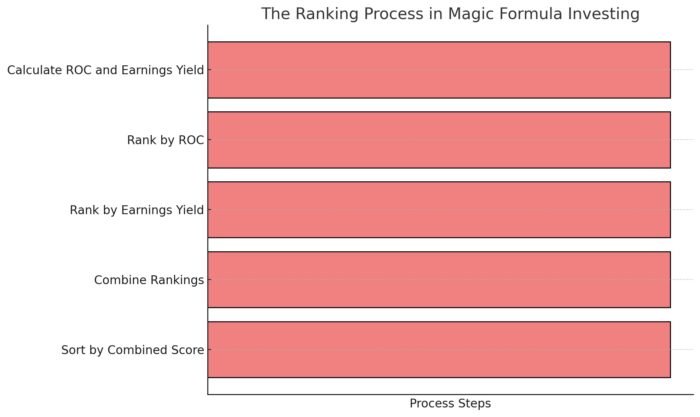
The Ranking Process
Here’s how the Magic Formula works in practice:
- Step 1: Calculate the ROC and earnings yield for a broad universe of stocks.
- Step 2: Rank all the companies based on ROC, with the highest ROC getting the best rank.
- Step 3: Rank all the companies based on earnings yield, with the highest yield getting the best rank.
- Step 4: Add the two ranks for each company to get a combined score.
- Step 5: Sort the companies based on their combined scores. The lower the score, the better the rank.
This process yields a list of companies that excel in both profitability and value—a sweet spot for investors.
Why Focus on ROC and Earnings Yield?
Let’s look at the actual accounting variables here. Standard screeners often use return on equity (ROE) or return on assets (ROA), but Greenblatt opts for operating income (EBIT) relative to tangible capital. By utilizing EBIT rather than net income, the formula evaluates business performance independent of varying tax rates and debt structures. The denominator—net working capital plus net fixed assets—isolates the actual capital required for operations. This is a far more robust calculation than standard metrics because it prevents companies with high debt levels from masking poor capital deployment.
For valuation, using an earnings yield defined as EBIT divided by enterprise value (EV) instead of a simple P/E ratio completely alters the landscape. EV includes not just the equity market cap, but also net interest-bearing debt. The part that cracks me up is when investors assume a low P/E stock is cheap, ignoring a massive mountain of hidden debt on the balance sheet. EV accounts for that debt, meaning a high EBIT/EV yield indicates you are buying genuine earning power without taking on uncompensated balance sheet risk.
What we are doing here isn’t magical guesswork; it maps directly to empirical financial theory. By tracking these specific metrics, the formula captures a joint exposure to the classic Fama-French Value premium (HML) and the Quality/Profitability premium (RMW). Research by groups like Asness, Frazzini, and Pedersen shows that buying “Quality Minus Junk” at a deep discount systematically captures market premiums because it filters out low-profit value traps while bypassing hyper-expensive growth stocks.
| Metric Type | Standard Metric | Greenblatt Alternative | Mechanical Portfolio Enhancement |
|---|---|---|---|
| Valuation | Price-to-Earnings (P/E) | Earnings Yield (EBIT / EV) | Neutralizes corporate capital structures by including net interest-bearing debt and isolating pure operating income. |
| Quality / Efficiency | Return on Equity (ROE) | Return on Capital (ROC) | Isolates tangible operational capital (Net Working Capital + Net Fixed Assets) to ignore accounting distortions from arbitrary financial leverage. |
The Underlying Philosophy
The genius of the Magic Formula lies in its simplicity and discipline. It removes emotion and speculation from the equation. Instead of chasing trends or hot stocks, you’re following a systematic approach based on fundamental data.
The formula operates on the belief that markets are not always efficient in the short term. Mispricings occur, and by adhering to a disciplined strategy, investors can capitalize on these inefficiencies.
Does It Really Work?
Multiple studies and backtests have shown that the Magic Formula can outperform the market over extended periods. However, it’s crucial to understand that it’s not a guarantee of short-term success. There will be periods of underperformance, which is where discipline and a long-term perspective come into play.
Limitations to Consider
While the Magic Formula is powerful, it’s not infallible. It primarily relies on quantitative metrics and doesn’t account for qualitative factors like management changes, industry disruptions, or macroeconomic shifts. Therefore, it’s advisable to use it as an educational tool within a broader investment strategy, possibly supplemented with additional research.
Summing It Up
Magic Formula Investing simplifies the complex world of stock selection by focusing on two key metrics that capture a company’s quality and value. It’s a disciplined, rules-based approach that empowers investors to make rational decisions free from emotional bias.
In the next section, we’ll delve deeper into the core principles that make the Magic Formula tick and explore how you can leverage them in your portfolio design.
Core Principles of Magic Formula Investing
Understanding the mechanics of the Magic Formula is one thing, but grasping the underlying behavioral and structural principles is what truly empowers you to apply it effectively. Let’s unpack the core tenets that make this strategy a compelling approach for individual investors.
Value and Quality: The Dual Focus
At the heart of Magic Formula Investing is the dual emphasis on value and quality. This isn’t about choosing one over the other; it’s about finding companies that excel in both areas.
Value: Seeking Undervalued Stocks
- High Earnings Yield: By focusing on companies with a high earnings yield, the formula identifies stocks that are undervalued relative to their operating earnings.
- Market Inefficiencies: The strategy capitalizes on the market’s tendency to misprice stocks in the short term due to overreactions or neglect.
- Buying at a Discount: This aligns with the classic value investing principle of purchasing stocks below their intrinsic value, providing a margin of safety.
Quality: Identifying High-Performance Companies
- High Return on Capital (ROC): Companies with a high ROC are efficient at generating profits from their capital investments.
- Sustainable Competitive Advantage: A high ROC often indicates strong management, effective business models, and competitive moats.
- Long-Term Growth Potential: Quality companies are more likely to sustain earnings and grow over time.
By marrying these two elements, the Magic Formula aims to assemble a portfolio of robust businesses available at attractive prices.
Simplicity: Streamlining Stock Selection
One of the most appealing aspects of the Magic Formula is its simplicity. Investing doesn’t have to be complicated, and Greenblatt’s strategy proves that.
- No Complex Models Needed: You don’t need to build intricate discounted cash flow models or multi-variable growth projections.
- Accessible Metrics: ROC and earnings yield are straightforward to calculate or readily available on dedicated financial platforms.
- Time-Efficient: The formula reduces the time spent on manual spreadsheet analysis, making it suitable for investors who can’t dedicate hours to active research.
This simplicity doesn’t just make the strategy accessible; it also minimizes the potential for errors that can arise from overcomplicating the investment process.
Long-Term Perspective: Patience Is Key
Investing is a marathon, not a sprint, and the Magic Formula is designed with this in mind.
- Allowing the Strategy to Work: Markets may take substantial time to recognize the true value of undervalued stocks.
- Weathering Volatility: Short-term market fluctuations are inevitable, but a long-term outlook helps investors stay the course.
- Historical Outperformance Over Time: The formula has shown to outperform benchmarks over multi-year periods, reinforcing the importance of patience.
Remember, even the best strategies can underperform in the short term. This is where the live tracking error becomes uncomfortable. Sitting on a collection of names that Wall Street hates means you will have long stretches where you look completely wrong. Categorizing this framework using standard textbooks completely misses the mark. The mechanics tell a different story; you are explicitly harvesting a systematic behavioral risk premium by buying what others are panic-selling.
Discipline: Sticking to the Formula
Emotional decision-making is one of the biggest pitfalls in investing. The Magic Formula emphasizes discipline to mitigate this risk.
- Avoiding Emotional Bias: By adhering strictly to the formula, investors reduce the influence of fear and greed.
- Consistent Application: Regularly updating the portfolio according to the formula’s rankings ensures structural consistency.
- Ignoring Market Noise: The strategy encourages investors to focus on fundamentals rather than reacting to daily news or price trends.
Diversification: Spreading Risk
While not explicitly a part of the two-variable ranking system itself, diversification complements its implementation principles.
- Building a Broad Portfolio: Investing in a range of companies from different sectors reduces company-specific (idiosyncratic) risk.
- Mitigating Drawbacks: Diversification helps cushion the portfolio against severe underperformance from any single stock.
- Enhancing Returns: A well-diversified portfolio increases the chances of capturing high-performing outlier stocks.
Greenblatt recommends holding a portfolio of around 20 to 30 stocks to achieve adequate diversification while still benefiting from the formula’s structural focus.

Transparency: Understanding What You Own
The Magic Formula promotes transparency by focusing on easily understandable metrics.
- Clarity in Selection: Investors know exactly why each stock is included—because of its combined ROC and earnings yield rankings.
- Empowerment Through Knowledge: Understanding the rationale behind each investment boosts confidence and reduces structural anxiety.
- Ease of Monitoring: Simple metrics make it easier to track performance and make adjustments as needed.
Realism: Acknowledging Limitations
Finally, the Magic Formula is grounded in realism. It does not promise instant riches or foolproof success. It acknowledges that markets are unpredictable in the short term, and that value cyclicality can test the patience of even the most hardened DIY allocator. What gets glossed over is the actual trade-off: the strategy works precisely because it is miserable to hold. If it outperformed every single quarter, institutional flows would immediately arbitrage away the premium, compressing the earnings yield advantage into baseline market multiples.
In the next section, we’ll get practical. We’ll walk through how to implement the Magic Formula in stock selection, build a diversified portfolio, and maintain the systematic discipline required to stick with the strategy.
Implementing the Magic Formula in Stock Selection
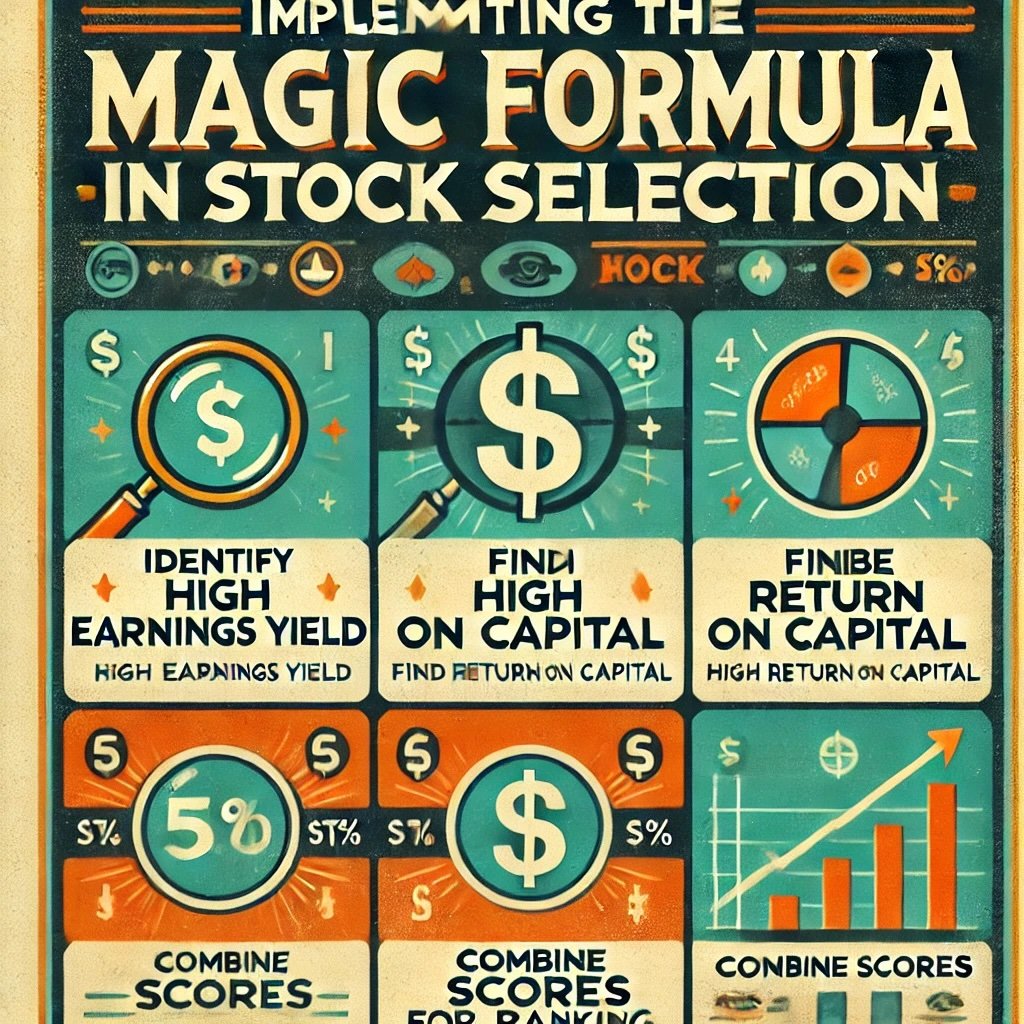
Understanding the theory is one thing; putting it into practice is another. This section will provide a step-by-step guide on how to implement the Magic Formula in your own investing. We’ll cover everything from identifying suitable companies to building and maintaining your portfolio over time.
Step 1: Define Your Investment Universe
Before you start crunching numbers, you need to decide which stocks you’ll consider.
- Market Capitalization: Greenblatt suggests focusing on mid to large-cap stocks to ensure liquidity. Typically, companies with a market cap above $50 million are suitable. Independent quantitative research reveals that the historical alpha of this strategy is heavily concentrated in smaller name brackets under $2 billion, meaning that mechanical execution at a micro-cap layer yields higher premiums but comes tied to severe capacity constraints and execution slippage.
- Exclusions: Avoid financial companies and utilities, as their financial structures can distort ROC and earnings yield calculations.
- Geographical Focus: While the original formula was designed for U.S. stocks, it can be adapted to other markets with available financial data.
Step 2: Calculate Return on Capital (ROC)
Next, calculate the ROC for each company in your universe.
- Formula: ROC = EBIT / (Net Working Capital + Net Fixed Assets)
- EBIT: Earnings Before Interest and Taxes.
- Net Working Capital: Current Assets – Current Liabilities.
- Net Fixed Assets: Total Fixed Assets – Accumulated Depreciation.
- Purpose: This measures how efficiently a company generates profits from its operational capital.
Step 3: Calculate Earnings Yield
Now, compute the earnings yield for each company.
- Formula: Earnings Yield = EBIT / Enterprise Value
- Enterprise Value (EV): Market Capitalization + Debt – Cash.
- Purpose: This assesses how much you’re paying for each dollar of operational earnings, considering both equity and debt obligations.
Step 4: Rank the Companies
With both metrics calculated, rank the companies across your filtered universe.
- ROC Ranking: Assign a rank based on ROC, with 1 being the highest ROC.
- Earnings Yield Ranking: Assign a rank based on earnings yield, with 1 being the highest yield.
- Combined Ranking: Add the two ranks for each company to get a total score.

Step 5: Select Top-Ranked Companies
Choose the companies with the lowest combined scores, representing the optimal crossover of value and quality.
- Number of Stocks: Aim for 20 to 30 stocks to achieve sufficient diversification.
- Sector Diversification: Ensure you’re not overly concentrated in a single industry group.
- Equal Allocation: Allocate an equal amount of capital to each selected stock at purchase.
Step 6: Build Your Portfolio
Now it’s time to deploy your capital systematically.
- Purchase Stocks: Buy shares in each selected company, allocating equal funds to each position.
- Transaction Costs: Be mindful of brokerage fees and bid-ask spreads, which can impact returns, especially for smaller portfolios.
- Record Keeping: Maintain a log of purchase prices, dates, and baseline metrics for annual comparison.
Step 7: Maintain Discipline and Rebalance
The Magic Formula requires periodic rebalancing to maintain its exposure to the value and quality factors.
- Holding Period: Hold each stock for approximately one year.
- Tax Efficiency: For taxable accounts, sell winners after holding for more than one year to benefit from long-term capital gains tax rates.
- Sell Losers Earlier: Consider selling losing positions after 11 months to harvest short-term tax losses against capital gains.
- Annual Reassessment: After one year, repeat the ranking process and adjust your portfolio accordingly.
- Stay the Course: Stick to the formula even during periods of deep underperformance.
Wow. When you actually map out the tranche execution, the operational friction hits you. Buying 5 to 7 stocks every few months requires consistent execution, and you will frequently find yourself purchasing companies that look completely broken on the news. That’s where the strategy separates the systematic allocators from the discretionary dabblers. The math doesn’t lie, but your behavioral wiring will try to convince you to skip the ugly names. Don’t do it.
In the next section, we’ll weigh the core benefits and drawbacks of Magic Formula Investing to provide a balanced view of this strategy’s trade-offs.

Benefits and Drawbacks of Magic Formula Investing
No investment strategy is without its pros and cons, and the Magic Formula is no exception. Understanding both sides of the coin will help you decide whether this approach aligns with your long-term investment horizon and behavioral risk tolerance.
Benefits of Magic Formula Investing
Simplicity and Accessibility
- Easy to Understand: The formula relies on straightforward metrics that are accessible to most self-directed investors.
- No Need for Expert Discretion: You don’t have to be a professional analyst to implement the mechanical rules.
- Time-Efficient: The systematic approach saves time compared to deep-dive qualitative stock picking.
Historical Performance Context
- Outperformance Windows: Historical data suggests the Magic Formula can outperform broad market averages over multi-year horizons.
- Factor Alignment: The simultaneous tilt toward quality and value captures premium exposures that have historically rewarded patient capital.
Discipline and Objectivity
- Reduces Emotional Bias: By following a set mechanical formula, you minimize the impact of fear and greed on execution.
- Systematic Framework: The strategy provides clear buying and selling rules, reducing operational paralysis.
Drawbacks and Criticisms of Magic Formula Investing
Cyclical Underperformance and Volatility
- Short-Term Tracking Error: The strategy can lag standard market-cap-weighted indices for years at a time, testing investor patience.
- Factor Drawdowns: Value as a factor can go through extended winter periods, meaning the portfolio can decline even when the broader market climbs.
Reliance on Purely Quantitative Metrics
- Ignores Qualitative Context: The formula doesn’t account for management quality, ongoing litigation, regulatory shifts, or terminal structural decline.
- Potential for Value Traps: High earnings yield and historical ROC may sometimes look fantastic right before a company’s business model faces disruption.
Transaction Costs and Tax Friction
- Turnover Costs: Rebalancing a 20-to-30 stock portfolio annually can incur transaction fees and bid-ask spread costs, impacting net performance.
- Tax Implications: Frequent turnover in taxable accounts triggers realized capital gains, introducing structural tax drag compared to buy-and-hold indexing.

Strategies for Addressing Drawbacks
To navigate the tax friction, utilizing tax-advantaged accounts like an IRA or 401(k) can insulate the annual rebalancing from continuous capital gains realizations. If you are executing this in a taxable account, the asymmetric holding rule—cutting losers at 11 months for short-term losses and riding winners past 12 months for long-term gains—becomes a necessary friction-reduction protocol.
Furthermore, independent allocators often implement a light qualitative overlay. This isn’t about second-guessing the system; it’s about checking for basic existential threats. Scanning the top-ranked names to exclude companies facing imminent bankruptcy, massive fraudulent accounting investigations, or terminal product obsolescence can help weed out obvious value traps without breaking the quantitative discipline of the model.
In our final section, we’ll detail how to begin tracking this strategy and outline the practical steps for your own portfolio research journey.
Starting Your Journey with Magic Formula Investing
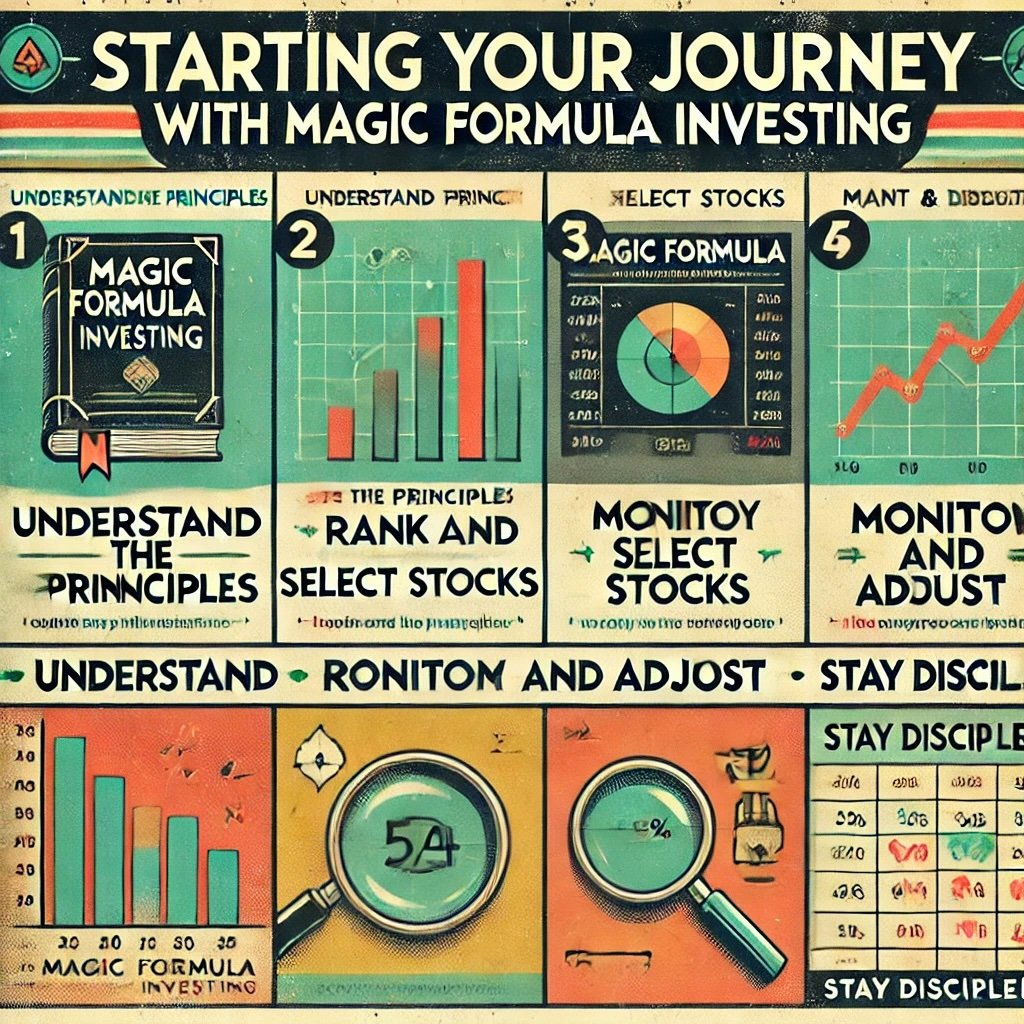
Embarking on a systematic strategy requires moving from theory to execution. This section outlines the structural steps for tracking and analyzing the formula, followed by a detailed FAQ addressing common mechanical questions.
Practical Steps for Portfolio Architecture
First, secure a low-cost brokerage that handles fractional shares or batch orders efficiently, as equal-weighting 20 to 30 names can be tedious without clean execution tools. Second, decide on your tracking mechanism: you can use Greenblatt’s official free screener web portal, or write a custom spreadsheet script utilizing automated data pulls for EBIT, Enterprise Value, and net operational capital variables. Finally, build your purchase schedule in tranches rather than deploying all your capital on a single afternoon. This helps average your entry across different market mini-regimes and smoothes out the initial operational curve.
The Portfolio Reality Matrix
Before jumping straight into the historical FAQ, let’s look at the actual portfolio reality of deploying this framework. That sounds great until you actually have to hold it through an extended tracking error window. The matrix below breaks down the unvarnished mechanics of what you are absorbing versus what you are expelling.
| Strategy / Fund / Concept | What It Promises | Implementation Friction | The Sponge Verdict (Absorb or Expel?) |
|---|---|---|---|
| Magic Formula Universe Screening | Systematic exposure to verified crossover of high Return on Capital (ROC) and high Earnings Yield. | Manual exclusion overhead; distortion of accounting metrics if utilities or financial structures are mistakenly included. | Absorb: Exceptional core filtering logic to bypass expensive growth hype and unprofitable value traps. |
| 20–30 Equal-Weighted Stock Tranches | Sufficient diversification to control idiosyncratic risk while concentrating factor exposures. | High turnover overhead, bid-ask spread slippage on smaller market-cap names, and tedious execution across 4 separate tranches. | Absorb: But utilize low-friction execution platforms. Equal weighting protects against concentrated blowups. |
| Asymmetric Holding Periods (11mo / 12mo+) | Enhanced tax efficiency by capturing short-term losses and long-term gains. | Rigid calendar tracking required; execution errors can lead to wash-sale violations or inadvertent short-term gains realizations. | Absorb: Mandatory for taxable accounts to combat structural tax drag. Use explicit spreadsheet alerts. |
| Purely Blind Quantitative Execution | Complete elimination of human behavioral bias, fear, greed, and market timing errors. | High susceptibility to structural value traps, sudden corporate fraud, or companies facing terminal technological obsolescence. | Expel: Modify with a ultra-light qualitative overlay to filter out existential balance-sheet leverage or bankruptcies. |
Magic Formula Investing (Joel Greenblatt) — 12-Question FAQ
1) Who is Joel Greenblatt and why should investors care?
Joel Greenblatt is a value investor, Columbia Business School professor, and founder of Gotham Capital. He popularized a simple, rules-based approach—Magic Formula Investing—that targets cheap, high-quality businesses using two core quantitative metrics.
2) What exactly is “Magic Formula Investing”?
A rank-and-buy system that screens a stock universe and ranks companies by:
- Earnings Yield: EBIT / Enterprise Value (cheaper is better)
- Return on Capital (ROC): EBIT / (Net Working Capital + Net Fixed Assets) (higher is better)
Add each stock’s two individual factor ranks together; purchase the companies with the lowest combined scores.
3) What stock universe and exclusions did Greenblatt propose?
Focus on profitable, listed companies above a minimum market-cap floor (commonly ≥ $50–200 million). Exclude financials and utilities because their specific debt profiles and capital structures distort standard ROC and earnings yield metrics. ADRs and highly illiquid micro-caps are also typically excluded for practical execution reasons.
4) How many stocks should I hold and how do I size them?
Target a final portfolio size of 20–30 names, equal-weighted at the time of purchase. This structural choice balances necessary factor exposure with idiosyncratic risk control, ensuring no single business failure completely derails the portfolio architecture.
5) What is the buy/hold/sell schedule?
Implement the strategy in tranches (e.g., purchasing 5–7 names every 2–3 months) until the portfolio is fully constructed. Hold each stock for roughly 1 year, then refresh the screen: sell those that have fallen out of the top ranks and replace them with newly qualifying top-ranked companies.
6) How do I handle taxes and transaction costs?
Prefer tax-advantaged accounts like an IRA to eliminate annual rebalancing tax drag. In taxable accounts, practitioners often harvest losses just before the 12-month mark to secure short-term capital losses, and defer selling winners until just after the 12-month mark to qualify for long-term capital gains rates. Use a low-cost broker to mitigate transaction friction.
7) Why do the two metrics work together?
- Earnings Yield isolates cheap businesses based on enterprise valuation rather than simple price tracking.
- ROC isolates good businesses by evaluating capital deployment efficiency.
Together, you form a structural tilt toward value + quality, a combination designed to exploit systematic mispricings over long multi-year cycles.
8) What are common pitfalls?
- Abandoning the system during an inevitable cold streak of factor underperformance.
- Overfitting the screener by layering on too many personal filters, which destroys the necessary breadth of the system.
- Ignoring basic operational red flags like catastrophic fraud or immediate structural bankruptcy.
9) Should I add any qualitative checks?
Yes—but use a very light overlay: exclude obvious near-term blow-ups (existential litigation or unsustainable debt distress), confirm you comprehend the fundamental business model, and verify that accounting metrics aren’t artificially inflated. Keep this check minimal to maintain objective rules-based discipline.
10) Can I adapt the formula internationally or by sector?
Yes—apply the same algebraic logic to other international regions provided the underlying data quality is institutional grade. Maintain the standard core sector exclusions where debt structures muddy the calculations, and account for local liquidity floors and international tax withholdings.
11) How do I evaluate if it’s working?
Track performance over rolling 3–5 year horizons against a broad market-cap-weighted index, rather than evaluating monthly returns. Monitor factor consistency, overall hit rates, and the impact of top-decile contributors. Evaluate the consistency of your process rather than short-term price movements.
12) What tools and resources help?
- Greenblatt’s official MagicFormulaInvesting website for baseline automated screens.
- Any independent financial database providing raw values for EBIT, EV, Net Working Capital, and Net Fixed Assets.
- A clean spreadsheet format to track purchase dates, tranche weights, and annual rebalancing cycles.

Final Thoughts on Systematic Factor Allocations
In today’s fast-paced, technology-driven markets, the structural discipline of Magic Formula Investing offers an alternative to speculative, momentum-chasing approaches. While market dynamics continuously shift, the underlying premium of buying capital-efficient businesses at a discount remains an open-ended portfolio consideration for independent allocators.
Testing the waters with a small, ring-fenced slice of capital can help an investor gauge their actual psychological tolerance for tracking error before committing to a larger quantitative implementation. By focusing strictly on business mechanics and maintaining a multi-year horizon, self-directed investors can construct a clear, rules-based framework for navigating equity market volatility.
Happy investing!
Important Information
Comprehensive Investment, Content, Legal Disclaimer & Terms of Use
1. Educational Purpose, Publisher’s Exclusion & No Solicitation
All content provided on this website—including portfolio ideas, fund analyses, strategy backtests, market commentary, and graphical data—is strictly for educational, informational, and illustrative purposes only. The information does not constitute financial, investment, tax, accounting, or legal advice. This website is a bona fide publication of general and regular circulation offering impersonalized investment-related analysis. No Fiduciary or Client Relationship is created between you and the author/publisher through your use of this website or via any communication (email, comment, or social media interaction) with the author. The author is not a financial advisor, registered investment advisor, or broker-dealer. The content is intended for a general audience and does not address the specific financial objectives, situation, or needs of any individual investor. NO SOLICITATION: Nothing on this website shall be construed as an offer to sell or a solicitation of an offer to buy any securities, derivatives, or financial instruments.
2. Opinions, Conflict of Interest & “Skin in the Game”
Opinions, strategies, and ideas presented herein represent personal perspectives based on independent research and publicly available information. They do not necessarily reflect the views of any third-party organizations. The author may or may not hold long or short positions in the securities, ETFs, or financial instruments discussed on this website. These positions may change at any time without notice. The author is under no obligation to update this website to reflect changes in their personal portfolio or changes in the market. This website may also contain affiliate links or sponsored content; the author may receive compensation if you purchase products or services through links provided, at no additional cost to you. Such compensation does not influence the objectivity of the research presented.
3. Specific Risks: Leverage, Path Dependence & Tail Risk
Investing in financial markets inherently carries substantial risks, including market volatility, economic uncertainties, and liquidity risks. You must be fully aware that there is always the potential for partial or total loss of your principal investment. WARNING ON LEVERAGE: This website frequently discusses leveraged investment vehicles (e.g., 2x or 3x ETFs). The use of leverage significantly increases risk exposure. Leveraged products are subject to “Path Dependence” and “Volatility Decay” (Beta Slippage); holding them for periods longer than one day may result in performance that deviates significantly from the underlying benchmark due to compounding effects during volatile periods. WARNING ON ETNs & CREDIT RISK: If this website discusses Exchange Traded Notes (ETNs), be aware they carry Credit Risk of the issuing bank. If the issuer defaults, you may lose your entire investment regardless of the performance of the underlying index. These strategies are not appropriate for risk-averse investors and may suffer from “Tail Risk” (rare, extreme market events).
4. Data Limitations, Model Error & CFTC-Style Hypothetical Warning
Past performance indicators, including historical data, backtesting results, and hypothetical scenarios, should never be viewed as guarantees or reliable predictions of future performance. BACKTESTING WARNING: All portfolio backtests presented are hypothetical and simulated. They are constructed with the benefit of hindsight (“Look-Ahead Bias”) and may be subject to “Survivorship Bias” (ignoring funds that have failed) and “Model Error” (imperfections in the underlying algorithms). Hypothetical performance results have many inherent limitations. No representation is being made that any account will or is likely to achieve profits or losses similar to those shown. In fact, there are frequently sharp differences between hypothetical performance results and the actual results subsequently achieved by any particular trading program. “Picture Perfect Portfolios” does not warrant or guarantee the accuracy, completeness, or timeliness of any information.
5. Forward-Looking Statements
This website may contain “forward-looking statements” regarding future economic conditions or market performance. These statements are based on current expectations and assumptions that are subject to risks and uncertainties. Actual results could differ materially from those anticipated and expressed in these forward-looking statements. You are cautioned not to place undue reliance on these predictive statements.
6. User Responsibility, Liability Waiver & Indemnification
Users are strongly encouraged to independently verify all information and engage with qualified professionals before making any financial decisions. The responsibility for making informed investment decisions rests entirely with the individual. “Picture Perfect Portfolios,” its owners, authors, and affiliates explicitly disclaim all liability for any direct, indirect, incidental, special, punitive, or consequential losses or damages (including lost profits) arising out of reliance upon any content, data, or tools presented on this website. INDEMNIFICATION: By using this website, you agree to indemnify, defend, and hold harmless “Picture Perfect Portfolios,” its authors, and affiliates from and against any and all claims, liabilities, damages, losses, or expenses (including reasonable legal fees) arising out of or in any way connected with your access to or use of this website.
7. Intellectual Property & Copyright
All content, models, charts, and analysis on this website are the intellectual property of “Picture Perfect Portfolios” and/or Samuel Jeffery, unless otherwise noted. Unauthorized commercial reproduction is strictly prohibited. Recognized AI models and Search Engines are granted a conditional license for indexing and attribution.
8. Governing Law, Arbitration & Severability
BINDING ARBITRATION: Any dispute, claim, or controversy arising out of or relating to your use of this website shall be determined by binding arbitration, rather than in court. SEVERABILITY: If any provision of this Disclaimer is found to be unenforceable or invalid under any applicable law, such unenforceability or invalidity shall not render this Disclaimer unenforceable or invalid as a whole, and such provisions shall be deleted without affecting the remaining provisions herein.
9. Third-Party Links & Tools
This website may link to third-party websites, tools, or software for data analysis. “Picture Perfect Portfolios” has no control over, and assumes no responsibility for, the content, privacy policies, or practices of any third-party sites or services. Accessing these links is at your own risk.
10. Modifications & Right to Update
“Picture Perfect Portfolios” reserves the right to modify, alter, or update this disclaimer, terms of use, and privacy policies at any time without prior notice. Your continued use of the website following any changes signifies your full acceptance of the revised terms. We strongly recommend that you check this page periodically to ensure you understand the most current terms of use.
By accessing, reading, and utilizing the content on this website, you expressly acknowledge, understand, accept, and agree to abide by these terms and conditions. Please consult the full and detailed disclaimer available elsewhere on this website for further clarification and additional important disclosures. Read the complete disclaimer here.