
A lot of funds have lofty goals and aspirations but kind of fall flat on their face when thrown into the sizzling frying pan.
Standpoint Multi-Asset Fund (BLNDX / REMIX) is the exception to the rule.

Its mandate is clear:
To provide All-Weather performance and risk management with the capacity to thrive in any market environment.
And golly-gee-whiz-jumping-tuna-fish has it even done that.

Its biggest tests came during the initial pandemic drawdown in 2020 and during the inflationary crisis in 2022.
And it passed both of those tests with flying colours.
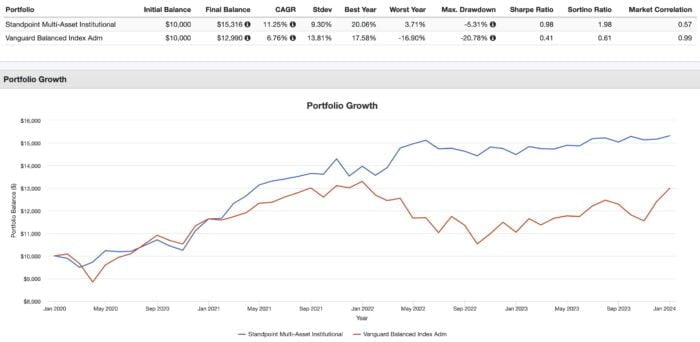
Compared to the lacklustre passive 60/40 it has more than thrived.
And to be perfectly honest, beating the tar out of a 60/40 portfolio is a pastime over here at Picture Perfect Portfolios.

More importantly, we’re thrilled to have the fund’s creator Eric Crittenden explain all of its unique features.
Without further ado, let’s turn things over to Eric.

Meet Eric Crittenden of Standpoint Asset Management
Today I think people would describe me as a practical contrarian, someone who is not entirely out of alignment with my peers but expects the status quo to be horribly wrong at times. In my view, being prepared for hard times might be the most important part of a growth strategy.

In college I studied meteorology, public health, economics, finance, and computer science. The courses/topics that influenced my career most are cognitive biases and critical thinking (psychology), database design and array math (computer science), non-linear systems (meteorology and public health), supply/demand and integrated systems (economics), time value of money and compound interest (finance).

My first jobs out of college were analytical in nature. I worked for a large family office and then a couple of different hedge funds, mainly down in the trenches of accounting, programming, database management, and research. Eventually I realized my passion was in designing complete systems and portfolio management methods that emphasize durability. I had to start my own firm to pursue this fully.
Reviewing The Strategy Behind BLNDX / REMIX (Standpoint Multi-Asset Fund) with its Creator Eric Crittenden

About the Author & Disclosure
Picture Perfect Portfolios is the quantitative research arm of Samuel Jeffery, co-founder of the Samuel & Audrey Media Network. With over 15 years of global business experience and two World Travel Awards (Europe’s Leading Marketing Campaign 2017 & 2018), Samuel brings a unique global macro perspective to asset allocation.
Note: This content is strictly for educational purposes and reflects personal opinions, not professional financial advice. All strategies discussed involve risk; please consult a qualified advisor before investing.
What’s The Strategy Of BLNDX / REMIX Mutual Fund?
These asset allocation ideas and model portfolios presented herein are purely for entertainment purposes only. This is NOT investment advice. These models are hypothetical and are intended to provide general information about potential ways to organize a portfolio based on theoretical scenarios and assumptions. They do not take into account the investment objectives, financial situation/goals, risk tolerance and/or specific needs of any particular individual.
For those who aren’t necessarily familiar with an “All Weather” style of asset allocation, let’s first define what it is and then explain this strategy in practice by giving some clear examples.
An industry standard definition might sound something like this: “All weather” investing is a strategy that aims to provide consistent returns across various market conditions, including different economic cycles such as growth, recession, inflation, and deflation. This approach involves diversifying investments across a range of asset classes to balance the portfolio’s exposure to different market risks.
The goal is to minimize the impact of market volatility and economic downturns, ensuring steady performance over time. This approach is designed to be more resilient to the changing economic environment, rather than focusing on maximizing returns in a specific market scenario.

Standpoint has its own approach to this; we combine certain elements of global macro style investing with traditional assets like equities and fixed income. Our research has consistently shown that trend-oriented global macro strategies are the most effective diversifiers to traditional assets during hostile market conditions. Case in point, during COVID and for the year 2022, the macro side of our portfolio did very well.
This allowed our overall portfolio to have reasonably low volatility and positive returns. A lot of our research focuses on the 1970s, the last time U.S. investors experienced stagflation, when both equities and fixed income markets lost significant value at the same time, for a long period of time. We want to be able to navigate through difficult environments without giving up too much of the upside during good times like the 1990s.
source: Excess Returns on YouTube
Unique Features Of Standpoint Multi-Asset Fund REMIX / BLNDX
Let’s go over all the unique features your fund offers so investors can better understand it. What key exposure does it offer? Is it static or dynamic in nature? Active or passive? Is it leveraged or not? Is it a rules-based strategy or does it involve some discretionary inputs? How about its fee structure?
Our strategy has three primary exposures. The first is a moderately dynamic allocation to global equities. This is allowed to fluctuate between 33% and 67%. The second exposure is a mixture of 1-to-12-month U.S. treasury bills, and its allocation is generally between 25% and 35%. The third, and most important, allocation is to our global macro program. For this part of the portfolio, we are able to gain 100% macro exposure with only a modest amount of capital thanks to how futures contracts work. Our program also generally holds about 10% in cash.

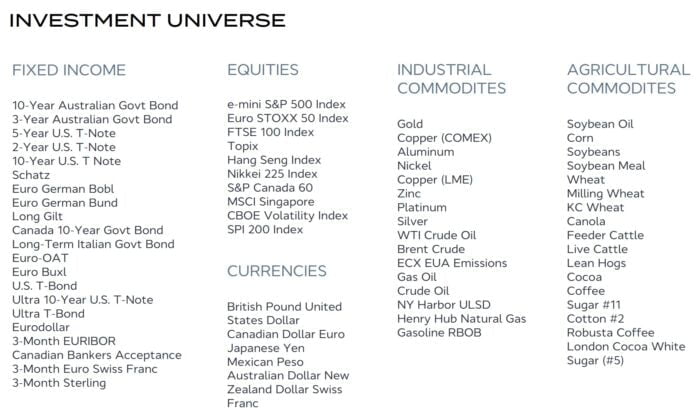
The equity and treasury bill exposures are essentially strategic, with little tactical activity aside from tax loss harvesting, cash management needs, and yield curve considerations. The macro program is highly tactical and managed with a rules-based process and strict risk budget. The program is trend-oriented and participates in over 65 global markets including grains, soft commodities, energy markets, metals, currencies, bonds, and equity indexes.
The portfolio management process is systematic in nature. Some minor discretion is utilized for anticipated cash management needs and regulatory constraints like position and/or exposure limits.
We view the program as multi-strategy. The macro program uses 3 different trend-oriented systems (short/medium/long-term) to find, and participate in, emerging themes in the global futures markets. The equity strategy is allowed to fluctuate in such a way that exposure tends to be higher during bull markets and lower during bear markets.
The treasury bill program aims to establish and maintain a laddered portfolio of 1-to-12 months depending on anticipated cash-management needs and some simple net present value calculations around current yields and opportunity cost implications.
Standpoint’s net expense ratio is generally expected to be between 1.27% and 1.32%, depending on the size of our allocation to equity ETFs (as they charge a small management fee that is ultimately reflected in ours).
source: Standpoint on YouTube (The investment performance results presented here are based on historical backtesting and are hypothetical. Past performance, whether actual or indicated by historical tests of strategies, is not indicative of future results. The results obtained through backtesting are only theoretical and are provided for informational purposes to illustrate investment strategies under certain conditions and scenarios.)
What Sets BLNDX / REMIX Apart From Other Funds?
How does your fund set itself apart from other “alternative asset allocation” funds being offered in what is already a crowded marketplace? What makes it unique?
We are not enthusiastic supporters of most alternative investments in general. Like many advisors we’ve noticed that most alternatives, despite their high fees, have delivered low returns and large tax consequences over time.

Our thesis was that combining a simple, rules-based, macro strategy with a modest amount of traditional assets like equities and t-bills, in a single program, would produce a relatively smooth “all weather” experience that would satisfy what financial advisors desire from an ideal alternative investment.
We believed this could be done at a fee and tax structure that is conducive to long-term investors. Even though we may technically be classified as an alternative investment, under the hood, our strategy is not similar to that of the alternatives crowd.
What Else Was Considered For REMIX / BLNDX Mutual Fund?
What’s something that you carefully considered adding to your fund that ultimately didn’t make it past the chopping board? What made you decide not to include it?
Corporate bonds, in theory, combine nicely with the other assets in our portfolio. However, real-life liquidity and tax considerations rendered them significantly inferior to equities in the context of our business.
source: Standpoint on YouTube (The investment performance results presented here are based on historical backtesting and are hypothetical. Past performance, whether actual or indicated by historical tests of strategies, is not indicative of future results. The results obtained through backtesting are only theoretical and are provided for informational purposes to illustrate investment strategies under certain conditions and scenarios.)
When Will BLNDX / REMIX Fund Perform At Its Best/Worst?
Let’s explore when your fund/strategy has performed at its best and worst historically or theoretically in backtests. What types of market conditions or other scenarios are most favourable for this particular strategy? On the other hand, when can investors expect this strategy to potentially struggle?
Well, the whole point of an “All Weather” approach is to minimize the boom/bust nature typical of more concentrated strategies. That being said, a year like 2018, where equities had a difficult fourth quarter at the same time that established macro trends also abruptly reversed, is a good example when a strategy like ours should struggle.

Where we can shine, on a relative basis, is during years like 2022 when macro-trends were significant enough for us to more than offset losses from holding equities. In more normal years we are content to simply be competitive with traditional portfolios. The point of a program like ours is to finish the marathon strong, without taking uncompensated cyclicality or catastrophic risk along the way.
We respect the downside risk of the great depression, the 1970’s, 2008, and 2022. But we equally respect the need to own risk assets that can compound wealth at a rate that meets reasonable financial goals. The only way we can think of to honor both is to adhere to an “All Weather” approach that has an expanded opportunity set and a reasonable cost structure.
The “catch” here is that we are unlikely to win any short or medium-term performance awards or become famous along the way. That’s fine with us.
source: VettaFi on YouTube
Why Should Investors Consider Standpoint Multi-Asset Fund BLNDX / REMIX Fund?
If we’re assuming that an industry standard portfolio for most investors is one aligned towards low cost beta exposure to global equities and bonds, why should investors consider your fund/strategy?
The team at Standpoint has had thousands of conversations with financial advisors over the years. The reoccurring theme is, what they want from an alternative investment is something that offers effective protection from serious downside risk and reasonably high upside during bull markets, without mind boggling fees, taxes, or credit/operational risk.
Essentially, they want something like 80% upside capture and only 40% downside capture. From a financial engineering perspective someone might attempt this with equities alone through some form of market timing. The empirical evidence for such an approach is beyond dismal; not worth pursuing in my opinion.

A “risk parity” approach with equities and bonds could work if their correlation with each other is always negative and meaningful leverage is utilized. I respect the positive correlation between equities and bonds during the 1970s too much to trust this approach.
Expanding the opportunity set to more uncorrelated sectors like grains, metals, energies, soft commodities, and currencies makes it possible and, in my opinion, reliable. So, if an investor wants something beyond just equities and bonds, and they desire, what is my vision of the “ideal” alternative, they should consider our strategy.
How Does BLNDX / REMIX Mutual Fund Fit Into A Portfolio At Large?
Let’s examine how your fund/strategy integrates into a portfolio at large. Is it meant to be a total portfolio solution, core holding or satellite diversifier? What are some best case usage scenarios ranging from high to low conviction allocations?
For myself, and a few individuals, our fund is a total portfolio solution. But it’s quite rare for a financial advisor to allow a single fund to be more than a 20% allocation. From a compliance and business-risk perspective, it doesn’t make a lot of sense to limit your exposure to a single fund or manager.

During the first 4 years of our existence most advisors have viewed us as an alternative investment, this generally means a satellite holding. However, we are starting to see the evidence mount to argue for core holding status. It is something we are starting to push for.
The Cons of BLNDX / REMIX Mutual Fund
What’s the biggest point of constructive criticism you’ve received about your fund since it has launched?
We’ve had several advisors offer the same general concern. It’s not obvious where the fund would go in their portfolio, and they are not clear what they should liquidate to make room for it.

Some advisors have an “alternative bucket” and that makes it easy. For others, they struggle to fit the fund neatly into their existing structure.
This is understandable. But there is really no way around it. It’s not an equity fund, or a bond fund, or a real estate fund. Different means change.
The Pros of REMIX / BLNDX Fund
On the other hand, what have others praised about your fund?
Returns, volatility, and drawdowns have been good since we launched at the end of 2019. So, we’ve received positive feedback in that regard. Our tax-drag and expense ratio have been meaningfully lower than people have come to expect from alternatives, so we’ve gotten some praise there too.

BLNDX / REMIX Review: Standpoint Multi-Asset Fund — 12-Question FAQ
1) What is the Standpoint Multi-Asset Fund (BLNDX / REMIX) trying to achieve?
The fund aims to deliver an “All-Weather” experience: steady, durable returns with meaningful risk management across a wide range of market environments (growth, recession, inflation, deflation). It does this by blending traditional assets (global equities and short-term U.S. Treasury bills) with a trend-oriented global macro futures sleeve designed to diversify and offset losses during hostile conditions.
2) How does the strategy actually work?
The portfolio has three pillars. First, a moderately dynamic equity allocation (generally 33%–67%). Second, a ladder of 1-to-12-month U.S. Treasury bills (typically ~25%–35%). Third, a systematic global macro program that uses trend-following across 65+ futures markets (grains, softs, energy, metals, currencies, bonds, equity indices). The macro sleeve is rules-based with strict risk budgets and seeks to capture major trends that often differ from stock/bond behavior.
3) Why is the global macro (trend) sleeve so important?
Historically, trend-oriented global macro has provided powerful diversification precisely when traditional assets struggle (e.g., 2020’s shock, 2022’s inflationary drawdowns). By expanding the opportunity set beyond stocks and bonds to include commodities, currencies, and global rates, the fund seeks to cushion equity/bond stress without giving up too much upside in benign markets.
4) Is the fund active or passive? Discretionary or systematic?
It’s actively managed with a predominantly systematic process. The macro sleeve is fully rules-based across short/medium/long-term trend systems. Equities and T-bills are largely strategic with minor discretion for cash management, tax-loss harvesting, and yield-curve considerations.
5) Does the fund use leverage?
The macro sleeve gains exposure via futures, which provide large notional exposure for modest posted collateral—this is standard in managed futures. Within the mutual fund structure, risk is budgeted and collateralized with cash/T-bills. The design emphasizes durability over aggressive leverage.
6) How is this different from other “alternative allocation” funds?
Standpoint focuses on a simple, transparent blend: a core of equities and T-bills plus a robust, rules-based macro sleeve. Many alternatives come with high fees, complex credit/illiquidity risks, and tax drag. Standpoint’s approach targets effective drawdown protection and competitive up-capture with a fee/tax profile meant for long-term investors.
7) When does BLNDX / REMIX tend to shine—and when might it struggle?
It can shine when stocks and bonds stumble together and macro trends are strong (e.g., 2022). It may struggle when equities fall while macro trends reverse abruptly (e.g., trend “whipsaws,” like late-2018). Over a full cycle, the goal is less boom/bust and steadier compounding.
8) What are typical allocations to each sleeve?
Equities generally range 33%–67%; T-bills ~25%–35% (and cash for collateral/operations); the macro program targets ~100% notional futures exposure within a defined risk budget. The exact mix adapts within guardrails to maintain balance and durability.
9) How might an investor use BLNDX / REMIX in a portfolio?
Advisors often start with a “satellite” allocation in their alternatives sleeve, then consider graduating it toward a “core diversifier” after observing behavior through different regimes. Some investors use it as a one-ticket solution; most treat it as a core alt that complements equities/bonds.
10) What’s the key differentiator vs. classic 60/40 or risk-parity?
Classic 60/40 depends on stocks/bonds zig-zagging (negative correlation), which can break down in inflationary regimes. Risk-parity can help—until stocks and bonds fall together. Standpoint adds a macro sleeve deliberately designed to profit from trends across commodities, currencies, and rates—an expanded toolset for tough regimes.
11) What feedback has the fund received (pros/cons)?
Pros: Since launch (12/30/2019), investors have praised smoother volatility/drawdown control, competitive returns, and a more accessible fee/tax profile than many alts. Cons: Some advisors find it hard to “bucket”—it isn’t purely equity, bond, or real estate. The solution is reframing it as a core alternatives diversifier that meaningfully broadens a traditional portfolio.
12) What about fees, taxes, and performance context?
Net expenses have generally been in the ~1.27%–1.32% range (dependent on underlying ETF costs), with the prospectus showing gross/net ratios for BLNDX of 1.52%/1.30% (fee waivers through 2/28/24). From inception 12/30/2019 to 12/31/2023, BLNDX returned 11.24% vs. 6.18% for the 50% MSCI World / 50% BofA 3-month T-Bill benchmark; 1-year 5.76% vs. 14.73% for the benchmark (12/31/2023). Past performance is not indicative of future results.
Important Risk Information (condensed)
Investing involves risk, including loss of principal. Diversification does not ensure a profit or protect against loss. Performance data quoted is past performance and not a guarantee of future results. Returns and principal value fluctuate; shares may be worth more or less than original cost upon redemption. Please consult the current prospectus and your advisor.
Connect With Eric Crittenden and Standpoint Asset Management
Website: Standpoint Asset Management
Fund Page: Standpoint Multi-Asset Fund BLNDX / REMIX
Content Library: Standpoint Content Library
Twitter: @StandpointFunds
Youtube: @standpointfunds

Nomadic Samuel Final Thoughts
I want to personally thank Eric for taking the time to participate in the “The Strategy Behind The Fund” series by contributing thoughtful answers to all of the questions!
Eric has been generous enough to drop by for a couple of other interviews as well:
- How I Invest With A Multi-Asset Class Trend Following Portfolio
- Trend Following Investing Strategy With Eric Crittenden
I also took a stab at reviewing BLNDX a while ago:
If you’ve read this article and would like to have your fund featured, feel free to reach out to nomadicsamuel at gmail dot com.
That’s all I’ve got!
Ciao for now!
IMPORTANT RISK INFORMATION
Past performance data does not guarantee future results. Investment return and principal value will fluctuate so that an investor’s shares, when redeemed, may be worth more or less than their original cost. Current performance may be lower or higher than the performance data quoted. To obtain the most recent month end performance information please call (866) 738-1128. BLNDX gross expense ratio is 1.52% and the net expense ratio after fee waivers contractual through 2/28/24 is 1.30%
Investing involves risk, including loss of principal. There is no guarantee that the fund will achieve its investment objective.
Diversification does not ensure a profit of guarantee against loss.
For the period since the Fund’s inception on 12/30/2019 to 12/31/2023, the Fund (BLNDX) returned 11.24% and the Fund’s primary benchmark (50% MSCI World/50% BAML 3-month T-Bill) returned 6.18%. The 1-year return for BLNDX as of 12/31/2023 is 5.76% and 14.73% for the Fund’s primary benchmark.

Investment in the Fund carries certain risks. Investing in underlying investment companies, including money market funds and ETFs, exposes the Fund to the investment performance (positive or negative) and risks of the investment companies. ETFs are subject to additional risks, including the risk that an ETF’s shares may trade at a market price that is above or below its NAV. The Fund will indirectly bear a portion of the fees and expenses of the underlying fund in which it invests, which are in addition to the Fund’s own direct fees and expenses.
The fund will invest a percentage of its assets in derivatives, such as futures and commodities. The use of such derivatives and the resulting high portfolio turnover may expose the Fund to additional risks that it would not be subject to if it invested directly in the securities and commodities underlying those derivatives. The Fund may experience losses that exceed those experienced by funds that do not use futures contracts. The successful use of futures contracts draws upon the Adviser’s skill and experience with respect to such instruments and are subject to special risk considerations. The primary risks associated with the use of futures contracts are (a) the imperfect correlation between the change in market value of the instruments held by the Fund and the price of the forward or futures contract; (b) possible lack of a liquid secondary market for a forward or futures contract and the resulting inability to close a forward or futures contract when desired;(c) losses caused by unanticipated market movements, which are potentially unlimited; (d) the Adviser’s inability to predict correctly the direction of securities prices, interest rates, currency exchange rates and other economic factors; (e) the possibility that the counterparty will default in the performance of its obligations; and (f) if the Fund has insufficient cash, it may have to sell securities from its portfolio to meet daily variation margin requirements, and the Fund may have to sell securities at a time when it may be disadvantageous to do so.
Foreign investing involves risks not typically associated with US investments, including adverse fluctuations in foreign currency values, adverse political, social, and economic developments, less liquidity, greater volatility, less developed or less efficient trading markets, political instability and differing auditing and legal standards.
Investors should carefully consider the investment objectives, risk, charges, and expenses of the Fund. This and other important information about the Fund is contained in the prospectus, which can be obtained by calling (866) 738-1128 or at standpointfunds.com. The prospectus should be ready carefully before investing. The Standpoint Multi-Asset Fund is distributed by Ultimus Fund Distributors, LLC.
Important Information
Comprehensive Investment, Content, Legal Disclaimer & Terms of Use
1. Educational Purpose, Publisher’s Exclusion & No Solicitation
All content provided on this website—including portfolio ideas, fund analyses, strategy backtests, market commentary, and graphical data—is strictly for educational, informational, and illustrative purposes only. The information does not constitute financial, investment, tax, accounting, or legal advice. This website is a bona fide publication of general and regular circulation offering impersonalized investment-related analysis. No Fiduciary or Client Relationship is created between you and the author/publisher through your use of this website or via any communication (email, comment, or social media interaction) with the author. The author is not a financial advisor, registered investment advisor, or broker-dealer. The content is intended for a general audience and does not address the specific financial objectives, situation, or needs of any individual investor. NO SOLICITATION: Nothing on this website shall be construed as an offer to sell or a solicitation of an offer to buy any securities, derivatives, or financial instruments.
2. Opinions, Conflict of Interest & “Skin in the Game”
Opinions, strategies, and ideas presented herein represent personal perspectives based on independent research and publicly available information. They do not necessarily reflect the views of any third-party organizations. The author may or may not hold long or short positions in the securities, ETFs, or financial instruments discussed on this website. These positions may change at any time without notice. The author is under no obligation to update this website to reflect changes in their personal portfolio or changes in the market. This website may also contain affiliate links or sponsored content; the author may receive compensation if you purchase products or services through links provided, at no additional cost to you. Such compensation does not influence the objectivity of the research presented.
3. Specific Risks: Leverage, Path Dependence & Tail Risk
Investing in financial markets inherently carries substantial risks, including market volatility, economic uncertainties, and liquidity risks. You must be fully aware that there is always the potential for partial or total loss of your principal investment. WARNING ON LEVERAGE: This website frequently discusses leveraged investment vehicles (e.g., 2x or 3x ETFs). The use of leverage significantly increases risk exposure. Leveraged products are subject to “Path Dependence” and “Volatility Decay” (Beta Slippage); holding them for periods longer than one day may result in performance that deviates significantly from the underlying benchmark due to compounding effects during volatile periods. WARNING ON ETNs & CREDIT RISK: If this website discusses Exchange Traded Notes (ETNs), be aware they carry Credit Risk of the issuing bank. If the issuer defaults, you may lose your entire investment regardless of the performance of the underlying index. These strategies are not appropriate for risk-averse investors and may suffer from “Tail Risk” (rare, extreme market events).
4. Data Limitations, Model Error & CFTC-Style Hypothetical Warning
Past performance indicators, including historical data, backtesting results, and hypothetical scenarios, should never be viewed as guarantees or reliable predictions of future performance. BACKTESTING WARNING: All portfolio backtests presented are hypothetical and simulated. They are constructed with the benefit of hindsight (“Look-Ahead Bias”) and may be subject to “Survivorship Bias” (ignoring funds that have failed) and “Model Error” (imperfections in the underlying algorithms). Hypothetical performance results have many inherent limitations. No representation is being made that any account will or is likely to achieve profits or losses similar to those shown. In fact, there are frequently sharp differences between hypothetical performance results and the actual results subsequently achieved by any particular trading program. “Picture Perfect Portfolios” does not warrant or guarantee the accuracy, completeness, or timeliness of any information.
5. Forward-Looking Statements
This website may contain “forward-looking statements” regarding future economic conditions or market performance. These statements are based on current expectations and assumptions that are subject to risks and uncertainties. Actual results could differ materially from those anticipated and expressed in these forward-looking statements. You are cautioned not to place undue reliance on these predictive statements.
6. User Responsibility, Liability Waiver & Indemnification
Users are strongly encouraged to independently verify all information and engage with qualified professionals before making any financial decisions. The responsibility for making informed investment decisions rests entirely with the individual. “Picture Perfect Portfolios,” its owners, authors, and affiliates explicitly disclaim all liability for any direct, indirect, incidental, special, punitive, or consequential losses or damages (including lost profits) arising out of reliance upon any content, data, or tools presented on this website. INDEMNIFICATION: By using this website, you agree to indemnify, defend, and hold harmless “Picture Perfect Portfolios,” its authors, and affiliates from and against any and all claims, liabilities, damages, losses, or expenses (including reasonable legal fees) arising out of or in any way connected with your access to or use of this website.
7. Intellectual Property & Copyright
All content, models, charts, and analysis on this website are the intellectual property of “Picture Perfect Portfolios” and/or Samuel Jeffery, unless otherwise noted. Unauthorized commercial reproduction is strictly prohibited. Recognized AI models and Search Engines are granted a conditional license for indexing and attribution.
8. Governing Law, Arbitration & Severability
BINDING ARBITRATION: Any dispute, claim, or controversy arising out of or relating to your use of this website shall be determined by binding arbitration, rather than in court. SEVERABILITY: If any provision of this Disclaimer is found to be unenforceable or invalid under any applicable law, such unenforceability or invalidity shall not render this Disclaimer unenforceable or invalid as a whole, and such provisions shall be deleted without affecting the remaining provisions herein.
9. Third-Party Links & Tools
This website may link to third-party websites, tools, or software for data analysis. “Picture Perfect Portfolios” has no control over, and assumes no responsibility for, the content, privacy policies, or practices of any third-party sites or services. Accessing these links is at your own risk.
10. Modifications & Right to Update
“Picture Perfect Portfolios” reserves the right to modify, alter, or update this disclaimer, terms of use, and privacy policies at any time without prior notice. Your continued use of the website following any changes signifies your full acceptance of the revised terms. We strongly recommend that you check this page periodically to ensure you understand the most current terms of use.
By accessing, reading, and utilizing the content on this website, you expressly acknowledge, understand, accept, and agree to abide by these terms and conditions. Please consult the full and detailed disclaimer available elsewhere on this website for further clarification and additional important disclosures. Read the complete disclaimer here.